
Loss prevention security has become a national operating priority in Australia. The Australian Bureau of Statistics reported 595,660 theft victims in 2024, the highest level in 21 years, with 45% of theft incidents occurring in retail settings. That represented 268,666 retail theft cases, making stores the most common location for theft in the country.
The practical lesson is straightforward. Retailers, hospitality operators and event organisers need controls that protect people, stock, cash and evidence at the same time. A guard at the door can deter opportunistic theft, but it won't correct refund abuse, weak receiving procedures or missing incident reports. Effective loss prevention security connects trained staff, disciplined processes, targeted technology and management reporting.
Loss Prevention Security and the Australian Retail Reality
Australian retail crime reaches the margin before it reaches the security register. A Griffith University-led study estimated retail crime at 0.88% of revenue in 2021–2022, equal to AUD 1.2 billion for participating businesses and AUD 4.3 billion across the full ANZ retail sector. External theft made up 53% of losses, according to the Griffith University retail crime study.
The ABS trend points to sustained exposure, not an isolated spike. Retail locations represented 32% of theft incidents in 2010 and 45% in 2024, an increase of 13 percentage points. Supermarkets, shopping centres, convenience stores, public-facing hospitality venues and event retail share the exposure, but controls must reflect the site. Alcohol service, crowd density, late trading, cash handling and restricted staff areas all change how officers should work.
Shrink must be measured against margin
The Australian Institute of Criminology guidance explains why losing 2% to 3% of sales to shoplifting can represent roughly 25% of profit. Prevention therefore belongs in margin management, not only in the security budget.
For a store turning over $5 million, a 0.88% loss rate equates to about $44,000 in lost revenue before considering investigation time, replenishment, staff impact or customer confidence. That calculation gives managers a practical test: fund controls where the likely reduction in loss and disruption justifies the people and technology cost.
Australian operators also need local deployment decisions. A CBD fashion store may need visible coverage around entrances, fitting rooms and exits. A suburban supermarket may gain more from receiving controls, refund review and coverage of high-value aisles. A late-night venue needs officers trained to manage intoxication, conflict and safe movement, while event teams must account for temporary cash points, contractor access and rapid pack-down.
The Australian Bureau of Statistics reporting provides the national context. Site managers still need incident categories that show what happened locally, who responded, whether evidence was retained and which control failed.
Start with a documented risk assessment. Then position trained staff and cameras at entrances, high-risk aisles, exits, tills, loading areas and cash-handling points. Operators comparing surveillance options can protect your shop with cameras, provided placement supports deterrence, safe observation and usable evidence rather than producing more footage.
The Four Layers of an Effective Loss Prevention Program
A reliable loss prevention security programme is built in the order managers can sustain on a real floor: people, process, technology and reporting. Buying equipment before assigning ownership usually creates footage, alerts and paperwork without consistent action.
People create the first control
Start by assigning a named duty manager or loss-prevention lead for every shift. Recruit for observation, communication and calm decision-making, then verify the required state security licence and any role-specific checks. Staff need clear instructions on what to observe, how to challenge safely and when to withdraw.
Train checkout, receiving, customer service and venue teams together. A cashier who understands refund abuse can flag a pattern that a floor officer won't see, while a receiving employee can identify a delivery discrepancy before stock reaches the sales floor.
Process removes avoidable gaps
Document opening and closing checks, key control, high-value SKU handling, receiving verification, markdown approval and refund escalation. Use exception reports to identify unusual voids, discounts, refunds, stock adjustments and till variances.
Run short daily checks, a weekly trend review and a monthly management scorecard. The process should make the next action obvious, including who reviews footage, who contacts police and who closes the incident.
Technology should follow the risk
On a constrained budget, fix blind spots and recording reliability before adding advanced analytics. A practical sequence is working CCTV with suitable retention, controlled access to footage, electronic article surveillance where it suits the merchandise, and POS exception reporting.
Then assess RFID, ONVIF-compatible camera integration and AI video analytics against a defined use case. Any deployment must account for the Privacy Act, appropriate notice, access controls and retention practices. Security installations should also be designed with relevant principles from AS 2201, particularly where monitoring, control rooms and operational security procedures intersect.
Managers comparing technology categories can browse loss prevention solutions while mapping each feature to a known loss pattern.
Reporting turns activity into control
A daily shrink flash report should show incidents, estimated value, recovery, unresolved cases and operational exceptions. The weekly review should look for repeat locations, shifts, products, employees, transaction types and offenders. The monthly scorecard should connect shrink movement with labour, technology uptime and training completion.
Practical rule: If an incident doesn't produce an owner, an evidence reference and a follow-up date, it isn't yet part of a loss-prevention system.
External Theft vs Internal Theft and Why Both Matter
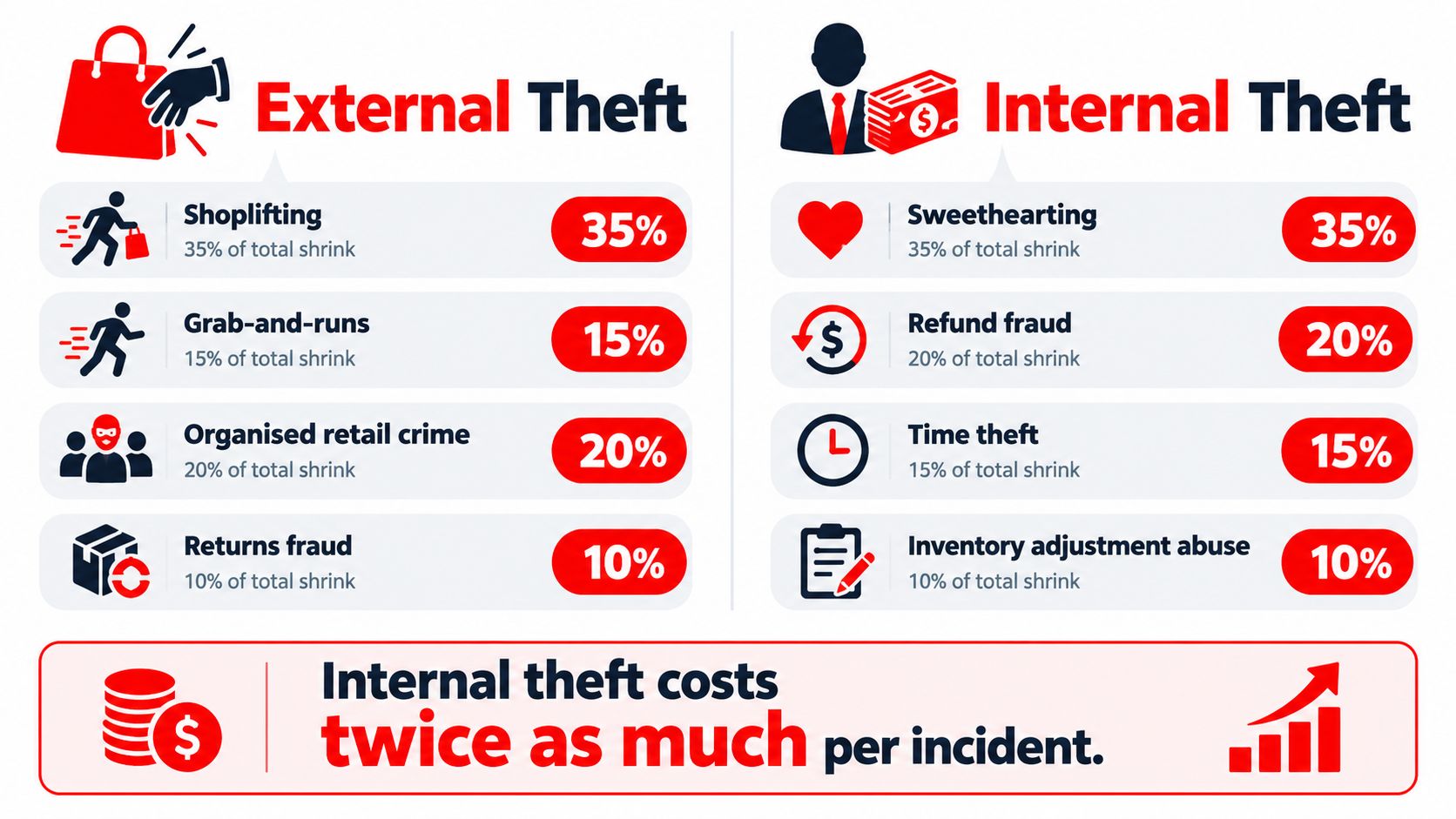
External and internal theft create different operational problems, so they need separate detection paths and shared reporting. Customer theft includes concealment, grab-and-runs, organised activity and returns fraud. Internal loss includes sweethearting, refund manipulation, time theft, unauthorised adjustments and collusion.
The 2022 Australia and New Zealand Retail Crime Study estimated external theft at nearly 45% of reported shrinkage. That proportion should be treated as a benchmark, not a staffing formula. Store managers need reconciled data by department, shift, product, transaction type and staff access level.
Incident cost changes the control priority. The Griffith University analysis put the average external theft incident at about A$415, compared with about A$1,200 for internal theft, as reported by Griffith University. A programme focused only on shoplifting can therefore overlook fewer incidents that remove more value. The same distinction matters in hospitality and events, where unauthorised comps, voided drinks, cash variances and supplier collusion may sit outside a retail shrink report.
Run two tracks at once
External controls should combine visible presence, clear sightlines, high-risk merchandise placement, safe intervention procedures and evidence-quality CCTV. Internal controls require role-based access, dual approval for refunds and markdowns, cycle counts, POS exception review and confidential reporting channels. In a venue, match those checks to bar tills, wristband or ticket controls, stock rooms and close-of-shift cash reconciliation.
Use a worked example to test decisions, not promise a universal result. If a business records $400,000 in annual shrink and later reports $90,000 less shrink after activating customer-facing and internal controls, management should identify which changes produced the result. The useful measure is value recovered or prevented, supported by an owner, evidence reference and follow-up date.
A uniformed officer may deter an active shoplifter. A trained supervisor and POS analyst may uncover sweethearting that floor patrol cannot see, so reporting lines must cover both.
Staffing and Deploying Loss Prevention Officers on the Floor
Staffing should follow the risk map, not a generic officer count. A big-box store with broad sightlines, high-value products and multiple exits needs a different coverage model from a compact CBD fashion store or a ticketed festival.
Some operators use a planning ratio such as one officer per 2,500 square metres in a big-box environment, or two officers on a peak shift in a CBD fashion store. These are deployment examples, not universal compliance rules. Confirm the model through incident density, floor visibility, entry and exit design, opening hours and the amount of internal investigation required.
Assign distinct roles
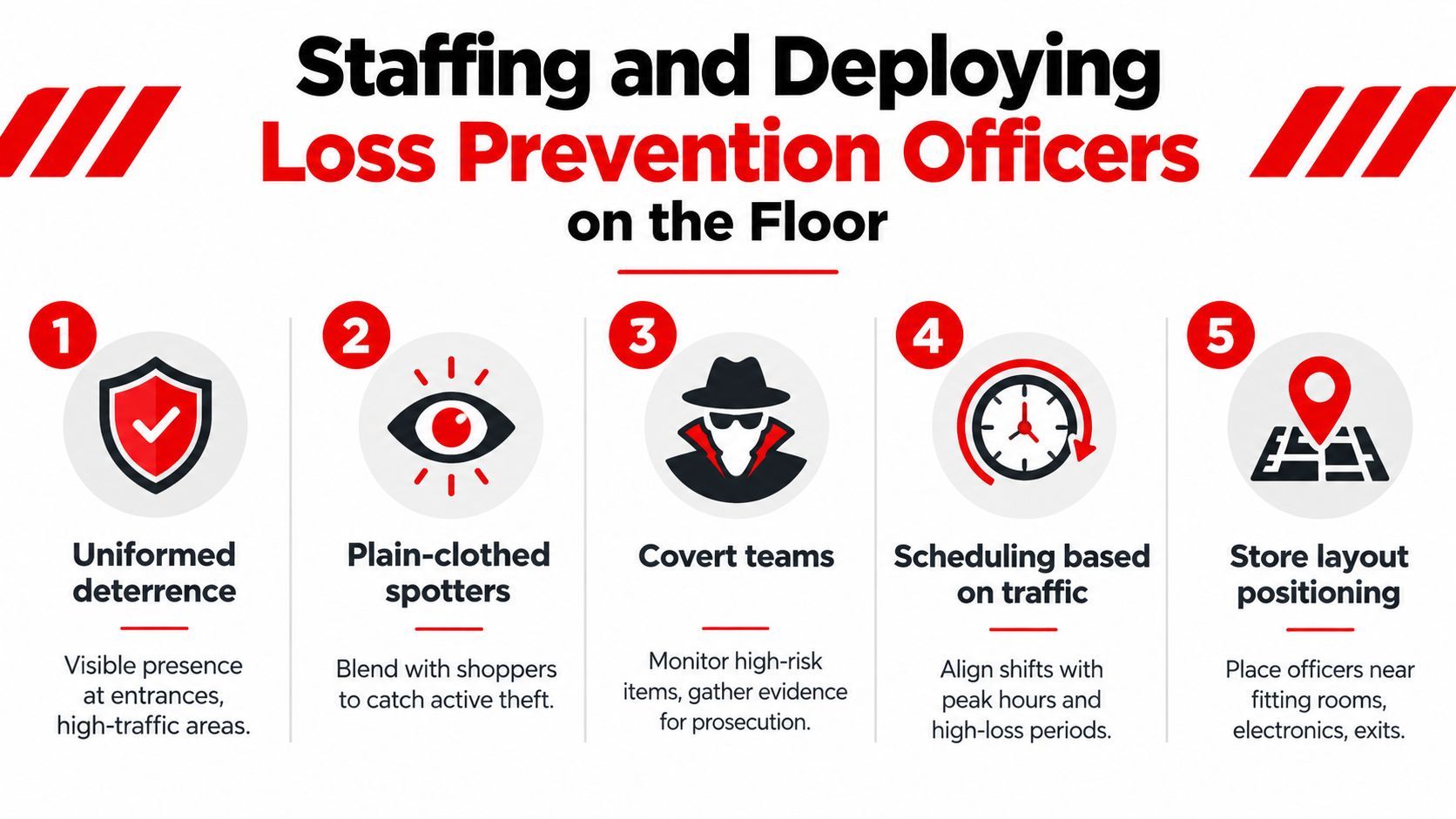
Uniformed officers provide visible deterrence at entrances, high-traffic zones and exits. Plain-clothed spotters observe customer behaviour without creating a confrontational atmosphere. Covert personnel focus on evidence gathering, repeat patterns and high-risk merchandise where lawful and properly supervised.
Schedule coverage around the site's actual loss windows. A retail roster might place officers across 11am to 2pm, 4pm to 7pm and weekends when those periods show higher incidents. A venue roster should instead follow doors, peak service, cash movement, artist access and close-down.
| Shift window | Primary deployment | Manager handoff |
|---|---|---|
| Opening | Entry points, key control, CCTV health check | Opening manager |
| Midday | High-risk SKUs, customer service, receiving | Department lead |
| Afternoon peak | Exits, fitting rooms, POS exceptions | Duty manager |
| Close | Cash room, stockroom, perimeter and incident review | Closing manager |
Brief every officer on evidence standards, de-escalation and the limits of intervention. NSW and Victorian operators must ensure procedures align with applicable state rules, licence conditions and employer safety obligations. Officers should know when to observe, when to call a supervisor, when to contact police and when to disengage.
Recruitment filters should include the relevant security licence, reliable report writing, First Aid capability and any Working with Vulnerable People requirement that applies to the role or site. Event teams also need crowd communication, radio discipline and experience working within a contracted guard company's chain of command.
The area manager should receive a concise daily report, a weekly trend summary and immediate escalation for serious incidents, staff injury, weapons, organised repeat activity or significant cash loss. GM GROUP Services is one Australian provider that lists loss prevention, static guards, covert operations, event security and emergency response among its services across NSW, VIC, QLD and the ACT.
Loss Prevention Security for Venues, Bars and Events
Hospitality and event loss prevention security can't be copied directly from a retail floor. A bar has alcohol, cash, intoxication and conflict. A festival adds temporary infrastructure, multiple contractors, merchandise, artist access, ticketing systems and crowd movement. The operator must protect stock and revenue without turning every customer interaction into a confrontation.
Scenario one, a late-night Sydney bar
Consider a late-night Sydney bar operating a busy Saturday service. The control plan starts before doors open. Managers verify CCTV views across the entrance, bar, cash-handling area, cellar access and key customer zones, then test recording, radio communications and incident escalation.
At the door, licensed security staff manage entry, refusals and crowd flow under the venue's responsible service of alcohol obligations and liquor licensing conditions. Bar staff receive short LP training on over-pouring, unauthorised comping, cash drawer sharing, fake refunds and stock movement through staff-only areas.
The cash room needs restricted access, documented handoffs and a clear reconciliation process. The floor team shouldn't investigate a suspected cash discrepancy while also managing an escalating patron incident. The duty manager assigns one person to the immediate safety issue and another to preserve records, secure footage and document the timeline.
A strong venue response protects the evidence without turning a stock problem into a safety problem.
Useful controls include access logs, POS exception reports, stock counts at handover, camera checks and a single incident number used across security, management and police reporting. If an external provider supplies guards, the venue still owns the operating standard. The contract should define radio channels, escalation points, report format, supervisor checks and handoff requirements.
Operators assessing hospitality technology and reporting workflows can review Creventa's hospitality group results as a reference point for how venue systems may be documented. Any example should be tested against the operator's own licence conditions, layout and staffing.
Scenario two, a three-day Melbourne festival
A multi-stage Melbourne festival needs zone ownership. Front-of-house security manages entry screening and crowd flow, while LP-trained personnel monitor merchandise, bars, storage cages, production access and settlement areas. RFID wristbands may support access control where the system is appropriate, but they won't replace physical supervision or a reliable exception process.
Merchandise loss often occurs through weak handoffs rather than one dramatic theft. Count stock into each sales point, record transfers, limit back-of-house access and reconcile sales against stock movement. Artist settlements and contractor payments need separate approval, documented receipts and controlled access to settlement information.
Crowd barriers should protect pinch points and keep staff routes clear. The incident plan must specify who calls emergency services, who opens an access route, who preserves CCTV and who communicates with the promoter. WorkSafe crowd duties, RSA obligations and liquor licensing conditions should be built into the briefing, not treated as paperwork after the gates open.
Build a weekly report card
Use a baseline before changing deployment. Track the same definitions across every service period, then investigate spikes through root-cause reviews rather than blaming individual staff without evidence.
| KPI | Target band | Data source | Reporting frequency |
|---|---|---|---|
| Shrink as a percentage of sales | Under 1.2% | Stock and sales reconciliation | Weekly |
| Incidents per 1,000 transactions | Establish site baseline | POS and incident log | Weekly |
| Average dwell time before intervention | Establish site baseline | CCTV and incident timeline | Weekly |
| Apprehension-to-prosecution rate | Establish site baseline | Incident and police records | Monthly |
| Recovery value | Increase verified recovery | Stock, cash and incident records | Weekly |
| CCTV uptime | Maintain continuous operational coverage | System health report | Daily |
| Staff training completion | 100% of assigned staff | Training register | Fortnightly |
The under 1.2% shrink target above is an operating target for this dashboard, not a universal Australian benchmark. Review the report card during fortnightly operations meetings, with each action assigned to a named duty manager. Accountability should sit with the person who can change the roster, process or layout, not with an anonymous LP function.
Legal Compliance and Reporting Across Australian States
A loss prevention officer doesn't gain unlimited powers by wearing a uniform. Apprehension, detention, search, evidence handling, surveillance and use of force require state-specific procedures, supervision and legal review. Operators commonly overreach when staff act on suspicion alone, hold a person without a defensible basis or handle CCTV without preserving its evidential context.
The safest operating model uses written protocols, approved escalation paths and incident reports that distinguish what a staff member saw from what they inferred. CCTV should retain the original file where possible, record who accessed it and document transfers. Police reports should use the same incident reference as the internal log.
State controls need local ownership
The following snapshot is an operational orientation, not legal advice. Managers should confirm current requirements with state police, regulators and qualified legal advisers before authorising intervention procedures.
| Jurisdiction | Key legislation | Apprehension limits | Police reporting channel | Common compliance risk |
|---|---|---|---|---|
| NSW | Police Act 1990 and other applicable laws | Use only lawful powers, with safe escalation and police contact | NSW Police reporting and emergency channels appropriate to the incident | Unsafe detention, weak evidence handling and inadequate staff consultation |
| Victoria | Applicable Victorian security and criminal law, with Victoria Police procedures | Follow lawful limits and venue procedures, prioritising safety | Victoria Police reporting channels appropriate to the matter | Unclear use-of-force boundaries and poor incident documentation |
| Queensland | Police Powers and Responsibilities Act and other applicable laws | Confirm lawful authority before detention or search | Queensland Police reporting channels appropriate to the matter | Treating security duties as police powers |
| ACT | Criminal Code 2002 and other applicable laws | Apply citizen-arrest limits cautiously and seek police assistance | ACT Policing reporting channels appropriate to the incident | Inconsistent escalation and incomplete chain-of-custody records |
Under-reporting weakens the intelligence picture. The AIC material notes that only around 10% of retail theft is reported to police, while much loss is discovered through audit rather than direct witnessing, as described in the Australian Institute of Criminology retail crime guidance. Internal shrink records still matter, but police reporting supports pattern recognition and repeat-offender investigations.
NSW operators should also treat staff safety as a formal control. Guidance for the state includes avoiding lone workers, keeping emergency numbers visible, consulting staff on response protocols and practising drills, as outlined in NSW retail loss-prevention guidance.
Loss Prevention Security FAQs for 2026 Operators
What is the fastest win when starting from scratch?
Start with staff training and a CCTV audit, not an automatic increase in guards. Confirm that cameras cover entrances, exits, high-risk merchandise, POS points, receiving and cash areas, then check whether managers can retrieve usable footage quickly.
At the same time, train staff to record incidents consistently, escalate safely and identify refund, markdown and stock-adjustment exceptions. More personnel won't solve a process that produces no evidence or follow-up.
How should staffing change when organised repeat theft appears?
Move from broad deterrence to intelligence-led deployment. Map repeat locations, products, times, vehicles or behaviours, then brief uniformed and plain-clothed teams without encouraging unsafe confrontation.
Assign a police liaison and preserve consistent evidence. Organised activity needs coordinated reporting, stronger supervision and targeted coverage, rather than placing more officers at the entrance.
Which KPIs best predict shrink movement?
Track recovery dollars, incident-to-apprehension ratio and case closure time, then compare them with shrink as a proportion of sales. Incident counts alone can rise because detection improved, so management must read activity alongside verified value loss.
Add CCTV uptime, training completion, unresolved incidents and POS exception closure. A dashboard works only when someone reviews it and changes a process, roster or layout in response.
When does external LP support make more sense?
External support suits events, seasonal peaks and multi-site venues where permanent covert infrastructure or a dedicated in-house team isn't justified. A provider can supply licensed personnel, supervisors, event deployment planning and reporting structures for a defined operating period.
Keep ownership internal. The venue or retailer should still set the risk tolerance, approve escalation rules, receive reports and review outcomes against its commercial and safety priorities.
The practical standard is simple: every control must have an owner, every incident must have an evidence trail and every KPI must lead to a management decision. Operators across NSW, VIC, QLD and the ACT can build that discipline internally or use a licensed partner for the parts that require specialist coverage.
GM GROUP Services provides licensed loss prevention security, static guards, covert operations, event security, emergency response and risk assessments across NSW, VIC, QLD and the ACT. If your retail site, venue or festival needs a fit-for-purpose deployment with structured reporting and trained supervision, visit GM GROUP Services to discuss the operating model.
Discover more from GM Group Services
Subscribe to get the latest posts sent to your email.