
K9 security training usually becomes urgent when a venue calendar fills up, a festival approval date is approaching, or a site manager suddenly needs a visible deterrent that can also work in noisy, high-distraction conditions. That's where many operators make the same mistake. They book a dog and handler too late, assume one state's approval covers another, and treat the dog as a visual asset instead of a compliance-heavy operational capability.
In the field, that approach causes friction fast. The dog may be capable, but the paperwork, welfare controls, handler licensing, or training pathway may not match the job. For event organisers, venue managers, construction operators and hospitality groups working across NSW, Victoria, Queensland and the ACT, the standard isn't whether a dog can patrol. It's whether the team can lawfully deploy, work reliably under pressure, and stay deployment-ready after the first accreditation.
SEO title: 7 Essential Steps for K9 Security Training Excellence
SEO meta description: K9 security training in Australia requires the right dog, staged competency, state licensing compliance, and welfare controls. Learn what works for real deployments.
Suggested URL: /k9-security-training-australia
Choosing the Right Dog for Security Work
At a crowded gate line before doors open, selection errors show up before training errors do. One dog scans the space, stays neutral around staff, and settles immediately when the handler resets position. Another startles at trolley noise, fixates on passers-by, and burns energy too early. Both may look impressive on lead. Only one is likely to hold together through a full shift.
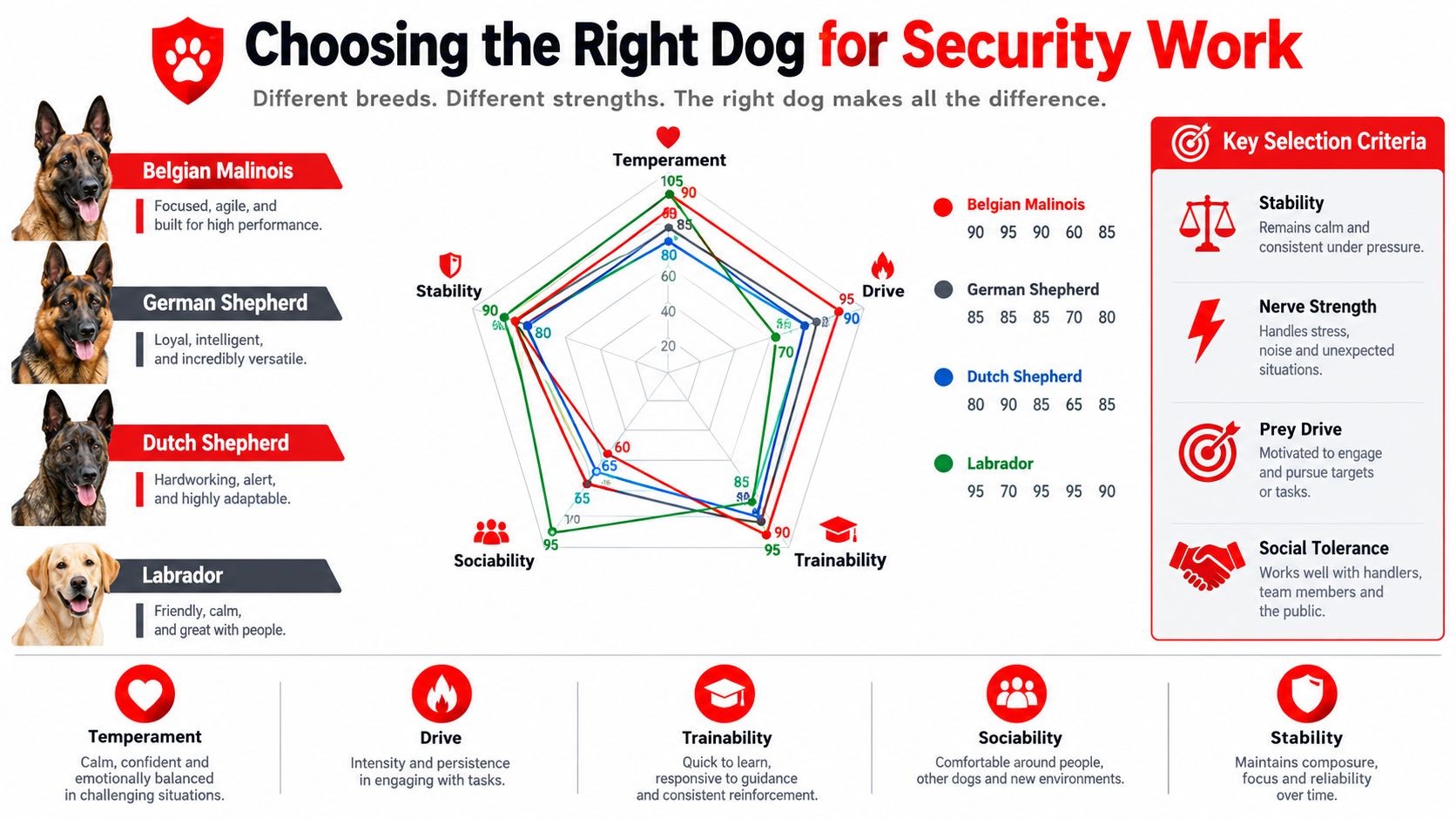
That's why dog selection sits at the centre of K9 security training. Australian working-dog history backs that up. The federal detector-dog capability began in 1968 with two black Labradors in Sydney, and by 1978 a review found pedigree-only breeding was too expensive and slow, leading to a shift toward training suitable abandoned dogs from pounds, shelters and private homes. In 1979, the first training unit was formed in Canberra, a major step in building a practical Australian model focused on reliability, temperament and operational suitability rather than pedigree alone, as outlined by Dog Force Australia's historical summary.
What matters more than breed
Breed matters, but not as much as many buyers think. The better question is whether the individual dog has the right balance of nerve, sociability, environmental stability and working drive for the exact role.
A patrol dog for a late-night hospitality strip doesn't need the same profile as a detection dog moving through family event queues. If you're trying to find a protective breed like a Rottweiler, that can be a useful starting point for understanding physical and behavioural profiles, but it still won't replace candidate testing under realistic conditions.
Three traits decide most outcomes:
- Environmental stability: The dog must tolerate noise, lighting changes, slippery flooring, barriers, and unpredictable movement without shutting down or escalating.
- Working drive: The dog needs enough intensity to stay engaged through repetitive searching or patrol tasks.
- Social tolerance: In public-facing security, the dog can't treat every nearby person as a problem.
Practical rule: Don't buy the breed. Select the dog in front of you, under pressure, on surfaces and around noise that match the work.
Common selection mistakes
The most expensive errors happen before formal training begins. Operators often overvalue appearance, size, or reputation and undervalue recoverability. A dog that reacts badly isn't always unsuitable. A dog that can't recover cleanly usually is.
A simple field screen should include:
| Selection factor | What good looks like in practice |
|---|---|
| Temperament | Alert but not frantic, responsive without constant correction |
| Prey drive | Engages with reward object, persists, re-engages after interruption |
| Prey inhibition | Can switch off and release cleanly when directed |
| Nerve strength | Recovers after sudden sound or movement |
| Handler acceptance | Works with structure, doesn't resist ordinary control |
The old assumption that only pedigree dogs can perform serious work doesn't hold up well in Australian conditions. The historical pivot away from pedigree-only sourcing proved the operational point years ago. Good K9 security training starts with a suitable candidate, not a fashionable one.
Understanding the Staged Competency Structure
At a festival gate or loading dock, weak training shows up fast. A dog that looked fine in a tidy training run can lose search discipline around noise, queues, vehicle movement, or a handler who starts rushing decisions. That is why competent K9 programs are built in stages, with clear pass points before the team is exposed to harder operational conditions.
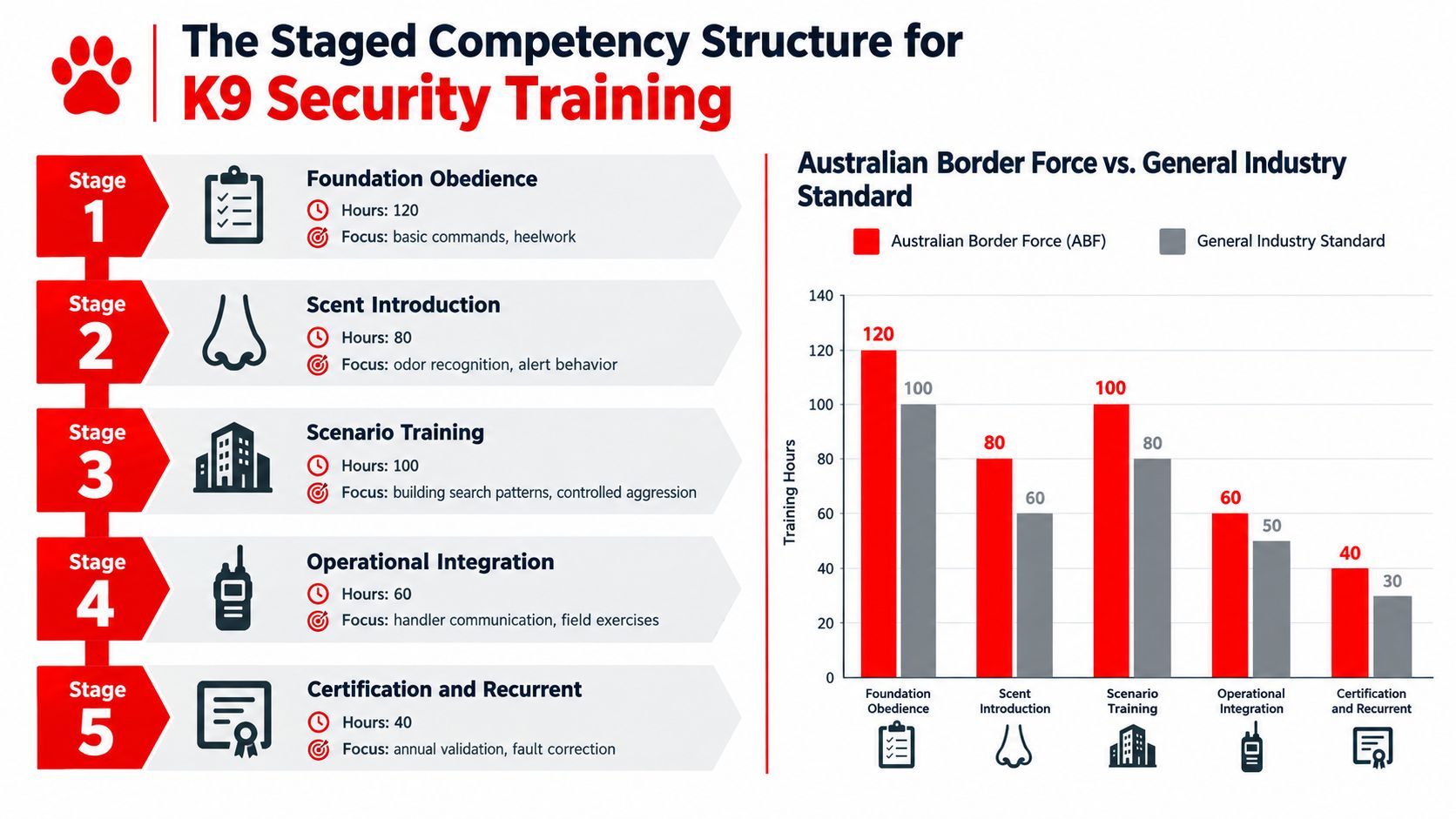
A useful benchmark sits outside private security. The Australian Border Force detector-dog training pathway sets out a training sequence of about seven months, including a 10-week basic course in Melbourne, 16 weeks of regional on-the-job training, and a 2-week final evaluation. For private operators, the point is not to copy a federal model task for task. The point is to copy the discipline of staged assessment, where teams prove they can screen people, goods and areas before they progress.
Why staged progression works
Private security work changes from state to state, and so do the compliance settings around security licensing, use-of-dog permissions, and welfare expectations. Training has to reflect that reality. A team prepared for static patrol work at a licensed venue in one jurisdiction may still be unready for crowd-facing work, transport screening, or public-space deployments somewhere else.
Staged progression reduces that risk because each phase tests the team under the level of control appropriate to the work. Early assessments check search behaviour, reward clarity, obedience under distraction, and handler timing. Later assessments should test the assignment the team will perform, whether that is perimeter patrol, queue management support, back-of-house sweeps, or venue access screening.
Attrition is part of the process. The Inspector-General of Biosecurity review recorded an average pass rate of about 60 percent in the Brisbane detector-dog training program and noted that dogs completed a 6 to 8 week training program before assessment for operational suitability. That matters for budgeting and compliance planning. If every dog has to pass for the program to make financial sense, the program has been costed badly.
A staged system protects two things at once. Operational reliability and your compliance position when a deployment is later scrutinised.
How private operators should structure it
The strongest private programs use gates that match the job brief and the state rules that sit behind it.
Suitability gate
Test the dog and handler in the environment they are being prepared for. A dog intended for licensed venue work should be exposed to barriers, close public movement, sound spikes, idle time, and confined search areas before serious money is spent.Foundation gate
Assess the handler as hard as the dog. Search pattern discipline, leash management, indication recognition, reward timing, and verbal control all need to be stable before scenario work expands.Scenario gate
Run controlled operational tasks that reflect the intended deployment. For some teams that means patrol routes and boundary work. For others it means screening lines, storage areas, green rooms, plant rooms, or vehicle approaches.Deployment gate
Sign off the team against the assignment and the jurisdiction. That includes the practical task, the paperwork, and the welfare controls required for the state they will work in.
That last point is where many operators cut corners. They assess the dog, then assume the legal side can be sorted later. In practice, training, licensing, and welfare obligations need to line up from the start, especially if the team may work across more than one Australian state.
What usually goes wrong
The first failure point is one-off accreditation. A team passes a course, starts work, then gradually loses search quality because no one checks pacing, environmental control, false-interest behaviour, or handler pressure under live conditions.
The second failure point is treating the dog as the asset and the handler as an accessory. In the field, the team is the operational unit. I have seen capable dogs made ineffective by poor route selection, late rewards, bad line handling, and handlers who miss the dog's change of behaviour in busy venues.
Staged competency works because it exposes those faults early, before they become licensing problems, client complaints, or welfare issues on shift.
Core Training Phases for Operational Readiness
A dog that works cleanly on a quiet training ground can still come apart at a stadium gate, in a loading dock, or outside a licensed venue at bump-out. Operational readiness is built in stages so the team can hold standard under noise, waiting time, public contact and the legal constraints that come with the assignment.
In field terms, the job is to produce a dog and handler who can do the task, recover quickly, and stay inside the rules of the state where they will work. That is the gap a lot of K9 content misses. Training is not separate from deployment conditions. If the team is likely to work across Queensland, New South Wales or Victoria, the training phase needs to reflect what each jurisdiction will allow, how the dog will be housed and transported, and what evidence of competence the operator may need later.
In Queensland, the training pathway reflects that staged approach. The Security Industry pathway includes CPPSEC3010A Manage dogs for security functions and CPPSEC3011A Handle dogs for security patrol, and Craig A. Murray Dogschool states those units are delivered together in a hands-on course with theory, field handling, training scenarios and practical assessments, as outlined at Dog Force Australia courses. The point is not the course length by itself. The point is that patrol work is assessed as applied competence.
Phase one builds control
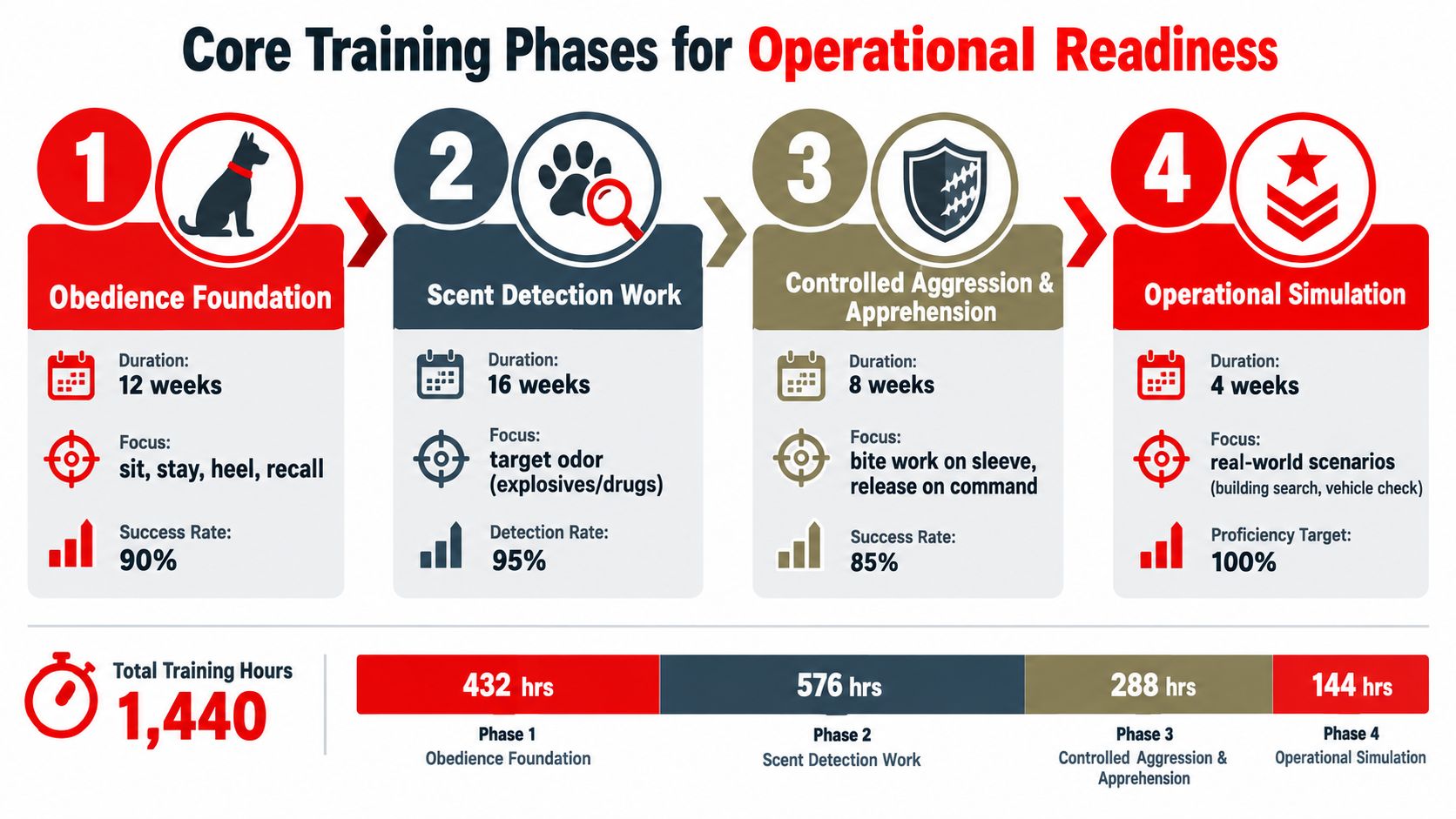
Obedience under distraction comes first because it sets the safety margin for every later task. Sit, stay, heel, recall, out, and controlled positioning are working behaviours. They let a handler stop at a congested entry lane, move around patrons and staff without conflict, and hold position near barricades or service corridors.
A dog that can search well but cannot reset on command will cause problems on shift.
Common faults at this stage are predictable:
- Handler chatter: repeated commands blur the cue and lift pressure on the dog.
- Poor lead discipline: constant tension blocks natural movement and creates conflict.
- Late reward timing: the dog gets paid for the wrong decision.
Phase two develops search behaviour
Search work has to become independent without becoming uncontrolled. The dog needs clear task boundaries, but the handler cannot solve the search for it by steering every movement.
That balance matters in venues. In plant rooms, green rooms, storage areas and vehicle approaches, handlers who over-direct usually create false interest, shallow patterns and dogs that start looking back for help. Dogs trained with clear marker cues, consistent reinforcement and disciplined handler neutrality hold up better once the environment gets busy.
A dog that only works off the handler's body language is not deployment-ready.
Phase three adds pressure, control and lawful response
For patrol-oriented roles, intensity is easy to create and hard to regulate. The standard is controlled response under command, with clean thresholds, reliable release, neutral transitions and fast recovery after arousal.
This is also the phase where poor program design starts to show. Dogs rushed into confrontation work often become noisy, conflicted or sticky on disengagement. Handlers who have not learned timing and distance management usually compensate with lead pressure or repeated commands, which makes the problem worse.
The legal context matters here as well. What is trained, what is documented and what is later authorised for use must line up with the deployment model and the state rules that apply to that job. A team prepared for overt patrol presence at an event perimeter is not automatically prepared, or approved, for the same tactics in another jurisdiction.
Phase four proves the team in real environments
Scenario work needs to reflect actual assignments, not tidy training patterns. Start in controlled spaces, then progress into loading bays, stairwells, car parks, queue lines, back-of-house corridors and venue surrounds where the dog must work near noise, delay and foot traffic.
A practical progression looks like this:
| Environment | What you're testing |
|---|---|
| Empty facility | Search pattern, lead handling, reset control |
| Active site | Noise tolerance, worker movement, vehicle distraction |
| Event perimeter | Crowd flow, barrier work, waiting periods, handler composure |
The final test is whether the team can perform the task consistently while the operator can support it properly. That includes transport, rest cycles, heat management, water access, records, and a deployment plan that fits the venue. Operators reviewing field readiness often use providers that pair K9 capability with venue and event deployment planning. GM GROUP Services offers K9 security units and handlers as part of broader security operations, which is useful where the dog team has to fit crowd management, access control and incident response rather than work on its own.
State-by-State Licensing and Compliance Requirements
Many K9 deployments become risky at this point. A team can be skilled, well-presented and operationally sound, but still not be lawfully deployable in the jurisdiction where the work sits. K9 security training doesn't automatically equal K9 deployment approval.
For multi-state operators, the gap is usually administrative, not tactical. Someone assumes a dog patrol endorsement or prior experience carries across state lines. It often doesn't.
NSW and Victoria are not the same job on paper
In NSW, a master licensee must obtain Commissioner approval before providing persons to carry on a security activity with a dog, under the NSW legislation governing security industry operations. That approval point gets overlooked regularly when operators focus only on the handler.
In Victoria, the gate sits earlier in the process. Only licensed security guards registered under the Private Security Act 2004 are eligible to have dogs trained as Protection Dogs, and the training establishment must see proof of the security licence before training starts, according to Agriculture Victoria's protection dog training requirements.
Those are two different compliance problems. In NSW, the business approval pathway matters. In Victoria, licence class verification before training matters.
Queensland has a structured handler pathway
Queensland is more explicit about the education path. A dog patrol security officer must complete all modules of CPP20218 Certificate II in Security Operations plus two elective modules from CPP31318 Certificate III in Security Operations before applying for the licence. Queensland also allows a restricted licence for trainees, but it lasts only 6 months and cannot be extended, as set out by the Queensland dog patrol security officer licence process.
That short trainee window affects rostering. If a business puts someone into supervised dog work and lets the paperwork drift, the licence pathway can stall before the operator becomes fully deployable.
Compliance failures in K9 work rarely happen because the dog did something unusual. They happen because nobody checked the endorsement pathway early enough.
Tasmania shows how documentation can block deployment
Tasmania makes the paperwork burden obvious. To obtain the endorsement Permitted to use a dog, the applicant must already hold a full security general licence, provide first aid, dog training evidence or a statutory declaration, and dog registration, as required by the Tasmanian security employee licence application process.
That's a good reminder for operators in any jurisdiction. The dog itself has an identity and evidence trail. You're not just licensing a person.
Practical comparison for operators
| Jurisdiction | Main compliance pressure point | Operational implication |
|---|---|---|
| NSW | Commissioner approval for providing persons carrying on security activity with a dog | Check business approval before confirming deployment |
| Victoria | Only licensed security guards can enter Protection Dog training | Verify licence class before booking training |
| Queensland | Certificate II plus Certificate III electives, trainee licence limited to 6 months | Plan training and supervised deployment tightly |
| Tasmania | Full licence, first aid, dog evidence or statutory declaration, dog registration | Build a complete paperwork file, not just handler evidence |
For the ACT, the practical lesson for cross-border operators is caution. Don't assume NSW, Victorian or Queensland pathways transfer cleanly. Verify the local licensing position before the dog ever arrives on site.
Ongoing Certification and Welfare Standards
A dog can look sharp in training and still come undone on a live shift. Put that team on a noisy gate at an all-day festival, add heat, idle time, crowd pressure and poor rotation, and small faults show up fast. That is why ongoing certification and welfare standards matter in practice, not just on paper.
Victoria gives a clear compliance example. Victoria Police states that dogs used for security purposes must be trained to at least the minimum obedience level set by the Domestic Animals Regulations 2015 where a guard licence is endorsed for guard with dog. It also states that approved training for licensed activities must be valid within 12 months of the licence application, according to Victoria Police private security requirements. For operators working across states, that recency point matters. A team that satisfies one booking with older paperwork may still be a poor fit for a new licence application, renewal cycle or cross-border deployment.
Keep proficiency current
Certificates record a point in time. Deployment exposes what has changed since then.
In the field, decline usually appears before a formal failure. The dog starts checking back too often. The handler rushes patterns or rewards late. Distractions hold the dog longer than they should, and recovery between searches slows down. None of that is theoretical. It is how reliable teams drift into average ones.
A practical sustainment routine should include:
- Monthly proficiency reviews: Check search discipline, obedience under distraction, handler timing and reward clarity.
- Short remedial sessions: Correct drift early, before repetitive patrol work turns it into habit.
- Environment-specific exposure: Train in the conditions the team works in, including hard flooring, loading docks, traffic edges, stairwells, queue lines and crowd-adjacent spaces.
- Handler-only refreshers: Revisit leash handling, reading threshold stress, pattern selection and use-of-force boundaries for the venue type.
As noted earlier, the Inspector-General of Biosecurity review also pointed to training-course frequency being shaped by dog-delivery timing. The operational lesson is straightforward. If intake, pairing and refresher scheduling are irregular, capability drops even while the paperwork still looks in order.
Welfare standards are part of operational control
Poor welfare reduces performance first, then creates legal risk.
In NSW, the Security dogs welfare code sets formal standards for care and management, and the Prevention of Cruelty to Animals Regulation 2025 recognises a business that trains dogs as security dogs, as set out in the NSW security dogs welfare code. That has a direct effect on deployment planning. Shift length, transport setup, temperature management, kennel conditions and recovery time are not side issues. They affect whether the dog can work clearly, safely and consistently.
This is also where state-by-state gaps catch inexperienced operators. One jurisdiction may focus your attention on handler licensing, while another creates more practical exposure around welfare controls, animal management standards or supporting records. The safe approach is to build welfare compliance into the deployment plan for every job, then tighten it to the state requirement rather than assuming one policy covers the whole country.
Ask direct questions before booking a K9 unit:
- How are kennel and vehicle conditions managed between shifts?
- What rest and rotation plan applies on long or high-arousal assignments?
- How is heat handled on outdoor jobs?
- What recovery time is given after intensive work?
- What records show ongoing welfare compliance and refresher training?
A flat dog on shift is often a management problem, not a training mystery.
FAQ on ongoing K9 readiness
How often should a deployed team train after initial certification?
Regularly, under conditions that match the work. A pass at the end of a course does not preserve search quality, control or environmental stability by itself.
Does welfare affect patrol or detection performance?
Yes. Heat stress, poor rest, weak transport arrangements and overwork reduce focus, recovery and consistency.
Can a venue rely on the provider's paperwork alone?
Not on higher-risk jobs. Venue operators should verify current licences, recent training activity, welfare controls and how the team is managed on shift.
Building Your Deployment Readiness Checklist
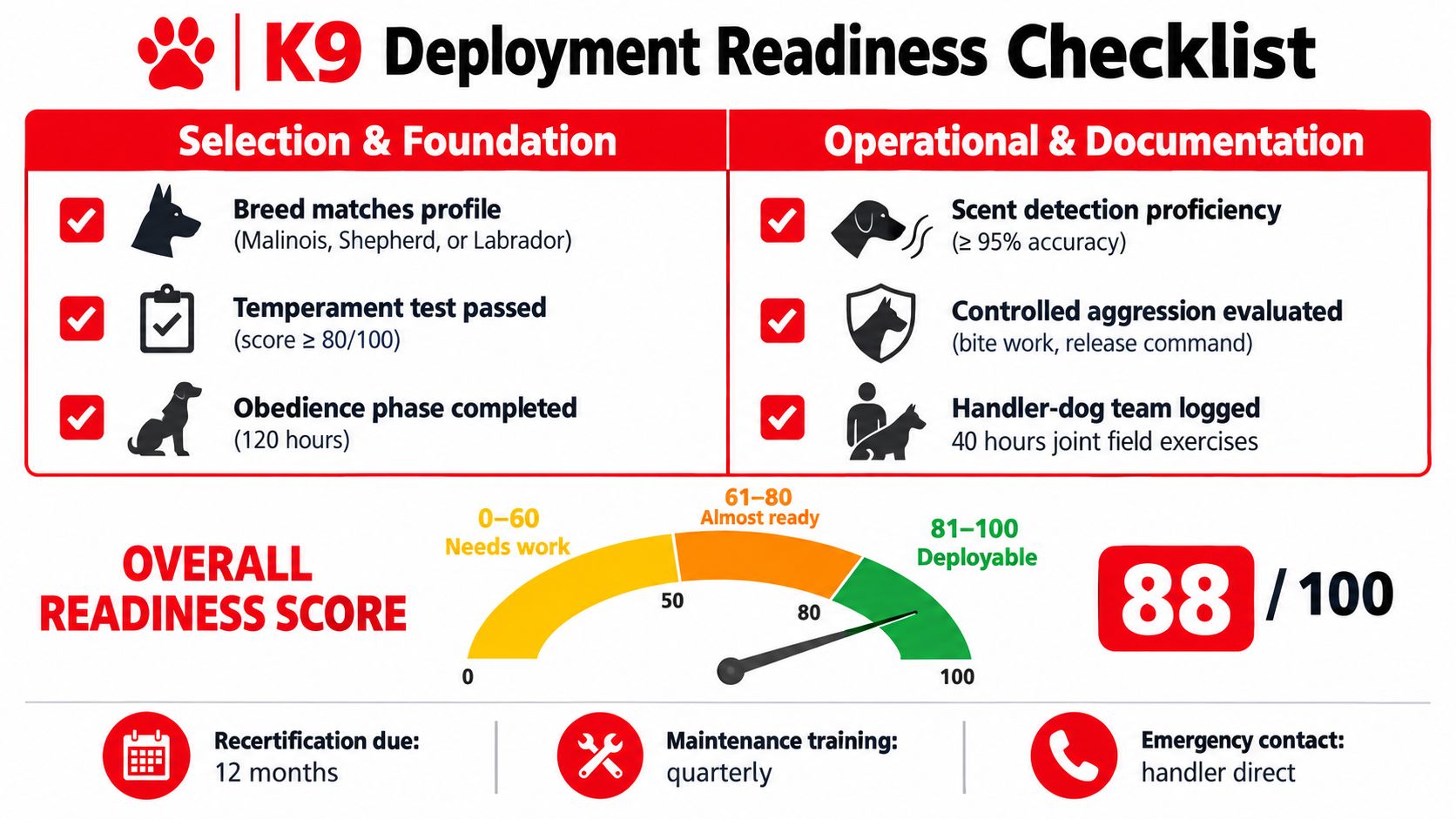
The fastest way to audit a K9 capability is to stop asking whether the dog is “trained” and start asking whether the whole unit is deployable, lawful and sustainable. That means checking the dog, the handler, the documentation, the welfare controls and the assignment fit at the same time.
A useful field checklist for K9 security training should cover five points.
What to confirm before the booking is locked
Role fit
Match the dog to the assignment. Festival queue work, construction patrols and hotel perimeter deterrence all place different demands on the team.Handler pathway
Confirm the handler holds the right licence and endorsements for the state of deployment.State compliance
Review the business and deployment approval requirements for the jurisdiction. Don't rely on interstate assumptions.
What to confirm before the team goes live
- Operational proof: Has the team worked in a similar environment with distractions, idle time and crowd movement?
- Welfare readiness: Are transport, shade, hydration, rest and rotation planned properly?
- Documentation control: Are licence records, dog records and training evidence current and site-ready?
A quick decision matrix helps:
| Scenario | Priority check |
|---|---|
| Festival or concert | Crowd tolerance, queue control, welfare during long shifts |
| Construction site | Perimeter routine, vehicle movement tolerance, after-hours patrol fit |
| Corporate event | Public-facing stability, low-profile handling, documentation readiness |
FAQ on deployment decisions
Is minimum licensing enough for a high-traffic event?
Usually not. Minimum licensing may satisfy a regulatory threshold, but it doesn't prove the team can work effectively in that exact environment.
What's the biggest warning sign in a K9 provider?
If they can't clearly explain the state approval pathway, handler status, welfare controls and sustainment training, the deployment risk is higher than it needs to be.
The best K9 programs don't rely on image. They rely on selection discipline, staged proof of competency, state-compliant deployment planning and welfare systems that keep the dog functional over time.
GM GROUP Services provides licensed K9 units and handlers as part of broader security operations for events, venues, hospitality, retail, construction and business sites across multiple Australian jurisdictions. If you're reviewing a current dog patrol setup or planning a new deployment, visit GM GROUP Services to assess what a compliant, fit-for-purpose K9 security model should look like for your site.
Discover more from GM Group Services
Subscribe to get the latest posts sent to your email.