
K9 security services make sense when you're responsible for a site that's hard to watch, hard to search, or hard to control with guards and cameras alone. If you're managing a festival with multiple entry points, a nightclub with recurring anti-social behaviour, or a construction site spread across dark perimeter lines, you're probably weighing the same question most buyers ask. Is a K9 unit a real operational advantage, or just an expensive visual deterrent?
The answer depends on the environment, the task, and the provider's compliance discipline. In the right setting, K9 security services give you a capability that static guards can't replicate. In the wrong setting, they can create friction, crowd anxiety, and avoidable cost.
Australian buyers need a practical view, not marketing copy. That means looking at where K9 teams outperform other controls, where they don't, and what you need to verify before a dog ever steps on site.
An Introduction to Advanced Event and Venue Protection
A venue manager usually calls for K9 support when the ordinary plan has stopped being enough. The site is too large for foot patrols to cover properly. The crowd profile is changing. Entry screening is under pressure. Theft, trespass, or contraband risk is climbing, and the client wants a visible control that changes behaviour before an incident starts.
That's where K9 security services fit. Not as theatre. Not as a substitute for a security plan. As a specialised layer that combines a trained dog with a licensed handler to extend detection, mobility, and presence across a site.
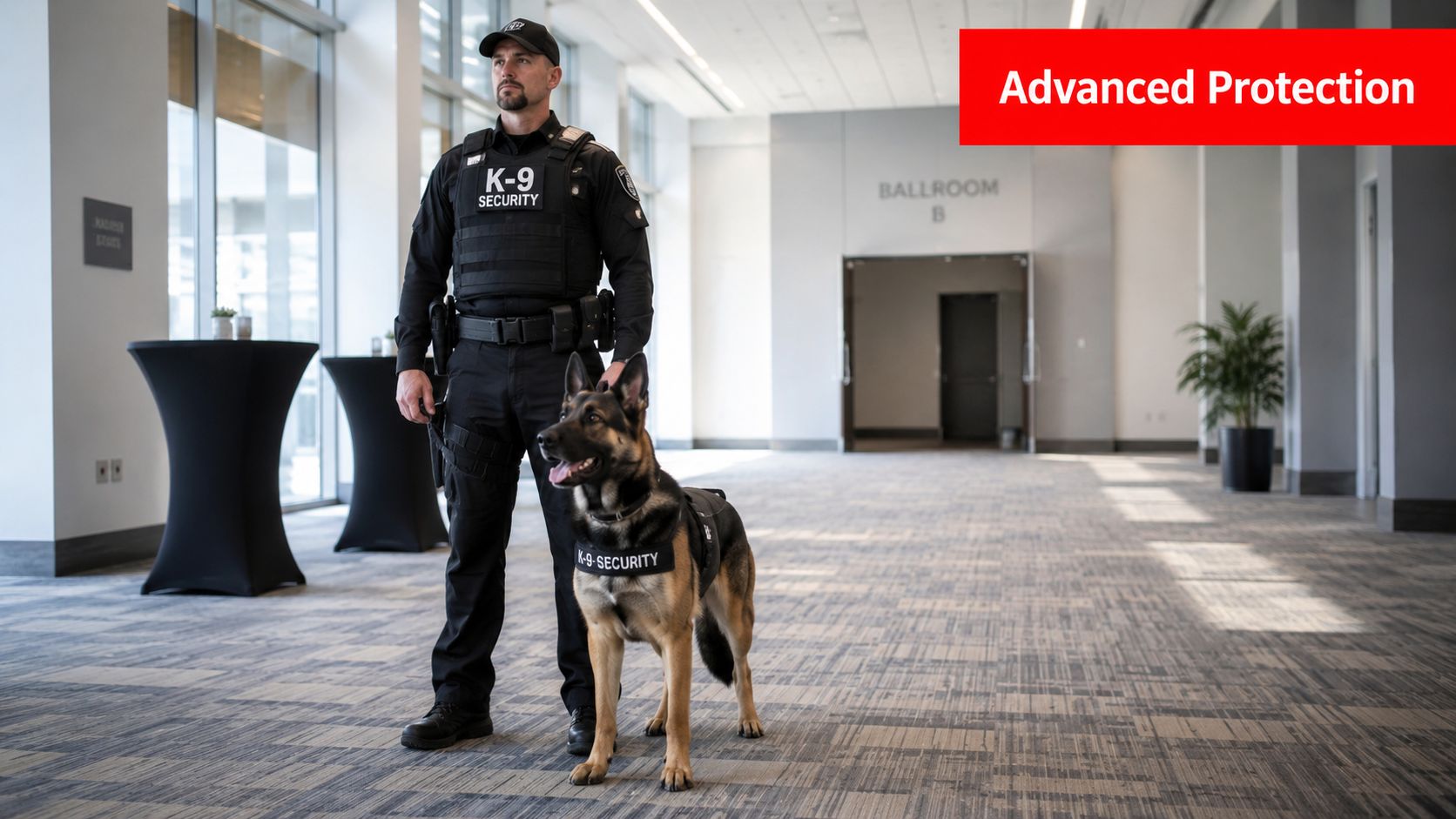
For event organisers, that often means using a K9 unit at the points where pressure builds first. Queue lines, gate areas, outer perimeters, service corridors, loading zones, and late-night movement between bars or stages. For construction and industrial clients, it usually means after-hours patrols, perimeter checks, and rapid investigation of suspicious movement in areas where cameras don't tell the whole story.
Good event planning still matters. If you're building the broader operating plan, 1021 Events' guide to event success is a useful resource for thinking through logistics, coordination, and stakeholder responsibilities before you layer in specialist security assets.
Practical rule: Bring in a K9 team when you have a defined security problem to solve, not because the dog “looks strong” on paper.
The best deployments are tightly matched to risk. A patrol dog can shift behaviour fast in a nightlife precinct or festival entry lane. A detection dog can support screening in more sensitive environments. A poorly matched unit, by contrast, can unsettle patrons, complicate crowd flow, and consume budget that would have been better spent on supervision or access control.
That's the starting point. K9 security services aren't automatically superior. They're superior when the environment rewards what dogs and handlers do better than anyone else.
What K9 Security Services Actually Involve
Buyers often ask for “a dog and handler” as if every K9 unit does the same job. On site, the difference is much sharper. A professional K9 team is a licensed handler and a trained dog working to a defined task, under site instructions, with clear reporting lines, welfare controls, and legal limits that suit the venue, event, or worksite.
That operating model matters in Australia, because the wrong deployment creates risk for everyone involved. A dog suited to night patrol on a construction perimeter may be the wrong choice for a crowded festival entry, and a detection dog used for screening has a very different purpose from a patrol dog used for presence and response.
Patrol dogs and detection dogs are different assets
Patrol dogs are used where visible deterrence, perimeter coverage, and quick investigation of suspicious activity are the priority. They are commonly deployed on after-hours sites, outer venue perimeters, service roads, loading areas, car parks, and other spaces where a mobile team can cover ground faster than a static guard.
Detection dogs are used to locate a target odour during screening, inspections, or planned sweeps. That work depends on controlled search conditions, a clear brief, and a client who understands what the dog is trained to indicate and how the handler will manage an alert.
Treating those roles as interchangeable is a common buying mistake. If a promoter in NSW wants to manage gate behaviour at a large outdoor event, patrol capability may fit. If a venue operator in VIC, QLD, or the ACT is focused on prohibited-item screening or targeted inspections, a detection profile may be the better fit. The decision should come from the risk picture, not from the generic label “K9 security”.
What a K9 team does on shift
On a well-run assignment, the dog is only one part of the capability. The handler briefs in, checks the environment, confirms the route or search task, assesses crowd conditions, manages spacing, watches the dog's behaviour for stress or alert changes, and records what happened in a way the client can use later.
In practice, that usually includes:
- Directed patrols through high-risk areas, not random walking.
- Perimeter and fence-line checks where intrusion, theft, or unauthorised access are realistic concerns.
- Targeted investigations of open gates, damaged barriers, suspicious vehicles, unusual noise, or movement picked up by CCTV or staff.
- Screening or sweep support where a trained detection dog is the right tool for the assignment.
- Incident reporting that captures time, location, observations, actions taken, and any follow-up needed.
A dog may pick up the first cue. The handler decides what that cue means, what action is lawful, and whether the matter needs escalation to venue control, site management, or police.
What competent K9 delivery looks like
The gap between a disciplined provider and a casual operator shows up in the routine details. Pre-start briefing. Site familiarisation. Lead control in tight spaces. Safe stand-off distances in queues. Planned rest and water breaks. Clear thresholds for withdrawing the dog from heat, noise, or crowd pressure. Handlers who stay calm when patrons test boundaries.
Those points matter even more at Australian festivals and major venues, where crowd density, heat, noise, alcohol, and uneven ground can affect both performance and welfare. The same applies on construction and industrial sites, where debris, poor lighting, plant movement, and multiple contractors create a very different set of handling risks.
Ask direct questions before you book the service. What task is the dog trained for? What environment is it used to working in? How are alerts recorded? When is the dog stood down for welfare or safety reasons? How does the provider adapt the deployment for state requirements in NSW, VIC, QLD, or the ACT?
Good K9 security should feel controlled, deliberate, and well supervised. If the answers are vague, the deployment usually is too.
The Undeniable Advantages of K9 Security Teams
A crowd starts to bunch at a festival entry. Lighting drops across the outer fence line. Radio traffic picks up because staff have spotted movement near a service gate. In that moment, a K9 team gives you something standard guarding does not. Fast mobile presence, stronger search capability, and a deterrent people notice immediately.
Where K9 security services outperform static coverage
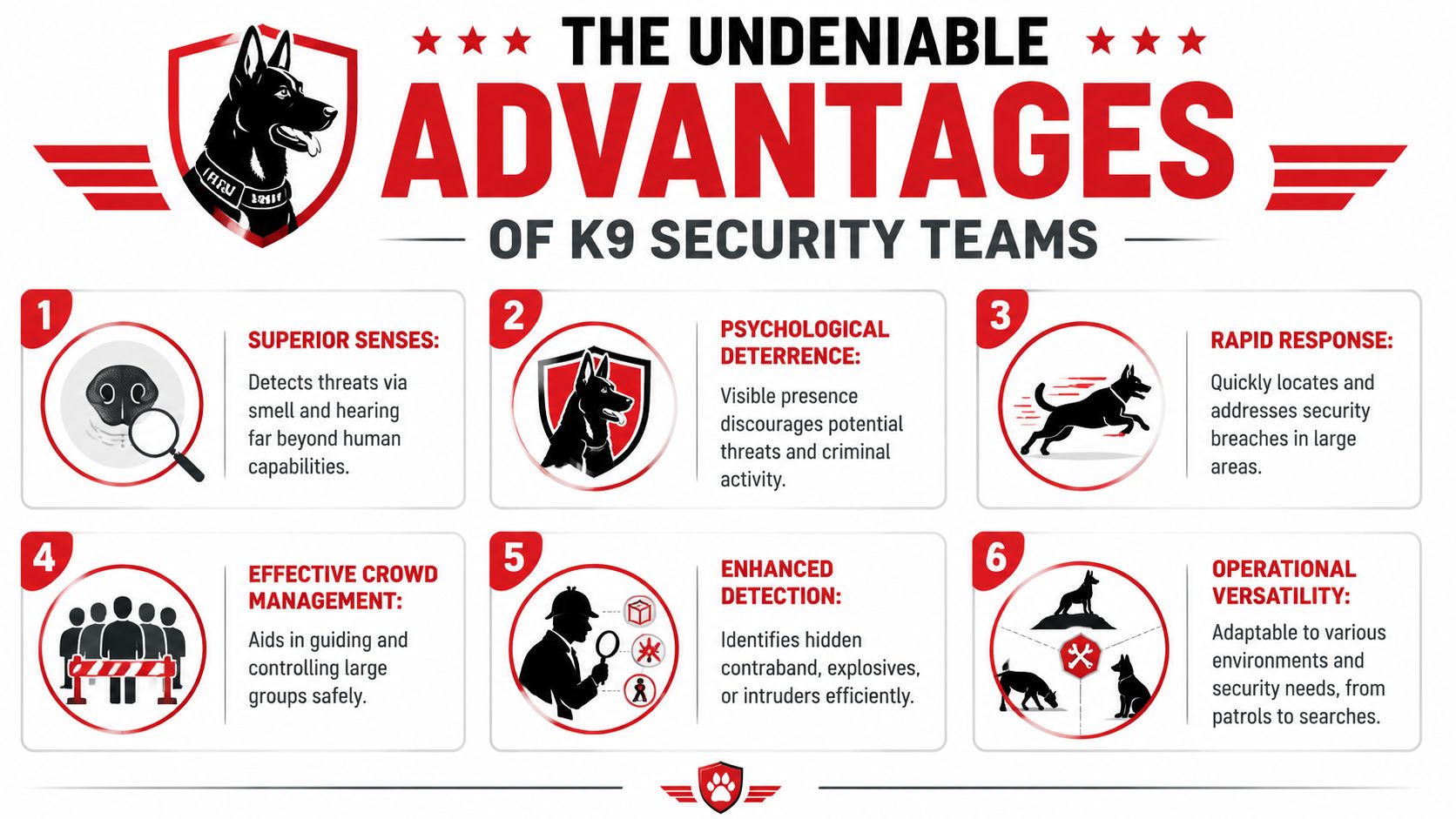
The first advantage is visible deterrence. At festivals, nightlife venues, retail precincts, and construction sites, a properly handled dog changes behaviour before an incident reaches your supervisors. That matters in Australian settings where crowd pressure, alcohol, cash handling, tool theft, and after-hours trespass can all shift quickly from nuisance to real risk.
The second advantage is speed across ground. A K9 team can patrol long perimeters, loading areas, car parks, scaffold edges, temporary compounds, and other awkward spaces more effectively than a static post. On a large site, that means less dead ground and faster investigation when something looks wrong.
Detection is the third advantage. CCTV can confirm movement and help with review after the fact. A trained dog adds a live detection capability that cameras and lighting do not provide, especially where concealment, blind spots, or complex terrain reduce the value of purely visual controls.
The practical value comes from fit for purpose. K9 units produce the best results when they are assigned to a clear problem. Night perimeter checks on a construction project. Queue and outer-zone presence at a major event. Search support where contraband or hidden items are a realistic concern. If the risk profile does not support those tasks, the spend is harder to justify.
Treat K9 security as one control in a layered plan. Pair it with CCTV, access control, radios, patrol supervision, and clear escalation paths. A dog can improve coverage and response. It cannot fix poor briefing, weak gate management, or confused command on the night.
A simple test is to look at where your current plan loses time or visibility.
| Security problem | Why a K9 team can help |
|---|---|
| Large areas with patchy visibility | Mobile patrols cover ground quickly and let the handler investigate suspicious activity without delay |
| High-risk entry points | Visible presence helps settle behaviour and supports early intervention before pressure builds |
| Contraband or concealment concerns | Detection capability adds a screening layer that does not rely only on sight |
| Night-time perimeter risk | Patrol presence and canine senses improve checks along fences, compounds, and dark approaches |
For venue managers and promoters, the key question is not whether K9 units look impressive. It is whether they solve a specific operational weakness better than another guard, another camera, or another fence line. In my experience, the answer is often yes at festivals and after-hours sites, provided the deployment is lawful, supervised, and matched to the environment.
One warning. K9 teams are not a substitute for basic control measures. If your queue layout is poor, your intox management is inconsistent, or your contractor access rules are loose, fix those issues first. Good K9 deployment strengthens a disciplined operation. It does not cover up a weak one.
Navigating K9 Security Compliance in Australia
Many buyers commonly become careless, focusing instead on the dog, not the legal and operational framework around the dog. In Australia, that's a mistake.
K9 deployment sits inside the broader private security system. It is not an informal specialist service operating on its own rules. In Australia, the private security industry is formally regulated by state and territory licensing, and in New South Wales providers must hold the correct business licence under the Security Industry Act while individual handlers must meet specific competencies, which places K9 units within a framework of documented compliance according to this overview of Australian security licensing and K9 operations.
What venue managers should verify first
If you're hiring K9 security services in NSW, VIC, QLD, or the ACT, start with the provider's legal standing and the handler's licence status. Don't accept vague assurances that the team is “qualified” or “fully trained”.
Check these points:
- Business licensing. The provider should hold the relevant licence to supply security services in the jurisdiction where the work occurs.
- Handler licensing. The individual on shift should hold the required state security licence and any relevant endorsements or competencies.
- Insurance position. Ask what cover applies to K9 operations, public interaction, and incident liability.
- Reporting process. You need to know how incidents, indications, complaints, and use-of-force issues are documented and escalated.
These checks matter most in hospitality and event settings, where crowd density, intoxication, and public scrutiny can turn a minor issue into a major complaint.
Welfare and suitability are compliance issues too
A professional buyer shouldn't separate legality from welfare. The dog's condition affects control, reliability, and public safety.
That means asking practical questions. How long is the working period? What rest arrangements are in place? How is the dog managed in heat, noise, and heavy pedestrian traffic? What happens if the environment becomes unsuitable mid-shift?
This is especially important in family events, indoor activations, and tightly packed hospitality venues. Some environments aren't a good fit. If crowd density is extreme, pathways are narrow, or the audience is likely to react badly to dogs, a plain-clothes team or a stronger outer-perimeter model may be the better call.
A compliant deployment isn't just licensed. It's controlled, documented, supervised, and suitable for the environment.
State-based thinking matters
NSW, VIC, QLD, and the ACT all operate within state or territory licensing structures. The practical lesson for buyers is straightforward. Don't assume a provider's operating model transfers cleanly across borders without checking the local requirements.
Use a short procurement checklist during pre-contract review:
- Confirm jurisdiction and where the work is being delivered.
- Match the licence type to the service being supplied.
- Review handler competency for the task. Patrol and detection work shouldn't be treated as the same thing.
- Request site-specific method statements covering movement, incidents, welfare, and public interaction.
If a supplier can't walk you through those points clearly, keep looking.
Ideal Deployment Scenarios for K9 Security Units
The most useful question isn't whether K9s are effective. It's where they're worth paying for.
Existing K9 security content often misses this point. It tends to describe what dogs can do, not where they measurably outperform static guards. The practical distinction is use case. Patrol dogs fit visible deterrence environments like festivals, while detection dogs suit screening roles at higher-security venues, as noted in this analysis of where K9 solutions justify added cost and training.
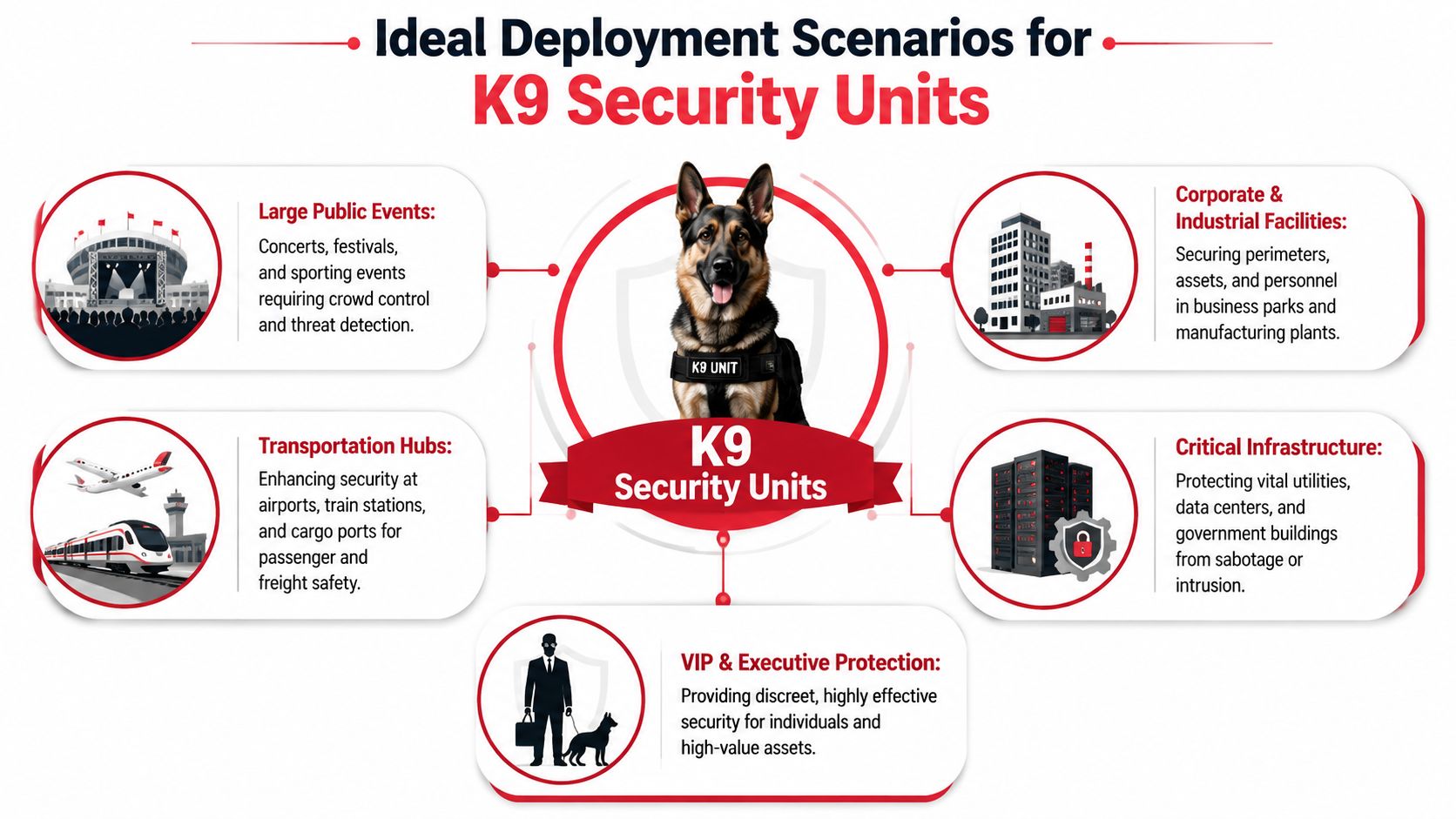
Festivals and major public events
Before gates open, a K9 team can move through outer grounds, service lanes, fenced edges, and temporary structures while other staff are still setting barriers and checking radios. Once patrons arrive, the role shifts. Presence at entry approaches and circulation points can discourage anti-social behaviour and reinforce the message that the site is actively managed.
This works best when the dog is one part of a larger plan. Queue management, screening staff, command communication, and patrol supervisors still carry the operation. The K9 team adds capability where speed, mobility, and deterrence matter most.
What doesn't work is dropping a dog into a crowded entry lane with no route, no spacing, and no clear public-facing instructions. That creates tension without adding control.
Construction sites after hours
This is one of the clearest patrol use cases. Large sites often have blind spots, temporary fencing, uneven lighting, and multiple access vulnerabilities. A static guard at the gate can't cover the full footprint.
A K9 patrol is useful here because the team can move through perimeter lines, material storage areas, plant zones, and partially completed structures with more confidence and speed than a single guard on foot. If the site is remote or sprawling, that mobility matters.
Night deployments also expose weak providers. You quickly see who has route discipline, communication discipline, and proper handling standards.
Nightclubs and licensed venues
Hospitality is more delicate. A visible K9 presence can be effective near outer entry points, car parks, and external patrol routes where it shapes behaviour before patrons enter dense interior spaces.
Inside the venue, suitability becomes the primary question. Noise, intoxication, tight movement corridors, and patron anxiety can make an indoor K9 deployment more trouble than it's worth. In many bars and clubs, the smarter model is a dog at the perimeter and conventional licensed guards inside.
Retail centres and mixed-use precincts
K9 security services can suit retail during peak trade periods, external patrol windows, and after-hours asset protection. The fit is strongest where the problem is loitering, trespass, suspicious after-dark activity, or broad-area patrol difficulty.
For family-oriented centres, presentation matters. The team must be calm, clearly managed, and deployed in a way that doesn't damage the customer experience. If the client's brand relies on a soft, welcoming atmosphere, use the dog sparingly and with clear purpose.
The best K9 deployment usually happens at the edge of a site, not the centre of a packed crowd.
Your Checklist for Choosing the Right K9 Security Provider
Buyers often get distracted by the dog breed, the uniform, or the sales pitch. None of that tells you whether the provider can run a safe, lawful, useful deployment.
A better approach is to procure K9 security services the same way you'd procure any specialist risk-control service. Start with the task. Then test the provider against the task.
The shortlist questions that matter
In Australia, K9 security teams are commonly priced from A$75 per hour, reflecting the cost of certified handler labour, dog maintenance, ongoing training, and higher liability insurance. That pricing benchmark is outlined in this guide to K9 security service costs and operating factors. If a quote comes in far below market expectation, ask exactly what has been stripped out.
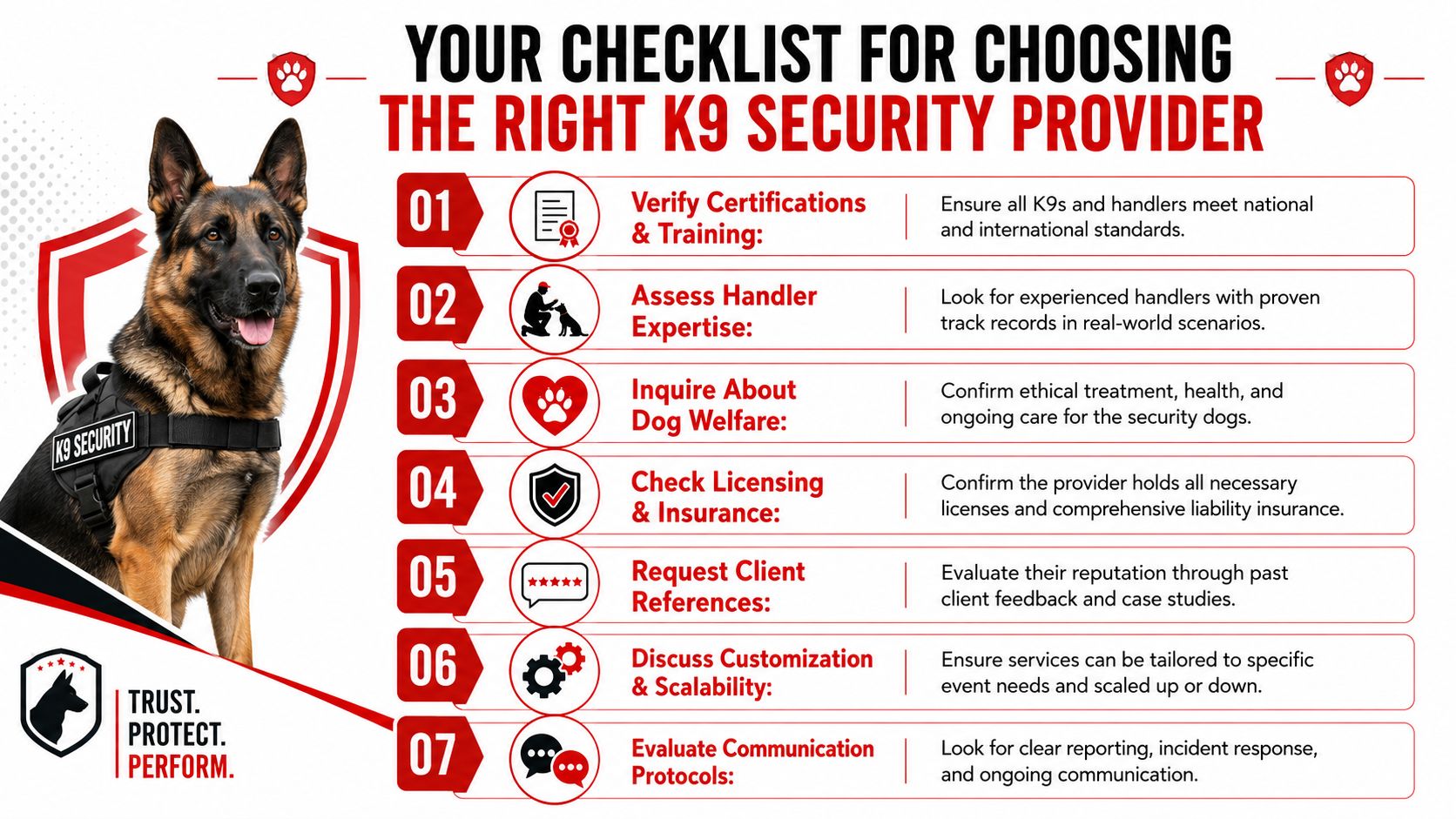
Use this checklist during tender review or supplier interviews:
- Licence first. Confirm the business and the individual handlers are properly licensed for the jurisdiction and service type.
- Match the dog to the task. Ask whether the proposed unit is a patrol dog or a detection dog, and why that choice suits your environment.
- Review insurance carefully. Don't just ask whether they're insured. Ask what K9-related incidents and public interactions are covered.
- Request reporting examples. A professional provider should be able to show the style and detail of patrol logs, incident reports, and escalation records.
- Test their welfare model. Ask about transport, rest periods, hydration, heat management, and removal from unsuitable conditions.
- Check supervision. Find out who manages the team on shift and who you call if the deployment needs adjustment.
Contract terms that protect the client
The cheapest quote is often the most expensive mistake. Low pricing can hide weak supervision, thin insurance, poor dog maintenance, and undertrained handlers.
Include these items in the service agreement:
| Contract item | Why it matters |
|---|---|
| Scope of deployment | Prevents confusion about whether the team is patrolling, screening, or responding |
| Hours and relief arrangements | Protects welfare and continuity across longer shifts |
| Incident reporting standard | Ensures you receive usable documentation |
| Public interaction protocols | Reduces disputes in hospitality and event settings |
| Removal and replacement terms | Gives you a clear path if the team is unsuitable |
One practical option in the market is GM GROUP Services, which offers licensed K9 units alongside event, venue, retail, and construction security operations across multiple Australian jurisdictions. The useful question with any provider, including that one, is whether their K9 deployment model fits your site, your crowd, and your compliance requirements.
A final procurement test
Ask the provider to walk through a realistic scenario from your site. A gate surge at a festival. A fence breach at a construction project. Suspicious after-hours movement in a retail loading bay.
If they answer in generic language, they probably deploy generically. You want a provider who can explain where the K9 team will stand, how it will move, when it will escalate, and when it will be withdrawn.
Frequently Asked Questions About K9 Security Services
Are security dogs aggressive towards the public
Professional K9 security services should not be run as uncontrolled intimidation. A properly handled dog is expected to remain under control, follow commands, and work within a clear operating role. Public safety comes from the handler's judgement, lead discipline, site positioning, and suitability of the deployment.
If a provider talks more about the dog's aggression than the handler's control, that's a warning sign.
Can K9 units be used in crowded indoor spaces
Sometimes, but not automatically. Crowded indoor use depends on noise, access width, patron behaviour, ventilation, and the nature of the event. In many hospitality and entertainment environments, K9s work better at entries, perimeters, loading areas, or external patrol routes than in the middle of dense foot traffic.
The right question isn't “can they be used indoors?” It's “does an indoor deployment improve control without creating new risk?”
What happens if a detection dog indicates a find
The handler should follow the site's documented procedure. That usually means securing the area, notifying the relevant supervisor or control point, and escalating according to venue rules and lawful reporting requirements. A professional team should never improvise this on the fly.
Before shift start, the client and provider should already agree on who is notified, who records the incident, and who takes the next step.
Are K9 security services suitable for family events
They can be, but only when the environment supports calm, low-friction deployment. Family audiences are more sensitive to fear, noise, and presentation. If the event has narrow walkways, highly interactive zones, or a soft-brand atmosphere, the dog may be better used for outer perimeter patrols or pre-opening sweeps rather than visible close-contact circulation.
What should I ask about animal welfare
Ask practical questions, not vague ones. How long is the dog working? Where are breaks taken? How is heat managed? What happens if the venue becomes too loud or too crowded? What transport arrangements are used? A provider that takes welfare seriously usually answers clearly and without defensiveness.
Are K9 teams worth the extra cost
They are when the risk profile justifies specialist capability. If you need visible deterrence, better perimeter coverage, or detection capability, the premium can make operational sense. If your real problem is poor staffing, weak supervision, or broken access control, spend the money there first.
If you're weighing whether K9 security services suit your venue, event, or site, GM GROUP Services can help you assess the practical fit. Their team provides licensed security support across events, hospitality, retail, construction, and venue operations in NSW, VIC, QLD, and the ACT. Start with the risk profile, the crowd environment, and the compliance requirements, then ask for a deployment model that matches the job.
Discover more from GM Group Services
Subscribe to get the latest posts sent to your email.