
K9 Protection Dogs 7 Proven Ways They Keep Events Safe
The gates are open, music is rising, and a queue is forming outside your venue. At the same time, contractors are moving through a construction site after dark, staff are checking credentials, and your security team is watching several access points. In that environment, K9 protection dogs can add a visible, highly trained layer of control, but only when the dog, handler, licence and deployment plan work together.
The safest approach isn't to treat a dog as a dramatic deterrent or a substitute for trained personnel. A professional K9 team supports access control, patrols, observation, incident prevention and a calm customer experience.
The practical objective is simple: increase confidence and control without making legitimate patrons, workers or visitors feel threatened.
This guide explains what K9 protection services involve, how teams are trained, where they fit across events and sites, and which Australian compliance issues operators must check. It also addresses the points that often cause confusion, including the difference between a security dog and a dangerous or guard dog, Queensland licensing, NSW health requirements and public-interface risk.
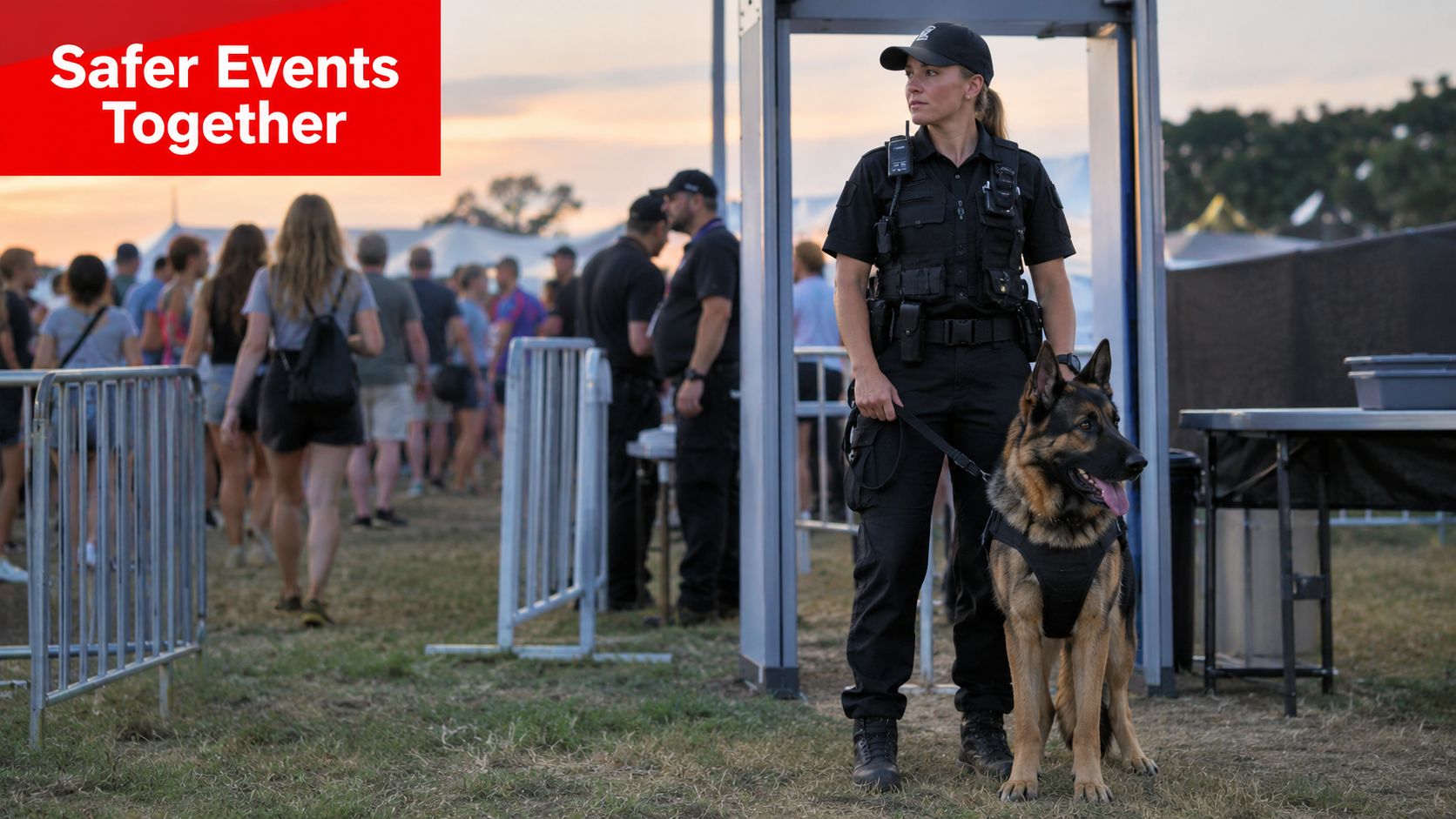
A dog can also influence the atmosphere around a site in a positive way when the handler communicates well and manages space carefully. For broader context on the social and emotional value people can associate with dogs, see why dogs reduce loneliness. In a venue setting, that human connection doesn't replace security, but it can help explain why a professionally managed K9 presence may feel reassuring rather than hostile.
Introduction to K9 Protection Dogs for Safer Events
An event operator rarely asks for K9 protection dogs because a dog looks impressive. The request usually starts with a practical problem: a festival has several entry lanes, a pub needs a stronger late-night presence, or a construction manager wants better visibility around materials and vehicles after ordinary staff have left.
The dog gives the team presence and observation. The handler gives that presence structure. Together, they can support a wider security plan that may include static guards, screening, gatehouse control, vehicle patrols, cameras, incident reporting and emergency response.
Australia's detector-dog capability shows how canine programs can develop from a small pilot into a national operational asset. The program began in 1968 with two black Labradors in Sydney, later expanded to two German Shepherds, and still had only two detector dogs in the Australian Customs Service by 1969. A first training unit was formalised in 1979, followed by a dedicated training centre in Fyshwick, Canberra, in 1984. By 2019, the Australian Border Force reported more than 60 detector dog teams across Australia. The Australian Border Force history illustrates the long-term value of disciplined canine capability, while also showing that professional performance depends on systems, training and governance.
What operators should expect
A K9 team isn't an automatic answer to every threat. The operator must define the task, the site conditions, the public contact points and the escalation process before the first shift begins.
At a concert, the team may support visible patrols and back-of-house access control. At a construction site, the emphasis may be perimeter observation and vehicle movement. At a hospitality venue, the handler must balance deterrence with respectful interaction around patrons, staff and delivery workers.
The rest of this guide focuses on that balance. Effective deployment protects people and property while helping the venue continue to operate normally.
What K9 Protection Services Really Mean
The phrase “protection dog” creates confusion because people use it for several different jobs. A family dog that barks at a stranger, a detection dog searching cargo and a trained security dog working with a licensed handler aren't interchangeable.
A useful analogy is a pilot and co-pilot. The dog has trained abilities, but the handler reads the environment, gives direction, decides how to respond and communicates with the rest of the security team. A venue should assess the team, not the animal in isolation.
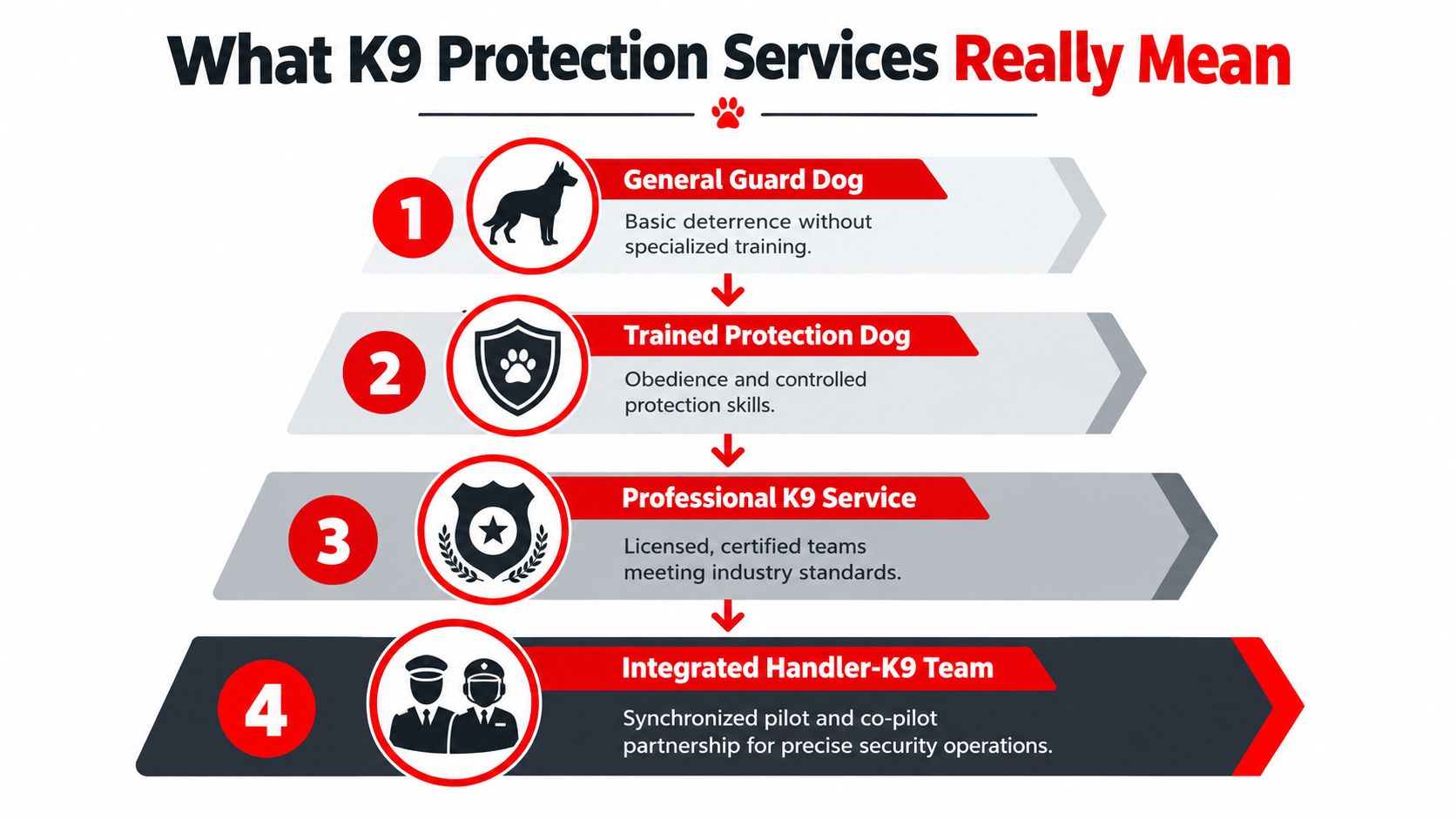
Four levels operators often confuse
A general guard dog may offer basic deterrence, but that doesn't establish specialised operational control. A dog left to react without a trained handler can create uncertainty instead of reducing it.
A trained protection dog has structured obedience and controlled protection skills. The operator still needs to confirm who is authorised to handle the dog and whether the team is suitable for the intended environment.
A professional K9 service adds licensing, assessment, documented procedures and an accountable security provider. This is the level venue managers should look for when the dog will work around customers, contractors or members of the public.
An integrated handler and K9 team operates as a coordinated unit. The handler understands the dog's signals, manages distance, controls movement and knows when a situation requires observation, communication or intervention.
Detection, patrol and protection aren't the same
Detection work focuses on finding a trained odour or prohibited item. Patrol work focuses on presence, observation and movement through a defined area. Protection work involves controlled responses to threats under handler direction.
One team might be appropriate for a cargo environment and another for a public event. A stadium operator should ask the provider to describe the exact service function rather than accepting “security dog” as a complete specification.
Ask what the dog is trained to do, what the handler is licensed to do, and how the team will behave around ordinary people.
That question prevents a common mistake. A venue may want visible deterrence and support during a busy entry period, but the provider may propose a function that requires different training, controls or authorisation. Fit the team to the task, the site and the applicable state rules.
How K9 Units Are Trained and Deployed as a Team
Reliable deployment starts before the dog reaches the venue. Training must build shared responses so the handler can make sound decisions while dealing with noise, movement, distractions and changing access conditions.
Australian Border Force states that a detector-dog team completes at least 7 months of joint dog-and-handler training before graduation. The program includes 10 weeks of basic training in Melbourne, 16 weeks of on-the-job regional training and 2 weeks of final evaluation. The Australian Border Force training outline demonstrates the principle that a dog isn't deployed as a standalone asset. The team is calibrated together, then tested before release.
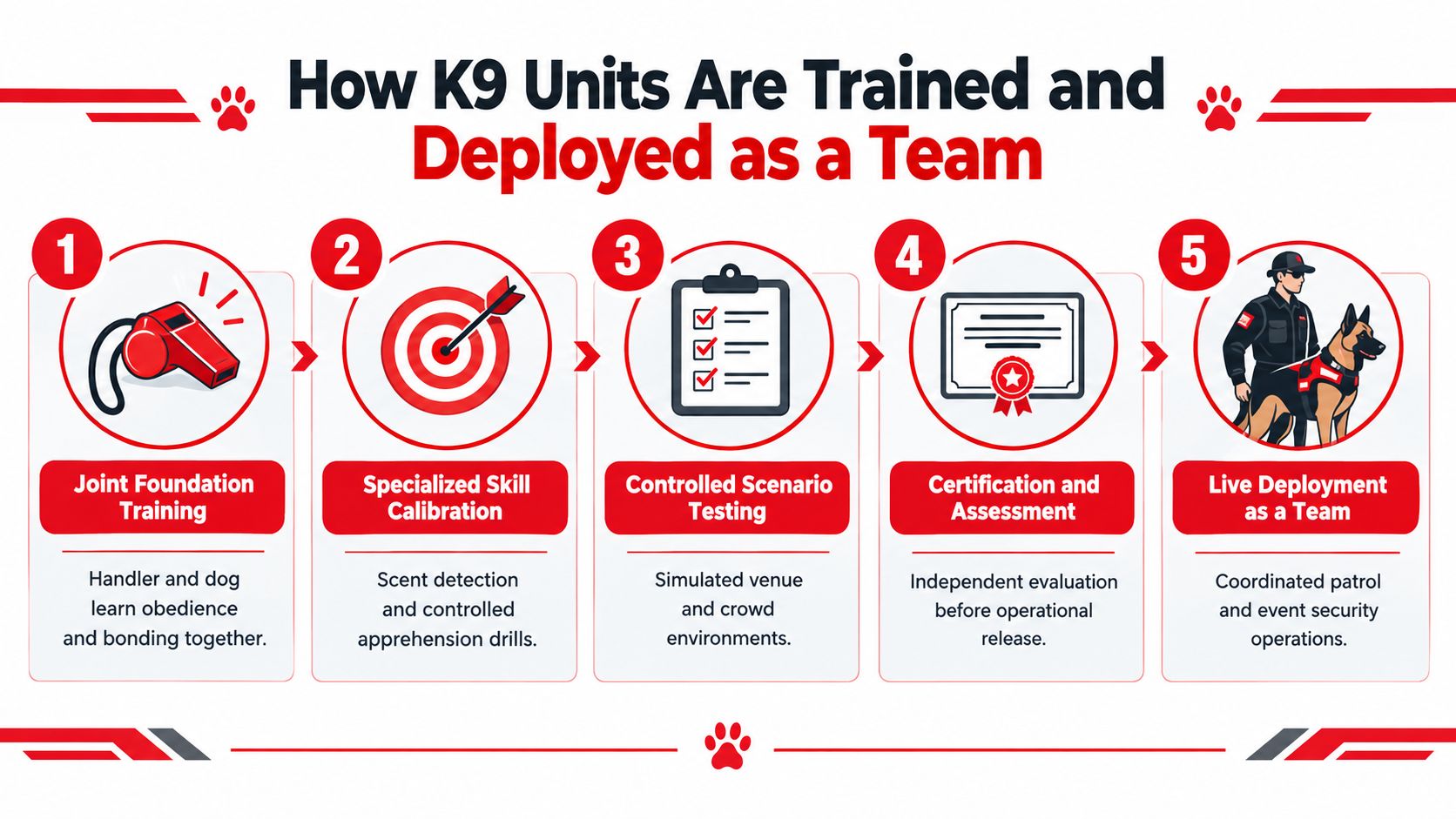
Training has to reflect the real site
A controlled exercise can teach a response, but a live venue introduces queues, lighting changes, loud music, food smells, vehicles, children, intoxicated patrons and staff who may not know the dog. The provider should therefore match training and deployment conditions as closely as possible.
DAFF's handler development model uses a 12-week development program in four stages. It includes simulated operational training in Brisbane, on-the-job work in busy screening locations, advanced problem-solving, verification exercises and mandatory biosecurity foundation or pathway training. DAFF's detector-dog program shows why the handler is a technical control layer, not merely an escort.
For a venue, that means asking practical questions:
- Who leads the team: Identify the handler responsible for decisions and communication during the shift.
- Where will the team work: Mark gates, staff areas, loading zones, public routes and restricted spaces before deployment.
- What ends the task: Establish clear stop, withdrawal and escalation points.
- Who receives reports: Nominate the event control room, site supervisor or duty manager.
- How is performance reviewed: Require shift feedback, incident records and follow-up where conditions changed.
A night patrol around a construction site may need a different briefing from a festival entrance. The provider should consider surfaces, lighting, access points, nearby residents, workers and emergency routes. Supervisors should also monitor fatigue, heat, crowd density and the handler's ability to maintain control.
The most useful performance question isn't whether a dog looks confident. It's whether the team remains predictable, responsive and controlled when the environment becomes difficult.
Key Benefits of K9 Protection Dogs for Venues and Sites
Operators usually choose K9 protection dogs for a combination of visible deterrence, observation and operational flexibility. The value depends on the setting, because a festival entrance, a hotel lobby and a construction perimeter create different risks.
At a concert or festival, a uniformed handler with a dog can support a broader entry plan. The team may patrol beside queue lines, observe behaviour around access points and help staff maintain a clear boundary between public and restricted areas. The dog shouldn't replace screening staff or become a reason to treat every patron as suspicious. It should help the team notice changing conditions and respond in a controlled way.
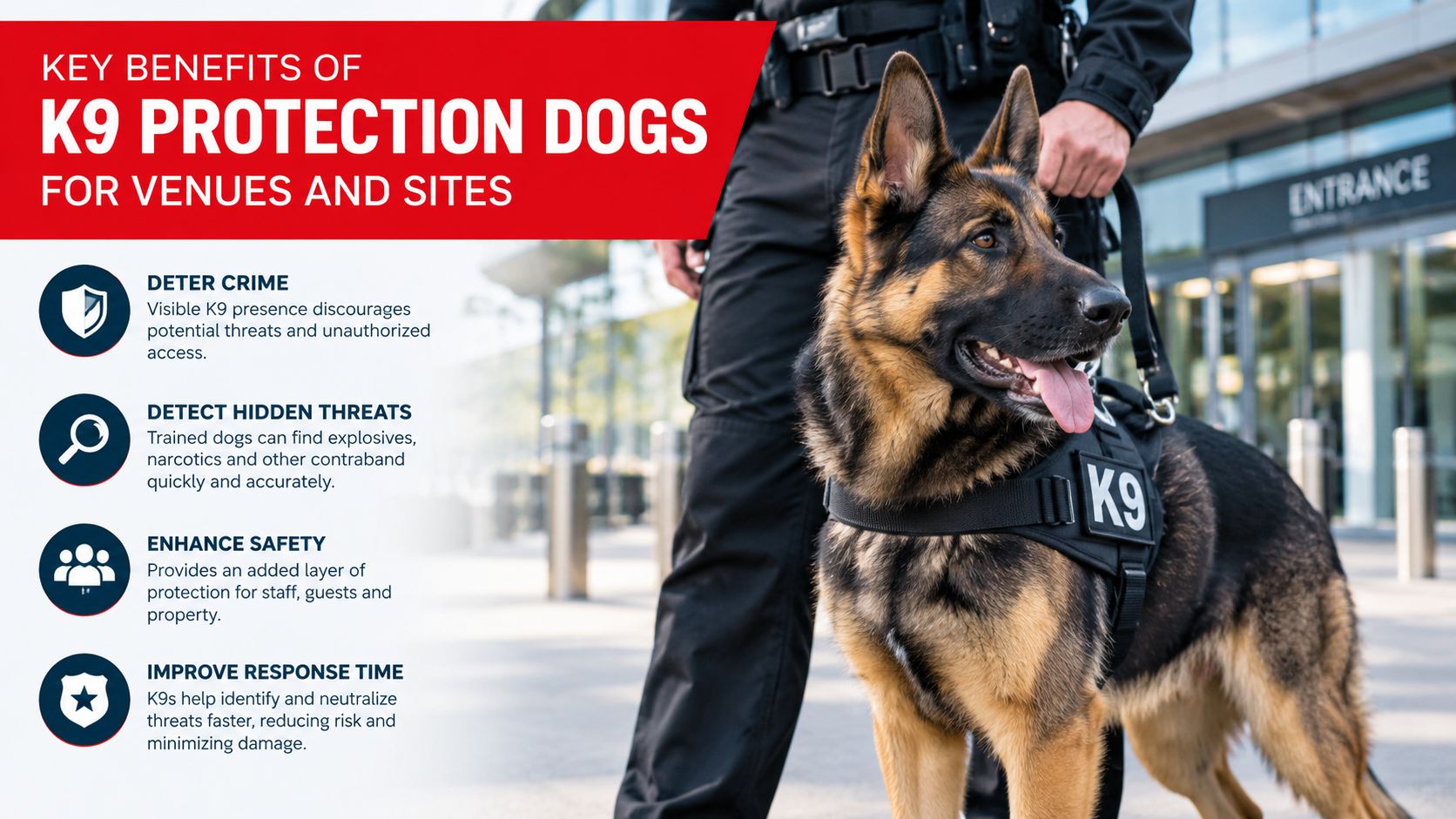
Where the presence adds practical value
Bars, pubs and clubs often need calm visibility around entrances, queues and dispersal periods. A handler who communicates clearly can help staff manage space without turning the doorway into a confrontation point.
Hotels and restaurants may use a K9 team for scheduled patrols, staff reassurance and support around deliveries or restricted areas. The presentation matters. A professional team must remain compatible with hospitality standards and customer service.
Retail sites and shopping centres can benefit from mobile patrol coverage around car parks, loading zones and less visible areas. The handler can coordinate with control-room staff and other guards rather than operating separately.
Construction and industrial sites may require after-hours perimeter patrols, gatehouse support and observation around vehicles, materials and temporary fencing. A pre-shift briefing should identify hazards such as machinery, uneven ground and authorised workers arriving unexpectedly.
Deterrence works best as part of a visible system
A dog can make a potential offender reconsider, but deterrence is only one layer. Lighting, access control, guard positioning, communication and response procedures still determine what happens after an unusual event is noticed.
A K9 presence should make the right behaviour easier and the wrong behaviour harder, without making ordinary customers feel like suspects.
Operators should also consider brand impact. The handler's language, uniform, positioning and willingness to explain the dog's role can influence how patrons perceive the service. A well-run team contributes to reassurance. A poorly briefed team can create anxiety, block accessible routes or escalate a minor disagreement.
Legal and Safety Rules Every Operator Must Know
Australian operators can't assume that the words “security dog”, “guard dog” and “dangerous dog” mean the same thing in every state. The legal classification, handling conditions and welfare obligations can vary by jurisdiction, so the venue must check the rules that apply to the actual site.
NSW has an Animal Welfare Code of Practice for Security Dogs under the Prevention of Cruelty to Animals Regulation 2025. Victoria's guidance states that dangerous dogs must be muzzled and on a lead outside the owner's premises, or when they aren't guarding inside an enclosure. Tasmania's 2026 dog welfare regulations and council guidance also show that collars, enclosure standards and public warning signage can differ. The NSW security dog service guidance is a useful starting point, but it doesn't replace checking the requirements for Victoria, Queensland, Tasmania or the ACT.
Security dog compliance by jurisdiction
| Jurisdiction | Key Requirement | Operator Implication |
|---|---|---|
| NSW | Security dogs are covered by a specific animal welfare code. | Confirm the provider follows the code and maintains required welfare records and controls. |
| Victoria | Dangerous dogs must be muzzled and on a lead outside the owner's premises, or outside an enclosure while not guarding. | Plan routes, public contact and enclosure arrangements before the shift. |
| Queensland | Dog patrol work has a specific security licensing pathway. | Verify the handler's dog-patrol authorisation, not only a general security licence. |
| Tasmania | Collars, enclosure standards and public warning signage can differ under state and council guidance. | Check local requirements for the exact site and deployment arrangement. |
The table is a planning aid, not a complete legal assessment. A venue manager should ask the provider to identify the relevant state rules, council conditions and site controls in writing.
Preventing incidents around the public
Dog-related risk is not theoretical. NSW defines a dog attack broadly to include rushing, attacking, biting, harassing or chasing, even when no injury occurs. NSW councils reported dog attack incidents in quarterly datasets for 2025–26, and Australia Post reported an average of 11 dog-related incidents per day over six months in 2024. The NSW dog attack data provides the relevant state data, while the Australia Post dog safety information highlights the broader handling risk.
For mixed public environments, use controlled access, clear signage, trained handlers and a documented incident process. Don't rely on the dog's appearance to manage people.
Planning a Compliant and Effective K9 Deployment
A good deployment brief answers three questions before the team arrives. What is the task? Where will the team operate? What happens if conditions change? If the provider can't answer those questions clearly, the operator hasn't yet defined a safe service.
Start with the site risk assessment. Mark public entrances, staff entrances, loading areas, emergency exits, restricted zones and places where the dog may encounter children, contractors, patrons or delivery drivers. Note heat, weather, lighting, noise, surfaces and crowd movement. A construction site and a nightclub may both need patrols, but their hazards and public interfaces are different.
The pre-deployment control list
- Confirm the service function: Write down whether the team is supporting patrol, protection, access control, observation or another defined task.
- Verify the handler's authority: In Queensland, applicants for a dog patrol security officer licence must complete all 14 core units in CPP20218 Certificate II in Security Operations plus 2 elective units from CPP31318 Certificate III in Security Operations. This also applies when adding dog patrol to an existing licence. Queensland's dog patrol licence requirements should be checked against the handler's current documents.
- Check health compliance: NSW requires security dogs to receive vaccinations against distemper, hepatitis and parvovirus every 12 months. The NSW animal welfare code gives operators a concrete annual health check to verify.
- Brief the public-interface plan: Decide where the dog will stand, how staff will direct people around the team and when the handler will withdraw from a congested area.
- Set reporting expectations: Specify who receives incident reports, shift notes, welfare concerns and changes to the site risk profile.
The provider should also identify relief arrangements and supervision. A dog may be suitable for one site but not another, and a handler's authorisation must match the actual function being performed.
A practical system uses a compliance calendar. Record licence dates, training evidence, vaccination dates, site briefings and review points before the roster is published. This simple step helps prevent a last-minute substitution that hasn't been properly verified.
K9 Protection Dogs FAQs for Event and Venue Operators
What training do I need for a Queensland security dog role?
Queensland applicants must complete all 14 core units in CPP20218 Certificate II in Security Operations and 2 elective units from CPP31318 Certificate III in Security Operations. The requirement also applies when an existing security licensee adds the dog patrol function. Check the Queensland application pathway before rostering a handler.
How long does a restricted dog patrol licence last in Queensland?
A restricted licence lasts 6 months and can't be extended. During that period, the applicant must complete the required training and apply for a full, unrestricted licence. A stadium contractor should schedule the training and application well before the restricted period ends. The Queensland training guidance sets out this temporary pathway.
How often must security dogs be vaccinated in NSW?
NSW security dogs must be vaccinated against distemper, hepatitis and parvovirus every 12 months. Ask for current records before a festival, venue or patrol deployment, and add the next renewal date to the operator's compliance calendar. The requirement appears in the NSW animal welfare code for security dogs.
How can a venue confirm a handler's authorisation?
Request evidence of the handler's current security licence, the dog-patrol function or authorisation where required, relevant training completion and the dog's health records. Match those documents to the state where the shift occurs, then confirm the provider's briefing, supervision and incident-reporting process.
Are K9 protection dogs suitable for every event?
No. Suitability depends on the task, crowd profile, site layout, environmental conditions and public-interface controls. A professional assessment may find that static guards, screening staff, vehicle patrols or another combination offers better coverage than a K9 team.
Operators can deploy K9 protection dogs responsibly when they treat the service as a regulated team function rather than a visual prop. Define the task, verify the documents, brief the site, protect public safety and review performance after each operation.
GM GROUP Services provides licensed security guards, K9 units and handlers, patrols, gatehouse control, event security and risk assessments across NSW, Victoria, Queensland and the ACT. To plan a fit-for-purpose deployment for your venue, festival, hospitality site or construction project, visit GM GROUP Services and discuss the operating conditions with the team.
Discover more from GM Group Services
Subscribe to get the latest posts sent to your email.