
Industrial site security starts before the first alarm reaches a monitoring centre. At 5am, a supervisor arrives at a suburban industrial estate and finds a roller door forced, a pallet of copper missing and a fence panel peeled back from its posts. The immediate reaction is usually to buy more cameras or specify a larger fence, but that approach often spends money on equipment without fixing the gaps between detection, verification and response.
A defensible security plan matches each control to a defined risk. The fence delays entry, lighting exposes movement, CCTV detects and verifies activity, access control records who entered, and a trained person decides what happens next. The same practical discipline that supports TP Training on-site safety also applies here, clear responsibilities, controlled access and procedures that people can follow under pressure.
What Industrial Site Security Really Means
Industrial site security isn't a product catalogue. It's a deployment problem involving people, physical barriers, technology, procedures and response.
A fence that looks impressive from the road may still fail at the rear boundary where trucks have damaged the mesh. A camera may produce excellent footage but miss faces because it points across a yard instead of towards the gate. A guard may be present but unable to identify which contractor is authorised to enter a restricted area. Each control can work in isolation and still leave the site exposed.
Australian evidence shows why the problem deserves a layered response. A 2025 extracted-offences summary for Australian construction-site location groups recorded 4,583 selected offences, compared with 4,292 in 2024 and 4,187 in 2023. Theft accounted for 2,720 offences, while burglary and break-and-enter accounted for 1,397, property damage for 327, public nuisance for 121, and arson for 18. The figures show that industrial-site security needs to address more than casual theft. Trespass, damage and deliberate fire-setting also belong in the risk picture. (SiteView's Australian construction-site theft summary)
Historical research points to the same operational lesson. An Australian Institute of Criminology study found that one in four builders was affected by theft or vandalism during 2002, and two-thirds of those affected experienced more than one incident. The research also estimated 26 thefts per 1,000 items of plant in use in 1997, showing that repeated losses and vulnerable equipment have been documented in Australia for decades. (Australian Institute of Criminology research on building-site theft)
Practical rule: Don't ask which security product you should buy first. Ask which threat must be delayed, detected, verified and answered.
The seven controls that follow are useful because they connect the layers. Risk assessment determines the priority. Physical barriers reduce easy opportunities. Staffing and patrols provide judgement and presence. Monitoring joins alarms, video and access records into an operational decision. Compliance keeps the system defensible, while budgeting and provider selection prevent the site from paying for features that don't address its actual exposure.
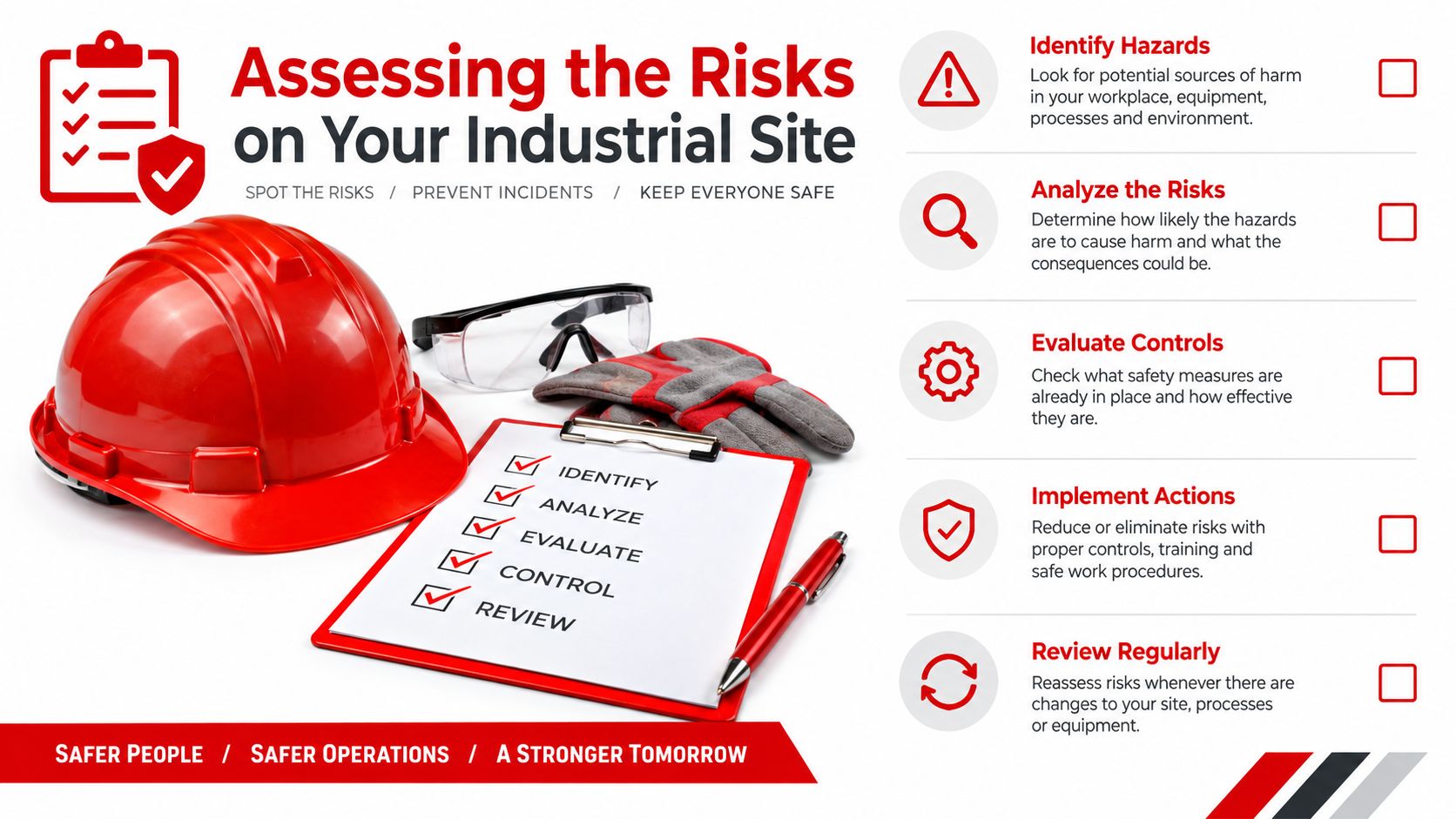
Assessing the Risks on Your Industrial Site
A useful risk assessment doesn't need specialist software. A site manager can produce a practical, defensible starting point by combining asset knowledge, local information and a physical walk-through.
Start with what matters
List the assets and activities that could attract theft, damage or unauthorised access:
- Valuable materials: Identify copper, fuel, scrap, tools, plant and stored stock that can be removed or resold.
- Hazardous items: Record chemicals, dangerous goods and other materials that could create harm if accessed or moved.
- Operational systems: Include production equipment, control rooms, server rooms, documents and data-bearing devices.
- People and movement: Map workers, contractors, visitors, delivery drivers and anyone working alone.
- Critical areas: Mark loading docks, compounds, workshops, rooftops, fuel points and areas hidden from the public road.
Use your state or territory police crime-statistics portal, insurer information and your own incident records to test assumptions. Local evidence won't tell you exactly what will happen at your site, but it can help distinguish between a theoretical concern and a recurring pattern.
Walk the site under different conditions
Inspect the perimeter when the site is open, during lunch and after dark. Look for gaps that a plan or camera survey won't reveal:
- Sight lines: Note where stacked materials, parked vehicles or vegetation conceal a person.
- Lighting gaps: Check gates, corners, storage compounds and pedestrian approaches rather than judging brightness from the office.
- Boundary weaknesses: Test loose panels, climbable structures, gaps beneath fencing and shared boundaries with neighbouring sites.
- Gate discipline: Watch whether vehicles can enter behind another vehicle, whether visitors are challenged and whether keys or remotes are controlled.
- Response routes: Check whether a patrol or emergency service can reach the relevant zone without meeting locked gates or obstructed roads.
Rank before you spend
Use a simple 1 to 5 likelihood and consequence matrix. A threat with high consequence deserves attention even if it appears less likely, while a frequent but low-impact nuisance may need a process change rather than an expensive technical installation.
Your final output should be a short ranked list. It might identify opportunistic theft at an uncontrolled gate, organised copper theft overnight, internal pilfering during a shutdown, or unauthorised access to hazardous materials. That list becomes the specification for industrial site security, not a supplier's standard package.
Core Physical Controls You Cannot Skip
A fence can delay entry while a camera records it, yet the alarm still fails if nobody can verify the event or reach the affected zone. Industrial site security works when each control has a defined task and the layers support one another. Fencing should slow or channel movement, lighting should make people and vehicles visible, CCTV should verify activity, and access control should show who is permitted to enter.
| Control | What it achieves | Common failure point |
|---|---|---|
| Fencing | Delays casual entry, defines the boundary and channels movement towards controlled points | A damaged, climbable or poorly anchored section gives an intruder an easier route around the main gate |
| Lighting | Exposes movement, supports camera identification and reduces concealed approaches | Glare, shadows or poorly aimed fittings leave faces and number plates unreadable |
| CCTV | Detects activity, verifies alarms and creates an auditable record | Wide-area views capture a person too far away for useful identification |
| Access control | Records entry, restricts zones and supports accountability during an incident | Shared cards, propped doors and inaccurate contractor records undermine the audit trail |
Specify the boundary for the threat
Chain-wire fencing built to AS 1725 can deter casual entry, but a determined offender with bolt cutters may defeat it. Higher-risk boundaries may require palisade or welded mesh around copper, fuel, plant or hazardous-material compounds. The specification also needs to cover gates, hinges, locks, vehicle impact and the space beneath the fence.
A fence should be tested as an operating control, not accepted as a line on a plan. Western Australian guidance says security fencing, where needed, should be high enough to deter entry, difficult to climb or crawl under, and strong enough to withstand wind loads and people attempting to scale it. (WorkSafe WA guidance on unauthorised access)
Light and video for verification
Perimeter and compound lighting should provide at least 50 lux where that specification suits the site design. Motion activation can reduce power use in secondary areas, but approaches used by vehicles, staff or intruders need enough baseline illumination for cameras and responding personnel to interpret the scene.
Place cameras at gates to capture faces and along entry lanes to capture number plates. Overview cameras provide context, while a closer view supports identification. Australian Government physical security guidance recommends CCTV coverage of access points, internal access to higher-security zones, full-site perimeters or specific physical assets and work areas. That supports a verification-led design, where an alarm event can be checked before dispatch. (Australian Government physical security management guidance)
Access control may be a signed visitor book at a lower-risk site. A higher-risk operation may need swipe or biometric gates linked to a current muster list. The system only produces a reliable record if staff prevent tailgating, stop door propping, protect cards and remove contractor access when the work ends. A camera should also cover the controlled point so an access event can be checked against the person or vehicle using it.
Staffing and Patrol Models That Fit the Site
Security staffing should follow the risk assessment and operating pattern, not the provider's preferred roster. A site with valuable assets and a continuous threat may need a permanent presence. Another site may gain more from mobile checks, controlled gate access and verified alarm response.
| Model | Best fit | Key limitation |
|---|---|---|
| Static guards | High-value sites, continuous threats, active worksites and locations needing an immediate on-site presence | Labour-intensive and dependent on supervision, handovers and clear post orders |
| K9 teams | Large perimeters, lay-down areas and sites where an intruder may hide among materials or plant | Requires suitable handlers, welfare arrangements and a deployment plan that matches the dog's capabilities |
| Mobile patrols | Lower-risk sites needing visible deterrence, lock-up checks and after-hours response | Coverage depends on route density and the patrol may be dealing with another call |
| Gatehouse officers | Sites with frequent vehicle, contractor and visitor movements | Can become a bottleneck if access rules, credentials and exception handling aren't clear |
| Back-to-base monitoring | Sites needing continuous alarm assessment and escalation without a person stationed on site | Operators can verify and escalate events but can't physically intervene |
Victoria Police recommends a practical package that includes locked buildings and storage containers, CCTV, audible alarms, good lighting, guard services where appropriate, unique tool marking, records of model and serial numbers, and secure overnight storage. It also advises removing batteries to disable equipment at night and keeping movement records for materials entering and leaving the site. (Victoria Police construction-site theft prevention guidance)
Match coverage to the working day
A gatehouse officer may be valuable during delivery peaks but unnecessary when the site is empty. A mobile patrol can check locks and compounds after shutdown, while back-to-base monitoring handles alarm verification between visits. Static coverage becomes more defensible where the consequences of delay are high or where the site has a history of repeated intrusion.
The handover matters as much as the roster. Post orders should identify restricted areas, key contacts, response priorities, access exceptions and the records each officer must complete. A patrol that only drives past the front gate isn't equivalent to a patrol that checks the rear boundary, compound locks and alarm status.
How Technology and Monitoring Tie the Layers Together
Technology adds value when it helps a person make a better decision quickly. CCTV that only records evidence after a loss has a role, but industrial site security becomes more effective when cameras verify alarms before someone is dispatched.
Use a defined escalation chain
A workable back-to-base sequence looks like this:
- Detection: A fence sensor, door contact, motion analytic, duress button or access event creates an alert.
- Verification: The operator checks the relevant camera view, nearby cameras, alarm details and recent access records.
- Assessment: The operator determines whether the event indicates a person, vehicle, environmental trigger, authorised activity or equipment fault.
- Dispatch: The agreed response goes to a mobile patrol, on-site guard, supervisor, police or emergency contact.
- Reporting: The operator records the event, images, calls, response and outcome so the site manager can correct the weak layer.
Camera analytics need defined detection zones and sensible tuning. A camera pointed at a road may repeatedly trigger on passing traffic, while one aimed at a dark corner may miss a person. The monitoring operator also needs a script that states who to call, in what order and what information to provide.
Access logs should influence patrol decisions. If a restricted workshop was entered shortly before a perimeter alarm, the patrol should know that zone is more relevant than the front office. Intercoms, duress buttons and lone-worker devices extend coverage into sheds, rooftops and isolated work areas where guards don't routinely walk.
Operational hand-off: Every alert should have an owner, a verification step and a documented next action. If one of those is missing, the system has a gap.
For a practical comparison of how video monitoring can support safer site operations, review construction site CCTV monitoring. The useful question isn't whether a camera is installed. It's whether the camera, alarm, access record and responder work as one chain.
Compliance and Regulatory Requirements in Australia
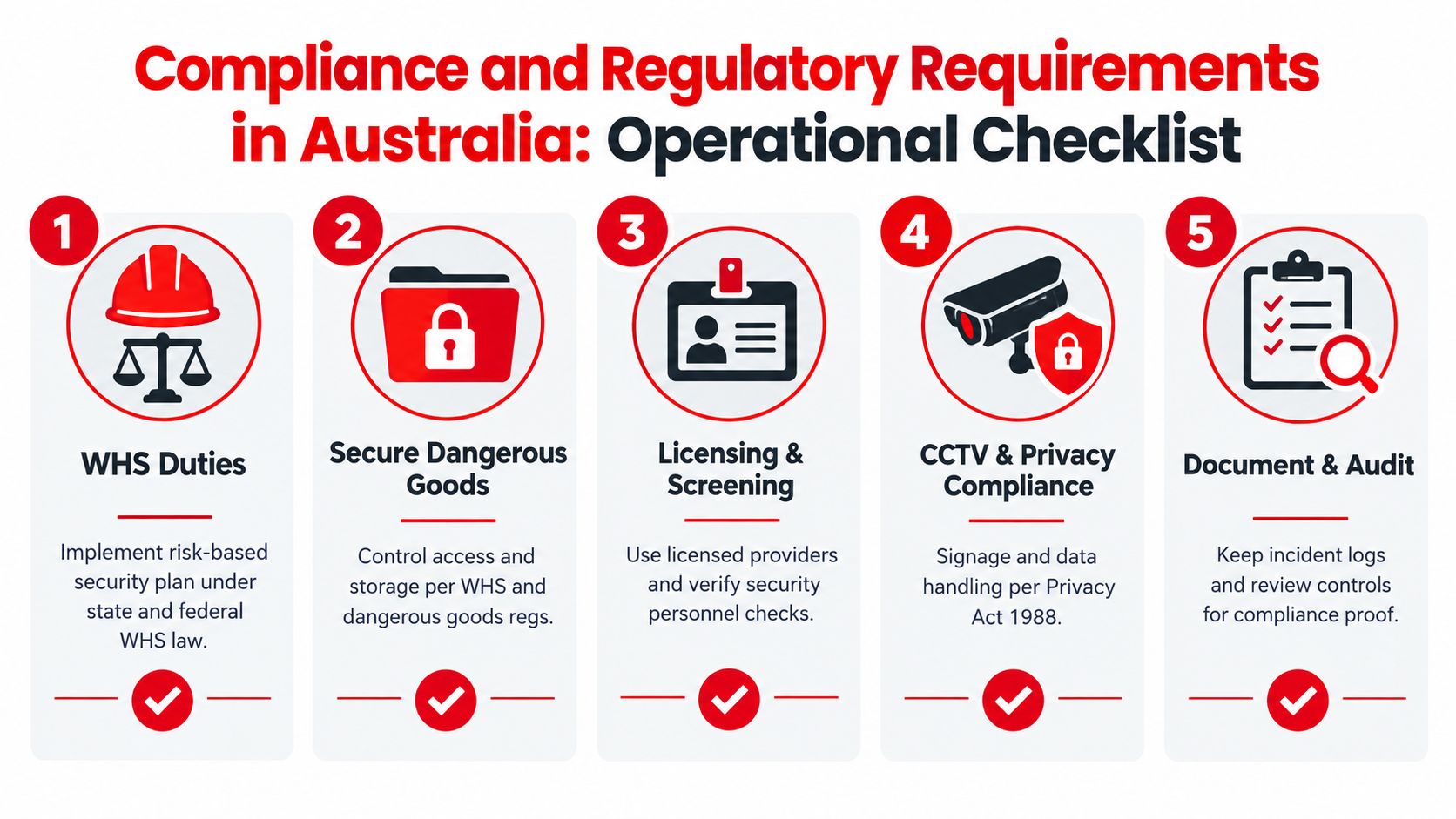
Compliance makes security accountable. It sets a working baseline for access, records, signage and review, while supervisors still need to judge whether the controls match the site's actual threat picture.
In New South Wales, workplaces where construction work is carried out must be secured from unauthorised access under the 2025 WHS Regulation. Operators of major hazard facilities must make security arrangements and provide details to police. SafeWork NSW states that the person with management or control of a construction workplace must ensure, so far as is reasonably practicable, that the site is secured. Its checklist also requires signage visible from outside the workplace, securely fixed and showing the principal contractor's name and a contact person's name. (SafeWork NSW site security checklist)
In Western Australia, Regulation 298 of the Work Health and Safety (General) Regulations 2022 requires a construction workplace to be secured from unauthorised access. Regulation 225(5) separately requires operators to prevent unauthorised access to incomplete or unattended scaffolds. Apply those duties through inspected gates, maintained barriers, controlled scaffold access and records of corrective action. A policy kept in an office does not demonstrate that the controls work.
Build the evidence trail
For sites handling security-sensitive dangerous substances, Tasmania's 2025 regulations require security risk assessments, site maps, inventory controls, access controls, transport-route details and identity checks for responsible workers. These requirements offer a useful operating model for higher-risk sites elsewhere, but the applicable local legislation remains the authority.
Keep records organised and current:
- Risk records: Assessment, review date, responsible person and completed corrective actions.
- Identity records: Worker, contractor and visitor approvals, inductions and access changes.
- Asset records: Tool identifiers, plant details, inventory movements and restricted-material registers.
- Site records: Maps, gates, zones, emergency contacts, patrol reports and incident logs.
- Provider records: Licences, training evidence, supervision arrangements and performance reviews.
Records should show both the control and its follow-up. If a damaged gate, failed camera or expired access permission is logged without an owner and completion date, the site cannot demonstrate that the risk was addressed.
Safe Work Australia explains that model Codes of Practice are practical guides under the model WHS Act and Regulations, but they have legal effect only when formally approved in a jurisdiction. Site operators should identify and follow the approved local code rather than assume a model code applies automatically everywhere. (Safe Work Australia Codes of Practice guidance)
A technical security review may be appropriate where unauthorised listening or sensitive information is a concern. Keep that work separate from routine guard duties. For context on the distinction, see UK bug sweep services, and confirm that any Australian engagement meets local legal and professional requirements.
Budgeting and Choosing the Right Security Provider
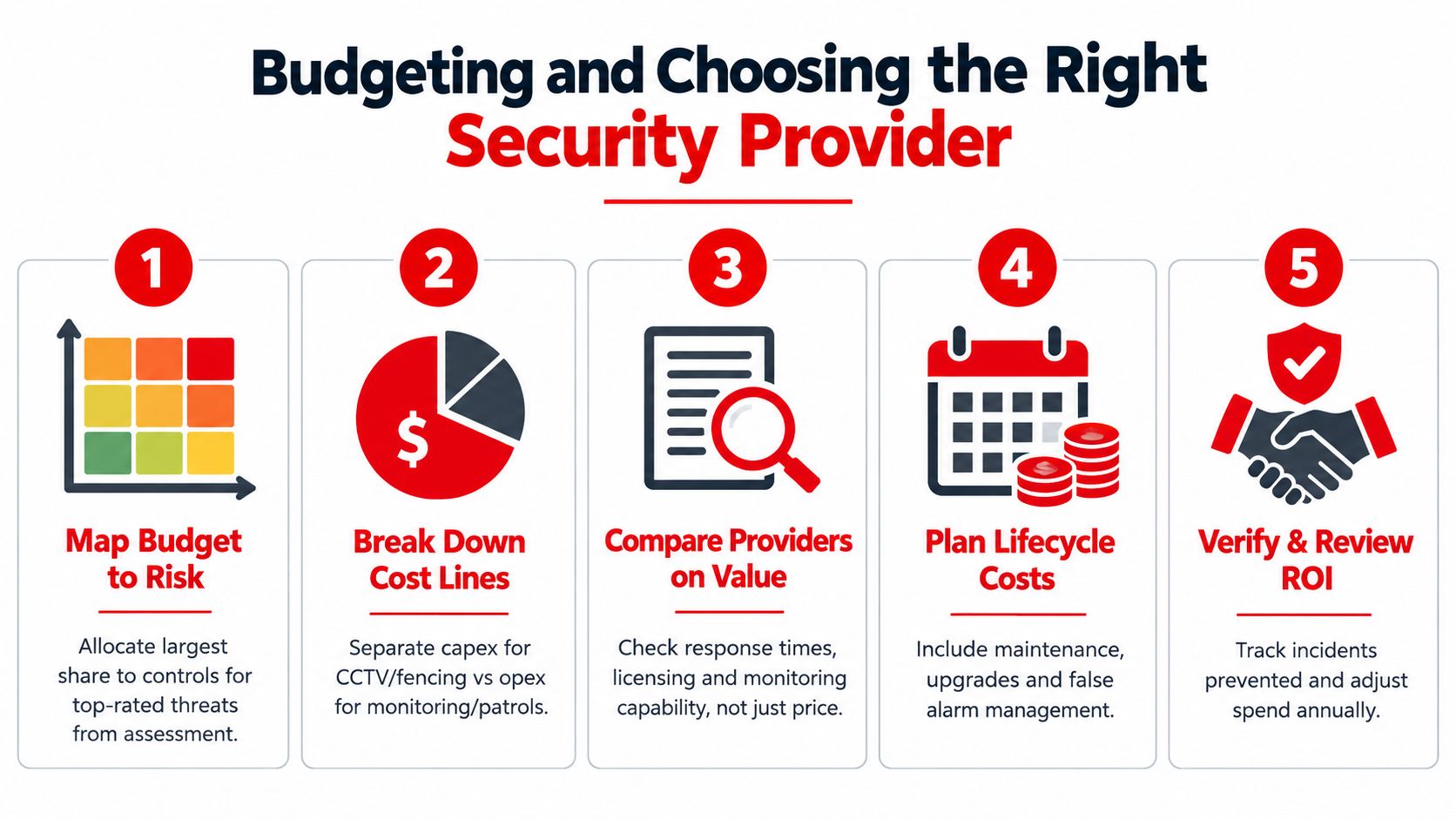
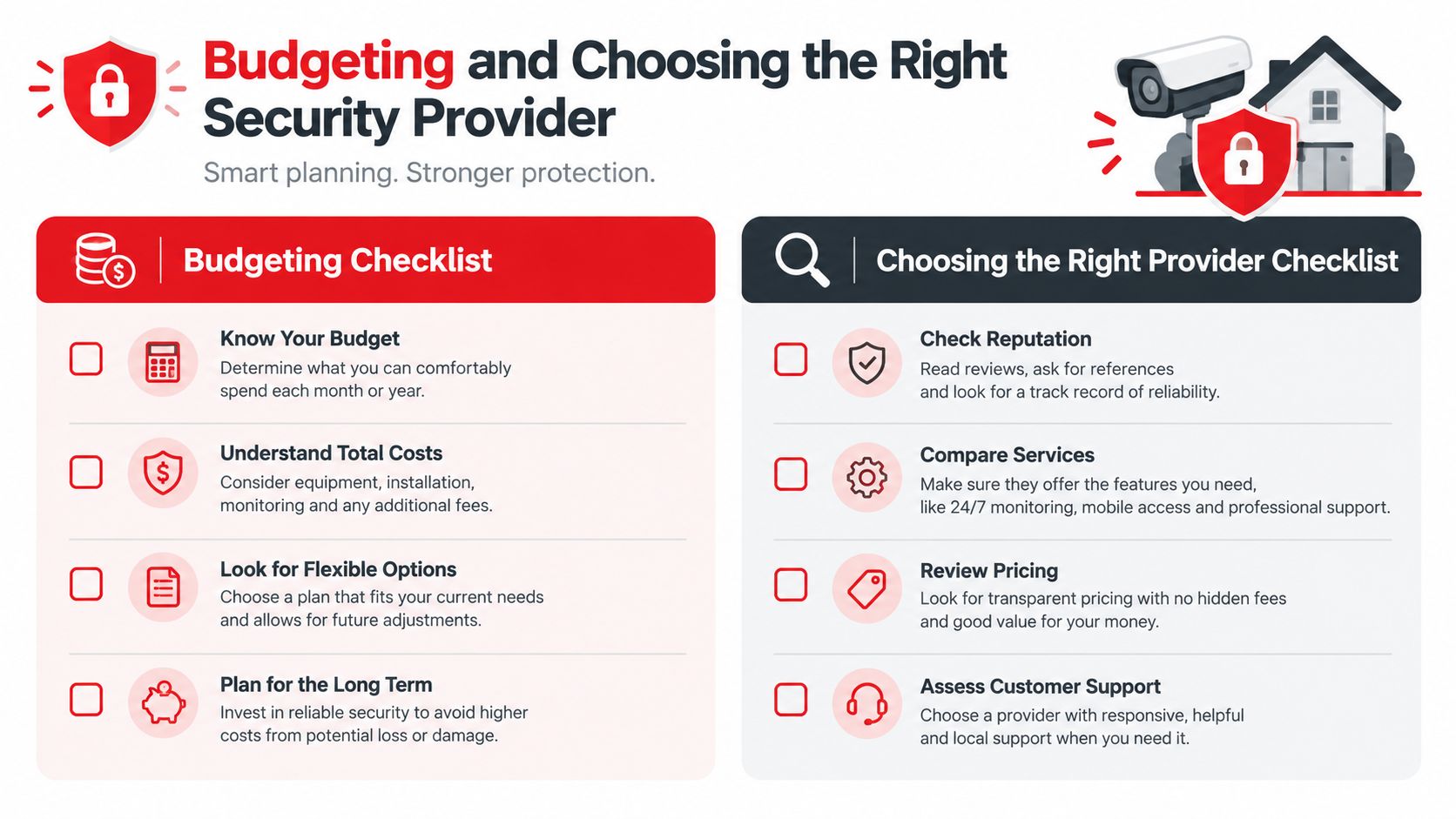
A security budget should start with the risk ranking, not last year's invoice. Fund the controls that address the most serious exposure first, then add supporting layers so the primary control doesn't operate alone.
Separate the cost lines
Treat the budget as a set of decisions:
- Perimeter and lighting: Usually installation-led expenditure, with ongoing repairs, testing and power costs.
- CCTV and access control: Hardware, connectivity, software, maintenance and monitoring may sit in separate lines.
- Guarding and patrols: Rostered hours, supervision, relief coverage, travel and reporting create the main operating cost.
- Incident response: Include alarm callouts, damaged locks, replacement panels, camera repairs and investigation support.
- Compliance administration: Allow time for inductions, access reviews, audits, registers and corrective actions.
A cheaper quote can become expensive if it creates false alarms, missed patrol checks or repeated repairs. Ask suppliers to explain what each cost line protects, what it doesn't protect and which assumptions would change the price.
Test the provider before signing
Require a site walk-through before a final proposal. The supplier should identify blind spots, challenge an oversized camera count, explain the proposed response path and show how a supervisor will check performance.
Verify that guards and providers hold the required state-issued licences. Confirm current class certifications, shift supervision, relief arrangements and escalation authority. Written response targets should state what happens after an alarm is received, how verification occurs and when the site manager is contacted.
Monthly reporting should cover incidents, alarm-to-verification activity, patrol completion, access exceptions, maintenance and recurring false alarms. If the monitoring centre claims compliance with AS 2201.2, ask for evidence of the relevant grading and scope rather than accepting a label in a sales presentation.
Provider test: A fit-for-purpose supplier will walk the site, explain trade-offs and reference comparable industrial work. It won't simply send a standard package with your logo added.
GM GROUP Services is one Australian option for sites requiring risk assessments, gatehouse control, static guards, K9 teams, vehicle patrols, back-to-base monitoring or emergency response across New South Wales, Victoria, Queensland and the ACT. The relevant service depends on the site's risk, operating hours and required response model.
Frequently Asked Questions About Industrial Site Security
How much does industrial site security cost?
There is no responsible single price without a site survey. Costs vary with perimeter length, operating hours, asset value, monitoring requirements, patrol frequency, access points and the condition of existing infrastructure. Get an itemised proposal that separates installation, monitoring, guarding, maintenance and callouts.
What response time should I expect from a back-to-base monitoring centre?
Ask the provider to state alarm acknowledgement, verification, dispatch and arrival targets in writing. The relevant target depends on the centre, location, event type and patrol availability, so don't accept an unexplained promise of “rapid response”.
How do I know the system is working?
Review monthly reports for alarm-to-verification activity, patrol completion, incident trends, access exceptions and recurring false alarms. Missed checkpoints, repeated nuisance triggers or unexplained gaps in footage indicate that someone needs to retune, repair or redesign a layer.
Should security be bundled with facility management?
Bundling can simplify invoicing and coordination, but it may dilute security specialisation. Keep licensed security responsibilities clear and define the interface with facilities management contractually.
How often should the risk assessment be refreshed?
Review it at least annually, and immediately after a material incident, a layout change, a change in stored materials or the arrival of a new neighbouring site. Your risk picture changes when the worksite changes.
Review your site against the seven controls, document the highest-rated gaps and request a practical proposal rather than a catalogue package. For coordinated risk assessments, gatehouse control, guards, patrols and back-to-base monitoring, visit GM GROUP Services and discuss a fit-for-purpose industrial site security plan.
Discover more from GM Group Services
Subscribe to get the latest posts sent to your email.