
Incident response capability isn't created by buying another monitoring tool or filing a crisis manual in a shared drive. The popular advice is incomplete. A plan matters, but it only becomes useful when people can make decisions, communicate, escalate, contain harm and keep operating while systems, facilities or normal communication channels are unavailable.
For Australian venues, construction sites, retail centres and corporate facilities, that distinction is practical rather than theoretical. A cyber alert may arrive while a crowd is entering, a fire panel is reporting faults, a gatehouse is controlling deliveries or a key supervisor is off-site. Incident response capability means the organisation can coordinate under pressure, across physical, digital and public-sector response boundaries.
Why Written Plans Fail Without True Incident Response Capability
A written plan can tell people whom to call. It can't make them answer, agree on priorities or understand who has authority to close a venue, isolate a network, evacuate a site or notify an external agency. Those decisions require practiced roles, reliable communications and a recovery model that has been tested under realistic conditions.
Australian reporting illustrates the gap. 76% of organisations surveyed said they suffered at least one high-impact cyber incident in the past year, while 97% said they already had a crisis response plan. The contrast shows that documentation alone doesn't equal resilience. The Australian reporting on high-impact cyber incidents also identifies communication gaps as a major obstacle and notes that only 43% included legal, HR and finance in exercises.
That omission creates predictable failure. Security teams may focus on containment while HR manages staff welfare, finance assesses payment and continuity impacts, legal evaluates notification duties, and operations tries to keep the site open. If those people haven't rehearsed together, each group acts on a different version of the incident.
The operational gap behind the paperwork
A crisis manual usually describes a stable organisation. Incidents create an unstable one. The usual incident commander may be unreachable, the access-control system may be offline, email may be untrusted and the person who knows the site layout may be dealing with an immediate life-safety issue.
A capable response model therefore answers practical questions:
- Who takes command: Identify the site lead, alternate lead and escalation authority for each incident category.
- Who joins the response cell: Include operations, security, IT, communications, HR, legal and finance when the situation affects their decisions.
- How information moves: Define primary and fallback channels, update intervals and the minimum information required for an incident report.
- How work continues: Document manual access control, visitor management, payment, rostering, dispatch and customer communication procedures.
- How recovery is approved: Set criteria for restoring systems or reopening areas, rather than allowing individual teams to make disconnected decisions.
HR is often treated as a notification recipient instead of an operational participant. That's a mistake during staff displacement, injury, fatigue, welfare concerns or workforce communications. A practical resource on the HR role in crisis management is useful when assigning those responsibilities.
Practical rule: If a role has to make a decision during an incident, that role should appear in an exercise before the incident happens.
Plans also fail when recovery is assumed rather than demonstrated. A team may know where backups are stored, yet not know which systems must return first, who validates restored data or how the venue operates while digital services remain unavailable. Incident response capability is the combination of preparation, coordination, practiced action and recoverable operations.
The Core Components of a Fit-For-Purpose Response Model
A workable model joins people, process, technology and communication. These aren't separate workstreams. A radio network is useless if guards don't know what information to pass. A detection platform is limited if nobody owns escalation. A procedure fails if it assumes access to a system that has already been disabled.
People who can act without creating confusion
Capability starts with named people who understand their authority. A venue may need a duty manager, security supervisor, medical liaison, facilities lead, communications contact and executive escalation point. A construction site may need a site manager, traffic controller, first-aid lead, contractor liaison and emergency services contact.
Training should include interpersonal judgement, not just technical instruction. Staff must know how to calm an agitated person, preserve a scene, record observations, pass accurate information and avoid making promises outside their authority. Supervisors need enough practical exposure to lead others when conditions are noisy, crowded or incomplete.
Processes that guide handovers
Processes should be short enough to use under pressure. They should define detection criteria, severity levels, notification triggers, command handover and recovery approval. A gatehouse officer who sees an unauthorised vehicle needs a clear path from observation to verification, escalation and controlled access, without improvising the chain of command.
Australian emergency management is federated. State and territory governments hold primary responsibility for protecting life, property and the environment, so local and state authorities are first responders. Site plans must integrate with the relevant state emergency services rather than operate as standalone documents. That principle is set out in the Australian Government's emergency response plans.
Technology that supports decisions
Technology should improve visibility without becoming a single point of failure. Useful controls can include access-control records, duress alarms, CCTV, radios, mobile patrol reporting, back-to-base monitoring, cyber alerts and offline contact lists. The response team should know what each system can confirm, what it can't confirm and how to continue if it fails.
Communications that create one operating picture
Use plain language, consistent incident identifiers and disciplined updates. A good report states what happened, where it happened, what has been checked, what action is underway and what decision is required. Keep a fallback channel available, such as radios, direct phone contact or a printed escalation list.
The trade-off is clear. More tools don't automatically improve response. A smaller set of understood, tested channels usually outperforms a complex stack that staff rarely use.
Executing the Incident Lifecycle From Detection to Recovery
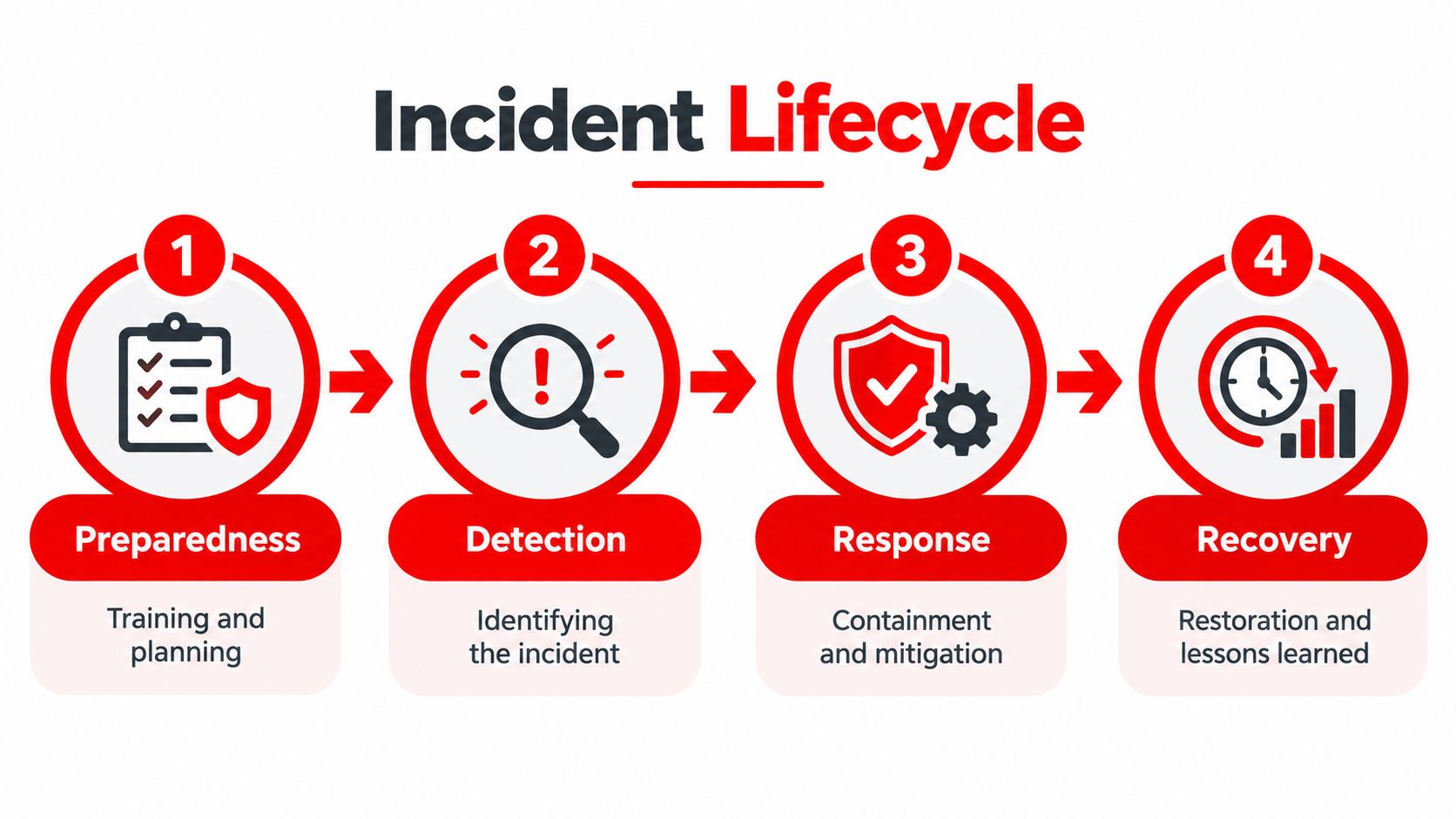
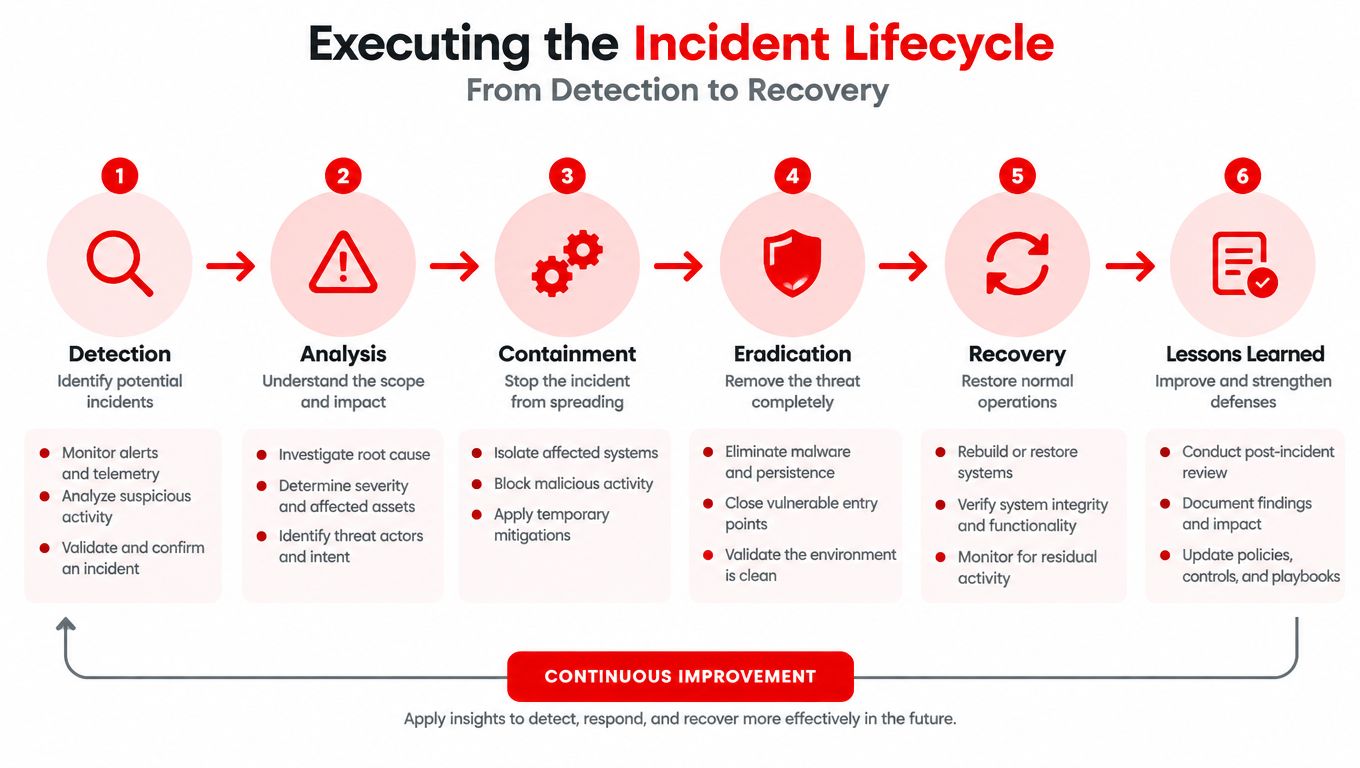
A response becomes manageable when each phase has a defined output. Preparedness creates the conditions for action, detection turns observations into a verified incident, response controls the immediate risk and recovery restores safe operations while capturing lessons.
Preparedness
Start with a site-specific risk picture. List likely incidents, critical assets, vulnerable periods, external agencies, contractors and services that must continue. Record the command structure, emergency contacts, access arrangements and fallback procedures in a format supervisors can use without searching through a long manual.
Prepare a response room or equivalent coordination point. It doesn't need to be elaborate. It needs secure communications, site plans, incident logs, charging capacity, access to relevant systems and a person responsible for maintaining the situation record.
Detection and verification
Frontline staff often detect physical incidents before a central platform does. Gatehouse personnel may notice an unusual delivery, static guards may identify crowd pressure, patrol officers may find a damaged fence and a monitoring centre may receive an alarm. Each observation needs verification without delaying action where life safety is at risk.
Use a simple escalation test:
- Identify: Record the location, time, people involved and immediate hazard.
- Verify: Check the relevant camera, alarm, supervisor report or system alert.
- Classify: Decide whether the event is routine, urgent, critical or potentially criminal.
- Notify: Contact the duty lead and external agency according to the threshold.
- Control: Protect people, restrict access and preserve evidence.
- Recover: Reopen, restore, document and review only after authority confirms conditions are safe.
Response and surge
Containment should match the risk. A retail centre may isolate a tenancy and redirect customers. A construction site may stop work, lock access points and account for contractors. A festival may need crowd movement, medical coordination, traffic control and protection of emergency lanes at the same time.
Surge resources must be arranged before the event. NSW Health's preparedness policy requires documented arrangements for rapid additional resources and the capability to establish a local public health emergency operations centre. It also demonstrates the value of a defined readiness threshold by requiring the capability to set up a mass vaccination clinic within 24 hours.
Recovery and continuity
Recovery isn't just switching systems back on. Confirm that the hazard is controlled, affected areas are safe, records are complete and essential functions can operate. If access control fails, use a controlled manual register. If the normal communications platform is unavailable, move to the fallback channel. If a cyber incident affects booking or payment systems, separate customer safety decisions from technology restoration.
Record the decisions made, not only the final outcome. A post-incident review should identify where information was delayed, where authority was unclear, which resource arrived late and what temporary workaround kept the operation moving.
Navigating Compliance and Reporting Thresholds Across Australia
Australian operators can't rely on one national response script. Emergency management responsibilities are distributed across jurisdictions, and cyber, health, safety, policing and venue obligations may apply at the same time. The operational challenge is to meet reporting duties without allowing paperwork to delay immediate protection of people and property.
Queensland provides a clear example. Its cyber security hazard response plan requires critical cyber incidents to be reported within 12 hours of awareness, written confirmation within 48 hours, and other cyber incidents within 72 hours. The Queensland cyber security hazard response plan creates a hard decision window, so organisations need an internal clock that starts when the incident is identified, not when the investigation feels complete.
Key reporting and compliance thresholds
| Jurisdiction / Framework | Key Requirement or Threshold | Operational Impact |
|---|---|---|
| Queensland cyber security hazard response plan | Critical incidents reported within 12 hours of awareness, written confirmation within 48 hours, and other cyber incidents within 72 hours | Forces early classification, executive escalation and disciplined evidence collection |
| Australian emergency management arrangements | State and territory authorities hold primary response responsibility, with Commonwealth arrangements supporting escalation and coordination | Requires site plans to define agency contacts, command handovers and jurisdictional interfaces |
| NSW public health emergency preparedness | Documented arrangements for rapid additional resources and an operational response centre, with a mass vaccination clinic capability within 24 hours | Requires pre-arranged staffing, space, equipment and escalation pathways |
| Commonwealth cyber posture reporting | Formal plans, logging and reporting controls must operate together | Prevents teams from treating a completed plan or alert as proof of operational readiness |
Build the clock into the workflow
Your incident log should capture the time of awareness, initial classification, decision owner, notifications made and evidence collected. Separate three tracks from the beginning:
- Life safety and physical control: Protect people, control access, preserve emergency routes and request assistance.
- Technical containment: Isolate affected accounts, systems or devices while preserving evidence.
- Compliance and communications: Engage the authorised legal, executive and government contacts.
The Australian Government Crisis Management Arrangements provide a national coordination model that includes a 24/7 National Situation Room, a Joint Crisis Coordination Team and a National Coordination Mechanism. The Australian Government Crisis Management Arrangements show why situation reporting should be structured and timely. A multi-site operator should know which data feeds its internal incident cell and which person can provide a concise update to external authorities.
The trade-off is between speed and certainty. Waiting for a perfect technical diagnosis may miss a reporting threshold. Reporting without basic verification may create confusion. Use staged updates, preserve the evidence behind the initial classification and assign one person to track obligations.
Real-World Deployments for Venues, Sites, and Retail Centres
A festival, a construction project and a retail centre may all need incident response capability, but they don't need identical deployments. The right model reflects movement, access points, operating hours, public exposure, contractor activity and the consequences of stopping work.

Music festival
A festival response model should connect event control, security, medical services, production, transport and the venue owner. Static guards manage assigned zones, while supervisors feed observations into the event control point. K9 units may support screening or targeted searches where appropriate, and VIP protection requires a separate movement and communication plan rather than pulling general security away from crowd-facing duties.
When a crowd surge develops, the first question isn't whether the entire event should close. The incident lead needs accurate information about the location, density, access routes, injuries, barriers and available emergency lanes. A supervisor can redirect personnel, coordinate medical access and request police support while communications staff prepare a controlled public message.
Construction and industrial sites
A high-risk site needs a response model built around changing work fronts. Vehicle patrols can check perimeter integrity, plant areas and isolated storage zones. Gatehouse control verifies workers, visitors, deliveries and contractor access. Supervisors must know how to stop work, account for people and protect evidence after an unauthorised entry, equipment incident or environmental hazard.
The weakest approach is relying on one guard to manage every function. A better deployment separates access control, patrol, incident reporting and site management authority. The site manager decides whether work stops, while security controls movement and preserves the area until the relevant emergency service or investigator arrives.
Retail centres and hospitality venues
Retail and hospitality operations need a customer-aware response. Loss prevention teams may identify theft, fraud or suspicious behaviour, while uniformed officers manage safety and customer movement. During an evacuation, staff need clear instructions about accessible exits, lift restrictions, tenant coordination, reunification and re-entry approval.
A back-to-base monitoring service can verify alerts and triage the response, but it can't replace on-site judgement. The monitoring operator may identify an alarm, the patrol officer may confirm a forced door and the centre manager may coordinate tenants and emergency services. Each role has a different task, and the handover must be explicit.
GM GROUP Services is one example of an Australian provider combining static guards, K9 units, vehicle patrols, covert operations, gatehouse control, loss prevention, back-to-base monitoring and emergency response across NSW, Victoria, Queensland and the ACT. For a venue director, the relevant question isn't the longest service list. It's whether the provider can match licensed personnel, supervision, reporting and escalation to the actual operating environment.
Measuring Maturity and Auditing Team Readiness
Readiness can't be proven by a signed attendance sheet. It should be visible in role competence, recent practice, response records, communication tests and the team's ability to operate when normal systems are disrupted.
The Australian Institute of Health and Safety offers a useful mechanics-based reference. Its Emergency Response Capability Framework requires an Emergency Response Officer to have 12 months full-time equivalent plus 80 logbook hours, while an Emergency Response Leader requires 24 months leadership full-time equivalent plus 160 logbook hours split between ERO and ERL roles. The AIHS emergency response capability framework also requires logged hours, recent experience and verification assessment.
Build a practical readiness matrix
Track each critical role against evidence rather than assumptions:
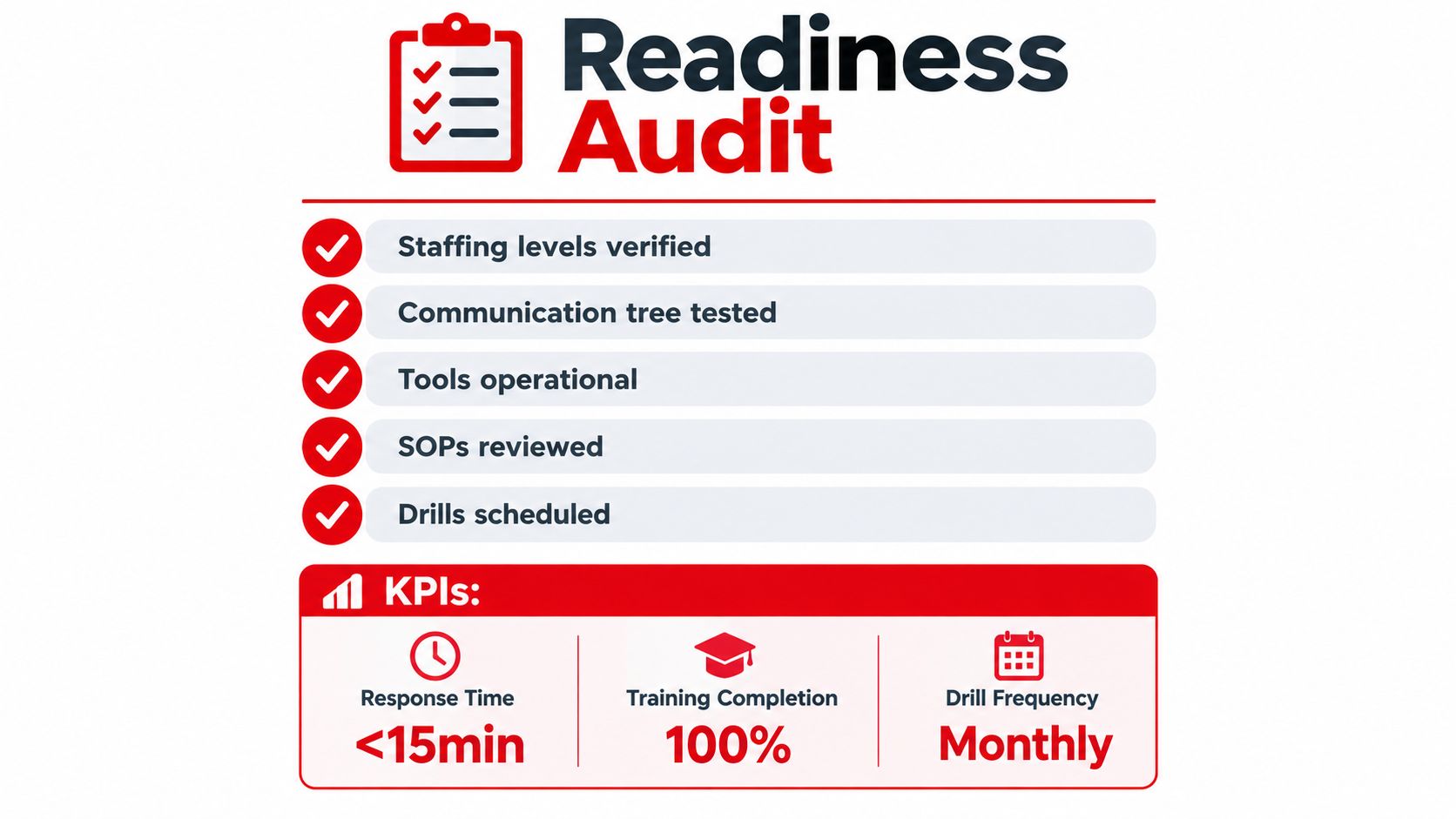
- Role coverage: Confirm primary and alternate personnel for every shift and escalation level.
- Recent exposure: Record the last exercise, incident or supervised response involving each person.
- Communication competence: Test radio procedure, phone escalation, report quality and fallback channels.
- Decision authority: Verify that supervisors know which actions they can authorise and when they must escalate.
- Recovery competence: Check who can reopen an area, restore a service, validate records and approve normal operations.
A useful audit includes an unannounced communication test, a scenario discussion and a review of recent incident reports. Ask a supervisor to describe the first actions after a duress alarm, a cyber alert or a failed access-control system. Don't reward a polished answer if the contact list is outdated or the fallback channel doesn't work.
Audit execution, not paperwork
Review incident reports for missing timestamps, unclear ownership, incomplete handovers and unsupported conclusions. Compare the written procedure with what staff did. If people bypass a step because it slows response, either explain the operational reason or redesign the procedure.
An information-security program can benefit from a structured ISO 27001 compliance roadmap when technical controls, governance and evidence need to align. That roadmap shouldn't replace physical exercises. It should sit alongside site drills, emergency communications testing and supervisor verification.
Capability is demonstrated when a trained person performs the right action with incomplete information, records the decision and hands control to the right authority.
Use audit findings to set priorities. A missing alternate contact may be more urgent than a minor document formatting issue. A supervisor who has completed training but never led a live or simulated response needs supervised practice before being assigned incident command.
Frequently Asked Questions About Incident Response Capability
Who needs to be in the incident command room?
The room should include the people who control the response, the operation and the consequences. That usually means an incident commander, security or site operations lead, communications contact, facilities or IT representative and a senior decision-maker. Add HR, legal, finance, medical, production or tenant representatives when the incident affects their responsibilities.
Keep the group small enough to make decisions. People who only need updates can receive situation reports rather than joining every discussion.
How can a site keep operating when core systems fail?
Prepare manual alternatives before the outage. Use printed contact lists, paper visitor registers, controlled keys, radio procedures, manual payment or booking workarounds where appropriate, and a documented process for reconciling records after restoration.
The response team should decide which functions are essential, which can pause and which can run safely without the affected system. Don't allow staff to create uncontrolled workarounds that compromise evidence or personal safety.
Why do organisations with plans still struggle to report incidents?
Because detection, documentation and reporting are different capabilities. Commonwealth data shows that 90% of Commonwealth entities had an incident response plan and centralised logging, yet only 35% reported at least half of observed incidents to the Australian Signals Directorate. The Commonwealth cyber security posture reporting for 2025 demonstrates that a plan and a log source don't guarantee timely escalation.
Organisations need defined reporting ownership, clear thresholds, trained staff and a process that works when the usual systems are unavailable.
What should be tested before a major event?
Test the contact tree, command handover, radio coverage, alarm verification, emergency access routes, contractor and tenant communications, manual operating procedures and recovery approval. Run a scenario that combines pressures, such as a technical outage during crowd arrival or an evacuation while the normal communications platform is unavailable.
The test should produce actions with owners and deadlines. A drill that generates no corrective work probably wasn't demanding enough.
GM GROUP Services can help venues, event organisers, construction managers and retail operators translate written procedures into coordinated on-site response through risk assessments, trained security personnel, patrols, emergency response, monitoring and reporting across NSW, Victoria, Queensland and the ACT. Review your current escalation paths and response coverage, then visit GM GROUP Services to discuss a fit-for-purpose deployment before the next incident tests it.
Discover more from GM Group Services
Subscribe to get the latest posts sent to your email.