
SEO Title: Incident Command System 7 Practical Wins for NSW VIC QLD Compliance
SEO Meta Description: Incident Command System guidance for Australian events. Learn how to apply AIIMS and ICS roles, IAPs, safety forms, and compliance steps across NSW, VIC, QLD, and ACT.
URL: /incident-command-system-australia-events
Incident Command System planning usually starts when an event team feels the operation slipping from orderly to reactive. Gates are open. One entry lane is backing up. A patron needs medical attention. A bar supervisor has an RSA concern. Production wants a vehicle moved through a pedestrian area. Security is getting radio traffic from three directions at once.
That's the point where good teams realise the problem isn't effort. It's structure.
For private events in Australia, the Incident Command System gives you a way to organise people, information, authority, and decisions before small issues become a bigger operational failure. It's known as a public emergency framework, but in practice it fits festivals, stadium events, corporate functions, licensed venues, and mixed-use sites very well. The reason is simple. It scales.
If you manage events in NSW, VIC, QLD, or the ACT, the core challenge isn't learning doctrine for its own sake. It's turning that doctrine into something your duty managers, security supervisors, bar leads, contractors, and emergency partners can use under pressure.
Your Introduction to the Incident Command System
The Incident Command System matters most when an event still looks manageable from the outside.
A weekend festival can appear calm to patrons while the control room is juggling an intoxication issue near the bar, a missing child report, a vehicle access dispute backstage, and deteriorating weather. None of those issues is automatically catastrophic. Together, without a clean command structure, they can overload supervisors and create contradictory instructions on the ground.
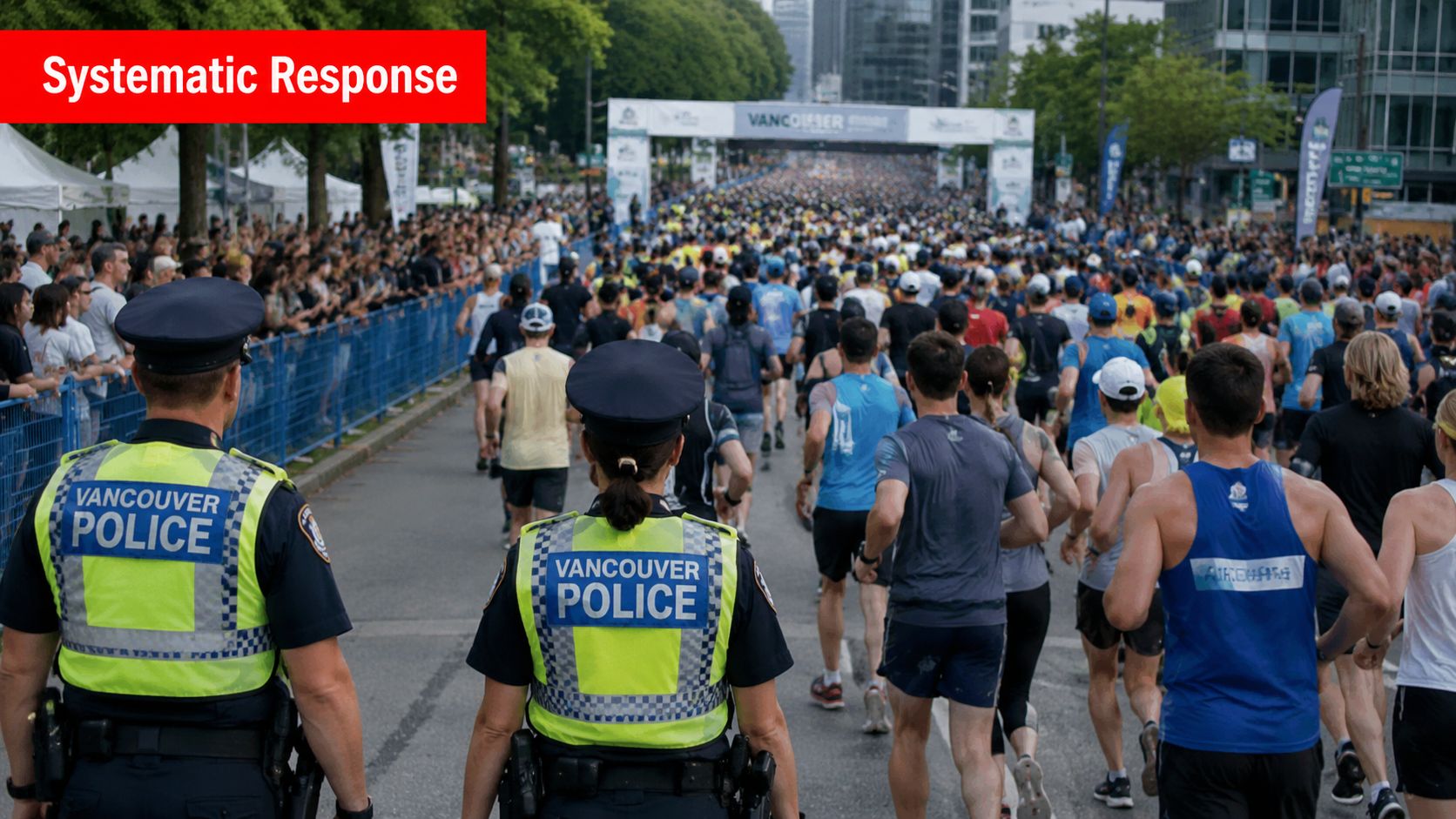
That's why this framework matters for private event management. It replaces ad hoc coordination with designated authority, role clarity, and disciplined reporting lines. In practical terms, that means one person sets priorities, each team knows who it reports to, and operational information moves through a controlled channel instead of bouncing across radios and group chats.
A major reason this remains difficult in the private sector is compliance overlap. A 2024 AESA survey reported that 68% of Australian event security managers are uncertain about aligning frameworks like the Incident Command System with RSA and state security compliance requirements during multi-day events. That finding matches what many operators experience on the ground. They understand emergency response in broad terms, but not how to embed it into licensing controls, crowd management, venue operations, and contractor supervision.
Practical rule: If your event plan only becomes structured after something serious happens, you started command too late.
The point isn't to run a music festival like a bushfire incident. The point is to borrow the parts that work. Clear authority, common terminology, disciplined escalation, and documented actions all translate extremely well to private event security.
What is the Incident Command System
The Incident Command System is a management structure for incidents and operations where multiple people, teams, and agencies need to work from the same plan.
Think of it as the most disciplined version of an organisational chart. It tells people who is in charge, what each function owns, how information moves, and how the structure expands when the situation gets more complex. That matters at events because complexity changes quickly. A routine patron removal can become a medical response, then a police matter, then a media issue if it happens in a public-facing area.
Incident Command System and the Australian context
In Australia, the equivalent doctrine is AIIMS, the Australasian Inter-service Incident Management System. According to the Tasmanian State Emergency Service overview of incident management, AIIMS has been the foundational doctrine for Australian emergency services for over 20 years and was adapted from the US system to provide a standardised approach across all-hazard scenarios in jurisdictions including NSW, VIC, and QLD.
For event operators, that matters because emergency services already understand this style of command. If your private security operation mirrors that logic, police, fire, ambulance, and venue stakeholders can orient themselves faster when something escalates.
The principles that make it useful on site
The framework works because it is:
- Scalable: A small corporate function might need one controller and a few delegated leads. A multi-day festival may need a full structure with planning, logistics, and liaison roles.
- Role-based: Authority sits with positions, not personalities. That avoids the common event problem where everyone calls the most experienced person regardless of who holds the decision.
- Common-language driven: Teams use standard terms for locations, roles, and incident categories. Fewer improvised labels means fewer misunderstandings.
- Objective-led: The command team sets priorities for the operational period. That keeps teams focused on life safety, stabilisation, and continuity rather than chasing the loudest problem.
- Modular: You can add layers as the incident grows instead of inventing a new structure halfway through the day.
The best event command structures feel slightly formal before an incident. That formality is what keeps them useful during one.
What doesn't work is importing government terminology without adapting it. If your team can't connect command language to gates, bars, loading docks, VIP routes, and patron flows, the framework will stay theoretical. It has to be translated into venue reality.
The 5 Key Functions of the Incident Command Structure
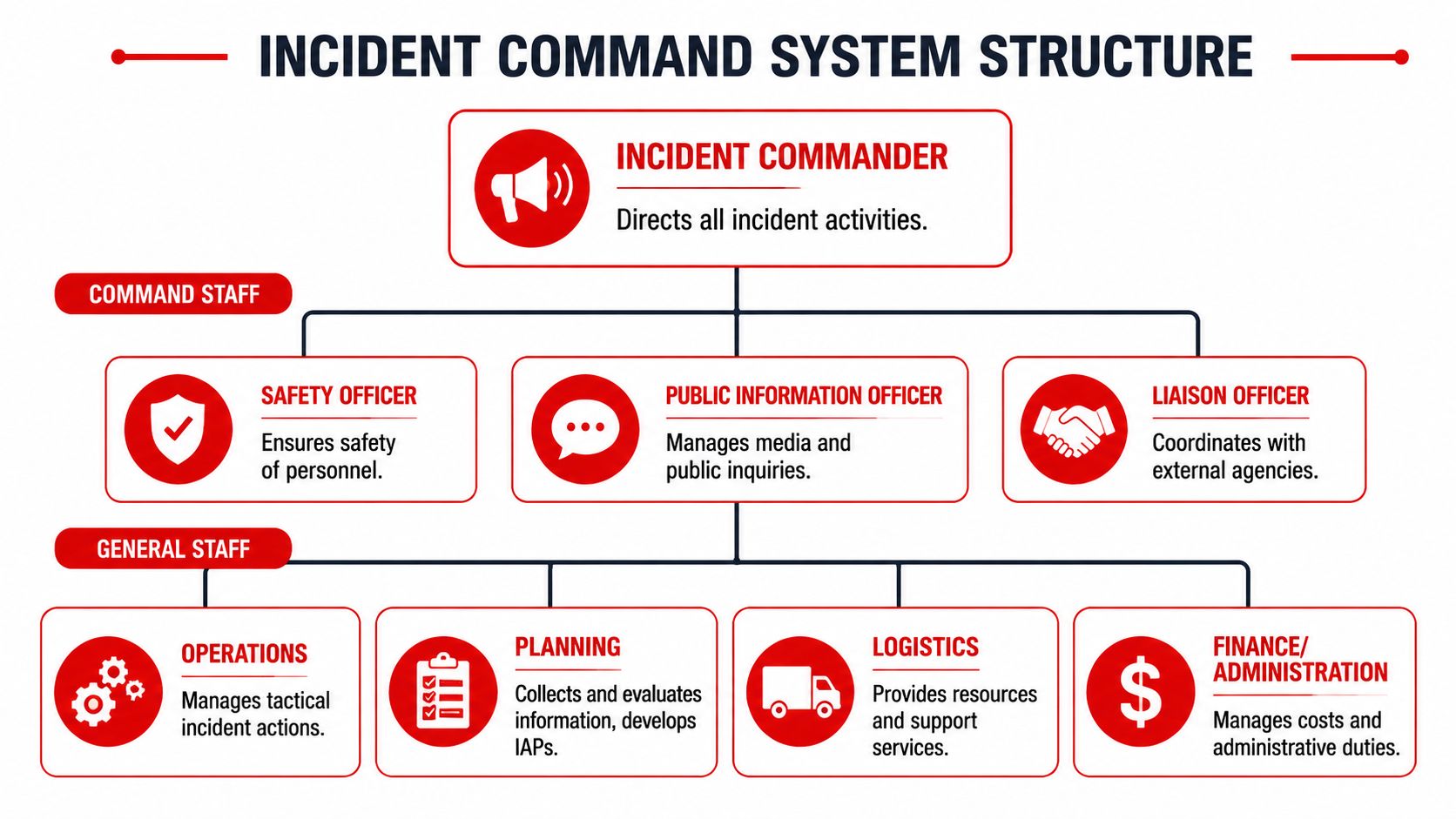
The Incident Command System only works when roles are assigned before the event, accepted by all parties, and backed by authority. The ICS 100 guidance from the USDA states that the system is built around five major management functions: Incident Command, Operations, Planning, Logistics, and Finance/Administration. In an event context, those functions stop overlap and force decisions into the right lane.
Who owns what on an event day
The first mistake many private operators make is blending command with supervision. A strong floor supervisor may be excellent at directing guards, but that doesn't automatically make them the right Incident Commander. Command is about priorities, delegation, external coordination, and decision discipline. Operations is about getting the work done safely and consistently.
The second mistake is leaving planning and logistics underdeveloped. At events, teams tend to overvalue visible security presence and undervalue the back-end functions that keep the response coherent.
| ICS Function | Role | Event-Specific Responsibilities |
|---|---|---|
| Incident Command | Incident Commander | Sets priorities, approves control measures, authorises escalations, manages overall strategy, and maintains the common operating picture |
| Operations | Operations Section Chief | Directs guards, crowd controllers, patrol teams, screening points, response teams, and field supervisors |
| Planning | Planning Section Chief | Tracks incidents, maintains logs, updates risk status, prepares action plans, and monitors forecast issues such as weather or crowd pressure points |
| Logistics | Logistics Section Chief | Manages radios, batteries, barriers, lighting, vehicles, keys, access credentials, welfare supplies, and specialist assets |
| Finance/Administration | Finance/Admin Lead | Records hours, contractor use, damage issues, approvals, cost tracking, and incident-related administrative documentation |
Command staff that private events often overlook
Outside those five functions, event teams should also think carefully about three support roles commonly used in this structure:
- Safety Officer: Reviews hazards, controls risky tasks, and challenges unsafe tactics before they become normalised.
- Liaison Officer: Handles coordination with police, ambulance, fire, venue owners, councils, promoters, and external contractors.
- Public Information Officer: Manages approved outward messaging so staff, patrons, and media don't receive conflicting updates.
In smaller events, one person may hold more than one role. That's acceptable if the workload stays realistic. What fails is assigning multiple titles on paper while expecting one person to perform all of them during a fast-moving incident.
What works and what doesn't
What works:
- Clear delegation: Field teams know whether they report to a zone supervisor, an operations lead, or direct to command.
- Named alternates: Fatigue, breaks, and shift changes happen. Backup role holders keep continuity intact.
- Visible decision logs: If command changes a traffic flow, closes an access point, or escalates a patron issue, that change should be logged and time-stamped.
What doesn't work:
- Radio freelancing: Guards contacting everyone for everything.
- Shadow command: Venue management, production, and security issuing separate instructions to front-line staff.
- Role inflation: Giving people titles without giving them actual authority or information access.
Field note: If your Operations lead is still chasing spare batteries, lost passes, and contractor signatures during peak ingress, Logistics hasn't been properly built.
A practical event structure doesn't need to look bureaucratic. It does need to be deliberate.
Integrating the Incident Command System into Event Operations
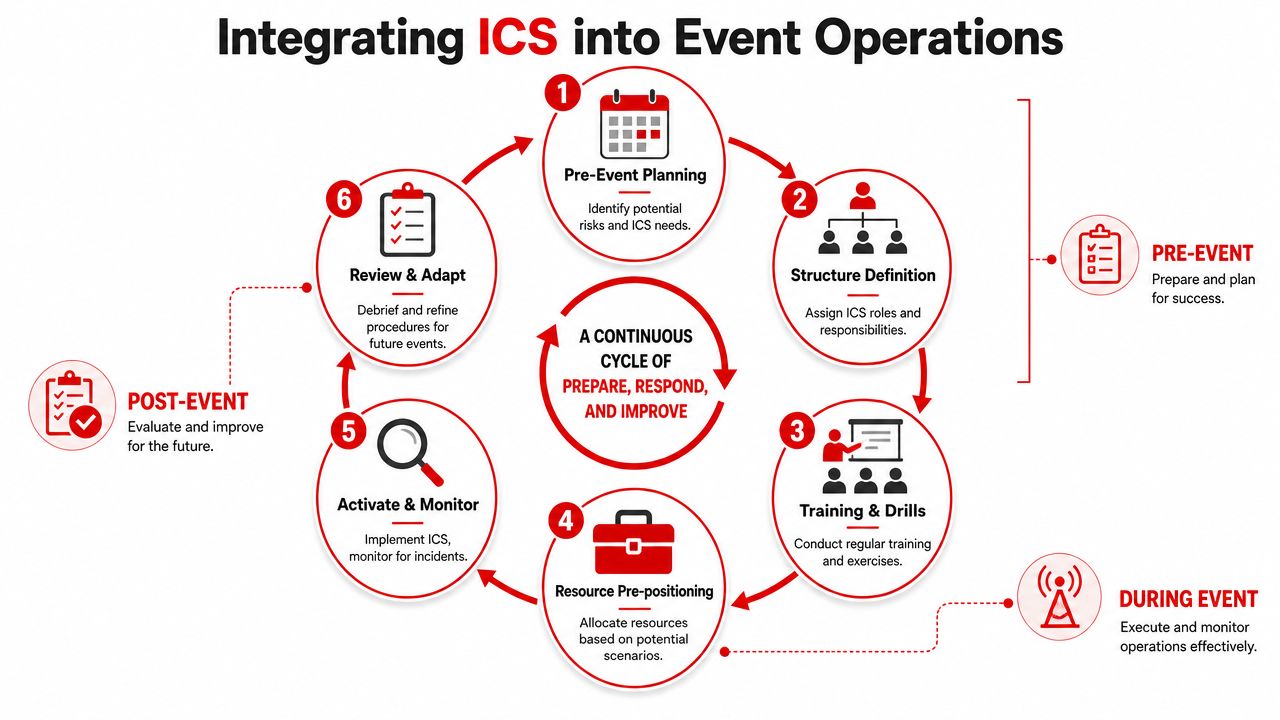
The Incident Command System shouldn't sit in a binder waiting for a crisis. It should shape how the event runs from bump-in to pack-down.
That starts with accepting that event operations are already cross-functional. Security, venue operations, production, bars, medical, transport, cleaning, and contractor management all affect safety. ICS gives those moving parts a shared command logic so that routine decisions and emergency decisions don't happen in separate worlds.
Applying Incident Command System logic to normal event tasks
A practical example is RSA monitoring. At many venues, bar teams handle service decisions while security handles patron behaviour. Problems start when those teams operate on parallel tracks. Under an ICS-aligned structure, Operations coordinates both streams. Bar supervisors report trends such as refusal rates, queue build-up, and patron friction points. Security supervisors report removals, crowd mood, and zone pressure. Command then decides whether to increase presence, alter entry, slow service in a specific area, or involve medical support.
The same applies to artist arrivals, loading dock congestion, queue management, and severe weather decisions. ICS doesn't replace specialist knowledge. It gives specialist teams one place to feed information and receive direction.
Aligning private plans with national practice
The National Incident Centre page from the Australian Government Department of Health, Disability and Ageing describes the national coordination role of the NIC. In that broader Australian context, AIIMS enables agencies, including private security providers, to resolve incidents through an integrated response aligned with national standards.
For venue and festival operators, that alignment is useful even in moderate incidents. It helps when an ambulance crew arrives and wants a clear access route, when police ask who holds command on site, or when multiple contractors need one consistent direction.
A working integration model
Instead of treating ICS as an emergency annex, build it into routine operating rhythms:
- Before doors open: Confirm command roles, reporting lines, radio channels, and trigger points for escalation.
- During operations: Run short situation updates at set intervals. Don't wait for trouble before you establish a common operating picture.
- For issue escalation: Push incidents through the structure. A bar issue that becomes a welfare issue should move through Operations to Command, not sideways through informal contacts.
- At shift changes: Transfer status, open issues, resource gaps, and pending risks in a formal handover.
Teams usually accept this quickly once they see the benefit. Less duplication. Fewer crossed instructions. Faster decisions when the pressure goes up.
Actionable Implementation with IAPs and Checklists
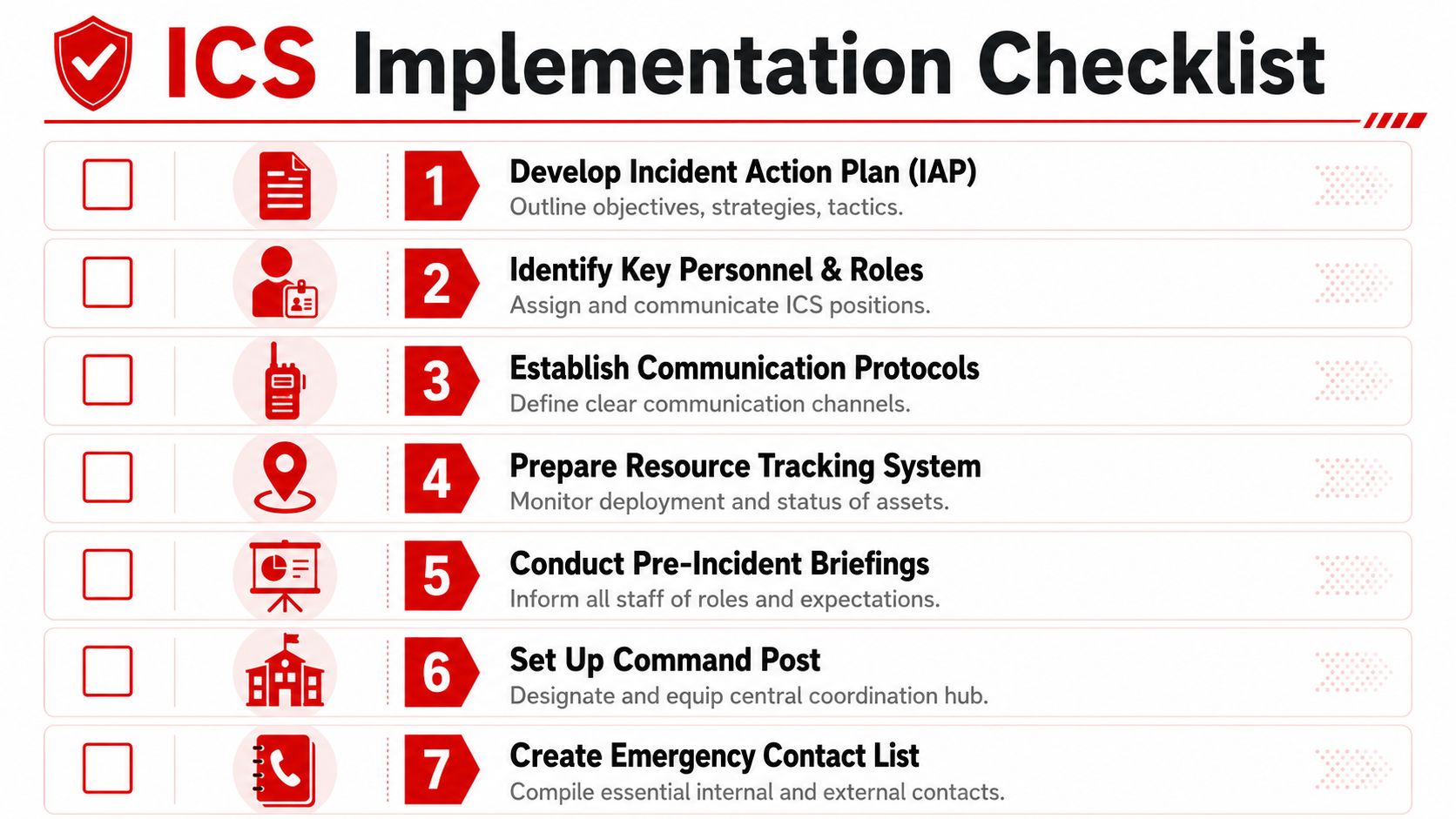
An Incident Command System becomes usable when it is written into an Incident Action Plan, briefed properly, and supported with the right forms.
In event work, an IAP doesn't need to be bloated. It does need to be operational. If a supervisor can't pull the plan and answer who is in command, what the priorities are, where resources are staged, and how escalation works, the document is too vague.
What an event IAP should contain
A practical IAP for a festival, venue, or corporate event should cover:
- Command structure: Name the Incident Commander, Operations lead, safety lead, liaison point, and alternates.
- Operational objectives: Prioritise life safety, site stability, regulated service compliance, crowd movement, and continuity of critical functions.
- Communications plan: Set radio channels, fallback contacts, call signs, and escalation rules.
- Resource status: Identify teams, vehicles, barriers, medical points, screening assets, spare radios, and specialist capability.
- Site intelligence: Include maps, restricted zones, emergency access routes, egress paths, and known pressure points.
- Contingency triggers: Define what causes escalation. For example, crowd surge concerns, weather deterioration, repeated RSA-related removals in one area, or external agency attendance.
- Safety documentation: Capture key hazards, control measures, and briefing points for the operational period.
Why standard forms matter
The documentation side of ICS is often dismissed as paperwork. That's a mistake. Standard forms give command teams a shared operating record, especially when personnel rotate or external agencies step in.
One example is the use of ICS 208 Safety Message/Plan and ICS 215A Incident Action Plan Safety Analysis. The verified benchmark attached to those forms is significant. Australian Safety and Emergency Services Authority reports have been cited as showing a 30% reduction in safety-related incidents at large-scale public events after the adoption of standardised ICS forms such as ICS 208, because they enforce pre-incident safety analysis and auditable documentation.
That doesn't mean the form itself solves the problem. The benefit comes from the discipline it imposes. Teams must stop, identify hazards, assign controls, and make safety part of the plan rather than a verbal afterthought.
Use the form to force the conversation. If a hazard hasn't been written down, briefed, and assigned, it usually hasn't been controlled.
A briefing format that works on real sites
Pre-event briefings should be short, role-specific, and tied to the IAP. A good sequence is:
- State the objective: What a safe operational period looks like.
- Confirm command: Who holds authority and how escalation works.
- Cover priority risks: Crowd, weather, access, intoxication, contractor movement, and medical interface.
- Assign actions: Who does what, where, and with what resource.
- Test understanding: Ask supervisors to repeat key escalation points back.
What doesn't work is reading the whole plan aloud, flooding teams with non-essential detail, or assuming that experienced staff will “figure it out”. Under pressure, people fall back to what was clearly briefed.
Coordinating with Emergency Services and State Compliance
The Incident Command System earns its keep when external agencies arrive and don't have to decode your site.
Police, fire, ambulance, and government stakeholders need to know who is in command, where the command post is, what the current priorities are, and how information is being controlled. If your event structure is improvised, those questions slow the response. If your structure is aligned to AIIMS and ICS logic, they can plug into it much faster.
Why span of control matters
The ICS structure reference on modular organisation states that a supervisor should manage no more than five to seven subordinate units. In practice, that principle is one of the most useful for private events because it reduces communication delays and accountability gaps.
If one security manager is directly handling entry screening, roaming patrols, stage pit response, vehicle control, and intoxication removals, that manager is overloaded before the incident even starts. Add emergency services into the mix and the system jams. Breaking the site into manageable reporting lines fixes that.
Compliance reality in NSW, VIC, QLD, and the ACT
Private event operators in these jurisdictions deal with overlapping duties. Security licensing, crowd control, alcohol service obligations, contractor safety, incident reporting, and venue conditions all sit beside emergency planning. ICS won't replace those obligations, but it gives you a disciplined way to evidence that responsibilities were allocated, decisions were recorded, and risks were actively managed.
That matters after the event as much as during it. If there's a complaint, investigation, injury review, or regulator query, a documented command structure is easier to defend than a series of informal verbal decisions.
For communications resilience, event teams should also review practical radio discipline and fallback procedures. This guide on best practices for resilient comms is useful because the communication problems described in disaster settings often show up in crowded event environments too, just at a smaller scale.
Agencies coordinate better with event teams that can answer four questions immediately. Who is in command, what is happening, what has been done, and what is needed.
Your Incident Command System FAQ
Is the Incident Command System only for major emergencies
No. That's one of the biggest misunderstandings.
The Incident Command System works best when used at smaller scale before a major incident ever develops. A single-site corporate event may only need an Incident Commander, an Operations lead, and one person handling planning and documentation. The value comes from clarity, not size.
How small can an event be and still benefit
If an event has contractors, public attendance, regulated alcohol service, vehicle movement, or multiple service partners, it can benefit from ICS logic. Smaller events don't need a heavy structure. They need a light version with clear command, escalation, and communications.
Do venue managers need formal AIIMS language
Not always in full doctrinal form. Teams should use language they understand. The key is that the underlying structure stays consistent. Roles, reporting lines, objectives, and command transfer need to be explicit even if the terminology is simplified for venue staff.
What technology supports an Incident Command System
Use tools that improve visibility and accountability. Common examples include:
- Digital run sheets: Keep operational periods, timings, and trigger points visible.
- Incident logging platforms: Record decisions, times, and actions in real time.
- Radio fleet management: Maintain channel discipline and spare equipment control.
- Shared mapping tools: Mark medical points, access lanes, exclusion zones, and resource locations.
- Briefing templates: Standardise what every supervisor receives before shift start.
The wrong approach is buying software before fixing structure. Technology helps once responsibilities are already clear.
How do you train staff without overcomplicating it
Start with supervisors and duty managers. Train them on role ownership, escalation thresholds, and handovers. Then brief front-line teams on the reporting line they use.
Short scenario exercises work well. Use realistic issues such as a patron collapse, an RSA refusal turning hostile, a gate queue surge, or a weather interruption. If staff can walk those through using your command structure, the system is becoming real.
What usually breaks first in private event command
Three things tend to fail first:
- Unclear authority: Too many people think they can direct the response.
- Weak information flow: Critical facts stay in silos.
- Poor handover discipline: The next shift inherits risk without context.
Fix those and most event operations become more stable immediately.
If your site team can identify the commander, state the current priorities, and escalate through one clean chain, you're already operating at a higher standard than many private events.
If you need a security partner that can apply structured command thinking in live venues, festivals, hospitality sites, retail environments, and multi-site operations, GM GROUP Services supports organisations across NSW, Victoria, Queensland, and the ACT with licensed personnel, responsive supervision, and fit-for-purpose deployment for complex Australian operating environments.
Discover more from GM Group Services
Subscribe to get the latest posts sent to your email.