
Hotel security procedures become real on a busy Friday night, not when they sit in a policy folder. A guest walks through the lobby, passes reception, reaches the lifts and disappears upstairs. A uniformed officer is nearby, but nobody briefed them on which behaviour to challenge, which doors were restricted or who was authorised to escort contractors after hours. The problem isn't a lack of visibility. It's a missing process.
In Australian hotels, security now crosses physical access, liquor licensing, incident reporting and cyber resilience. The practical question for an operations manager is simple: can every control be followed, checked and handed over cleanly when the shift changes? The seven procedures below are designed for that test.
Why Hotel Security Procedures Matter More Than Visible Guards
A uniformed officer, CCTV monitor and entry signage can deter poor behaviour, but they don't replace documented hotel security procedures. A guard can't enforce a rule nobody has defined, and a camera can't repair an access list that still grants a former contractor entry to the loading dock.
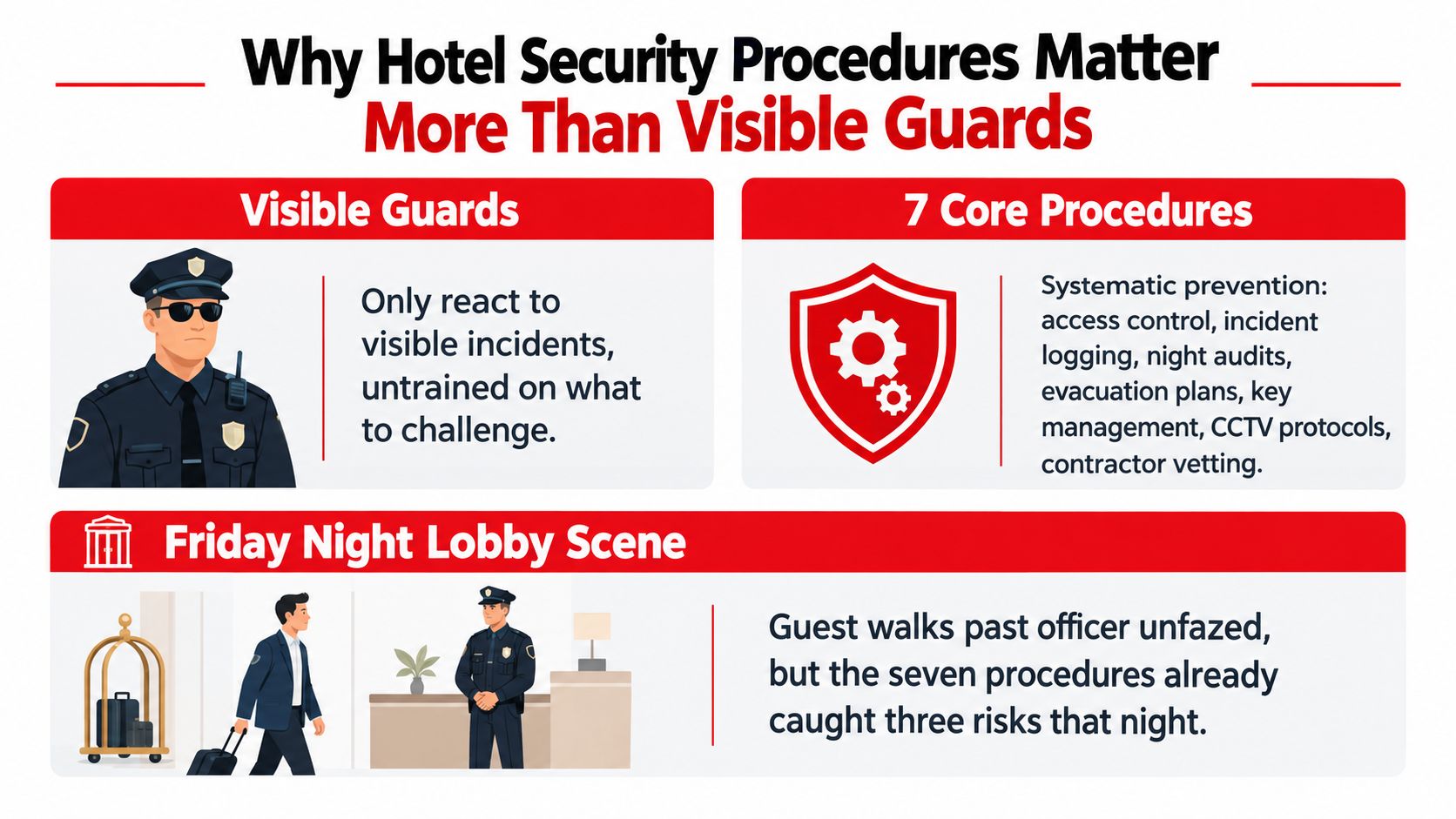
The reliable operating model assigns ownership to each control. Reception verifies identity and credentials. The duty manager reviews exceptions. Security officers patrol defined zones. The night auditor checks access logs, unreturned cards and unresolved incidents. Those tasks survive a shift change because someone records what happened and what still needs attention.
In NSW, liquor licensing makes that discipline more than a preferred operating style. Venue plans commonly require staff involved in alcohol service to hold current RSA certification, with an RSA register kept on-site and current RSA and RCG competency cards available for inspection. Security guards engaged at hotels must hold a current NSW security licence and current NSW RSA certification, provide competency cards to the licensee and wear clearly identifiable security uniform markings, as set out in the NSW venue plan requirements.
The control has to survive the handover
The same principle appears in incident registers, refusal records, CCTV review notes, contractor sign-in sheets and key-card audits. A verbal briefing may cover a problem for one shift, but a written record lets the next manager see the time, location, people involved and action already taken.
NSW's historical licensed-venue experience also shows why procedural controls matter. Reported incidents fell from 1,270 across 48 venues in 2008 to 200 across 14 venues in the later period cited by hospitality coverage, an absolute reduction of 1,070 incidents, or roughly 84%, according to Hospitality Magazine's NSW violent venues coverage. The relevant lesson isn't that one measure solved the problem. RSA enforcement, refusal of entry, intoxication monitoring, CCTV, incident registers and safer departure arrangements worked as a connected operating system.
Practical rule: If a control isn't assigned, recorded and tested, it isn't a dependable control.
A busy night exposes weak ownership quickly. One untested door reader, missing RSA card check or incomplete register entry can turn a contained matter into a licensing concern. Visible guards still matter, but the procedures behind them decide whether the team acts consistently.
Access Control Procedures That Stop Unauthorised Entry
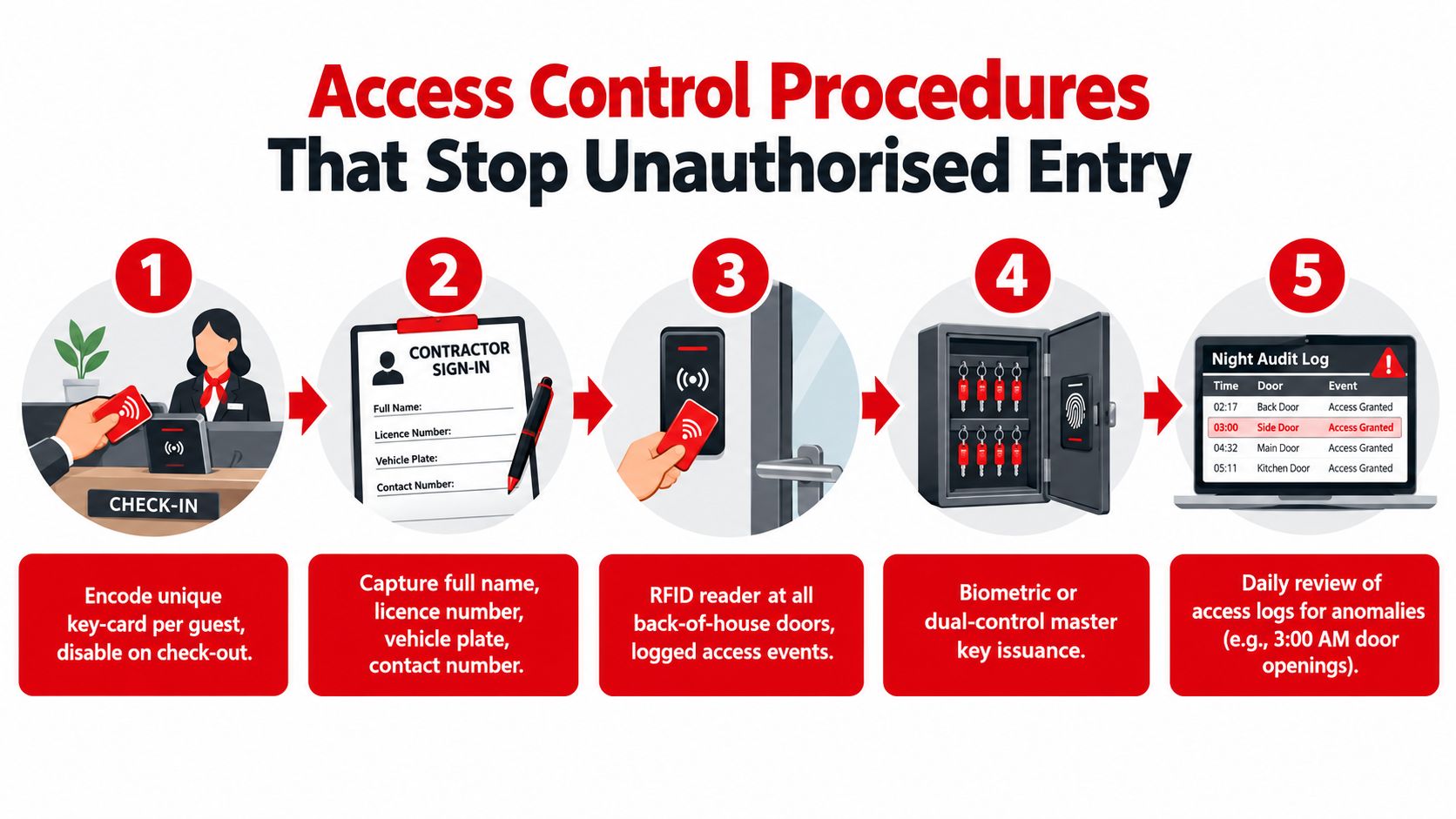
Start with the credential, then follow the person using it. A Sydney hotel plan provides a useful model: each guest receives an RFID key card at check-in, programmed for the allocated floor, room and nominated amenity areas. The card expires at scheduled departure, and Reception can deactivate and replace it if it's lost or stolen, as described in the Sydney hotel access-control plan.
Build the stack from the guest floor backwards
At check-in, encode the card for the correct room and zones. At check-out, confirm the credential expires or is cancelled. When a guest reports a missing card, Reception should deactivate it before issuing a replacement, not print another card and hope the first one never turns up.
Contractors need a separate flow. Capture their full name, licence number, vehicle plate and contact number, record the host employee, issue only the access required for the task and require sign-out. A duty manager should know whether a contractor is escorted, working independently or still inside the building at closing.
Lift zoning should prevent guest cards from opening service, plant, cash-handling or server areas. Between late evening and early morning, set card-only access on designated staff and back-of-house doors, but make sure emergency egress remains lawful and usable. The loading dock deserves particular attention because deliveries, waste removal and maintenance create natural opportunities for tailgating.
For properties with vehicle barriers or restricted service lanes, access control should also cover the approach, not just the building door. A resource on commercial gate access control can help operators think through vehicle permissions, visitor management and audit trails as part of the wider hotel perimeter.
Run a short control test
A duty manager can test the system quickly during a quiet period:
- Tailgating test: Follow an authorised person through a restricted door without presenting a credential. The team should challenge or report the attempt.
- Deactivated-card test: Use a card cancelled after departure or loss. The reader should deny access, and the event should appear in the access log.
- Contractor escort test: Ask the listed host to confirm the contractor's location and task. If nobody can account for the person, the sign-in process has failed.
The night audit should review unusual openings, expired cards still appearing in logs and doors held open outside expected hours. Access events become useful only when someone checks them against occupancy, roster and contractor records.
Front-Desk Verification and RSA Sign-Off Protocols
Reception is the first security control point, even when the team sees its role as hospitality. A front-desk employee decides who receives room access, who can move towards restricted venue areas and whether an intoxication or identity concern reaches the duty manager before it becomes an incident.
Use one repeatable sequence: greet, scan, verify, log, hand over. Greet the guest and establish the purpose of the interaction. Scan or inspect the relevant photo identification, then verify the booking details and the person presenting the request. Log exceptions, refusals, replacement cards and escalation decisions before handing over a key or directing the person elsewhere.
Keep RSA checks connected to the guest journey
For a licensed hotel, the RSA check isn't limited to bar staff. Current RSA certification and competency cards must be verified for staff involved in alcohol service, and NSW requirements also apply to security personnel performing crowd-control functions. The NSW liquor regulation requires crowd controllers and bouncers on or about licensed premises to hold a recognised competency card with a current RSA endorsement. The maximum penalty is 20 penalty units in a prescribed precinct and 10 penalty units otherwise, so contractor verification belongs in onboarding, shift sign-off and compliance audits.
Front desk staff should flag visible intoxication, suspected minors seeking alcohol access and guests declined service. Under the Liquor Act 2007, a refusal involving a minor or intoxicated person needs to be handled according to the venue's approved process, with the refusal and relevant circumstances recorded in the incident or refusal register.
Don't send a clearly intoxicated guest towards an in-house bar without telling the bar or security team. The handover should state the observable behaviour, time and action taken, without unnecessary personal commentary.
Match the role to the area
If a guest is heading to a gaming room, late-night bar or restricted function space, confirm the relevant staff responsibility and licence requirements before access is granted. Security staff must also hold the right NSW security authority for the task. A class 1A security officer is authorised to patrol, protect or guard property while unarmed and to act as a crowd controller or in a similar capacity under the Security Industry Act 1997.
That distinction prevents a common mistake: rostering someone because they're available, rather than because their licence and RSA status match the work. A signed register, visible competency card and clear escalation path give the front desk something stronger than instinct when a difficult interaction develops.
Rostering Security Officers to Match Your Venue
A roster should reflect the venue plan, not merely the number of people available. Sydney planning conditions provide a concrete benchmark for licensed premises: two licensed contract security officers at the main entrance, one licensed contract security officer per 100 persons inside, random vicinity patrols at least hourly from midnight until 30 minutes after closing or until the last patron leaves, and a further continuous patrol from 30 minutes before closure until the last patron leaves or 30 minutes after closing, whichever is later. External patrols must be recorded in the Security/Incident Register Book under the Sydney planning conditions.
The ratio is a floor, not a magic staffing answer. A door officer can't reliably screen arrivals, watch the queue, monitor the toilets and respond to a floor dispute at the same time. Split the assignment before the doors open.
Worked planning examples
For a 250-person hotel venue, the base internal ratio produces three officers when rounded up from the 1:100 benchmark. The planning condition also calls for two entrance officers, so the operational roster needs a door and floor split rather than one blended number. A contingency buffer can be added for absences or concurrent incidents, but it must be treated as an operational planning choice, not a statutory ratio.
For a 600-person nightclub, the same base ratio produces six internal officers before entrance coverage, patrol obligations, late-shift relief or other conditions are considered. The larger footprint also makes zones important: foyer, floor, amenities, smoking area, lift approach and dispersal route need named coverage.
| Venue Capacity | Base Ratio (1:100) | Door + Floor Split | Late-Shift Relief | Total Officers Required |
|---|---|---|---|---|
| 250 patrons | 3 base officers | 2 at entrance, 3 across floor and zones | Add after fatigue and closing review | Base plus approved contingency |
| 600 patrons | 6 base officers | 2 at entrance, 6 across floor and zones | Add after fatigue and closing review | Base plus approved contingency |
Roster against the risk, not the headcount alone
Record the expected peak, entry configuration, gaming or function activity, closing time and dispersal route. If RSA marshals or extra crowd controls apply to the operation, include them in the plan rather than assuming security officers can absorb every duty. Every officer should have a defined zone, radio channel and relief arrangement.
Incident Response Playbook for Hotel Operators
A dispute becomes manageable when the first employee knows what to do. The duty manager's role is to reduce immediate harm, preserve evidence and create a record that another person can understand later.
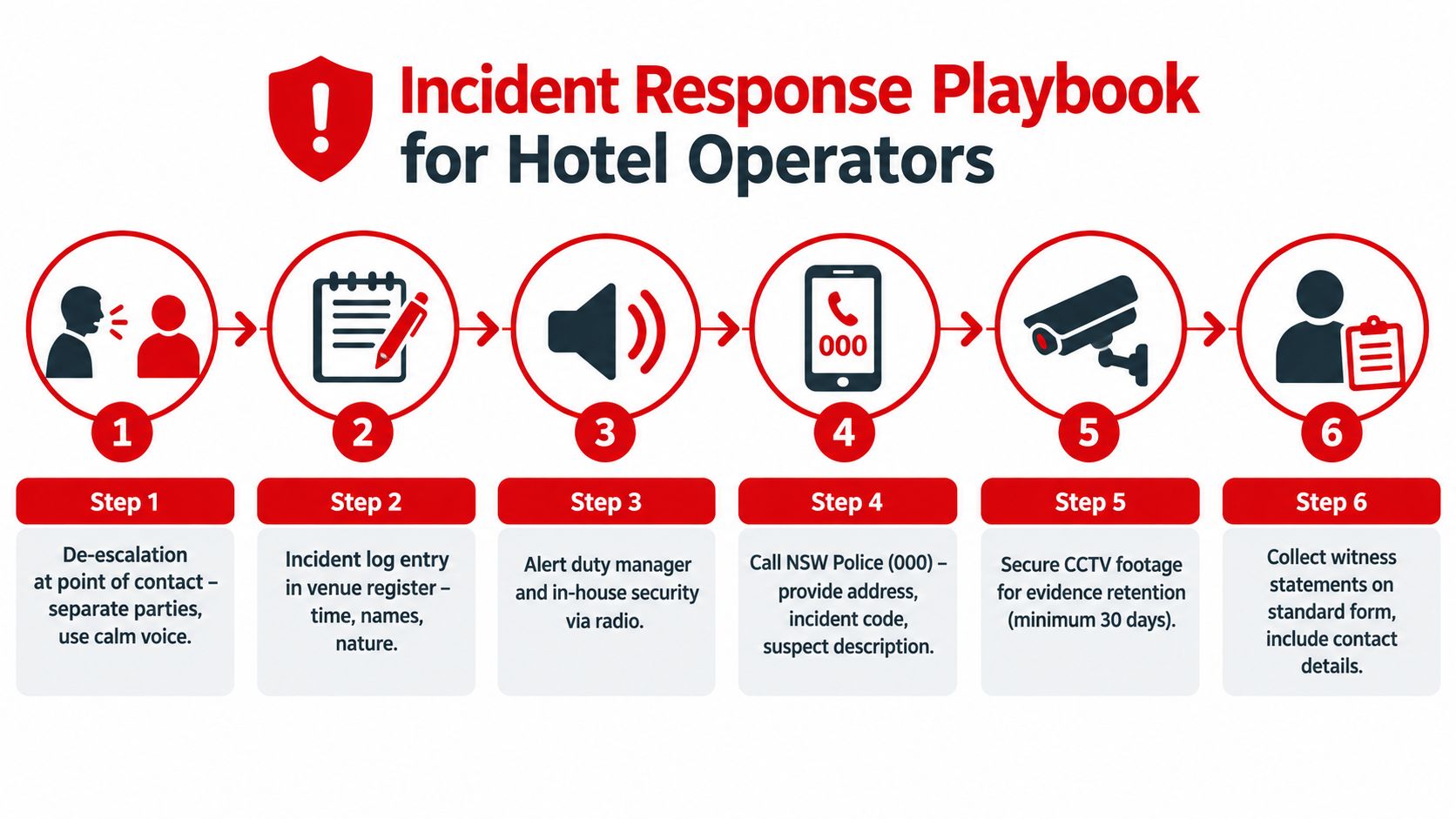
Begin at the point of contact. Separate the parties where it can be done safely, use a calm voice and avoid crowding the person who is escalating. Call in security and the duty manager early if there is aggression, a weapon concern, a medical issue or a threat to staff or guests.
Record facts while they are fresh
The incident register should capture the time, location, people involved, nature of the event, action taken and witnesses. Cross-reference any RSA refusal record, staff report, security notebook entry or CCTV time window. Don't write conclusions such as “bad customer”. Record observable behaviour and the decision made.
Use these checkpoints as internal discipline:
- Within 30 minutes: Stabilise the scene, notify the duty manager, record the initial facts and preserve the relevant CCTV window.
- Within two hours: Obtain witness statements, confirm staff accounts, check whether the event involves RSA refusal or licensing concerns, and decide whether Police or management escalation is required.
- Within 24 hours: Complete the formal review, secure supporting records, identify a procedural failure and assign an owner for corrective action.
Those timeframes are an internal playbook, not a claim about a universal statutory deadline. Emergency danger should never wait for an internal checkpoint. Call 000 when there is an immediate threat to life, serious violence or another emergency requiring Police attendance.
NSW hotel security benefits from the same evidence discipline used in broader licensed-venue controls. Incident registers, CCTV, intoxication monitoring and safer departure arrangements give management a defensible account of what happened and what the venue did next.
Make the follow-up operational
A report that ends with “staff reminded” usually changes little. Specify whether the fix is a roster change, door repair, RSA refresher, lighting adjustment, contractor removal or access-permission review. For wider continuity planning, operators can use LeaveWizard's preparedness checklist to test whether security incidents connect properly to business recovery, communication and delegation arrangements.
Closing the Cyber-Physical Gap in Hotel Safety
A guard can stop an unauthorised person at a door, but they can't see a compromised property-management account creating room credentials from a back-office terminal. CCTV can show who entered the server room, yet it won't prevent a rogue USB device or a stolen administrator password from changing the access-control system.
Australian hotel incidents have made this crossover visible. The 2025 TFE Hotels network disruption and the Fullerton Hotel Sydney breach reportedly involved exposure of passport and driver's licence data. An Australian hospitality cybersecurity report published in 2026 found only 47% of hospitality businesses used unique passwords and 37% had cloud backups, according to AusDataBreach's hospitality breach coverage. Those figures point to an operational weakness, not a purely technical problem.
Treat digital permissions like master keys
Start with controls the hotel can verify:
- Separate networks: Keep guest Wi-Fi away from property-management, point-of-sale and access-control systems. Test that a guest connection cannot reach operational equipment.
- Protect administrator accounts: Require multi-factor authentication for PMS and security-platform administrators. Review the administrator list when people change roles.
- Control physical media: Restrict USB use on front-desk and back-office terminals. Escalate an unknown device rather than plugging it in to identify it.
- Secure surveillance infrastructure: Change default CCTV recorder credentials, restrict remote access and keep the server or network cabinet locked.
- Test recovery: Maintain backups for critical operational data and verify that the team can restore what it needs, rather than assuming a backup exists because a dashboard says “complete”.
A useful CCTV review should link footage to access events, incident times and the relevant zone. Guidance on camera placement, recording architecture and maintenance is available in IT Cloud Global's business CCTV guide, but the operator still owns the daily check.
Audit the crossover: For every physical incident, ask whether a digital account, device, credential or vendor connection could have enabled it.
This approach also improves guest trust. A hotel can keep the lobby welcoming while applying stronger controls behind reception, in lifts, at loading docks and around operational systems.
Your Hotel Security Procedures Checklist and FAQs
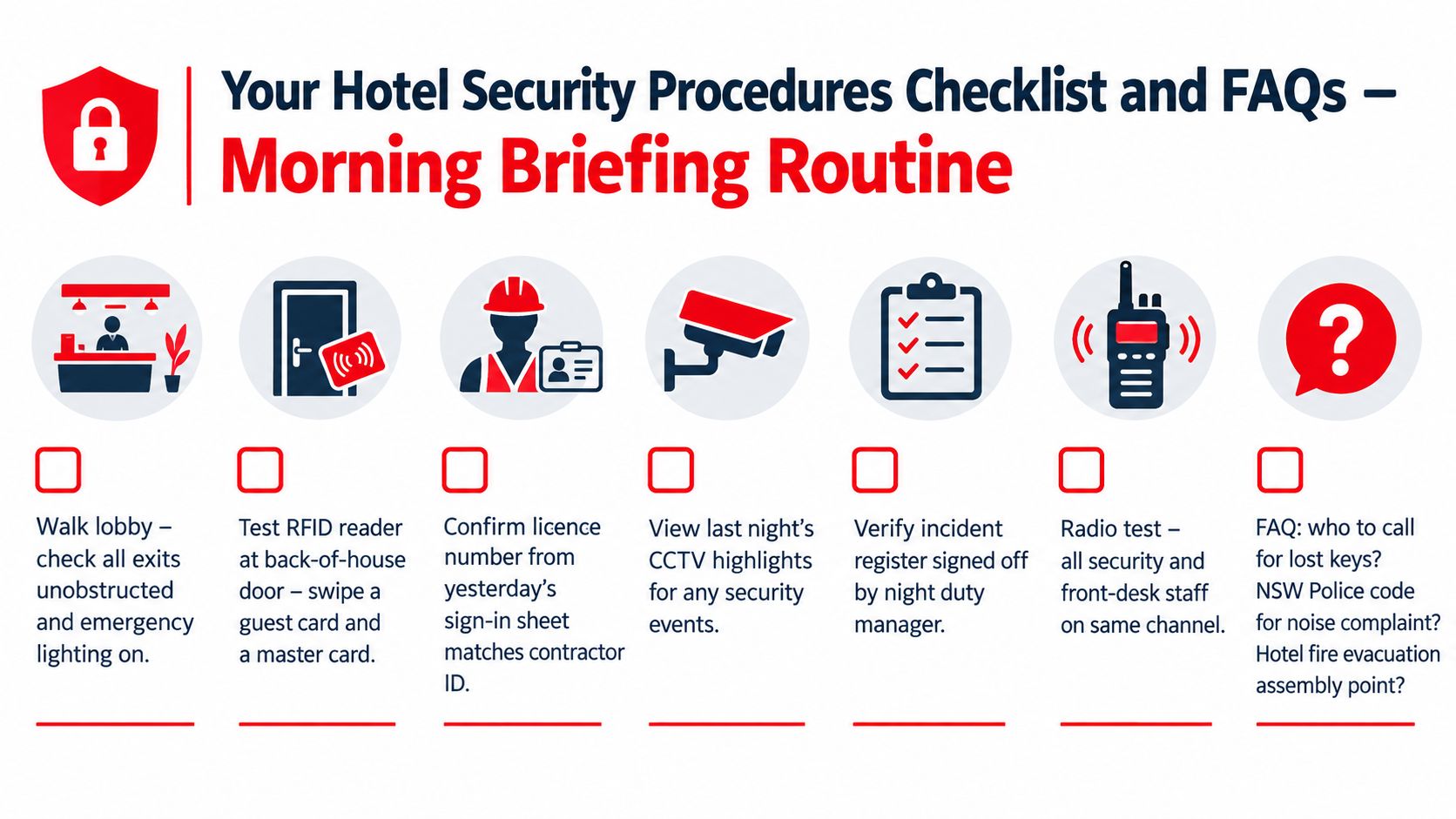
The morning briefing should be short enough to run consistently and specific enough to expose yesterday's failures. Use the property walk as a cross-check, not a ceremonial sign-off.
The one-page morning routine
- Walk the lobby and exits: Check that exits are unobstructed, emergency lighting is operating and sightlines remain clear.
- Test access: Use an active guest card and a master card at the back-of-house reader. Confirm the correct permissions and review any failed event.
- Verify contractor records: Match the licence number on yesterday's sign-in sheet to the contractor's identification and host record.
- Review the incident register: Confirm the night duty manager signed off entries, attachments and outstanding actions.
- Check the roster: Compare tonight's expected covers, venue zones, door assignments, patrol requirements and relief arrangements.
- Spot-audit CCTV: Review the previous night's relevant footage for access events, disputes, propped doors or unexplained movement.
- Check cyber alerts: Skim the security dashboard, failed logins, backup status and vendor notifications before service begins.
Frequently asked questions
Who keeps the incident register?
The licensee or venue operator should nominate a responsible manager, with each shift completing entries and the duty manager reviewing them. Security officers should provide their records to the venue rather than keeping the only account in a personal notebook.
How long should NSW venues retain CCTV footage under Liquor & Gaming NSW guidance?
The required retention period depends on the venue's licence conditions, plan and applicable guidance. Confirm the current requirement directly with Liquor & Gaming NSW and set the recorder policy to preserve footage for the required period. Don't rely on a generic industry setting.
What training certificate does RSA need?
Staff and relevant security personnel need current NSW RSA certification or endorsement where the licensing requirements apply. Keep the RSA register current and make competency cards available for inspection.
When does a 1:40 patron-to-guard ratio trigger a second officer?
A 1:40 ratio is not the Sydney planning benchmark stated above. Staffing depends on the applicable planning condition, licence, venue layout, duties and risk assessment. If one officer can't cover the door and floor safely, roster another officer regardless of a simple ratio.
Will cyber insurance cover a POS breach?
Not automatically. Coverage depends on the policy wording, exclusions, security warranties, notification duties and the cause of the breach. Ask the insurer or broker to confirm whether POS, privacy, business interruption and forensic costs are covered.
How often should access permissions be audited?
Audit access lists and logs on a scheduled basis, and immediately after staff departure, contractor completion, lost credentials or a suspected compromise. The important point is that the review must produce an action record, not just a tick.
Printable summary: Walk the property. Test the doors. Verify RSA and contractor records. Confirm the roster. Review incidents and CCTV. Check cyber alerts. Assign every exception to a named manager before service starts.
GM GROUP Services provides licensed security personnel, venue patrols, access and gatehouse control, incident reporting, emergency response and risk assessments across NSW, Victoria, Queensland and the ACT. For a hotel-specific deployment that balances visible reassurance with RSA-compliant, zone-based procedures, visit GM GROUP Services and discuss your property, trading hours and current control gaps.
Discover more from GM Group Services
Subscribe to get the latest posts sent to your email.