
When you need to hire security for an event, your first job is to get a crystal-clear picture of your risks. This isn't about ticking boxes; it's about building a solid foundation for your entire security plan. Getting this right from the start is what separates a successful, safe event from a potential disaster. A well-thought-out security strategy ensures your guests have a great experience while being protected.
Start with a Smart Event Risk Assessment
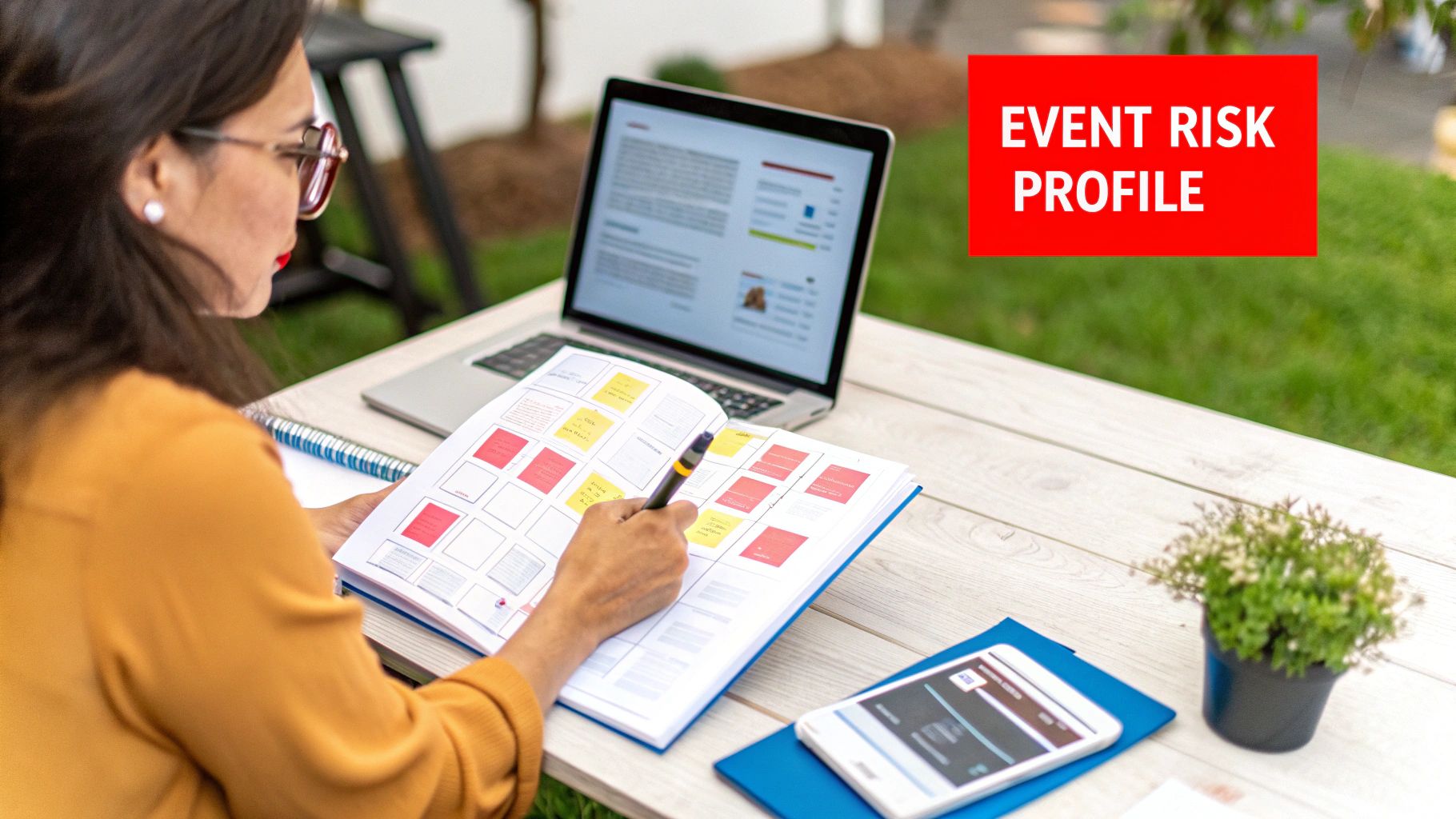
To effectively hire security for an event, you first need a detailed risk profile. Think of it as the strategic blueprint for every security decision you'll make, from how many guards you need to the specific skills they should have. An intimate corporate dinner in a secure Melbourne laneway venue has a completely different risk profile than a sprawling, multi-day music festival in regional NSW.
By thinking through what could go wrong ahead of time, you shift from being reactive to proactive. This process forces you to spot vulnerabilities you might otherwise miss—the poorly lit car park, an unsecured service entrance, or that tricky bottleneck where crowds will jam up between stages.
Identifying and Profiling Your Event's Risks
You need to dive deep into the specific details of your event. A generic template just won't cut it. Your assessment has to be tailored to your venue, your audience, and the nature of the gathering itself.
Start by asking these critical questions:
- Event Type: Is it a black-tie corporate gala or a high-energy concert? The presence of high-profile guests, valuable equipment, or alcohol completely changes the game. Actionable Insight: For a high-end charity auction, asset protection becomes a top priority. For a music festival, crowd management is paramount.
- Audience Demographics: Who's coming? A family-friendly community fair poses a much lower risk than an 18+ electronic dance music event. Consider the crowd size, age, and general temperament.
- Venue Layout: Walk the site. Map out every single access point—main entrances, loading docks, staff doors, and emergency exits. Are there blind spots your venue's CCTV doesn't cover? Practical Example: A venue with multiple, unmonitored entry points requires more static guards than one with a single, controlled entrance.
- Location Context: Where is it? An event in a known trouble spot has different needs than one in a quiet suburb. Look at its proximity to pubs, clubs, or public transport hubs that might affect how people arrive and leave.
A thorough risk assessment is the most critical investment you can make in your event's safety. It transforms your security spend from a generic expense into a targeted strategy, ensuring every dollar is allocated to mitigating a specific, identified threat.
This simple three-step process is a great way to structure your thinking.
Following this flow—identifying what could happen, figuring out how likely and severe it is, and then focusing on the big stuff first—gives you a clear roadmap for your security planning.
To get you started, here's a quick checklist covering the key areas to evaluate when you're profiling risks.
Quick Risk Assessment Checklist for Event Planners
| Risk Category | Key Considerations | Example Threat |
|---|---|---|
| Crowd Management | Attendee numbers, demographics (age, sobriety), entry/exit flow, potential for overcrowding or crushing. | A "gate-crashing" attempt at a ticketed music festival. |
| Venue Security | Perimeter fencing, lighting, access control points, CCTV coverage, existing venue security staff. | Unauthorised access through an unmonitored service entrance. |
| Asset Protection | High-value equipment (AV, staging), cash handling points, merchandise stalls, guest valuables. | Theft of cash from a bar or merchandise stand. |
| Medical & Emergency | Proximity to hospitals, on-site first aid capacity, fire hazards, evacuation routes. | A medical emergency (e.g., heatstroke) in a dense crowd. |
| Behavioural Issues | Alcohol/drug consumption, potential for fights or anti-social behaviour, known rival groups attending. | Alcohol-fuelled altercation between two patrons. |
| External Threats | Proximity to high-crime areas, local protests, traffic congestion, severe weather forecasts. | An approaching electrical storm at an outdoor event. |
This is just a starting point, but it helps frame your thinking around the diverse range of potential issues.
Classifying and Prioritising Threats
Once you've listed out everything that could go wrong, it's time to sort through it. A practical way to do this is to score each risk based on its likelihood (how probable is it?) and its potential impact (how bad would it be?).
A risk matrix is a brilliant tool for this. For example, a bit of petty theft might be highly likely but have a low overall impact. On the other hand, a stage rush is far less likely but would be absolutely catastrophic if it happened.
This prioritisation is where the magic happens. It focuses your budget and attention squarely on the threats that matter most. When you finally go to hire security for an event, this detailed profile becomes your most powerful asset. Instead of vaguely asking for "ten guards," you can confidently request a team specifically briefed and equipped to handle the exact risks you’ve identified. That's how you get an effective and cost-efficient security solution.
How to Hire Security for an Event: Choosing the Right Mix of Services
Once you’ve got your risk assessment sorted, the next step is turning that plan into a team on the ground. When you hire security for an event, it’s easy to feel overwhelmed by the options. But remember, a one-size-fits-all approach is a recipe for disaster. You wouldn't bring a VIP protection detail to a local fete, and a single static guard isn't going to cut it for a sold-out concert.
The real skill is in building a layered, intelligent security plan that directly counters the specific threats you’ve identified. This is about more than just putting bodies at doors; it’s about strategically deploying different specialists to create a complete safety net. Think of it as creating a team where each player has a crucial role, and their combined effort is what makes your event truly secure.
Core Security Roles and When to Use Them
First up, you need to know who’s on the roster. Getting familiar with the different security roles is like a casting call – you need to pick the right person for each part. A solid plan almost always involves a clever mix of these core services.
Here are the primary players you’ll be working with:
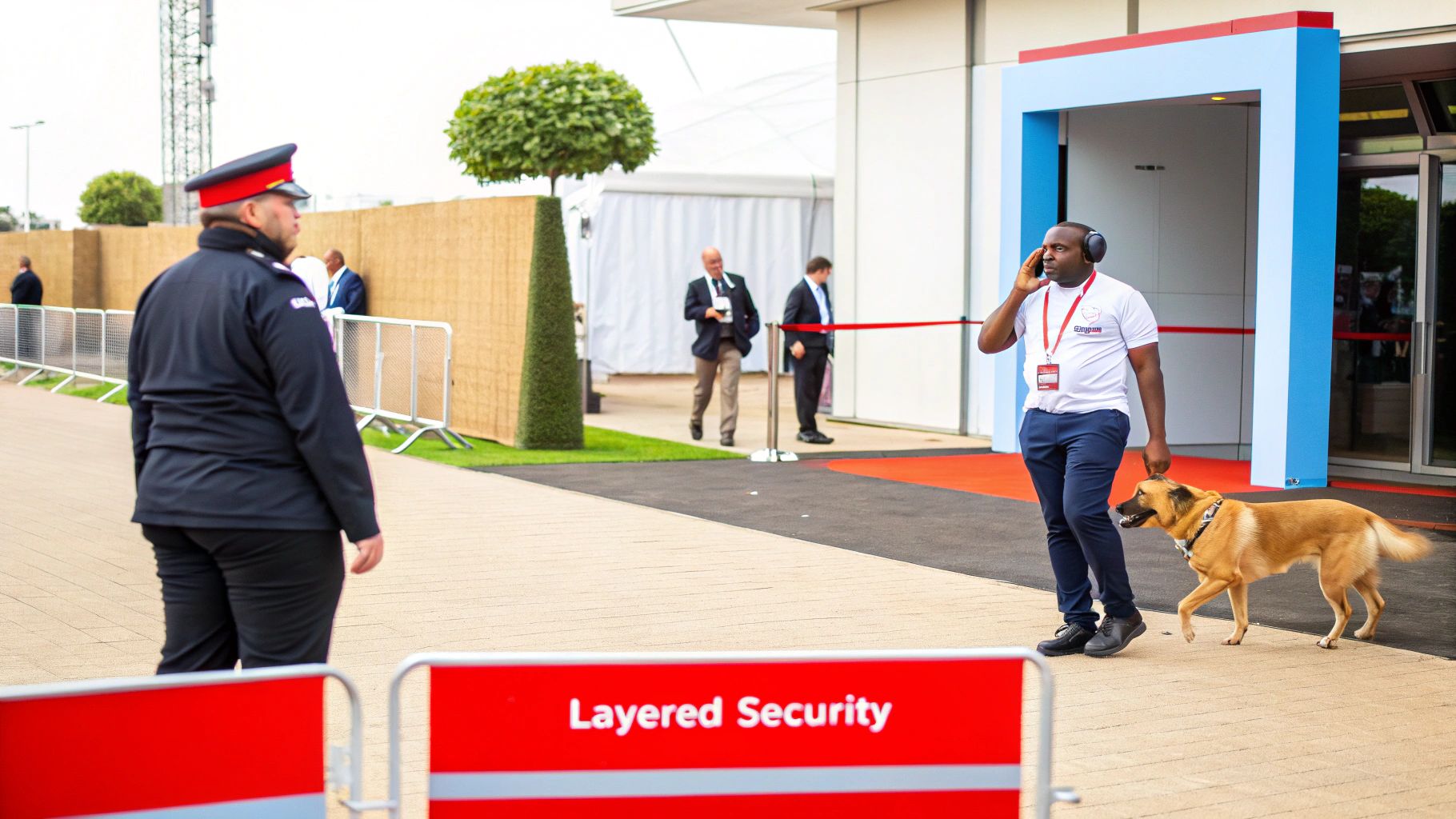
- Static Guards: These are your anchor points. You’ll position them at entrances, exits, and key access points to handle access control, scan tickets, and act as a visible deterrent. They’re the backbone of managing guest flow and securing your perimeter.
- Crowd Controllers: These officers are much more dynamic. Trained in crowd psychology and de-escalation tactics, they actively patrol through crowds, watch for behavioural red flags (especially where alcohol is involved), and are your first line of response for any minor disputes.
- K9 Units: Bringing in a security dog and its handler gives you a unique edge. Their incredible sense of smell makes them highly effective for sniffing out prohibited items, and their sheer presence is a powerful psychological deterrent against trouble. They’re a fantastic asset for large festivals or high-risk events.
- Covert Operatives (Plain Clothes): These officers are your eyes and ears inside the crowd. By blending in, they can spot professional thieves, drug dealers, or anyone planning to cause a scene long before it happens. They feed crucial intelligence back to the uniformed team.
- VIP Protection (Bodyguards): If you’ve got high-profile guests, artists, or speakers, close personal protection is non-negotiable. These specialists focus entirely on the safety of their designated principal, managing their movements and locking down green rooms or private areas.
Building a Layered Security Plan
Now, let's put it all together. A layered approach simply means combining these services to cover all your bases, creating overlapping fields of responsibility. The idea is that no single point of failure can jeopardise your event's safety.
A layered security strategy is more than the sum of its parts. By combining visible deterrents like uniformed guards with the subtle oversight of covert operatives and the specialised skills of K9 units, you create a security presence that is both robust and adaptable to any situation that arises.
Let's look at how this plays out in two very different real-world scenarios:
- A Corporate Product Launch: Here, the main risks are managing the guest list and protecting valuable assets. Your security plan would lean heavily on static guards at the entrance, supported by a few covert operatives mingling to protect valuable prototypes from theft or corporate espionage.
- A Multi-Stage Music Festival: This is a whole different beast. You’d need static guards at every gate, a large team of roaming crowd controllers, K9 units at key entry points for detection, and a dedicated VIP protection team for your headline acts.
This kind of strategic deployment ensures you’re spending your budget where it matters most. For more complex events, you might also look at integrating intelligent security systems and smart surveillance. This is where a professional security partner really proves their worth.
Australia's private security industry is massive—the Investigation and Security Services sector is projected to hit $13.9 billion in revenue by 2025. This market, which is significantly larger than the police and defence forces combined, shows just how much expertise is out there.
Get Your Head Around Australian Licensing and Compliance
When you hire security for an event, you're not just getting a person in a uniform. You're bringing in a professional service that’s heavily regulated by state-specific laws. In Australia, security isn't a one-size-fits-all game. Each state and territory plays by its own rulebook, and getting it wrong can land you in hot water with fines and legal dramas that could derail your event and tarnish your reputation.
Think of it this way: checking a security provider's credentials is just as crucial as the risk assessment you spent hours on. It's not just bureaucratic box-ticking. It’s a fundamental step to protect your guests, your team, and your own liability.
Why Licensing Is a Non-Negotiable
At its core, all this regulation is about public safety. A properly licensed security professional has been through the wringer—background checks, mandatory training in de-escalation, first aid, and a solid understanding of their legal boundaries. Hiring an unlicensed operator is like hiring a sparky who isn't certified. You're just asking for trouble.
Any legitimate security company must hold a Master Licence (or an equivalent business licence) for the state they're working in. On top of that, every single guard they send to your event needs their own personal security licence, specific to the job they'll be doing.
A Quick Guide to State-by-State Licence Classes
The rules aren't the same across the board, so you need to know what to look for depending on your event's location. A company might be fully licensed in NSW, but that means nothing if your conference is in Melbourne.
Here’s what you need to verify on the east coast:
- New South Wales (NSW): Guards need a Class 1 licence. This is then split into subclasses like 1A (Unarmed Guard), 1B (Bodyguard), and 1C (Crowd Controller). For almost any event, you’ll need guards with the 1C crowd control endorsement.
- Victoria (VIC): The key licences are 'Security Guard' and 'Crowd Controller'. If your event involves checking IDs, monitoring behaviour, or asking disruptive people to leave, you absolutely must have personnel licensed as Crowd Controllers.
- Queensland (QLD): Much like NSW, QLD issues a 'Security Officer Licence' with endorsements for specific functions. For events, the 'Crowd Controller' function is the one you need to see on their licence.
- Australian Capital Territory (ACT): In the ACT, look for a 'Security Employee Licence' with the right endorsements, specifically 'Crowd Control' for event-based roles.
Actionable Insight: When you're vetting a security provider, don't just take their word for it. Ask to see a copy of their Master Licence for your state. Then, get confirmation that all guards assigned to your event will have the correct individual licence class for the tasks you're giving them. A pro company will have this information ready to go.
The Other Essential Certifications
A security licence is just the entry ticket. A truly professional team comes with other critical qualifications that directly impact safety and compliance, especially if you're serving alcohol.
There are two certifications that I consider absolutely essential:
- Responsible Service of Alcohol (RSA): This is a legal must-have. Any security guard working near a bar or licensed area needs a current, state-specific RSA certificate. It proves they can spot and manage intoxicated patrons, which is a massive part of event security.
- First Aid Certification: At the very least, a good chunk of the security team should hold a current 'Provide First Aid' certificate (the code is HLTAID011). In a medical emergency, a security guard is often the first person on the scene. Their ability to act quickly and confidently can literally save a life.
Ultimately, sorting out the compliance side of things comes down to asking the right questions upfront. Before you hire security for an event, see how a provider responds to your requests for licensing and insurance details. Their transparency is the best sign you've found a professional who takes safety and the law as seriously as you do.
Getting Your Security Brief Absolutely Right
You've waded through the licensing and compliance checks, which is a huge step. But now comes the part that often separates a smooth operation from a chaotic one: translating all your plans into a crystal-clear document for your security provider.
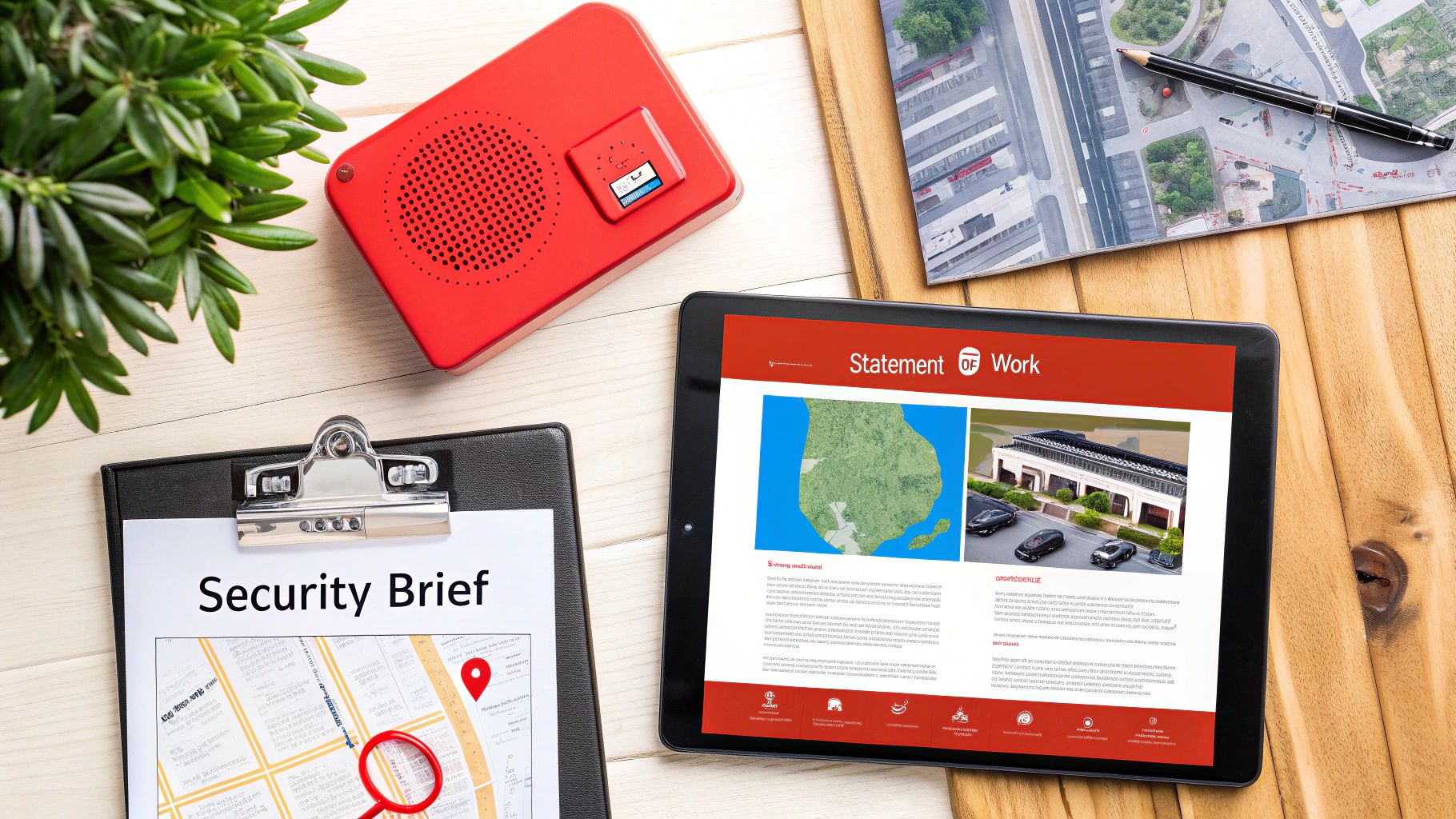
Too many event organisers trip up here. A quick phone call or a vague email chain just won't cut it. You absolutely need a detailed security brief and a Statement of Work (SOW). Think of it as the ultimate source of truth for your security team, the one document that spells everything out so there’s no room for error when you hire security for event staff.
This isn't just about ticking a box. A solid brief is what makes the difference between a security team that feels like a natural extension of your own crew and one that just seems to be in the way.
The Must-Have Components of a Security Brief
An effective brief leaves nothing to chance. It needs to be a practical, easy-to-digest guide that lays out every single one of your expectations. If you need some guidance, understanding best practices for crafting an effective event brief can really help sharpen your approach.
Here’s what I always insist on including in mine:
- A Granular Event Timeline: Don't just list the start and finish times. Include bump-in and bump-out schedules, when vendors are due, sound check timings, and the arrival windows for key talent or VIPs. The more detail, the better.
- Marked-Up Venue Maps: A clean floor plan is a start, but a marked-up one is gold. Clearly highlight all entrances and exits, first aid posts, VIP areas, places where cash is handled (like bars and merch stands), and of course, the emergency assembly points.
- Specific Duties for Each Position: This is critical. "Guard at Door 1" is useless. Instead, get specific: "Guard at Main Entrance is responsible for ticket scanning, conducting bag checks for prohibited items (list attached), and managing the guest list for the VIP arrivals."
- A Clear Chain of Command: In the heat of the moment, everyone needs to know who’s in charge. Your brief should map out who the on-site security supervisor reports to on your team, and also clarify the security team's internal hierarchy. When things go sideways, you need to know who makes the final call.
Looking Beyond the Price Tag When You Hire Security for Event Teams
Once the quotes start rolling in, the temptation to jump on the cheapest one is strong. Resist it. From my experience, this is almost always a mistake that costs you more down the track. You're not just hiring a contractor; you're bringing a partner into your event ecosystem.
A cheap hourly rate is often a massive red flag. It can point to undertrained staff, questionable insurance coverage, or non-existent management support. Any of those can blow up in your face and lead to incidents, reputational damage, or even legal trouble.
Instead of fixating on the dollar amount, you need to be assessing the operational depth and professionalism of the companies you're considering.
How to Evaluate Quotes and Find a True Partner
To really get a feel for a provider, you have to dig a bit deeper than the quote they send over. This is how you figure out if they can actually deliver when it matters. Any quality provider will have no problem answering these questions.
Here’s the checklist I use to vet potential partners:
- Ask for Relevant Case Studies: Request examples of events they’ve handled that are similar in size and scope to yours. A company that excels at large-scale music festivals is a completely different beast to one that mostly does small corporate gigs.
- Check Their References: Don't just settle for the testimonials on their website. Ask for actual, contactable references from past clients. A quick call can give you honest, unfiltered feedback on their real-world performance.
- Review Their Management Structure: Who will be your point of contact on the day? Will there be a dedicated on-site supervisor managing the team? A solid management structure means clear communication and accountability.
- Examine Their Reporting Process: Ask to see a sample incident report or a post-event summary. A professional outfit will have standardised, detailed reporting procedures for everything from a minor slip-and-fall to a major security issue.
Following these steps ensures the company you ultimately hire security for event services is a genuine partner who is as invested in your event's success as you are.
Getting On-Site Security Management Right
The real test of your security plan begins when the guards hit the ground. All the paperwork in the world means nothing without sharp, decisive on-site management. The choices you make on the day are what turn a solid plan into a seamless operation. When you hire security for an event, your goal is to have a team that operates as one cohesive unit, from the moment the gates open until the last piece of equipment is packed away.
This is about more than just handing over a brief. It’s about active, real-time leadership that bridges the gap between your meticulous planning and a safe, successful event.
The Pre-Event Briefing: Your Final Huddle
First thing on event day, get your security supervisor and key team leaders together for a comprehensive pre-shift briefing. This isn’t a quick "g'day"; it's your final chance to align everyone and set the tone for the entire shift.
Here’s what this meeting needs to cover:
- Do one last walkthrough of the venue, physically pointing out any last-minute layout changes or potential trouble spots.
- Clearly define the chain of command. Who is the primary point of contact on your team? Who do the guards report to?
- Revisit the key risks you identified in your assessment and connect them to specific guard posts. Make sure every guard understands why they are positioned where they are.
The pre-event briefing is where you turn a group of individual guards into a unified team with a single mission. It ensures everyone, from the supervisor to the guard at a quiet side exit, grasps their role in the bigger picture.
Keeping Communication Lines Open and Clear
When things get hectic, communication is everything. The ability to pass on information quickly and accurately across the entire team is what stops a small issue from spiralling into a full-blown crisis.
Two-way radios are still the old reliable for a reason—they just work. But many professional firms are now using dedicated comms apps on smartphones. These can offer extra features like group chats for specific zones, location tracking, and the ability to discreetly share photos or videos. Before the event, confirm what system your provider uses and make sure your key staff are integrated into their channels.
Technology is definitely changing the game in event security. The Australian security industry is seeing some interesting developments with AI and the Internet of Things (IoT) offering new tools for managing safety. For example, AI-powered camera analytics can monitor crowd density and movement in real time, flagging potential safety risks before they escalate. It's worth reading up on these modern security approaches to understand how tech is reshaping the industry.
Professional Incident Response and Reporting
No matter how airtight your plan is, incidents can and do happen. The true measure of a professional security team isn't preventing every single issue, but how they handle them when they occur. A well-drilled team works on a simple but effective protocol: Assess, Act, Report.
- Assess: The first guard on the scene does a rapid evaluation to gauge the severity of the situation.
- Act: They take immediate, appropriate action. This could be anything from de-escalating a verbal stoush to administering first aid or calling for backup.
- Report: Absolutely every incident gets documented. No exceptions. A minor disagreement, a slip and fall, a medical issue—it all goes in the log.
This documentation is non-negotiable. A professional incident report captures the time, location, people involved, a factual summary of what occurred, and the actions taken. This creates a bulletproof official record for any potential legal or insurance follow-up down the track.
The Post-Event Debrief: Learning for Next Time
Once the crowds are gone and the dust has settled, there’s one last critical task: the post-event debrief. This is your opportunity to learn from the day and tighten up your processes for the future. Sit down with your security supervisor while everything is still fresh in your minds and review the entire operation.
You'll want to cover what went right, what could have been better, and any curveballs that came up. The formal post-event report from the security company, which should include all incident logs, is an incredibly valuable resource here. This data helps you spot patterns. Maybe one particular entry point was a constant bottleneck, or perhaps your staffing felt a bit stretched during the peak arrival rush.
By digging into this feedback, the decision to hire security for an event becomes part of a continuous improvement loop, ensuring each event you run is safer and smoother than the one before it.
Frequently Asked Questions When You Hire Security for an Event
When you're putting together an event, figuring out the security side of things can bring up a lot of questions. From costs and staffing numbers to booking timelines, it can feel a bit overwhelming. Let’s cut through the noise and get you some straight answers to the questions we hear most often from event planners.
Q1: What's the real cost to hire security for an event?
Honestly, it varies wildly. The cost to hire security for an event really depends on the specifics. We're talking about how many guards you need, what kind of guards (a static guard costs less than a K9 unit, for example), how long the event runs, where it is, and the overall risk level you've identified. A professional outfit will always give you an itemised quote that's based on a real risk assessment.
Q2: Is there a magic guard-to-guest ratio?
There isn’t one. The perfect guard-to-guest ratio is completely dictated by your event's specific risk profile. A low-risk event might work with 1 guard per 100 guests, while a high-risk concert might need 1 guard per 50 guests. A good security provider will use your risk assessment to recommend the right staffing levels.
Q3: How far in advance should I book security?
For large events like festivals or major conferences, book 3 to 6 months in advance. For smaller, lower-risk functions, 4 to 6 weeks ahead is usually fine. Actionable Insight: Always book as early as possible, especially during peak seasons like summer or New Year's Eve, to secure the best providers.
Q4: What actually happens if there's a major incident?
A professional security team follows a well-rehearsed Emergency Response Plan. Their primary goal is guest safety, which means immediate actions like crowd control, initiating safe evacuations, and securing the incident area. The on-site supervisor will coordinate with your team and be the primary contact for emergency services, ensuring a calm and effective response.
Q5: What should I look for in a top-notch security company?
When vetting providers, look for proven experience with events like yours. Key things to check are a valid Master Licence for your state, comprehensive public liability insurance, and a commitment to ongoing staff training (First Aid, RSA). The best companies are proactive, ask detailed questions, and provide transparent reporting.
Planning your next event and need a security partner you can rely on? The team at GM GROUP Services provides licensed, professional, and friendly security solutions across NSW, VIC, QLD, and the ACT. We specialise in making events safe and successful, from huge festivals to private corporate functions. Let's work together to build a security plan that protects your guests, your assets, and your reputation. Learn more about our event security services.
Discover more from GM Group Services
Subscribe to get the latest posts sent to your email.