
When you hire event security, you’re doing more than just ticking a box. It’s a crucial decision that directly impacts the safety of your guests and the success of the entire occasion. This isn't just about putting guards at the doors; it’s about a comprehensive strategy to manage risks and protect your brand from preventable chaos. Getting this wrong can have serious consequences, but by following a structured approach, you can ensure your event is remembered for all the right reasons.
Why You Need to Hire Event Security Professionals
Let's be honest, pulling off a great event—whether it's a massive music festival in regional Victoria or an exclusive corporate function in Sydney—is a huge undertaking. The responsibility for every single person on site, from attendees to staff, lands squarely on your shoulders. While cutting corners on the budget is always tempting, security is the one area where you absolutely can't afford to skimp. The fallout from a security failure can be catastrophic, leading to serious legal trouble, a damaged reputation, and eye-watering fines.
Beyond Just Bouncers at the Door
One of the biggest mistakes event organisers make is thinking of security as just muscle. A professional security team is so much more than that. Their job is to be proactive, not just reactive.
Here’s a snapshot of what they’re really doing:
- Proactive Risk Management: A good team is always scanning for trouble before it starts. They’re looking for potential flashpoints like overcrowded areas, poorly lit car parks, or arguments brewing in a queue. Actionable Insight: Before your event, walk the venue with your security lead and identify these potential "hot spots" together.
- Crowd Dynamics Control: They understand how people move. Their job is to manage the flow to prevent dangerous bottlenecks or crushes, especially when everyone is trying to get in or out at the same time.
- Emergency Coordination: When something goes wrong—a medical issue, a fire, or a security threat—they are the first responders on the scene, trained to manage the situation and coordinate with police or paramedics.
- Asset Protection: They’re there to make sure your expensive AV equipment, merchandise, and the venue itself are protected from theft or vandalism.
The truth is, crowds are unpredictable. An amazing, high-energy vibe at a sold-out concert can turn dangerous in an instant without the right people watching over it. Even in more controlled environments, understanding general security considerations is vital to keeping everyone safe. It’s simply not a job for amateurs.
The Real Cost of Inadequate Security
The consequences of getting this wrong are severe, and we’ve seen it happen time and again. Looking at Australia’s event history across NSW, VIC, QLD, and the ACT, the numbers speak for themselves. Between 2010 and 2015, Australian music festivals saw a tragic 12 fatalities and over 100 injuries linked to safety issues. More recently, the 2019 Sydney New Year's Eve celebration resulted in 180 arrests from a crowd of one million, showing just how complex managing large-scale events can be. These aren't just statistics; they're a stark reminder that without licensed professionals, your event can quickly become a liability nightmare.
By investing in a reputable security partner, you're not just preventing negative outcomes. You're actively creating a safe, welcoming atmosphere that allows your guests to relax and enjoy the experience you've worked so hard to create.
At the end of the day, professional security is the bedrock of any successful and memorable event.
Figuring Out Your Event’s Actual Security Needs
Before you even think about picking up the phone to hire a security team, you need to have a solid handle on what your event's specific risks are. It’s a common mistake to think security is a one-size-fits-all service, but that’s a surefire way to either waste money or, worse, leave gaping holes in your safety plan.
The security you'd need for a black-tie corporate dinner in Melbourne is completely different from what’s required for a massive, multi-day music festival up in Byron Bay. This is why a proper risk assessment isn't just bureaucratic box-ticking; it's the absolute foundation of a safe, successful event. You’re essentially creating the blueprint for your entire security operation.
This means looking at your event from every conceivable angle to spot where things could go wrong. You have to think past the obvious stuff and consider the subtle dynamics of the crowd, the venue, and the event itself.
The Core Details to Nail Down
Let’s start by breaking down the key components of your event. Each of these factors directly impacts the number of guards you’ll need, what their roles will be, and the overall security strategy. Getting this right from the start saves you from overspending or being dangerously underprepared.
What kind of event is it? A high-energy concert with a younger crowd is a world away from a formal awards night with high-profile guests. The vibe of the event sets the tone for the type of security presence you need.
How many people are coming? It sounds simple, but the raw number of attendees is a huge driver. More people means a greater chance of incidents, and you’ll need more staff to manage the crowd effectively.
What's the venue like? Walk the space and look for potential choke points – think narrow entrances, hallways, or exit gates where a crowd could quickly become a crush. You also need to scout for isolated spots like distant car parks or dimly lit walkways that might need a dedicated patrol.
Who is your audience? Think about the age and likely behaviour of your guests. An all-ages community fair has very different security challenges compared to an 18+ electronic music festival.
Let’s Look at Two Real-World Examples
To really drive home how critical this is, let's put two very different events side-by-side.
| Factor | Outdoor Music Festival | Corporate Gala Dinner |
|---|---|---|
| Primary Risk | Crowd surges, medical emergencies, illicit substances. | Unauthorised access, theft of personal belongings, VIP safety. |
| Security Focus | Perimeter control, bag checks, stage security, roaming patrols. | Discreet entrance control, access management for restricted areas, VIP protection. |
| Guard Style | A highly visible presence to deter bad behaviour. | Low-profile, professional guards who blend in with the corporate setting. |
| Special Services | K9 units for detection, rapid response teams for emergencies. | Covert operatives, personal bodyguards for keynote speakers. |
See the difference? The decision to hire event security leads you down two completely separate paths. The festival needs a big, layered team focused on managing a massive crowd. The gala, on the other hand, requires a subtle, almost invisible approach focused on controlled access and protecting specific individuals.
A good risk assessment isn’t about just dreaming up worst-case scenarios. It’s a practical process that helps you put your resources where they’re needed most, ensuring every dollar you spend on security is tackling a real, potential risk for your specific event. Get this right, and you're already on the path to hiring with confidence.
How to Find and Vet the Right Partner When You Hire Event Security
Once you have a solid idea of your security needs, it’s time to find the right people for the job. When you hire event security, you’re doing more than just filling a roster; you’re bringing on a partner who needs to understand your event’s unique vibe and help you protect it.
Don’t rush this part. The team you choose has a direct impact on your guests' safety, your legal responsibilities, and ultimately, your reputation. A great security partner brings a sense of calm and expertise, while the wrong one can create more problems than they solve.
The Non-Negotiables Checklist
Before you even think about pricing, there are a few absolute must-haves. These aren't just nice-to-haves; they're the bare minimum for protecting your event, your guests, and your business.
- State-Specific Licensing: The company must hold a valid Master Security Licence for the state you're in (NSW, VIC, QLD, or ACT). Just as important, every single guard they send to your event needs their own individual security licence. No exceptions.
- Comprehensive Insurance: You need to see their current Certificate of Currency for Public Liability Insurance. This is your safety net if something unexpected happens.
- Proof of Ongoing Training: Top-tier security companies invest in their staff. Ask them what kind of training their guards receive in things like conflict de-escalation, first aid, and RSA (Responsible Service of Alcohol).
This principle of thorough vetting holds true for any event supplier. It's the same careful approach you'd take when choosing an event hire company—due diligence is always a smart move.
Going Beyond the Basics
With the fundamentals covered, you can start separating the truly great providers from the merely adequate. You're looking for a team that gets the nuances of events, not just the basics of security.
The private security industry in Australia is massive—far larger than our police and defence forces combined—so you have plenty of choices. According to IBISWorld, the industry is valued at a staggering $13.9 billion in 2025, fuelled by the resurgence of live events after the pandemic. This makes professional vetting absolutely critical.
This simple flowchart can help you visualise how the scale and risk of your event dictate the level of security you’ll likely need.
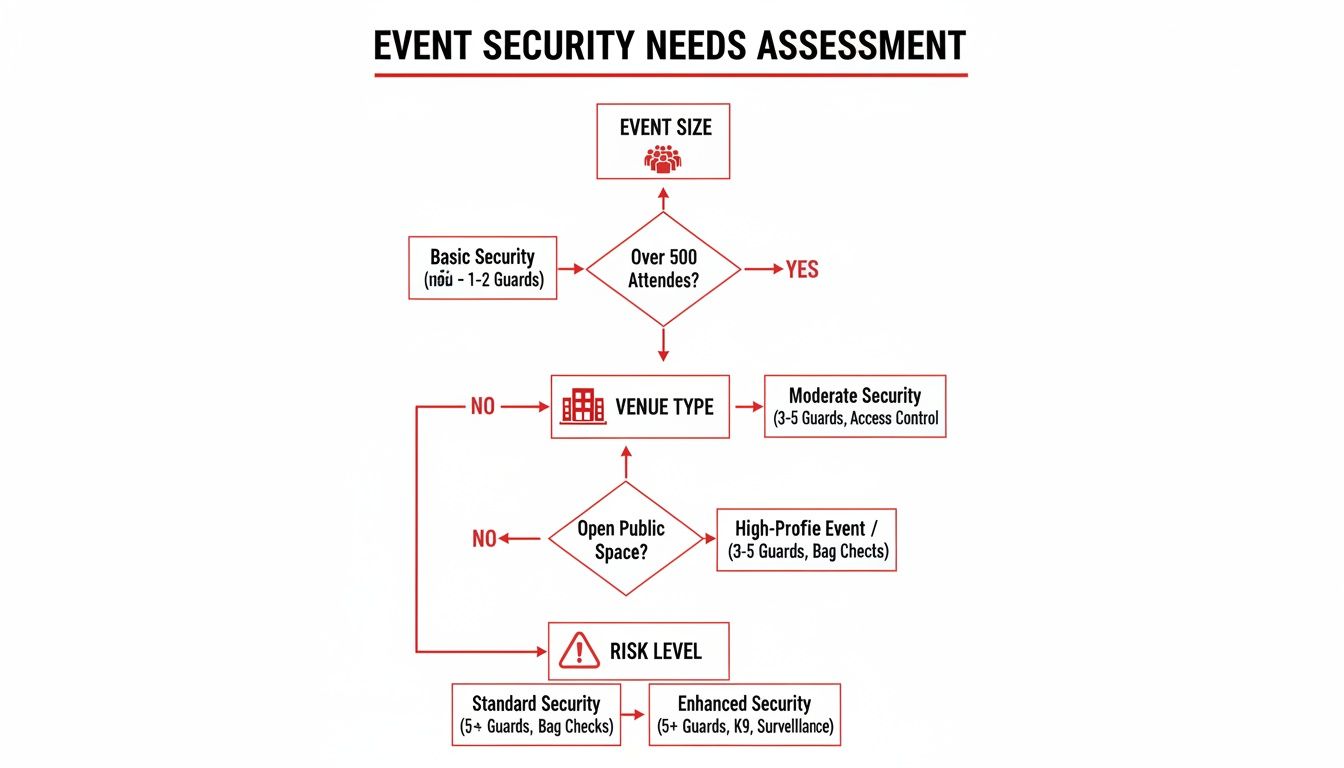
As you can see, a bigger crowd or a higher-risk venue means you need to move beyond basic crowd control and into more specialised security services.
Actionable Insight: A truly great security partner will ask you more questions than you ask them. They’ll want to know about your attendees, your schedule, and what keeps you up at night. That’s how you know they’re building a real plan, not just selling you a package.
Security Provider Vetting Checklist
To make this process easier, here's a checklist to help you compare potential security partners. It covers the essentials and the finer points that distinguish a professional team.
| Vetting Criteria | What to Look For (Ideal Provider) | Red Flags to Avoid |
|---|---|---|
| Licensing & Insurance | Proactively provides Master Licence and Certificate of Currency. All guards individually licensed. | Hesitates to provide documents; claims "it's on the way"; vague about individual guard licensing. |
| Experience & Reputation | Has verifiable experience with similar events (size, type, venue). Provides references you can actually call. | Can't provide relevant case studies; has poor online reviews or no industry presence. |
| Communication & Planning | Asks detailed questions about your event. Proposes a custom security plan, not a generic quote. | Provides a quote with no questions asked; communication is slow or unprofessional. |
| Staff Training & Professionalism | Invests in ongoing training (first aid, conflict resolution). Staff present as professional and well-equipped. | Vague about training programs; guards appear unprofessional or ill-equipped. |
| Contingency Planning | Discusses "what if" scenarios and has clear emergency protocols in place. | Dismisses concerns about potential issues; has no clear plan for emergencies. |
Using a checklist like this ensures you're making an informed decision based on competence and professionalism, not just the bottom-line price.
Ultimately, your goal is to find a team that feels like an extension of your own—proactive, communicative, and as invested in your event’s success as you are. Taking the time to properly vet your security partner is one of the most important things you can do.
Unpacking Quotes and Finalising the Contract
Alright, you’ve put in the work and the quotes are rolling in. It’s easy to get tunnel vision and just scan for the lowest number, but I can tell you from experience, that’s a risky move. An unusually cheap quote is often a massive red flag.
More often than not, it means the provider is cutting corners somewhere. This could be anything from hiring undertrained staff to skimping on proper insurance or, worse, completely misjudging what your event actually needs. It might even mean they're not paying their guards properly, which is a recipe for unmotivated, unhelpful staff on your big day. Real value isn't about the lowest price; it's about getting reliable, experienced professionals who will protect your guests, your venue, and your reputation.
What to Look for in a Security Quote
A proper, professional quote is far more than just a final figure. It should be a clear, detailed breakdown that proves the company has genuinely listened to you and understood the unique risks and requirements of your event. Transparency is everything here.
A solid quote will always spell out:
- A full description of services: What are you actually getting? It should specify the exact roles, like static guards for the main entrance, roaming patrols for the perimeter, or a dedicated supervisor to manage the team.
- The proposed guard-to-guest ratio: A good provider won't just throw a number at you. They’ll explain why they're recommending a specific ratio, linking it back to your event's risk assessment.
- A line-by-line cost breakdown: You should see hourly rates for each guard, any additional fees for supervisors, and costs for specialised equipment if needed. No hidden surprises.
- Proof of insurance and licensing: The quote should explicitly state that they hold all the required state-specific security licences and current Public Liability Insurance.
If a quote is vague and just lumps everything into a single "security services" fee, don't be afraid to push back. Ask for a detailed breakdown so you can make a fair, apples-to-apples comparison with other providers.
The Contract Clauses That Really Matter
Once you've picked your provider, the contract is your final safety net. It’s tempting to just give it a quick glance and sign, but please, read it carefully. This document is the legally binding agreement that outlines everyone's responsibilities and protects you if things don't go to plan.
Take your time with the fine print. A well-drafted contract isn't just about protecting the security company; it's about protecting you, too. It ensures everyone is on the same page and avoids any nasty shocks later on.
Make sure the contract clearly defines the terms of the job. You'll want to double-check clauses that cover:
- Liability and Indemnification: This is a big one. It clarifies who is financially responsible if an incident occurs.
- Cancellation Policy: Life happens. You need to know exactly what the financial implications are if your event has to be cancelled or postponed.
- Staff Conduct and Uniforms: The contract should set out the expected standards of professionalism, including the team's dress code, to ensure they represent your event properly.
- Emergency Procedures: This section should detail how the security team will respond to different emergencies, and it absolutely must align with your overall event safety and emergency plan.
Dedicating a bit of extra time to properly scrutinise the quotes and contracts is one of the most important things you can do when you hire event security. It’s the final step in making sure you’re partnering with a truly professional team that offers real protection and peace of mind, not just a bargain-basement price.
Integrating Security for On-The-Day Success
You’ve signed the contract, but the real work of integrating your chosen security team is just beginning. Think of them less as a separate entity and more as an extension of your own event management crew. The goal is to weave them so deeply into your operations that they function as one cohesive unit, from the first briefing to the final pack-down.
This all starts with a proper pre-event briefing. This isn’t a quick ten-minute huddle; it’s a detailed walkthrough where your event managers and the security supervisor meticulously go over the entire operational plan. You need to align on everything from the run-of-show and venue layout to potential friction points and emergency procedures.
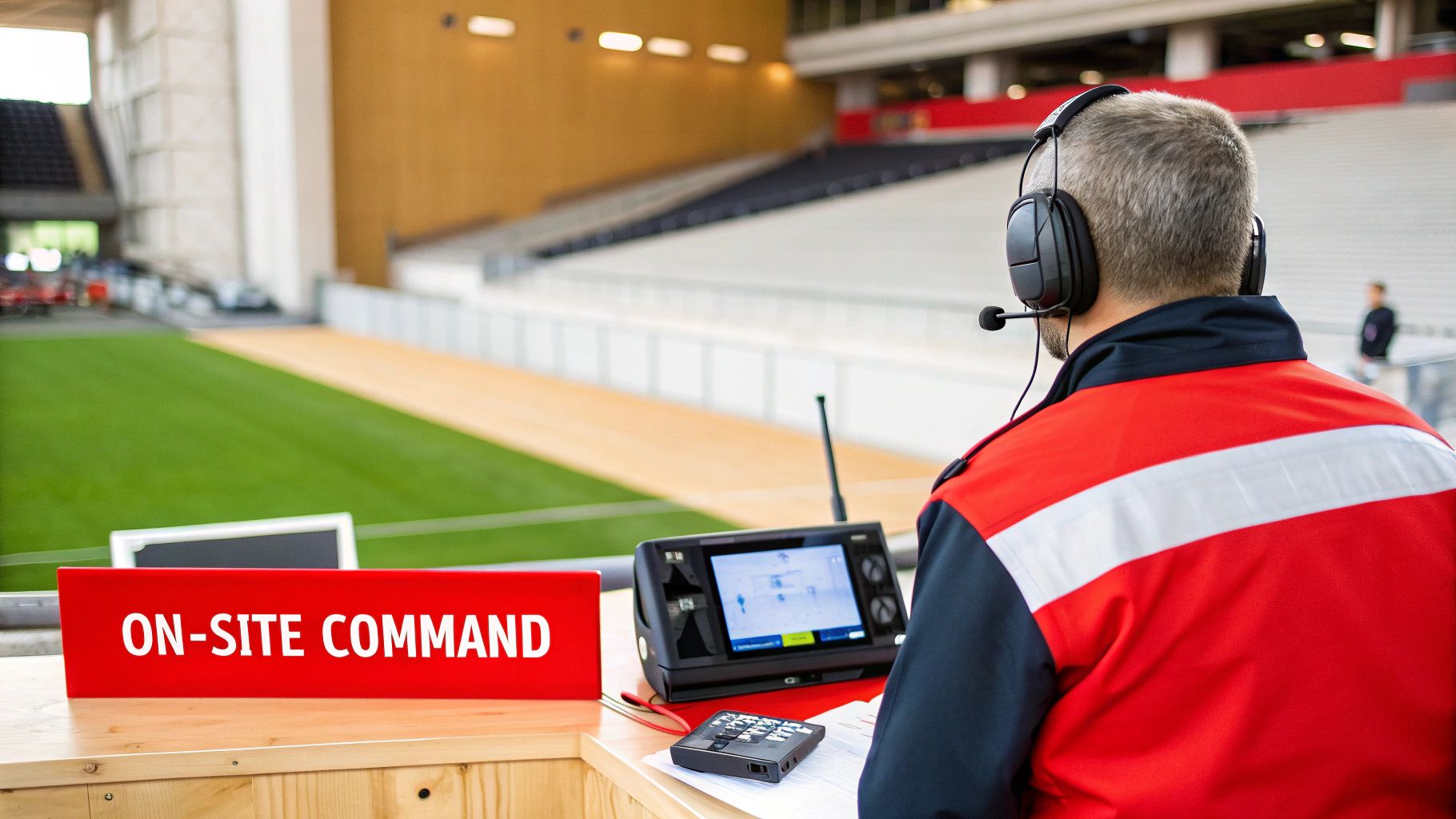
Establishing Clear Command and Communication
On event day, clear and instant communication is your lifeline. Without it, the best-laid plans can quickly unravel under pressure. That’s why setting up a rock-solid chain of command and reliable communication channels is completely non-negotiable.
I always recommend establishing a central command post—a single, designated hub where your event manager, the security lead, and other key personnel (like first aid or production heads) can be based. This becomes the event's nerve centre, ensuring information flows seamlessly and critical decisions are made without a moment's hesitation.
Practical Example: If a guard at an entry gate identifies a potential issue (e.g., an overly intoxicated guest), they shouldn't be left wondering who to contact. A clear protocol means they immediately radio their supervisor, who can then relay the intel directly to you at the command post for a swift, coordinated response.
Defining Roles and Running Drills
When things get hectic, confusion is the enemy. Every single person on site, from your front-of-house staff to the security guards, needs to know exactly what their role is and who they report to. Your team must know who the security point-of-contact is, and the security team needs to understand the roles of your key personnel.
The best way to solidify this is to practice. You don't need a full-blown crisis simulation, but running through a few "tabletop" drills for likely scenarios is invaluable.
- Medical Emergency: What’s the plan? A guard spots the incident, radios the command post for medical support, and works to create a clear path for the first responders to get through the crowd.
- Crowd Surge: How does the team react? Guards at the front-of-stage alert the command post, who then instructs the production team to pause the performance while pre-planned safety announcements are made.
- Lost Child: What's the procedure? A description is immediately circulated to all staff and security via radio, and guards are briefed on designated safe meeting points.
By working through these scenarios and coordinating with local emergency services beforehand, you build a prepared, proactive team. This integrated approach is what separates a chaotic event from a professional, safe, and genuinely successful one.
FAQ: Frequently Asked Questions When You Hire Event Security
When you get to the point to hire event security, you’re bound to have questions. It’s completely normal. In my experience, most event organisers circle around the same key concerns. Let's walk through them so you can feel confident in your decisions. Getting your head around the details of staffing numbers, costs, and legal requirements is half the battle.
So, How Many Security Guards Do I Actually Need?
Everyone asks this, and the honest answer is: it depends. While a common rule of thumb is one guard for every 75-100 guests for a standard, low-risk event, you should treat that as a starting point, not a final number.
Think of it this way – that ratio gets thrown out the window the moment other risk factors come into play.
- Serving Alcohol? This is a big one. The moment alcohol is involved, the dynamic of an event can change, and you’ll almost certainly need more security staff on the ground.
- Venue Layout: Is it a sprawling outdoor festival with multiple entrances and exits, or a single-room conference hall? A complex layout requires more eyes and a more strategic presence.
- The Vibe of the Event: A high-energy music festival requires a far more robust security plan than a daytime corporate networking event.
A good security partner won't just pluck a number out of thin air. They’ll insist on a proper risk assessment to understand your specific event's needs before recommending a staffing level.
The right number of guards isn't about meeting a quota. It's about having trained professionals exactly where they need to be to manage the unique risks of your event.
What Should I Expect to Budget for Event Security?
The cost to hire event security isn't one-size-fits-all. It really hinges on your location in Australia, the specific duties required, and the experience level of the guards. As a rough guide, you can expect to pay somewhere in the range of $45 to over $80 per hour, per guard.
I know it’s tempting to go with the lowest quote, but this is one area where cutting corners can backfire spectacularly. An unusually cheap price can be a massive red flag, often pointing to poorly trained staff, non-compliance, or a lack of proper insurance.
Focus on value and expertise, not just the bottom line. The wrong security team can become a liability, creating more problems than they solve.
What Are the Must-Have Licenses for a Security Company?
This is non-negotiable. Seriously. Any legitimate security company in Australia must be properly licensed to operate. It’s the first thing you should check.
Before you even think about signing a contract, you need to verify two key things:
- The company itself has a Master Security License for the state you're operating in (whether that's NSW, VIC, QLD, or the ACT).
- Every single guard who will be working your event holds their own individual security license (for example, a Class 1 license in NSW).
Don't be shy about asking for proof. Request copies of these licenses and also ask for their current Public Liability Insurance certificate. This isn't just about ticking boxes; it's about protecting your event, your guests, and yourself by ensuring you're partnering with a compliant and professional outfit.
What should I do if an incident occurs?
Always ensure your security team has a clear incident reporting procedure. This should include documenting what happened, who was involved, any actions taken, and who was notified. Actionable Insight: Request a copy of all incident reports after your event for your records. This is crucial for legal protection and for refining safety plans for future events.
Ready to put a professional, reliable, and friendly security plan in place? GM GROUP Services delivers multi-award-winning protection across NSW, Victoria, Queensland, and the ACT. From static guards to K9 units, we build complete security solutions to protect your people, assets, and reputation. Get a quote today and let’s work together to create a safe and successful event.
Discover more from GM Group Services
Subscribe to get the latest posts sent to your email.