When you need to hire a security guard, it’s tempting to just get a few quotes and pick the cheapest one. That’s a critical mistake. The first step isn’t about quotes; it's about understanding precisely what you're protecting against. Jumping straight into hiring often leads to the wrong type of security, inadequate coverage, or wasting money on services you don’t need. A solid security brief is your blueprint for getting it right from the start.
First Things First: Defining Your Security Needs
Just saying "I need a couple of guards" is one of the most common and costly mistakes. The smart way to hire a security guard begins with a thorough risk assessment, not a simple headcount. This means moving beyond assumptions to build a real-world picture of your specific threats, vulnerabilities, and the day-to-day duties your guards will perform.
If you skip this crucial step, you’ll end up with guards unprepared for the unique challenges of your site. For example, the security plan for a weekend music festival—focused on crowd control, bag checks, and medical emergencies—is completely different from securing a construction site, where the primary goal is protecting equipment after hours and preventing trespassing.
Actionable Tip: Pinpoint Your Specific Threats and Vulnerabilities
Walk around your venue, event space, or worksite, but see it through the eyes of someone looking for an opportunity. Where are the easy targets? It could be a poorly lit car park, an unmonitored back entrance, or the area where cash is handled. These are your vulnerabilities.
To build a comprehensive threat profile, ask these practical questions:
- What are we protecting? Is it thousands of dollars of equipment on a building site? The safety of patrons in a nightclub? Sensitive data in a corporate office? Or high-value stock in a retail shop?
- What is the most likely risk? Are you more concerned about internal issues like employee theft, or external threats like break-ins, vandalism, or public disturbances?
- When are we most at risk? For a pub, it’s probably closing time on a Saturday. For an office building, it's likely overnight or on a quiet weekend.
Get Specific About Guard Roles and Responsibilities
Once you know your risks, you can define what your security guards will actually do. A vague job description is a recipe for ineffective security. You need a detailed list of duties.
Practical Example: A Corporate Event
Instead of a lazy instruction like "watch the entrance," a detailed brief would look like this:
- Greet all guests professionally upon arrival.
- Check attendees against the registered guest list using the tablets provided.
- Direct guests towards the main conference hall, amenities, and fire exits.
- Discreetly monitor the crowd for signs of intoxication, distress, or suspicious behaviour.
- Maintain constant radio contact with the event manager to report any issues immediately.
A detailed security brief is the most crucial document you'll create. It doesn't just get you accurate quotes; it becomes the backbone of your Service Level Agreement (SLA), giving you something concrete to hold your security provider accountable to.
This level of detail leaves no room for confusion. When you approach a company to hire a security guard, you provide them with this document. Their proposal must directly address your specific needs. It’s a proactive approach ensuring you’re not just hiring a uniform, but a genuine security solution that protects your people, property, and reputation.
Choosing the Right Type of Security Service to Hire
Once you’ve mapped out your risks, the next move is matching those specific threats to the right kind of security. This is not a one-size-fits-all decision. The success of your entire security plan hinges on picking the right strategy for your unique environment. A highly visible, uniformed guard might be the perfect deterrent at a shopping centre entrance, but they would be completely ineffective at a corporate event requiring discretion.
Knowing the different service types is crucial. Each one is designed to tackle distinct vulnerabilities, whether protecting a fixed asset, managing a dynamic crowd, or patrolling a large area. Making the right choice means you get the protection you actually need without blowing your budget.
Static Guards for Fixed Posts
A static guard is what most people picture when they think of security: a uniformed professional stationed at a specific spot. These guards are your go-to for controlling access points and maintaining a solid, visible presence.
Practical Examples:
- Corporate Lobbies: A professional static guard acts as a concierge, greeting staff and visitors while monitoring access control systems and CCTV. Their presence establishes a tone of safety and order.
- Gatehouses: For industrial sites or residential communities, a guard at the gate is essential. They are on the frontline, logging vehicles, verifying credentials, and preventing unauthorised entry.
- Retail Store Entrances: A visible guard at the front of a store is a powerful deterrent against opportunistic shoplifters and anti-social behaviour.
This decision tree helps visualise the process of figuring out what you actually need before you commit.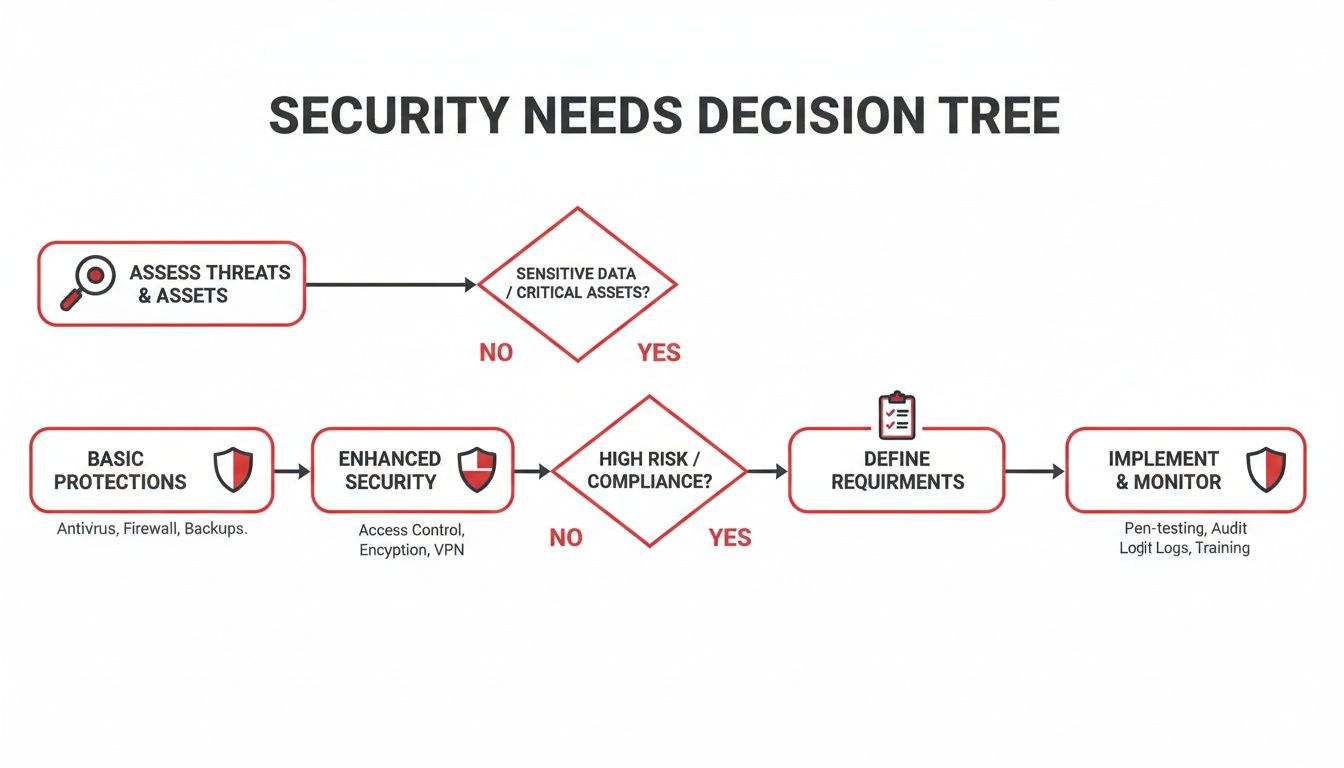
As you can see, a clear-headed assessment of the threats you face is the foundation for any effective security action.
Mobile Patrols for Large Areas
When your property is too large for a single static guard to cover, mobile patrols are the logical and cost-effective solution. These guards move through a designated area, either on foot or in a vehicle, creating a deterrent presence across a much wider space.
Actionable Insight: If you manage a construction site, you could hire a security guard service to run random vehicle patrols all night. This unpredictability is a nightmare for potential thieves who scout sites for patterns, making it incredibly difficult for them to find a window to steal equipment or materials. The same strategy applies to large industrial parks or university campuses that need a fast response to incidents anywhere on the property.
The demand for this kind of service is booming. Australia's Investigation and Security Services industry is projected to hit a revenue of $13.9 billion by 2025, with mobile patrols being a major component. This growth is driven by businesses across NSW, VIC, and QLD needing a reliable set of eyes on the ground. You can review the full security services research for more data.
Matching Security Services to Your Needs
To make the choice clearer, here’s a quick breakdown of the different security services and where they fit best. Use this as a cheat sheet for matching the right guard to the right job.
| Service Type | Best For | Key Responsibilities | Example Scenario |
|---|---|---|---|
| Static Guard | Fixed locations with high foot traffic or critical access points. | Access control, CCTV monitoring, visible deterrence, customer service. | A corporate office lobby or a retail store entrance. |
| Mobile Patrol | Large properties like industrial parks, construction sites, or campuses. | Perimeter checks, alarm response, random patrols, incident reporting. | Nightly vehicle patrols of a sprawling university campus. |
| Loss Prevention | Retail environments with high rates of shrinkage or shoplifting. | Covert surveillance, identifying and apprehending thieves, staff training. | A plain-clothes officer monitoring shoppers in a department store. |
| K9 Unit | High-risk sites, large events, or areas needing substance detection. | Crowd control, narcotics/explosives detection, enhanced deterrence. | Screening attendees at a major music festival entrance. |
| VIP Protection | High-profile individuals, executives, or celebrities needing personal security. | Threat assessment, secure transport, close protection, route planning. | A bodyguard escorting a CEO during an international business trip. |
Ultimately, the best strategies often blend these services for a layered defence.
Specialised Security Services
Beyond static and mobile guards, you'll find specialised services for specific situations.
- Loss Prevention Officers (LPOs): These are undercover professionals. Often in plain clothes, LPOs blend in with shoppers to spot and apprehend shoplifters. Their main tool is discretion.
- K9 Units: A security guard paired with a highly trained dog is an incredible deterrent. They are exceptionally effective for crowd control at large events, screening for illicit substances, and securing high-risk sites.
- VIP Protection (Bodyguards): For high-profile individuals, close personal protection is essential. This dedicated service involves managing travel logistics, constantly assessing threats, and ensuring personal safety.
The most effective security strategies often combine different service types. For a large music festival, you might use static guards at entry gates, mobile patrols around the perimeter, and a specialised team for backstage VIP protection. This layered approach covers all bases.
How to Properly Vet Security Companies Before You Hire a Security Guard
Choosing a security provider is a critical decision for your business or event. Before you hire a security guard, you must do your homework on the company behind them. This isn't just a box-ticking exercise; it's your first line of defence against non-compliance, undertrained staff, and liabilities that could come back to haunt you.

A slick website and a cheap quote mean nothing if the company isn't fully licensed and insured. Cutting corners here exposes your entire operation to significant risk. You have to be methodical to ensure you’re dealing with a legitimate, professional outfit.
Confirming Licenses and Compliance
Your first and most crucial step is to verify the company's master license. Every security firm in Australia must hold a master license for the state they operate in—whether NSW, Victoria, Queensland, or the ACT. This is non-negotiable.
Equally important is confirming that every guard assigned to your site holds a valid individual security license. Don’t be afraid to ask for copies of these licenses and check them yourself against the relevant state authority’s online register.
Beyond that, you need to see their insurance. Request a current Certificate of Currency for their public liability insurance. Any reputable provider will have at least $20 million in coverage and should produce this document without hesitation.
"Never take a provider's word on compliance. Always ask for the paperwork—master licenses, individual guard licenses, and public liability insurance. If a company hesitates or makes excuses, that's a massive red flag. Walk away immediately."
Gauging Reputation and Experience
A company's track record tells you a lot about its reliability. Don't just rely on testimonials on their website; ask for contactable referees from clients with needs similar to yours.
When you speak to them, ask specific questions:
- How does the management team respond to issues?
- Do the guards present themselves professionally?
- How do they handle unexpected incidents or emergencies?
- Would you hire a security guard from them again?
This firsthand feedback is invaluable. You're looking for consistent patterns of professionalism, reliability, and proactive problem-solving. This diligence is the difference between finding a true security partner and just another contractor.
Spotting the Red Flags
While you're looking for green lights, it’s just as important to know what warning signs to watch for. One of the biggest red flags is a price that seems too good to be true. If one quote is dramatically cheaper than others, be cautious. It often means the company is cutting corners on guard pay, insurance, or training—all of which puts you at risk.
The security industry is growing, with a 6.10% increase in individual license holders over the past year, bringing the total to over 155,000 professionals. This means there are plenty of qualified guards available through reputable companies that properly vet their team. You can learn more about the industry's growth in the ASIAL Security Industry Licensing Report 2025.
Getting the Paperwork Right: Your Security Contract and SLA
Once you’ve found a provider that ticks all the boxes, it’s time to get everything in writing. When you hire a security guard, a handshake deal is a one-way ticket to trouble. You need a rock-solid, legally sound contract and a detailed Service Level Agreement (SLA). These aren't just formalities; they’re the blueprint for your security operation.

Think of it this way: the contract sets the rules, and the SLA defines how you measure success. Without them, you’re flying blind, leaving yourself open to subpar performance, miscommunications, and serious liability risks.
Must-Have Clauses for a Watertight Security Contract
Your contract must be crystal clear, leaving no room for interpretation. Ambiguity is your enemy. The goal is to spell everything out so there are no surprises.
Here’s what you must include:
- Scope of Services: Be incredibly specific. Don't just say "patrol the premises." Instead, detail exactly what that means. For example, "Conduct documented foot patrols every 60 minutes, checking all ground-floor doors and windows, and monitoring CCTV feeds from the main control room."
- Hours and Location of Coverage: Pinpoint exact times and places. For instance, "One static guard is to be posted at the main northern gate from 7:00 PM to 7:00 AM, seven days a week."
- Emergency Response Protocols: What should the guard do in case of a fire, medical emergency, or break-in? List the exact steps, who they need to call, and their immediate responsibilities.
- Compliance and Licensing: The contract must state that the provider and all assigned guards will maintain all required state-specific licenses and insurance policies for the entire duration of the agreement.
Using an SLA to Define and Measure Success
The contract is the legal foundation, but the SLA is what tells you if you're getting your money's worth. It turns vague expectations into measurable numbers. This is how you ensure the service you pay for is the service you get.
A good SLA is built on Key Performance Indicators (KPIs). Forget fuzzy goals like "provide a strong security presence." You need data.
Example KPIs for a Security SLA:
| KPI Metric | Target | How It's Measured |
|---|---|---|
| Incident Response Time | Acknowledge alarm within 90 seconds; on-site response within 5 minutes. | Timestamped logs in the incident management system. |
| Patrol Completion Rate | 100% of scheduled patrols completed per shift. | Data from digital checkpoint scanning or GPS patrol tracking. |
| Reporting Accuracy | 98% of reports submitted on time with no critical errors. | Audits of daily activity logs by the site supervisor. |
| Guard Punctuality | 99% on-time arrival for all shifts. | Digital timekeeping software or manual sign-in sheets. |
Your SLA is your number one tool for managing performance. It shifts the conversation from a subjective "I feel like they're doing a good job" to an objective, data-backed discussion. If targets are missed, the SLA should also clearly state the consequences, like service credits or a formal performance review.
Taking the time to create a detailed contract and a tough-but-fair SLA sets a foundation of total clarity. It’s the single best thing you can do to make sure your security investment pays off.
When you’re looking to hire a security guard, it’s easy to focus only on the hourly rate. But that’s a classic mistake that can lead to budget blowouts. A rock-bottom quote often hides costs that will appear later. To make a smart investment, you need to understand the whole picture.
The true cost is a blend of a guard’s experience, their specific skills, and other factors a professional security provider builds into their pricing. Getting a handle on this means you can compare quotes properly and build a budget that won’t have any nasty surprises.
Breaking Down the Core Cost Factors
So, what goes into that base rate? A seasoned guard who can handle high-pressure situations will naturally cost more than a newly licensed one. The job itself also plays a huge role. Providing security for a massive, late-night music festival carries more risk than watching a quiet corporate lobby during office hours, and the rate will reflect that.
You also need to account for situations that trigger penalty rates:
- Public Holidays: Expect to pay a premium for coverage on days like Anzac Day or Australia Day.
- Overtime: Shifts that push past standard hours will incur overtime, as set by industry awards.
- After-Hours Work: Nights and weekends almost always come with a higher rate than a standard 9-to-5 shift.
The Price of Specialised Skills and Equipment
If you need more than a standard patrol, your costs will scale accordingly. Guards with special certifications or those who need specific gear will have a different price tag.
Common add-ons include:
- First Aid/CPR Certification: A guard who can act as a first responder is a massive asset, especially at large events.
- K9 Units: A security dog and handler are an effective deterrent but are a specialised service with its own cost structure.
- RSA Certification: For any licensed venue in NSW, VIC, or QLD, having guards with a Responsible Service of Alcohol ticket is a must.
Beyond training, the gear required for the job contributes to the final price, such as two-way radios, body cameras, or patrol vehicles.
Remember, the goal isn't to find the cheapest option; it's to find the best value. A slightly higher rate for a well-trained, properly equipped guard is a much smarter investment than a low-cost service that leaves you exposed.
Australia’s private security industry pulls in over $11 billion in revenue each year and employs more than 180,000 people. With a projected 3% annual growth, the demand for quality security is rising. You can find more stats in the Security 2025 Summary report.
When piecing together your finances, a solid guide on budgeting for an event can be a lifesaver for factoring in these security costs properly. When comparing quotes, a transparent provider will happily break down all costs. If they're vague, that's a red flag.
Security Budgeting Checklist Beyond the Hourly Rate
| Cost Component | Description | Budgeting Tip |
|---|---|---|
| Supervision & Management | The cost of 24/7 support, field supervisors, and client management. | Ask if this is bundled or an extra. Good providers include this as standard. |
| Insurance Premiums | Public liability and WorkCover insurance for the guards. | Never use a provider without proper insurance. Ask for their Certificate of Currency. |
| Uniforms & Equipment | Standard uniforms, radios, body cams, and other necessary gear. | Clarify if specialised equipment (e.g., vehicles) is an additional hire fee. |
| Reporting & Technology | Access to digital reporting software for incident logs and guard tracking. | Ask for a demo of their reporting platform to see if it meets your needs. |
| Penalty Rates | Higher pay rates for weekends, public holidays, and overtime. | Map out your roster in advance to anticipate when you'll incur penalty rates. |
| Training & Compliance | Ongoing training, licensing, and certification costs for guards. | A higher rate often reflects a provider's investment in well-trained staff. |
By asking about these specific line items, you can get a clearer comparison of what you're actually paying for. It protects you from hidden fees and ensures you get the quality service you need.
Frequently Asked Questions About How to Hire a Security Guard
When you start looking to hire a security guard, many questions come up. It’s a big decision that directly impacts the safety of your people, property, and reputation. Here are clear answers to the most common queries.
Q: How much does it cost to hire a security guard?
A: The cost varies based on several factors: the guard's experience, the specific duties required, your location (e.g., metro Sydney vs. regional QLD), and the site's risk level. Expect to pay a premium for specialised skills (like advanced first aid) or for shifts on public holidays and weekends due to penalty rates. Always ask for a detailed quote that breaks down all potential costs, not just an hourly rate.
Q: What qualifications should I look for in a security guard?
A: The absolute non-negotiable is a valid security licence for the state they are working in (NSW, VIC, QLD, or ACT). Beyond that, look for experience that matches your needs. For events, you want guards with crowd control experience. For construction sites, look for asset protection skills. For hospitality, certifications like Responsible Service of Alcohol (RSA) and First Aid/CPR are crucial. A good provider will match the guard's skills to your environment.
Q: What is the difference between armed and unarmed guards?
A: An unarmed guard acts as a visible deterrent, handles access control, monitors for issues, and reports incidents. They are suitable for most commercial, retail, and event settings. Armed guards are for high-risk environments like cash-in-transit services or protecting high-value assets under a specific threat. The decision to hire a security guard with a firearm must be based on a formal risk assessment.
Q: Can I hire a security guard directly instead of going through an agency?
A: While you technically can, it's a path filled with administrative burdens and risk. When you hire directly, you become the employer and are responsible for everything: verifying licenses, running background checks, managing payroll and super, arranging insurance, organising ongoing training, and finding replacements for sick days. A reputable agency handles all this, ensuring you always have a fully licensed, insured, and trained professional on-site, providing reliability and peace of mind.
Q: Why is a master license so important when choosing a security company?
A: A master license proves the security company is legally permitted to operate in that state. It confirms they have met strict regulatory standards, including background checks on the directors. Hiring a company without one is illegal and leaves your business completely exposed to legal and financial risks.
Navigating the world of security doesn't have to be complicated. At GM GROUP Services, we provide fully licensed, experienced, and professional security personnel tailored to your exact needs across NSW, VIC, QLD, and the ACT. From large-scale events to construction sites and corporate venues, we make sure your people and property are protected. Get a transparent quote and build your security solution today.
Discover more from GM Group Services
Subscribe to get the latest posts sent to your email.