
Executive security solutions start to matter the moment your day stops being simple. A keynote speaker is due at a CBD hotel. A board director is flying in from interstate. A sponsor dinner runs straight into a public event where phones are out, guest lists are fluid, and a protest nearby could shift foot traffic without warning. Most problems don't begin with a dramatic incident. They begin with exposure, predictability, and poor coordination.
That's why effective executive security solutions aren't just about putting a guard beside a person. They're about managing risk across the full movement of the client, from departure point to venue, through meetings, transport, media exposure, and return. For Australian event managers, hospitality operators, and corporate teams, that's a duty-of-care issue as much as a security one.
Organisations are treating it that way. In 2024, 33.8% of executives in the Equilar 500 received at least one security-related perk, up from 23.3% in 2020, a 45.1% increase. For CEOs, the share rose from 29.5% to 43.7% over the same period, according to LaSorsa's review of executive security spending trends. That dataset is U.S.-based, but the operating logic carries over cleanly to Australia. Public visibility, travel, contentious issues, and brand profile all change the risk picture.
The practical question isn't whether a client needs “a bodyguard”. It's whether the organisation has a plan that reduces avoidable exposure without disrupting business. That's the standard serious buyers should use.
Introduction The Modern Imperative for Executive Security Solutions
A festival promoter usually notices the security gap late. The artist arrival has been locked in, the media wall is set, VIP tickets are sold, and then someone asks the obvious question: who controls the route from vehicle drop-off to backstage, and what happens if supporters, media, or agitators crowd that access point?
The same thing happens in corporate settings. A senior executive's travel itinerary looks tidy on paper, but the actual risk sits between the lines. Airport pickups, hotel check-in, conference entry, public dinner reservations, and social posts can expose movement patterns faster than is commonly understood. Executive security solutions exist to control those gaps before they become incidents.

Why the business case has changed
Security used to be framed as a discretionary add-on. That view doesn't hold up anymore. The shift is visible in corporate disclosure trends, where executive protection has moved into the category of routine risk management rather than exceptional spend.
Practical rule: If the person is material to revenue, reputation, negotiations, or stakeholder confidence, their protection is an operational issue, not a vanity purchase.
For Australian buyers, that matters because the same drivers show up locally. Hospitality groups host public-facing leaders. Conference organisers move keynote speakers between open and controlled spaces. Venue operators manage mixed environments where invited guests, staff, media, contractors, and the public can overlap in minutes.
What clients often get wrong first
The first mistake is buying for appearance instead of control. A visible officer at the door may reassure people, but that alone won't manage route exposure, unauthorised access, hotel leakage, or schedule drift. The second mistake is waiting for a trigger event before planning. By then, your options narrow fast.
A workable approach starts earlier and asks better questions:
- Who is exposed: Not only CEOs, but founders, board members, speakers, talent, and family principals.
- Where are the weak points: Airports, foyers, lifts, loading docks, service corridors, and private dining rooms are common friction points.
- What needs protecting: The person, their schedule, private information, brand reputation, and continuity of the event or business activity.
When clients treat executive security solutions as a coordinated operating plan, they usually get smoother arrivals, fewer surprises, tighter access control, and better incident response if something shifts on the day.
Beyond the Bodyguard What Executive Security Really Means
Many buyers still picture executive protection as one capable person walking beside an executive. That's too narrow to be useful. Modern executive security solutions work more like a firewall for people. The visible guard is only one control layer. Its value lies in planning, intelligence, access management, transport discipline, and communications.
A guard at the door isn't a complete solution
A single close protection officer can be highly effective in the right setting. But if the itinerary includes an airport transfer, a hotel arrival, a conference keynote, a private investor dinner, and a return through public space, then the risk moves with the schedule. Security has to move with it too.
That means practical coordination across:
- Travel planning: Arrival windows, route options, driver briefings, and alternates.
- Venue liaison: Entry points, holding rooms, service corridors, lift control, and exit strategy.
- Privacy protection: Limiting unnecessary disclosure of room numbers, table placements, and movement timings.
- Contingency response: Clear triggers for rerouting, delaying, or extracting.
Good executive protection should feel organised, calm, and almost invisible to the client. If it's loud, improvised, or purely reactive, the planning was weak.
Why integrated programs are becoming normal
A broader market shift supports this. One 2024 market analysis valued the global executive protection service market at approximately USD 427.8 million and projected it to reach USD 853.7 million by 2032 at a CAGR of 10.4%. Within that market, personal protection services accounted for 45% of use, event security 30%, and residential security 15%, according to Protos Security's executive protection overview. That mix mirrors what Australian operators deal with. It's rarely one setting only.
What effective executive security solutions look like in practice
A proper brief doesn't start with “How many guards do I need?” It starts with “What does this person's day look like, where are they exposed, and which controls reduce risk without making the program cumbersome?”
A whole-of-journey approach usually separates strong providers from basic labour supply. The stronger model is built around anticipation. The weaker model waits for pressure, then improvises.
A simple way to think about the difference is this:
| Approach | What it looks like | What usually goes wrong |
|---|---|---|
| Bodyguard-only mindset | One officer assigned with minimal pre-planning | Bottlenecks, avoidable exposure, poor venue coordination |
| Whole-of-journey model | Protection, transport, access, liaison, and contingency planning integrated | Fewer surprises, cleaner movements, better control if conditions change |
If you're buying executive security solutions for an event, venue, or corporate movement, buy the plan, not just the person.
The 7 Core Components of Effective Executive Security Solutions
A complete protective program isn't built from one service. It's built from layers that support each other. When one layer is missing, another has to absorb the risk. That's where programs become clumsy, expensive, or unreliable.
Risk assessment and threat management
This is the decision engine. Before any deployment, the provider should assess who's travelling, where they're going, what public exposure exists, how access is controlled, and what could change on short notice.
Australian guidance on protective security management puts the emphasis in the right place. The highest-risk failure mode is often the exposure of movement patterns and personal information, not just direct physical threats, which supports a layered design using pre-visit reconnaissance, route variation, and controlled access, as noted in this executive security and protection analysis.
Close protection and personal escort
This is the element often recognised first. It matters, but it has to be matched to context. A conference speaker may need discreet escorting through shared spaces. A board chair attending a contentious shareholder event may need tighter proximity and more deliberate ingress control.
Secure transportation
Vehicles are often treated as logistics. They shouldn't be. Transport is part of the protection envelope, especially when timings, pickup points, and public visibility are involved.
For teams reviewing movement protocols, a practical reference is 10 critical vehicle inspection points. It's useful because secure transport starts with reliability and readiness, not only route planning.
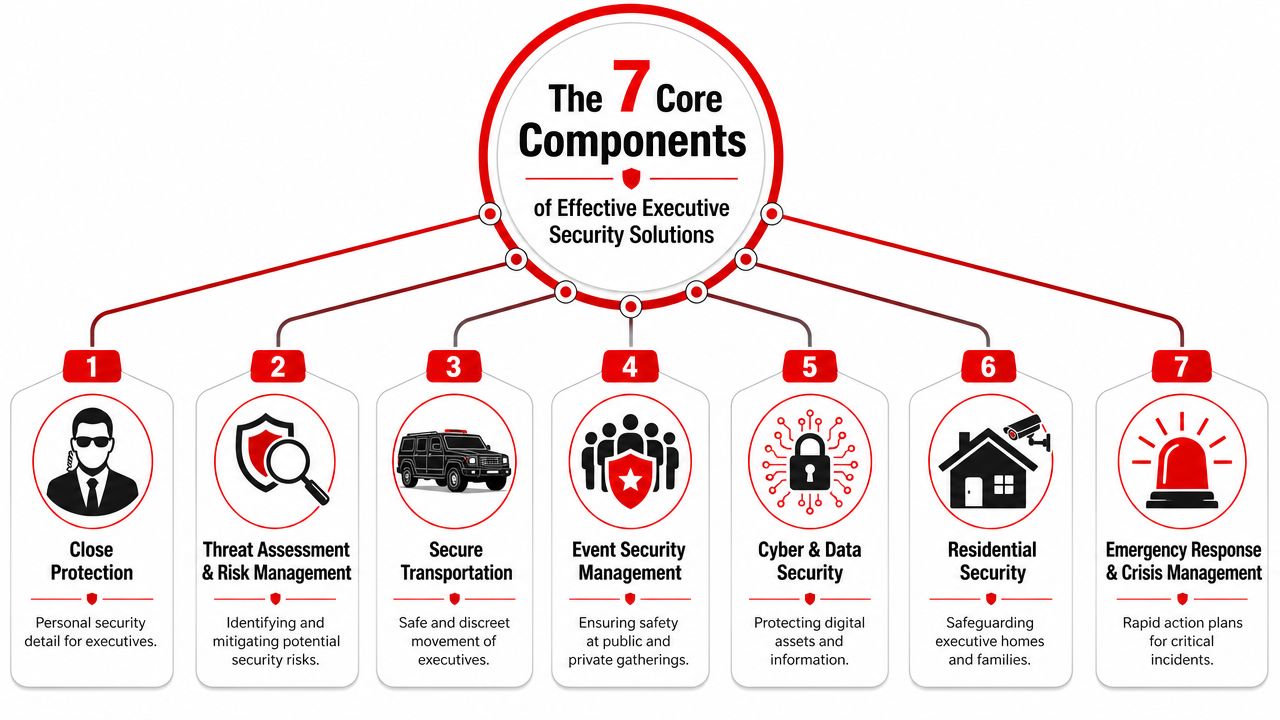
Event security management
Executive protection often fails at the seam between personal security and event operations. Credential checks, backstage access, VIP holding areas, loading dock control, and public queue pressure all affect the principal's safety even if the principal never sees them.
Residential security
For some clients, home is the quiet weak point. Deliveries, routine patterns, domestic staff access, and visible family habits can create unnecessary predictability. Residential measures don't need to be extreme to be effective. They need to be consistent and customized.
Technical monitoring and communications
Protective work relies on timely information. That may include access control logs, monitored alarms, radio discipline, incident reporting, and live communication between venue, transport, and protective personnel. If the team can't pass clear information quickly, response quality drops.
Emergency response and crisis management
Every plan needs thresholds. Who makes the call to reroute? When does a movement pause? Where is the safe room or fallback location? Which manager has authority to alter the schedule? These decisions can't be left vague.
The best emergency plan is usually the one the client barely notices because the team solved the issue before it reached them.
A provider such as GM GROUP Services may combine static guards, VIP protection, vehicle patrols, risk assessments, monitoring, and event security under one operating plan. That model is often more practical than stitching together separate contractors who don't share the same brief.
Key Triggers When to Activate Executive Security Services
Most organisations don't need executive protection every day. But many leave it too late when the risk profile clearly changes. The better question is whether your operations have crossed into conditions where routine staffing no longer gives adequate control.
Are you hosting a public-facing event
If the answer is yes, look at more than crowd numbers. Consider whether the event includes known VIPs, media attention, alcohol service, activist interest, or mixed public and private access zones.
Ask yourself:
- Can the principal move from vehicle to secure holding area without public interference
- Do media, guests, contractors, and staff share any access points
- Is there a fallback plan if arrival timing changes
If those answers are unclear, executive security services should be considered.
Does your executive travel across multiple environments in one day
Many buyers underestimate risk. The threat isn't only at the destination. It sits in the joins between airport, car, hotel, foyer, lift, side entrance, conference floor, and after-hours dinner.
A one-day itinerary that jumps between public and private spaces creates handover risk. Security should tighten each transition, not just the headline event.
Are you dealing with visibility, controversy, or disruption
Some triggers aren't tied to event scale. They're tied to profile. A restructuring announcement, a labour dispute, a public legal matter, a viral post, or a political issue can change the security requirement very quickly.
If people can predict where your executive will be, and some of them have a reason to confront them, your planning window has already narrowed.
Do venue conditions increase volatility
Hospitality and entertainment venues have their own risk multipliers. Late trading, alcohol, queue pressure, public personalities, and limited private circulation paths all create friction. In those settings, executive security is often less about dramatic intervention and more about managing movement cleanly so situations don't escalate.
A simple internal check helps:
| Trigger | What it means operationally |
|---|---|
| High-profile guest attendance | Tighten arrival, holding, and exit control |
| Frequent travel | Add route planning, driver coordination, and venue liaison |
| Mixed public-private itinerary | Build handover points and contingency options |
| Known dispute or public tension | Raise monitoring, access control, and response thresholds |
If one or more of those conditions apply, don't wait for an incident report to justify action.
Navigating Australian Security Compliance and Licensing
In Australia, compliance is where many otherwise sound security plans come unstuck. Buyers often assume licensing works nationally. It doesn't. Security regulation is fragmented across states and territories, and that directly affects who can legally perform which role.
Why licensing affects operational reliability
A provider might be well organised in one state and non-compliant in another. That matters immediately for executive security because these programs often cross borders. A principal may depart Sydney, appear in Melbourne, continue to Brisbane, and finish with a Canberra meeting. If your provider can't lawfully deploy the right people in each jurisdiction, the protection plan is weakened before the first movement begins.
Security licensing is fragmented across Australia. A provider must operate within frameworks such as the NSW Security Master Licence in New South Wales, alongside distinct regulations in Victoria, Queensland, and the ACT, and for multi-state operations, verifying jurisdiction-specific licensing is a critical compliance step before deployment, as outlined in ZeroFox's guidance on executive security and executive protection.

What buyers should verify before deployment
Don't stop at “Are you licensed?” That question is too broad to be useful. Ask for details that affect deployment reality.
- Licence coverage: Confirm the provider and individual operatives hold the correct classes for the state where work will occur.
- Subcontractor control: If the provider uses subcontractors, check how credentials, scope, and supervision are verified.
- Renewal visibility: Ask how the company tracks expiry dates and prevents an out-of-date operative from being rostered.
- Site-specific procedures: Confirm they maintain state-by-state SOPs rather than one generic playbook.
Training matters as much as paperwork
A compliant licence isn't the same as role readiness. Executive work requires judgement, discretion, communication, and venue coordination. For buyers reviewing training pathways or baseline education standards, resources like Perth security courses help clarify the type of formal preparation that sits underneath competent deployment.
The practical takeaway is simple. In executive security, compliance isn't back-office admin. It determines whether the person standing at the access point is legally deployable, properly scoped, and fit for that setting.
A protection plan that ignores licensing detail can create legal exposure, insurance issues, and reputational damage at the same time.
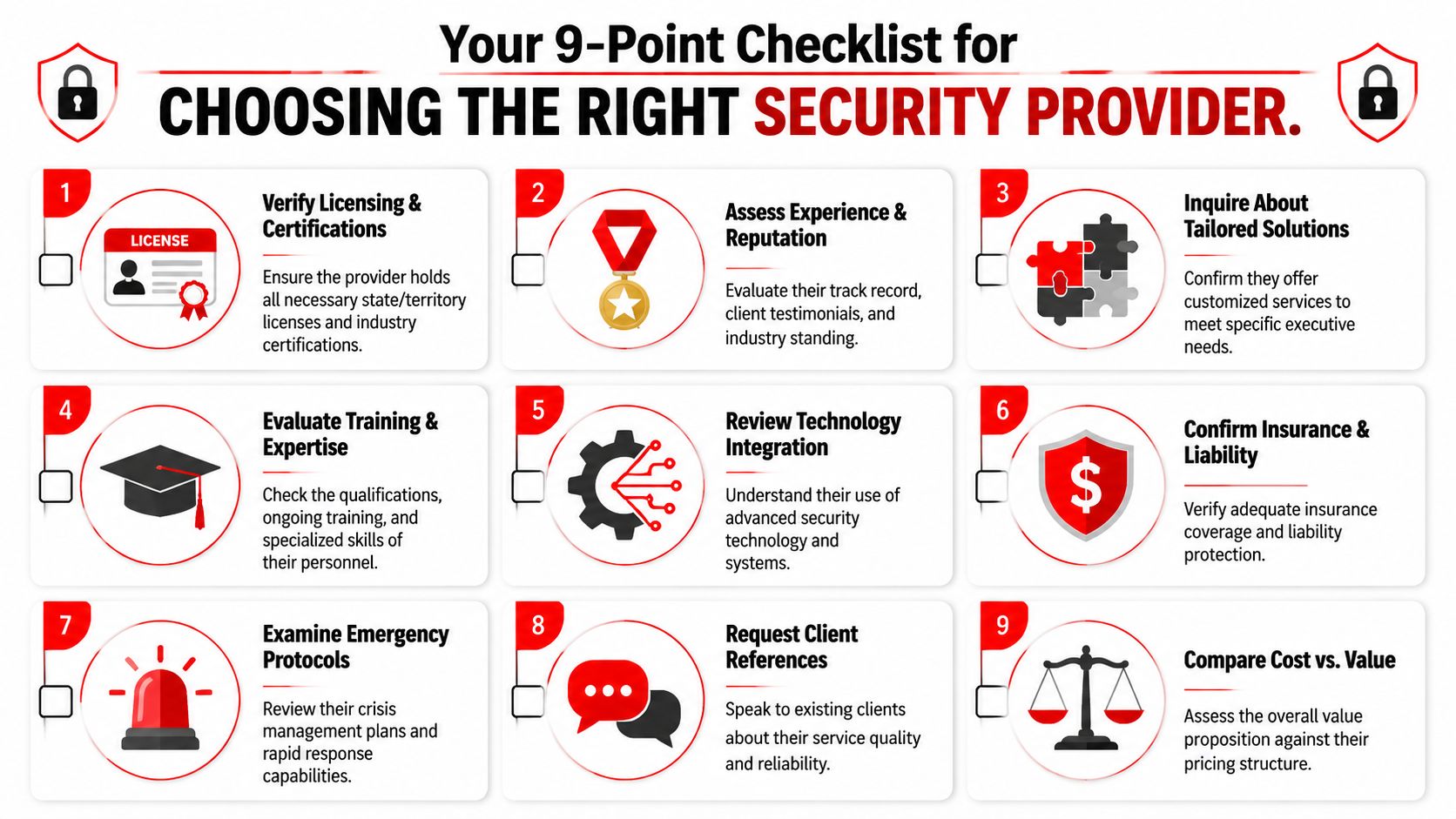
Your 9-Point Checklist for Choosing the Right Security Provider
Price matters, but it's a poor first filter. Cheap security can become expensive once you factor in weak planning, poor supervision, missed risks, and client disruption. The right provider behaves more like an operating partner than a roster filler.
What to test before you buy
State-specific licensing
Ask for evidence pertaining to the exact jurisdictions involved.Relevant operating experience
A provider that understands festivals, hotels, executive travel, and corporate functions will usually ask sharper planning questions.Risk assessment method
If they can't explain how they assess route exposure, venue access, privacy leakage, and escalation triggers, they're likely staffing by habit.Training and supervision
Find out who checks standards on shift, who briefs the team, and who intervenes when the environment changes.Communication discipline
Reporting should be timely, usable, and linked to action. Vague post-event summaries don't help decision-making.
How to separate vendors from partners
Not every provider is built for whole-of-journey work. Some can supply personnel but can't manage coordination across transport, venue operations, and executive movement. That's the gap buyers need to spot early.
A useful comparison sits outside the security sector. The Nutmeg Technologies guide explains how to evaluate a managed service provider, and the logic transfers well here. You're not only buying a task. You're buying process, responsiveness, accountability, and problem-solving.
Here's the rest of the checklist:
- Scalability: Can they increase coverage if the itinerary expands or the risk picture changes?
- Insurance position: Confirm current cover and ask what incidents or scopes require special attention.
- Client references: Speak to clients with similar operating conditions, not just generic testimonials.
- Whole-of-journey capability: Can they integrate route planning, venue liaison, and close protection into one coherent plan?
That final point matters most. A key gap in the market is the difference between simple bodyguarding and whole-of-journey risk management. The best providers integrate route planning, venue liaison, and close protection for clients moving between public venues and private functions, which is common in Australian corporate and event sectors, as described by Allied Universal's executive protection overview.
A quick decision filter
| If a provider says this | Treat it as a warning sign |
|---|---|
| “We'll work it out on the day” | Weak planning culture |
| “A bodyguard should be enough” | Narrow service model |
| “Licensing is covered nationally” | Compliance misunderstanding |
| “We don't need venue input” | Poor coordination habits |
A strong provider should make your operations simpler, not force your team to do the planning they were hired to deliver.
Frequently Asked Questions about Executive Security Solutions
How far in advance should I book executive security solutions
Earlier is better, especially if the brief crosses states, venues, or travel segments. Short notice can still be workable, but the quality of planning improves when the provider has time to assess routes, venue access, principal exposure, and contingency options.
Are executive security solutions always obvious and visible
No. In many environments, a discreet posture works better. The right visibility level depends on the client, venue, threat profile, and business context. Some principals want a clear protective presence. Others need low-profile coverage that doesn't change the tone of the event.
Is this only for CEOs and high-net-worth individuals
Not at all. Executive protection can suit speakers, founders, board members, political figures, family office principals, entertainment talent, and any person whose visibility or role creates operational risk.
What information should I prepare before contacting a provider
Have the basics ready. Share who needs protection, where they'll be, timing, transport requirements, public exposure, known concerns, venue details, and whether the movement includes private functions as well as public appearances.
Will security slow down the guest or executive experience
Bad security does. Good security usually improves flow because arrivals, access points, holding areas, and exits are planned properly. The client experiences fewer delays, fewer awkward bottlenecks, and less confusion.
How is privacy handled
A competent provider limits itinerary sharing, controls access to movement details, and keeps reporting tight. Only people who need the information should have it. Loose internal circulation is one of the fastest ways to undermine a protection plan.
If you're planning a corporate event, managing a hospitality venue, or coordinating executive travel across NSW, VIC, QLD, or the ACT, GM GROUP Services can be considered for licensed, end-to-end support that combines venue security, VIP protection, patrols, monitoring, and risk assessment into one operational plan. The practical starting point is a clear discussion about itinerary, exposure points, compliance needs, and how much visibility the protection should have on the day.
Discover more from GM Group Services
Subscribe to get the latest posts sent to your email.