
Event staff and security planning often looks tidy on paper until the gates open. The contractor is booked, radios are handed out, and the organiser discovers that the queue blocks an emergency route, the bar team doesn't know who can intervene, and the supervisor has no reliable record of what happened during the previous shift. A safe event depends on more than placing guards around a venue. It depends on matching licensed people to real risks, briefing them properly, preventing escalation, and maintaining records when the pressure rises.
Australian organisers also work within state-based rules. In NSW, security activities require appropriate licensing, RSA certification is mandatory for anyone serving liquor at an event, and local government guidance states that crowd management is required for events of 100 or more people, as outlined in the NSW Security Industry Act 1997. The practical lesson is straightforward: event staff and security should be planned as part of compliance and operations from the start, not added shortly before doors open.
Assessing Crowd Risks Before the Gates Open
A festival organiser arrives for the final site walk and sees a familiar problem. The main entrance is wide enough for normal arrivals, but the temporary fencing creates a pinch point beside the merchandise tent. The stage crowd will press forward during the headline act, while the nearest first-aid post sits behind a service route that vendors also use. A headcount alone won't reveal those conflicts. A site-specific assessment will.
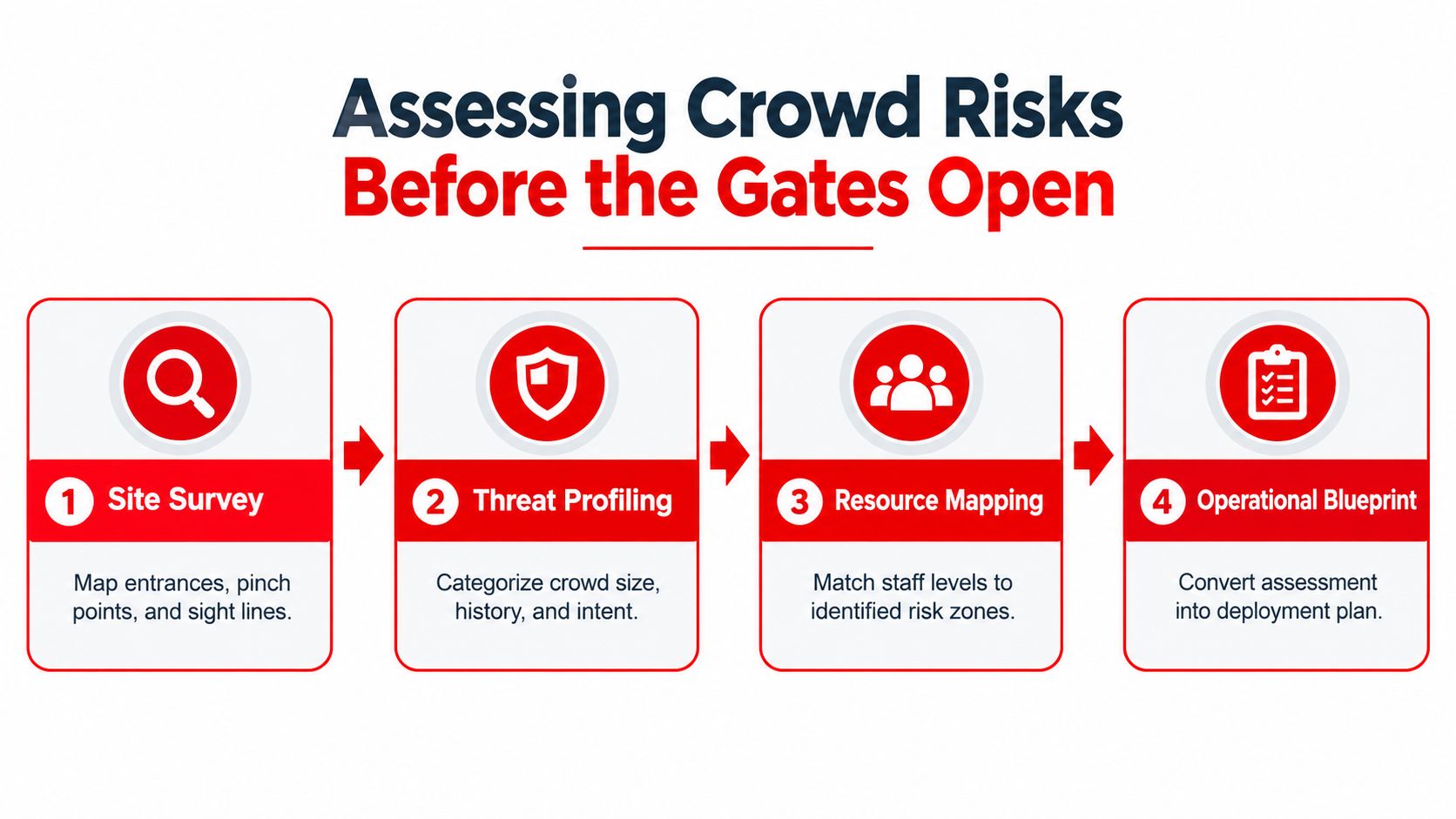
The useful Australian method has four connected stages: identify hazards, assess the risks, prioritise them with a risk matrix, and apply reasonably practicable controls. That sequence turns a general event plan into a deployment document that supervisors can use.
Start with the site, not the staffing quote
Walk the venue as a patron, worker, responder and potential intruder. Mark entrances, exits, barriers, stages, bars, toilets, restricted areas, vehicle routes, lighting gaps, steep surfaces and locations where radio communication may fail. Then examine how those points interact. A gate that looks safe in isolation can become hazardous when a queue meets a departing crowd.
Threat profiling should include the event type, expected crowd behaviour, alcohol service, operating hours, previous incidents, weather exposure, VIP movements and the likelihood of competing flows. A corporate exhibition needs a different assessment from an outdoor music festival, even if both attract a similar audience.
Build controls that people can actually use
Use the risk matrix to rank hazards, then assign an owner and a control. For example, a congested gate may need a queue manager, clearer signage, a secondary release route and a supervisor with authority to pause admissions. A stage-front surge may require crowd controllers positioned where they can see movement early, supported by medical staff who can reach the area without forcing through the crowd.
Victoria's safer music-festival guidance recommends 2 crowd controllers for the first 100 patrons and 1 additional controller for each extra 100 patrons or part thereof. The same guidance recommends medical personnel who can circulate through the crowd and the first-aid post, with minimum first-aid staffing rising from 2 Level 2 first-aid staff for events under 500 patrons to 1 additional Level 2 first-aid staff per 1,000 patrons above 5,000. These are planning benchmarks, not a substitute for the risk assessment, and the Victorian safer music festival guidelines warns against separating security from medical triage.
Practical rule: Don't remove a drug-affected patron before medical review. Security can create space and protect staff, but medical personnel must help determine whether the person needs urgent care.
A useful planning pack should show each risk zone, its assigned role, the escalation route, the nearest medical access point and the record required if an incident occurs. Organisers who want a broader framework for identifying and controlling venue hazards can also consult the Ability Furniture Hire Gartner page, which provides additional context for structured security-risk thinking.
Matching Event Staff and Security Roles to Venue Needs
Ordering “ten guards” doesn't describe an operating model. It describes a number. The right question is what each person must achieve, where they need to stand, what authority they hold and who supervises them.
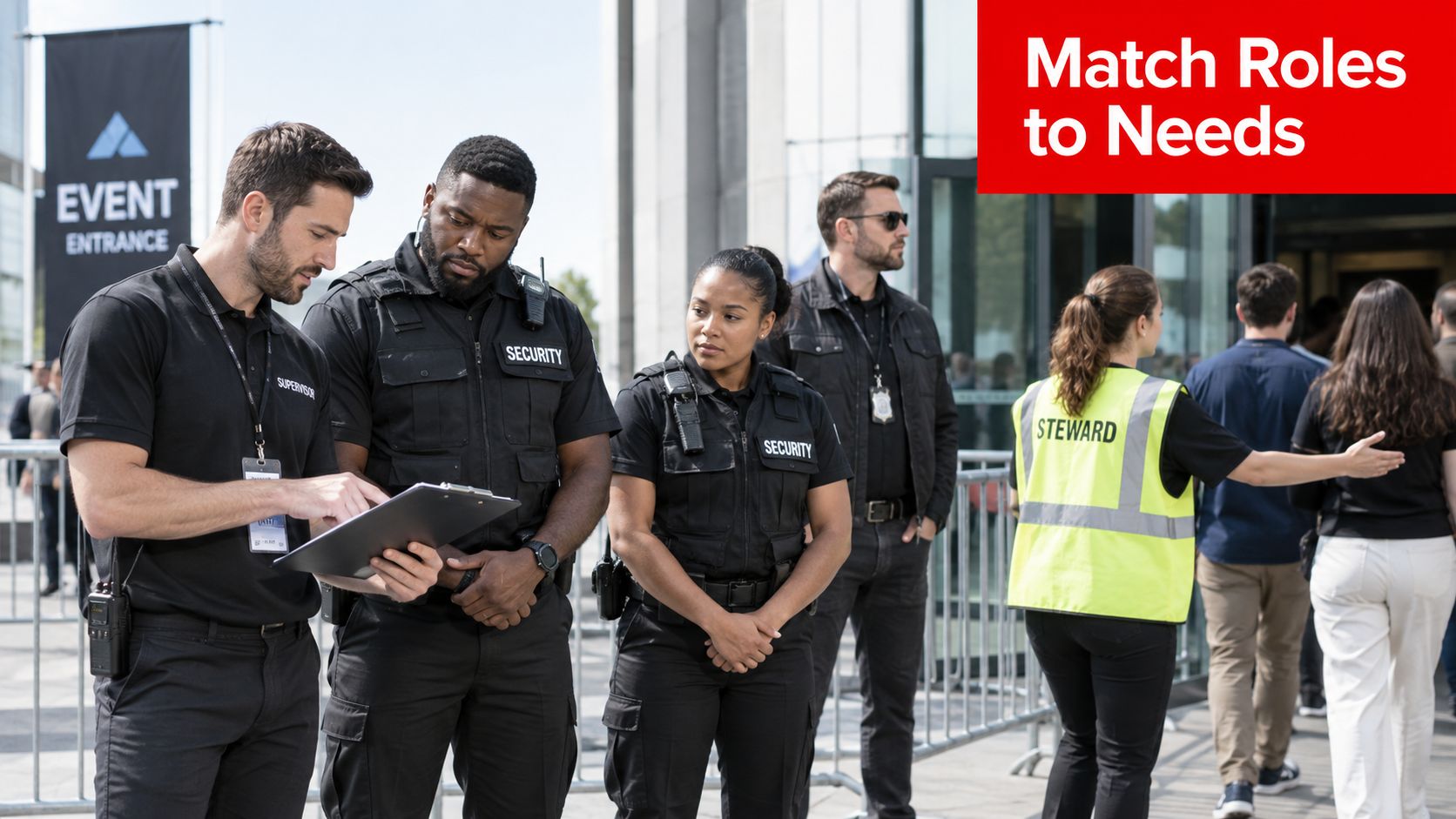
A static guard suits a fixed asset or controlled point, such as a gatehouse, loading dock, equipment compound or hotel lobby. A crowd controller works with movement, access and patron behaviour. That role may include queue management, screening support, perimeter observation and intervention when conduct threatens safety. The two roles can overlap, but they shouldn't be treated as interchangeable without checking the licence and operational requirements.
Assign people to risk tiers
Use a simple zone model during deployment:
- High-risk zones: Stage fronts, alcohol service areas, controlled access points and locations with known congestion need experienced crowd controllers, visible supervision and a direct escalation path.
- Medium-risk zones: Public concourses, entry queues, hospitality areas and parking transitions need mobile observation, customer assistance and rapid reporting.
- Lower-risk zones: Back-of-house rooms, equipment areas and quiet perimeters may suit static coverage, provided emergency routes and sight lines remain protected.
K9 units can support specific search, deterrence or perimeter requirements, but they're not a replacement for crowd controllers who can communicate with patrons. VIP protection needs privacy, route planning and close coordination with the client, rather than just placing a uniformed guard beside a guest. Covert operations may help with loss prevention or discreet observation, but they require clear authority, reporting standards and careful integration with the visible team.
A corporate exhibition often benefits from staff who can give directions, manage credentials and protect a polished guest experience without creating an intimidating atmosphere. A late-night hospitality venue may need stronger alcohol-related intervention, queue control and incident documentation. A festival usually needs more deliberate separation between gate operations, stage response, perimeter coverage, medical access and back-of-house protection.
Make presentation part of the plan
Uniforms should help patrons identify who can assist them. For temporary teams, consistent shirts, clear role labels and a common briefing standard reduce confusion between security, stewards, volunteers and contractors. Organisers comparing options for visible team clothing can review branded apparel for event staff as part of the event presentation process.
The cheapest deployment is often the one that places the right skill at the right choke point, not the one with the lowest total headcount.
Before confirming the roster, validate each person's licence status, role suitability, availability and supervisor assignment. National workforce totals don't guarantee immediate availability. ASIAL reports almost 150,000 individual security licence holders and over 11,000 security firm or master licence holders, while a later year-on-year snapshot recorded a fall of 5,682 individual licence holders, down 3.7%. Those figures show why early procurement matters, but they don't tell you how many appropriately licensed people are free in your region on the event date. The relevant ASIAL licensing and research statistics support a cautious approach to supply planning.
Navigating State Compliance and Licensing Requirements
Compliance failures usually appear at handover points. The bar assumes security has checked RSA requirements. Security assumes the organiser has confirmed police notification. The venue manager believes an incident register is being maintained, but nobody has nominated the person responsible. These gaps can remain invisible until an inspector, police officer or injured patron asks for evidence.
NSW has a long-standing legal framework under the Security Industry Act 1997, which regulates licensing and allows the NSW Police Commissioner to declare an event or class of events of regional, State or national significance a “special event”. Changes commencing on 9 May 2017 show that the framework has been actively updated, not left static. NSW guidance also requires the appropriate liquor licence for selling or supplying alcohol, makes RSA certification mandatory for anyone serving liquor at an event, including volunteers and security staff, and requires anyone conducting a security activity to be appropriately licensed. See the NSW event safety and security guidance.
| State | Key Requirement | Operational Impact |
|---|---|---|
| NSW | Appropriate liquor licensing, RSA certification for people serving liquor, and licensing for defined security activities | Complete RSA and licence checks during onboarding, then retain evidence and assign role-appropriate duties |
| Victoria | Notify police at the earliest opportunity, with guidance stating this should be at least 12 weeks before the event | Start police engagement, contractor selection, site planning and management-plan preparation early |
| Queensland | Entry and exit at a major event area must use entrances and exits designated by the organiser | Map gates, wristband checks, staffed exits and prohibited perimeter points before deployment |
| Queensland | Crowd controllers on licensed premises must be recorded in a register and sign in and out | Nominate a register owner and reconcile attendance during every shift |
| ACT | Apply the relevant local event, venue, liquor and security requirements before deployment | Confirm requirements with the responsible authority and document approvals in the event file |
Victoria Police advises organisers to notify police at the earliest opportunity and says this should be at least 12 weeks before the proposed event date. Large events and festivals should contact the State Event Planning Unit, while small local events should contact the local police station, which may request event-specific management plans. The Victoria Police events guidance should sit on the planning checklist, not in a folder opened after bookings are made.
Queensland adds a clear access-control mechanic. Under the Major Events Act 2014, a person must not enter or exit a major event area except through an entrance or exit designated by the major event organiser. That makes gate maps, controlled lanes and perimeter instructions operationally important, rather than merely convenient.
Treat records as a safety control
In Queensland, crowd controllers on licensed premises must be recorded in a crowd controller register and sign in and out. Brisbane venues trading beyond 1 am must also keep an incident register for injuries and removals. In NSW festival settings, a security incident register must capture thefts, assaults, ejections, drug seizures, weapons, missing persons, police attendance and the officers involved, and must be available for inspection. The Queensland safety best-practice material is useful when building a recordkeeping process.
Volunteers need the same disciplined onboarding as paid staff. Where screening is appropriate, organisers can use a criminal background check for volunteers, then record who approved the person, what role they hold and what they must not do. A volunteer can welcome patrons or provide directions, but critical crowd-control decisions should remain with trained, appropriately licensed personnel.
Briefing and Supervising Your Security Team
A licensed roster still fails if nobody shares the same operating picture. The pre-shift briefing should be short enough to hold attention and detailed enough to support decisions under pressure. Reading a generic script in a car park isn't a briefing. Walking the team through the actual venue is.
Use a site-specific briefing sequence
Start with the event purpose, opening and closing conditions, patron profile, prohibited items and customer-service expectations. Then walk the physical controls:
- Show the routes. Identify public entrances, emergency exits, medical posts, ambulance access, staff-only doors, evacuation assembly areas and areas where radios may be unreliable.
- Name the decision-makers. State who leads security, who manages the venue, who controls the event, who coordinates medical response and when police or emergency services must be called.
- Assign zones. Give each person a location, task, radio channel and relief arrangement. A guard should know whether they're expected to observe, assist, screen, patrol, protect an asset or request a supervisor.
- Rehearse escalation. Explain the order of response for a queue dispute, suspected weapon, missing person, medical emergency, violence, harassment complaint and evacuation.
- Test communication. Have every team confirm radio function, call signs and channel use. Repeat critical information in plain language.
Supervisors should carry a deployment sheet that matches the site map. If a crowd controller leaves a gate to assist elsewhere, the supervisor needs to know immediately, because an apparently minor redeployment can expose the only controlled entrance.
Supervision turns staffing into coverage
Set check-in points around operational changes, such as opening, peak arrival, headline performance, bar closing and departure. The exact schedule should follow the risk assessment, but each check-in should ask the same practical questions: Are queues moving? Is any zone uncovered? Are medical routes clear? Are patrons gathering at an unplanned location? Has any incident changed the risk level?
Give floor supervisors the authority to make proportionate decisions without waiting for a distant manager. They should be able to request support, pause an unsafe flow, move personnel, protect a medical handover and preserve evidence. They also need clear limits. Physical intervention, searching, removal and police notification must follow the applicable law, licence conditions, venue policy and training.
Briefing standard: Every person should be able to answer three questions before deployment: where am I, what am I watching, and who do I call when the situation changes?
During handover, the outgoing supervisor should report open incidents, vulnerable patrons, equipment faults, staffing changes, blocked routes and any instruction from the organiser or police. The incoming supervisor should acknowledge the information, inspect the highest-risk zones and sign the handover record. That simple discipline prevents the common failure where the next team starts with no memory of what happened earlier.
Prioritising De-escalation and Harassment Prevention
The “remove the difficult patron” mindset is too narrow for modern venues. Ejection may be necessary, but it should sit at the end of a managed response, not at the beginning. A firm voice, a clear boundary, a second staff member and a safe route away from the crowd can resolve a problem before physical intervention becomes necessary.
NSW reported that 40,000 hospitality workers had been trained to help make venues safer from sexual harassment and assault, and said RSA refresher training was being updated so existing holders receive prevention content every five years. That direction matters for event staff and security because frontline safety now includes recognising harassment, supporting disclosures and communicating with patrons, not only controlling entrances. The relevant NSW venue safety announcement provides the state context.
Give staff a response people can understand
A useful de-escalation sequence is simple:
- Approach early: Speak to the person before frustration becomes a public confrontation.
- Describe the behaviour: Refer to the queue-jumping, threatening language, unwanted contact or unsafe movement, not a personal judgement.
- Set the boundary: Explain what must stop and what will happen if it continues.
- Offer a safe option: Move the discussion away from the crowd, involve a supervisor or connect the patron with medical or welfare support.
- Record the outcome: Note what was observed, who acted, what the patron said and whether a handover occurred.
Queensland guidance says crowd controllers should hold RSA, and best practice recommends it even where it isn't strictly required. That knowledge helps security staff recognise intoxication, communicate with bar teams and avoid turning an alcohol-related welfare issue into an unnecessary confrontation.
Harassment complaints need privacy and consistency. Don't make the complainant repeat the story to a crowd of staff. Move them to a safe location, identify immediate risks, preserve relevant details, notify the nominated manager and explain what support is available. Security should never promise an outcome it can't control.
Training also needs supervision. Managers can observe how staff greet patrons, give directions, handle refusal and respond to a complaint. A guard who can maintain authority without humiliating someone protects safety and the venue's reputation at the same time.
Managing Day-of Coordination and Incident Response
Once patrons arrive, the plan becomes a live control system. Supervisors watch movement, radio traffic, queue conditions, medical access and staff coverage, then adjust resources before a small problem becomes a crowd problem.
Keep the response sequence practical
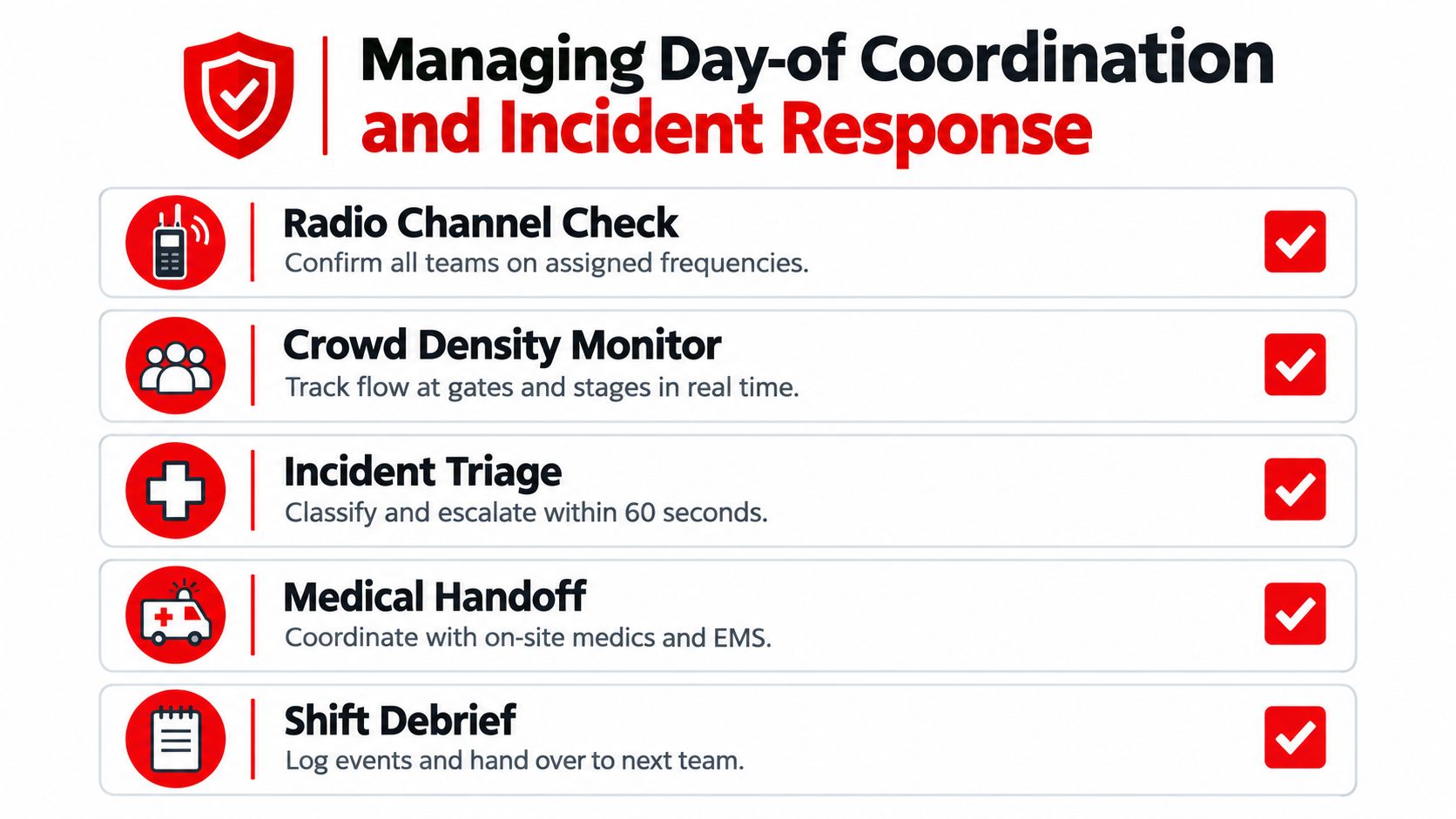
At the start of the shift, confirm the radio channel, call signs, backup method and supervisor contacts. During operations, monitor crowd density at gates, stages, bars and exits. When a report comes in, triage it quickly, send the right resource and keep the access route clear for medical staff or emergency services.
A medical handover should include the person's location, observed condition, hazards, witnesses and actions already taken. Security staff should protect the area and assist access, not crowd the patient or make a medical diagnosis. The same principle applies to drug-affected patrons, who should receive medical review before removal where the situation requires it.
Record what happened, not what you assume
The incident register should capture the time, location, people involved, objective observations, staff who attended, actions taken, witnesses, medical involvement, police attendance and the final handover. For NSW festival settings, that includes thefts, assaults, ejections, drug seizures, weapons, missing persons, police attendance and the officers involved. Queensland licensed venues also need disciplined crowd-controller sign-in and sign-out records, plus incident recording where applicable.
At shift change, the outgoing supervisor should read open incidents aloud, transfer any physical documents securely and identify unresolved risks. The incoming supervisor should confirm the roster, inspect priority zones and acknowledge the handover. A register without a handover is only a history book. The handover makes it operational.
Incident discipline: If it matters enough to change a deployment decision, it matters enough to record clearly.
Use the completed records for a post-event review. Look for repeated queue pressure, delayed medical access, unclear radio calls, missing signatures and roles that were routinely pulled away from their assigned zones. Those findings should change the next risk assessment, not disappear into an archive.
GM GROUP Services provides licensed event security across NSW, Victoria, Queensland and the ACT, including crowd controllers, static guards, K9 units, VIP protection, covert operations, supervision and risk assessments. If your event needs a documented deployment plan with clear handovers and responsive on-site management, contact GM GROUP Services to discuss the venue, audience and operating risks before the roster is finalised.
Discover more from GM Group Services
Subscribe to get the latest posts sent to your email.