
Event security plan work usually becomes urgent at the worst possible time. A promoter may be 10 days out from a 12,000-capacity coastal festival, facing a venue “shape-up” email, conflicting council and police directions, and an inbox full of generic security quotes. A roster and a row of hi-vis vests won't resolve unclear evacuation authority, an unmanaged stage-front surge, or a licensing gap.
An event security plan is a written, signed-off operating instrument. It assigns people to defined tasks, records risk controls, sets communications and escalation rules, and gives the venue, organiser, police and emergency services one version of the truth. It also has to match the event's jurisdiction, licence conditions and operating environment across NSW, Victoria, Queensland and the ACT.
![A layered event security plan framework showing risk assessment, licensing, crowd flow, communications and emergency response.]
Why Every Event Needs an Event Security Plan
A plan earns its keep before the first guest arrives. On site, it turns broad intentions into instructions such as who controls an entry lane, who can stop an unsafe queue, which supervisor authorises an evacuation message, and where ambulance access must remain clear.
In New South Wales, the compliance position is explicit. The NSW Government safety and security guidance states that anyone undertaking a security activity must be appropriately licensed. Organisers operating under the Music Festivals Act 2019 must submit a safety management plan at least 90 days before the festival, keep an approved copy on site, and provide it to police or emergency officers when requested. The plan must identify entry and exit points, emergency-vehicle access, evacuation points, patron boundaries, medical assistance and supervised relaxation spaces.
That makes the document more than a staffing schedule. It has to coordinate crowd management, welfare, access control, emergency response and inter-agency decisions. For agreed health and medical plans, NSW Health requires submission at least 60 days before the event, while the Act requires an addendum at least 14 days before the festival covering provider qualifications and work experience.
Operational rule: If a control isn't assigned to a person, placed on a map and checked at a stated time, it isn't ready for deployment.
The wider Australian context points in the same direction. Drug-related harm, crowd pressure and emergency coordination failures have made regulators more interested in the quality of the written plan and its evidence trail. NSW guidance also expects risk analysis, control development, continuous monitoring and record keeping, while Victoria's crowded-place guidance recommends a layered model based on deter, detect, delay and respond.
The practical method is straightforward:
- Define the event and its compliance boundaries.
- Assess site-specific risks and document controls.
- Derive staffing and roles from those risks.
- Design communications, crowd flow and emergency response.
- Verify every control before doors open.
- Keep the plan live during operations.
- Record incidents and improve the next deployment.
Defining Scope, Scale and Compliance Boundaries
Start with a scope statement, not a guard quote. Record whether the event is a concert, festival, sporting fixture, corporate function or recurring venue programme. Then capture attendance profile, licensed areas, operating hours, expected peaks, transport interchanges, neighbouring properties, temporary structures and the authority responsible for the relevant approval.
The organiser should identify the exact notice, permit or licence that governs the event. Don't assume the venue's usual approval covers a temporary festival footprint or a road closure.
Build the jurisdiction map
The available AU guidance shows that event obligations can turn on attendance, duration, event type and state-specific approval pathways. NSW council guidance states that crowd management is required for events of 100 or more people, and road closures create an additional professional-consultant obligation for crowd security and traffic control. The Waverley and NSW local-government event guidance is useful when testing whether a community event has crossed that threshold.
| Jurisdiction | Triggering attendance or conditions | Governing authority | Key legislation |
|---|---|---|---|
| NSW | Events of 100 or more people require crowd management under cited council guidance. Music festivals have plan submission and content requirements. | NSW Government, councils, police and emergency services | Music Festivals Act 2019 and applicable council requirements |
| Victoria | Apply the relevant crowded-place and major-event approval pathway identified by the responsible authority. | Victorian Government, councils and Victoria Police | Applicable private-security and event legislation |
| Queensland | Licensed-premises and public-event security work requires appropriately licensed crowd controllers. | Queensland Government and Office of Fair Trading | Security Industry Regulation framework |
| ACT | Confirm whether the event is treated as a major event and identify the applicable approval and WorkSafe ACT consultation pathway. | ACT Government and relevant regulators | Applicable ACT major-event and security requirements |
Don't add unsupported thresholds to a working plan. Instead, attach the actual approval notice, licence conditions and correspondence that establish the event's obligations. A defensible scope page should include:
- Event definition: name, type, venue, dates and operating hours.
- Attendance profile: expected capacity, peak zones and licensed areas.
- Regulator: approving authority, contact person and reference numbers.
- Plan owner: named organiser or security lead with revision authority.
- Controlled documents: site plan, risk register, emergency plan and licence evidence.
Use a signed scope statement
The plan owner signs the scope statement and records the revision date. If the venue footprint changes, the attendance model shifts or a road closure is added, the owner reopens the scope rather than leaving the old assumptions in place.
Running a Risk Assessment That Actually Holds Up
A risk register should explain why a control exists, rather than just list familiar hazards. NSW Government risk guidance requires hazards to be analysed and rated, control measures developed, and the plan monitored and reviewed throughout the event. It also expects records to be kept for legal review and future improvement. The NSW risk assessment and management guidance supports treating the register as a live operating document.
Use a consistent matrix, such as a documented likelihood and impact system, and record the assessor, date, approval and next review. A register without revision control won't tell you which assumptions applied when an incident occurred.
Focus on the site's real pressure points
Start with the hazards that can change the outcome quickly:
- Crowd pressure: stage-front surges, mosh-pit compression, queue spillback and blocked egress.
- Health and welfare: drug and alcohol harm, heat, fatigue and delayed medical access.
- Perimeter threats: vehicle approach, unauthorised entry and poor separation from public roads.
- Infrastructure failure: severe weather, power loss, lighting failure and radio or network outage.
- Accessibility: evacuation of people with disability and support for identified vulnerable patrons.
- Operational conflict: unclear authority between security, production, venue management and emergency services.
For each hazard, document the cause, consequence, initial rating, control owner, residual rating and review trigger. Controls might include welfare services, cool-down routes, amnesty bins, separate general-admission and VIP flows, CCTV retention aligned with applicable NSW Liquor & Gaming requirements, and harm-reduction messaging.
The Australian Institute for Disaster Resilience manual recommends a written emergency response plan covering on-site handling, escalation, handover, authorised evacuation roles, event interruption, a grid plan, access and evacuation routes, evacuation areas and an incident control centre with backup power and lighting. The AIDR mass-gathering manual gives the plan a practical test. If authority, routes, lighting and communications aren't specified, response will depend on improvisation.
Let residual risk drive deployment
Staffing follows the residual risk. A dense stage-front zone may need a supervisor, response coverage, welfare liaison and clear extraction route, while a low-traffic asset store may need controlled access and periodic checks. Sign the register after the final site walk, then reopen it when the weather, programme, layout or crowd behaviour changes.
Staffing, Licensing and Role Allocation
Guard numbers are an output, not an input. The correct deployment comes from peak attendance, entry and exit pinch points, licensed and unlicensed zones, stage-level pressure, response time, communications coverage and the controls recorded in the risk register.
A role map should name the incident controller, floor supervisors, egress marshals, roving response pairs and backstage officers. Each role needs a post location, shift window, radio channel, escalation line and evidence of the required licence or competency.
Match the role to the state
In NSW, the organiser must ensure people carrying out security activities such as crowd control or bouncer duties are appropriately licensed. Queensland's licensing guidance covers crowd controllers at licensed premises and public sporting events, restaurants and shopping centres. Applicants must be at least 18, complete approved training, provide 100 points of identification and undergo police fingerprinting. Queensland also requires ongoing training every 3 years and CPR refreshers every 12 months while a first-aid certificate remains current, as set out in the Queensland crowd-controller licence requirements.
Victoria's private-security process requires applicants to be 18 or over, hold Australian residency or a current visa with working rights, provide fingerprints and 100 points of certified identification, and demonstrate competency through approved training. Interstate personnel may require a Temporary Visitor Permit for special-event work. The Victoria Police private-security eligibility guidance should be checked before deploying touring staff.
| State | Governing framework | Licence evidence | Supervisory rule | Main staffing driver |
|---|---|---|---|---|
| NSW | Security Industry Act 1997 and applicable event approvals | Current licence appropriate to the activity | Match supervision to event risk and approval conditions | Crowd density, access control and response coverage |
| VIC | Private Security Act 2004 framework | Victorian licence or eligible Temporary Visitor Permit | Confirm class and interstate eligibility | Zone risk, licence class and crowd-flow duties |
| QLD | Security Industry Act 1993 framework | Current crowd-controller licence and training currency | Verify licence and refresher records | Licensed areas, public access and shift readiness |
| ACT | Security Industry Act 2003 framework | Current ACT evidence for assigned duties | Confirm supervisory requirements | Event significance, site risk and command structure |
Keep a deployment file with licence evidence, expiry checks, training records and post orders. If you need branded high-visibility PPE, buying custom safety vests can help distinguish supervisors, marshals and welfare personnel, provided the vest design doesn't confuse staff with police, medical responders or emergency services.
Remove uncertainty from the post order
A post order should state what the officer watches, what they may decide, what they must report, and when they escalate. The Event Operations Plan should reconcile with payroll, shift times, contractor names and incident records. Late substitutions, missing credentials, fatigue or failed radio checks are hard-stop issues, not minor administration.
Comms, Crowd Flow and Emergency Response Design
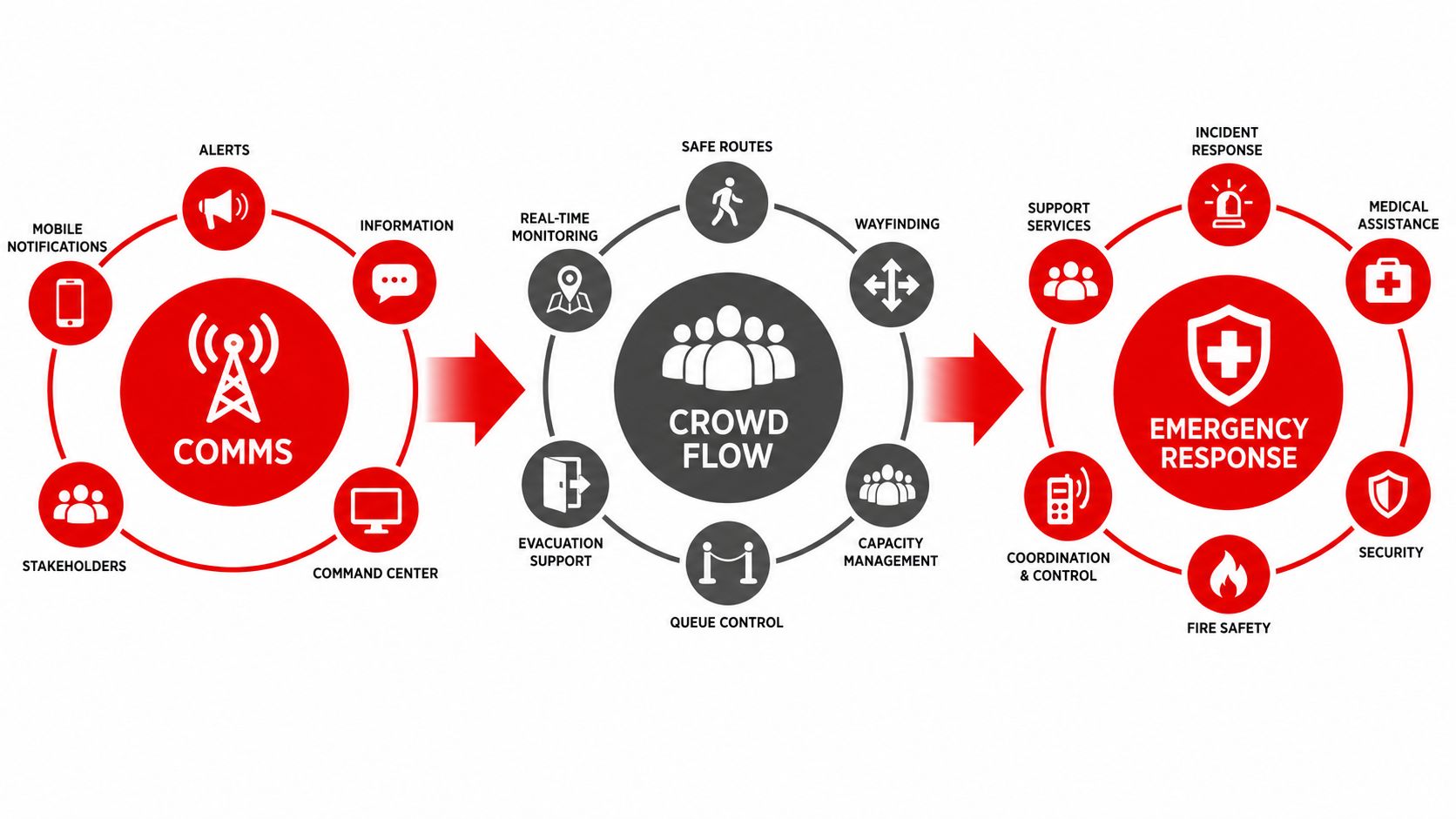
Draw the communications architecture before finalising the site map. The incident controller needs a command channel, each functional group needs a working channel, and incident traffic needs a tactical path that doesn't drown in routine gate calls. Declare a backup channel and test it in the places where concrete, stages, temporary fencing and distance may weaken coverage.
Build the command picture
The Mobile Incident Control Centre should have clear sightlines to high-density zones where possible. Its pack should contain the current site plan, grid references, emergency contacts, approval documents, incident log, decision record and backup lighting and power arrangements.
A workable design normally identifies:
- Radio groups: command, access control, crowd operations, welfare and response.
- Escalation language: plain-language calls for medical incidents, crowd pressure, fire, missing persons and threats.
- CCTV oversight: named monitor operators, camera coverage limitations and evidence-handling rules.
- PA authority: who can issue an operational message, pause an event or direct evacuation.
- External liaison: police, ambulance, fire, venue management and transport contacts.
Treat movement as a safety system
Map ingress gates, queue holding areas, sweep intervals, emergency lanes, circulation routes and egress paths. The plan should identify where a queue can spill, where a stage-front crowd can compress, and how staff will stop entry without creating a second hazard.
The Victorian crowded-places guidance recommends assessing risks and applying proportionate deterrence, detection, delay and response measures. It also warns against prioritising crowd experience while leaving security planning exposed. Detailed site maps and dimensions shouldn't be published indiscriminately in promotional material, because excessive layout information can assist hostile reconnaissance.
Pre-assign emergency decisions
Record evacuation routes, assembly areas, medical posts, emergency-vehicle access and liaison points. Define wet and dry severe-weather triggers, lost-child and missing-person procedures, event-interruption authority, and handover to emergency services.
Backup power isn't a line item to tick without testing. Log radio, lighting and CCTV fail-over tests before doors open, including the result, owner and corrective action. If a communications failure changes the response method, write that alternative into the plan.
The Pre-Event Checklist Before Doors Open
The final checklist should be dated, time-stamped and signed line by line. Give every item an owner and a hard-stop rule. A security manager shouldn't have to decide at the gate whether an unresolved licensing issue is acceptable.
Verify people and documents
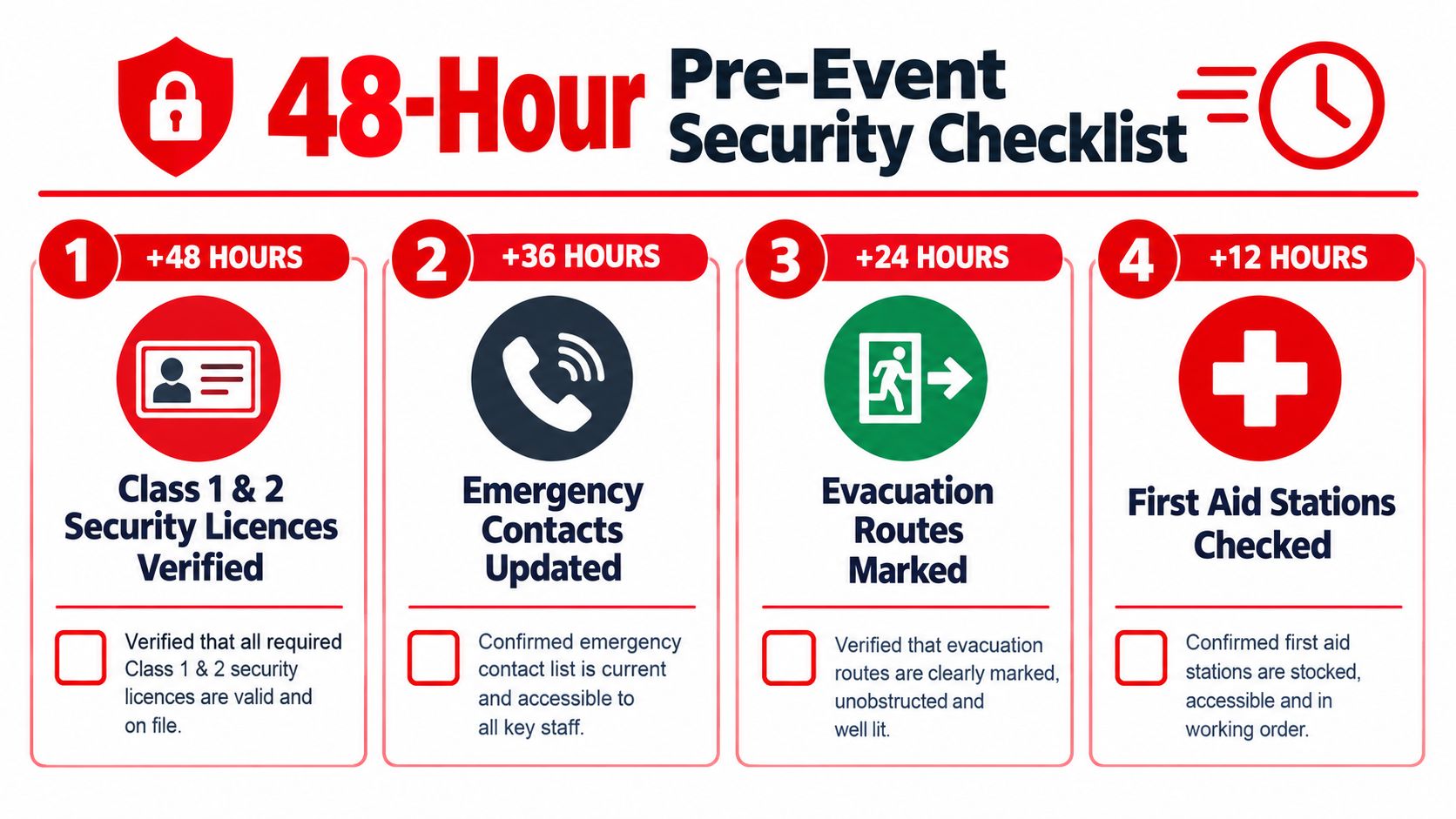
During the 48 hours before opening, check current Class 1 and Class 2 evidence against the relevant NSW Security Licensing Register, Victorian public register, Queensland Office of Fair Trading licence search and Access Canberra register. Confirm signed Work Health and Safety Safe Work Method Statements, Working with Vulnerable People cards where staff interact with minors, pre-shift drug and alcohol attestations, PPE issue records and the final post allocation.
Then verify the operational pack:
- Contacts: Print the inter-agency contact sheet and lodge it in the incident control centre.
- Communications: Test radios and PA, record signal coverage, and confirm spare batteries.
- Surveillance: Confirm CCTV recording, camera views, time synchronisation and the required retention arrangement.
- Medical readiness: Sight the first-aid and defibrillator service agreement, then check station access.
- Insurance: Match the certificate of currency to the approved event profile and attendee assumptions.
- Briefing: Issue the final 24-hour agenda and retain the attendance register.
- Site controls: Mark evacuation routes, emergency access, assembly areas and welfare locations.
- Equipment: Confirm barriers, signage, torches, radios, high-visibility identifiers and incident forms.
The 2026 event registration and hygiene guide can sit alongside the broader event-readiness pack when organisers are checking registration processes and hygiene arrangements.
Make incomplete controls visible
A hard stop should state the consequence. For example, unverified licence evidence means the person isn't deployed, a failed radio test means the post receives a replacement device or alternate communication method, and an obstructed exit means the event doesn't open that zone until cleared.
The security lead signs the completed checklist and records unresolved items in the incident control centre log. A verbal assurance isn't a substitute for evidence that another manager can inspect.
Practical Tips and Common Event Security Questions
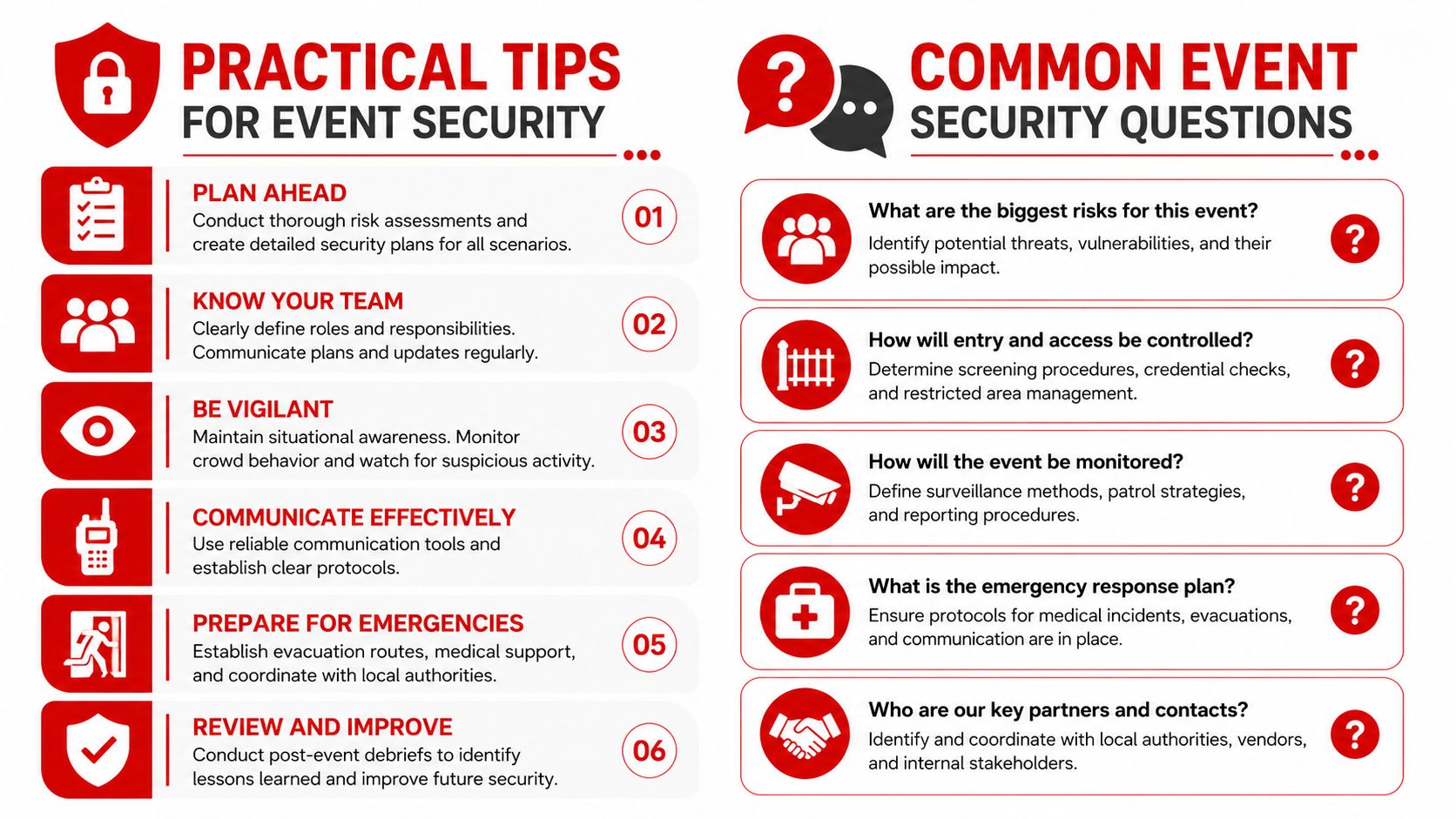
Keep the plan live through bump-in, show and bump-out. Run a 0600 brief, update the event picture as contractors and infrastructure arrive, then hold an 1800 stand-down debrief when the operation closes. Time-stamp every revision, keep hard copies in the incident control centre and gatehouse, and give the person making a decision a defined 30-minute escalation window before a developing issue becomes a delayed response.
A late subcontractor can appear cheaper until the organiser has to verify licences, brief unfamiliar staff, rebuild post orders and repair a broken chain of command. If the risk assessment supports additional coverage, a 10% guard buffer is usually more useful than trying to fill gaps during the event. The exact deployment still has to come from the site and risk profile, not a generic ratio.
Questions event managers ask
How does the NSW Music Festivals Act 2019 affect crowd-control submissions?
It makes the safety management plan a formal submission with defined content and timing. Under the NSW Government guidance, festivals must submit the plan at least 90 days before the event, keep the approved copy on site, and include access, evacuation, patron boundaries and harm-reduction locations. Health and medical planning has separate submission and addendum requirements, so the security lead should maintain a dated compliance register.
When does a Class 1 or Class 2 event apply in Victoria?
Don't rely on a generic label. Confirm the event's classification, licence pathway and staffing implications with the responsible Victorian authority, then verify every worker's Victorian licence or Temporary Visitor Permit status. The Victoria Police licensing guidance is the practical starting point for personnel eligibility.
What should a Queensland contractor check include?
Verify the crowd-controller licence, approved training evidence, identification and currency of required refreshers. A contractor's assurance isn't enough. The organiser should retain the licence search result and link each worker to a named role and shift.
When should ACT organisers consult WorkSafe ACT?
Start when the event introduces material work health and safety risks, temporary structures, unusual crowd conditions or complex contractor arrangements. Record the consultation, decisions and resulting controls in the plan rather than treating it as an informal conversation.
What survives contact with the gates?
Clear authority, short radio messages, visible supervisors, unobstructed emergency access, welfare teams that can reach distressed patrons, and a plan that changes when the site changes. The SafeWork NSW major-event safety guidance supports continuous monitoring and review, which is exactly what the control room needs during a live operation.
If your team needs help turning a risk register into posts, communications, access controls and emergency procedures, GM GROUP Services provides licensed event security, crowd control, risk assessments, supervision and response coverage across NSW, Victoria, Queensland and the ACT. Share your venue plan, approval timeline and event profile with the team so they can help build a site-specific deployment that is ready for review and operation.
Discover more from GM Group Services
Subscribe to get the latest posts sent to your email.