
When you're planning an event in Melbourne, getting the security right is the absolute bedrock of its success. Event security Melbourne specialists will tell you it's not just about ticking a box; it's about protecting your guests, your valuable assets, and the reputation you've worked so hard to build. A solid security plan is a careful mix of licensed professionals, smart risk assessment, and knowing the local rules inside and out to create an atmosphere where everyone feels safe and welcome. This applies to everything, from a huge music festival down at the Sidney Myer Music Bowl to an intimate corporate function in the CBD.
Why Proactive Event Security Is Essential
Putting together a brilliant Melbourne event means creating a safe and positive vibe for everyone who walks through the door. This is where getting your event security Melbourne plan sorted early on becomes your greatest advantage. It's so much more than just a cost on your spreadsheet; a professional security strategy is what stands between a smooth-running event and a potential disaster, protecting your attendees, your gear, and your brand.
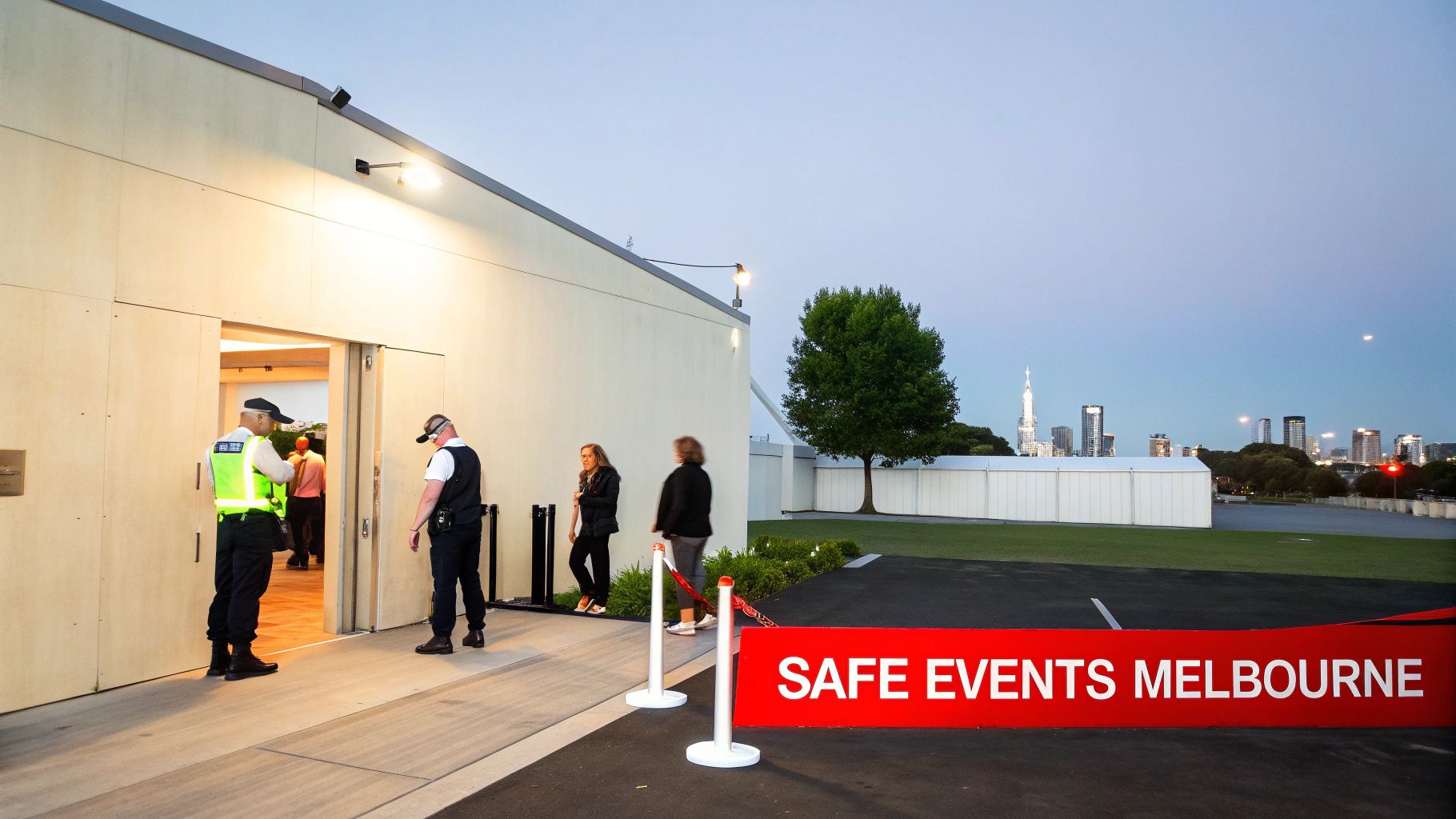
We'll get into the common risks event organisers face right here in Melbourne—from handling the high energy of festival crowds to keeping things orderly at a high-stakes corporate gala. It's also worth remembering that security needs vary wildly depending on the event type; the approach for one of the top corporate team building activities will be completely different from a public concert.
The True Cost of Inadequate Security
Cutting corners on security is a gamble that can backfire spectacularly, with consequences that ripple out long after the last guest has left. A single incident can spiral into financial chaos, legal nightmares, and serious damage to your public image. In Victoria, having a tailored, compliant security plan isn't just a good idea—it's non-negotiable.
Practical Example: An understaffed corporate product launch could see someone walk out with sensitive prototypes or data. Or picture a music festival where poor queue management leads to a crowd surge. That's not just a dangerous situation; it's a terrible experience for your patrons before the first act even hits the stage.
Transforming Liability into a Positive Experience
When you get security right, it stops being a potential headache and becomes a key part of a seamless, positive experience for your guests. People who feel safe are free to relax, have a good time, and really engage with what you've created.
A professional approach delivers on multiple fronts:
- Guest Safety First: The right team deters trouble before it starts and can react instantly to everything from a medical issue to a heated argument.
- Protecting Your Assets: Guards are there to prevent the theft of expensive AV equipment, merchandise, and even your guests' personal items.
- Guarding Your Reputation: A secure event shows you're a professional who cares, and that builds incredible trust with your audience.
This guide is all about showing you how smart security planning is the cornerstone of any successful and memorable Melbourne event.
Laying the Groundwork for a Secure Event
Before the first guest even thinks about arriving, the foundation for your event’s security needs to be rock-solid. This is the stage where planning your event security Melbourne goes from being a line on a checklist to your most critical safeguard. It's all about getting ahead of potential problems and making sure you're ticking every single compliance box.
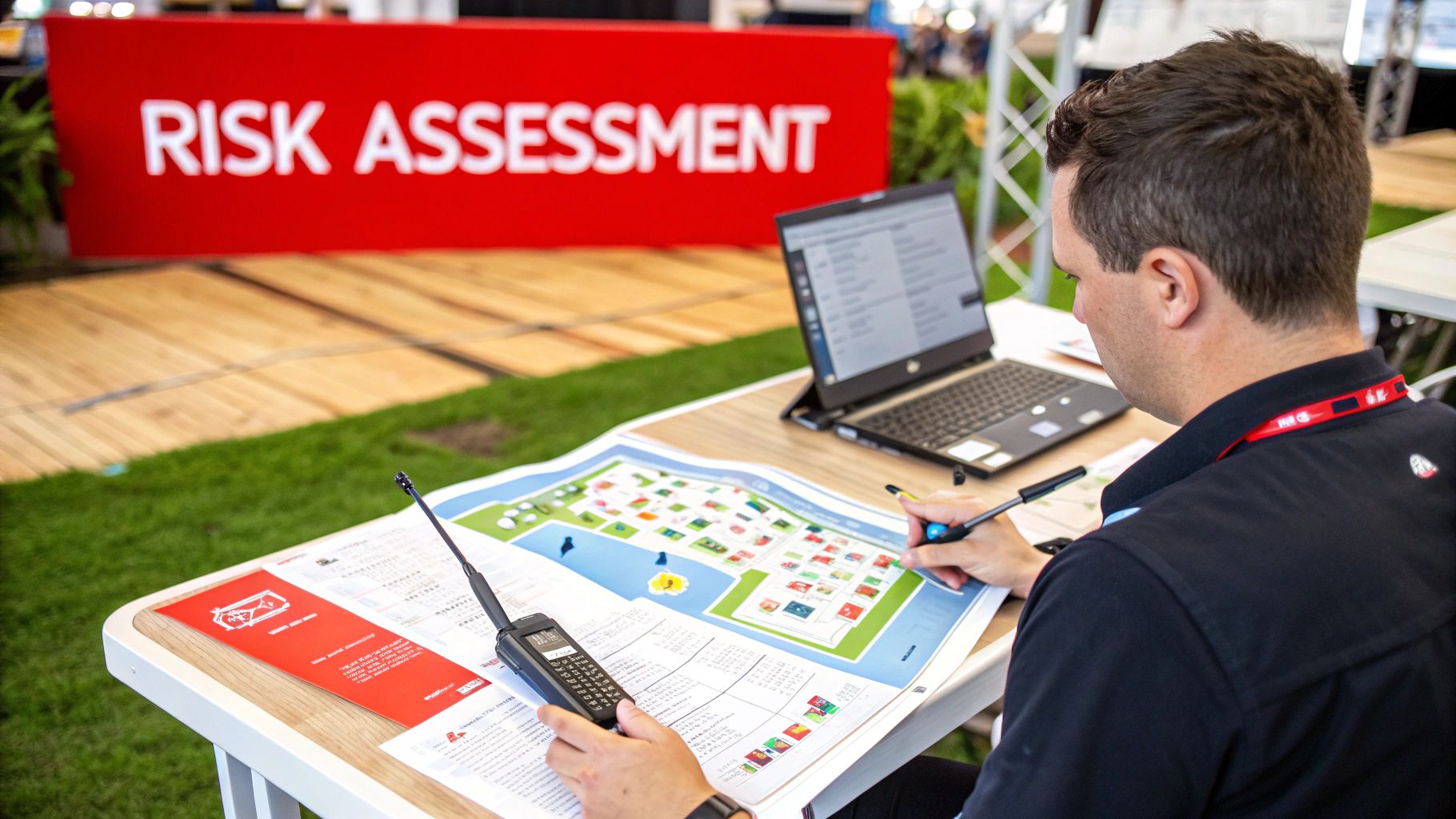
One of the first, and most crucial, things we do is get a handle on potential threats by conducting a comprehensive risk assessment. This isn't just a quick stroll around the venue; it’s a deep dive into every single thing that could go wrong based on your specific event.
Uncovering Venue and Event Vulnerabilities
Every venue in Melbourne, from a slick conference centre to a sprawling park, has its quirks and weak spots. A proper assessment means methodically mapping them out.
- Entry and Exit Points: It's not just about the front door. Where are the staff entrances? The loading docks? Any point of access that isn't locked down is a potential vulnerability.
- Crowd Flow: We look for the pinch points. These are the narrow hallways, poorly positioned bars, or merch stalls that can create frustrating, and sometimes dangerous, bottlenecks.
- Perimeter Security: For an outdoor event, is the boundary clear and genuinely secure? Indoors, are there ground-floor windows or doors to adjoining buildings that could be easily accessed?
Actionable Insight: For a laneway festival in the CBD, a classic Melbourne event, there can be dozens of unofficial entry points. A good risk assessment would immediately flag those alleys. The solution? Position static guards or install temporary fencing to funnel everyone through proper checkpoints. It’s a simple fix that completely changes your control over who comes and goes.
Navigating Victorian Permits and Compliance
Getting the paperwork right isn't just bureaucratic box-ticking—it's the law. In Victoria, getting this wrong can shut your event down on the spot or land you with some seriously painful fines. Your whole security strategy has to be built on a compliant framework.
Here are the non-negotiables:
- Council Permits: You’ll need the green light from the relevant Melbourne council, and they will almost always have specific conditions tied to security and public safety.
- Liquor Licensing: If alcohol is on the menu, you're playing by the rules of the Victorian Gambling and Casino Control Commission (VGCCC). There’s no grey area here.
- RSA Certified Staff: Every single person serving alcohol and all security personnel must hold a current Responsible Service of Alcohol (RSA) certificate. No exceptions.
The truth is, even well-managed major events can face issues. You only have to look at something on the scale of the Australian Open to see the challenges. Large-scale events often deal with arrests for public intoxication and disorderly conduct, which just hammers home how vital it is to have your crowd management and security protocols sorted from day one. You can read more about how Australian event security adapts to these challenges on ShieldCorporateSecurity.com.
Building Your A-Team: Your Guide to Event Security Melbourne
The best security plan on paper means nothing without the right people on the ground to make it happen. Honestly, a lot of organisers just think about getting a certain number of guards, but that's a rookie mistake. Building a genuinely effective event security Melbourne team is about understanding what your event actually needs and putting the right people in the right places.
Think about it. The security setup for a massive food festival stretching across Birrarung Marr is worlds away from what you’d need for a black-tie awards night at the Grand Hyatt. One demands a highly visible presence to manage huge crowds, while the other calls for subtlety and tight access control. Nailing that difference is what separates a smooth event from a chaotic one.
How Many Staff Do You Really Need?
Working out your staffing numbers is a balancing act between venue rules, crowd size, and the general vibe of your event. For something like a music festival with 5,000 people in an open park, a good starting point is one guard for every 100-250 attendees.
But here’s the kicker: as soon as you bring alcohol into the mix, everything changes. The potential for trouble goes up, so that ratio often needs to tighten to 1:100. When you're budgeting, remember that security can run you anywhere from $37 to $105 an hour per guard, all depending on their specific role and your event's risk level. If you want to dive deeper, you can learn more about calculating security guard numbers and find the perfect fit.
Actionable Insight: Don't just apply a blanket ratio and hope for the best. Your risk assessment is your bible here—it tells the real story based on who's coming, the venue layout, and any past incidents. A high-profile guest list or a history of incidents at the venue might mean you need to increase your security presence.
Getting the numbers right is crucial, but it's not the whole picture. The type of security you deploy is just as important. Below is a simple table to give you a solid starting point for different kinds of Melbourne events.
Recommended Security Staffing Ratios For Melbourne Events
| Event Type / Venue | Low Risk (No Alcohol) | High Risk (Alcohol Served) |
|---|---|---|
| Corporate Function / Conference | 1 per 150-200 attendees | 1 per 100-120 attendees |
| Private Party / Wedding | 1 per 100 attendees | 1 per 50-75 attendees |
| Indoor Concert / Theatre | 1 per 100-150 attendees | 1 per 75-100 attendees |
| Outdoor Festival / Public Event | 1 per 150-250 attendees | 1 per 100 attendees |
Remember, this table is a guide. Always refer back to your detailed risk assessment to finalise your numbers.
Choosing the Right Roles for Maximum Impact
A smart security operation isn't just a sea of uniformed guards; it's a team of specialists, each with a clear purpose.
Static Guards: These are your rock-solid anchors. You'll post them at key spots like entrances, exits, and VIP areas. They’re brilliant for access control, protecting expensive gear, and just being a visible deterrent. Their job is to hold the line.
Crowd Controllers: Think of these guys as your dynamic response team. They’re constantly on the move, weaving through the crowd to manage flow, spot potential flare-ups before they escalate, and make sure fire exits stay clear. They are your eyes and ears inside the event.
Specialised Units: For certain events, you need to bring in the big guns. K9 teams are non-negotiable for large-scale public events where you need bomb detection. For your high-profile speakers or performers, VIP protection officers provide that discreet, close-contact security that keeps them safe without making a scene.
When you start mixing and matching these roles to fit your event, you’re no longer just "hiring security." You’re building a strategic defence force tailored perfectly to what you need.
Getting Your Security Team Up to Speed: The Briefing
You can hire the best security firm in Melbourne, but if you don't brief them properly, you're rolling the dice. Think of your security team as an extension of your own event staff. For them to be truly effective, they need to be brought into the inner circle.
A solid briefing is what turns a group of hired guards into your team for the day. It’s the critical step that bridges their security expertise with the unique needs of your event. Skipping this or doing it poorly is like giving someone the keys to your house but not telling them which one is for the front door.
To get the conversation started, it helps to understand where your event falls on the risk spectrum. This quick flowchart can help you frame those initial thoughts.
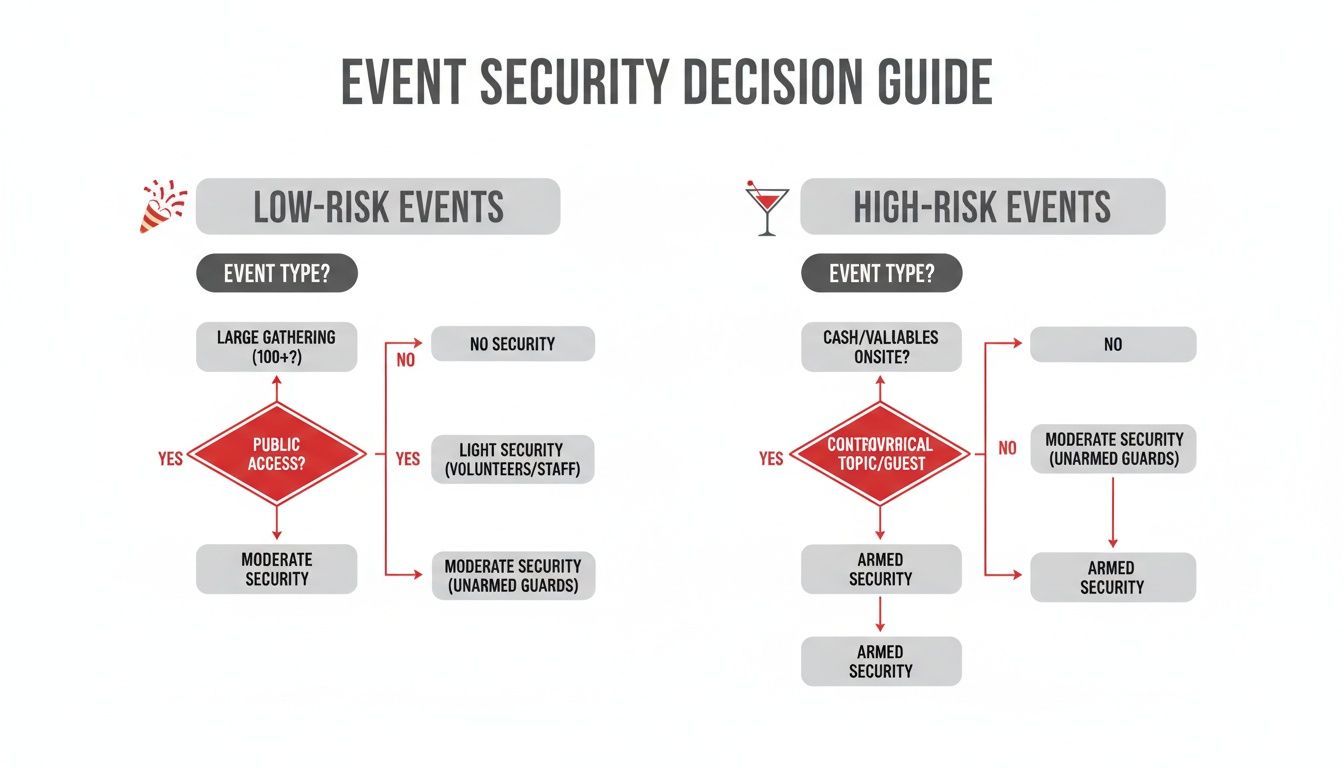
As you can see, things like serving alcohol or expecting a big crowd instantly push your event into a higher-risk category, which means the detail in your briefing becomes even more crucial.
What Goes Into a Great Briefing?
A powerful security briefing isn't just a five-minute huddle before the doors open. It’s a proper handover of information that gives your security team the context they need to make smart, fast decisions.
Your briefing pack should be clear, comprehensive, and easy to digest. Here's what you absolutely must include:
- A Detailed Run Sheet: This is your event's bible. A minute-by-minute schedule helps security anticipate pinch points, like the surge to the front when a headline act starts or the mass exit at the end of the night.
- Venue Maps with Security Zones: A standard floor plan isn't enough. Mark it up yourself. Show exactly where each guard should be, where the first aid stations are, all emergency exits, and any areas with high-value gear.
- Key Contact List: This is non-negotiable. A laminated sheet with names, photos, and phone numbers for your event managers, the venue contact, medical lead, and anyone else critical. In a crisis, no one has time to scroll through their phone.
- Rules of Engagement: Be crystal clear about your expectations. What’s the procedure for a lost child? How should they de-escalate a heated argument? At what specific point do they call the police? Spell it all out.
Practical Example: I once ran a corporate launch with a surprise pyrotechnics display. Because we'd included it in the run sheet, the security team knew it was coming. They weren't startled by the bang and were able to calmly reassure guests, preventing what could have easily turned into a moment of panic.
Keeping the Lines of Communication Open
On the day of the event, communication needs to be instant. Radios are the industry standard, but you need to think about structure.
Who does the on-ground security supervisor report to? Who has the final say? It's smart to set up dedicated radio channels—one for general operational chatter ("the queue at bar two is getting long") and a separate, sacred channel just for emergencies.
This simple step ensures that a genuine emergency call doesn't get lost in the noise. Regular, scheduled check-ins between your event manager and the security team leader are also a great way to stay on the front foot. When your event security melbourne partner is armed with this level of detail, they stop being just a contractor and become a core part of your success.
Putting Your Security Plan Into Action (And Preparing for When Things Go Sideways)
This is where the rubber meets the road. All your careful planning comes down to execution on the day. With your team briefed and ready, your focus shifts to the nitty-gritty of logistics, timing, and having a solid plan for when things don't go to script. A truly successful event isn't just about a great plan; it's about flawless coordination and being prepared for the unexpected.
One of the biggest logistical hurdles organisers trip over is timing. If you're planning a large-scale event during Melbourne's packed spring or summer festival season, you need to be locking in your security provider 3-6 months in advance. For a smaller corporate function, you might get away with 4-6 weeks, but booking early saves you the headache of last-minute scrambles and ensures you get a quality, experienced team.
Budgeting: It's More Than Just an Hourly Rate
When you're putting together the budget, it's tempting to just look at the hourly rate for a guard. That’s a mistake. A realistic security budget covers the whole picture, not just the headcount.
You'll need to think about a few other potential costs:
- Specialised Gear: Does your event need two-way radios, body cameras, or metal detectors? This all depends on the risk profile.
- K9 Units: For high-profile guests or serious screening needs, K9 teams are an incredibly effective, specialised resource.
- Public Liability Insurance: This is non-negotiable. Check that your security provider's insurance meets the venue’s requirements and is robust enough for your event's size.
- Weekend & Public Holiday Rates: Remember that guard rates will be higher for work on weekends or public holidays.
Factoring these in from the start means your budget is useful and you won't get hit with surprise costs later.
Preparing for the Unexpected
Look, no matter how perfectly you plan, things can happen. The real mark of a secure, well-run event isn't the total absence of problems. It's having clear, well-rehearsed emergency plans ready to go at a moment's notice.
The goal isn't to magically prevent every possible issue. It's to have an immediate, tested response for the most likely ones. A clear plan gives your security team the confidence to act decisively, turning a potential crisis into a managed incident.
Work with your provider to develop simple protocols for common scenarios.
- Medical Issues: Who calls for medical help? Who secures the area to give the person privacy, and who manages crowd flow around the scene?
- Heated Arguments: There must be a de-escalation procedure. The first goal is always to resolve a conflict with words before it gets physical.
- Venue Evacuation: You need primary and secondary evacuation routes mapped out. Every security staff member must know how to calmly guide guests to muster points.
Lastly, make sure you have a straightforward incident reporting system. Every single thing that happens, no matter how small, should be logged. This isn't just for insurance paperwork; it’s gold dust. That data helps you refine your event security Melbourne strategy and make your next event even safer.
It’s About More Than Just Security – It’s About the Experience
At the end of the day, top-notch event security in Melbourne isn't just about ticking boxes or preventing trouble. It's about actively creating an environment where people feel safe, welcome, and free to enjoy themselves. When security is handled with professionalism and care, it stops being a background chore and becomes a visible part of a well-run event.
Think of it this way: every piece of the puzzle, from that initial risk assessment to the final team briefing, comes together to build confidence. That feeling of safety is what allows your guests to relax and have a truly memorable time.
Your Reputation is on the Line
Bringing in a seasoned team like GM GROUP Services is a direct investment in your event’s success and, just as importantly, your brand’s reputation. You're not just hiring guards; you're handing over the responsibility for your guests' wellbeing to licensed professionals who have seen it all before.
When your attendees feel secure, they're not worried. They're engaging, they're spending, and they're creating the kind of positive buzz that brings people back year after year. That's how you build a legacy.
Hopefully, this guide has given you the confidence to make smarter, more informed decisions about your security planning. The goal is always the same: to run an event that’s remembered for all the right reasons.
Frequently Asked Questions about Event Security Melbourne
Even the most organised event planner runs into questions when it comes to security. To give you clarity, here are answers to the most common questions we hear from organisers on the ground in Melbourne.
How far in advance should I book my event security Melbourne team?
For a large-scale event like a festival, book 3-6 months in advance. For smaller functions, 4-6 weeks is usually sufficient. Melbourne’s event calendar is packed, so booking early gives you access to the best, most experienced teams.
What licences do security guards need in Victoria?
Every guard must hold a current Private Security Individual Licence issued by Victoria Police. If alcohol is served, any crowd controllers must also have a valid Responsible Service of Alcohol (RSA) certificate. Always ask your provider for proof of licensing.
Can a guard legally remove someone from my event?
Yes. Licensed crowd controllers can legally remove a person from a venue for disorderly, violent, or intoxicated behaviour. The focus is always on de-escalation first, using clear communication to resolve issues before physical intervention is needed.
What information does my security company need from me?
The more detail, the better. Provide them with:
- A detailed event schedule or run sheet.
- A venue map marking entrances, exits, first aid stations, and restricted areas.
- A list of key contacts with mobile numbers.
- An outline of your emergency response plan.
Ready to secure your next event with a team that prioritises safety and professionalism? GM GROUP Services provides expert, licensed security solutions tailored for any Melbourne event, from corporate functions to large-scale festivals. Ensure your guests have an unforgettable and safe experience. Secure your event with GM GROUP Services today.
Discover more from GM Group Services
Subscribe to get the latest posts sent to your email.