
Event security cost in Australia usually starts around A$45–A$85 per guard per hour as a practical baseline, but the final price depends heavily on risk, event type, and location. For lower-profile work, independent pricing guidance puts guards around A$25–A$40/hour, while higher-risk or more specialised coverage rises to A$50–A$85/hour, and short bookings often still trigger a four- to six-hour minimum.
If you're finalising a run sheet, juggling venue demands, and trying to stop the budget from blowing out, security is often the line item that suddenly stops everything. A quote comes in, the hourly rate looks straightforward for about five seconds, and then you realise you're not buying a single person standing at a door. You're buying licensed labour, supervision, compliance, rostering, incident response capability, and a plan that has to work when the crowd changes mood.
That's why event security cost catches new organisers off guard. A small corporate function, a licensed hospitality activation, and a festival with the same duration can land in very different budget territory. In practice, the difference usually comes down to risk, staffing density, state compliance, and whether the provider has priced the job properly or just made the number look attractive on page one.
Planning Your Event Budget The Security Question
You're probably at the point where the event is becoming real. Tickets are moving, vendors want bump-in times, the venue needs final numbers, and someone has asked, “What have we allowed for security?” That's usually the moment the simple version of event planning disappears.
Why event security cost gets underestimated
Most organisers start with headcount and hours. That's understandable, but it misses how the job is built. Security at an event covers entry screening, crowd movement, monitoring of licensed areas, response to incidents, protection of restricted zones, and safe dispersal at the end. Even when the event feels low-key, the quote still has to account for compliant staffing and operational control.
Australia's event economy gives you a sense of how common this need is. The Australian Bureau of Statistics showed that Australia hosted just over 500,000 tourism and hospitality businesses in 2022–23, a sector that includes licensed venues, catering, and event-linked operations where security demand is common, as noted in this pricing overview referencing ABS context.
The organiser mistake I see most often is assuming security is just there to “tick the box”. It isn't. Good security protects revenue as much as people. Poorly planned coverage creates entry delays, frustrated guests, avoidable incidents, and venue friction that can damage the whole event.
Practical rule: If security looks cheap compared with the rest of the event, check what's been left out before you celebrate.
The budget question behind the quote
A useful way to think about event security cost is this. You're not asking, “What does one guard cost?” You're asking, “What coverage does this event need to operate properly?”
That changes the conversation. A licensed bar activation needs different control points from a daytime family event. A music event with a late finish and alcohol service needs a different deployment again. If you're also coordinating guest arrivals and access control, it helps to plan Wi-Fi events with Splash Access so your entry flow, guest experience, and security operations don't work against each other.
Three planning questions help early:
- What kind of crowd are you managing. Seated, roaming, standing, intoxicated, mixed-age, VIP, or public access all change the job.
- What does the venue force you to do. Multiple entrances, car parks, back-of-house access, fencing gaps, and shared tenancy all add posts.
- What happens at the end. Many organisers cost ingress and forget egress, which is often when tempers rise and staffing still matters.
Core Factors That Determine Your Event Security Cost
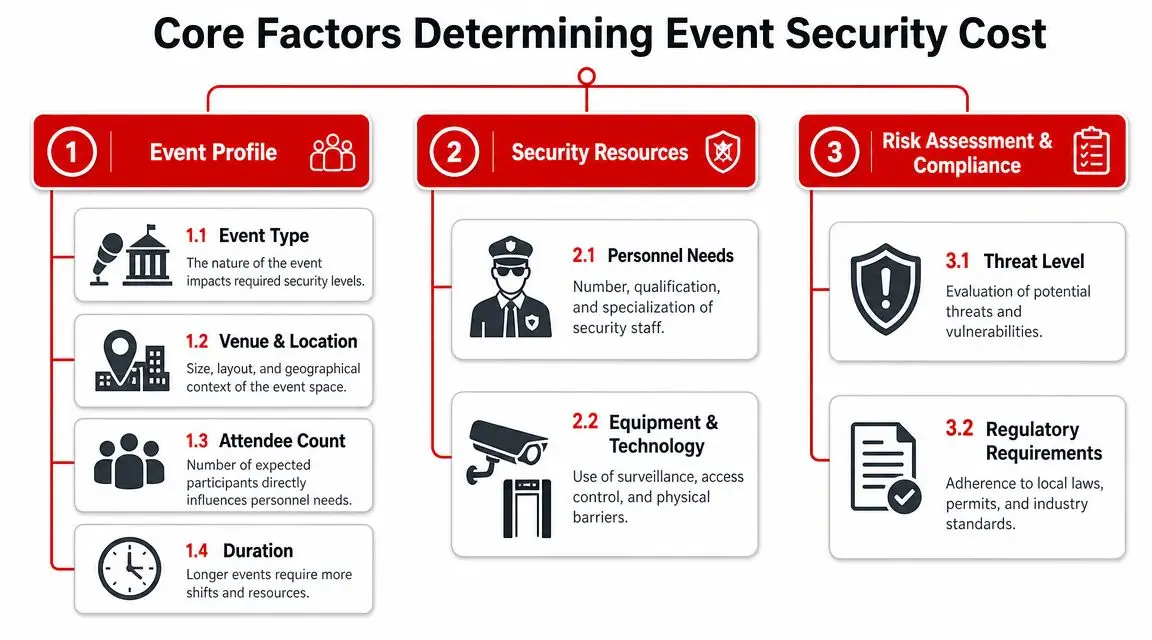
A security quote only makes sense when you know what sits underneath it. The number on the page is the result of labour rules, staffing logic, site risk, and operational overhead. If one of those is priced badly, the quote might look good and still fail the event.
Labour is the base, not the whole story
In Australia, the biggest driver under any event security cost is labour compliance. The Fair Work Ombudsman's Security Services Industry Award 2020 sets minimum pay rates, and providers also need to cover superannuation, workers' compensation, training, insurance, supervision, uniforms, and travel time. The Award's wage schedule is updated annually from the 1 July minimum-wage increase, so labour cost changes every year before any supplier margin is added, as explained in this Australian event security cost guide.
That matters because buyers often compare quotes as if one is “the true price” and the other is overpriced. Often, the cheaper quote has stripped out supervision, under-allowed for travel, or compressed staffing in a way that leaves no margin for late finishes or problem periods.
A properly loaded rate usually covers:
- Award-based pay obligations for the guard on shift
- Employment on-costs such as superannuation and workers' compensation
- Insurance and compliance overhead
- Operations management, including rostering and shift oversight
- Uniforms, equipment, and administration
Risk changes staffing faster than organisers expect
The next big cost driver is risk. Event type matters, but practical site conditions matter just as much. A flat, fenced corporate venue with a guest list is simpler to control than a public-facing event with alcohol, multiple access points, and uneven crowd behaviour.
That's why staffing is never just “one guard per entrance”. Providers look at:
- Ingress pressure at opening time
- Perimeter exposure and blind spots
- Alcohol service and RSA-sensitive areas
- VIP or artist protection needs
- Cash handling or restricted access zones
- Exit dispersal after the formal finish
For organisers who want a useful planning companion on crowd control, Darkaa's insights for event safety are worth reviewing alongside your venue map and run sheet.
The quote should reflect the way the crowd actually moves, not the way the floorplan looks in a PDF.
Specialist roles and hidden extras
Some events need more than general crowd controllers. The moment you add a supervisor, K9 team, covert operative, vehicle patrol, executive protection, or a dedicated control point, the structure changes. Those roles can be the right call, but they should be tied to a clear operational reason.
Short events often surprise organisers because minimum booking periods push up the floor cost even when the event itself is brief. Administration also grows when the provider has to coordinate inductions, site briefings, access credentials, or multi-zone deployment.
Here's what works well when reviewing a quote:
| Quote item | What to check | Why it matters |
|---|---|---|
| Guard hours | Start and finish times | Coverage often starts before doors and ends after guests leave |
| Supervision | Included or separate | A multi-post event needs active management |
| Equipment | Radios, barriers, screening support | Operational tools affect response speed |
| Licensing and compliance | State-ready staffing | Non-compliant labour is a risk, not a saving |
| Specialist roles | Clear justification | Useful when risk supports them, wasteful when copied in by habit |
What doesn't work is buying the lowest visible hourly rate and assuming the provider will “figure it out on the day”. That approach usually fails during peak entry, during the first incident, or when the event runs late.
Typical Event Security Price Ranges in Australia
Organisers always ask for a benchmark, and that's fair. You need a starting point before you ask suppliers to quote. The trick is to treat pricing ranges as guidance, not as a promise that two similar-looking events will cost the same.
Independent guidance for Australian event security puts typical per-guard rates around A$25–A$40/hour for low-profile events, with higher-risk or highly trained personnel rising to A$50–A$85/hour. The same guidance notes that providers often apply a four- to six-hour minimum, which raises the floor cost for short bookings, according to this pricing guide for event security.
What the ranges mean in practice
For practical budgeting in NSW, VIC, QLD, and the ACT, many organisers use a working baseline in the A$45–A$85/hour range because it better reflects the fully loaded market reality once risk, supervision, and event conditions are taken seriously. The lower end tends to fit straightforward, lower-profile work. The higher end appears when the event is late-night, alcohol-heavy, VIP-sensitive, or needs more experienced personnel.
State differences do exist, but they're usually driven by labour availability, local licensing conditions, and the operating difficulty of the site, not by a simple fixed state tariff. That's why the same brief can land differently across Sydney, Melbourne, Brisbane, Canberra, and regional locations.
Estimated Event Security Costs by Event Type 2026
| Event Type | Risk Profile | Typical Per-Guard Rate (NSW/VIC) | Typical Per-Guard Rate (QLD/ACT) | Example Estimated Total Cost (1000 attendees, 6 hours) |
|---|---|---|---|---|
| Corporate function | Low | A$45–A$55 | A$45–A$55 | Around A$2,700 to A$3,300 |
| Concert | Medium | A$55–A$70 | A$55–A$70 | Around A$6,600 to A$8,400 |
| Multi-day music festival | High | A$70–A$85 | A$70–A$85 | Around A$16,800 to A$20,400 |
| Hospitality venue event | Medium to high | A$50–A$85 | A$50–A$85 | Around A$6,000 to A$20,400 |
These are planning estimates, not universal market quotes. They assume staffing that matches the risk profile of each event type and are best used to stop under-budgeting, not to replace a proper site assessment.
If your short event still gets a higher-than-expected quote, the minimum booking period is often the reason, not supplier greed.
How to read the table without misusing it
The total-cost column is an example, not a shortcut. It helps illustrate how quickly the event security cost moves when guard numbers rise with risk. A corporate function with calm ingress and controlled access can sit in a manageable range. A festival with perimeter pressure, alcohol, artist areas, and staggered crowd movement won't.
Use the table for three things:
- Set a budgeting floor early so security isn't squeezed at the end
- Compare event types realistically instead of assuming all six-hour jobs are similar
- Pressure-test your brief before you send it to providers
What the table can't do is replace site detail. If your venue has multiple gates, public interfaces, awkward load-out conditions, or shared tenancy, expect the actual quote to reflect that.
How to Budget for Your Event Security
The easiest way to build a draft budget is to start with staffing density, then adjust for event conditions. Here, many organisers either overspend on generic over-coverage or underspend and end up scrambling a week out.
Guidance recommends approximately 1 guard per 100 attendees for low-risk settings, while medium-risk concerts may need 1 per 50–75 attendees and high-risk events 1 per 25–50 attendees. For a 1,000-person event, a risk upgrade can move you from roughly 10 guards to 20–40 guards, which can double or even quadruple labour cost, based on event security staffing guidance.
Start with headcount, then test the risk
For a draft budget, work through the event in this order:
Set expected attendance
Use realistic numbers, not best-case ticket sales or the venue's optimistic maximum.Choose the nearest risk profile
Low-risk usually means controlled environment and calmer crowd conditions. Medium risk usually means higher movement, entertainment, or alcohol. High risk usually means dense crowds, late finish, difficult behaviour profile, or multiple sensitive zones.Apply a staffing ratio
This gives you an initial number of guards.Check operational posts
Add roles for gates, backstage, roaming, perimeter, control room liaison, or supervisor coverage if the site requires them.Multiply by hours and likely rate band
That gives you a realistic draft range before formal quoting.
A practical budgeting example
Say you're planning a 1,000-person licensed music event over six hours. A medium-risk assumption might place you in the 1 per 50–75 attendees range. That can mean a staffing plan well above a low-risk corporate event, even before you add a supervisor or restricted-area coverage.
A simple draft worksheet might look like this:
| Budget line | Working assumption |
|---|---|
| Attendance | 1,000 people |
| Risk profile | Medium |
| Guard density | 1 per 50–75 attendees |
| Duration | 6 hours |
| Rate band | Depends on role mix and event conditions |
| Final draft budget | Calculated after staffing plan is confirmed |
This approach works because it mirrors how providers think. It doesn't guarantee the final quote, but it stops the most common budgeting mistake, which is setting a flat amount first and trying to force the staffing plan to fit it later.
What organisers should ask suppliers
Before you lock your numbers, ask these questions:
- Is the quote based on actual post positions or just a rough headcount
- Have you allowed for ingress and egress, not just event hours
- Is supervision included
- What assumptions have you made about alcohol, access points, and crowd behaviour
The better your brief, the more accurate your event security cost will be. Vague briefs create vague quotes, and vague quotes usually become expensive on event day.
5 Smart Ways to Manage Your Event Security Cost
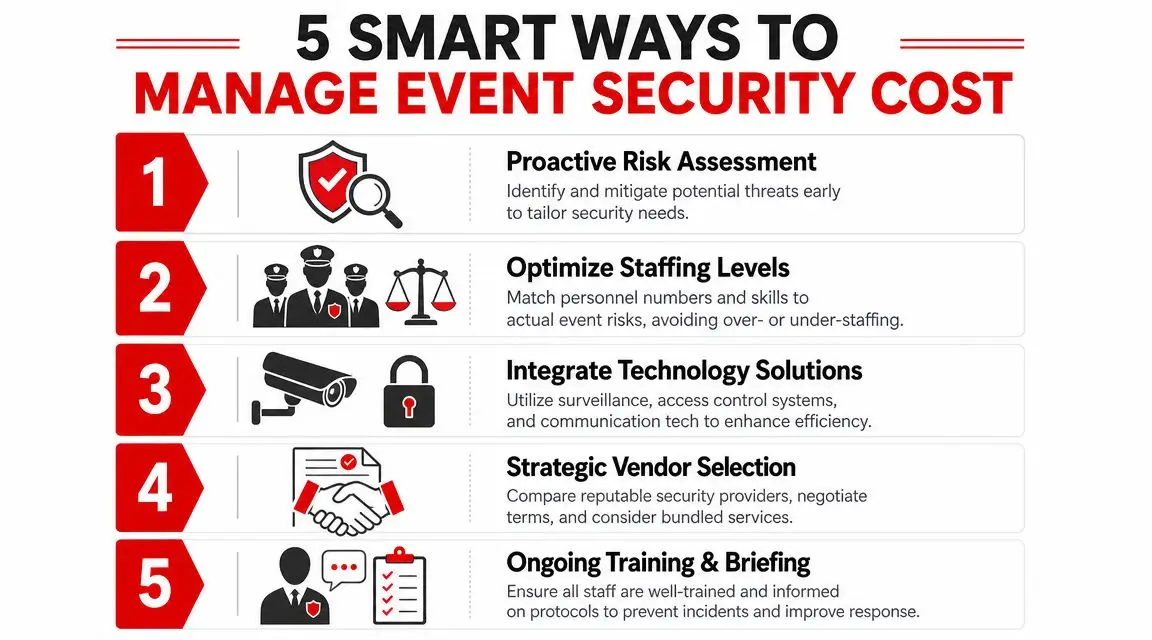
The smartest way to reduce event security cost is to remove wasted spend, not to strip away capability. Cheap security often becomes expensive once incidents, delays, and venue issues start affecting operations.
Spend earlier, not more blindly
A rushed security brief usually costs more. When the provider gets the venue map, bump-in timing, alcohol plan, ticketing model, and crowd profile early, they can build a cleaner deployment. Last-minute planning usually produces protective overstaffing because nobody has time to refine the job.
A good pre-start process includes:
- Clear site plans with public, staff, and restricted paths
- Realistic schedules for doors, peak periods, and pack-down
- Known risk points such as cash areas, artist access, or unsealed perimeter edges
Match people to peaks
You don't need maximum visible staffing in every zone for every minute. You do need strong coverage when pressure is highest. Entry queues, bar rushes, headline set changes, and close-of-night dispersal usually drive more risk than the quiet middle of the program.
That means better deployment can lower waste:
- Concentrate coverage at ingress when the crowd arrives
- Shift rovers toward bars or pinch points during busy periods
- Hold experienced supervisors where escalation is most likely
Use technology where it genuinely helps
Technology won't replace licensed staff, but it can make them more effective. CCTV, radios, access-control tools, and cleaner ticket scanning processes can reduce confusion and help smaller teams perform better.
For a broader operations mindset, Call Loop's guide to cost savings is useful because it frames cost control as a process problem, not just a staffing cut.
Better systems reduce wasted labour. They don't remove the need for capable people on the ground.
Don't buy undertrained labour for high-friction venues
Safe Work Australia reports that public order and safety services staff face ongoing exposure to violence. That helps explain why premium coverage is rising for higher-risk venues and why better-trained staff can reduce incident costs, downtime, and reputational damage, as discussed in this article on the cost of hiring security for an event.
In plain terms, the cheapest team is often the least able to de-escalate problems without disruption. That creates hidden costs:
- Longer incident resolution
- Poor guest experience
- Damage to venue relationships
- Operational distraction for the event team
Build a provider relationship, not a one-off transaction
Providers do better work when they know your venue style, crowd behaviour, and operating standards. Repeat partnerships usually produce tighter briefs, smoother inductions, and less defensive overstaffing.
What works:
- Sharing incident learnings after each event
- Reusing proven post maps
- Keeping one point of contact on both sides
What doesn't:
- Re-briefing from scratch every time
- Buying only on hourly rate
- Treating supervision as optional
Navigating Compliance Requirements for Your Event
Compliance is where many budgets become uncomfortable, because these costs aren't negotiable once the event is properly scoped. They also aren't paperwork for someone else to worry about. If the provider isn't compliant, the organiser inherits the risk.
Licensing is state-based and practical
In Australia, private security licensing is managed at the state level. That means the provider and the officers deployed need to be properly licensed for the jurisdiction where the event is being held. In real terms, NSW, VIC, QLD, and the ACT each require you to pay attention to local licensing readiness, not just the headline rate.
For organisers, the practical checks are simple:
- Confirm the provider is authorised to operate in your state
- Confirm the individual staff hold the correct licences
- Check that the staffing mix fits the event role, especially in licensed or high-contact areas
If the event includes licensed service areas, RSA-related obligations can also affect who can work where and how those zones are supervised. That's one reason hospitality events often cost more to staff properly than organisers first assume.
Insurance and documentation matter
A professional provider should be able to speak clearly about insurance, incident reporting, shift supervision, and site instructions. If those answers are vague, the operational standard is usually vague too.
Use this checklist before confirming a booking:
| Compliance item | Why you should check it |
|---|---|
| State licensing | Confirms the provider can legally deliver the service |
| Individual guard licences | Confirms the deployed team is valid for the role |
| Insurance position | Protects the event if something goes wrong |
| RSA-aware deployment | Important for licensed environments |
| Site briefing process | Reduces confusion and inconsistency |
| Reporting chain | Ensures incidents are escalated and recorded properly |
Compliance spend can feel invisible until something goes wrong. Then it becomes the only thing anyone cares about.
The organiser's role
Don't delegate compliance in a blind way. Ask direct questions. Request confirmation in writing. Make sure the quote and scope align. A provider that is serious about event work won't treat those questions as a nuisance. They'll expect them.
Frequently Asked Questions About Event Security Costs
Why does a short event still cost more than I expected
Because many providers apply a four- to six-hour minimum booking. Even if the public-facing part of your event is short, the provider may still need time for pre-start, briefing, deployment, and pack-down. That minimum creates a cost floor that catches organisers who only budgeted by headline duration.
Can volunteers handle security instead of licensed guards
Volunteers can help with guest guidance, check-in support, and general event assistance. They shouldn't replace licensed security for core crowd control, incident response, access enforcement, or licensed-area risk. If something goes wrong, the difference between hospitality help and trained security becomes obvious very quickly.
Is event security cost mostly about the hourly rate
No. The hourly rate matters, but the bigger budget driver is usually how many staff the event needs and what level of supervision or specialisation sits behind them. A modest rate multiplied across too many posts still becomes expensive. The reverse is also true. A higher-grade team may be the better value if the event is friction-heavy.
Should insurance be included in a professional quote
A professional security business should have an insurance position that supports its operations. Organisers should ask what sits behind the quoted service and make sure the documentation matches the role being delivered. If a provider avoids the topic, that's a warning sign.
What's the biggest mistake first-time organisers make
Under-scoping the job. They budget for “guards” instead of budgeting for controlled entry, crowd movement, incident response, restricted access, and safe egress. Once you frame the requirement properly, the quote usually makes a lot more sense.
If you're planning an event in NSW, VIC, QLD or the ACT and want a quote that reflects real staffing, real compliance, and the actual risk profile of your venue, GM GROUP Services is worth contacting. Their team works across festivals, concerts, hospitality venues, and corporate events, with licensed personnel, customized deployment, and the operational oversight needed to keep security practical rather than performative.
Discover more from GM Group Services
Subscribe to get the latest posts sent to your email.