
Emergency response time standards aren't represented by one universal number. In the ACT, the average ambulance response time to a priority 1 incident was 16.8 minutes in 2022–23, while Ambulance Victoria targets a Code 1 response within 15 minutes for 85% of incidents statewide. The headline figure matters, but it's only useful when a venue defines where the clock starts, what event stops it, which percentile applies, and what type of incident the service must handle.
For a Sydney pub, a regional Queensland festival, a Victorian construction site and an ACT conference venue, “fast response” means different things. Distance, dispatch load, access routes, staffing, traffic, incident severity and the deployment model all change the result.
This guide treats emergency response time standards as an operational and commercial problem. It separates public-service benchmarks from private security obligations, then turns the available Australian data into practical SLA language, deployment targets and audit controls. The objective isn't to promise an arrival time that looks impressive in a tender. It's to write a standard that still makes sense when a real incident occurs.
What Emergency Response Time Standards Actually Measure
A response-time number only becomes meaningful when its boundaries are explicit. The ACT's 16.8-minute average for priority 1 ambulance incidents and Ambulance Victoria's 15-minute Code 1 target for 85% of statewide incidents describe different measures. One is an average, the other is a percentile-based service target, so a venue manager shouldn't place them side by side as though they represent the same promise. The ACT figure is reported by the ACT Government's emergency services wellbeing reporting, while Victoria's ambulance target is set out in Ambulance Victoria's official response reporting.
A usable standard has four essential variables:
- Clock start: The timestamp might be when a call is received, an alarm is verified, a guard contacts control, or a dispatcher alerts a unit.
- Clock stop: The endpoint could be arrival at the nominated access point, arrival inside the venue, first contact with the incident, or handover to another agency.
- Percentile: The median describes a typical result. The 90th percentile shows the point within which most responses occur and exposes tail-end delays.
- Incident type: A violent-person call, a medical emergency, a fire alarm, a perimeter breach and a routine lockout shouldn't share one response obligation.
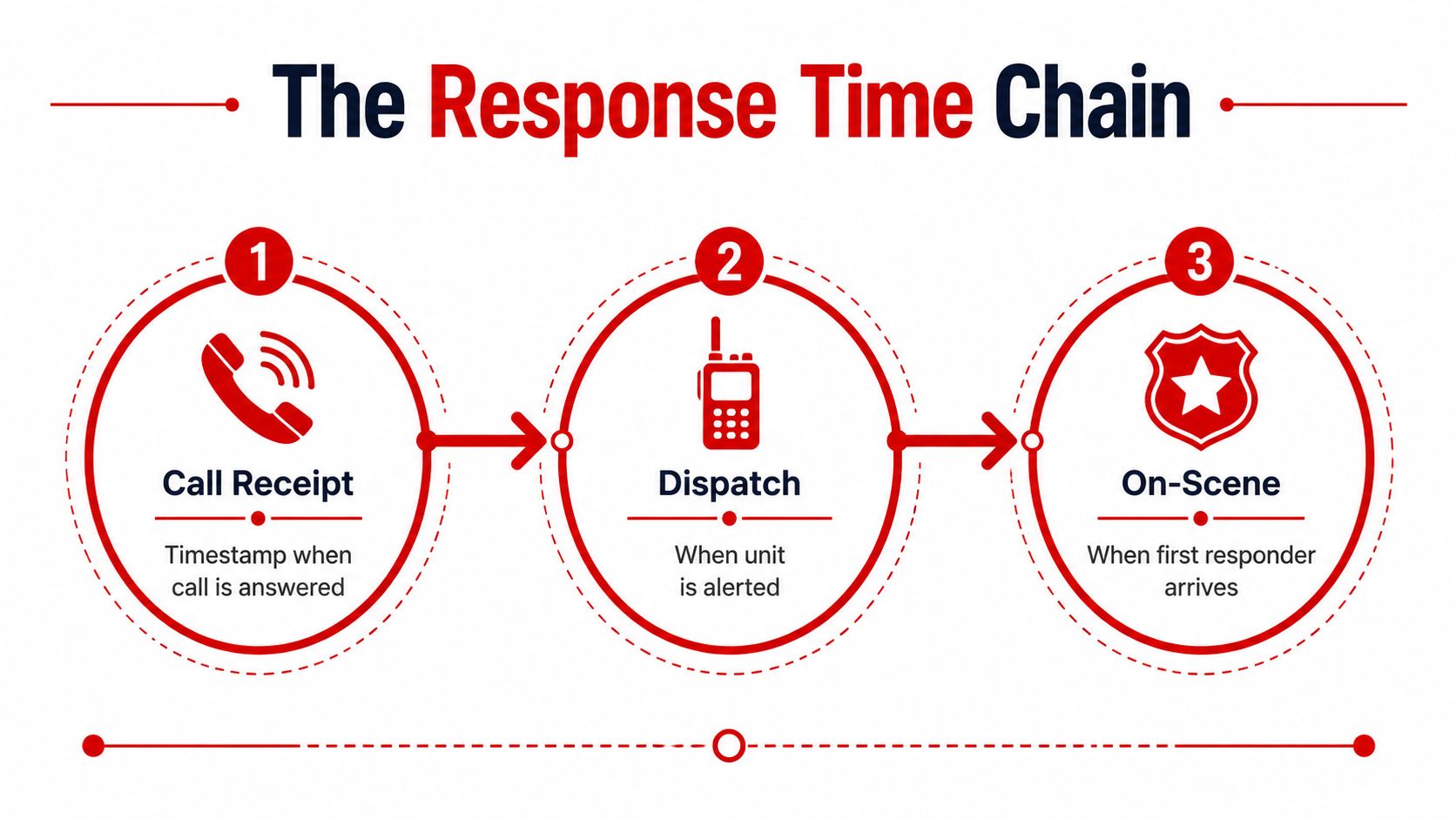
The response chain has several clocks
Victoria's historical emergency framework shows why the chain matters. A Victorian Auditor-General review described road accident rescue arrangements using 4 minutes for call processing, 8 minutes for volunteer turnout or 1.5 minutes for paid on-station crews, followed by travel targets of 12 minutes in urban areas and 32 minutes in rural areas. The Victorian Auditor-General review of emergency services also noted that Victoria Police had no response-time targets and that no national or international benchmarks were available for comparison in some categories.
That framework measured more than vehicle travel. It treated call handling, mobilisation and travel as separate operational stages. A private security SLA should use the same discipline. If a contractor reports “response within 15 minutes” but starts the clock only after dispatch, the client may be carrying an unmeasured delay between alarm activation and mobilisation.
Practical rule: Never approve a response-time clause until a supervisor can identify the exact system record that starts and stops the measurement.
Public emergency services and private security also sit in different contractual layers. Ambulance, fire and police reporting reflects government service design and jurisdictional measurement. A security provider's SLA governs the resources it controls, such as guard availability, patrol routing, alarm verification, radio escalation and site access. The private clause shouldn't imply control over an ambulance or police arrival that the contractor can't guarantee.
Response Time Benchmarks Across NSW, VIC, QLD and the ACT
Australia doesn't use one universal ambulance arrival standard. The Productivity Commission commonly reports the time from call receipt to the arrival of the first responding ambulance resource at the 50th and 90th percentiles, and its national data show substantial variation. In 2020–21, code 1 ambulance response times in capital cities ranged from 9.0 to 13.8 minutes at the median, while the 90th percentile ranged from 14.7 to 34.4 minutes. Those figures are reported in the Productivity Commission's 2022 ambulance services data.
The more recent national picture remains uneven. In 2024–25, the 90th-percentile time for first responding ambulance resources at code 1 emergencies ranged from 17.8 minutes in the ACT to 47.9 minutes in the Northern Territory, according to the Productivity Commission's 2026 Report on Government Services ambulance data. The table below focuses on the requested jurisdictions, while recognising that public reporting isn't identical across each service.
| Jurisdiction | Service | Measure | Target | Reported range |
|---|---|---|---|---|
| NSW | Ambulance | Code 1 first-resource arrival, typically assessed by percentile | Published service reporting applies, but no single national target applies across Australia | National capital-city median range of 9.0 to 13.8 minutes and 90th-percentile range of 14.7 to 34.4 minutes in 2020–21, as reported by the Productivity Commission |
| VIC | Ambulance | Code 1 arrival | 15 minutes for 85% statewide, and 15 minutes for 90% in centres above 7,500 population | 65.6% of Code 1 cases met the statewide 15-minute target in January to March 2025, with an average response of 15 minutes and 25 seconds |
| QLD | Ambulance | Code 1 first-resource arrival, reported through national service measures | No single Australia-wide target | The national reporting range demonstrates that jurisdiction, demand and geography materially affect results |
| ACT | Ambulance and fire | Priority 1 ambulance average, plus first fire crew 90th percentile | ACT Fire and Rescue aims to reach 90% of structure fires within 10 minutes | Ambulance average of 16.8 minutes in 2022–23, and first fire crew structure-fire 90th percentile of 11.5 minutes |
Geography changes the risk more than the headline
Fire response data make the urban and remote divide plain. In major cities, 90% of first responding fire crews arrived within 9.3 to 13.2 minutes, while remote areas recorded 13.1 to 36.0 minutes, based on the Productivity Commission's emergency management reporting. A festival operator who copies a metropolitan expectation into a remote-site contract may create a requirement that local deployment cannot reliably meet.
Victoria's structure also demonstrates that population tiers affect the applicable benchmark. A regional town of 8,000 people falls within the stricter 90% within 15 minutes Ambulance Victoria target, rather than only the statewide 85% target. The buyer must therefore identify the site's classification, not merely its state.
The historical lesson is equally important. Australian response standards developed service by service and state by state, and some police categories lacked published targets. Importing a foreign benchmark without checking the local measurement definition usually creates false confidence.
Recommended Target Times for Each Security Deployment
Private security targets should be achievable, auditable and matched to the resource being purchased. A static guard already inside a venue can respond differently from a vehicle travelling across a regional district. A K9 team positioned on site has a different role from an after-hours alarm contractor who must verify an activation before attending.
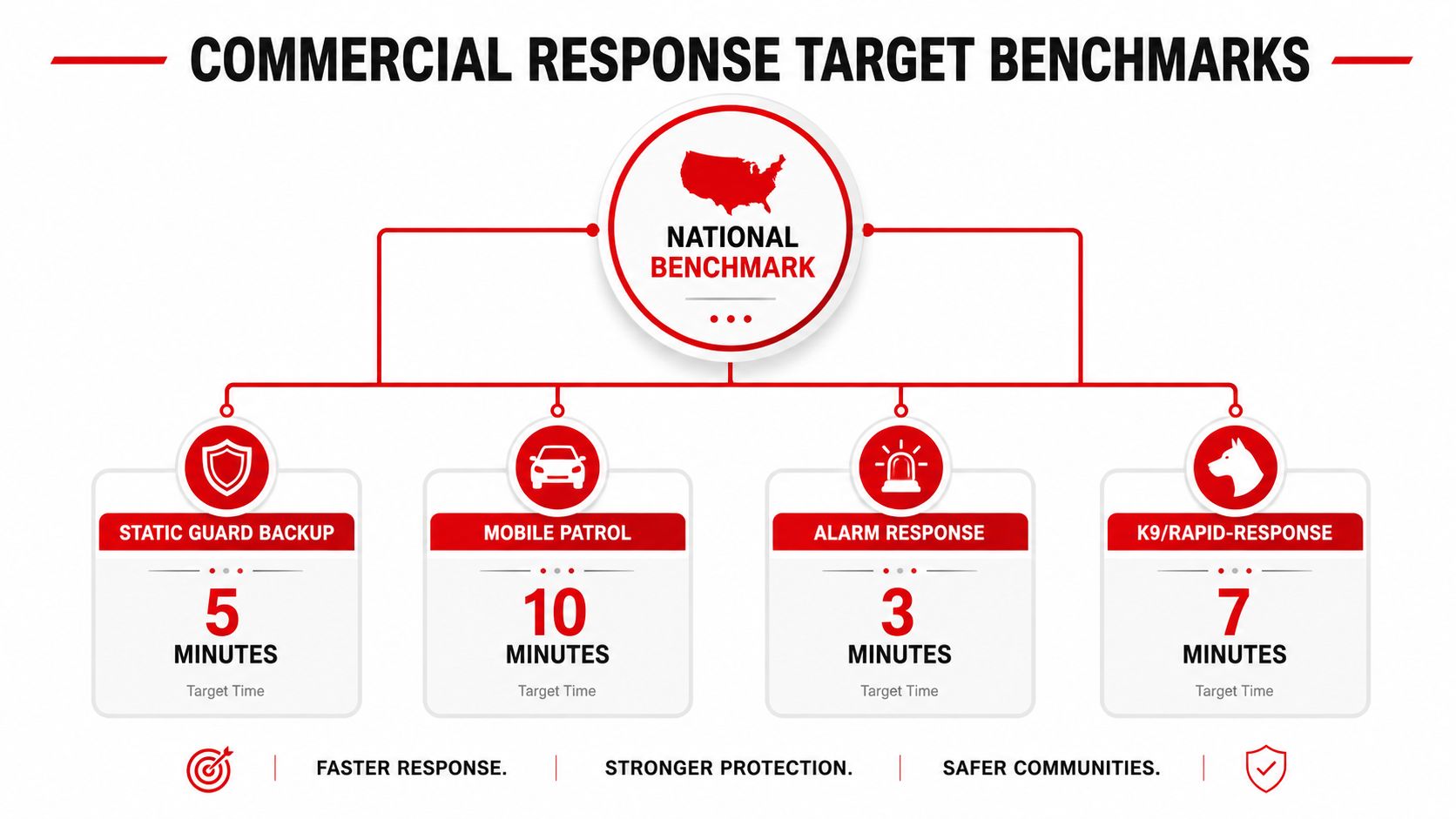
Use the following as commercial starting points, not statutory promises. The SLA should record whether each target is a median, a 90th percentile, or an individual maximum, and it should distinguish urban sites from regional or remote locations.
| Deployment model | Urban starting point | Regional or remote starting point | What to measure |
|---|---|---|---|
| Static guard backup | A short internal response target agreed around the site layout | A longer target where the guard must move between separated work areas | Radio call to first contact |
| Mobile patrol | A defined 90th-percentile arrival target based on the patrol zone | A separate 90th-percentile target reflecting travel distance and road access | Dispatch or verified alarm to site arrival |
| Alarm response | Separate business-hours and after-hours targets | A remote-site target that includes travel and key-holder constraints | Verified alarm to arrival at the agreed access point |
| K9 or rapid response | A rapid overlay target when the team is rostered and within the deployment area | A mobilisation target plus a realistic travel target | Dispatch acceptance, departure and arrival |
Static coverage is a control, not a travel promise
For a crowded pub or festival gate, static guard backup should be measured from the radio call to first contact with the incident. The clause should identify the zones covered and specify whether “arrival” means reaching the complainant, the entry point or the location shown by CCTV.
Mobile patrols work best when the client defines the patrol area and accepts that a vehicle cannot be in two places at once. Avoid a universal 5-minute promise unless the roster, geography and access arrangements support it at the required percentile. A realistic 90th-percentile target with documented exceptions is more useful than a nominal maximum that operators routinely miss.
Alarm and K9 deployment need separate conditions
Alarm response should separate verified activations, false alarms, lockouts and requests involving a confirmed threat. It should also distinguish business hours from after-hours coverage. A contractor may meet a dispatch-to-arrival target while the monitoring centre spends unmeasured time trying to verify an activation, so both stages belong in the record.
K9 teams are generally more effective as a rapid-response overlay for high-risk periods, perimeter searches, crowd management support or targeted deterrence. They're not automatically a substitute for static coverage. Deployment planning should record handler availability, vehicle readiness, site access and the point at which police or emergency services are called.
For operators comparing staffing models, security company staffing solutions can help frame the relationship between roster design, coverage requirements and response obligations. The commercial decision should remain site-specific, especially where the venue moves between normal trading, event mode and late-night lockout conditions.
Writing SLA Language, KPIs and Audit Trails That Hold Up
A response-time SLA fails when it uses a polished phrase without defining the underlying event. “Immediate attendance” sounds strong but gives a client little to test. A defensible clause names the trigger, the endpoint, the measurement population, the exclusions and the evidence required.
Put the four definitions into every clause
Use a schedule that states:
- Trigger event: Alarm activation, verified alarm, control-room dispatch, guard radio call or client telephone request.
- Arrival event: Arrival at the property, nominated gate, control room or incident location.
- Measurement: Median, 90th percentile, individual maximum or a combination.
- Incident class: Threat to life, violence, fire indicator, intrusion, welfare check, lockout or routine patrol.
A static backup clause might require the provider to acknowledge a guard radio call, dispatch the nearest available resource and record the time of first contact at the specified zone. An alarm clause should record activation, verification, dispatch, departure and arrival separately. A mobile patrol clause should define whether GPS records arrival at the property boundary or at the designated checkpoint.
Separate speed from handling quality
A fast arrival doesn't prove a competent response. The audit should assess whether the guard followed the escalation tree, preserved evidence, contacted the correct key-holder, recorded witness details, used the radio correctly and handed the matter to police or emergency services when required.
A useful KPI register can include:
- Mean response time, used as a broad operating indicator rather than the only pass or fail measure.
- 90th-percentile response time, used to expose slower outcomes that an average can hide.
- Missed-response incidents, including the reason, notification path and corrective action.
- Response bands, such as within target, outside target but excused, and outside target requiring rectification.
- Quality outcomes, including report completeness, escalation accuracy and evidence preservation.
The contract should specify a monthly incident log and a regular KPI review. A quarterly review can examine recurring access problems, demand peaks, staffing gaps and false-alarm patterns. An annual audit should test source records, GPS evidence, radio logs, rostering records and training currency.
A penalty changes the invoice. A rectification process changes the operation.
Use evidence that another person can verify
The provider's record should show the source timestamp rather than a manually typed duration alone. Suitable evidence may include access-control records, alarm-monitoring logs, radio recordings, GPS patrol tracks, incident reports and signed handover records. The client should also record its own delays, such as an obstructed gate, missing key-holder or incorrect alarm contact, because a fair SLA distinguishes provider failure from site failure.
Contract remedies should match the seriousness of the breach. A single late routine patrol may require a correction, while repeated missed responses to high-risk incidents may require a formal improvement plan, staffing review or contract escalation. The clause shouldn't encourage guards to drive unsafely or close incidents prematurely just to protect a number.
Operating a Security Operation That Actually Meets the Standard
A target becomes achievable through deployment design, not contract language. The supervisor must position people, vehicles, radios, keys and escalation authority so the response chain has as few avoidable delays as possible.
Roster for the incident pattern
Start with the venue's actual operating rhythm. A late-night venue may need stronger internal coverage during entry, peak trading and dispersal, while a construction site may need after-hours alarm response and reliable key-holder access. A festival requires zone ownership, gate coverage, medical coordination and a clear route for emergency vehicles.
Use a layered model where the risk justifies it:
- Static guards provide immediate observation and first contact.
- Mobile patrols extend coverage across car parks, perimeters and secondary assets.
- K9 teams provide a specialist overlay for searches, deterrence or high-risk periods.
- Control-room support records calls, dispatches resources and maintains escalation discipline.
The right guard profile matters as much as headcount. A customer-facing hotel role, a construction gatehouse role and a crowd-control role require different communication, judgement and site knowledge. Fit-for-purpose allocation reduces the chance that the first responder arrives but can't safely manage the incident.
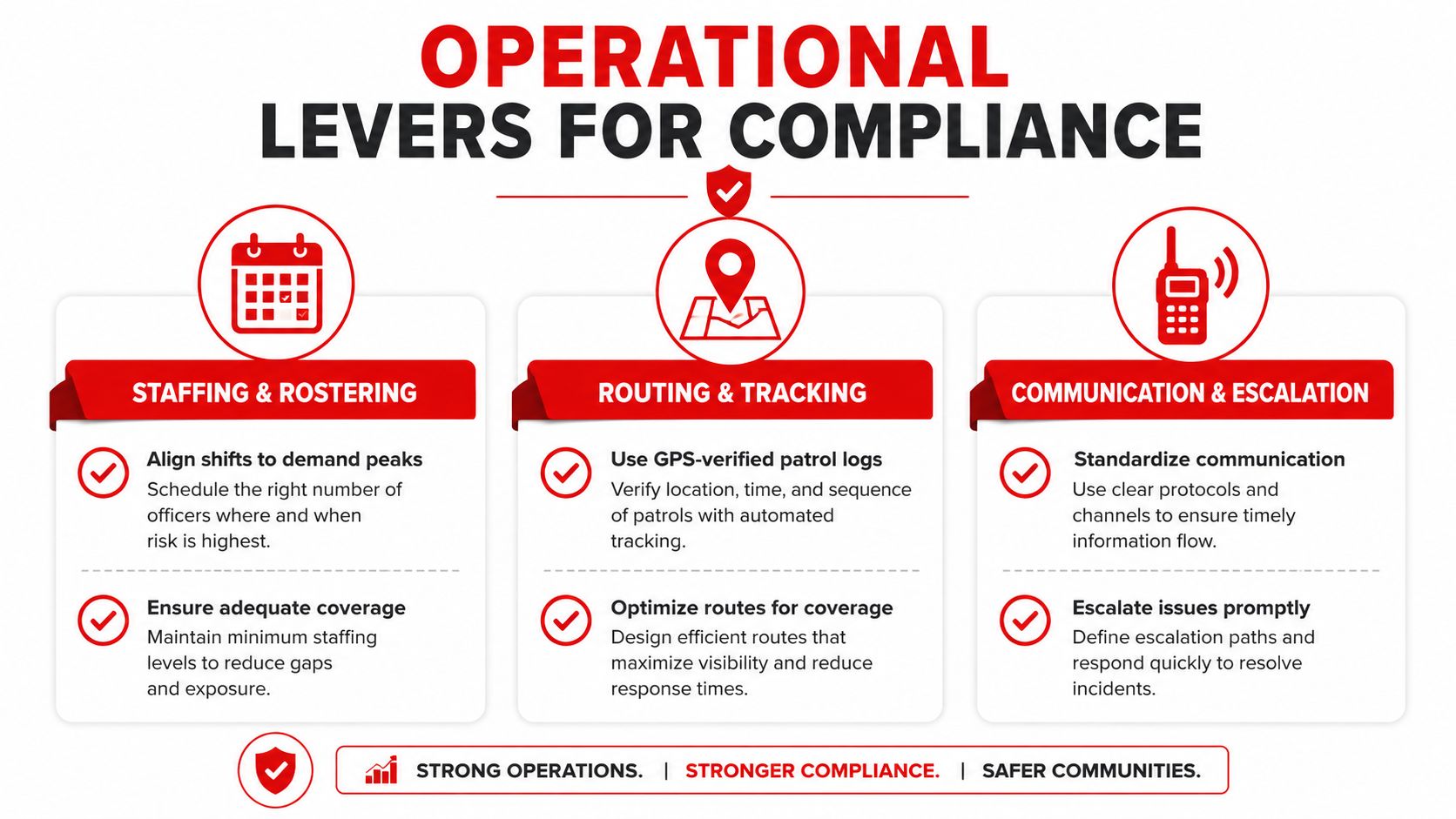
Remove avoidable activation delay
Dispatch scripts should capture the location, incident type, immediate threat, access route and caller details before the resource moves. That doesn't mean delaying urgent action. It means using a short, rehearsed sequence so the dispatcher doesn't waste time searching for basic information after the unit has been sent.
Supervisors should verify:
- Radio coverage across basements, loading docks and external zones.
- Vehicle fuel, keys, lighting, first-aid equipment and access passes.
- GPS tracking and the correct site geofence.
- Current key-holder and emergency-contact details.
- Escalation authority for police, ambulance, fire and venue management.
- Incident-log fields for each timestamp in the response chain.
A restoration provider may also become part of the escalation plan after fire, flood or major property damage. For example, a manager dealing with an affected commercial site may keep a specialist resource such as Tampa Bay business restoration services in a broader recovery directory, while recognising that restoration is separate from immediate security response.
Train for the handover, not just the arrival
Recurring exercises should test the first five minutes, the escalation tree, the site map and the handover to emergency services. Guards need to know which access point remains clear, who meets responding agencies, where CCTV is monitored and how witnesses are kept safe.
The shift-start checklist should be short enough to use every time. Confirm the radio check, vehicle check, key-holder register, site hazards, roster gaps and incident-log readiness. A standard that can't be verified at shift start is already vulnerable before the first call arrives.
Reporting, Auditing and Treating Targets as Risk Metrics
The most useful response number for a venue manager isn't the provider's advertised maximum. It's the site's own 90th-percentile response time over the previous 12 months, segmented by incident type, location, shift and deployment model. That figure reflects what the venue experiences, including blocked access, demand peaks, incomplete alarm information and regional travel conditions.
Victoria's published results illustrate why buyers must track actual performance rather than rely on a target. Ambulance Victoria reported that 65.6% of Code 1 cases met the statewide 15-minute target in January to March 2025, while the statewide average was 15 minutes and 25 seconds, as shown in its latest ambulance response-time update. The target remains an important planning reference, but it isn't a guarantee that every incident will meet it.

Build a monthly monitoring record
A practical monthly report can include:
- Incident volume: Count alarm activations, violence calls, medical assists, perimeter breaches, lockouts and other agreed categories.
- Response evidence: Record the clock-start event, clock-stop event, mean, 90th percentile and missed-response incidents.
- Location pattern: Identify gates, loading areas, car parks, stages, bars or work zones with repeated delay.
- Demand conditions: Note event mode, peak trading, road closures, weather, simultaneous incidents and access restrictions.
- Corrective actions: Assign an owner, due date, verification method and follow-up result.
A debrief should separate process failure from performance failure. If the patrol arrived late because dispatch sent it to the wrong gate, the corrective action differs from a late arrival caused by insufficient coverage. If the guard reached the location promptly but failed to escalate a violent incident, the quality failure is more serious than the time result alone suggests.
Access control can also reduce the distance and uncertainty involved in responding to restricted areas. A site manager reviewing permissions, visitor movement and entry records may find a practical reference in this Perth commercial access control guide, while adapting the principles to the site's own layout and jurisdiction.
Treat the gap as a planning input
The difference between a published standard and on-the-ground performance should influence staffing, event design, insurance discussions and emergency planning. Remote geography, congestion, crowd density and limited access can push outcomes beyond the nominal benchmark, so a venue should maintain internal controls rather than assume a public-service target will solve its exposure.
Quarterly reviews should ask three direct questions:
- Which incident types missed the agreed target?
- Which stage created the delay, call handling, dispatch, turnout, travel or access?
- What operational change will be tested before the next review?
That approach produces a defensible record. It also gives the venue a stronger basis for changing patrol zones, increasing static coverage, improving access routes or revising the SLA when the original design doesn't match reality.
GM GROUP Services can help venues, events, construction sites and businesses plan layered coverage with static guards, vehicle patrols, K9 teams, monitoring and emergency response procedures aligned to site-specific risks. Visit GM GROUP Services to discuss a practical deployment model, measurable response controls and reporting that can stand up to an incident review.
Discover more from GM Group Services
Subscribe to get the latest posts sent to your email.