
Emergency response procedures become real the moment something goes wrong. A patron collapses beside a hotel bar, smoke appears near a construction site, or a festival crowd surges towards an unexpected obstruction. In those first moments, staff rarely consult a lengthy policy. They follow the steps they remember, the roles they understand, and the instructions they can hear.
The strongest procedures are built for Australian conditions. They connect legal duties, AS 3745, the NSW State Emergency and Rescue Management Act 1989, Safe Work Australia's model WHS expectations, and practical response benchmarks from the Productivity Commission's emergency management reporting. They also account for casual staff, contractors, radio congestion, locked gates and delayed information.
Why Emergency Response Procedures Matter on Australian Sites
It's a hot December afternoon at a Sydney inner-city hotel. A patron collapses beside the lobby bar while a queue forms at reception. The duty manager has only seconds to decide whether to call for medical assistance, clear the immediate area, evacuate the level or hold the building while staff assess the situation.
A written procedure doesn't remove judgement. It gives that judgement a starting point. The manager knows who calls Triple Zero, who brings the first-aid kit, who meets the ambulance at the entrance and who controls guests. That turns a stressful pause into a rehearsed sequence.
The legal framework behind the paperwork
In NSW, emergency management procedures sit within the State Emergency and Rescue Management Act 1989. The Act defines response as combating an emergency and providing immediate relief, while also placing response alongside prevention, preparation and recovery as parts of the broader emergency management framework.
NSW guidance identifies Triple Zero, 000, as the number for life-threatening emergencies. It also identifies 132 500 for NSW SES flood and storm assistance. The state's system depends on coordinated agencies, including NSW Ambulance, NSW Rural Fire Service, Fire and Rescue NSW, NSW SES and NSW Police. The EMPLAN system provides NSW with a coordinated emergency management approach, so a site procedure must work with multiple agencies rather than assume one service will manage everything.
Across Australia, the approach covers prevention and mitigation, preparedness, response and recovery. Safe Work Australia also states that workplaces must have an emergency plan under model WHS laws, with implementation occurring through each jurisdiction's legislation and regulators. That makes the plan more than an operational convenience. It supports the organisation's duty to protect workers and others affected by its operations.
Why the first minutes belong to the site team
External response times matter, but they don't replace immediate action. The Productivity Commission reports ambulance performance through the 50th and 90th percentiles, rather than relying only on an average. Its 2020–21 capital-city data records a median range of 9.0 to 13.8 minutes and a 90th-percentile range of 14.7 to 34.4 minutes for code 1 ambulance responses, as reported in its emergency management data.
That spread shows why a venue needs trained people, accessible equipment and a clear access plan before an ambulance arrives. A procedure that starts at dispatch may conceal delays caused by verification, locked doors, poor directions or a gate attendant who wasn't told to expect responders.
Practical rule: Measure the response from the moment someone recognises the incident, not only from the moment an agency accepts the call.
AS 3745 provides the practical structure. It calls for an emergency planning committee, emergency plan, emergency response procedures, emergency control organisation, testing and validation, and emergency-related training. Compliance theatre produces a signed document that casual staff can't use. A working procedure fits on a quick-reference card, names the decision-maker, survives a radio failure and is tested with the people rostered on an ordinary shift.
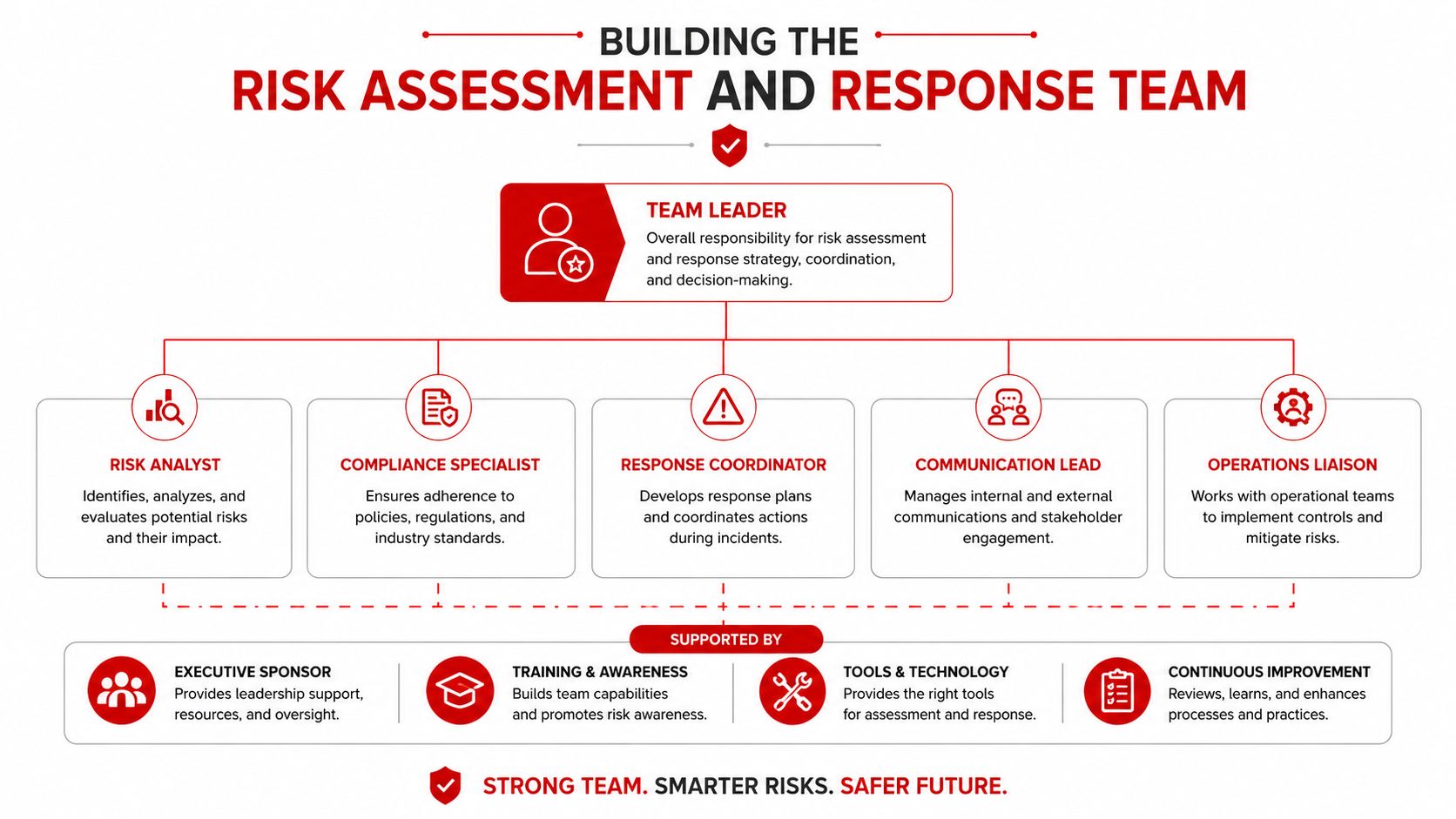
Building the Risk Assessment and Response Team
Start with the risk assessment, not the template. A festival, hotel and construction site may all need evacuation, medical and communications procedures, but their hazards, access routes and decision rights are different. Australian guidance expects plans to consider fire or explosion, dangerous chemical release, medical emergencies, natural disasters, bomb threats, violence and robbery, so a fire-only document is incomplete.
Give the risk assessment operational value
List the hazards that could seriously affect people, then document the controls already in place. Consider crowd density, plant movement, temporary structures, kitchens, chemicals, working at height, isolated areas, severe weather and public access. The useful question isn't whether the register contains every imaginable event. It's whether the team knows what it will do for the credible high-consequence events.
AS 3745 supplies the backbone for the planning structure. The Emergency Planning Committee, or EPC, should have authority to approve the plan, allocate resources, review drill findings and make changes. It shouldn't exist only to sign meeting minutes.
A venue EPC might include the venue manager as chair, chief warden, deputy chief warden, area wardens, communications officer, first-aid coordinator, security supervisor, facilities manager and event organiser. A construction EPC may instead include the principal contractor, site manager, WHS manager, leading hands, first-aid officers, traffic controller and emergency-services liaison.
Assign roles people can perform
The core emergency control organisation commonly needs:
- Chief warden: Takes control of the site response and authorises evacuation actions within the plan.
- Deputy chief warden: Assumes control when the chief warden is unavailable and supports coordination.
- Area wardens: Sweep assigned areas, report conditions and direct people to safe locations.
- Communications officer: Controls internal messages, records transmissions and supports contact with emergency services.
Add site-specific functions where they're necessary. A festival needs crowd controllers, stage management and a gate liaison. A hotel needs front-office, engineering and guest-services coordination. A construction site needs plant isolation, access control and contractor accountability.
The organisation chart must be printable, laminated and posted where wardens stand. Keep a copy at reception, the site office, the control room and relevant muster points. Include after-hours coverage, reporting lines, relief arrangements and a simple briefing method for casuals and contractors. A share-drive copy won't help a new security officer who starts during a busy evening shift.
Designing Communication and Escalation Plans
Communication fails when everyone has a phone but nobody knows who speaks first. Build the plan in layers, with each layer answering a different question: who contacts public emergency services, who directs people on site, who issues the public message and who records what happened?
For a life-threatening emergency, staff should call Triple Zero, 000. The national emergency number 112 can also be used from digital mobile phones in appropriate circumstances. The 106 text-based emergency service supports deaf, or hearing and speech-impaired, callers. The procedure should state which service applies and what information the caller must provide, including the site address, access gate, casualty location, hazard and callback details.
Build redundancy into internal channels
Use a primary two-way radio channel and a backup channel. Keep a telephone tree for supervisors who aren't carrying radios, and prepare short PA or digital-signage messages that wardens can read without improvising. A message such as “Please remain where you are and follow staff instructions” may be appropriate for a contained incident, while an evacuation instruction must identify the route and assembly location.
Escalation triggers should be plain. Examples include fire or smoke, hazardous release, structural instability, credible violence, a missing child in a dense crowd, or any situation beyond the site team's capability. The procedure should identify the relevant agency, such as Fire and Rescue NSW, the Country Fire Authority, NSW SES or the Police Forward Commander, without making staff guess who has authority.
At a festival, radio traffic may peak just as a stage evacuation begins. The communications officer should move non-critical traffic to the backup channel while the chief warden keeps the operational channel clear. At a construction site, a crane incident may require simultaneous notification to SafeWork NSW, the principal contractor and the client's WHS manager. One person shouldn't try to make every call while also managing the exclusion zone.
Communication channels by site type
| Channel | Festival / Event | Hotel / Venue | Construction Site |
|---|---|---|---|
| Triple Zero | Medical, fire, violence or major crowd emergency | Life-threatening medical, fire or security emergency | Serious injury, fire, collapse or hazardous release |
| Primary radio | Security, event control and wardens | Security, duty manager and engineering | Site management, supervisors and traffic control |
| Backup radio | Used during stage or crowd-control congestion | Used if the main channel fails | Used during plant or access incidents |
| PA and signage | Crowd instructions and zone movement | Guest instructions and floor-specific directions | Muster instructions and work-area isolation |
| Phone tree | Promoter, production and agency contacts | General manager, owners and contractors | Principal contractor, client and WHS contacts |
| Incident log | Communications officer or event control | Duty manager or security control | Site manager or WHS representative |
Every significant transmission needs a log entry. Record the time, sender, recipient, message and action taken. That record helps the next shift understand the situation and gives the EPC evidence for review.
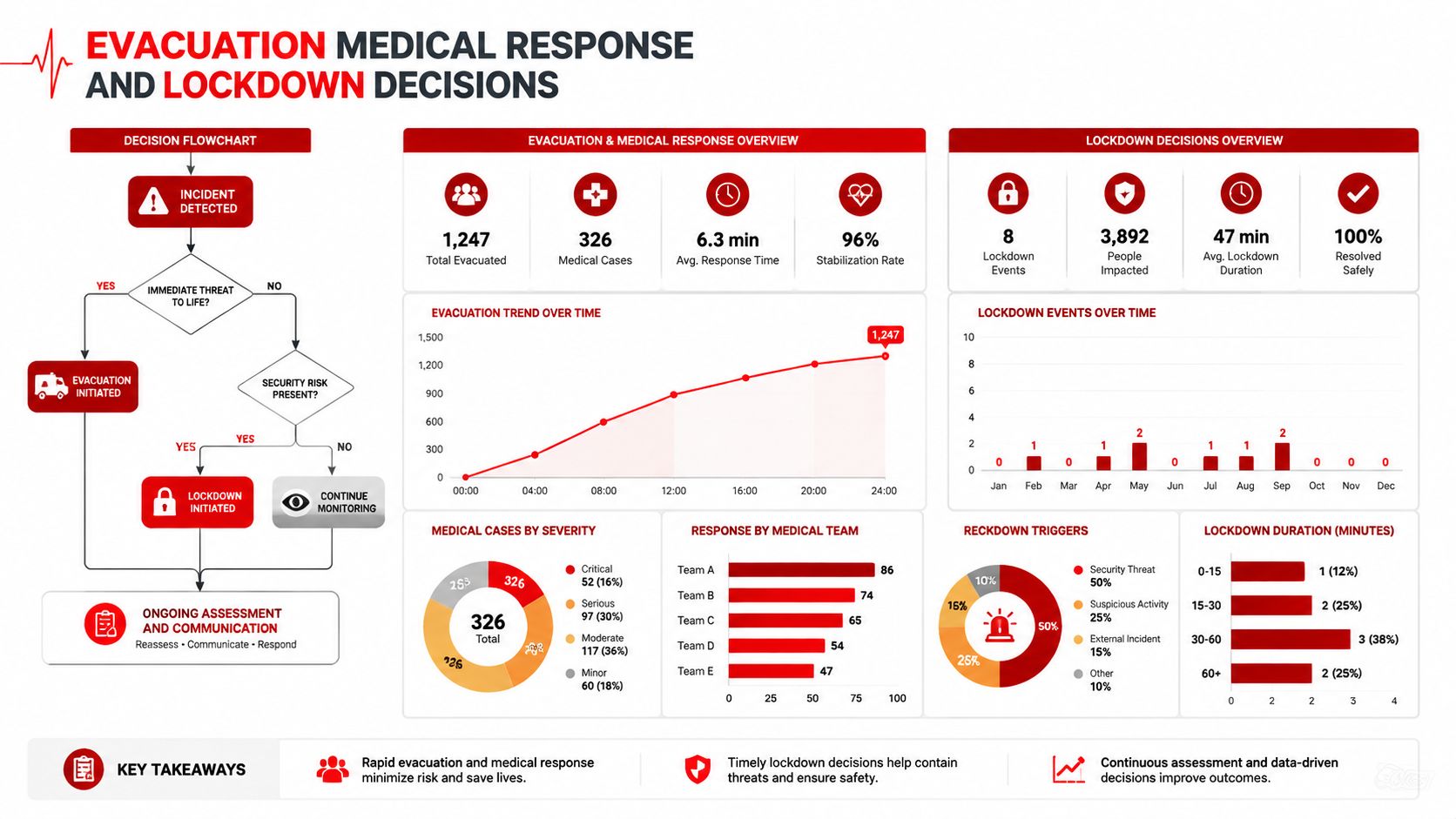
Evacuation Medical Response and Lockdown Decisions
Evacuation, medical response and lockdown are different controls. Treating every incident as an evacuation can move people into danger, while treating every incident as a medical call can leave a wider hazard unmanaged.
The Productivity Commission's percentile approach is useful because it exposes the difference between a typical response and a slower response. Its reported 2020–21 capital-city data places code 1 ambulance response medians between 9.0 and 13.8 minutes, with the 90th-percentile range extending from 14.7 to 34.4 minutes. The figures support a practical conclusion: sites need capable first response, reliable access and a handoff process that doesn't depend on an ideal arrival.
Set a site-level target for first-aid activation that your organisation can test. A four-minute on-site first-aid target for life-threatening calls can be used as an operational objective, provided the site has the staffing, equipment and coverage to support it. Don't present that target as an ambulance standard.
Use a one-page decision framework
Medical response: Send the first-aid team, clear space, call Triple Zero and assign someone to meet the ambulance at the nominated gate. Move other people only when crowd pressure or a secondary hazard makes it necessary.
Evacuation: Use partial evacuation for a defined affected zone where routes remain safe. Use full evacuation for fire, gas, major structural instability or another hazard that can affect the whole building or site. The chief warden or nominated controller should act under the plan's authority, not wait for every fact to be confirmed.
Lockdown: Consider lockdown when an intruder, credible violent threat or hostile vehicle threat makes movement outside more dangerous than sheltering. Wardens should secure or isolate areas where practicable, stop unnecessary movement and await police direction.
Four practical scenarios
- A 5,000-person festival stage collapse: The control room calls Triple Zero, the medical lead establishes a casualty area away from the structure, and a gate liaison guides responders in. The chief warden holds the unaffected crowd where safe, while the EPC chair authorises partial or full evacuation according to structural risk.
- A level 12 hotel kitchen fire: The duty manager calls Triple Zero, engineering isolates relevant services where safe, and the chief warden begins the fire procedure. Wardens protect stair access, direct guests to the nominated assembly area and meet Fire and Rescue NSW at the access point.
- A construction trench collapse: The supervisor stops work, prevents secondary entry, calls Triple Zero and sends a site representative to the gate. The first-aid team supports from a safe position, while the principal contractor controls the exclusion zone and decides whether nearby work areas need evacuation.
- A credible intruder at a logistics warehouse: The control room calls police, uses the internal alert channel and instructs exposed areas to shelter or lock down. Staff don't move towards the threat or send people outside until the risk picture supports that action.
For accommodation operators, clear arrival details and accessible emergency contacts also support guest safety in short-term rentals. The same principle applies to hotels and serviced apartments: guests need usable information before an incident, not a confusing notice after one.
Training Drills and Documentation That Stays Current
Procedures decay when people don't practise them. Staff change, rooms are reconfigured, contractors arrive, radios are replaced and assembly points become blocked by deliveries. A plan that worked last year may fail on the next shift unless the organisation tests the assumptions behind it.
AS 3745 gives facilities a structured model covering planning, emergency response procedures, the emergency control organisation, testing, validation and training. Use that structure to create a training calendar rather than relying on a single annual reminder.
Rehearse the conditions that cause delay
A useful drill should contain friction. Include a casualty, a missing person, a communications outage and a late-arriving agency. Don't warn every participant about every inject. The aim isn't to embarrass staff. It's to expose where a normal person hesitates, mishears an instruction or can't find the equipment.
A full evacuation exercise can test movement, wardens, assembly control and emergency-services access. A tabletop scenario lets the EPC test decisions without moving the whole workforce. A desk check confirms that phone trees, personal protective equipment, first-aid supplies, maps and contact details remain usable.
Document each exercise with:
- Activation time: When the incident was identified and when the procedure started.
- Notification method: Radio, phone, alarm, PA, SMS or another channel.
- Movement record: Time to reach the muster area and any unaccounted people.
- Communication failures: Missed calls, unclear messages, dead batteries or channel congestion.
- Corrective actions: The owner, due date and evidence required to close the issue.
The drill report should sit with the EPC minutes and the current Emergency Plan. That creates an audit trail under the organisation's WHS system and supports the broader emergency management duties that apply in NSW.
Keep the plan under controlled review
Use a one-page After Action Review. Record what was expected, what happened, why the gap occurred, what will change and the next revision date. A correction without an owner is only an observation.
A practical calendar can include an annual full evacuation exercise, six-monthly tabletop scenarios for wardens and quarterly desk checks of call trees, equipment and first-aid kit expiry dates. Retain drill reports and training records according to the organisation's document-control policy and applicable state requirements. NSW, VIC, QLD and the ACT use their own regulators and legislative settings, so confirm retention and notification obligations with the relevant regulator or WHS adviser.
Notifiable incidents require separate attention. If an incident meets the applicable threshold, preserve the scene where required and notify the relevant regulator within the required process. Don't treat a drill report as a substitute for an actual notifiable-incident record. Keep competency evidence aligned with the WHS training register, including induction, warden duties, first aid and role-specific refreshers.
Common Pitfalls and the Compliance Checklist
The weakest emergency response procedures usually fail in ordinary ways. A phone tree depends on one carrier. Wardens completed training once and haven't been checked since. The muster point sits inside a potential fall zone. The plan lists every threat but never says who decides.
A compliance review should connect the site plan to the relevant regulator and legal framework. In NSW, compare the procedure with SafeWork NSW expectations and the emergency management structure established by the SERM Act. In Victoria, Queensland and the ACT, check the applicable WorkSafe Victoria, Workplace Health and Safety Queensland and Access Canberra requirements, alongside the Safe Work Australia model WHS framework.
Check the documents and the physical site
The EPC should be able to produce current minutes, an approved plan, signed revision records, training evidence, drill reports and corrective-action registers. Auditors commonly find gaps where the documents exist but don't match the building, roster or equipment on the ground.
Walk the site and test the basics:
- Access: Can emergency responders reach the nominated gate without a key, locked bollard or confused attendant?
- Coverage: Do the available wardens cover each occupied area during the busiest shift?
- Equipment: Can staff find alarms, first-aid kits, radios, torches and relevant protective equipment?
- Assembly: Is the muster point clear of traffic, falling objects, smoke movement and other hazards?
- Accountability: Can supervisors identify workers, contractors, guests and people requiring assistance?
- Version control: Does the posted plan show the current approval and review status?
Turn compliance into operating measures
A quarterly scorecard should show whether the plan works under pressure, not merely whether a document exists. Choose measures that staff can record consistently and discuss at EPC meetings.
| Indicator | Target Threshold | Regulatory Anchor |
|---|---|---|
| Time to activate the procedure | Defined and tested against the site's approved objective | AS 3745 testing and validation, Safe Work Australia emergency-plan expectations |
| Warden headcount versus area coverage | Sufficient coverage for each occupied area and shift | AS 3745 emergency control organisation |
| Staff with current first-aid certification | Role coverage maintained for operating periods | WHS emergency-plan duties and site risk assessment |
| Ambulance handoff delay | Defined start and stop points, then reviewed after each exercise or event | Productivity Commission percentile-based response measurement |
| Current plan revision | Approved version posted at control points and accessible to workers | AS 3745 emergency plan and document control |
| Corrective actions closed | Each action has an owner, due date and evidence | EPC governance, testing and continuous improvement |
A procedure is working when a casual worker can identify the alarm, a warden can state the next action, a supervisor can account for people and responders can enter without delay. If nobody can demonstrate those points during a drill, the plan is filed, not operational.
The same practical approach can be supported by an external security and emergency-response provider where the site lacks trained coverage. GM GROUP Services provides emergency response, risk assessments, static security, event security, patrols and related protection across NSW, VIC, QLD and the ACT, with deployment matched to the operating environment.
Frequently Asked Questions About Emergency Response Procedures
What must an Australian workplace emergency plan include?
It should identify foreseeable emergencies, emergency contacts, alarm and evacuation actions, roles, communication methods, assembly arrangements, assistance for people who may need it and review arrangements. Safe Work Australia states that workplaces must have an emergency plan under model WHS laws, while AS 3745 provides a structured framework for the planning committee, emergency control organisation, procedures, training and validation.
Is a fire evacuation plan enough?
No. Australian planning guidance identifies a wider range of emergencies, including medical events, dangerous chemical releases, natural disasters, bomb threats, violence and robbery. The response may be evacuation, shelter, lockdown, isolation or a medical intervention, depending on the hazard.
Who should call Triple Zero?
The plan should nominate the role, rather than rely on whoever happens to be closest. Any person who recognises a life-threatening emergency must be enabled to call 000, while the control structure ensures the incident location, access instructions and hazards reach the responding agency.
How often should procedures be tested?
Use a planned cycle based on AS 3745, the site risk assessment and operational change. A useful programme includes a full evacuation exercise, tabletop scenarios and regular desk checks, with every exercise recorded and corrective actions assigned.
How should a venue measure response performance?
Define the start and stop points, incident class and point of arrival. Measure activation, first-aid attendance, access delays, communication failures and ambulance handoff. Percentile-based external benchmarks are more useful than an average alone because they show how performance changes during slower responses.
GM GROUP Services can help event, hospitality, construction and business operators develop practical risk assessments, emergency response coverage and site-specific evacuation arrangements across NSW, VIC, QLD and the ACT. Visit GM GROUP Services to discuss a procedure that your wardens, contractors and supervisors can use under pressure.
Discover more from GM Group Services
Subscribe to get the latest posts sent to your email.