
Emergency response procedures for security officers begin with a clear boundary: officers are trained to observe, report and escalate, not to detain offenders as a default tactic. Their primary emergency objectives are to get people to safety and get accurate information to police, then support the handover without creating a second casualty or contaminating the scene.
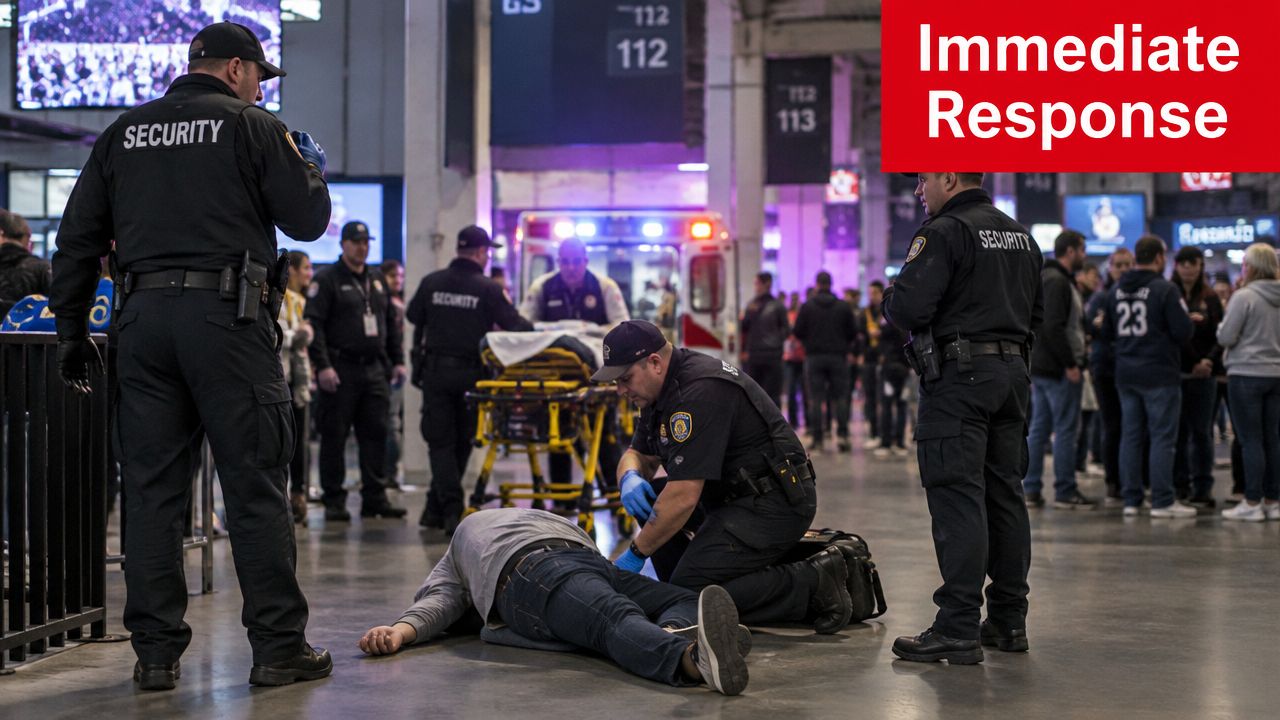
You're standing near a crowded bar when someone collapses beside a table. At the same time, a fight breaks out near an exit, the radio fills with overlapping calls, and people start filming instead of moving. In that first 60 to 120 seconds, the officer's value doesn't come from heroic intervention. It comes from disciplined decisions, clear communication and a practiced command structure.
Understanding the Immediate Pressure of Venue Emergencies
A venue emergency rarely arrives as one neat problem. At a festival, a medical collapse can obstruct an egress route while a crowd gathers around the patient. At a construction site, a fall may leave machinery operating nearby and workers moving towards the scene. In a corporate building, a fire alarm can trigger an evacuation before anyone knows whether the alarm reflects smoke, a fault or deliberate activation.
The first officer on scene has to manage competing demands without losing the central priority. People need direction, supervisors need information, first aiders need access and emergency services need a reliable description of the incident and the best way into the site.
Why the first minutes become disorderly
A common failure occurs when one officer tries to do everything. They approach the casualty, argue with an aggressive person, answer radio traffic and attempt to direct the crowd. Each task receives partial attention, while nobody owns the overall response.
A better deployment separates responsibilities:
- First officer: Assesses immediate danger, calls for help and gives the first clear report.
- Supervisor or control: Takes command, confirms escalation and allocates tasks.
- Support officer: Creates space, protects access and keeps bystanders away.
- First aider: Provides assistance within their training.
- CCTV or control operator: Tracks relevant movement and preserves useful information.
- Gate or access officer: Meets police or ambulance crews and guides them to the location.
Operational rule: If everyone is responding, nobody is coordinating. Assign ownership early, even if the assignment is brief and verbal.
Australian emergency planning rules require a written plan covering effective response, evacuation, emergency-service notification, medical treatment, communication, testing and worker training. ACT WorkSafe emergency preparedness guidance also addresses trained emergency planning committees and sufficient trained first aid officers based on risk assessment. Those requirements matter because a procedure must work under pressure, not merely exist in a compliance folder.
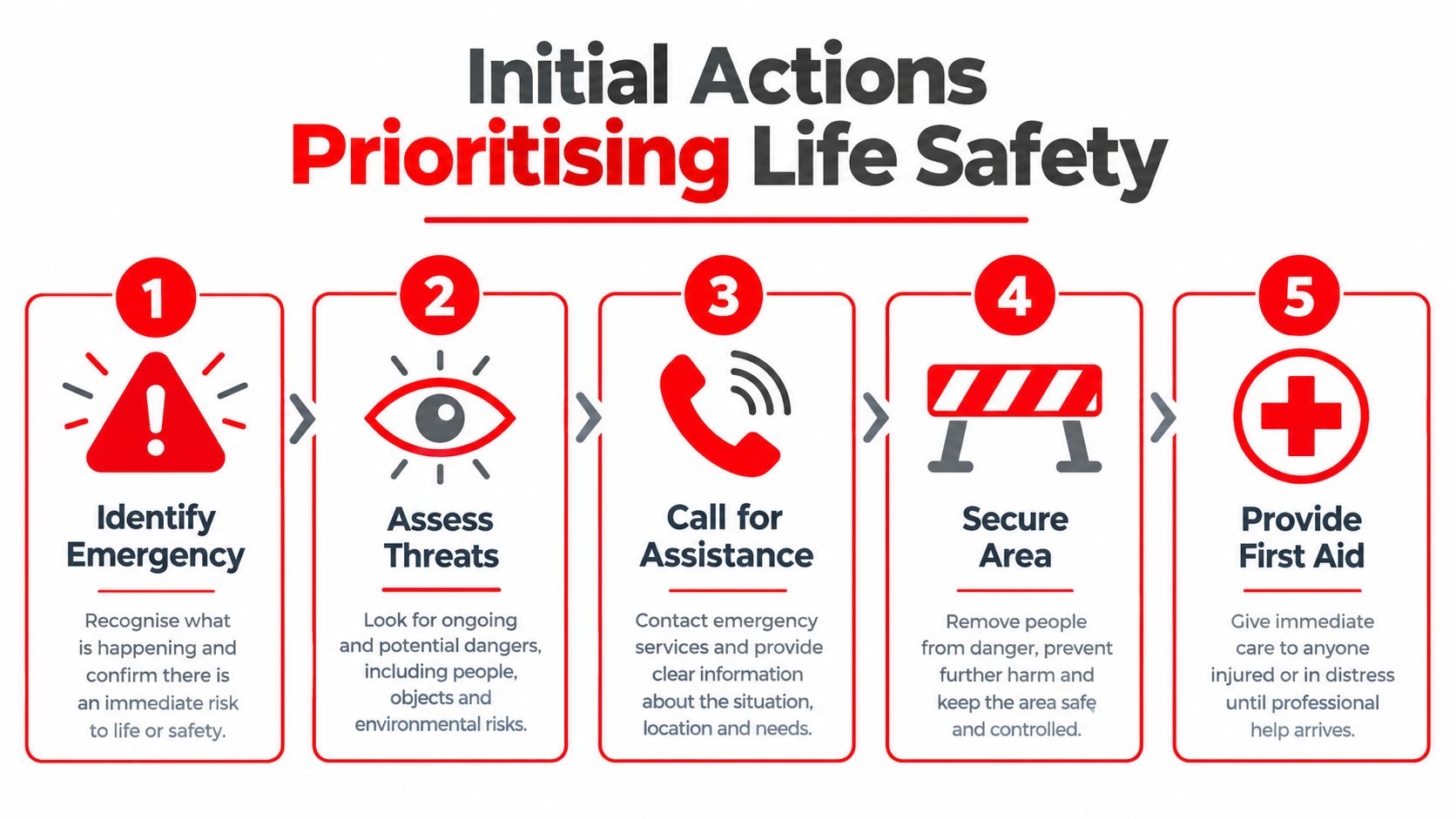
Initial Actions Prioritising Life Safety
The first decision is whether the scene is safe enough to approach. An unconscious person beside a live electrical source, an aggressive offender near a dense crowd or a suspected device in a public area all require distance and escalation before hands-on assistance.
Use a fixed order so stress doesn't rearrange your priorities:
- Identify the emergency. Name what you can see, such as a collapse, fire, assault, suspicious package or uncontrolled crowd movement.
- Assess immediate hazards. Look for weapons, smoke, electrical danger, traffic, unstable structures and secondary threats. Don't enter a hazard without appropriate authority, equipment or training.
- Call for assistance. For a life-threatening or significant emergency, call 000 immediately and transmit the location, hazard, casualty condition and safe access route.
- Move people away from danger. Use the site's authorised option, which may be evacuation, shelter, lockdown, a show pause or a controlled search.
- Secure the area. Establish a practical barrier, preserve emergency access and stop unauthorised people entering.
- Provide first aid within training. For a medical incident, use DRSABCD, alert trained first-aid staff and request an ambulance whenever there's doubt about a life threat.
Keep intervention proportionate
A fight near a bar may call for verbal direction, separation of bystanders, supervisor attendance and police escalation. It doesn't automatically justify an officer entering the centre of the conflict. An active armed-offender situation demands a different response, including following the venue's lockdown or evacuation procedure, calling Triple Zero, restricting vehicle access and establishing medical triage or first-aid locations where safe.
National crowded-places guidance sets out these types of measures for high-risk incidents in Australia. The active armed offender guidance for crowded places should be adapted to the site, rather than copied into a generic post order.
The practical test is simple: does the action reduce immediate danger, improve access to professional responders or supply better information? If it does none of those things, it may be a distraction.
The Australian Standard for Observation and Escalation
Security officers often face public pressure to “do something” physical. In Australian operations, doing something useful usually means seeing accurately, reporting quickly and escalating within authority. The Bondi Junction inquest identified the core security objectives as “get people to safety” and “get information to police”.
The inquest also described actionable assignments such as calling 000, using CCTV to substantiate reports and track offenders, activating public-address announcements and coordinating emergency override systems. It noted that Australian security officers aren't trained to attempt to detain offenders. That distinction protects the public and keeps the response aligned with the officer's role.
What a useful observation contains
A vague radio call, such as “there's a dangerous person near the shops”, leaves police with little to work from. A useful report gives responders a changing picture:
- Location: State the precise venue zone, level, entry point or landmark.
- Description: Report clothing, appearance and distinguishing features without guessing.
- Behaviour: Describe actions, direction of travel and whether a weapon has been seen.
- People at risk: Identify crowds, casualties, trapped people or blocked exits.
- Evidence: Tell control which camera views may substantiate the report.
- Access: Give police the safest route and identify the officer who'll meet them.
CCTV should support the report, not delay it. A control operator can track movement while the on-site officer communicates the immediate risk. Public-address announcements can direct people away from danger, but only when the message has been approved through the site's command structure and won't expose people to greater risk.
The wrong instinct is confrontation for its own sake. The right instinct is to improve the information available to the people who have the authority and training to intervene.
The trade-off is visible during every serious incident. A guard who pursues an offender may leave an exit, casualty or crowd unmanaged. A guard who maintains observation, protects people and keeps police informed may appear less dramatic, but delivers the response the Australian operational model expects.
Communication and Escalation Protocols
Radio discipline matters most when several incidents compete for airtime. Every site should define who calls Triple Zero, who controls the radio channel, who contacts the client and who meets responders. Without those decisions, officers can assume someone else has made the call.
Separate urgent calls from routine reports
A violent assault, fire, serious medical incident or immediate threat requires 000 at once. Give the operator the site address, exact location, nature of the emergency, immediate hazards, casualty details and the best access point. Keep the line available for questions, then update control and the supervisor.
A minor suspicious-contact report or other non-emergency matter follows the site's routine reporting path. Defence's Security Officer Resource Guide states that emergencies should be reported to 000 immediately, while non-emergency security incidents must be reported within 24 hours of discovery through the Security Report process or by email if portal access isn't available.
A simple escalation matrix helps officers make the split under pressure:
| Situation | Immediate action | Internal follow-up |
|---|---|---|
| Life-threatening emergency | Call 000, then notify control | Complete the incident record |
| Active violence or serious threat | Call police and protect people from distance | Preserve CCTV and witness details |
| Fire or dangerous condition | Call emergency services and follow the authorised site response | Record decisions and handover |
| Non-emergency security matter | Notify the supervisor through the site channel | Submit the report within 24 hours |
Build a clean handoff
Back-to-base monitoring should receive live, concise updates, not a stream of speculation. The operator can direct cameras, preserve relevant footage and keep a timeline while the supervisor assigns on-site tasks. Use plain language, identify the caller and repeat critical facts when the situation changes.
For teams refining their written messages and escalation wording, this guide to secure crisis messaging offers useful context on protecting clarity when information is moving quickly.
The handoff to police or ambulance crews should include four things: what happened, what's happening now, what actions the site has taken and what risks remain. A supervisor should identify the officer who can answer questions, point out CCTV or witnesses and advise whether any areas have been locked down, evacuated or preserved.
Coordination with Emergency Services and Event Plans
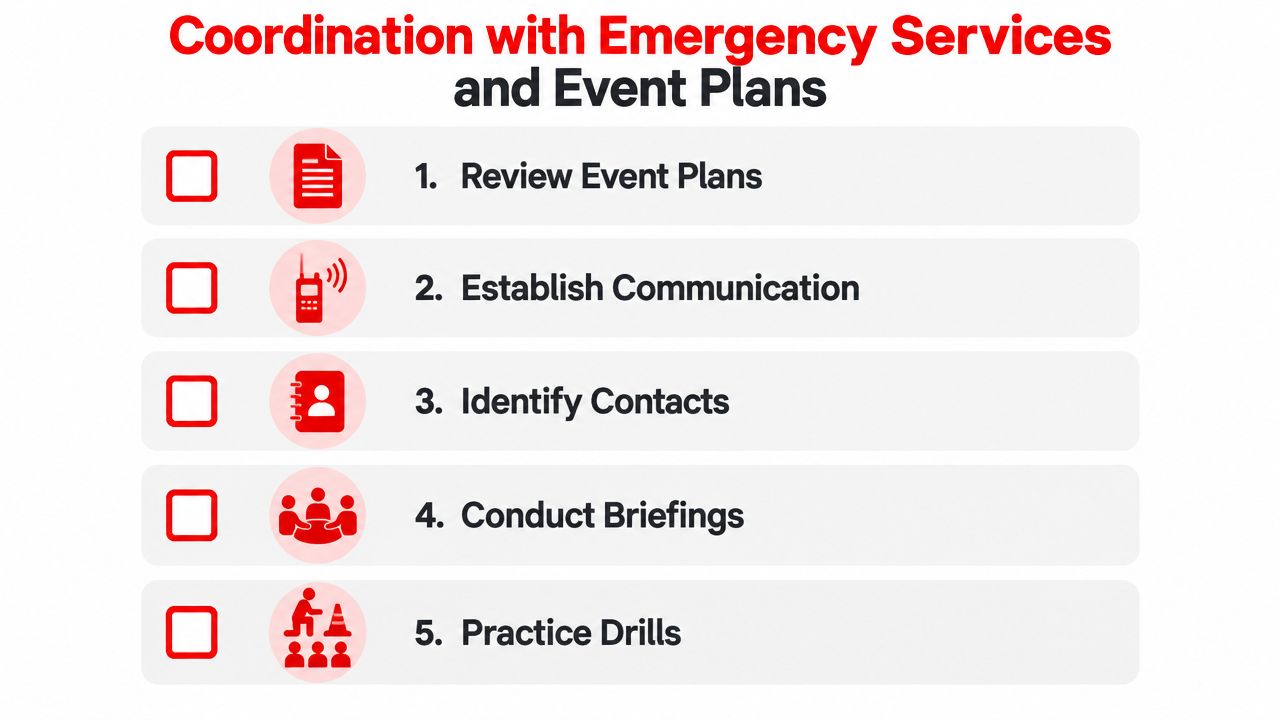
A security team can't improvise an event command system after the first emergency call. NSW event guidance requires emergency management plans to be developed with the venue or landowner and relevant agencies, including NSW Police, NSW Ambulance, Fire and Rescue NSW or the NSW Rural Fire Service where applicable.
The plan should name the person or role responsible for managing the response, establish a chain of command and explain how that person can be contacted during an incident. The most useful plan doesn't merely say “respond appropriately”. It states who can order an evacuation, who can pause a show, who can authorise a lockdown and who speaks to emergency services.
Turn the plan into a field checklist
Before doors open, the supervisor should be able to answer these questions:
- Which option applies? Evacuation, shelter, lockdown, show pause or stop, or search.
- Who triggers it? Name the role, backup role and contact method.
- Where do people go? Identify assembly, shelter, triage and restricted areas.
- Who protects access? Assign cordons, gates, traffic routes and responder entry.
- Who owns information? Allocate radio control, CCTV, PA and external liaison.
- Who records decisions? Nominate a person to maintain the incident timeline.
- Who handles witnesses? Identify a safe location where witnesses can remain available.
Make responder access part of the design
The handoff can fail before responders arrive if gates are locked, access routes are blocked or no officer knows the agreed entry point. Site teams should confirm how police, ambulance and fire crews will reach the incident, who will open controlled access and where the supervisor will meet them.
For gated or complex sites, planning resources on how to enhance first responder gate access can help planners examine access controls before an incident. The principle applies equally to venues, construction compounds and corporate sites: responders should not have to search for the right gate while officers are trying to manage the crowd.
During handover, security should retain useful site knowledge without competing for command. Establish the perimeter, point out hazards, identify witnesses and provide the incident timeline. Then follow the direction of police, ambulance or fire personnel.
Documentation, Evidence Preservation, and Scene Integrity
Once people are safe and emergency services have taken control, the officer's task changes. The priority becomes preserving the scene, supporting the investigation and creating a factual record that another person can understand later.
The Australian National University emergency procedure gives a practical sequence: assess danger and call emergency services, notify site security, secure the scene from unauthorised entry, avoid moving items, keep witnesses available and complete offender details independently before police arrive. That sequence separates immediate life safety from evidence preservation, which prevents well-meaning responders from damaging information.
Protect the scene without obstructing care
First aid and rescue take priority. Don't delay treatment to protect evidence. Once the casualty has been assisted, establish a boundary around relevant areas and record anything that was moved, by whom and why.
Examples include:
- A dropped object: Don't pick it up or place it somewhere safer unless a hazard requires removal. Note its original location.
- A damaged door: Stop staff from touching the handle or resetting the lock until police advise otherwise.
- A spill or blood trail: Keep people away, photograph only under approved policy and record the visible condition.
- A CCTV sequence: Tell control which cameras cover the area and preserve the relevant footage through the approved system.
- A witness group: Keep witnesses available and avoid allowing them to coordinate their accounts.
Write facts, not conclusions
A strong report records the date, time, exact location, people involved, witness details, observed actions, calls made, directions received and outcome. Write “the person pushed the patron towards the exit” rather than “the person became violent without reason”. Separate what you saw from what someone else told you.
Complete an offender-details checklist independently where the procedure requires it. Independent notes reduce the risk that one person's assumptions replace another person's direct observation.
The report also needs a clear handover record. Note when police or ambulance arrived, who received the information, which witnesses were identified, what areas remained restricted and whether any evidence or footage was transferred. Accurate contemporaneous notes protect the integrity of the investigation and the officers who acted within procedure.
Training, Drills, and Regulatory Compliance
A written procedure that officers haven't practised is a reference document, not an emergency capability. Reactive teams search for instructions during the incident, while drill-based teams recognise the first call, assign the scene and create a reliable handoff without waiting for perfect information.
Australian workplace emergency planning rules require written plans, effective communication, testing and worker training. ACT guidance also requires emergency planning committees to consist of trained personnel and requires a sufficient number of trained first aid officers based on risk assessment, with first aid officer and location lists prominently displayed.
Compare compliance with readiness
| Compliance-only approach | Drill-based approach |
|---|---|
| Stores a plan in the office | Walks officers through the actual site |
| Reviews contacts occasionally | Tests radio, supervisor and responder pathways |
| Treats first aid as a qualification | Places trained first aid capability where risk demands it |
| Records attendance | Checks whether officers can perform assigned tasks |
| Waits for an incident review | Uses exercises to expose gaps before an emergency |
Drills should reflect the site's real hazards. A festival team might rehearse a medical collapse obstructing a crowd route, a show pause and ambulance access. A construction team might practise a fall, machinery isolation and a controlled perimeter. A corporate team might test evacuation, shelter and the reception handoff to police.
Training records should identify the course, participant, date, competency evidence and refresher needs. When a provider needs consistent documentation, these certificate templates for training providers can support an organised recordkeeping process. The certificate isn't the capability. The observed performance during a drill is.
GM GROUP Services provides licensed security personnel, emergency response, risk assessments, back-to-base monitoring and site supervision for events, venues, businesses and construction environments across NSW, Victoria, Queensland and the ACT. Visit GM GROUP Services to discuss a response plan that defines the first call, the first assignment and the handover route before your next incident occurs.
Discover more from GM Group Services
Subscribe to get the latest posts sent to your email.