
Emergency response planning starts before the gates open, the bar fills, or the first contractor arrives. A festival manager checks the radio channel, a venue supervisor confirms the exits, and a construction site manager reviews the day's high-risk work. Then a storm warning changes the programme, a patron collapses, a plant alarm sounds, or a crowd begins moving toward an exit that isn't designed for that volume. The response succeeds or fails on decisions made before the incident.
Why Emergency Response Planning Matters for Events and Venues
Emergency response planning is more than a folder labelled “emergency procedures”. It's the operating system that connects risk assessment, trained people, communications, evacuation, first aid, security, emergency services and recovery. On a busy site, staff need to know who can activate the plan, who gives instructions, which route is safe, where vulnerable people go, and when normal operations stop.
Australia's response workload shows why this preparation matters. In 2024–25, fire service organisations attended 472,361 emergency incidents, while state and territory emergency services attended 101,662 incidents, excluding Queensland. Government expenditure for fire services and state and territory emergency services reached $7.4 billion in the same period, according to the Productivity Commission's emergency management data. These figures don't describe one venue or festival, but they show the scale of the environment in which Australian organisers operate.
A typical event-day failure is rarely dramatic at first. A staff member notices smoke near a temporary structure, but doesn't know whether to contact the event controller or the security supervisor. A radio message reaches one team but not another. A patron using a mobility aid waits for assistance that nobody has been assigned to provide. Minutes pass while people debate whether the issue is serious enough to escalate.
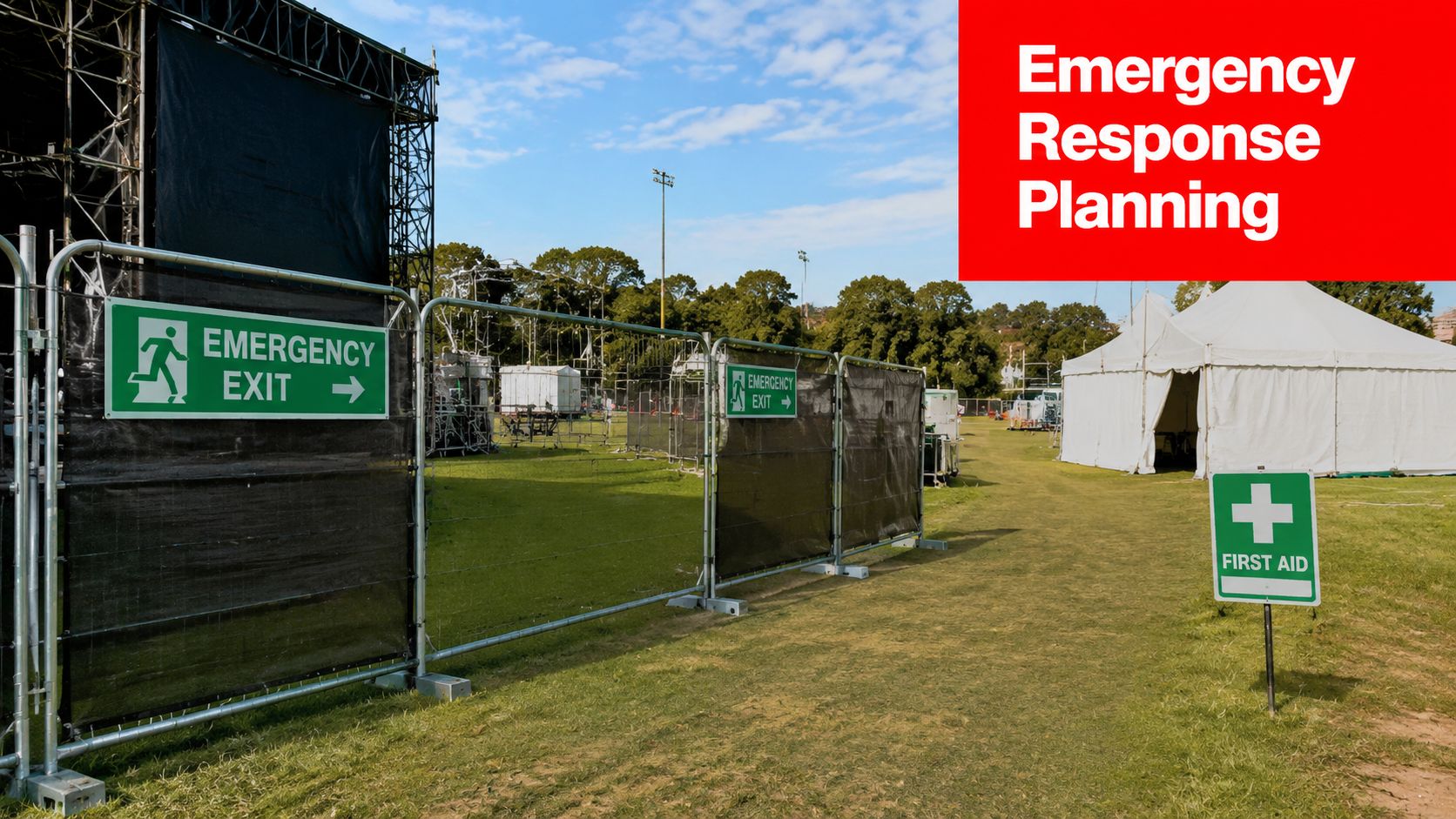
Preparedness gaps appear on the ground
The Productivity Commission reports that 61% of people surveyed across NSW, Queensland, the ACT, WA and SA didn't have an emergency plan. Although the survey concerns people rather than event operations, the practical lesson is clear. Staff, contractors and patrons won't automatically understand what to do just because an organiser has written a policy.
Australian Red Cross research published in 2025 found that 90% of Australians had been affected by an emergency or disaster in their lifetime, yet only 35% were prepared, as reported in its emergency preparedness research. For events, hospitality, construction and retail, formal planning is therefore a working requirement, not paperwork completed for an approval file.
The plan also protects more than physical safety. Poor decisions can damage property, interrupt trading, expose workers and patrons to avoidable harm, and weaken confidence in the organiser or venue. Good safety planning for live events treats security, medical response, crowd movement and emergency coordination as one connected system.
Practical rule: If a new supervisor can't find the activation trigger, command contact and immediate action within moments, the plan is too difficult to use.
How to Assess Risks Before You Build Your Emergency Response Plan
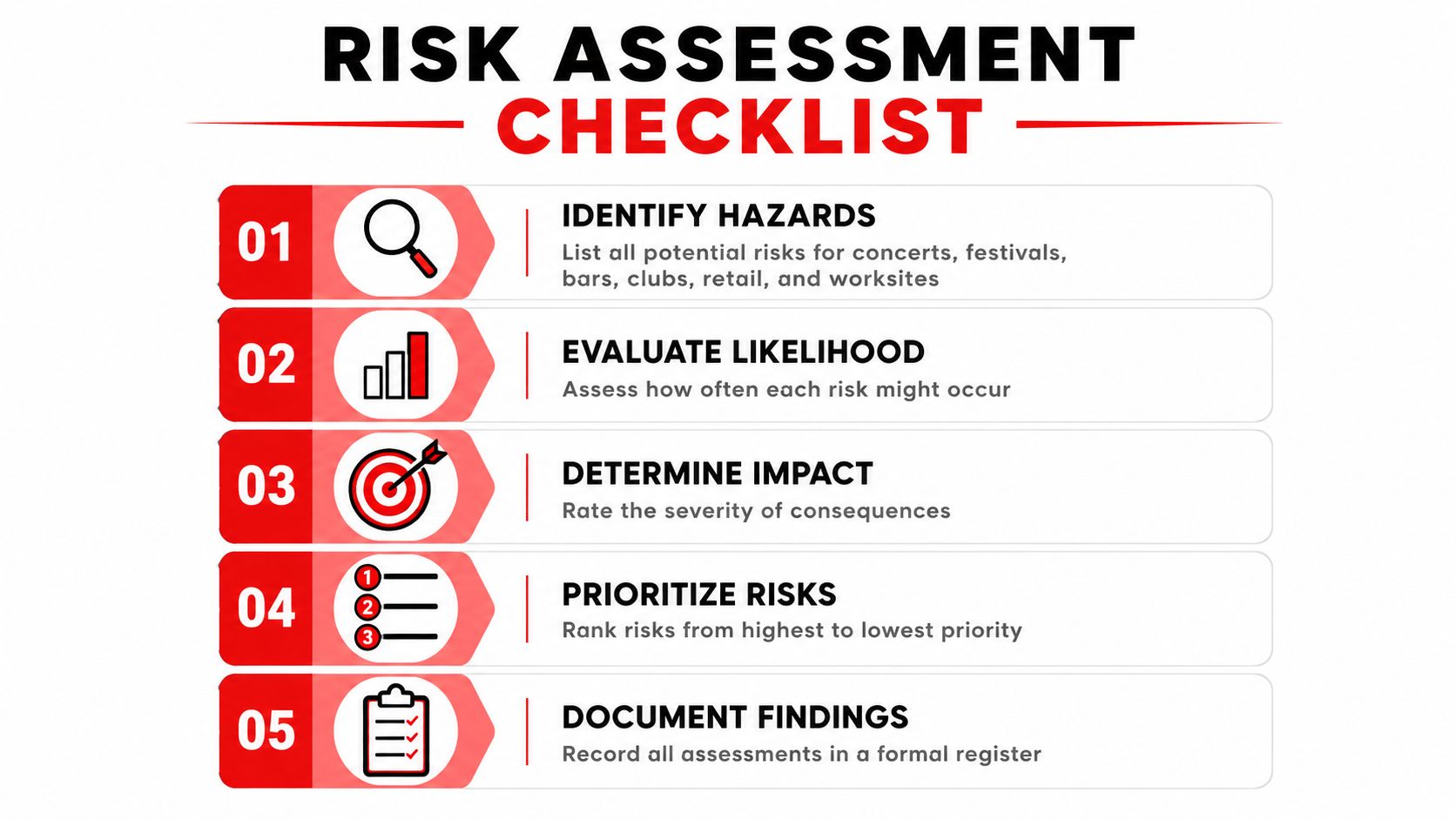
A risk assessment starts with the site, not a template. Walk the venue, event footprint or worksite in the conditions it will face. At a festival, inspect entry queues, temporary structures, backstage access, alcohol service, vehicle movements, weather exposure, and the distance between public areas and first aid. A hotel bar needs checks for intoxication, conflict, restricted areas, fire doors and late-night staffing. Construction assessments should cover plant, excavation, stored materials, temporary services, deliveries and workers moving between zones.
Build a usable risk register
Record hazards in a register that gives the response team a clear next action. Each entry should identify:
- Hazard: Describe the event, condition or activity, such as a blocked exit, aggressive patron, severe weather or plant incident.
- Exposed people: Include patrons, workers, contractors, performers, children, visitors and anyone who may need assistance.
- Existing controls: Record barriers, guards, lighting, signage, supervision, first aid and access restrictions already operating.
- Potential consequence: Consider injury, crowd compression, fire spread, lost children, property damage, operational shutdown or delayed emergency access.
- Required response: Connect the hazard to an activation trigger, decision-maker, resource and communication method.
Assess likelihood and impact separately, then set priorities. A rare hazard with severe consequences may require more planning than a frequent nuisance. A slippery service corridor at a club calls for immediate housekeeping and supervision. A forecast storm may require an event pause, a shelter decision and a prepared public message before patrons arrive.
Test the plan against realistic scenarios
Use short prompts that expose gaps in decisions and deployment. Ask, “What happens if the main gate becomes unusable during peak arrival?” Then specify the alternate route, queue manager, security position, public message and emergency access lane. Ask, “What happens if a worker is injured in an isolated construction zone?” Check the location reference, access route, first aid response, plant isolation and ambulance handover.
RSA risks need the same level of detail. A venue plan should state what staff do when intoxication, conflict or refusal to leave escalates. Security personnel need authority to call a supervisor, separate parties, protect staff, maintain emergency access and document the incident. The aim is to remove uncertainty from the first response, not predict every detail.
Use a trigger matrix to connect observations with action. For example, rising crowd density may require extra security and controlled entry, while a confirmed fire requires emergency services notification, evacuation decisions and access for responding crews. Assign each trigger to the incident controller, venue manager, security supervisor or other nominated role so responsibility does not remain unclear.
Risk assessment must also cover shelter-in-place and evacuation decisions. NSW SES planning material advises deciding in advance whether to leave or shelter, selecting safe destinations with reliable road access, and preparing an emergency kit. It describes evacuation centres as an option of last resort. A site plan should therefore identify more than one practical destination and account for transport, assistance and access conditions, rather than relying on a generic meeting point.
Creating an Emergency Response Plan That Meets Australian Requirements
A compliant plan must also be usable. Safe Work Australia says the model WHS framework requires every workplace to have a written emergency plan covering emergency response, evacuation, rapid notification of emergency services, medical treatment and assistance, communication between the emergency coordinator and people at the workplace, testing, and worker training and instruction. The plan must be maintained so it remains effective, as set out in Safe Work Australia's emergency plan guidance.
For NSW workplaces, Fire and Rescue NSW states that section 43 of the Work Health and Safety Regulation 2025 requires every workplace to prepare, maintain and implement an emergency plan appropriate to that workplace. The Fire and Rescue NSW emergency planning guidance makes the operational point clearly. A plan must be current and implemented, not only stored.
Put decisions in the document
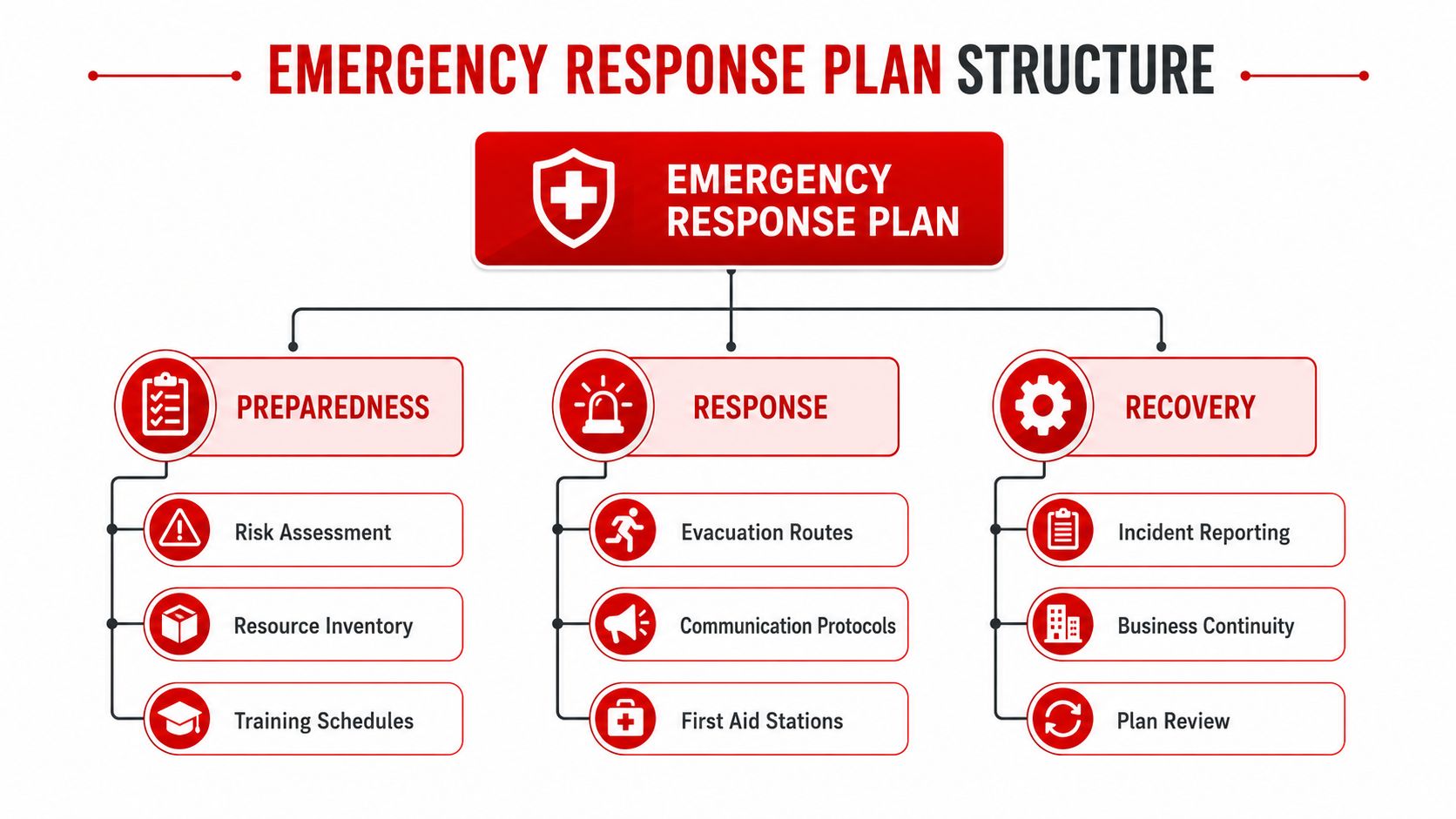
Use a short base plan supported by site maps and hazard-specific procedures. At minimum, define:
- Activation: Which conditions start the plan, and who has authority to activate it.
- Notification: Who contacts emergency services, management, contractors, clients and affected occupants.
- Escalation: What changes when an incident spreads, blocks a route, affects multiple zones or exceeds site resources.
- Stand-down: Who confirms the incident is controlled and authorises re-entry or continued closure.
- Command: Who leads the response, who supports them, and how control transfers.
- Resources: Where radios, first aid equipment, torches, keys, barriers, attendance information and emergency contacts are held.
- Recovery: How the organisation records the incident, supports affected people, protects evidence and reviews the plan.
NSW guidance requires plans to define activation, notification, escalation and stand-down procedures, authority, roles, and control and coordination arrangements using an Incident Command System structure. It also stresses that plans must be specific to the facility and include training and maintenance, as explained in the NSW emergency management policy.
Tailor the same structure to each site
At a festival, the plan might activate a weather trigger, pause performances, move patrons to designated safer areas, protect emergency lanes and coordinate with the production manager. At a hotel bar, it may activate for fire alarm, medical collapse, violence or a missing child, with the duty manager retaining venue control while security manages immediate safety. On a construction site, the plan needs location references that workers understand, plant isolation steps, controlled access and a reliable process for meeting emergency crews at the correct gate.
A useful plan gives staff a role card, not a long paragraph. The card should state the first action, reporting channel, authority limit and handover requirement. That format improves recall without removing the detailed plan needed by managers and emergency coordinators.
Roles Responsibilities and Communication Protocols That Work Under Pressure
A crowd surge, fire alarm or plant incident can make a plan unstable within minutes if several people assume they are in charge. Use an Incident Command System structure with one incident controller, named functional leads and a clear escalation path. The structure can scale from a small hospitality venue to a major festival, but authority must remain visible to staff, contractors and security.
The incident controller sets priorities, approves protective actions, coordinates with emergency services and decides when the response changes level. Security supervisors manage immediate scene safety, access control, crowd movement and reports from guards. Venue or site managers provide operational knowledge, keys, plans, staff details and business decisions. First aid teams manage treatment and handover. Communications personnel issue approved messages and maintain the incident log.
Give each person a role card, not a long paragraph. State the first action, reporting channel, authority limit and handover requirement. Keep the detailed plan for managers and emergency coordinators, then give frontline staff instructions they can recall under noise, pressure and incomplete information.
Build a trigger matrix
A trigger matrix connects an observation to a decision. For every scenario, record the trigger, first action, decision-maker, notification path, required resource and escalation point. A reported electrical fault near a public area may require isolation, a security cordon, notification to the venue manager and a decision about whether the area can remain open. A lost child needs a different sequence, including controlled information sharing, coordinated searches and protection against unnecessary public disclosure.
Use primary and backup communication methods. Radios often suit a festival footprint, but reinforced structures can block them. Mobile phones support direct calls, although too many people contacting one manager can delay decisions. A face-to-face runner may be the only reliable option in a noisy club or construction zone. Agree on plain-language terms and location references during the briefing. Use closed-loop communication: the recipient repeats the instruction and confirms completion.
| Site Scenario | Recommended Command Setup | Communication Method |
|---|---|---|
| Small hospitality venue | Duty manager as incident controller, security supervisor responsible for immediate safety, first aid contact nominated | Direct verbal instruction supported by phone and a visible contact list |
| Festival with multiple operational zones | Event controller supported by operations, security, medical, production and communications leads | Dedicated radio channels, escalation call tree and approved public messages |
| Construction site with changing work fronts | Site manager or nominated emergency coordinator, zone supervisors responsible for worker accountability | Radio, site noticeboard, worker induction contacts and emergency access reference |
| Shopping centre or retail complex | Centre controller with security control room, tenant liaison and first aid or facilities lead | Control-room radio, phone escalation and centre-wide public announcements |
Coordinate with external responders
Security providers should know which gates to open, how to clear emergency lanes, where fire and ambulance crews will be met, and how relevant information will be preserved. They also need authority to prevent well-meaning staff or patrons from crowding a scene. Event organisers should provide emergency services with current site maps, access points, hazardous areas, expected occupancy information and the location of command facilities. Agree in advance who retains site control and when statutory responders take command.
Accessibility needs named ownership. At a festival, assign a guard to the accessible viewing platform and give that person a radio contact for the incident controller. At a venue, record assistance needs declared at entry where privacy and operational procedures allow, then brief the relevant supervisor without exposing unnecessary personal information. On a construction site, identify workers who may need help, confirm their work location during the shift and assign a buddy or zone supervisor. Display contact lists, assign assistance responsibilities and plan for incomplete information. Do not assume every person can self-evacuate.
GM GROUP Services is one option for organisations seeking licensed security personnel, event security, site supervision, emergency response support or risk assessments across NSW, Victoria, Queensland and the ACT. Its services include static guards, K9 teams, gatehouse control, vehicle patrols, loss prevention and incident reporting. These functions can be fitted into a site's command and communication arrangements when responsibilities, reporting lines and escalation limits are agreed before deployment.
Training Drills Testing and Keeping Your Plan Alive
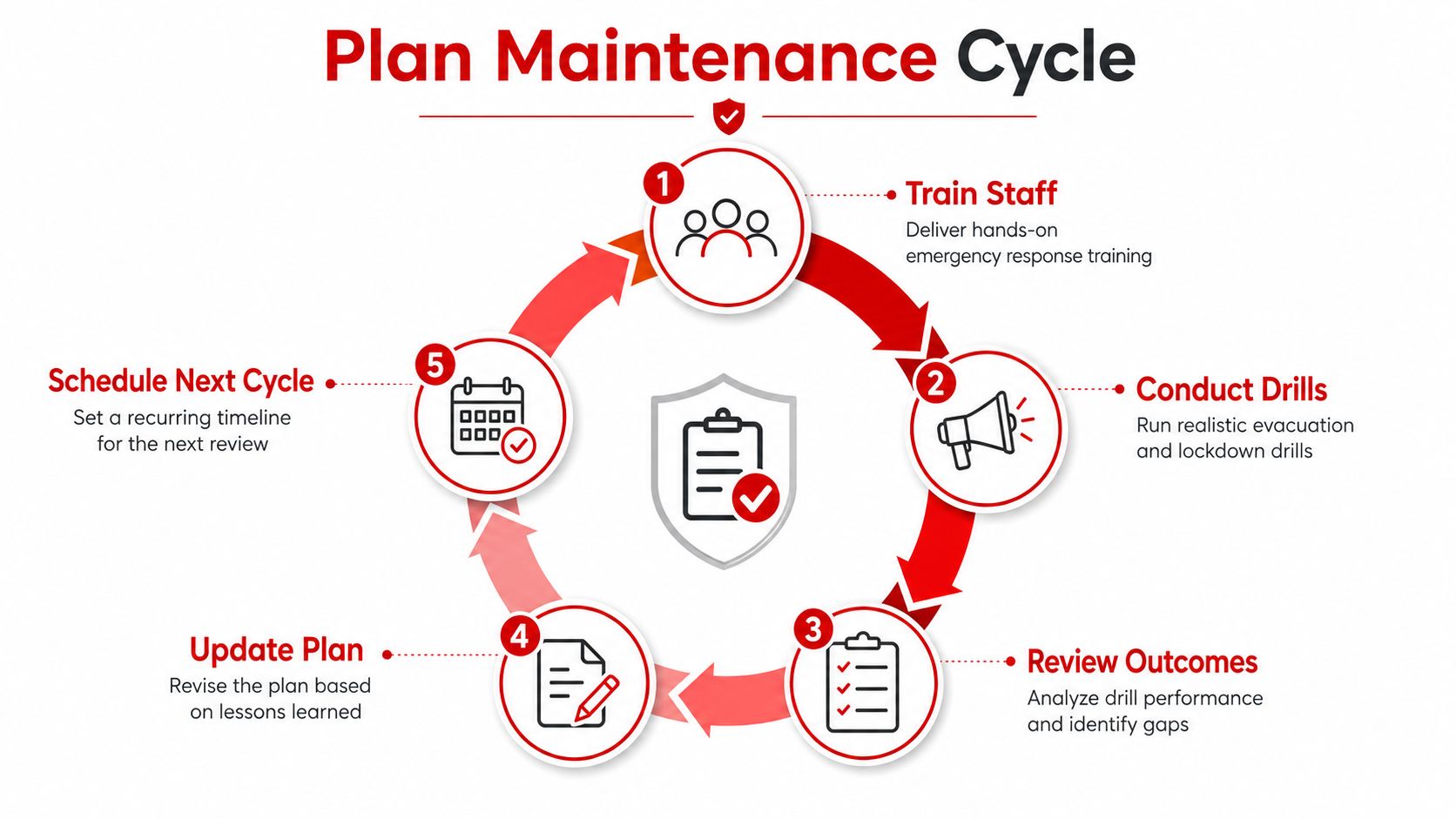
A written plan becomes credible only after people use it. Training should start with role clarity, then move into short exercises that expose practical weaknesses. A security guard who knows the evacuation route but doesn't know who can close a gate still has an operational gap. A venue manager who can activate the plan but can't locate the current contact list has the same problem.
Use a readiness cycle
Run different types of exercises for different purposes:
- Briefing: Walk staff through triggers, routes, roles, radio language and assistance arrangements before the event or shift.
- Tabletop exercise: Give managers a scenario and make them explain decisions, notifications and escalation without moving people.
- Functional drill: Test one capability, such as emergency communications, first aid handover, lockdown or access for emergency vehicles.
- Live exercise: Rehearse movement and coordination where it's safe, controlled and unlikely to alarm patrons or neighbours.
- After-action review: Record what happened, what failed, who owns each corrective action and when the revision will be completed.
Roaming workers deserve particular attention. Safe Work Australia's emergency-plan material includes workers who may work at multiple workplaces, so businesses must account for event crews, contractors, security teams and mobile site workers rather than briefing only permanent staff. A contractor arriving for one shift should receive the emergency contact, alarm response, assembly information and reporting expectations without relying on a previous induction.
Review after change, not only after failure
Update the plan when the footprint changes, a tenant or contractor changes, access routes move, staffing changes, new equipment arrives, or a serious incident reveals a weakness. Don't wait for an annual calendar reminder if the risk environment has already shifted.
Victoria's emergency-management planning rules require plans to be prepared collaboratively, aligned with other plans, based on integrated response and recovery arrangements, and assured, approved and published every 3 years or more frequently if required, according to the Victorian emergency-management planning guidance. That cycle is a governance requirement, not a substitute for operational reviews.
NSW guidance requires plans to be maintained, and multi-hazard conditions make passive reviews unreliable. In 2025, the National Emergency Management Agency reported floods, bushfires, a biosecurity threat, severe storms and cyclones, with the Crisis Coordination Team active for 191 days and 19 National Coordination Mechanism meetings, as recorded in its 2025 review of collaboration and coordination. A plan should therefore remain adaptable across overlapping hazards and longer disruptions.
Useful test: After every drill or incident, make one named person responsible for each corrective action. An observation without an owner is unlikely to become an improvement.
Emergency Response Planning FAQs for Australian Organisers
How often should an emergency response plan be updated?
Review it whenever the site, people, operations or threat environment changes. That includes altered exits, new temporary structures, changed contractors, revised trading arrangements, new plant, major events, incidents, drills and credible warnings about hazards.
A scheduled review still matters, but it shouldn't be the only review. Victoria requires emergency-management plans to be assured, approved and published every 3 years or more frequently if required, while NSW workplace guidance requires plans to be maintained and implemented. Use the formal cycle for governance, then use event-by-event and change-triggered reviews for operational control.
How should plans cover workers who move between sites?
Give roaming workers a portable, role-specific briefing. Event security officers, contractors, construction crews and relief managers need the local emergency contact, site reference, alarm response, assembly or shelter arrangements, access restrictions and reporting channel for each workplace.
Safe Work Australia specifically includes workers who may work at multiple workplaces in its emergency-plan guidance. Don't assume a worker's experience at one venue transfers to another. A radio channel, gate number, assembly point or evacuation route may be completely different.
Should every event plan rely on an evacuation centre?
No. NSW SES material describes evacuation centres as an option of last resort. The site plan should first establish whether people should shelter, move to a safer internal or external area, evacuate in stages, or leave through a controlled route.
Choose destinations with reliable road access and include transport contingencies, assistance for people with impaired mobility, weather protection and communication arrangements. A single generic evacuation script won't cover a flood warning, smoke movement, violent incident or structural problem equally well.
What should security providers receive before deployment?
Provide the current site plan, role card, trigger matrix, radio protocol, emergency access points, prohibited actions, assistance assignments and escalation contacts. Supervisors should confirm that guards understand the boundaries of their authority and how they'll hand control to venue management or emergency services.
A short pre-shift briefing is more useful than sending a large document without explanation. Keep the full plan available, but make the first actions easy to retrieve under pressure.
How can an organiser tell whether the plan works?
Ask staff to demonstrate rather than describe. Can they identify the nearest suitable route, contact the correct person, support someone needing assistance, keep an emergency lane clear and report an incident using the agreed location reference? A drill, tabletop or controlled functional test will reveal gaps that a document review can miss.
GM GROUP Services can help event organisers, venue managers, construction teams and retailers translate site risks into practical security, emergency response and supervision arrangements across NSW, Victoria, Queensland and the ACT. Review your current plan, identify the gaps your staff would face under pressure, and visit GM GROUP Services to discuss a fit-for-purpose approach.
Discover more from GM Group Services
Subscribe to get the latest posts sent to your email.