
Diversity and inclusion training usually becomes urgent right after a bad incident, not before it.
A patron gets stopped at an entry point. The guard's tone is curt, the explanation is unclear, and a situation that should've taken twenty seconds turns into a crowd, a phone camera, a complaint, and a venue manager trying to work out whether this is now a safety issue, a reputational issue, or both. In security, events, and hospitality, those are often the same thing.
That's why diversity and inclusion training matters on the frontline. Not as a corporate slogan. Not as a generic HR module. As an operational control that shapes how staff speak, assess risk, enforce rules, and de-escalate pressure without humiliating people or exposing the client's brand.
The Critical Need for Diversity and Inclusion Training
A Friday night crowd is building. A patron asks for help at the gate, the staff member misreads the situation, and within a minute the issue has shifted from routine screening to a complaint, a gathered audience, and a supervisor making decisions under pressure. In public-facing security, events, and hospitality, that shift happens fast.
Diversity and inclusion training matters because frontline errors are rarely judged only by intent. They are judged by impact, consistency, and whether staff can control the interaction without creating unnecessary friction, embarrassment, or risk. For Australian operators, that standard now carries more weight. The positive duty under federal sex discrimination law expects organisations to take reasonable and proportionate steps to prevent unlawful conduct before it happens, not just respond after a report lands.

For frontline teams, inclusion shows up in operational moments. Bag checks. Queue control. Directions to amenities. Refusals of entry. Responses to complaints, confusion, distress, disability-related requests, cultural misunderstandings, and inappropriate behaviour from patrons or colleagues. If staff get those moments wrong, the result can be a safety problem, a discrimination allegation, or a brand issue captured on video.
The trade-off is real. Teams still need to enforce conditions of entry, remove risk, and back each other under pressure. Good training does not soften standards. It gives staff a better way to apply them consistently, explain decisions clearly, and recognise the difference between non-compliance, vulnerability, and misunderstanding.
Where frontline teams feel the gap
The gap usually appears in speed, judgment, and communication.
Common pressure points include:
- Entry screening: Staff may give a lawful direction, but use wording or tone that sounds selective, dismissive, or hostile.
- Complaint intake: A patron raises a concern about bias, harassment, or accessibility, and the first response makes the issue worse.
- Crowd movement: During peak periods, rushed instructions and poor body language can escalate tension across a wider group.
- Back-of-house coordination: Casuals, contractors, venue staff, and security supervisors may apply different standards unless training is aligned.
- Incident reporting: Staff often record the outcome of an interaction but miss the behavioural details that matter in a review or legal response.
One hard truth sits underneath all of this. Patrons judge the venue by the person in front of them, not by the policy manual in the office.
Training also works better when it matches wider people systems such as induction, supervision, reporting pathways, and support settings. This piece on employee benefits and inclusion is useful context if you are reviewing how inclusion is reinforced beyond a single workshop.
Why D&I Training Is a Game-Changer for Security and Events
A Friday night queue is backing up outside a Melbourne venue. One patron is frustrated, another is hard of hearing, a third is filming on a phone, and your guard has ten seconds to make a call that could either settle the line or trigger a complaint, an incident report, and a social media problem. That is where practical diversity and inclusion training earns its keep.
Security managers usually invest in training to improve four outcomes. Safer interactions, a better guest experience, more consistent team performance, and lower legal and reputational risk. D&I training supports each of those outcomes when it is built for frontline decisions rather than classroom theory.
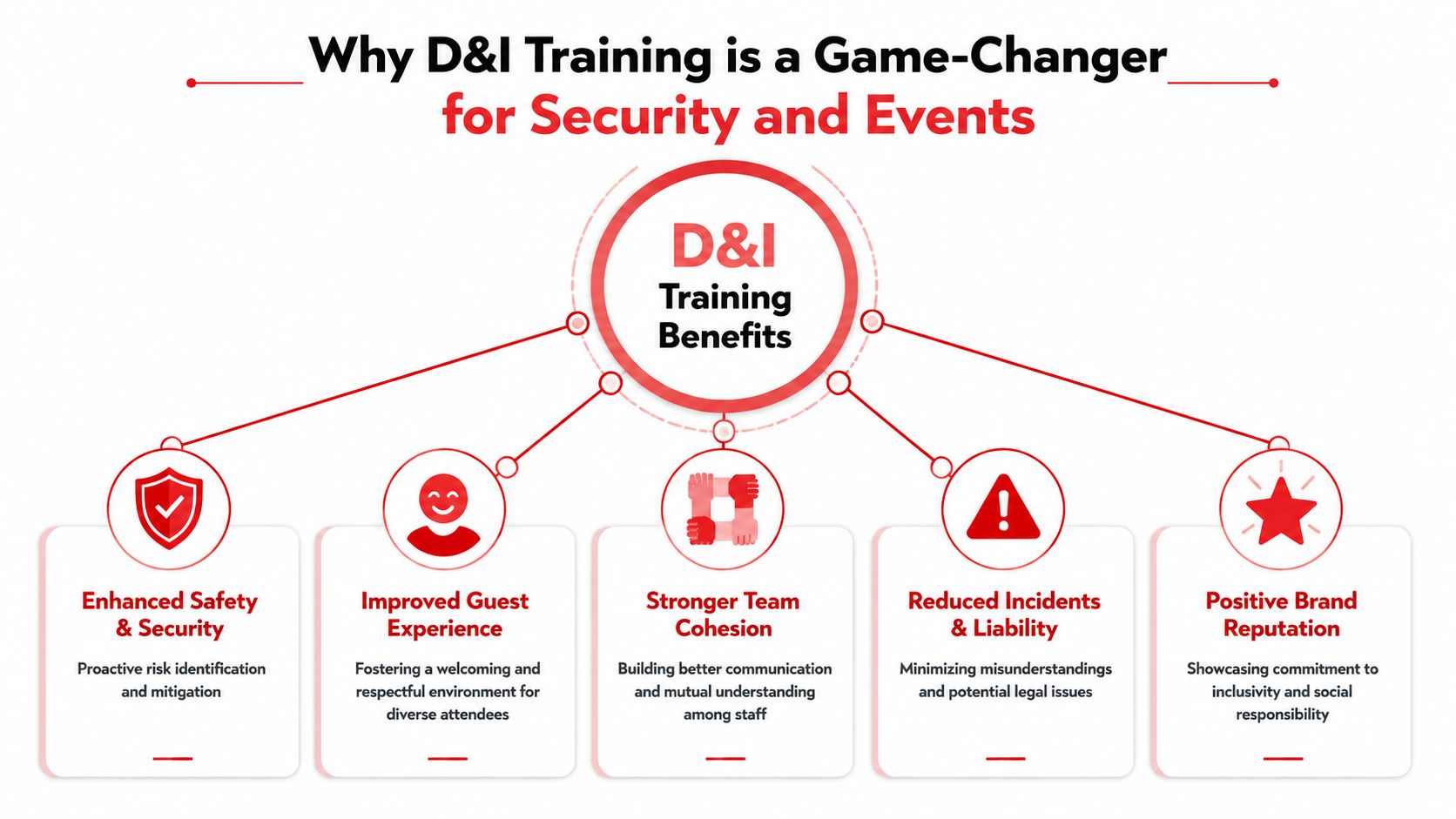
It improves safety and decision quality under pressure
On the ground, inclusion training is not about being softer. It is about being more accurate.
Frontline staff make fast judgments about intent, risk, intoxication, aggression, vulnerability, and compliance. Good training helps them separate these factors instead of treating every difficult interaction as defiance. In public-facing security, events, and hospitality settings, that distinction changes outcomes. A confused guest needs clear instructions. A person in distress may need space and support. A patron refusing a lawful direction still needs firm, professional handling. Staff who can read those differences early are less likely to escalate the wrong problem.
That matters in Australia, where employers are under greater pressure to prevent harassment, discrimination, and hostile conduct before it happens, not just respond after a complaint. For venue operators and contract security providers, the operational question is simple. Can your people enforce standards in a way that is lawful, consistent, and defensible when reviewed later?
It protects guest confidence and brand reputation
Patrons rarely separate the brand from the person standing at the entry point.
For a venue, stadium, hotel, festival, or licensed precinct, one poor interaction can travel fast. What starts as a refusal of entry or a complaint about treatment can become a client issue, a sponsor concern, or a public allegation that the site is unsafe or biased. D&I training reduces that exposure by improving how staff speak, listen, explain decisions, and respond to complaints in full view of others.
Teams with this training tend to perform better in areas such as:
- High-pressure communication: giving directions that are clear, calm, and respectful during queues, bag checks, refusals, and crowd movement
- De-escalation: lowering tension through tone, spacing, and word choice before physical intervention becomes necessary
- Complaint handling: recognising when a concern relates to bias, harassment, accessibility, or cultural misunderstanding, and escalating it properly
- Visible professionalism: showing fairness in a way patrons, clients, and bystanders can see for themselves
In these environments, professionalism is part of risk control.
It lifts consistency across mixed teams and changing shifts
Security and events operations often run with a mix of full-time staff, casuals, venue employees, contractors, and supervisors from different backgrounds. Without shared behavioural standards, each group fills the gaps differently. One guard explains a direction clearly. Another uses blunt language. A third avoids intervention altogether because they are unsure how to handle a sensitive situation.
Training gives managers a common operating standard.
The practical gains are straightforward:
| Operational problem | What poor training does | What effective D&I training does |
|---|---|---|
| Patron complaint at entry | Leaves staff relying on instinct | Gives staff response scripts and escalation triggers |
| Mixed casual workforce | Creates inconsistent behaviour across shifts | Sets a common standard for communication and conduct |
| Supervisor under pressure | Focuses only on policy wording | Teaches coaching, intervention, and reporting habits |
| Reputational risk | Reacts after incidents | Reduces preventable flashpoints before they spread |
I have seen this repeatedly in frontline operations. The strongest teams are not the ones that talk most about values. They are the ones that can apply the same standard at the gate, on the floor, in a complaint, and in the incident report.
A safe venue is one where staff resolve more situations early, explain decisions well, and leave fewer interactions open to dispute.
Core Modules for Effective Security Staff Training
Most training fails because it's too broad. It talks about values but not behaviour. It explains concepts but not shifts, gates, queues, radios, refusals, and incident reports. Effective diversity and inclusion training for security staff has to be built around what people do at work.
Research summaries also point in that direction. For training to be effective, it needs to target specific, measurable day-to-day behaviours in operational settings, not just awareness, as discussed in this operational DEI training analysis.
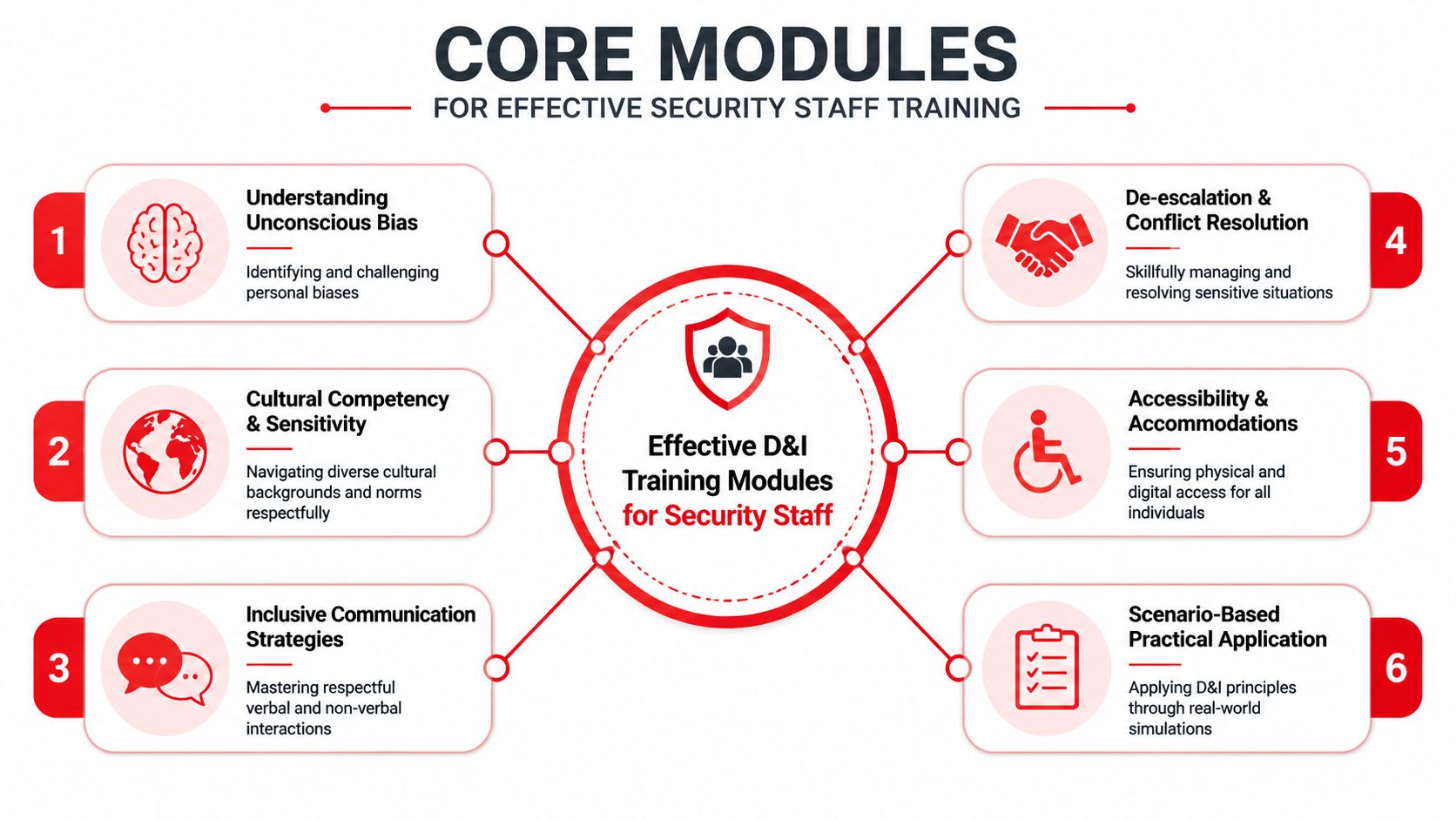
Start with bias, but don't stop there
Unconscious bias belongs in the curriculum, but it shouldn't dominate it. Frontline staff need to understand that assumptions can affect who they scrutinise, how they interpret behaviour, and how quickly they escalate.
That module should answer practical questions such as:
- Who do you stop first in a crowded line, and why?
- How do assumptions affect decisions about intoxication, aggression, or credibility?
- What does consistent enforcement look like when two guests present differently?
If the session ends there, though, little changes on shift.
Build capability around real interactions
The strongest programs include skills staff can use that night, not just ideas they can discuss in class.
A solid curriculum usually includes:
- Cultural competency and sensitivity: enough to help staff avoid disrespectful assumptions and communicate across different social norms.
- Inclusive communication: choosing words that are clear, neutral, and professional under stress.
- Disability awareness and accommodations: understanding visible and non-visible access needs, and knowing when to adapt pace, positioning, or instructions.
- Bystander response: stepping in when a staff member, contractor, or patron crosses a line.
- Complaint handling and reporting: documenting concerns properly and escalating without minimising them.
Make de-escalation part of the inclusion program
Many clients get the most value where inclusion and de-escalation overlap in high-pressure environments. A patron who feels embarrassed, singled out, or ignored is harder to manage. A patron who feels heard is often easier to direct, even when the answer is still no.
Field note: if your team can't explain a decision respectfully, they probably don't understand the decision well enough themselves.
A useful way to structure the curriculum is by work zone:
| Work zone | D&I skill needed | Example behaviour |
|---|---|---|
| Entry gates | Respectful verification | Explains ID or bag-check process without loaded language |
| Pit or crowd line | Calm redirection | Uses non-threatening posture and concise instructions |
| Concierge or foyer | Inclusive service | Adjusts communication style to guest needs |
| Back-of-house | Team coordination | Challenges disrespectful talk and reports concerns early |
Use scenario-based practice
The final module should never be theory. It should be rehearsal.
Role-play matters because it forces staff to apply policy, communication, observation, and judgement at once. That's much closer to real work than slides. If your provider can't run realistic site scenarios with supervisors, guards, ushers, and venue staff, the training probably won't transfer well to operations.
Putting Training into Practice with Real-World Scenarios
The fastest way to test whether diversity and inclusion training is useful is simple. Put it into a live scenario and see whether staff know what to say, what not to say, and when to call a supervisor.
Evidence consistently points to the value of iterative training that uses role-play and case studies, rather than one-off compliance delivery, as outlined in this guidance on how to deliver more effective diversity training.
Scenario one with ID and gender presentation
A patron presents valid ID, but the guard hesitates because the person's presentation doesn't match the guard's expectation.
Poor response:
The guard questions the guest loudly, calls over another staff member unnecessarily, and turns a verification task into a public spectacle.
Better response:
The guard checks the required details carefully, confirms whether the ID is valid, and if there's a genuine issue, speaks discreetly and requests supervisor support without commentary about the person's appearance.
What matters here isn't ideology. It's professionalism, privacy, and control.
Scenario two with a hearing-impaired guest in a loud environment
The music is heavy, the entry lane is packed, and a guest isn't responding to a verbal direction.
Poor response:
The staff member repeats the same instruction louder and louder, becomes frustrated, and interprets the lack of response as non-compliance.
Better response:
The staff member changes position to gain eye contact, uses simple gestures, reduces the amount of information being given at once, and if needed moves the interaction to a quieter point or gets another staff member to assist.
That's inclusive conduct, but it's also basic operational competence. The same method helps with language barriers, stress responses, and sensory overload.
Scenario three with a patron complaint about a microaggression
A customer says another patron or even a contractor made a disrespectful remark.
Poor response:
“Don't worry about it.”
“It was probably a joke.”
“There's nothing we can do unless it turns into a fight.”
Better response:
The staff member listens, records who was involved, assesses immediate safety, separates parties if needed, and escalates to the right supervisor with facts rather than personal opinion.
That protects both the complainant and the operator. It also prevents the secondary mistake of staff dismissing a concern that later becomes a formal complaint.
Scenario four with cultural misunderstanding at a checkpoint
A guest seems reluctant to follow a search instruction and avoids direct eye contact.
Poor response:
The guard interprets hesitation as guilt, tightens tone immediately, and crowds the person physically.
Better response:
The guard keeps instructions short, explains the reason for the process, offers the least intrusive lawful option available, and watches the total context before escalating.
Sometimes the difference between a smooth interaction and a reportable incident is one sentence delivered calmly.
These scenarios should be practised in refreshers, toolbox talks, and supervisor coaching. If they only appear once in a classroom, staff won't retain them under pressure.
A 4-Step Roadmap for Implementing Your Training Program
Rolling out diversity and inclusion training properly takes more than booking a presenter and sending a calendar invite. The organisations that get traction treat it like any other operational improvement project. They assess the site, define the behaviours that need to change, train for those conditions, and then measure whether the conduct shifts.
Research backs the need for repetition. A systematic review found that 85.7% of multi-session diversity trainings showed significant improvements, compared with 62.5% of single-session trainings, according to this 2024 systematic review of DEI and antiracism training studies.
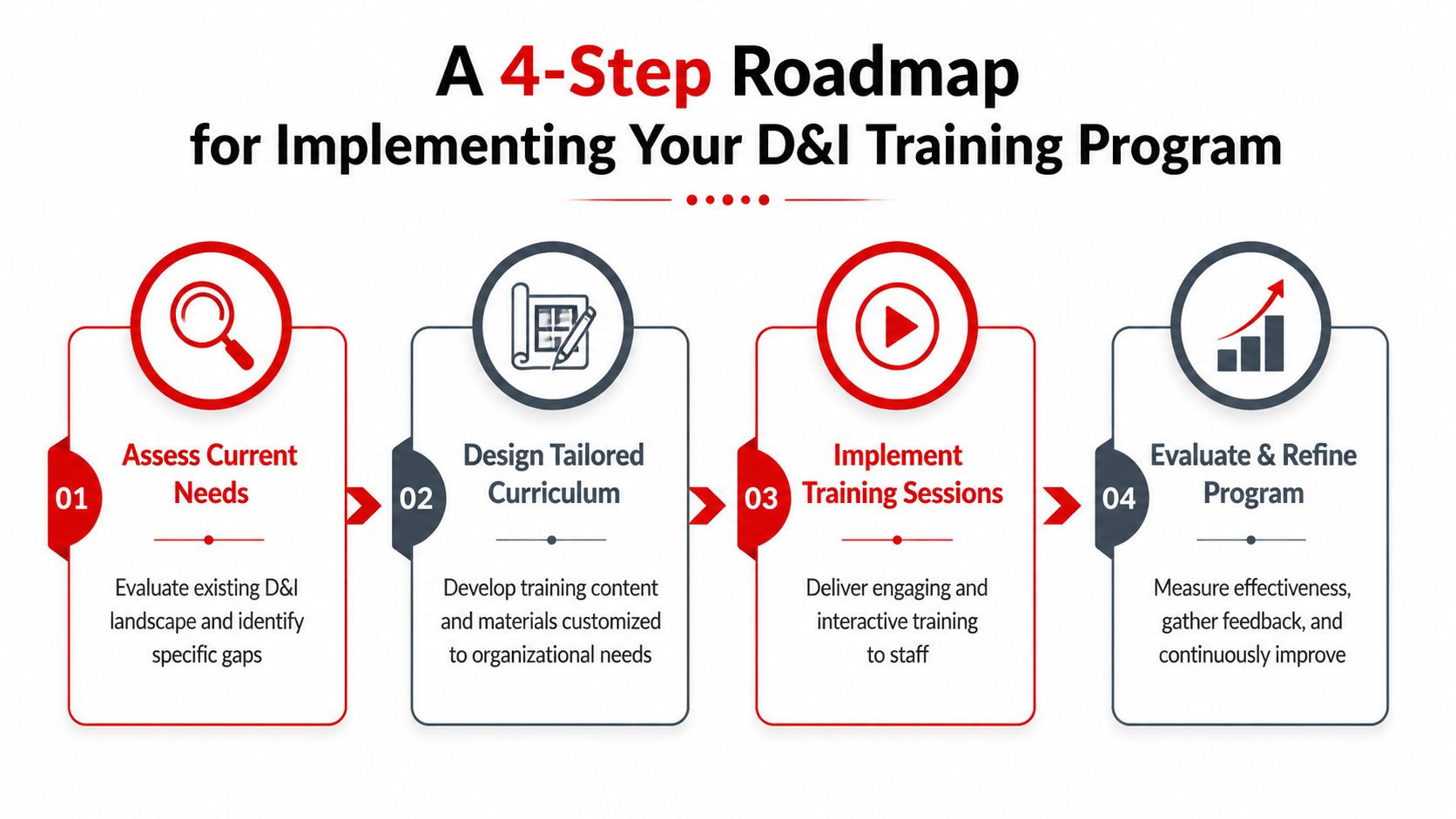
Step one Assess current pressure points
Start with the places where conduct risk already lives. Entry searches. Alcohol-related refusals. Complaint escalation. Contractor interactions. Supervisory handovers.
Review incident reports, guest complaints, ejections, and manager observations. You're looking for patterns in language, judgement, and inconsistency.
Step two Design for the site, not the brochure
A hotel, festival, construction gatehouse, and stadium concourse don't need the same examples. The curriculum should reflect the venue, patron mix, hours, and operating model.
Useful design questions include:
- Which interactions go wrong most often
- Which roles need extra scenario practice
- What should a supervisor correct in real time
- Which behaviours should appear in post orders or briefing notes
Step three Deliver in layers
One workshop won't be enough. Use a blend of induction content, supervisor-led refreshers, scenario drills, and post-incident coaching.
A layered rollout often works best:
- Foundation session for shared language and expectations
- Role-specific practice for guards, ushers, supervisors, and managers
- Short refreshers tied to current incident trends
- Coaching on shift when supervisors observe gaps
Step four Measure and refine
Don't rely on attendance sheets. Measure whether the training changed behaviour.
Track indicators such as:
- Complaint themes: especially those involving disrespect, misunderstanding, or escalation style
- Supervisor observations: whether staff use the expected language and decision process
- Incident reporting quality: whether facts, context, and escalation steps are recorded clearly
- Team feedback: whether staff feel more confident handling difficult interactions
What to measure: not whether staff enjoyed the session, but whether they handled the next difficult interaction better.
If the answer is no, adjust the scenarios, refresh the messaging, and tighten supervisor accountability.
Meeting Australian Compliance and Choosing the Right Partner
Australian employers now face a sharper compliance environment. That matters for events, venues, and public-facing operations because risk often appears in the exact places where frontline staff make rapid judgement calls.
Current guidance points to the importance of the new positive duty. The Australian Human Rights Commission's compliance focus means employers need to take proactive, reasonable, and proportionate steps to prevent sex discrimination and related harassment, and training should connect inclusion directly to legal risk, incident reporting, and supervisor accountability, as noted in this Australian compliance-focused diversity training guidance.
What positive duty means in practice
For operators, this means generic awareness content isn't enough. Training needs to prepare staff for situations such as:
- Bystander intervention: when a patron, contractor, or co-worker behaves inappropriately
- Immediate reporting: who gets told, what gets documented, and how quickly
- Supervisor response: what managers must do when concerns are raised
- Customer-facing conduct: how to manage inappropriate behaviour while still controlling the site
If the program doesn't deal with those scenarios, it may look compliant on paper and still fail operationally.
What to ask a training provider
Not every provider understands frontline environments. Some are strong on policy language and weak on actual site behaviour.
Use this checklist:
| Question | Why it matters |
|---|---|
| Do they customise for security, events, or hospitality operations | Generic office examples won't prepare gate or crowd staff |
| Do they use real scenarios and role-play | Staff need rehearsal, not just information |
| Can they train supervisors separately | Supervisor conduct determines whether standards stick |
| Do they address reporting and escalation | Inclusion failures become legal problems when they're mishandled |
| Can they help define measurable behaviours | You need observable standards, not broad intentions |
A good provider should also be comfortable hearing uncomfortable truths from your operation. If they only want to deliver slides and leave, they're not solving the actual problem.
Frequently Asked Questions About Diversity and Inclusion Training
How long should diversity and inclusion training be
Long enough to practise, not just listen. For frontline teams, a short awareness session on its own rarely sticks. A better model is an initial workshop followed by shorter refreshers, role-specific drills, and supervisor coaching on shift.
How do we measure return on investment
Start with operational indicators, not abstract culture language. Look at complaint patterns, incident quality, escalation style, consistency between shifts, and whether supervisors report fewer preventable conflicts. If training is working, the team should handle difficult interactions with more control and less friction.
What if staff resist the training
That happens when the program feels political, vague, or disconnected from the job. Resistance drops when the message is practical. Explain that this training helps staff stay professional, reduce conflict, make better decisions, and protect themselves as well as the client.
How often should refresher training happen
Use a cycle, not a one-time event. Refreshers should follow incident trends, seasonal peaks, client feedback, and major staffing changes. High-turnover environments need more reinforcement because new habits won't hold if the team changes constantly.
Should supervisors attend the same training as frontline staff
They should attend the foundation session, but they also need separate content. Supervisors coach behaviour, approve reports, intervene in complaints, and set the tone on shift. If they aren't aligned, the frontline standard won't last.
What topics matter most right now in Australia
For public-facing teams, focus on respectful communication, behaviour-based de-escalation, disability awareness, bystander response, complaint handling, and the link between inclusion, reporting, and legal obligations. That's where theory turns into site control.
If you need a security partner that understands how frontline conduct affects safety, compliance, and brand reputation, GM GROUP Services works with venues, events, hospitality sites, retail operators, and businesses across NSW, VIC, QLD and the ACT. Their approach combines licensed security capability with ongoing training, supervision, and fit-for-purpose deployment, which is exactly what public-facing environments require when expectations are high and mistakes are visible.
Discover more from GM Group Services
Subscribe to get the latest posts sent to your email.