
Customer service security starts the moment a patron calls the front desk, sends a frantic message after midnight, or walks up to a gate staff member asking for help. In a busy venue, that same interaction can be a loyalty moment, a compliance moment, or a breach moment, and frontline teams often have to make that call in seconds.
The pressure is real across Australian venues, events, retail sites and offices, because the service expectation is now built around speed, continuity and calm escalation. In one security-industry customer-experience survey, 90% of customers expected a response within 15 minutes to emergency alerts, 71% preferred 24/7 customer support, and customers who got a response within 5 minutes were 3x more likely to remain loyal, which is why the security team's communication style matters as much as its visibility security-industry customer-experience survey.
A practical definition of customer service security is simple. It means the way you greet, verify, communicate, log, escalate and recover is designed to protect people, data and reputation without slowing the job down. If the secure path feels clunky, staff will bypass it under pressure. If the secure path is the fastest path, they'll use it naturally.
What Customer Service Security Means
A Friday night at a club shows the tension clearly. The guest at the door wants fast entry, the duty manager wants the queue moving, the bar team wants the line to settle, and the security officer has to spot intoxication, protect the licence conditions, and still sound professional. When that officer handles the contact well, the guest experience improves. When the officer gets sharp, vague or slow, the whole venue feels it.
Customer service security is the integrated model where protection and hospitality work together. It is not guard presence alone. It includes first contact, de-escalation, incident reporting, reassurances to customers, and clean handover between security, venue management and response partners. That matters across NSW, Victoria, Queensland and the ACT, where the business footprint is broad and the operating environments range from high-traffic entertainment to retail, construction and corporate settings. Australia had 2,419,235 actively trading businesses in 2022–23, with the largest share in NSW at 343,278, followed by Victoria at 271,414, Queensland at 214,769, and the ACT at 30,071 ABS business counts.
Security as part of the guest experience
That scale matters because every one of those environments expects different contact behaviour. A hotel guest asking about a lost item, a festival patron needing medical help, and a warehouse visitor needing access all need different language, different checks and different escalation paths. The shared rule is that security staff must be clear, calm and quick, while still keeping access controlled.
In hospitality and events, the compliance layer also sits inside the customer experience. Alcohol licensing and responsible service obligations shape how security teams interact with patrons, especially when a refusal, removal or welfare call is involved. Good operators do not treat security as a separate island. They build it into the venue's service standard, so the patron sees one coordinated team rather than a series of disconnected roles.
If you need a starting point for physical response capability alongside service-led operations, it can help to find armed security guard solutions from Lock, Stock & Barrel Locksmiths and compare how response coverage fits your risk profile.
Practical rule: if a customer interaction needs a handover, the handover process has to be easier than improvising. Otherwise, staff will improvise.
Recruiting and Training Guards for Service-Led Roles
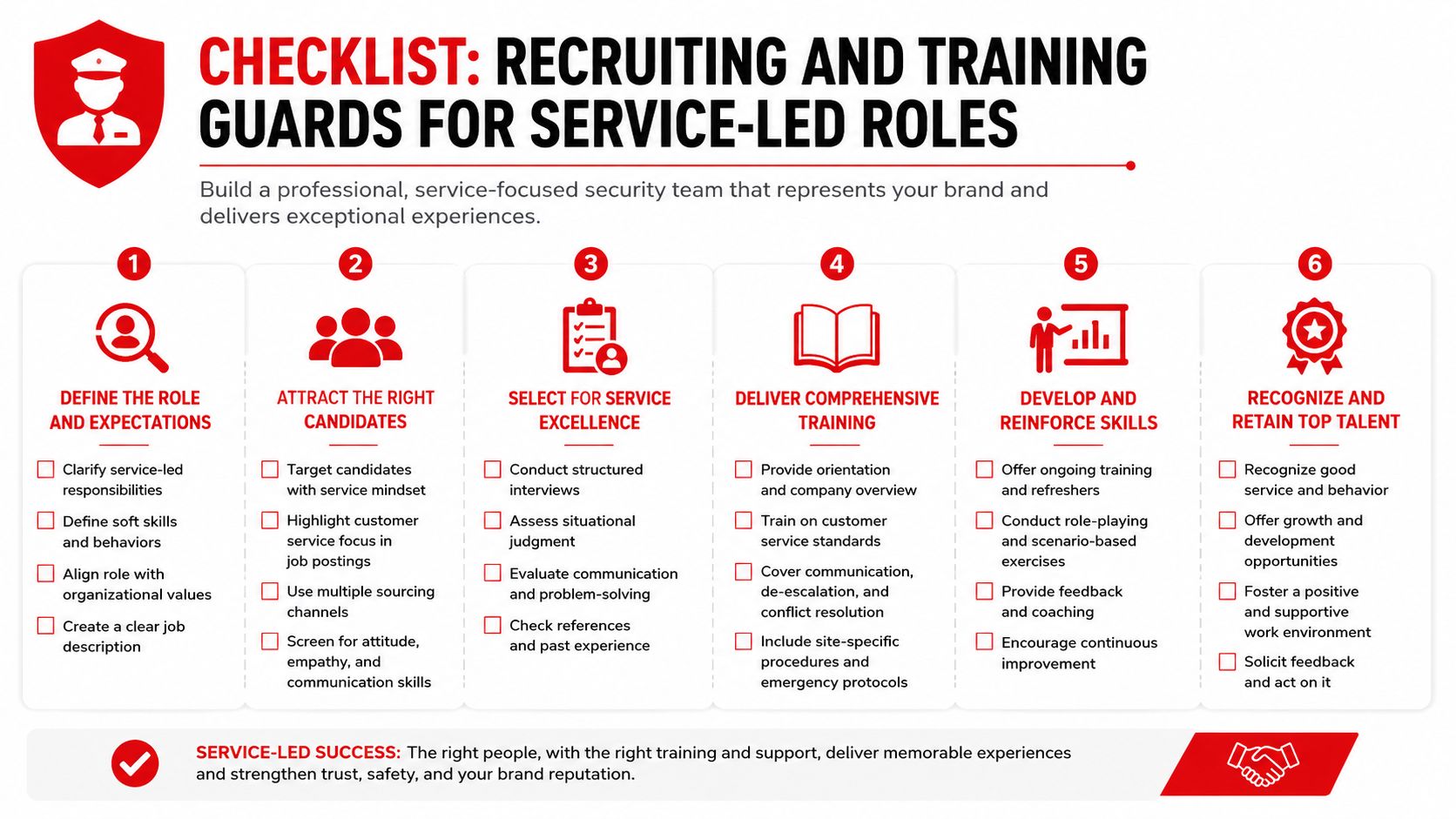
Hiring for customer-facing security is where many operators go wrong. They recruit for build, licence status or prior enforcement experience, then act surprised when the officer cannot calm a stressed guest or write a useful incident report. On the floor, the better predictor is whether the person can keep control without sounding punitive.
Start with communication style, not just licensing. Ask candidates how they would respond to an angry patron who wants a refund, a confused contractor who cannot find a gate, or a VIP guest who expects privacy. You are looking for short, respectful answers, not clever ones. If they cannot explain a problem clearly in the interview, they will struggle when the venue is noisy and the radios are busy.
Look for people who can switch tone without losing authority. A good officer can be warm at the door, firm during an access issue, and neutral during an incident write-up. That range matters because the same shift can move from greeting guests to managing a trespass issue in minutes.
Training has to cover the service side and the control side together. Build it around the job they will do, using scenario work that mirrors your site, such as a nightclub refusal, a corporate after-hours visitor, or a retail theft disruption. If the only training is generic induction, people will not know what your brand expects under pressure.
A workable onboarding structure should include:
- Site rules and RSA alignment so the officer knows where hospitality obligations end and security decisions begin.
- Communication tone so they can give clear instructions without escalating frustration.
- Incident note standards so reports capture facts, time order and handover details.
- Escalation triggers so staff know when to involve managers, police, ambulance or fire response.
The point is consistency. Customers notice when one guard is polished and another sounds hostile. Supervisors need to review those differences early, then coach them out. Ongoing supervision matters more than the first day of training, because service quality drifts when nobody checks it.
A service-led team is also easier to integrate with customer experience expectations. If you are comparing provider options, the right question is not just who can stand a post. It is who can keep the site safe while making the front-of-house experience smoother for guests, staff and contractors.
On-Site Communication and De-Escalation Protocols
A lot of avoidable friction starts with the first sentence. If a patron hears a command before they hear a reason, the situation hardens. If staff get a clear script and a simple radio process, the same issue often settles without a scene.
Make communication short, specific and logged
Radio traffic should be plain and functional. Use location, issue, status and next action. That keeps managers, bar staff and supervisors aligned without long back-and-forth explanations. Mobile messaging should be reserved for non-urgent coordination, because open-text chatter is a poor place for sensitive details or real-time confusion.
Use the same rule with patrons. State what needs to happen, why it matters, and what the next option is. “You can wait here while I check with the manager” works better than “you need to move now.” The second line still sets the boundary, but it reduces the chance of a public confrontation.
Design de-escalation for fast decisions
The biggest mistake in frontline security is making the officer hunt for approval while tension rises. If the secure path requires ten minutes of back-and-forth, someone will cut corners. Build decision trees that let staff act within clear limits, then escalate only when the issue needs a higher call.
The fastest way to lose control is to make staff wait for permission on a situation they're already standing in.
For intoxicated or aggressive patrons, the best practice is simple. Separate the person from the crowd, lower the noise, keep one speaker, and avoid crowding them with multiple staff. One officer talks, one officer observes, and the manager stays informed. That division of labour keeps the message clean and reduces the chance of mixed signals.
For venues that also manage after-hours site access, a useful reference point is the rental safety guide, because emergency contact clarity and escalation discipline matter just as much in short-term or mixed-use environments. The same principle applies to event spaces and hospitality sites: if staff can't reach the right person quickly, the process fails under pressure.
Integrating Security with Venue Operations and Emergency Response
Security gets weaker when it sits outside venue operations. Door staff who don't know the floor plan, bar staff who don't know the handover process, and managers who only learn about incidents after the shift all create delay. Good integration removes that delay before anyone needs to improvise.
Tie security into the opening, not the aftermath
A useful venue routine is a short pre-shift briefing that covers access points, expected high-risk areas, medical contacts, incident escalation and who owns the final call. That briefing doesn't need to be long, but it does need to be specific. Security should know where the first aid kit is, where the evacuation routes are, and which manager has authority for welfare removals, refusals or closures.
The handover between shifts is just as important. If the outgoing team leaves a half-written note, the incoming officer starts blind. The fix is a structured handover that captures unresolved issues, guest concerns, access problems and any unusual behaviour. This is especially useful for distributed sites and after-hours operations, where the next decision might happen with no supervisor physically present.
Keep emergency response and guest flow aligned
Emergency planning shouldn't feel separate from service. Fire, medical and security responses all affect the guest experience, so they need one operating picture. During an evacuation, for example, the best officer is the one who gives calm instructions, keeps pathways clear and avoids panic, not the one who adds noise or vague shouting.
A site that handles this well treats the security team as part of the emergency response chain, not an observer standing nearby. In practical terms, that means clear access control, direct escalation routes, and incident notes that let management reconstruct what happened without dragging staff back into confusion later.
For operators comparing service models, GM GROUP Services is one option that combines static guards, mobile patrols, K9 capability, VIP protection and event coverage across NSW, Victoria, Queensland and the ACT, which makes integration easier when one provider needs to support multiple site types.
Reporting, KPIs and Measuring Service Quality
The quickest way to tell whether customer service security is working is to check what gets recorded, what gets escalated, and what gets resolved before it turns into a complaint. A guard who handles an issue well but leaves no record has still created a management gap. Reporting is part of the service, because it lets the next shift act with the same context.
Measure the moments that matter
Track the KPIs that show both protection and professionalism. Start with response time to alerts, completion of incident reports, handover accuracy, and the share of incidents resolved without unnecessary escalation. Those measures show whether the team is calm, consistent and workable for the client.
A security-industry customer-experience survey found that customers expect fast responses to emergency alerts, prefer round-the-clock support, and are more likely to stay loyal when the first response comes quickly. The service lesson is straightforward. Speed is not just an operational metric, it shapes whether the client sees the provider as dependable.
Use reporting as a management tool
Incident reports should support compliance and follow-up, not just create paperwork. Keep them factual, chronological and easy to scan. Include who was involved, what happened, what action was taken, and what needs follow-up. If the format is too long or too vague, supervisors will stop using it properly.
Dashboards should make sense to clients as well. A venue owner does not need jargon. They need to see whether incidents are trending down, whether response is timely, and whether the team is communicating well with patrons and staff. Reporting works best when it is reviewed in supervision meetings, because that is where patterns get corrected before they turn into repeat failures.
The same discipline supports trust in regulated environments. Customer service teams often touch identity, contact and account data, so their reporting habits need to support operational learning and breach readiness at the same time. If a record shows who saw what, when they saw it and what they changed, you can investigate problems much faster.
Operational truth: if the report cannot help the next shift make a better decision, it is not a good report.
Common Failure Modes and How to Avoid Them
The most common failure in customer service security isn't a dramatic breach. It's a routine shortcut. Someone sends a sensitive detail in the wrong channel, someone approves an access request too quickly, or someone assumes a caller is legitimate because they sound urgent.
Stop relying on manual discipline alone
Industry guidance on support security recommends using multi-factor authentication, encrypting data in transit and at rest, masking sensitive fields, and logging access so anomalies can be audited quickly customer data protection guidance. That matters because good intentions don't stop mistakes. If the system makes sensitive information too easy to expose, staff will eventually expose it under pressure.
A common operational error is handling high-risk data in email or chat just because it feels convenient. Guidance also warns against using open-text channels for sensitive information and recommends secure collection paths instead customer support security tips. In practice, that means payments, identity checks and recovery details should move through controlled workflows, not ad hoc messages.
Design for the human layer
Frontline teams are where urgent requests meet policy. Attackers know that, and they increasingly target help desks, phone lines and message channels with social engineering that sounds legitimate. Guidance for retail and hospitality front lines recommends out-of-band or step-up verification before password or MFA resets, because one urgent call can still hand over an account front-line threat guidance.
That lesson extends well beyond cyber. Security staff who are pressured to move faster than the process can make the wrong call on access, visitor checks or escalation. The fix isn't harsher language or more rules. It's building workflows where the secure option is the easiest option, so the officer doesn't have to choose between service and control.
In Australia, that matters because support teams often handle identity and account data that can trigger Privacy Act obligations if a breach is likely to cause serious harm. The response has to be fast, contained and documented, with notification to affected individuals and the OAIC when the threshold is met Australian breach response guidance. When staff have secure channels, clear ownership and a clean audit trail, they're much better placed to act quickly and correctly.
Frequently Asked Questions About Customer Service Security
How do you keep service friendly without losing control
Set the tone early, speak plainly, and explain the reason for the boundary. Friendly doesn't mean soft, it means calm and clear.
What if staffing is thin after hours
Use simple handover notes, clear escalation contacts and limited decision paths. Thin staffing only becomes dangerous when people have to guess who owns the next step.
How should VIP or high-profile guests be handled
Keep the process discreet, avoid unnecessary discussion in public areas, and assign one lead person for communication. Privacy and consistency matter more than showing how much attention the guest is getting.
How do you match security with brand experience
Train the team on the tone you want customers to remember, then check that tone during supervision. If the guard behaviour clashes with the brand, customers will remember the clash before they remember the service.
GM GROUP Services supports venues, events, retail sites and commercial operations with licensed security, patrols, K9 options, VIP protection and incident-focused supervision across NSW, Victoria, Queensland and the ACT. If you need customer service security that protects people while keeping communication professional and responsive, visit GM GROUP Services and review how their service model fits your site.
Discover more from GM Group Services
Subscribe to get the latest posts sent to your email.