
Construction sites carry a high level of daily risk, and the incidents that cause the most harm are usually the predictable ones. Falls, plant movement, vehicle interaction, poor access control, and rushed starts to work continue to injure people because they are treated as routine instead of being actively controlled.
Strong safety performance starts before a task begins. It depends on clear site rules, disciplined supervision, and access control that holds up during busy shift starts, delivery windows, subcontractor changeovers, and programme pressure. Site managers set the standard, but enforcement at the gate and across active work zones often determines whether those standards hold.
That is where security adds practical value.
On a working construction site, security staff are often the first people to see conditions drifting out of control. They see workers arriving without the right PPE, visitors trying to enter without induction, vehicles turning up in the wrong sequence, and people moving into restricted areas before the workface is ready. If those issues are caught early, the site avoids preventable exposure. If they are missed, the same gaps can feed straight into injury, delay, property loss, or a reportable incident.
This article looks at construction site safety topics through that operational lens. The focus is not only on what the safety team should set, but also on how security providers such as GM GROUP Services can support compliance in real time through gate checks, patrols, access control, logging, escalation, and coordination with supervisors. On complex sites, safety and security work best as one control system, not two separate functions.
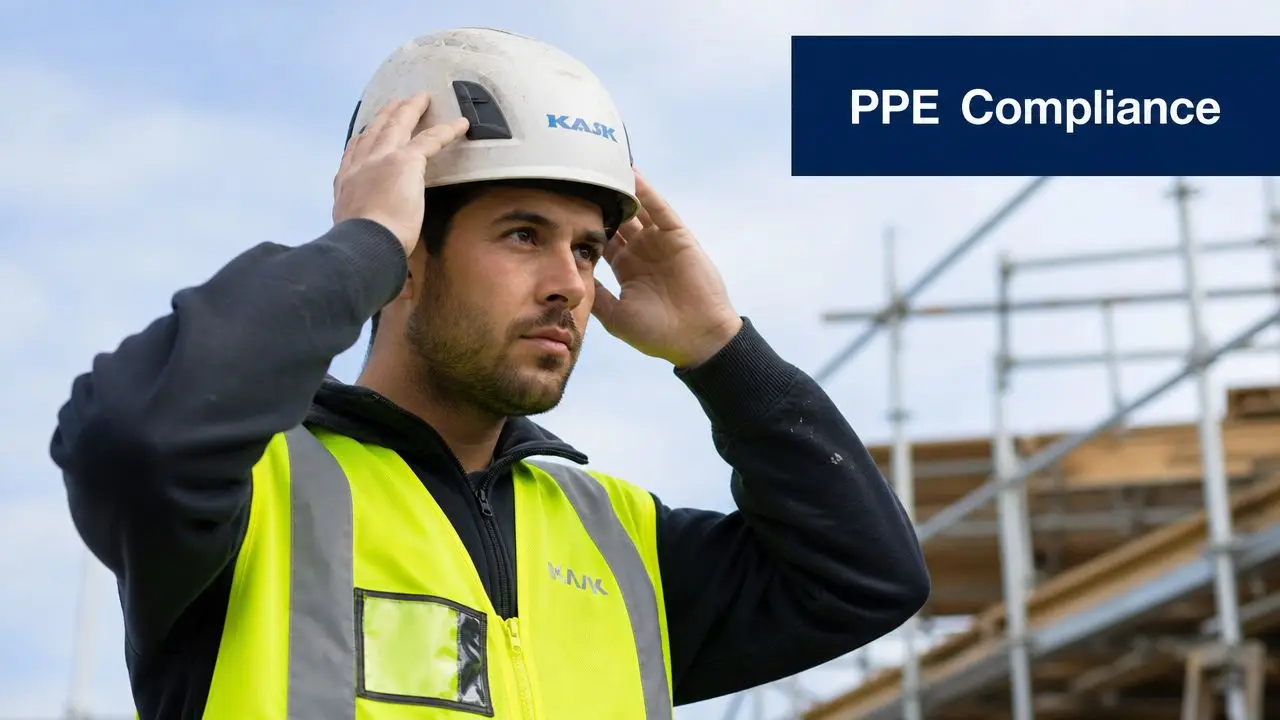
1. Personal Protective Equipment Management
PPE is basic, but poor PPE management still causes constant avoidable exposure. Hard hats, safety glasses, high-vis, gloves, boots, hearing protection, and respiratory protection only work when the right item is issued, fits the worker, and gets used in the right area.
On mixed-trade sites, the common failure isn't lack of stock. It's inconsistency. One crew is fully compliant, another borrows damaged gear, and visitors walk in wearing gear that would never pass a proper induction check.
What works on active sites
The best sites treat PPE as an entry control issue, not just a toolbox talk topic. Gate staff verify minimum PPE before access is granted. Supervisors then check task-specific PPE at the point of work.
A practical setup includes:
- Zone-based PPE rules: Mark cutting zones, demolition areas, traffic zones, and fit-out areas with specific PPE requirements.
- Spare stock at the gate: Keep replacement glasses, vests, gloves, and hard hats where entry is controlled.
- Fit checks for respiratory gear: Don't hand out dust masks and assume the problem is solved.
- Damage removal rules: If a helmet is cracked or a vest is no longer visible, it comes out of service immediately.
Practical rule: If workers can bypass PPE checks to save two minutes at shift start, they will.
Security providers can help by logging repeated PPE breaches, controlling turnstiles or pedestrian gates, and stopping non-compliant subcontractors before they move into live work zones. That's especially useful on projects with frequent deliveries, visitors, and labour turnover.
2. Fall Prevention and Working at Heights
Falls remain one of the recurring causes of fatal harm in Australian construction, which is one reason regulators continue to treat construction as a priority sector for prevention controls such as fall protection and exclusion zones, as noted in the national prevention context referenced above. That priority reflects what site leaders already know. Height work becomes dangerous fastest when teams rely on habits instead of engineered controls.
Harnesses matter, but they're not the first answer. Guardrails, edge protection, properly installed scaffold, covers over penetrations, and workface planning do more to prevent a fall than issuing more lanyards.
The trade-off most sites get wrong
Some managers push productivity by allowing short-duration height tasks to proceed with weak controls because "it's only a quick fix". That decision usually creates a larger exposure than the original task.
Strong height control usually looks like this:
- Engineering first: Use edge protection, temporary handrails, and work platforms before personal fall arrest.
- Weather holds: Stop roof and exposed scaffold work when wind, rain, or visibility make footing unreliable.
- Rescue planning: A harness without a recovery plan isn't a complete system.
- Ground exclusion zones: Keep workers and visitors out from beneath active overhead work.
A security patrol can support this by checking that exclusion barriers remain intact, access ladders aren't being misused, and unauthorised persons aren't entering scaffold or roof access points after hours or between shifts.
For site managers, the practical question isn't whether workers have harnesses. It's whether the task was designed so they need them as little as possible.
3. Electrical Safety and Hazard Management
Temporary power, damaged leads, wet conditions, portable tools, overhead lines, and buried services create one of the most unforgiving risk categories on site. Electrical incidents don't leave much room for recovery, which is why controls have to be disciplined.
The first mistake is letting temporary become permanent. A board installed for a short phase often stays in place while cords multiply, covers break, and test records go stale. The second mistake is poor control around excavation and mobile plant near services.
Field controls that hold up
Electrical safety improves when the site applies simple mandatory practices:
- Licensed oversight: Only qualified electrical workers should install, alter, or sign off temporary systems.
- Cord discipline: Damaged leads and improvised joins come out of service immediately.
- Wet work restrictions: If the area is wet, muddy, or exposed, supervisors need to reassess tools and supply points before work starts.
- Service location before digging: Excavation teams should never rely on memory or old drawings.
Lockout and isolation procedures matter just as much during maintenance, commissioning, and plant repair. If your crews need a refresher on implementing LOTO procedures, build that into supervision for electricians, fitters, and service contractors.
Security's role here is often underestimated. Guards can stop unauthorised entry into switch rooms, isolate public or visitor movement near exposed electrical work, and secure areas after an electrical fault until the competent trade arrives. That reduces the chance of someone turning a known hazard into an emergency.
4. Hazardous Materials Handling and Management
Hazardous materials incidents rarely start with a dramatic failure. They start with ordinary site shortcuts. Dry cutting instead of wet cutting. A drum with no readable label. Demolition starting before anyone has confirmed what is in the wall, floor, or ceiling void.
That is why hazardous materials management has to start in planning, not at the point of exposure. As noted earlier, good construction safety practice depends on identifying the hazard early, choosing the right control for the task, and checking that the control still works once the job is live. PPE has a place, but it is a weak plan if the site has skipped identification, substitution, isolation, ventilation, or licensed removal.
What disciplined management looks like
Pre-start review should pick up likely asbestos, silica-generating work, lead exposure, fuel and chemical storage, contaminated spoil, and waste disposal routes. Once the work begins, the controls need to be visible on site, not just written into a folder. That means marked exclusion zones, correct labelling, secure storage, dust or fume control, and active supervision during the highest-risk tasks.
The methods change with the material. The management standard should not.
Controls that hold up in the field include:
- Task-matched controls: Use wet methods, on-tool extraction, encapsulation, segregation, ventilation, or licensed removal based on the actual material and process.
- Restricted access: Keep unrelated trades, visitors, and delivery drivers out of contaminated or high-exposure areas.
- Usable SDS access: Safety data sheets need to be available where work happens and readable by the crews handling the product.
- Storage discipline: Separate incompatible substances, secure fuel and chemicals, and keep decanting containers labelled.
- Waste control: Hazardous waste, contaminated PPE, slurry, and general waste need separate streams from the start.
One poor handover can undo all of that. I have seen well-planned controls fail because the night crew moved barriers, a subcontractor stored solvents in the wrong container, or waste bins were left open and unmonitored after hours. The safety risk then becomes a security risk as well.
Security teams have a practical role here that many sites underuse. Guards can control entry to asbestos enclosures and silica work zones, keep unauthorised contractors out of chemical storage areas, record who accessed restricted locations, and secure contaminated waste and stored substances after shifts end. For providers such as GM GROUP Services, that means supporting the exposure control plan, not just watching the gate.
Set the boundary before the task starts. Once dust, fumes, or contamination spreads, regaining control is slower and more expensive.
5. Site-Specific Safety Induction and Training Programs
A generic induction is almost useless on a live construction site. Workers need to know this site, this traffic flow, this emergency route, this crane zone, this permit system, and these restricted areas. If the induction could be delivered unchanged to ten unrelated jobs, it's too vague.
Australian regulators also emphasise that many serious incidents are preventable with basic controls such as safe work method statements, supervision, and consistent induction. That should shape how inductions are built. They aren't paperwork. They're the first line of control for people who don't yet understand the site.
How to make induction stick
The best inductions are short enough to hold attention and specific enough to change behaviour. They use site photos, actual maps, known interface risks, and current rules for access and permits.
A practical induction should include:
- Entry conditions: PPE, sign-in process, prohibited areas, and visitor rules.
- Emergency response: Muster point, alarms, first aid process, and who takes control.
- Movement rules: Vehicle routes, pedestrian paths, lift zones, and delivery timing.
- Task escalation: When a worker must stop and seek supervisor approval.
Security can strengthen this process by linking induction completion to access control. If a worker, subcontractor, or visitor hasn't completed the site process, they don't come through the gate. Gatehouse staff can also check whether cards, stickers, or digital profiles are current before granting access.
That sounds strict, but it prevents the most common induction failure. People entering a changing site on assumptions from another job.
6. Incident Reporting, Investigation, and Corrective Actions
Sites with poor reporting usually aren't safer. They're just blind. Near misses, minor injuries, unsafe conditions, and repeated control failures tell you where the next serious incident is likely to come from.
The quality of the response matters more than the form used to report it. If workers think reporting will only create blame, they'll stay quiet. If they see broken barriers fixed, procedures updated, and supervisors acting on feedback, reporting becomes useful.
What a useful investigation looks like
A decent investigation asks what failed in planning, supervision, sequencing, access control, or communication. It doesn't stop at "worker error". On construction sites, the last act is rarely the whole cause.
Good practice usually includes:
- Immediate scene control: Preserve the area and stop parallel exposure.
- Worker input: The people doing the job usually know what changed.
- Action tracking: Corrective actions need owners and deadlines.
- Workforce feedback: Lessons should be shared in plain language.
Security personnel can contribute in a very practical way. They may be first to isolate an area, preserve CCTV footage, note who entered or left a zone, or document scene conditions before plant, materials, or weather alter the evidence.
If legal follow-up becomes part of the picture after a serious event, some firms also review construction accident services from Mattiacci Law to understand how incidents are assessed from a claims perspective. On the site itself, though, the priority is always learning fast enough to prevent the next one.
7. Excavation Safety and Trenching Operations
Excavation work is deceptive because the hazard is often hidden until the ground moves, a service is struck, or access becomes impossible. Crews can work around trenches for days without incident and start thinking the risk is under control. That's exactly when trench discipline tends to slip.
The strongest excavation systems are built before digging starts. Utility location, soil assessment, traffic separation, spoil placement, access points, plant positioning, and emergency arrangements all need to be decided early. Once an excavation is open, changing method becomes harder and more expensive.
Common failure points in trench work
Most trench problems start with one of four issues. The protective system doesn't match the ground, the inspection wasn't thorough, plant gets too close to the edge, or workers enter because "it'll only take a second".
Site managers should insist on:
- Service verification before excavation
- Competent supervision during active digging
- Barrier protection around open excavations
- Safe entry and exit that workers will use
- Stop-work triggers after rain, vibration, or ground change
A trench that looked stable at first light can be unsafe by mid-morning if conditions change.
Security can support excavation safety by maintaining perimeter fencing around open cuts after hours, preventing public or unauthorised worker access, and controlling vehicle entry near trench edges where ground loading matters. On urban sites, that support becomes especially important because the exposure often continues beyond normal work hours.
8. Site Vehicle Safety and Traffic Management
Moving plant and vehicle interaction are recurring causes of serious harm in Australian construction. That's one reason traffic management and exclusion zones remain core prevention controls in national guidance for the sector. On most sites, the highest-risk path is the one people use every day between the gate, the amenities, the laydown area, and the workface.
You don't control vehicle risk with signs alone. You control it with layout, timing, supervision, and discipline. Reversing movements, mixed pedestrian routes, delivery congestion, and blind corners create problems fast on tight sites.
Practical traffic controls that reduce exposure
The strongest traffic plans separate people from plant wherever possible. If separation isn't possible, the site needs active management through spotters, controllers, timed access windows, and strict route rules.
Controls that usually hold up in practice include:
- Dedicated pedestrian paths: Marked, protected, and kept clear of deliveries.
- Delivery scheduling: Avoid stacking trucks at the same access point during shift change.
- One-way internal flows: Simplify movement where space is tight.
- Gate control: Confirm where each vehicle is going before it enters.
- Reversing discipline: Use spotters and restrict ad hoc reversing in congested areas.
For fleet operators and contractors who also need to think beyond the site boundary, roadside inspection preparedness can sharpen vehicle compliance habits that support safer site entry and departure routines.
Security has a direct operational role here. Gatehouse officers can stagger arrivals, stop unauthorised vehicles, verify delivery bookings, and keep visitor cars away from plant routes. On larger sites, patrols can also report route blockages before they force drivers into unsafe workarounds.
9. Confined Space Entry and Management
Confined space incidents often happen because crews don't recognise the space as confined, or they assume ordinary ventilation and a quick entry make the risk manageable. That assumption kills people. Restricted access, poor atmosphere, engulfment risks, and difficult rescue conditions make confined spaces a separate class of hazard.
Basements under construction, pits, tanks, vaults, shafts, service voids, and some deep excavations all need deliberate assessment. If the team is arguing about whether a permit is necessary, the site probably hasn't planned the work properly.
Non-negotiables before entry
No permit system can compensate for poor preparation. The permit should confirm controls, not replace them.
A workable confined space system includes:
- Atmospheric testing before entry and as conditions change
- Isolation of plant, services, and stored energy
- A trained standby person who stays at the point of entry
- Rescue equipment positioned and ready
- Reliable communication between entrant and attendant
One of the weakest habits on construction sites is informal entry by maintenance workers, service trades, or supervisors who think they're only "checking something". The rules have to apply to everyone, not only to the main crew performing the task.
Security's contribution is simple and useful. They can maintain restricted access around the entry point, stop casual interference with barricades, and ensure only permitted personnel move into the area while the work is live.
10. Mental Health, Fatigue Management, and Psychosocial Safety
A tired, distracted, stressed, or bullied worker is less likely to notice a reversing plant signal, a change in scaffold condition, or the early signs of heat strain. Mental health and fatigue aren't separate from physical safety. They affect decisions, reactions, communication, and error rates across the day.
One area that still doesn't get enough practical attention in Australian construction site safety topics is heat, UV, and fatigue management as an operational risk, not just a PPE issue. Safe Work Australia guidance highlights working in heat as a real hazard that can reduce concentration, increase mistakes, and trigger serious illness, while sun exposure is also a major long-term risk for outdoor workers, as discussed in heat and construction hazard guidance context. On real sites across NSW, VIC, QLD, and the ACT, that means supervisors should adjust schedules, breaks, and monitoring when conditions spike.
What site leaders should change
If your hottest days are managed with "drink more water" posters and no shift adjustment, the site is undercontrolled. Stronger practice means changing the work, not just reminding workers to cope with it.
Useful actions include:
- Earlier scheduling for high-exertion tasks
- Extra rest and shade during heat spikes
- Supervisor checks for fatigue and heat symptoms
- Clear reporting pathways for bullying, overload, and welfare concerns
- Visible mental health support contacts on site boards
The worker most at risk from fatigue is often the one who insists they're fine.
Security staff can help here too. They often notice behavioural changes at entry points, overnight shifts, or isolated areas before supervisors do. A good security team reports concerns early, especially where workers appear disoriented, agitated, exhausted, or unfit for access.
10-Topic Construction Site Safety Comparison
On construction sites, serious incidents usually trace back to a small set of control failures repeated in different forms. Comparing these 10 topics side by side helps site managers set priorities, and it helps security providers identify where they can actively support enforcement instead of only watching the gate.
| Safety Topic | Implementation Complexity 🔄 | Resource Requirements ⚡ | Expected Outcomes ⭐ | Best Fit on Site 💡 | What Good Security Support Looks Like 📊 |
|---|---|---|---|---|---|
| Personal Protective Equipment (PPE) Management | Moderate 🔄🔄, established issue, inspection and replacement processes | Low to Moderate ⚡⚡, consumables, storage and stock control | High ⭐⭐⭐, reduces injury severity and improves compliance | Sites with multiple access points, changing crews, dusty works, demolition, cutting and grinding | Gate checks for mandatory PPE, refusal of entry for non-compliant workers, logging repeat breaches, after-hours monitoring of PPE stores to reduce theft and shortages |
| Fall Prevention and Working at Heights | High 🔄🔄🔄, edge protection, permits, rescue planning and competency checks | High ⚡⚡⚡, engineered controls, harness systems, trained personnel | Very high ⭐⭐⭐, prevents a leading cause of fatalities | Multi-storey builds, roof work, façade access, scaffold-heavy projects, shutdown works with short programs | Enforcing restricted access below overhead works, checking permit status before access, securing exclusion zones, reporting removed barriers or open edges immediately |
| Electrical Safety and Hazard Management | High 🔄🔄🔄, design control, testing, tagging and supervision by licensed trades | High ⚡⚡⚡, electricians, RCDs, lockout gear and test equipment | High ⭐⭐⭐, prevents shock, fire and equipment damage | Sites with temporary power, wet areas, night work, generator use, excavation near services | Controlling access to switch rooms and temporary boards, protecting lockout zones, challenging unauthorised interference, recording after-hours entry to electrical areas |
| Hazardous Materials Handling and Management | High 🔄🔄🔄, identification, registers, containment and licensed removal pathways | High ⚡⚡⚡, monitoring, PPE, decontamination controls and specialist contractors | High ⭐⭐⭐, reduces exposure, contamination and legal risk | Refurbishment, demolition, brownfield projects, suspected asbestos, lead or contaminated spoil | Preventing entry into contaminated zones, maintaining perimeter controls, checking removalist and vehicle authorisation, preserving chain of custody around sealed waste areas |
| Site-Specific Safety Induction and Training Programs | Moderate 🔄🔄, content, records, language support and refresher scheduling | Low to Moderate ⚡⚡, trainers, materials and verification systems | High ⭐⭐⭐, improves consistency and site rule compliance | Sites with high subcontractor turnover, labour hire workers, multilingual crews, fast mobilisation phases | Verifying induction status at entry, denying access to uninducted personnel, matching licences and VOCs to site roles, flagging expired competencies to site management |
| Incident Reporting, Investigation & Corrective Actions | Moderate 🔄🔄, reporting systems, evidence capture and follow-up discipline | Moderate ⚡⚡, investigator time, records and corrective action tracking | High ⭐⭐⭐, reduces repeat incidents when findings are closed out | Projects with several contractors, repeated near misses, public interface, vandalism or trespass history | Securing incident scenes, preserving CCTV and access logs, collecting witness details early, supporting timeline reconstruction for both safety and security events |
| Excavation Safety and Trenching Operations | High 🔄🔄🔄, service locating, ground assessment, engineered support and inspections | High ⚡⚡⚡, shoring, barriers, permits and rescue planning | Very high ⭐⭐⭐, prevents collapse, engulfment and service strikes | Utility works, road projects, drainage, deep service corridors, cut-and-fill operations | Maintaining trench exclusion zones, stopping unauthorised plant or pedestrian entry, protecting barriers overnight, reporting water ingress, subsidence or barrier movement |
| Site Vehicle Safety and Traffic Management | Moderate 🔄🔄, route planning, segregation, signage and marshal coordination | Moderate ⚡⚡, controllers, barriers, lighting and cameras | High ⭐⭐⭐, reduces strike and crush incidents | Tight metro sites, projects with frequent deliveries, reversing plant, shared public interface, schools or hospitals nearby | Managing gate flow, enforcing delivery booking rules, separating visitors from plant routes, monitoring pedestrian crossings, escalating breaches by drivers or spotters |
| Confined Space Entry and Management | Very high 🔄🔄🔄, permits, atmospheric testing, standby roles and rescue planning | Very high ⚡⚡⚡, monitors, breathing gear, retrieval systems and trained responders | Very high ⭐⭐⭐, prevents atmospheric and engulfment fatalities | Tanks, pits, vaults, sewers, service chambers and enclosed underground spaces | Locking down entry points, checking permit and standby arrangements before access, stopping unauthorised entry, helping keep rescue access clear and unobstructed |
| Mental Health, Fatigue Management & Psychosocial Safety | Moderate 🔄🔄, supervision standards, reporting pathways and workload controls | Moderate ⚡⚡, training, support services and monitoring | Moderate to High ⭐⭐, improves judgement, attendance and incident prevention | Projects with long shifts, remote workfaces, night works, compressed programs, isolated security or maintenance posts | Spotting workers who appear impaired, distressed or unfit for access, escalating welfare concerns early, documenting behavioural issues at gates, supporting lone-worker checks after hours |
Used properly, a comparison table like this should help with decisions, not just summarise the obvious. The strongest pattern here is that security has the most value where access, exclusion zones, permits, scene control, and after-hours enforcement affect whether a safety control holds up under real site pressure.
Integrating Safety and Security for Total Site Protection
Mastering these construction site safety topics is how sites move from reactive compliance to controlled operations. The pattern behind most serious events is familiar. A known hazard exists, a basic control weakens, supervision doesn't catch it in time, and the site carries on until something goes wrong.
That's why safety has to be built into planning, access, sequencing, and review. Australia's WHS approach places strong emphasis on controls applied at design and planning stage, along with ongoing review of whether those controls still work in the field. On a construction site, that principle shows up in practical decisions. Separate pedestrians from plant before mobilisation. Design height work around edge protection before issuing harnesses. Identify hazardous materials before demolition. Adjust start times and workloads when heat and fatigue exposure rise.
What works is usually straightforward, but it requires discipline. Site-specific induction. Clear exclusion zones. Enforced traffic routes. Competent supervision. Reliable reporting. Consistent barrier control. None of those controls are glamorous. All of them prevent incidents.
Security strengthens that system when it's integrated properly. A professional security team can support gatehouse verification, manage access restrictions, enforce delivery rules, preserve incident scenes, monitor exclusion zones, and report unsafe conditions in real time. That doesn't replace supervisors, HSE staff, or project managers. It gives them another layer of eyes, control, and response on a site that changes by the hour.
For construction and industrial managers, that matters most in three situations. First, when the site has high subcontractor turnover. Second, when plant, deliveries, and pedestrian movement overlap heavily. Third, when after-hours access, theft, vandalism, or unauthorised entry can also create safety exposure for the next shift. In those environments, safety and security stop being separate functions.
GM GROUP Services is one option relevant to that model because it provides construction site security in Australia, including services such as gatehouse control, static guards, patrols, emergency response, and risk assessments. Used properly, that kind of support helps sites enforce the controls they've already decided are necessary.
The practical standard is simple. If a rule matters enough to write into the site plan, it matters enough to enforce at the gate, at the workface, and after hours. That's how safer sites operate.
Need support putting these construction site safety topics into daily site control? GM GROUP Services works with construction and industrial clients across NSW, VIC, QLD and the ACT to help manage access, patrols, gatehouse operations, incident response, and site security that supports safer day-to-day operations.
Discover more from GM Group Services
Subscribe to get the latest posts sent to your email.