
Construction site safety rules start to matter most when the site gets busy. A truck is reversing into a loading area. A labourer cuts behind it to save time. A dogman is focused on the next lift. The exclusion zone is marked, but half the crew is treating it like a suggestion. That is how near misses happen.
A new project manager often inherits this exact kind of site. The paperwork exists. The inductions were done. The SWMS are in the folder. But the ultimate test is whether the rules hold when deliveries stack up, subcontractors overlap, and production pressure rises. On a live project, safety is not a poster. It is control, coordination, and enforcement.
Why Strong Construction Site Safety Rules Are Non-Negotiable
The reason strong construction site safety rules matter is simple. They stop ordinary site movement from turning into a life-changing event. Most serious incidents don't begin with something dramatic. They begin with a shortcut, a blind spot, a missed handover, or one contractor assuming someone else is managing the risk.
That's why the basics must be treated as essential. Traffic routes, edge protection, exclusion zones, electrical isolation, access control, housekeeping, and task-specific briefings all work together. Remove one layer and the rest of the system starts to weaken.
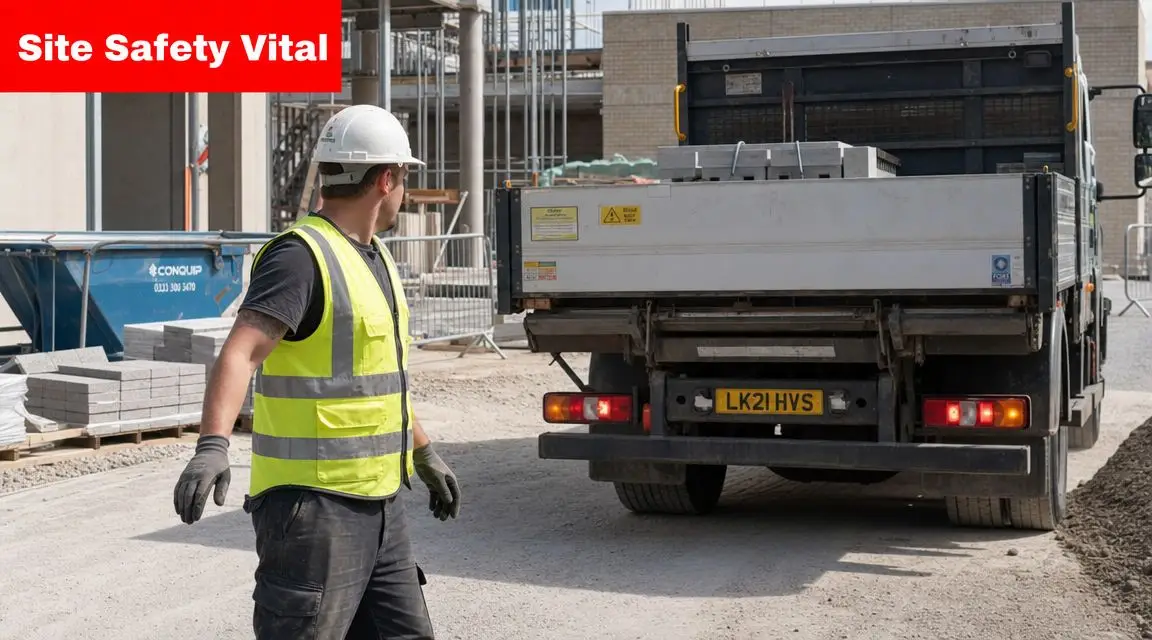
Construction site safety rules protect people and the programme
In Australia, construction remains one of the highest-risk sectors. Safe Work Australia reports 171 worker fatalities nationally in 2023, with construction accounting for a substantial share, and many site rules are built around preventing the Fatal Four hazards of falls, struck-by incidents, electrocution, and caught-in or between incidents, as outlined in this summary of Australian construction safety statistics.
A manager who treats safety as a compliance burden usually creates more operational problems, not fewer. Unsafe access slows deliveries. Poor housekeeping blocks emergency paths. Weak plant control creates stoppages. Injuries and near misses consume time, attention, and credibility.
The live-site problem is coordination
On paper, most sites already know the standard rules. The gap is enforcement when multiple activities happen at once. One crew is cutting, another is pouring, a telehandler is moving packs, and a visitor arrives at the gate with no clear escort plan. That is where strong site leadership separates a controlled project from a reactive one.
Practical rule: If a pedestrian can enter a plant zone without anyone stopping them, your system is not working.
This is even more important on occupied or sensitive sites. If your project affects schools, shared access ways, or public interfaces, practical planning around movement, barriers, cleanliness, and separation becomes critical. A useful reference is this guide on school safety during construction projects, because it shows how quickly construction risk expands when non-workers are nearby.
Good construction site safety rules do more than prevent injury. They make the site predictable. Predictable sites run better.
Understanding Your Legal Duties Under Australian WHS Law
Australian construction site safety rules sit inside the national Work Health and Safety framework. In practice, that means the obligations are not optional site preferences. They are legal duties enforced through state and territory law.
For a project manager, the term that matters is PCBU, or Person Conducting a Business or Undertaking. If you control work, direct contractors, or influence how risks are managed, your duty is practical. You must identify hazards, assess risk, put controls in place, and make sure those controls are maintained as conditions change.
What your duty looks like on site
Legal duty on a construction project is not abstract. It shows up in daily decisions such as:
- Planning work at height: If there is a fall risk, controls must be managed. Where there is a risk of a fall of more than 2 metres, protection measures are required unless an exemption applies or another control is reasonably practicable.
- Managing plant interaction: If trucks, forklifts, excavators, and pedestrians share space, the PCBU must organise the site so that interaction is controlled, not left to chance.
- Reviewing changing conditions: A safe setup on Monday may be unsafe by Wednesday if scaffolding changes, deliveries increase, or a new trade arrives.
The legal framework has become more prescriptive over time for a reason. According to the Safe Work Australia figures referenced in this summary of construction injury statistics in Australia, the worker fatality rate fell from 2.3 to 1.4 fatalities per 100,000 workers between 2013 and 2023. That tells site managers something important. Structured controls like induction, traffic management, and fall protection are not paperwork exercises. They are part of what has improved outcomes.
Key WHS legislation by state and territory
The principles are broadly consistent, but enforcement happens through the relevant jurisdiction.
| State/Territory | Primary Act | Primary Regulation |
|---|---|---|
| NSW | Work Health and Safety Act 2011 (NSW) | Work Health and Safety Regulation 2017 (NSW) |
| VIC | Occupational Health and Safety Act 2004 (VIC) | Occupational Health and Safety Regulations 2017 (VIC) |
| QLD | Work Health and Safety Act 2011 (QLD) | Work Health and Safety Regulation 2011 (QLD) |
| ACT | Work Health and Safety Act 2011 (ACT) | Work Health and Safety Regulation 2011 (ACT) |
What a new project manager should do first
Don't start by asking whether the site has rules. Ask whether the rules are being translated into field controls.
Use this quick test:
- Check inductions: Everyone on site should be inducted for that specific environment, not just generally qualified.
- Check high-risk work controls: Look at falls, plant movement, excavation, and electrical work first.
- Check supervision lines: Every trade must know who can stop work, who controls access, and who authorises changes.
- Check document-to-field alignment: If the SWMS says one thing and the crew is doing another, the paperwork has no protective value.
If a control only exists in the site office, it does not exist.
7 Core Construction Site Safety Rules You Must Enforce
The most effective construction site safety rules are the ones that survive contact with a busy day. They are visible, enforced, and easy to verify in the field. Below are the seven rules I'd expect a project manager to lock down first.
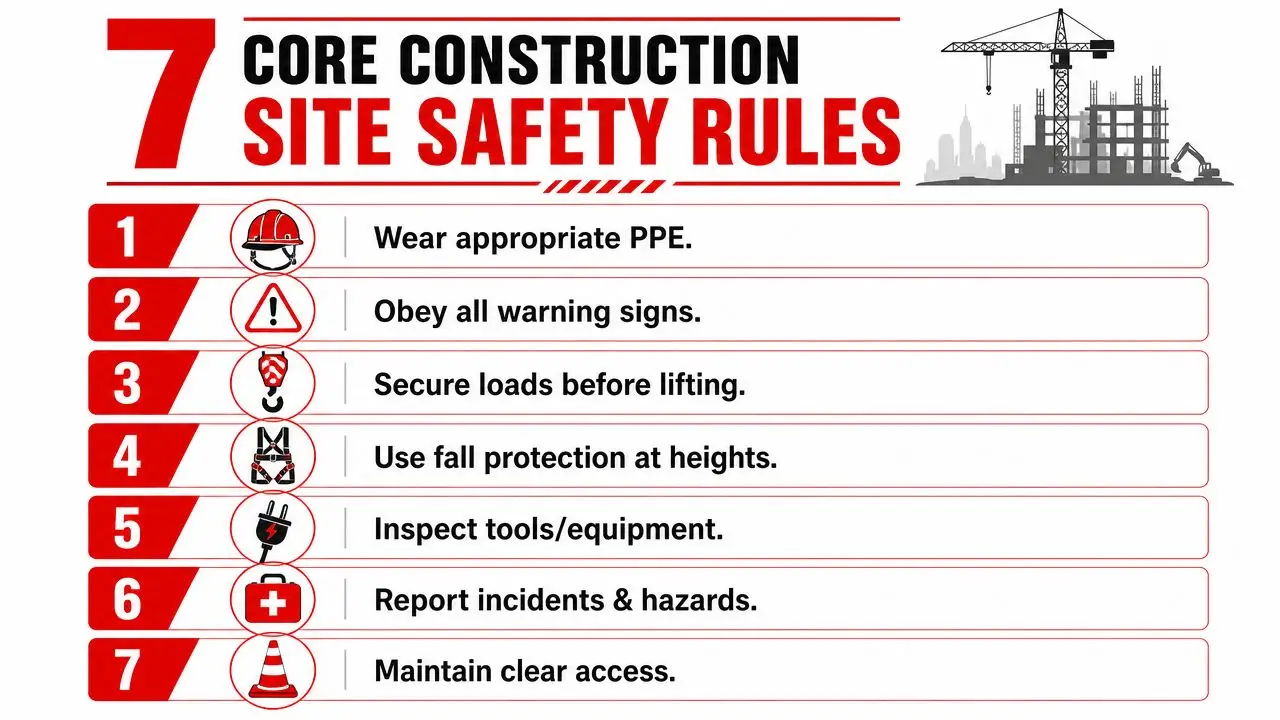
PPE must be correct and consistent
PPE is not the first control, but it is still mandatory. Hard hats, high-vis, task-appropriate footwear, eye protection, gloves, hearing protection, and fall-arrest gear all need to match the task and the zone.
What doesn't work is a blanket rule with no enforcement. What works is gate checks, supervisor spot checks, and immediate correction when PPE is missing, damaged, or misused.
A simple field example. If a cut crew moves from general framing into grinding or demolition, the PPE requirement changes with the task. Supervisors must catch that before the work starts.
Site access control must be tight
A site with weak access control loses control fast. Every person entering should be known, inducted, authorised, and directed.
Use practical controls such as:
- Single controlled entry: One main point of access is easier to supervise than multiple informal gates.
- Induction verification: Don't rely on verbal assurances. Check the record before entry.
- Visitor management: Short-term visitors and delivery drivers need boundaries, escorts, and designated waiting points.
If unauthorised people can walk straight into the workface, your safety rules are already compromised.
Traffic and plant management must separate people and machines
Here, many sites fail. A traffic management plan only works if it is reflected in the actual layout and enforced in real time.
You need clear pedestrian routes, vehicle routes, reversing controls where required, delivery timing, exclusion zones, and spotter arrangements. Paint on the ground is not enough if pallets, spoil, and parked plant force workers to improvise their path.
Keep pedestrians out of plant space by design, not by hope.
A practical test is to stand at the busiest crossing point on site for ten minutes. If people and mobile plant are negotiating movement informally, the plan needs redesign.
Fall protection must be installed before exposure
Falls remain a major source of severe harm in construction, which is why work at height needs planning before the task begins. Guardrails, edge protection, scaffold controls, covers, work platforms, and fall-arrest systems all need to be considered before anyone reaches the edge.
What does not work is issuing harnesses after the crew has already started setting up. What works is sequencing the work so the edge is protected first, then the task proceeds.
Excavation safety must be treated as a live risk
Excavations change quickly. Soil conditions shift. Water appears. Deliveries vibrate the area. Workers take shortcuts getting in and out.
Enforcement here means checking the excavation condition, access, separation from plant, edge protection where needed, spoil placement, and whether the safe system of work still matches the actual excavation. If conditions change, stop and reassess.
Hazardous materials handling must be controlled by task
On many sites, the issue is not a dramatic chemical event. It is routine exposure handled casually. Dust, adhesives, fuels, solvents, curing compounds, and waste streams all need controlled storage, handling, and disposal.
Good practice looks like designated storage areas, clear labelling, restricted access, spill response readiness, and task-specific instruction. Bad practice looks like mixed containers, ad hoc decanting, and workers relying on memory.
Electrical safety must be visible, not assumed
Temporary power, leads, tools, switchboards, and energised work areas create constant exposure on construction projects. Electrical incidents are often preceded by small signs that get normalised. Damaged leads. Unauthorised modifications. Wet-area use without enough thought. Isolation points that are not clearly controlled.
Enforce electrical safety through routine inspection, tagging and removal of damaged equipment, controlled access to temporary boards, and lockout or isolation procedures where the task requires them. If a worker says, “It should be right,” that is the moment to stop and verify.
Implementing the Hierarchy of Controls on Your Site
Most sites talk about risk control. Fewer apply the hierarchy of controls properly. That matters because Australian construction site safety rules are built around this order of decision-making. You are expected to look for stronger controls first, not jump straight to PPE.
According to this summary of WHS hierarchy of controls requirements, the hierarchy of controls is the operational anchor for construction safety, and site managers are required to prioritise higher-level controls such as elimination and engineering over administrative measures and PPE. It also points to the need for a documented risk register that maps each hazard to a control level.
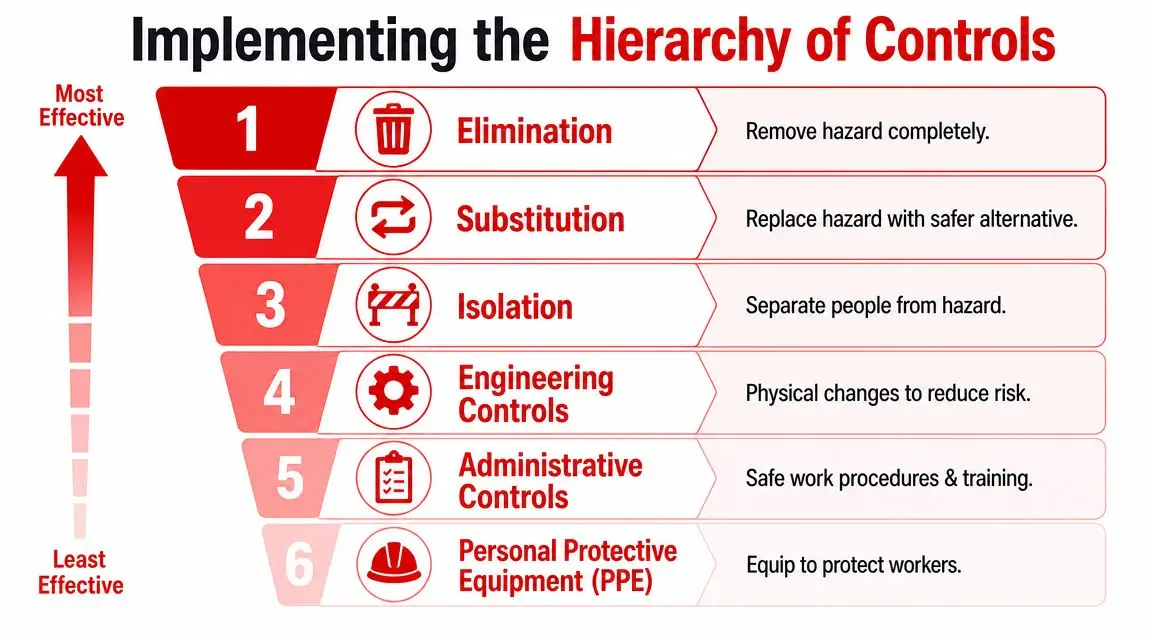
Use one hazard and work down the hierarchy
Take a common task. Workers need to install materials near a live edge.
Here is how to think through it:
Elimination
Can the work be done at ground level first. Prefabrication often removes part of the height exposure.Substitution
Can you use a safer method, tool, or sequence that reduces edge exposure.Isolation
Can you physically separate workers from the edge with barriers or restricted zones.Engineering controls
Install edge protection, guardrails, or a temporary work platform. This is usually where a site should be aiming before work starts.Administrative controls
SWMS, permits, supervision, briefings, and signage matter, but they depend on people following them every time.PPE
Harnesses and lanyards are important, but they are the last line of defence.
What works and what fails
The failure I see most often is starting at the bottom. A team issues harnesses and says the height risk is covered. It is not. Harnesses rely on anchor points, correct fit, worker behaviour, rescue planning, and inspection. If any of those fail, the system degrades fast.
What works is designing the task so that workers are exposed to less risk in the first place. Guardrails beat paperwork. Prefabrication beats trying to manage edge exposure after the fact.
A harness is not a substitute for planning.
Turn the hierarchy into a field tool
Don't leave the hierarchy in a training slide. Build it into site decisions.
A practical approach is to ask three questions during planning and pre-starts:
- Have we removed the hazard where possible
- If not, what physical control is in place
- If we are relying on admin or PPE, why was a stronger control not used
That line of questioning forces discipline. It also improves your SWMS and JSA quality because the control logic becomes visible rather than generic.
The Critical Role of Supervisors and Security in Enforcing Safety
At 7:10 am, the concrete truck is at the gate, a steel delivery is early, one subcontractor has shifted its work area without notice, and pedestrians are still using the route beside the loading zone. The paperwork may be in order. The site can still become unsafe within minutes if no one controls entry, sequencing, and movement on the ground.
That is the fundamental enforcement problem on live projects. Safety rules usually break down at interfaces between trades, plant, visitors, and deliveries. Safe Work Australia guidance on managing construction work and high risk activities makes the point directly. Risks increase when duties overlap and site coordination is weak. Supervisors and security close that gap by turning written controls into field control.
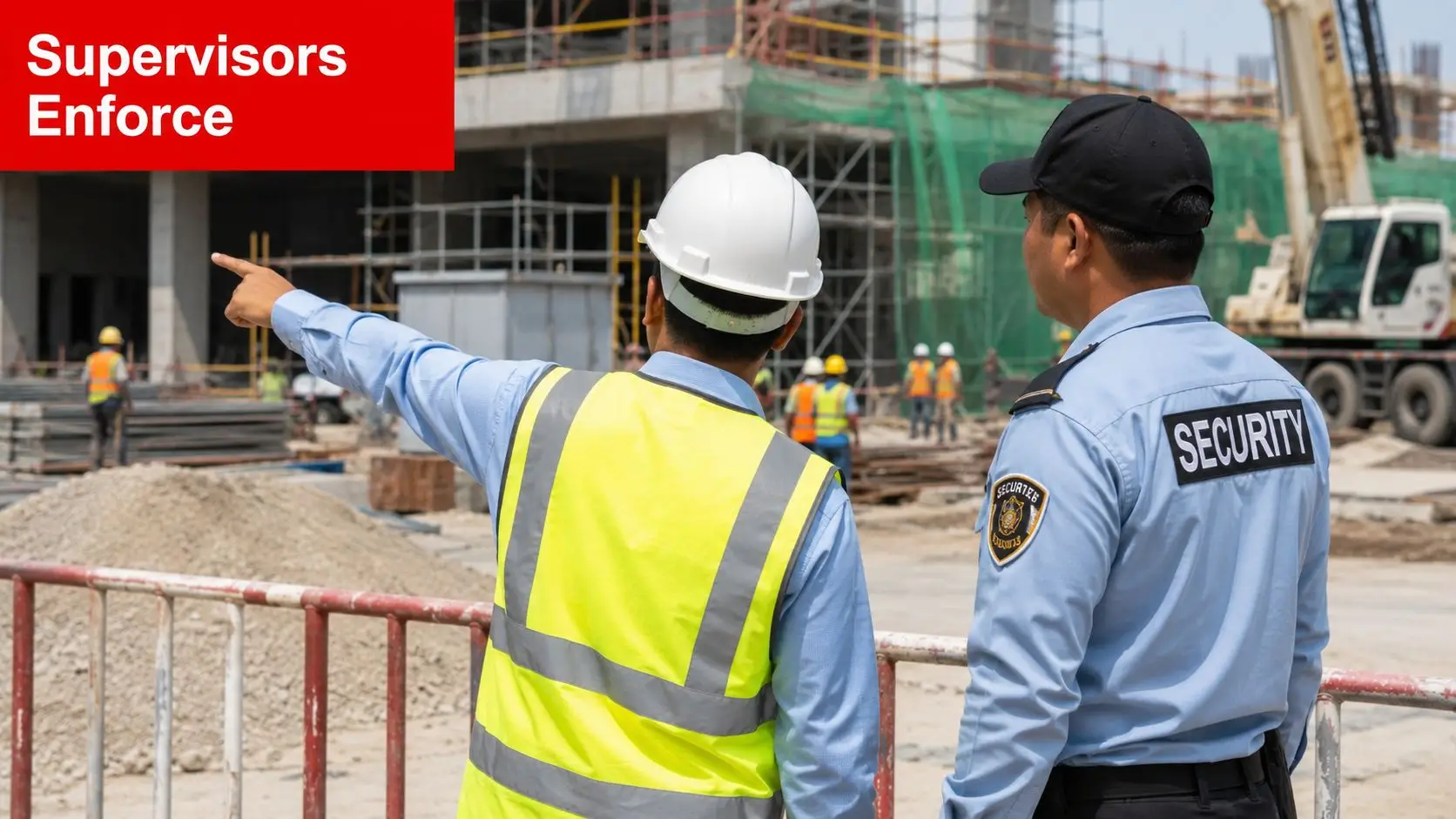
Supervisors control the workface
A supervisor is there to verify that the planned method still matches actual site conditions. If conditions change, the controls must change with them. That means stopping clashing activities, adjusting access routes, checking exclusion zones, confirming permits still apply, and forcing a re-brief when a subcontractor changes sequence or scope.
On a live site, enforcement often looks ordinary. It is still decisive.
- Holding a delivery outside the work area until the pedestrian path is clear
- Stopping a lift because another crew has entered the drop zone
- Resetting a work area after a subcontractor alters its sequence without approval
- Tagging out a damaged lead, tool, or item of plant immediately
- Reassigning a spotter when visibility, traffic flow, or plant movement changes
Good supervisors do not treat these actions as delays. They treat them as normal site control. If production pressure is allowed to override supervision, small conflicts stack up fast and the chance of an incident rises.
Security supports enforcement before hazards reach the workface
Security should not be limited to guarding the perimeter. On construction projects, security supports safety by controlling access, checking authorisation, managing visitor entry, protecting restricted areas, maintaining sign-in records, and reporting movements that do not fit the site plan.
That matters most on multi-contractor sites, where the first failure often happens before work starts. An uninducted visitor walks in. A driver arrives at the wrong gate. A delivery turns up outside its booked window. A worker whose access should be suspended re-enters site. If those issues are not stopped at the boundary, the supervisor inherits a preventable problem inside an active work area.
Used properly, security gives site management time and visibility. Security can hold drivers in a waiting area, confirm who they are there to see, check whether access has been approved, and alert the supervisor before vehicles or visitors enter a congested zone.
GM GROUP Services is one provider in this space, with construction security functions that include access control, patrols, gatehouse operations, emergency response, and support for site safety protocols across NSW, VIC, QLD, and the ACT.
The best sites link gate control with workface control
Supervisors and security should work to one operating picture. Security manages entry, identity, timing, and initial direction. Supervisors manage the workface, plant interfaces, trade separation, and permit-controlled tasks. If those roles operate in isolation, hazards slip through the handover point.
A common example is clustered deliveries during a partial access change. Security holds the vehicles at the gate or in the waiting area, confirms the booking order, and prevents drivers from self-deploying into the site. The supervisor checks the revised route, confirms the overhead exclusion zone, clears pedestrian movement, and releases each vehicle in sequence.
That is how rules are enforced on a live project. Not by relying on the induction alone. By assigning clear authority at the gate and at the workface, then making both roles act on changes as they happen.
A Practical Guide to Incident Response and Enforcement
Even strong construction site safety rules won't prevent every event. What matters then is how the site responds. Good incident response is calm, structured, and immediate. Bad response is confused, delayed, and focused on blame before control.
What to do the moment something goes wrong
When a safety rule is broken or an incident occurs, the first actions should be predictable:
Stop the work
Halt the task and any connected activity. Don't let momentum carry the job forward.Make the area safe
Isolate plant, secure power if relevant, set barriers, and prevent additional exposure.Help the injured person if there is one
Get first aid in, call emergency services if needed, and keep access routes clear.Preserve the scene where required
Don't disturb the area unnecessarily if the incident may trigger a formal investigation.
Enforcement has to be firm and usable
If the issue is a rule breach rather than an injury event, deal with it while the facts are fresh. The aim is not theatre. The aim is correction and prevention.
Use a clear response path:
- Minor first breach: Correct it on the spot, document it, and confirm the worker understood the rule.
- Repeated breach: Escalate to formal warning and involve the subcontractor supervisor.
- Serious or wilful breach: Remove the person from the task or from site, depending on the risk created.
Consistency matters more than volume. Crews will respect enforcement when they see the same standard applied to everyone.
Investigate the cause, not just the behaviour
A worker may have broken a rule, but the investigation still needs to ask why the breach was possible. Was the route unclear. Was the supervision weak. Was the delivery unscheduled. Did the task briefing fail to reflect the actual conditions.
A useful internal review should capture:
| Review point | What to check |
|---|---|
| Immediate trigger | What happened right before the event |
| Site conditions | Layout, lighting, traffic, weather, overlapping works |
| Control failure | Which control was missing, weak, or ignored |
| Responsibility | Who was meant to verify or enforce the control |
| Corrective action | What changes before work resumes |
Close the loop before restarting
Don't restart work because the area looks calm again. Restart only when the corrective action is in place, the responsible people have been briefed, and the revised control is visible in the field.
That may mean changing the traffic route, updating the SWMS, reassigning supervision, tightening gate control, or rescheduling conflicting tasks. If nothing changes after the incident, the site has learned nothing.
Frequently Asked Questions About Construction Site Safety
Do construction site safety rules apply to short-term visitors and delivery drivers
Yes. Anyone entering the site must be controlled to the level their exposure requires. Short-term visitors should be signed in, briefed on site rules, issued required PPE, and escorted where needed. Delivery drivers should not roam the site looking for someone to unload them. Give them a holding point, a clear route, and a contact person.
When is a SWMS mandatory
A Safe Work Method Statement is required for high-risk construction work. In practice, that means you should identify those activities before they reach site, make sure the SWMS matches the actual task, and verify that the crew understands it. A generic document copied from another job won't protect anyone if the live conditions are different.
How often should a site safety plan be reviewed
Review it whenever conditions change in a meaningful way. New project stage, new plant, new contractor interface, changed access route, altered scaffold, changed excavation, or revised delivery pattern all justify review. On active sites, waiting for a scheduled review alone is too passive.
What should a PCBU do if a subcontractor keeps breaching the rules
Start with documented direction and immediate correction. If the behaviour continues, escalate through the subcontractor's supervision and apply the consequences already built into your site rules. If the breach is serious, remove the worker or suspend the activity. The key point is this. If you know the breach is happening and keep allowing the work to continue, you are accepting the risk.
Construction site safety rules only work when the site team treats them as operating conditions, not suggestions. New project managers who understand that early usually avoid the worst mistakes. They don't chase compliance after the fact. They build control into the day.
If you need support turning written procedures into controlled site access, active supervision support, and practical on-the-ground enforcement, GM GROUP Services can assist construction and industrial sites across NSW, VIC, QLD, and the ACT with gatehouse control, patrols, access management, and responsive site security coordination.
Discover more from GM Group Services
Subscribe to get the latest posts sent to your email.