
Concert security guard planning usually starts too late. Ticket sales are moving, the artist schedule is locked, and someone suddenly asks who will manage the queue, search bags, protect backstage access, respond to an intoxicated patron, and keep exit routes clear. A few uniformed people at the front gate won't solve those problems on their own.
A sound operation matches licensed personnel, venue layout, crowd behaviour, emergency planning, and state compliance. The right deployment keeps patrons moving, gives supervisors reliable information, and lets the promoter respond before a local issue becomes a crowd-wide incident.
What a Concert Security Guard Actually Does on Site
The first sign of weak planning is often an entrance that looks busy but has no clear owner. Ticket scanners pause over credential problems, a queue spills into a pedestrian route, and a patron challenges a bag-search decision. Without clear roles, one guard ends up handling several unrelated problems while the bottleneck grows.
A concert security guard provides more than a visible deterrent or ticket-scanning support. The role covers access control, observation, radio communication, de-escalation, incident response, and protection of restricted areas. At a larger event, duties can include front-of-stage monitoring, artist and crew access, perimeter patrols, support for emergency services, and accurate incident reporting.
The operating brief must also account for Australian conditions. A promoter may bring an interstate crew into a venue where licensing, uniform, identification, supervision, and crowd-controller requirements differ from the team's home state. Those permits and checks need to be confirmed before deployment, not discovered when guards arrive at the gate. The same planning applies to vehicle access, delivery routes, and hostile vehicle mitigation around entrances, queuing areas, and pedestrian approaches.
What professional deployment looks like
A minor confrontation shows the difference quickly. An inexperienced guard may issue a blunt instruction, raise the temperature, and draw nearby patrons into the dispute. A capable guard creates space, explains the decision clearly, calls a supervisor early, and separates the issue from the wider queue. The response protects safety while keeping the event welcoming.
Before contracting a provider, ask how the team will handle:
- Pre-event briefing: Confirm prohibited items, radio channels, escalation paths, emergency routes, artist movements, vehicle controls, and venue-specific responsibilities.
- Visible and discreet coverage: Position uniformed personnel where reassurance matters, then use supervisors and targeted patrols for less obvious risks.
- Incident ownership: Require each report to identify the responder, decision, notifications, and any follow-up.
- Patron communication: Select guards who can give directions and explain decisions respectfully at gates, bars, accessible entrances, and crowded circulation points.
- Interstate compliance: Confirm each officer's licence or permit status, required records, and supervision arrangements for the state hosting the event.
Operational rule: A guard who spots a developing queue or perimeter problem and reports it early is more valuable than one who reacts after movement has stopped.
The provider should supply a practical supervision model. Ask who conducts site checks, how often the client receives updates, and how incidents are recorded. Good security remains active throughout the event, with enough structure to manage risk without making legitimate patrons feel treated as a threat.
Calculating Staffing Ratios and Legal Thresholds
A concert can meet a legal headcount and still leave the stage front, perimeter, or emergency route uncovered. Attendance is only the starting point. A single controlled entrance creates different demands from a festival with several gates, alcohol service, backstage areas, transport interfaces, and separate performance zones. Apply the relevant state baseline, then roster the operational posts that the baseline does not cover.
Queensland offers a clear example for licensed premises. Its framework requires one crowd controller for 1 to 100 patrons, two for 101 to 200, three for 201 to 300, four for 301 to 400, and five for 401 to 500. Above 500 patrons, the requirement increases by one additional crowd controller for every extra 250 patrons or part thereof. ASIAL's 2025 Security Industry Licensing Report sets out this rule.
Queensland Crowd Controller Staffing Ratios
| Patron Load | Minimum Controllers Required |
|---|---|
| 1 to 100 | 1 |
| 101 to 200 | 2 |
| 201 to 300 | 3 |
| 301 to 400 | 4 |
| 401 to 500 | 5 |
| Above 500 | 5, plus 1 for every extra 250 patrons or part thereof |
Use the table as a minimum compliance reference, not as the finished concert roster. For 450 patrons in a licensed area, five controllers may satisfy the threshold, but those officers still need defined posts. Entry control, the bar, the dance floor, an emergency access route, and supervision may all require coverage. Put everyone at the gate and the interior becomes difficult to manage once the audience enters.
Build the worksheet around functions rather than a single total:
- Entry control: Queue management, credential checks, bag-search support, and refusal-of-entry decisions.
- Internal crowd management: Movement near the stage, bars, toilets, circulation routes, and high-density areas.
- Restricted access: Backstage, production compounds, artist rooms, loading areas, and staff-only doors.
- Response and supervision: Mobile response, radio coordination, client liaison, and incident documentation.
- Perimeter and egress: Boundary observation, emergency access protection, hostile vehicle exposure, and dispersal support.
State compliance also affects interstate crews. An officer licensed in one state may need a local licence, mutual-recognition arrangement, or event-specific permit before working elsewhere. Confirm that status before travel, then verify supervision, records, and any venue or liquor requirements. A roster that looks adequate on paper can lose capacity if several officers cannot lawfully perform the assigned duties.
Cutting coverage to the legal ratio can create long queues, slower intervention, missed welfare checks, and excessive pressure on individual guards. Excess staffing affects profitability and may make the event feel intimidating. The practical balance is a risk-based roster that records patron load, site map, programme schedule, alcohol arrangements, access points, transport interfaces, and expected surges, while showing why each position is needed.
Australia has a substantial licensed workforce. ASIAL reporting summarised by GM GROUP Services states that individual security licence holders grew 6.10% year-on-year to 162,535 at the end of December 2023. That national benchmark can inform discussions about staffing depth and surge capacity, but promoters still need to confirm local availability, licensing, and suitability for the specific event.
Managing Crowd Dynamics Across Three Risk Phases
Crowd risk changes as the audience moves. A roster that works at the gates may be wrong for the performance peak, and a team that manages the show well can still fail during dispersal if exit routes and transport areas aren't prepared.
Arrival and entry
Start with the route, not the guard position. Separate pedestrian queues from vehicle movements, provide enough queuing space for expected demand, and prevent a queue from folding across an emergency access path or another entrance. Assign a supervisor to watch density rather than focusing only on individual patron checks.
Entry width matters because screening and ticket resolution can slow movement. Keep a visible route for patrons who need assistance, position staff where they can redirect people without creating a second queue, and establish a clear escalation process for prohibited items, invalid credentials, and refusals.
On-site circulation
During the performance, density usually concentrates around predictable attractions. Monitor stage-front pressure, bars, toilets, narrow corridors, merchandise points, and any place where opposing streams meet. Security should use observation and communication to identify compression early, then coordinate with venue staff on a controlled response rather than pushing indiscriminately into a dense crowd.
The NSW event safety and security guidance recommends designing access routes, queuing space, entrance width, exit gate width, and circulation areas to reduce crush risk. It also advises operators to stagger performance and bar closing times so patrons don't leave in one synchronised surge.
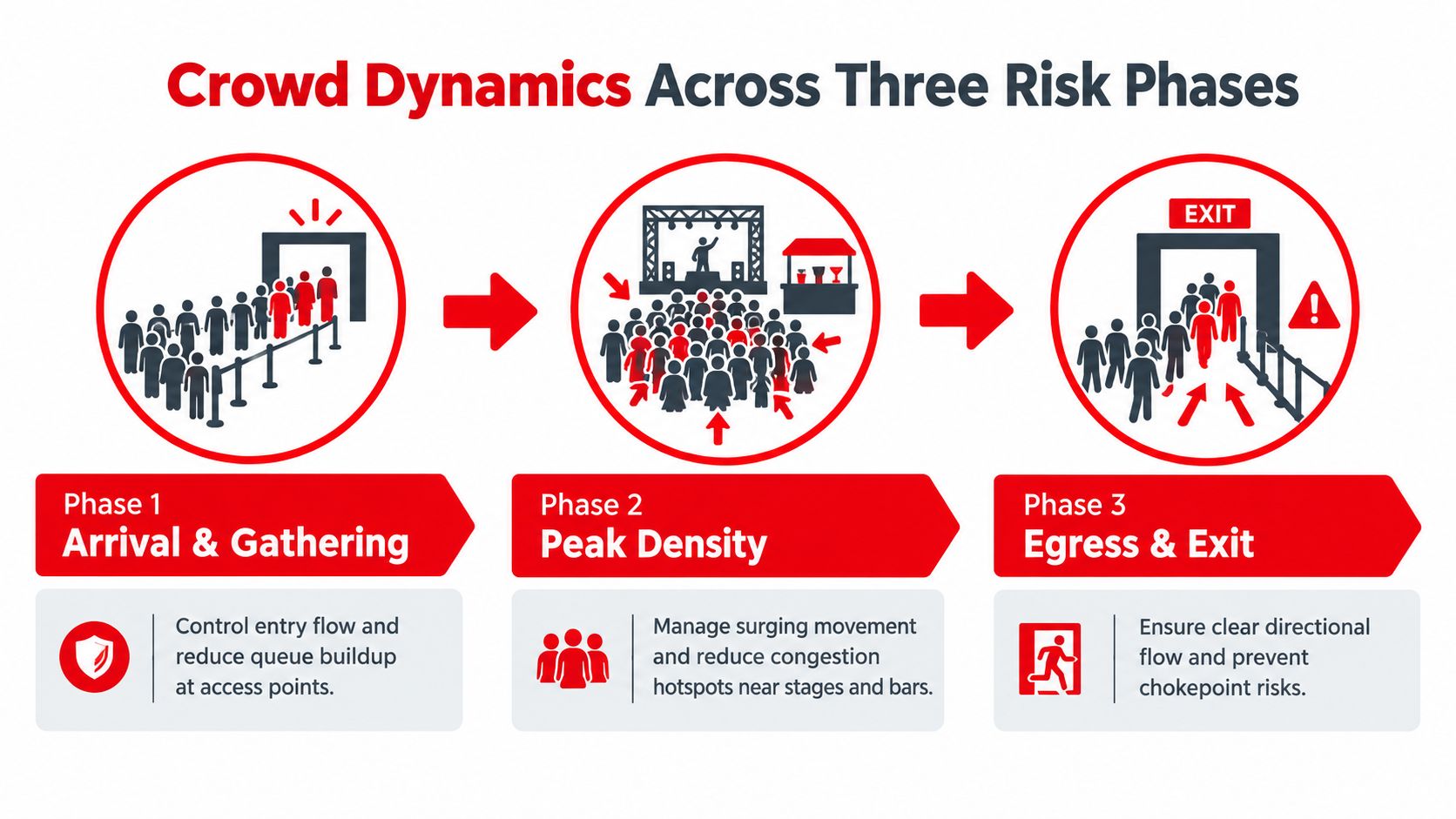
Dispersal and exit
Don't treat the final song as the end of the operation. Keep gates open and routes observable, remove avoidable obstructions, coordinate with transport and venue teams, and retain supervisors until the crowd has cleared the relevant areas. Staggering closing activities can be more effective than just adding guards at the exit, because it reduces the pressure those guards must manage.
Practical test: Walk the site as a patron, then walk it as an emergency responder. Any point where those routes conflict deserves a named owner and a documented control.
Record changes during the event. If a queue forms in an unexpected location or patrons repeatedly stop at a particular junction, the post-event review should convert that observation into a layout, signage, staffing, or scheduling adjustment.
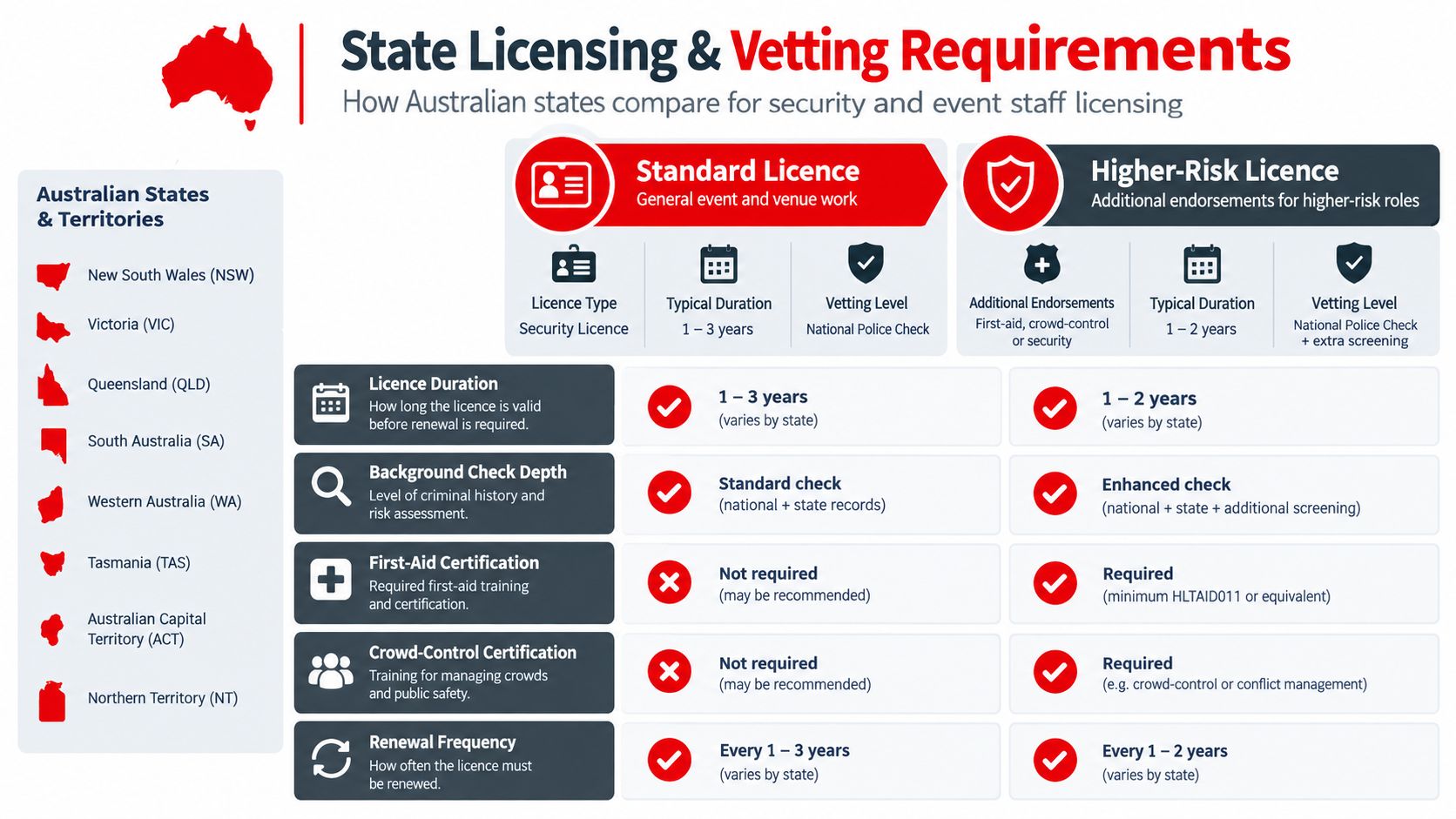
Navigating State Licensing and Vetting Requirements
A roster can look complete and still fail a compliance check. The relevant question isn't only whether a person has security experience. It is whether that person holds the authority, licence, endorsement, or permit required for the work and location.
Queensland's crowd controller requirements are particularly relevant to concerts linked to licensed premises. Applicants must be 18 or older, complete the required training, and aren't eligible where they have a recorded conviction for a disqualifying offence within the previous 10 years. The application also requires 100 points of formal identification, as described by the Queensland Government crowd controller licence requirements.
Comparing the operational burden
Victoria applies its own private security eligibility requirements. Applicants must be 18 or over, be an Australian resident or hold a current visa with working rights, provide fingerprints, submit certified international police checks for periods spent overseas for more than 12 months in the previous 10 years since age 16, and provide 100 points of certified identification. The Victoria Police eligibility and training information also states that a current Victorian private security licence and/or registration, or a Temporary Visitor Permit, is required to work in Victoria.
| Planning question | Queensland | Victoria |
|---|---|---|
| Age and identity | 18 or older and 100 points of formal identification | 18 or older and 100 points of certified identification |
| Background screening | Disqualifying-offence rules apply | Fingerprints and relevant certified international police checks |
| Event role | Crowd controller licensing is relevant to licensed venues and public events | Private security licensing or the applicable visitor authority must be confirmed |
| Roster check | Verify the licence category before assigning duties | Verify licence, registration, or Temporary Visitor Permit before deployment |
NSW planners should require the provider to confirm the authority applicable to each role before the roster is finalised. Don't assume a licence accepted in one jurisdiction automatically authorises work in another. For touring productions, retain evidence of checks, licence details, role assignments, and any state-specific approval in the event file.
Preparing for High-Risk Scenarios and Perimeter Threats
Visible patrols make patrons feel safer, but visibility alone doesn't stop a vehicle from reaching a pedestrian-heavy perimeter. Outdoor concerts, festivals, and hallmark events need a separate conversation about hostile vehicle mitigation, site access, barriers, emergency routes, and response coordination.
The NSW Police hostile vehicle mitigation guidance links security risk assessments for hallmark events with ISO 31000:2018 and HB 167-2006. The same guidance notes Australian Institute for Disaster Resilience information that nearly 150 terrorist attacks targeted concerts, festivals, and mass gatherings globally from 1970 to 2019. That history supports proportionate planning, not panic.
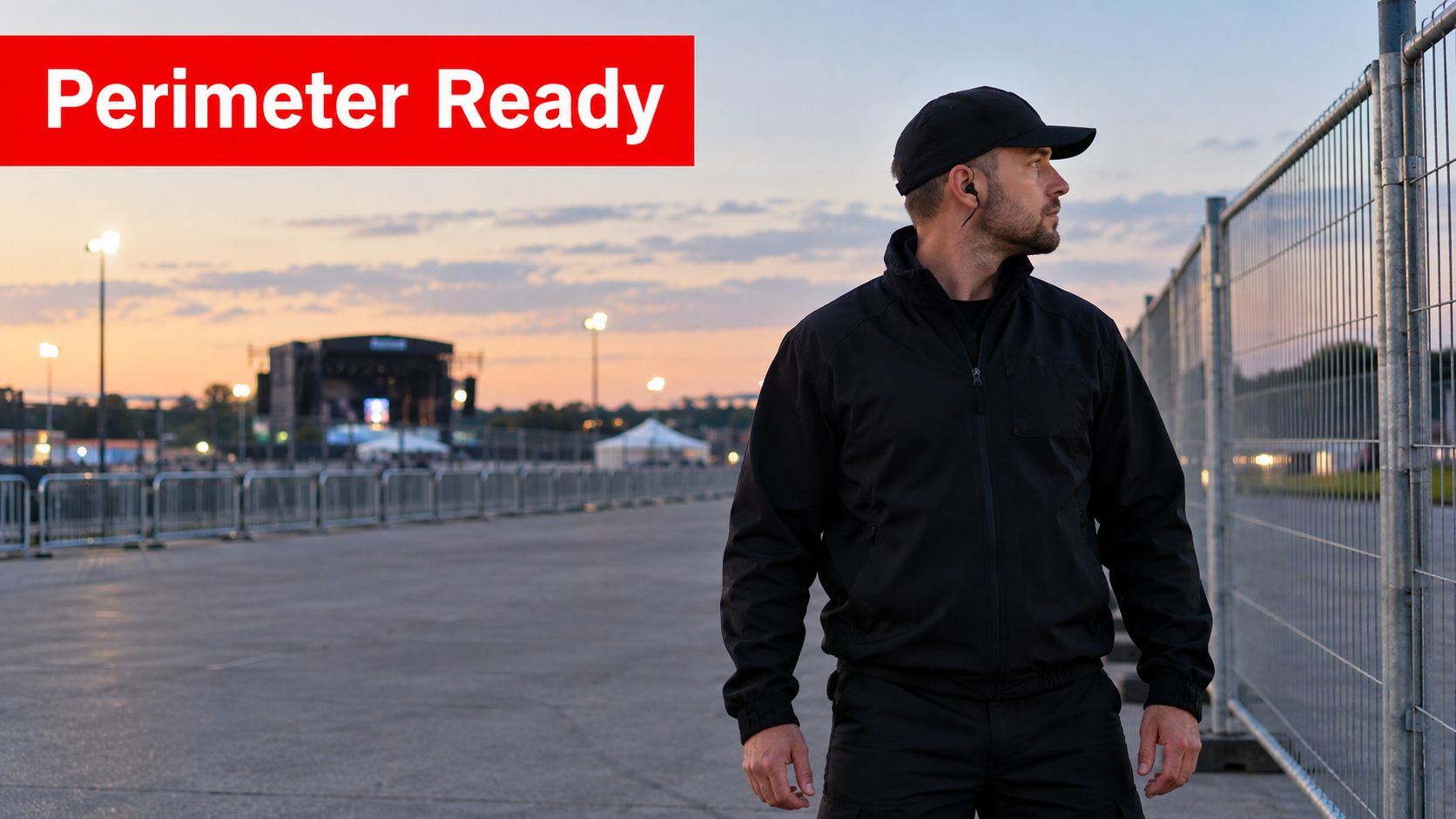
When guards need physical controls
A perimeter plan should identify where vehicles can approach crowds, which access points require screening, how authorised deliveries are verified, and how emergency vehicles retain access. Depending on the risk assessment, controls may include rated barriers, stand-off distance, traffic management, hardened entry points, and a clearly briefed response procedure. Guards operate those controls, but they can't substitute for them.
Event logistics and security must work together here. Promoters reviewing transport and risk management for events can use the same planning conversation to examine vehicle routes, deliveries, pedestrian separation, and site access. The transport plan should be shared with the security supervisor before deployment, not handed over after the gates open.
A good briefing explains what triggers escalation, who contacts police or emergency services, and how the team communicates without creating unnecessary alarm. It also distinguishes ordinary vehicle access from suspicious behaviour, so staff don't improvise inconsistent decisions under pressure.
Aligning Deployment Models With Brand Reputation
A concert can be remembered for how security staff handled ordinary interactions. Calm directions at the gate, a professional response to refusal, and assistance for an uncertain visitor build confidence. Abrupt language, inconsistent enforcement, or unnecessary confrontation can damage trust even when no serious incident occurs.
Deployment should match the audience, venue, and operating model. A club-linked show may need crowd controllers experienced with alcohol-related behaviour, entry conditions, and RSA expectations. A festival usually requires separate functions for gates, roaming crowd management, stage-front coverage, perimeter patrols, and production liaison. A VIP programme may call for discreet protection and controlled access rather than a larger uniformed presence at public entrances.
A national labour pool does not remove state-based licensing or permit checks. If an interstate crew is proposed, confirm that each guard can lawfully work in the event state and that any visitor approval is arranged before rostering. The deployment plan should also show who can be moved between roles if attendance, weather, or crowd behaviour changes.
Build the team around the audience
Ask the provider for:
- Named supervision: Identify the shift supervisor and the client liaison, including who has authority to change posts.
- Role-specific allocation: Match experience and communication style to gates, backstage, stage-front, patrol, or vehicle access duties.
- Reporting discipline: Require incident reports, handover notes, and post-event observations within agreed timeframes.
- Customer-facing standards: Brief staff on tone, accessibility, prohibited items, and dispute resolution without needless confrontation.
- Contingency coverage: Confirm relief arrangements for breaks, late arrivals, and a rapid response to emerging crowd pressure.
A low-cost roster can create queue failures, complaints, weak records, and production delays. A fit-for-purpose team protects patrons while making the promoter appear organised, fair, and in control. Visibility should reassure the audience, not make the event feel over-policed.
Frequently Asked Questions About Concert Security
Does an interstate security business need approval for a NSW special event?
Yes, where the event is a declared Special Event. Organisers bringing in a licensed security business from another state or territory must use a Visitor Permit, and the application must be lodged one month before the first day of the event, according to the NSW Visitor Permit service information. Build that deadline into production planning because the permit applies for the event duration and isn't a substitute for ordinary roster checks.
Can generic door staff work a Queensland concert afterparty?
Not where the duties require crowd controller licensing. Queensland requires applicants to be 18 or older, complete the required training, meet the background rules, and provide 100 points of formal identification. Confirm the licence category before assigning door, access, or licensed-premises duties.
What should a promoter request before the event?
Request licence verification, role assignments, supervisor details, the site deployment plan, escalation contacts, emergency coordination arrangements, and the reporting process. For Victoria, check the relevant private security licence, registration, or Temporary Visitor Permit and retain the required vetting evidence in the event file.
Is a visible patrol enough for an outdoor festival?
No. The perimeter assessment should consider vehicle approach routes, barriers, pedestrian separation, emergency access, and response coordination alongside ordinary patrols. Guards are one layer of the plan, not the entire hostile vehicle mitigation system.
GM GROUP Services provides licensed concert and event security across NSW, Victoria, Queensland and the ACT, including crowd management, access control, VIP protection, patrols, emergency response and risk assessments. Visit GM GROUP Services to discuss a deployment matched to your venue layout, state compliance obligations and patron experience.
Discover more from GM Group Services
Subscribe to get the latest posts sent to your email.