
Using CCTV for security is a fundamental strategy for protecting people and property. In a world of increasing risks, a well-implemented surveillance system acts as your most vigilant witness—a powerful tool that deters threats and provides crucial evidence when incidents occur. For any serious risk management plan, understanding how to leverage CCTV for security is no longer optional; it's essential.
Why CCTV for Security Is an Essential Layer of Protection
Imagine running security for a sprawling commercial complex or a sold-out music festival. The scale is daunting. You need to prevent unauthorised access, monitor crowd behaviour, and be ready to respond to emergencies in an instant. Relying solely on security personnel is like asking them to be everywhere at once.
This is where a modern CCTV for security system becomes a game-changer. It's no longer just a passive set of cameras recording to a dusty VCR. Today’s systems are an intelligent, proactive force multiplier for your entire team.
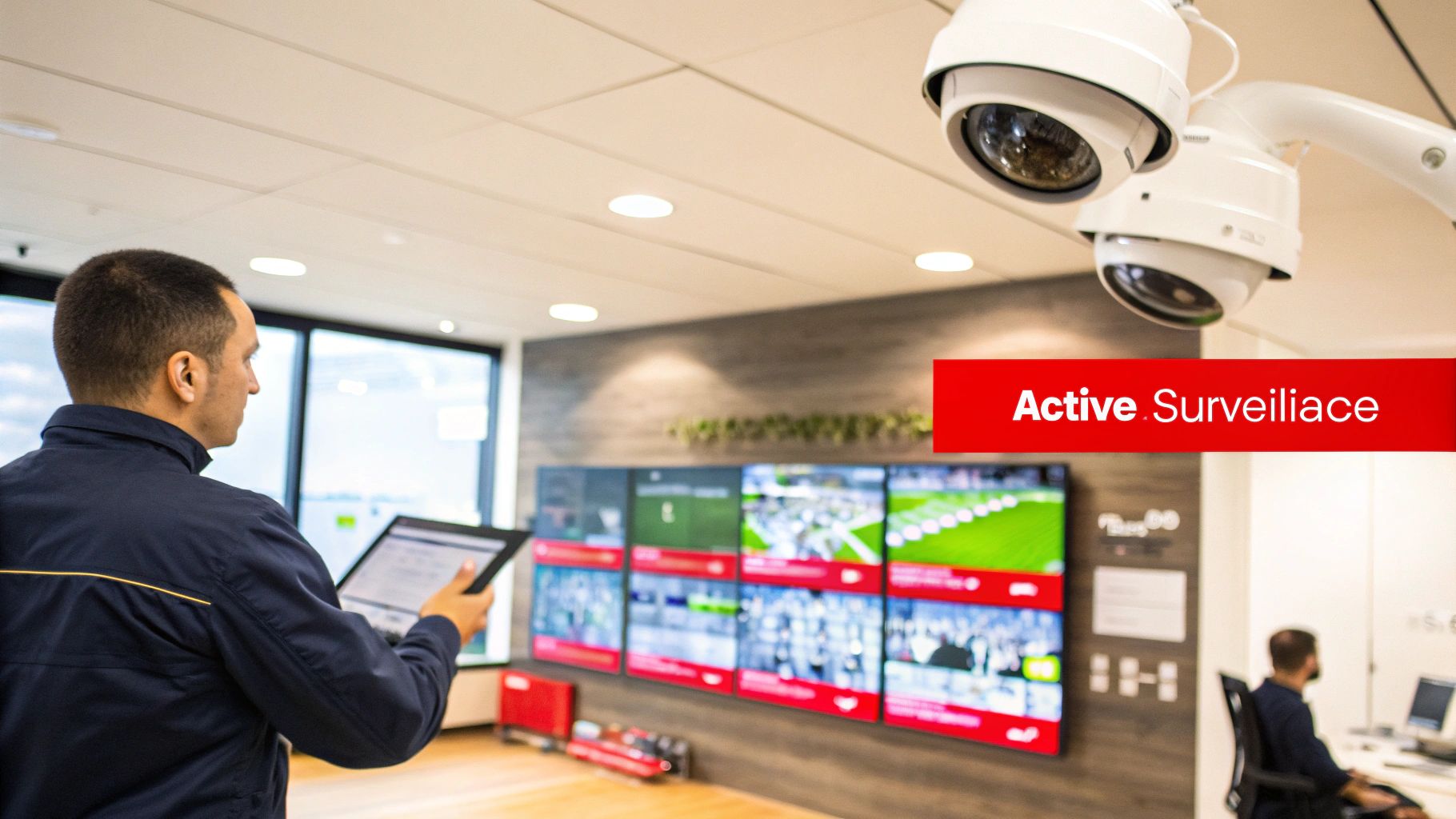
This guide is designed for event organisers, venue managers, and site supervisors who need practical, actionable insights on using surveillance effectively. We’ll cover everything from choosing the right system to navigating Australian compliance, ensuring your investment enhances safety and delivers a clear return.
The Growing Demand for Advanced Surveillance
The shift towards smarter surveillance isn't just a trend; it's a response to proven effectiveness. The Australian CCTV market, valued at USD 1.16 billion, is projected to surge to USD 6.02 billion by 2033, reflecting a compound annual growth rate of 17.90%.
This growth signifies that businesses are recognising that CCTV for security is a non-negotiable part of any serious security strategy. You can explore more insights on the Australian CCTV market growth to understand its implications for your business.
A well-planned system does far more than just record. For security professionals, it provides:
- Real-Time Situational Awareness: Operators can monitor multiple locations simultaneously. Actionable Insight: For a large event, this means identifying an overcrowded section near a stage and dispatching staff to manage crowd flow before a dangerous crush can begin.
- Enhanced Team Safety: Surveillance acts as an 'eye in the sky' for guards on patrol. A control room can guide them away from a potential ambush or send immediate backup if they encounter trouble.
- Post-Incident Investigation: High-quality footage is critical after an incident. It provides clear, indisputable evidence to law enforcement, which can be the deciding factor in a successful prosecution.
- Operational Efficiency: Beyond security, cameras offer operational insights. You can monitor customer foot traffic to optimize store layouts, ensure staff adhere to safety protocols in a warehouse, or identify bottlenecks in a venue.
How to Choose the Right CCTV System for Your Security Needs
Selecting the right CCTV system can feel overwhelming, but it boils down to matching the technology to your specific needs. The primary choices are analogue, Internet Protocol (IP), and wireless systems. Each has distinct advantages, and the best fit depends on your environment—a sprawling outdoor festival requires a different solution than a corporate high-rise needing razor-sharp footage.
Analogue CCTV: The Reliable Standard
Analogue systems are the traditional workhorses of surveillance. They capture video and transmit it via coaxial cable to a Digital Video Recorder (DVR), where it's digitized and stored. They are reliable, straightforward, and effective for basic monitoring without complex network configurations.
Practical Example: A small retail shop with existing coaxial wiring can use an analogue system for cost-effective general monitoring of the sales floor and entrance. It provides a visible deterrent and records activity without a significant investment in new infrastructure.
IP CCTV: The High-Definition Choice
IP cameras are the modern standard for professional security. These fully digital cameras transmit high-definition video over a computer network, offering superior image quality and advanced features.
An IP camera system is the 4K smart TV of the security world. It delivers stunningly clear, high-definition images and connects to the internet, opening up a world of smart features like remote access and intelligent analytics.
The clarity is crucial. The ability to zoom in on recorded footage to identify a face or a license plate can make or break an investigation. For large venues or high-risk areas, the detail provided by an IP-based CCTV for security is non-negotiable.
Wireless CCTV: The Flexible Solution
Wireless cameras offer maximum flexibility by transmitting video over Wi-Fi, eliminating the need for extensive data cabling. This makes them ideal for temporary setups or covering hard-to-reach spots where running wires is impractical.
Practical Example: A multi-day music festival can deploy wireless cameras on lighting rigs and temporary structures to monitor stages, entry gates, and vendor areas. The system can be set up quickly and removed just as easily once the event is over.
CCTV System Types at a Glance
This quick comparison highlights the key differences to help you choose the right fit for your security needs.
| System Type | Best For | Pros | Cons |
|---|---|---|---|
| Analogue | Smaller sites, budget-conscious projects, existing coaxial cable setups. | Lower initial cost, simple setup, reliable and easy to maintain. | Lower image resolution, limited features, less scalability. |
| IP | Professional security, large venues, high-risk areas, new installations. | High-definition video, advanced analytics, remote access, scalable. | Higher upfront cost, requires network knowledge for setup. |
| Wireless | Temporary events (festivals, construction), hard-to-wire locations. | Maximum flexibility, fast deployment, no data cabling required. | Reliant on Wi-Fi strength, potential for interference, battery/power needs. |
There is no single "best" system; the optimal choice depends on your protection goals. To explore modern cloud-managed solutions, this guide to Meraki security cameras offers valuable insights into how advanced systems integrate these technologies.
Diving Into the Features That Really Matter in Modern Security Cameras
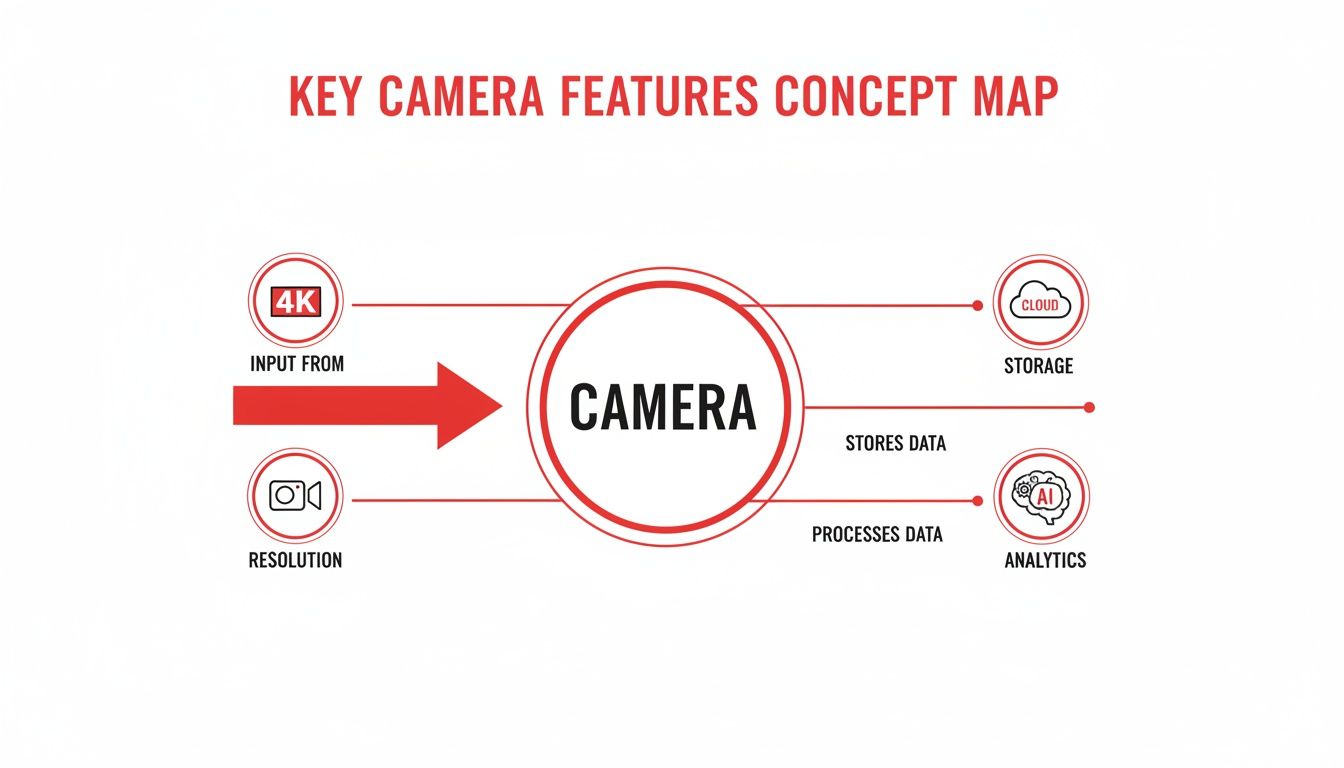
Choosing the right type of CCTV for security is just the starting point. The real power of a modern surveillance system lies in its specific features, which transform it from a passive recorder into a proactive security tool.
Key features like resolution and night vision are fundamental. A 4K camera provides the clarity to zoom in on a face across a large venue or read a license plate from footage days later. For 24/7 security, night vision is essential. While standard infrared (IR) provides clear black-and-white images in darkness, advanced low-light sensors can capture video in full colour, which is critical for identifying the colour of a vehicle or clothing.
Moving Beyond Just Recording: Proactive Intelligence with CCTV for Security
The most significant advancement in CCTV for security is artificial intelligence (AI). AI-powered analytics turn your system into a smart partner that can identify potential threats and alert your team automatically.
- Smart Motion Detection: Differentiates between people, vehicles, and irrelevant movements like swaying trees, drastically reducing false alarms.
- Facial Recognition: Creates a watchlist of known individuals. Actionable Insight: A casino can use this to get an instant alert if a person on a self-exclusion list enters the premises.
- Crowd Analysis: Monitors crowd density in real-time. For large events, it can detect dangerous surges or panicked movements, allowing security to intervene before a situation escalates.
- Loitering Detection: Flags individuals lingering in sensitive areas—like a loading dock after hours—alerting guards to potential threats before they occur.
Imagine your system automatically spots a car parked in a no-standing zone, snaps a photo, and sends it straight to your patrol team's tablet. That’s what modern analytics does: it turns hours of video into clear, actionable information your team can use right away.
Where Does All That Footage Go?
Finally, consider storage. On-premise storage with a Network Video Recorder (NVR) gives you full control but requires maintenance and a significant upfront cost. Cloud storage offers flexibility and security; your footage is stored safely off-site, protecting it from theft or damage. This is often a more practical choice for businesses that want reliable access to crucial video without managing hardware.
Mastering Strategic Camera Placement and Coverage
Even the most advanced CCTV for security gear is useless if not placed correctly. A single blind spot can undermine your entire system. Strategic camera placement is about creating overlapping fields of view to ensure complete coverage, leaving no gaps for an intruder to exploit.
Identifying Key Surveillance Zones
To achieve total coverage, you must think like a potential threat. Walk your site and identify high-risk zones that require monitoring.
Here’s a practical checklist to get you started:
- Entry and Exit Points: Every door, gate, and access point must have a camera.
- Cash Handling Areas: POS systems, cash offices, and safes need dedicated cameras.
- High-Traffic Corridors: Lobbies, hallways, and main walkways are crucial for tracking movement.
- Perimeters and Fences: Loading docks, car parks, and fence lines are often the first point of entry.
- High-Value Asset Locations: Server rooms, stockrooms, and areas with sensitive equipment require surveillance.
Deploying the Right Camera for the Right Job
Once you've identified key zones, match the camera to the task. A wide-angle dome camera is great for an overview of a lobby, but you'll need a Pan-Tilt-Zoom (PTZ) camera for active surveillance. A skilled operator can use a PTZ camera to track a suspicious individual across a large area or zoom in on a vehicle's number plate from hundreds of metres away.
The best security plans use a mix of camera types. By layering different models, you create a robust defence that captures both the big picture and the critical details. Smart placement ensures your investment in CCTV for security delivers the protection you need.
Creating a Powerful Partnership with Integrated Security
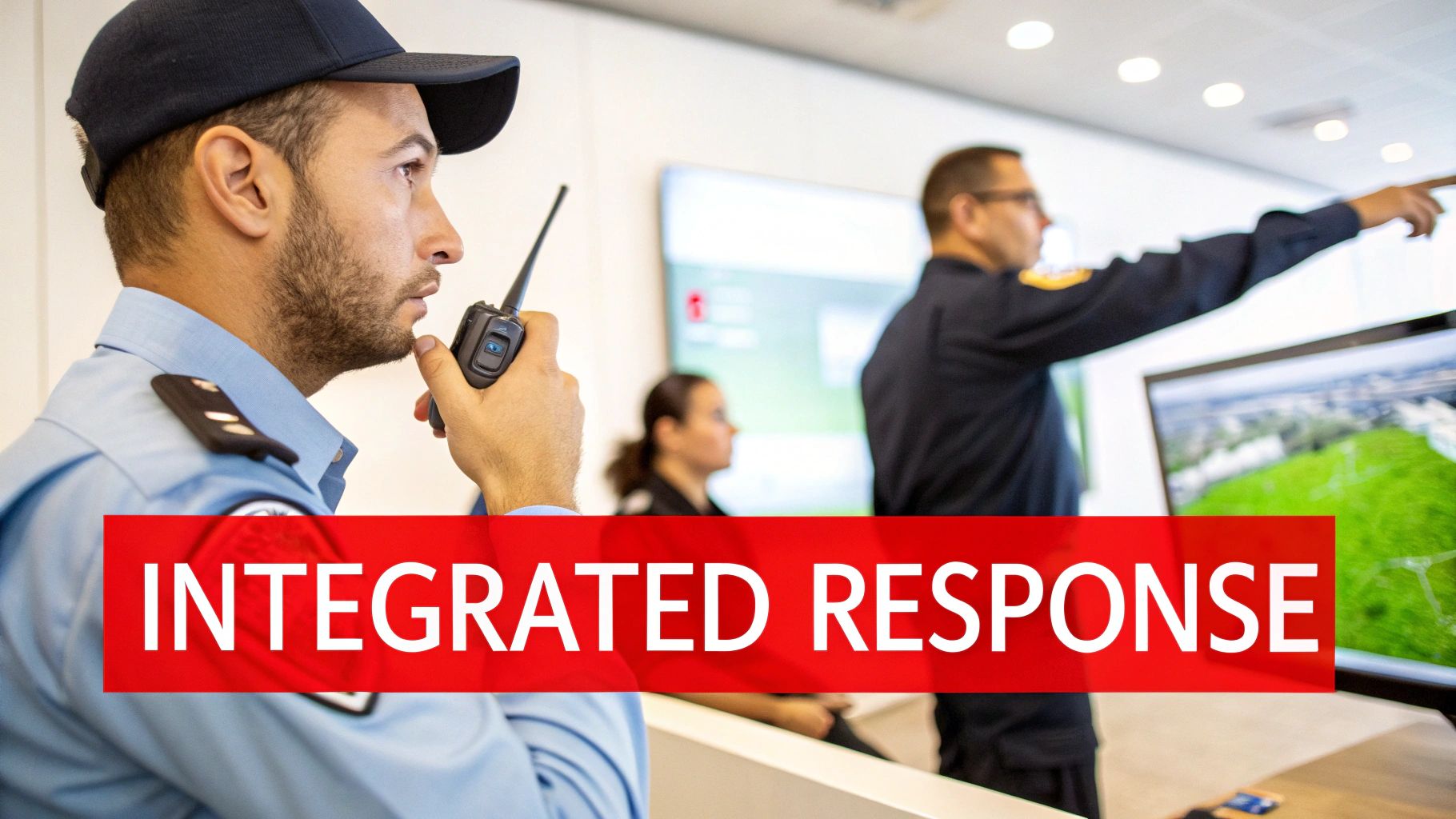
A sophisticated CCTV for security system is only half the solution. Its true strength is unleashed when integrated with skilled, on-the-ground security personnel. The best strategies blend technology and people into a single, responsive force.
This approach transforms your security from passive monitoring into an active, intelligent operation, creating a synergy between the eyes in the sky and the boots on the ground.
From Surveillance to Actionable Intelligence
Practical Example: A remote operator monitoring a large construction site at night spots an unauthorized person near a fuel depot. The operator immediately radios the patrol guard, providing the intruder's exact location and direction of travel. The guard can then intercept them efficiently, preventing theft or vandalism.
The real value of an integrated system lies in its ability to turn raw surveillance data into immediate, actionable intelligence for the people on the ground. It’s about seeing trouble early and directing a fast, effective response.
Benefits of an Integrated CCTV and Manned Guarding Approach
Combining smart surveillance with a physical security presence offers numerous advantages:
- Faster Response Times: Operators guide guards directly to incidents, reducing resolution time.
- Improved Guard Safety: A remote team can monitor guards, call for backup, and warn them of unseen dangers.
- Better Evidence Collection: An operator can use PTZ cameras to track a subject while directing guards to intercept, ensuring the entire event is documented.
- Enhanced Deterrence: The combined presence of guards and visible cameras is a powerful deterrent.
This partnership ensures your CCTV for security investment actively protects your people and property, 24/7.
Navigating Australian CCTV Privacy and Compliance
Operating a CCTV system comes with significant legal and ethical responsibilities. In Australia, the Privacy Act 1988 and state-specific laws govern surveillance. Understanding these regulations is crucial to protect your organization from liability and maintain public trust. For a detailed overview, it's wise to review Australian data privacy laws before installation.
The Importance of Visible Signage
You must clearly inform people they are being recorded. Secretly filming in areas where privacy is expected is illegal.
Actionable Insight: Place clear, visible signs at all entrances. A simple sign stating, "CCTV Surveillance in Operation on These Premises for Security Purposes," effectively meets your legal obligation and acts as a deterrent.
Key Compliance Rules You Must Follow
- Audio Recording: It is illegal to record a private conversation you are not a part of. As a rule, your CCTV for security system should not record audio unless you have explicit consent from everyone involved.
- Footage Storage and Access: Recorded footage is sensitive data and must be stored securely. Access should be restricted to authorized personnel for legitimate security purposes only.
- Justifiable Purpose: You must have a legitimate reason for filming, such as crime prevention or public safety. Using cameras for purposes like monitoring employee break times can lead to legal challenges.

Frequently Asked Questions About CCTV for Security
Navigating the world of CCTV for security often brings up practical questions. Here are answers to some of the most common queries.
Q1: Can I access my CCTV system remotely?
A: Yes. Modern IP-based systems are designed for secure remote access, allowing you to view live feeds or review footage from your phone, tablet, or computer. These connections are encrypted and protected by multi-factor authentication to ensure privacy.
Q2: How much storage do I need for my CCTV footage?
A: Storage needs depend on the number of cameras, resolution (4K footage requires more space than 1080p), and recording schedule. Actionable Insight: A good rule of thumb is to have enough storage for at least 30 days of footage. This is often a requirement for insurance policies and legal compliance, ensuring you have evidence when needed.
Q3: Does visible CCTV actually deter crime?
A: Absolutely. The evidence overwhelmingly shows that visible security cameras are a significant deterrent. Potential offenders are far less likely to target a property where they know they are being recorded. Furthermore, high-quality footage is invaluable for police investigations, helping to identify suspects and recover stolen property.
Q4: What is the biggest mistake people make with CCTV for security?
A: The most common mistake is the "set and forget" mentality. A security system requires regular maintenance. Actionable Insight: Schedule quarterly checks to ensure all cameras are operational, lenses are clean, and the recording system is functioning correctly. A non-working camera provides a false sense of security and is useless during an incident.
For a professional security solution that integrates seamlessly with your operations, trust the experts at GM GROUP Services. We design and manage security systems that protect people, property, and peace of mind. To discuss your specific needs, visit us at https://www.gmgroupservices.com.au.
Discover more from GM Group Services
Subscribe to get the latest posts sent to your email.