
Background check requirements are what usually get challenged at the worst possible time, when the crew is already on the bus, the radios are handed out, and someone at the gate realises a clearance is missing or wrong for the state. In Australian event security, that isn't a paperwork problem, it's a deployment problem that can stop access, delay opening, or force a last-minute swap that everyone feels on site.
The reason is simple. Background check requirements in Australia sit inside state licensing, child-safety screening, and privacy law, so the old idea of one generic check for every role doesn't hold up. If your team touches patrons, cash, alcohol, children, or controlled sites, the check has to match the job and the jurisdiction before anyone steps onto site.
Why Background Check Requirements Are Now Non-Negotiable for Event Security
A festival promoter gets a call on Wednesday afternoon. One crowd controller is ready to start, but the paperwork on file does not match the state where the event is being held, and another worker's clearance has lapsed for the role they are doing. The roster looked fine in the spreadsheet, then the site manager realised the checks on file were not aligned to the work being performed.
That is the point where background check requirements stop being an HR admin issue and become an operational risk. In regulated work, screening sits inside state-based licensing and safeguarding frameworks, especially where staff work with children, vulnerable people, alcohol service, cash handling, or controlled sites, and compliance is required rather than optional (state-based screening and licensing context).
What is driving the change on the ground
Three forces keep showing up in real deployments. First, state-based licensing laws mean the right check in one jurisdiction may not satisfy another. A crowd controller who is cleared for one state does not automatically tick the box elsewhere, even if the role title sounds identical.
Second, child-safety screening regimes can apply to employees, contractors, volunteers, and performers in child-related work, which matters in family zones, school events, and festivals with youth areas (jurisdiction-based child-related screening). If a role can place someone in contact with children, the organiser has to treat that risk as part of the booking, not as a last-minute fix at the gate.
Third, the Privacy Act 1988 (Cth) and the Australian Privacy Principles require employers to collect personal information only where it is reasonably necessary and to tell people why it is being collected, how it will be used, and how corrections can be requested (privacy obligations for background checks). That notice has to mean something in practice, not just sit on a form nobody reads.
Practical rule: if the worker can interact with patrons, cash, alcohol, children, or a controlled site, the check needs to be verified before deployment, not after the roster is live.
The ground reality is that compliance now sits inside the job design. A venue manager cannot treat screening as a quiet back-office step, because the wrong or missing check can turn into a gate issue, a supervision issue, or an insurance headache. Once that is accepted, background check requirements become part of scheduling, onboarding, and site access control. For crews that also need documented voice verification as part of a broader risk screen, Explore WorkSignal voice screening is one example of how teams are tightening pre-deployment checks.
The Core Background Check Requirements Every Australian Employer Should Know
A lot of crews say, “we've done the background check,” but that can cover very different screens. On Australian event, venue, and security work, four check types keep turning up, and each one answers a separate risk question.
The four check types in plain English
National police check. This is the basic criminal-history screen used across employment and volunteer roles. In Australia, national police checks are commonly issued through accredited ACIC agencies, and they disclose certain disclosable court outcomes subject to the purpose of the check and spent-convictions rules, so the result is not always a simple clean or not clean outcome (national police check mechanics).
Working with Children Check. This is a state or territory child-safety screen, and it often applies to employees, contractors, volunteers, and performers in child-related work rather than only permanent staff. If a role can enter a school event, youth festival, family zone, or another child-related environment, this check can matter even for casual crew.
Security licence prerequisites. For security roles, employers usually have to line vetting up with state licensing laws and the risk profile of the job, because higher-trust positions can require identity verification, criminal-history screening, and sometimes additional suitability checks before a licence is issued or renewed (licensing and vetting alignment). A police check by itself often does not cover the whole requirement.
Right-to-work or immigration verification. This confirms the person can lawfully work in Australia. It does not replace a police check or a licence check, but it belongs in the same onboarding file because a well-screened worker still cannot be engaged if they are not legally allowed to work.
The practical point is simple. One check rarely solves all obligations. A crowd controller, a family-zone casual, and a site supervisor can need different combinations, even if they start on the same day.
If you need a practical model for separating checks by role and consent flow, Explore WorkSignal voice screening is a useful comparison point for how screening programs are being packaged in other compliance-heavy markets.
Useful shortcut: match the check to the risk, not the roster type. Casual, contractor, and full-time staff can all trigger different screening needs.
How Background Check Requirements Differ Across NSW, VIC, QLD and ACT
A single national template falls apart fast once the roster crosses a border. The check trigger, the issuing authority, and the licence pathway all change depending on where the work is being done, which is why venue managers run into trouble when they copy one state's process into another.
NSW and Victoria are not interchangeable
In NSW, the common mistake is assuming a state security workflow automatically covers every paid event role. It does not. The role, the site, and the licensing rule all matter, so if a contractor moves between crowd work, venue security, and event deployment, the screening stack needs to follow the job rather than the company logo.
Victoria operates at a different scale. The state expanded its Working with Children Check regime in 2016 to cover paid child-related work and many volunteers, and the Victorian government says more than 1.5 million Working with Children Checks had been issued by 2024 (Victorian screening scale). That shows how normal child-related screening has become in regulated sectors, and why venues cannot treat it as a niche admin task.
The practical trade-off is simple. A broad screening approach gives you more coverage, but it also creates extra admin, extra waiting, and more chances to chase the wrong document. A tighter role-based approach keeps the file cleaner, provided the manager understands the local rule set.
Queensland and the ACT still need local checking
In QLD, venue and security work often gets tangled with licensing and site-specific access rules, so the mistake is relying on verbal sign-off or a generic induction to cover the screening requirement. It does not. If a role is tied to a licensed venue, the compliance file should show the check type that matches the role, not a casual note from a supervisor.
The same pressure shows up in the ACT with paid event work and child-related environments. A contractor may be cleared for one setting and still need a different check where the role touches children, public events, or another regulated site. That is why the jurisdiction where the work happens matters more than the office where the roster was built.
For a broader compliance comparison beyond Australia, the Paradigm International Inc. guide to hiring compliance in Florida is a useful reminder that state-by-state screening logic shows up in tightly regulated labour markets everywhere.
Local rule of thumb: check the state authority and the site trigger before deployment. A copied template is where most compliance gaps start.
Matching Background Check Requirements to Specific Security and Venue Roles
Once you stop thinking in terms of “staff” and start thinking in terms of actual jobs, the screening picture gets clearer. A role with crowd access, alcohol access, cash access, or child access usually needs a different stack of checks than a back-of-house support role.
Role by role matrix
| Role | Typical Risk Profile | Minimum Check Stack |
|---|---|---|
| Crowd controller at a licensed venue | Public contact, de-escalation, controlled access | Identity verification, state security licence prerequisites, national police check |
| RSA-rated bar staff at a festival | Alcohol service, patron interaction, cash handling | Identity verification, role-appropriate licence or RSA evidence, national police check |
| K9 handler on a construction perimeter | Controlled site access, asset protection, high trust | Identity verification, state security licence prerequisites, national police check, right-to-work verification |
| Loss prevention officer in a retail centre | Asset protection, surveillance, customer contact | Identity verification, national police check, licence check if required by the role |
| Casual event crew member in a family zone | Child-related environment, public contact, manual tasks | Identity verification, Working with Children Check where triggered, national police check where required |
The common mistake is to over-screen low-risk support roles and under-screen high-trust roles. The better approach is to map the role to its actual exposure, then document why each check sits in the file.
Where casual crew get pulled into child-related obligations
Family zones, school events, youth festivals, and community activations change the compliance picture fast. A casual worker who normally helps with bump-in can become child-related the moment they're placed in a space that triggers the state scheme, and that's where background check requirements often get missed because the roster title doesn't look sensitive.
A construction site supervisor is a good example of layered screening. If the role involves site access, identity documents, work history, and licence evidence should all have a documented purpose, and each item should be tied to the actual job task rather than collected “just in case.” That's the cleanest way to stay defensible when the file is reviewed.
Operational takeaway: build the matrix from the site risk, then attach the person to it. Don't build the matrix from the person's job title alone.
How to Obtain, Verify and Store Background Checks Properly
A compliant screening process is usually straightforward to run, but only if each step is written down and followed the same way every time. Once supervisors start improvising consent, storage, or verification, the file loses value fast.
The workflow that actually holds up
Start with written consent and a short notice that explains what is being collected, why it is needed, who will see it, and how corrections can be requested. Many teams rush this part. The Privacy Act 1988 (Cth) and the Australian Privacy Principles still require the collection to be reasonably necessary and the notice to be clear to the person being screened.
Then submit the request through an ACIC-accredited agency for the relevant police check. Once the result comes back, verify it against the original identity documents and the role requirement before it is stored or shared. The file should show why that check matched that role.
Store the information securely and keep only what is needed. If the worker is a construction site supervisor, the purpose for identity documents, work history, and licence evidence should be recorded separately so you can show why each item was collected and why it belonged in the file.
What to document every time
- Why the check was needed: Tie it to the role, site, or licence condition.
- What was collected: List the exact documents, not a vague note.
- Who approved it: Name the person who authorised the check request.
- How it was verified: Record the match between the result and the identity documents.
- Where it was stored: Keep the record secure and retrievable for audit.
A simple rule helps here. If you cannot explain why a document was collected, you probably should not have collected it.
Re-Screening Cadence and Ongoing Monitoring for Higher-Risk Roles
The biggest hole in a lot of screening programs is what happens after onboarding. A check done on day one won't tell you that a licence changed, a record changed, or a driving entitlement changed six months later, which is exactly why static files create blind spots in security-sensitive work.
Risk-tiered re-screening works better than blanket cycles
Federal suitability frameworks give a useful reference point. The federal PIV-eligibility baseline is a favourably adjudicated Tier 1 investigation, while higher-risk positions can require deeper checks that include law-enforcement records, written inquiries to employers and references, and sometimes five years of employment, residential, and education history plus interviews (tiered suitability depth). The logic is simple, check depth should rise with access level and harm potential.
That same logic translates well to events, hospitality, construction, and retail. A low-risk support role doesn't need the same cadence as a licensed security role or a child-related role, but the higher the trust and access, the more often the file should be refreshed. Recent screening guidance also points to periodic annual re-screening and continuous monitoring for higher-risk roles, although many general FAQ pages still stop at pre-employment checks (re-screening best practice).
What usually changes after hire
Licence status can lapse. Criminal records can change. Driving-related entitlements can change. In practice, those changes matter most when the worker is still active on site and the risk exposure hasn't changed with them.
Best practice: use risk tiers, not a single calendar date, to decide who gets re-screened and when.
For a venue manager, that means higher-trust roles should be revisited on a scheduled basis, while lower-risk roles can be checked only when the risk profile changes. That's more operationally realistic than a one-size-fits-all annual cycle, and it gives supervisors a process they can maintain.
Five Common Pitfalls That Break Background Check Compliance
The same five mistakes keep turning up in contractor and staff files. They look minor on paper, then become a problem the moment an auditor, insurer, or licensing body asks for the paperwork.
The mistakes that cost you
Treating a national police check as the whole answer. It is only one part of the file. A police check does not replace Working with Children checks, right-to-work verification, or a role-specific security licence file, so a person can still be blocked from deployment even when the police result looks fine.
Flattening every old matter into the same bucket. A result is not just “clean” or “dirty.” Old matters can carry different weight depending on the role, the state or territory, and the rules that sit around the check, as explained in the spent-conviction context. If managers treat every historical entry as an automatic stop sign, they create unfair decisions and a mess for HR and operations.
Leaving child-related screening out of casual crew planning. This shows up in family zones, youth festivals, and school-linked work because the staff member is casual and the job looks low risk. The practical outcome can be a denied insurance claim or a compliance finding when the role should have triggered a child-safety check.
Keeping weak records for consent and verification. If you cannot show what was requested, why it was requested, and what check supported the decision, the file will not stand up well in an audit. In practice, that is close to having no record at all.
Relying on verbal approval instead of written authorisation. A quick yes over the phone or in person feels efficient, but it leaves no trail showing what the person agreed to, what they were told, or how their information would be used. That creates a privacy problem before the screening result even lands.
For teams trying to separate paperwork from actual process control, the compliance vs conformity guide for HR is a useful reference because it shows the difference between ticking a box and running a file that can survive review.
Your Compliance Checklist and Frequently Asked Questions
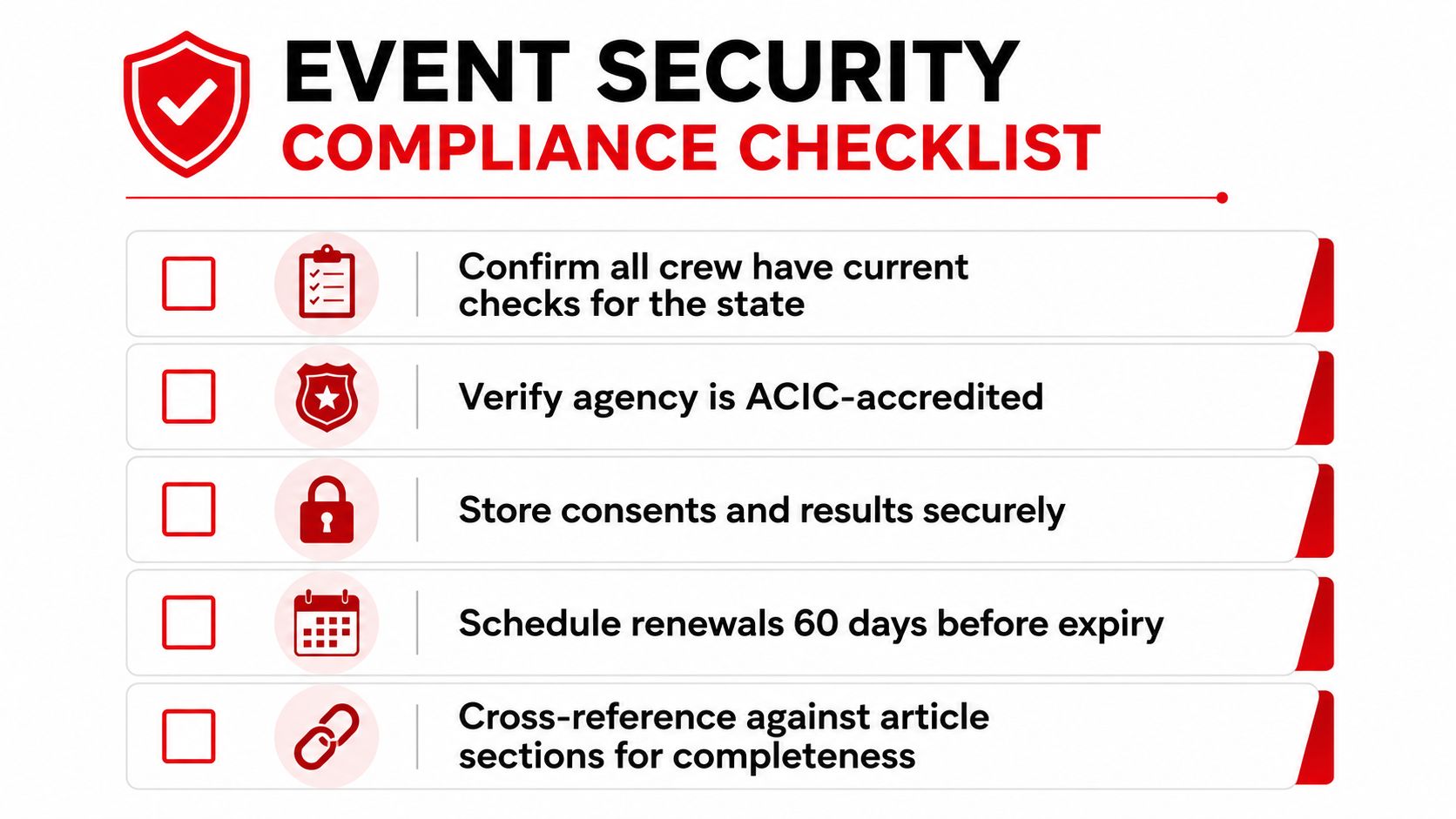
Fast checklist for event and venue teams
- Confirm the role first: Decide whether the person is handling patrons, cash, alcohol, children, or a controlled site.
- Identify the state: Check the jurisdiction where the work happens, not where the business is registered.
- Run the right stack: Match the role to the right combination of police check, Working with Children Check, licence check, and right-to-work verification.
- Document consent and purpose: Keep the notice, the authorisation, and the reason each document was collected.
- Store and re-screen properly: Retain records securely and set a review date for higher-risk roles.
FAQ
How long is a national police check current for?
There isn't one universal expiry built into the concept itself. Many employers set a freshness period in their own policy, but the test is whether the result still reflects the role's risk.
Does a Working with Children Check transfer between states?
No, not as a general rule. These schemes are state and territory based, so the jurisdiction where the work occurs matters.
What if a staff member's record changes mid-contract?
Pause the deployment, review the role risk, and decide whether the change affects site access, licence status, or child-related duties.
What should a contractor do if a check is failed or contested?
Hold the person off the relevant duties, review the specific reason, and follow the employer's documented process before making a final decision.
If you're planning a concert, venue rollout, retail deployment, or construction site start and want the paperwork aligned before the crew lands, contact GM GROUP Services for a compliance review ahead of your next event or venue deployment.
Discover more from GM Group Services
Subscribe to get the latest posts sent to your email.