
Are festivals safe? Not if your whole plan is bag checks, a few guards at the gate, and hope.
That's the most common mistake I see. Organisers obsess over what looks serious from the outside, then get blindsided by what hurts people inside the fence: dehydration, delayed medical response, bad crowd flow, harassment in dark transition zones, and intoxicated punters making poor decisions in unmanaged spaces. Visible enforcement matters, but it's not the centre of the safety picture.
If you want the blunt answer, festivals can be run safely enough for people to have a good time without preventable harm. But that only happens when organisers treat safety as a layered operating system, not a policing exercise. Security is one layer. Medical, welfare, water, crowd design, lighting, transport, communications, and harm reduction are the others.
For SEO and planning purposes, use this slug: /are-festivals-safe
SEO title: Are Festivals Safe? 7 Real Risks and How to Stay Protected
SEO meta description: Are festivals safe in Australia? Learn the 7 real risks, what organisers must plan for, and how health-led festival safety beats security theatre.
Why Asking Whether Festivals Are Safe Is the Wrong Question
“Are festivals safe” is the wrong question because it assumes safety is a single condition. It isn't. A festival can avoid a fatal incident and still fail people badly on the ground.
An event can feel fine in the headline set, yet still have patrons overheating near the barricade, queuing in poorly lit amenities corridors, struggling to find water, or getting harassed on the way back to camp. If your planning team only asks whether the event is “safe”, they'll miss the separate risk streams that need separate controls.
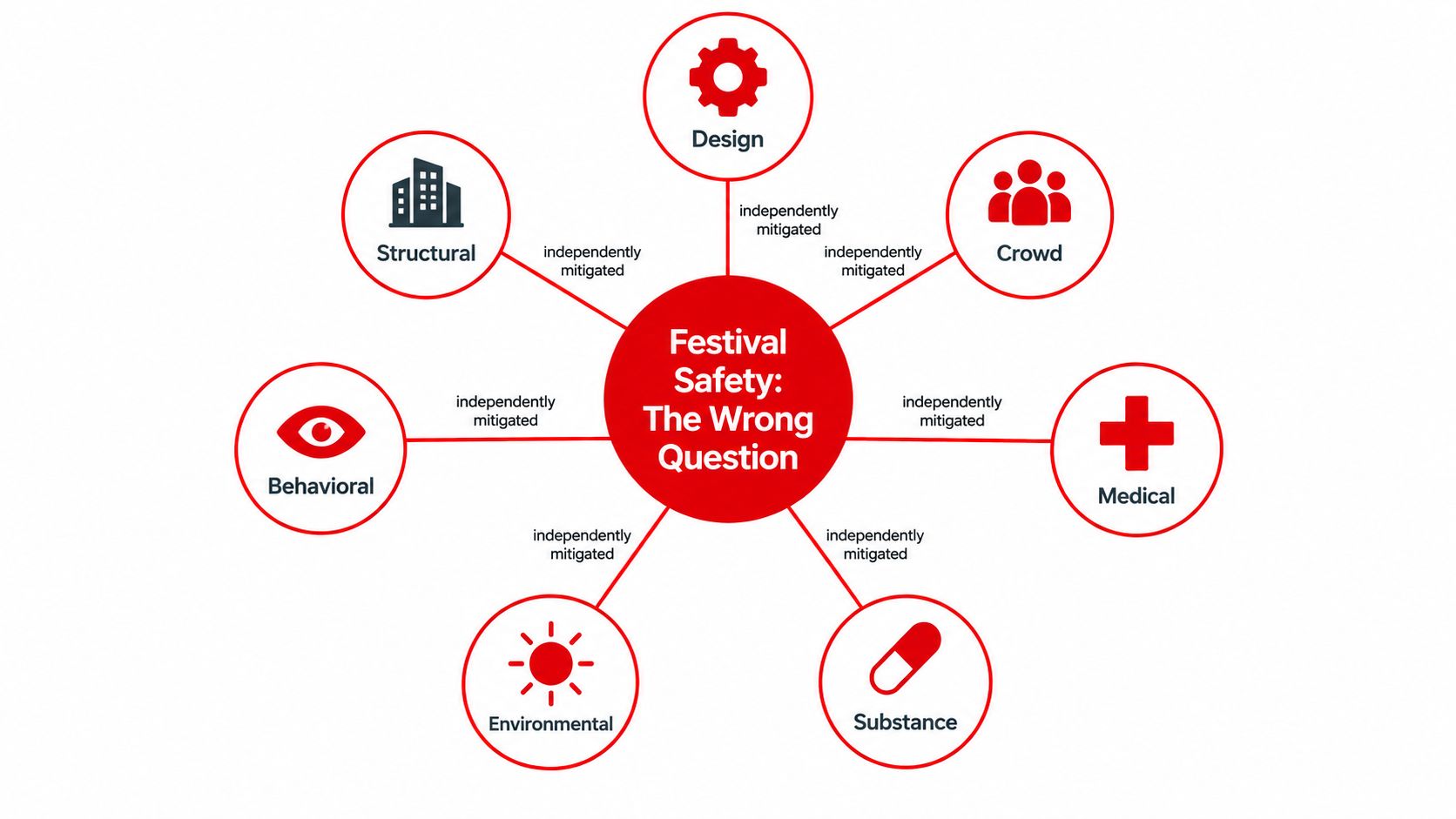
A better way to think about festival safety
I use a seven-layer model:
- Design risk: Entry lanes, exits, fencing, sightlines, choke points, and bar placement.
- Crowd risk: Surges, pinch points, barrier pressure, uncontrolled inflow.
- Medical risk: Dehydration, collapse, delayed access, triage bottlenecks.
- Substance risk: Drug toxicity, alcohol overload, risky consumption behaviour.
- Environmental risk: Heat, dust, storms, mud, low visibility.
- Behavioural risk: Aggression, harassment, anti-social conduct, panic.
- Structural risk: Staging interfaces, barriers, temporary builds, unstable surfaces.
Each layer fails differently. Each one needs its own owner, triggers, and response playbook.
Practical rule: If one person on your team “owns safety”, you probably don't have a safety system. You have a blind spot.
Perception and risk are not the same thing
Organisers often confuse crowd mood with actual safety. A happy crowd can still be a medically stressed crowd. A quiet campsite can still be unsafe for women walking back alone. A strong gate operation can still mean nothing if welfare is hidden and medics can't move.
The useful question isn't “Are festivals safe?” It's this: which risks at this specific festival are most likely to hurt people, and what are we doing about each one before gates open?
That's the standard worth working to.
The Seven Real Risks at Festivals Right Now
Most festival incidents don't come from movie-style disasters. They come from ordinary failures that stack up. Here are the seven that matter most on the ground.
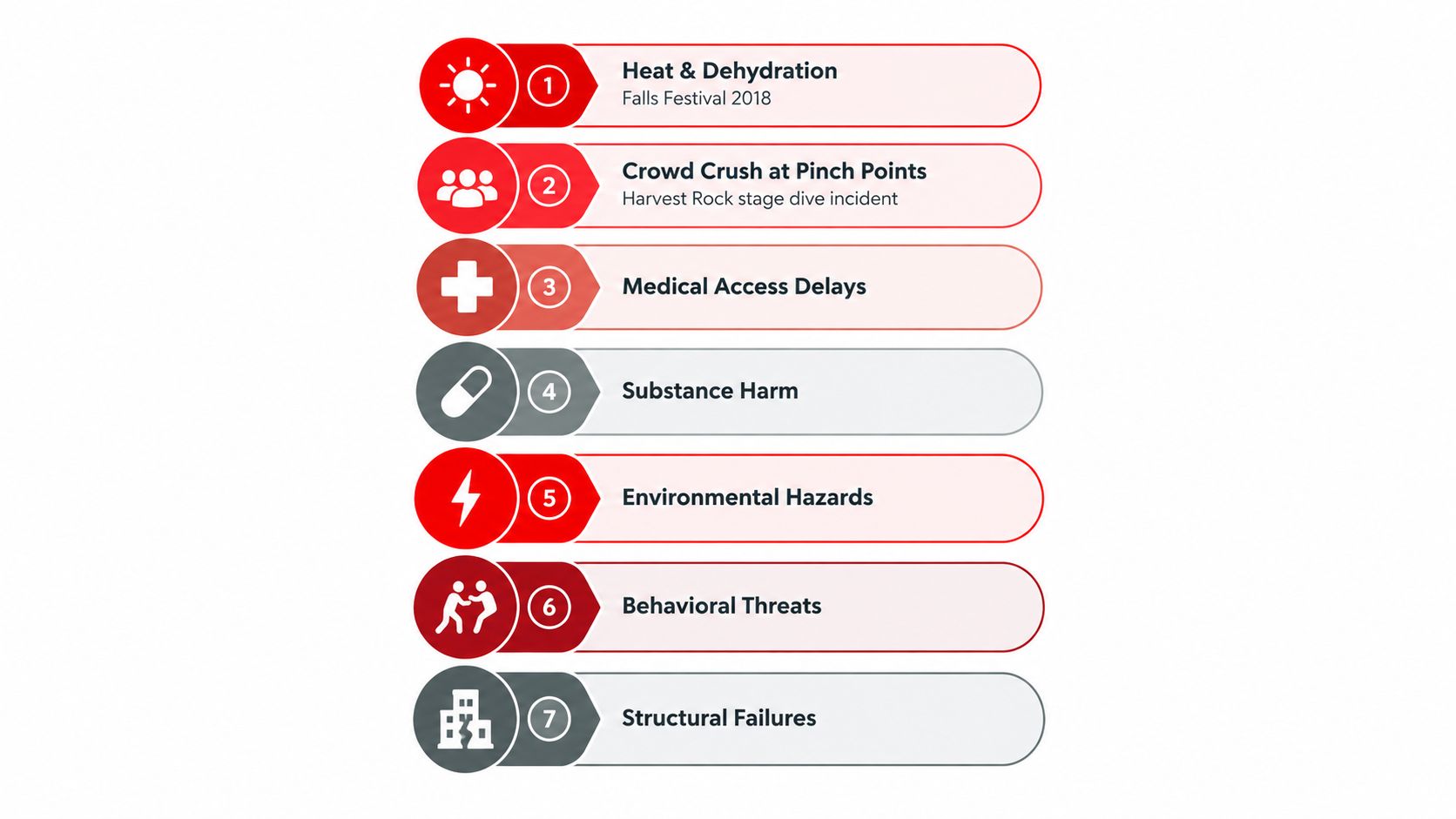
What these risks look like in practice
Heat and dehydration
A patron doesn't need to be reckless to end up in trouble. Long queues, direct sun, alcohol, dancing, and poor water access do the job fast.Crowd crush at pinch points
The danger zones aren't always the biggest crowds. They're the badly designed ones. Think front barrier compression, bar queues spilling into walkways, or two streams of patrons crossing near a stage edge.Medical access delays
You can have medics on site and still fail if they can't reach the patient quickly. Poor vehicle lanes, blocked paths, and confused radio traffic turn routine presentations into serious ones.Substance harm
A lot of public conversation goes off the rails here. People talk as if the whole answer is searching harder. It isn't. Drug harm is a clinical and behavioural issue as much as a security issue.Environmental hazards
Storm movement, dust, darkness, mud, and wind all change crowd behaviour. Punters bunch together, run for cover, ignore routes, and overload sheltered zones.Behavioural threats
Aggression, harassment, drink spiking concerns, and conflict near bars or toilets don't always show up in official crowd safety messaging, but they shape whether people can use the event safely.Structural failures
Most temporary infrastructure performs well when planned properly. The problem starts when installation, inspection, or exclusion zones are treated as paperwork instead of live controls.
Where organisers usually get caught out
The weak point is usually transition space. Not the headline stage. It's the route between camp and amenities, the queue at the portable toilets, the narrow run behind food stalls, or the back gate after the encore.
That's also where documentation helps. A simple visual log from setup through bump-out can show when fencing moved, where queues formed, or when welfare signage disappeared. A tool like this festival photo collection tool is useful because it gives organisers a practical record of conditions across the site without relying on someone's memory after the fact.
Most event failures don't start as emergencies. Staff allow them to become emergencies because nobody acted early.
What Australian Organisers Are Actually Required to Plan For
A lot of organisers overcomplicate the wrong things and under-plan the basics. You need to separate the legal floor, what regulators expect to see, and what competent operators add because experience says it works.
In NSW, the clearest hard requirement for music festivals is that organisers must prepare a health and medical plan under the NSW music festival guidelines. Those same guidelines also say festivals should provide a minimum of one water outlet per 500 people, which is one of the few directly usable crowd-health benchmarks in this space.
In Victoria, an emergency management plan is required for every public event with more than 5,000 patrons. That's not a nice-to-have. It's a trigger point.
What belongs in each planning bucket
| Planning Category | Legally Required | Regulator-Expected | Industry Best Practice |
|---|---|---|---|
| Health and medical planning | Health and medical plan for music festivals in NSW | Clear treatment pathways, access routes, escalation contacts | Joint medical, security and welfare operating picture |
| Water access | Minimum water outlet benchmark in NSW guidance | Water points placed where queues won't create crowd issues | Shade, refill visibility, roaming welfare reminders |
| Emergency management | Emergency management plan for large public events in Victoria | Documented evacuation and incident roles | Scenario drills before event day |
| Crowd management | Safe ingress, egress and monitored movement | Crowd maps, barrier plans, patrol sectors | Real-time density monitoring and trigger actions |
| Patron welfare | Usually implied through duty of care settings | Welfare visibility and reporting pathways | Dedicated welfare teams near high-friction zones |
| Accessibility and inclusion | Site and safety obligations still apply | Safe access and exit routes for diverse patrons | Lighting, quiet spaces, liaison staff, trauma-aware response |
Don't confuse compliance with readiness
A permit stack doesn't mean the event is operationally ready. I've seen beautiful paperwork attached to sites with terrible egress, hidden medic tents, and no practical plan for late-night aggression.
If you want a cleaner approach, ask three questions:
- What must we legally produce?
- What will police, health, council, and emergency stakeholders expect to see working on the day?
- What extra controls do we need because this site, this crowd, and this programme create known pressure points?
That's how competent organisers plan. Not by throwing more guards at a weak layout.
What the NSW Festival Safety Data Really Shows
The cleanest Australian evidence on this issue doesn't support the old fantasy that visible enforcement alone keeps festivals safe. It points to stronger regulation, health planning, and medical readiness as the things that materially change outcomes.
The NSW Review of the Music Festivals Act 2019 found that among higher-risk music festivals, deaths fell from 5 in 2018/19 to 1 in 2019/20 and 0 in 2020/21, while transports to hospital fell from 255 in 2018/19 to 149 in 2019/20 and 9 in 2020/21. The same review reported that the yearly number of deaths associated with higher-risk festivals decreased by 4 to 5 cases compared with the period before the Act.
What changed outcomes
| Intervention | Window Introduced | Reported Impact |
|---|---|---|
| Stronger festival regulation and mandated planning | After commencement of the Music Festivals Act 2019 | Lower deaths and fewer hospital transports reported in the review |
| Formal health and medical planning | Embedded in the post-Act framework | Better management of serious incidents and clinical pathways |
| Layered safety settings around higher-risk festivals | Post-Act operating environment | Material improvement in recorded safety outcomes in NSW |
What operators should take from that
The lesson is simple. Put medical and welfare capability near the centre of the site plan, not at the margins. Build routes so medics can move. Give patrons visible places to ask for help before they become a stretcher job. Train security to escalate early instead of treating every impaired patron as a compliance problem.
There's another reason this matters. An Australian analysis of drug-related deaths at music festivals found 64 deaths between 2000 and 2019, with drug toxicity as the primary cause in 46.9% of cases and MDMA detected or reported in 65.6% of deaths in the NDARC bulletin on festival deaths and policing. That's why a festival safety plan built only around gates and bag searches is incomplete from the start.
Crowd Density and the Numbers That Trigger a Crush
Crowd density is one of the few areas where you can draw a hard line and act before people get hurt.
For NSW planning, a crowd management document used in major project documentation states that critical crowd densities are approached when floor space per standing person drops to about 0.5 m2 in the NSW crowd management reference. That's the number you brief into your event-day decision-making.
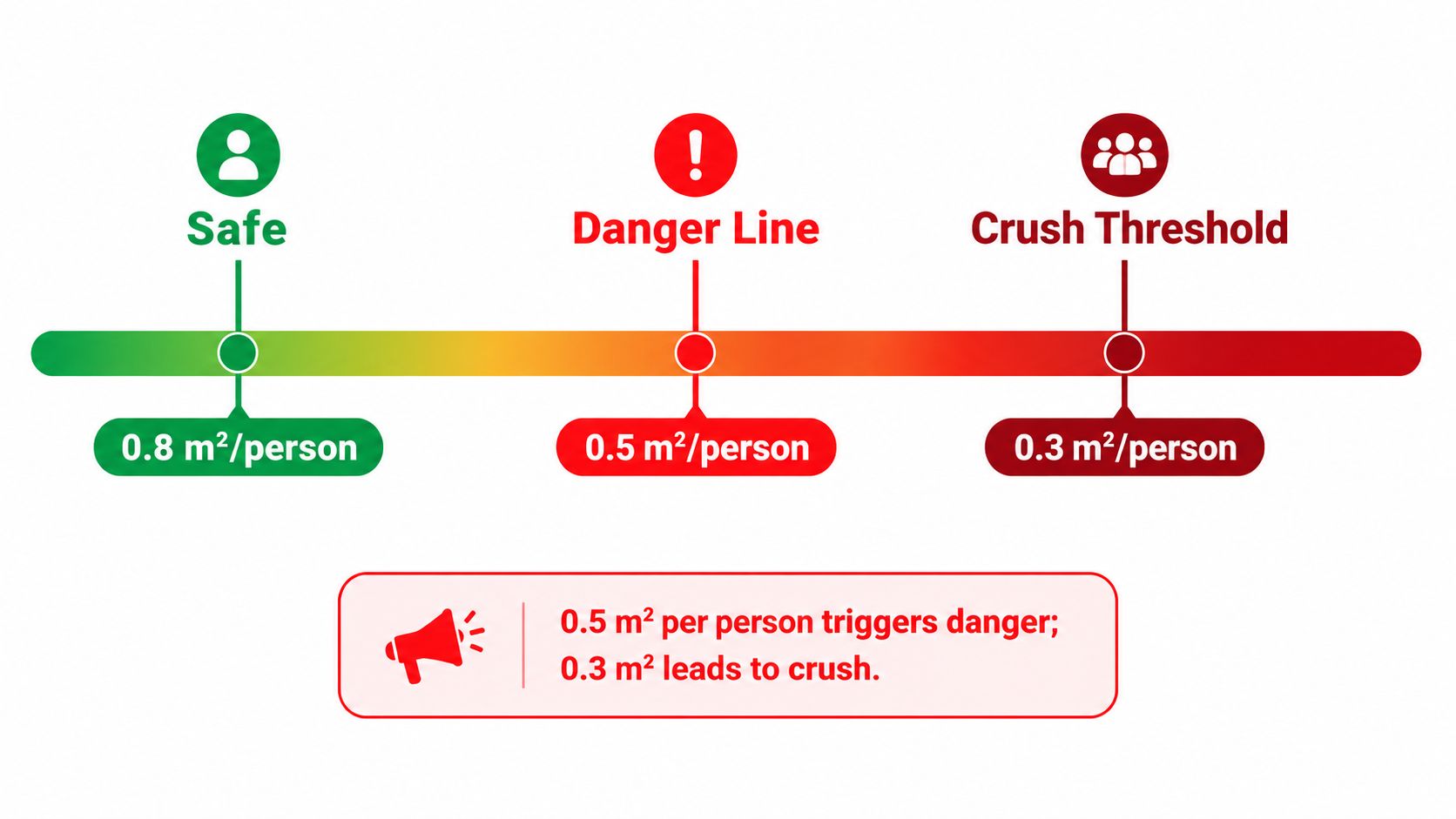
The event-day rule
When you're approaching 0.5 m2 per standing person, stop guessing and start acting.
- Open pressure-release routes: Use secondary egress points or side lanes fast.
- Slow inflow: Pause entry to the affected zone and redirect traffic before surge momentum builds.
- Push spotters forward: Put trained eyes on front barrier, corners, and crossing streams.
- Change the programme if needed: A short controlled pause is better than extracting collapsed patrons from a compressed front pen.
If your team waits for people to fall over before calling it a crowd issue, the call came too late.
Where density spikes first
Watch the usual pressure moments:
- Headliner changeovers
- Surprise appearances
- Weather shifts
- Free giveaway points
- Bar queues near active performance zones
- Paths where camp, toilets, and stage traffic intersect
You don't need a giant control room to monitor this properly. You need fixed observation points, competent supervisors, clean radio discipline, and permission for someone senior to act early without arguing about optics.
How Professional Security Teams Like GM GROUP Change the Picture
Good festival security doesn't look like a line of static bodies in hi-vis. It looks like a crew that understands movement, patron behaviour, escalation thresholds, and how to work with medics and organisers without adding friction.
What proper deployment looks like
A credible security plan usually splits the site into different functions:
Front-of-house needs calm access control and fast issue recognition. Pit teams need experience with barrier pressure and extraction support. Backstage needs controlled access and professional judgement. Perimeter crews need to manage boundary integrity without creating unnecessary confrontation. Roaming staff need to be visible, approachable, and switched on to welfare cues.
That mix matters more than “having security”.
What changes outcomes on the day
The strongest teams do the groundwork before the first patron arrives:
- Pre-event site walks: identify crush points, hidden corners, awkward fence returns, and poor lighting.
- Shared radio protocols: so security, medics, and operations use the same incident language.
- Briefing on welfare indicators: confusion, overheating, distress, separation, or predatory behaviour.
- Role clarity: who owns pit response, who holds egress, who escorts vulnerable patrons, who speaks to police.
That's where a provider such as GM GROUP Services fits sensibly into the picture. The practical value is fit-for-purpose event security across crowd management, access control, perimeter coverage, backstage protection, and coordination with venue risk assessments and event-day operations. That's useful because a festival site needs more than badge-checking. It needs people who can read conditions and act before a minor issue turns clinical.
What bad security still gets wrong
The weak model is easy to spot. Guards clustered at the gate. No one roaming the dark edges. No communication with welfare. Aggressive patron interactions over low-level behaviour. Slow reporting. Confusion about who can call for medical support.
That setup might look firm in photos. It won't protect the event when the pressure shifts inside the site.
Why Safety Feels Different for Women, Young Attendees and Marginalised Groups
A festival can score well on general crowd sentiment and still be unsafe for the people most exposed to harassment, aggression, or isolation. That gap isn't a branding problem. It's a planning failure.
The All Good Project report found that in the NT in 2025, 32% of participants reported sexual violence in entertainment spaces in the past year and 24% experienced aggression, even though 90% said the festival felt as safe or safer than before. The same project's 2024 report found 51% said the festival felt safer than previous years. That contrast tells you something important. Broad reassurance can mask concentrated harm.
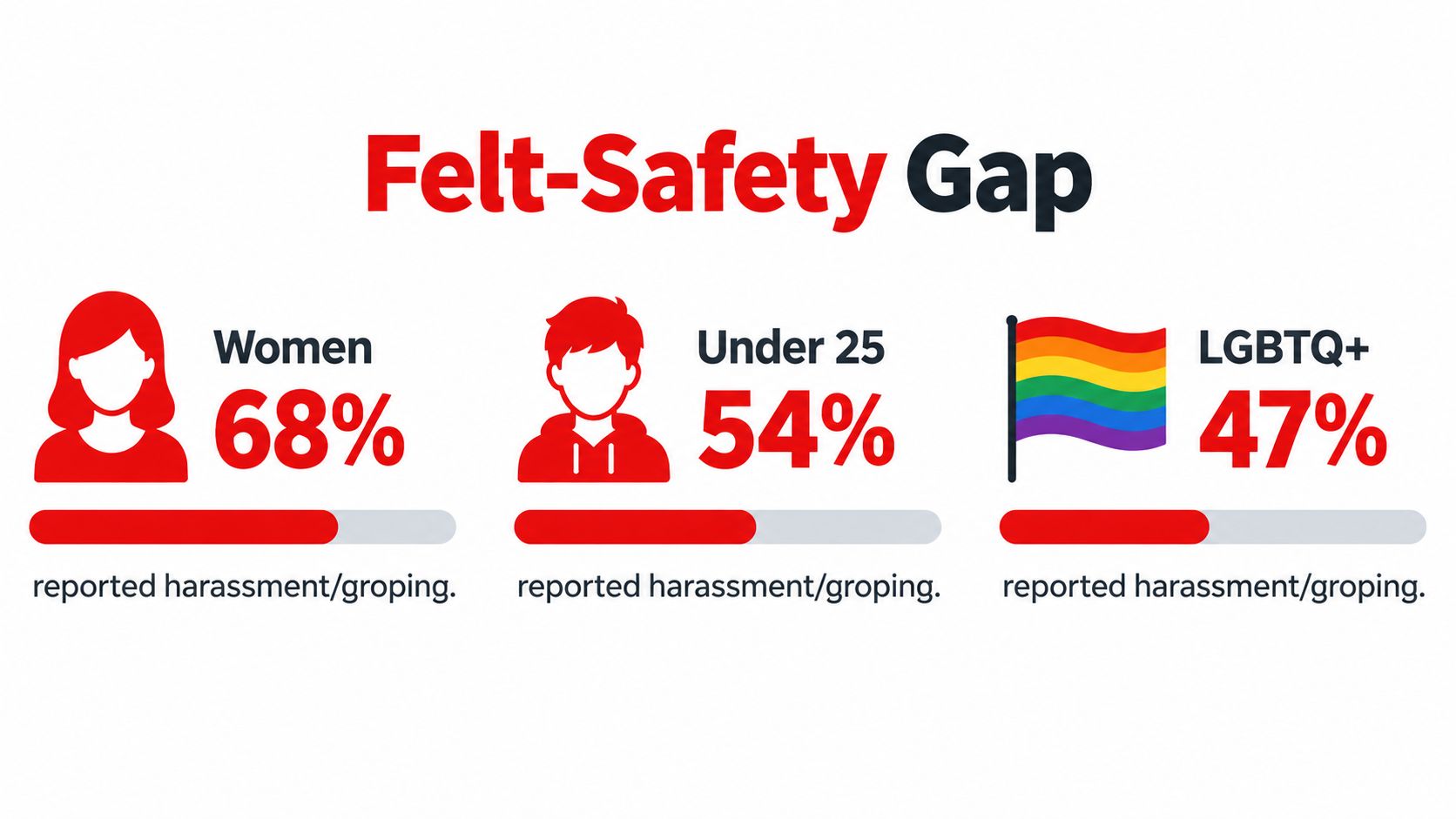
Why some patrons feel less safe
The causes are usually mundane and fixable:
- Poor lighting on routes between stages, campsites, and toilets
- Single-path access that forces isolated walks late at night
- Amenity queues with no staff presence
- Alcohol-heavy zones where supervision drops as the night gets later
- Reporting points that are hard to find or socially difficult to approach
Most perpetrators are already inside the event. That's why bag checks don't solve this problem.
What actually helps
Safety perception is an operational metric. When people stop feeling safe, they also stop reporting.
Use practical controls:
- Attended welfare points near activity, not hidden behind production compounds
- Well-lit corridors between amenities and exits
- Visible staff presence in queue zones and outer edges
- Simple reporting pathways that don't require navigating back through dense crowd areas
- Staff briefings on harassment response, vulnerable patron support, and bystander intervention
If women, younger attendees, and marginalised groups are telling you a route, queue, or camp edge feels wrong, believe them and redesign it. Don't hand them a generic safety statement and call it inclusion.
A Practical Safety Checklist for Organisers and Attendees
Festival safety improves when both sides do the basics early, not react late. Organisers need a live operating plan. Attendees need a personal fallback plan.
For organisers
- Finish the risk register properly: Include crowd, medical, environmental, behavioural, and structural triggers.
- Pressure-test the site map: Walk every route a patron will use at night.
- Check water placement: In NSW, plan against the water outlet benchmark and make refill points obvious.
- Run a tabletop exercise: Use at least one crowd issue, one medical issue, and one communications failure.
- Audit lighting and welfare visibility: If help is hard to find, it's functionally absent.
- Brief every contractor together: Security, bars, medical, traffic, stage, and cleaning crews need the same picture.
- Set up mass communications: If you need to move people quickly, a solid emergency notification system implementation guide is worth reviewing before event day.
For attendees
- Screenshot the map: Don't rely on signal.
- Pick a meet point: One inside, one outside.
- Know where medical and welfare are: Check before the first set, not after something goes wrong.
- Bring water gear and sun cover: Heat sneaks up on people.
- Use the buddy system: Especially for late exits, campsites, and toilet runs.
- Wear decent footwear and ear protection: Comfort and hearing both matter.
- Watch your own condition: If you feel off, get help early.
- Plan your trip home before arrival: The last hour of the night creates plenty of bad decisions.
The smartest next move is simple. If you're organising a festival, run a tabletop scenario within the next 30 days. If you're attending one, screenshot the site map before you enter the gate.
If you're running a festival and want the security layer done properly, GM GROUP Services provides event security that fits the actual risks on site, including crowd management, access control, perimeter coverage, and coordination with the wider event team. That matters because festivals aren't made safer by theatre. They're made safer by planning, trained people, and clear action when conditions change.
Discover more from GM Group Services
Subscribe to get the latest posts sent to your email.