
Alarm monitoring systems are the central nervous system of your business's security. It's the critical link between a potential threat on your property and a rapid, professional response, ensuring your assets are always protected.
Think of it this way: a standard, unmonitored alarm is like a car horn blaring in a busy street—loud, but often ignored. A monitored system, on the other hand, is your dedicated 24/7 security concierge. It never sleeps and ensures someone is always there to act the moment an alarm goes off. By understanding how these systems operate, you can take an actionable step towards fortifying your business against unforeseen threats.
Understanding How Alarm Monitoring Systems Work
A professionally monitored alarm adds a powerful, active layer of protection that a simple siren just can't match. An unmonitored alarm makes a lot of noise, sure, but it completely relies on a neighbour or a random passerby to notice and decide if it's worth calling for help. For a business, especially after hours, leaving your security to chance like that is a huge gamble.
Professional monitoring bridges that gap. When a sensor is tripped—whether it's a door contact, a motion detector, or a glass-break sensor—it does more than just trigger a local siren. It instantly sends a secure, encrypted signal to a specialised, off-site Alarm Receiving Centre (ARC), what we in Australia often call a "back-to-base" station.
From there, trained operators are on it in seconds. Their first job is to follow a strict protocol to figure out if the threat is real. This verification step is absolutely crucial for filtering out false alarms, which can be caused by anything from employee error to a stray animal. For a truly robust security setup, it's also smart to pair your alarm monitoring with other technologies like integrated CCTV systems.
Monitored vs. Unmonitored Alarms At a Glance
To make the difference crystal clear, let's break down how a professionally monitored system stacks up against a standard, self-monitored alarm. The value really lies in the response.
| Feature | Unmonitored Alarm System | Professional Alarm Monitoring System |
|---|---|---|
| Alert Response | Relies on neighbours or passersby to report the alarm. | Immediate alert sent to a 24/7 professional monitoring centre. |
| Verification | No professional verification; high risk of false alarms being ignored. | Trained operators verify the alarm to confirm a genuine threat. |
| Emergency Contact | You (or your contacts) are notified, but must coordinate the response yourself. | Operators dispatch security patrols, police, or fire services on your behalf. |
| Reliability | Dependent on local power and your phone's connectivity. | Multiple communication paths (cellular, internet) for failsafe connection. |
| Peace of Mind | Limited; you're responsible for handling alerts 24/7. | Complete; experts are watching over your property around the clock. |
As you can see, the key difference isn't just about detection—it's about a guaranteed, expert-led response every single time.
The Core Process Explained
This flow chart gives you a quick snapshot of the process, showing how an alarm trigger is turned into a coordinated, human-led response.
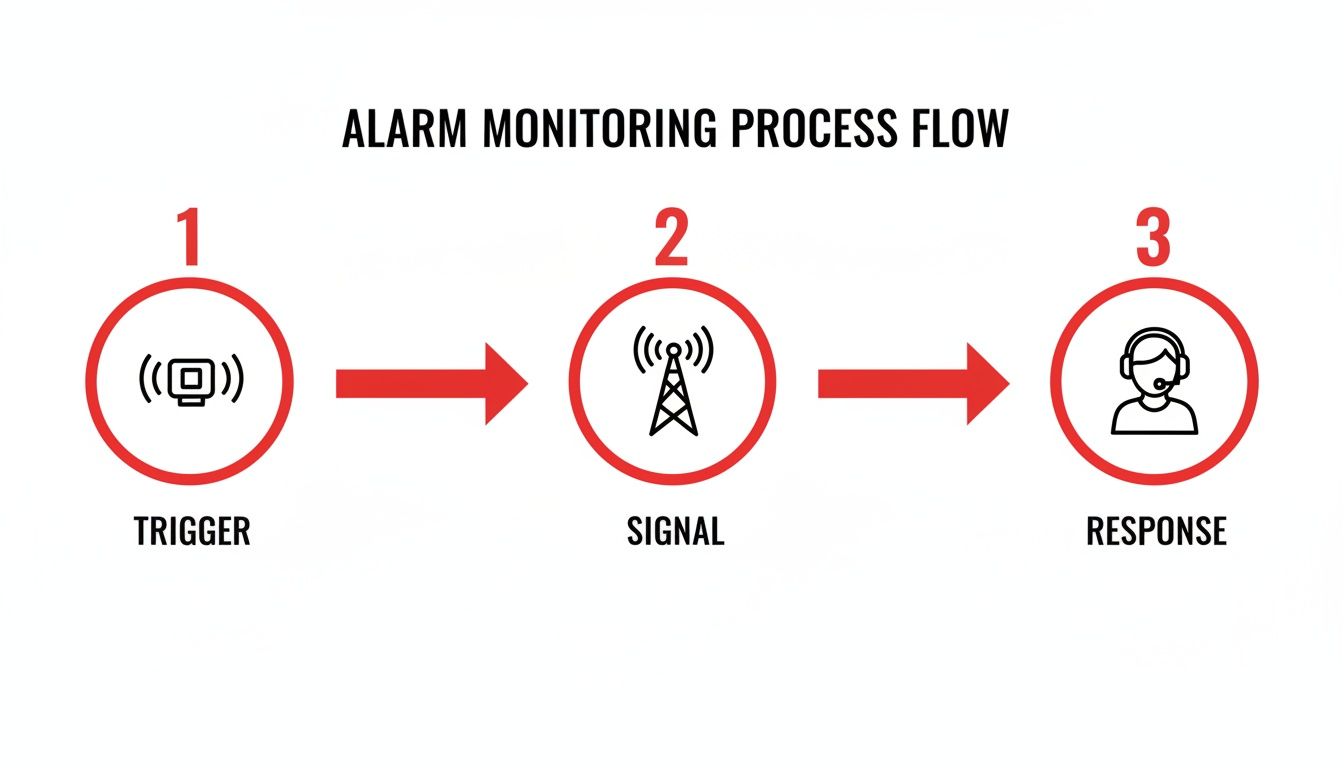
The system isn't just about a sensor going off; it’s about what happens next. It’s that professional, human intervention that ensures every genuine alert gets the immediate attention it needs.
An alarm is only as effective as the response it generates. A monitored system guarantees that response, turning a potential crisis into a managed incident with precision and speed.
Once the ARC operators verify the threat, they act immediately. They can dispatch a mobile security patrol to your location, contact the police or fire department directly, and notify you or your designated emergency contacts. This kind of organised, fast response is absolutely essential for Australian businesses, construction sites, and event venues.
Why This Matters in Australia
The need for serious security solutions is growing right across the country. In Australia, the home security market—where alarm monitoring is a key feature—hit USD 2.03 billion in 2024 and is expected to climb to USD 5.16 billion by 2033.
This massive growth is being driven by genuine concerns over property crime. Australia has one of the world's highest burglary rates, and we've seen a noticeable rise in theft of personal property recently.
These numbers paint a clear picture: active protection is no longer a "nice-to-have." The peace of mind that comes from knowing experts are watching over your assets is one of the biggest benefits you can get. It's a smart investment in your business's continuity, safety, and stability.
Exploring the Types of Alarm Monitoring Systems
When you think of an alarm monitoring system, you might just picture a loud siren. But what really matters is what happens next—that crucial link to a professional response. The thing is, not all monitoring solutions are built the same. The right choice really comes down to your specific security needs, whether you're running a business, managing a venue, or securing a construction site.
Different environments face different risks, which is why the industry has developed a few distinct ways to keep an eye on things. From the old-school reliability of traditional methods to the smart, context-aware power of modern video tech, each type has its own strengths. Let’s break down the three main categories to help you figure out what makes the most sense for you.
Back-to-Base Alarm Monitoring
Back-to-base monitoring is the backbone of the security industry. It's the classic, most recognised form of professional security for a good reason. Think of it as a digital hotline connecting your property directly to a secure, 24/7 command centre, known as an Alarm Receiving Centre (ARC).
The moment a sensor at your site is triggered, it zaps an immediate signal to this off-site station. From there, trained operators follow a strict, pre-agreed plan. This usually involves calling the property or keyholders to check if it's a false alarm before sending out a mobile patrol or contacting the police. Its real strength is its simplicity and rock-solid reliability.
- Practical Example: Imagine a retail store in a Melbourne laneway after closing. If someone forces a back door open, the system instantly alerts the monitoring centre. An operator verifies the breach and dispatches a security patrol, shrinking the window of opportunity for theft long before the owner even knows something is wrong.
This method is perfect for businesses needing dependable, around-the-clock oversight without any fuss.
Remote Video Verification Systems
This is where things get a lot smarter. Remote video verification adds a powerful layer of intelligence by connecting your on-site security cameras directly to the monitoring process. When an alarm goes off, it gives operators temporary, event-specific access to the right camera feeds.
This is an absolute game-changer for cutting down false alarms. Instead of just getting a blind signal, operators can see exactly what caused it. Is it an intruder, or just a banner that blew over at an outdoor event? This visual confirmation means a much faster and more accurate police response, because they know it's the real deal.
With video verification, operators can give law enforcement real-time descriptions of suspects and what they're doing. This turns a generic alarm call into a verified, high-priority incident, which is critical for getting a rapid and effective response.
Once an alarm monitoring system detects an issue, a reliable emergency answering service becomes critical for processing and responding to these alerts effectively, ensuring rapid action when your business is most vulnerable.
- Practical Example: A large construction site in Western Sydney is a hot target for after-hours theft of tools and copper wiring. When a motion sensor near a storage container picks up movement, the monitoring operator immediately pulls up the linked camera. They see two people with bolt cutters, confirm an active crime, and dispatch police with precise, actionable intelligence.
Integrated Hybrid Monitoring Solutions
Why choose when you can have it all? An integrated hybrid solution blends the steadfast reliability of back-to-base monitoring with the sharp intelligence of video verification and the sheer convenience of self-monitoring apps. This setup gives business owners an incredible amount of control and flexibility.
This approach is fast becoming the new standard, reflecting a major trend in Australian security. The smart home security market in Australia, which includes these advanced integrations, pulled in USD 809.6 million in 2024 and is forecast to hit USD 2,136.8 million by 2030. This boom is largely driven by businesses and homeowners adopting cloud-based, AI-enhanced monitoring to combat rising property crime rates across states like NSW, VIC, and QLD.
A hybrid system gives you the peace of mind of professional oversight while also letting you check live camera feeds, arm or disarm the system remotely, and get instant notifications on your smartphone.
- Practical Example: A company with multiple cafes across Brisbane uses a hybrid model. Overnight, the system defaults to professional back-to-base monitoring. During the day, however, the manager can use their phone to get an alert if a restricted storeroom is opened or to view camera footage to sort out a customer dispute—all while knowing a professional team is ready to step in for any major emergency.
The Real-World Benefits of Professional Alarm Monitoring Systems
Beyond the tech specs and jargon, what does a professional alarm monitoring system actually do for you? It delivers real, tangible benefits that protect your bottom line, your people, and your peace of mind. Investing in a monitored service shifts your security from a passive 'hope for the best' approach to an active, responsive shield that’s on duty 24/7.
Frankly, the advantages ripple through every part of your operation, from stopping crime before it starts to saving you serious money. The simple act of putting up stickers and signs that say you're professionally monitored is a massive psychological deterrent. It tells potential intruders that you're not a soft target, encouraging them to simply move on.
Deterring Crime and Ensuring Fast Response Times
The number one job of a monitored system is to guarantee a swift, coordinated response the second something goes wrong. An unmonitored alarm just makes a lot of noise. A monitored alarm, on the other hand, kicks off a clear, pre-defined action plan run by security experts. When every second counts, that difference is everything.
Let's play it out with a real-world example:
- The Scene: A forced entry at a warehouse in an industrial park, late on a Saturday night.
- Without Monitoring: A siren wails, but who’s around to hear it? The thieves get a nice, long window to help themselves to valuable equipment and stock.
- With Monitoring: The instant the door sensor is tripped, an alert hits the monitoring centre. An operator immediately pulls up the integrated camera feed, confirms the intrusion, dispatches a mobile patrol unit, and calls the local police with verified details of a break-in in progress.
In that second scenario, the organised response completely changes the outcome. The thieves are either confronted and apprehended or they bolt empty-handed—all because a professional was watching.
Reducing Financial Losses and Lowering Insurance Costs
The financial upsides go far beyond just preventing theft. Many insurance companies see the value in professional monitoring and are willing to reward businesses for reducing their risk profile. This can turn your security system into an investment that helps pay for itself.
For instance, it’s not uncommon for insurers to offer premium discounts of up to 20% for businesses with professionally monitored alarm monitoring systems. That return on investment often offsets the monthly service fee. In 2025, Australian businesses and households are typically paying between $30 and $60 per month for professional monitoring, with the price changing based on features like video verification.
When you consider that Australia's investigation and security services industry was valued at an estimated $13.9 billion in 2025, it's clear that these services are a critical business expense. A 2025 guide on security costs breaks down how these investments deliver real value.
A professionally monitored security system is not just an expense; it's a strategic investment in business continuity. By reducing the likelihood and impact of incidents, it protects your assets and your ability to operate without disruption.
This proactive stance on security provides a clear financial win, turning what could be a huge liability into a predictable operational cost. The insurance savings alone can make the decision a no-brainer.
Improving Staff Safety and Operational Peace of Mind
At the end of the day, the human element is arguably the most important benefit. If you have lone workers or staff who stay late, a monitored system is a vital safety net. You can integrate duress or panic buttons, giving your team a way to summon immediate help if they feel threatened.
This focus on safety doesn't just improve morale; it shows your people you're committed to their wellbeing. For business owners and managers, that translates directly into peace of mind. You can finally step away from the business, confident that a dedicated team is watching over it. This frees you up to focus your energy on growth, not just on worrying about what might go wrong.
Choosing the Right Alarm Monitoring Systems for Your Industry
Generic, off-the-shelf security solutions simply don’t cut it. Every industry has its own set of unique risks, and a truly effective alarm monitoring system is never a one-size-fits-all product. It has to be a specific solution designed to meet the real-world challenges of your environment.
What works for a sprawling music festival won't be right for a high-value construction site, and a busy retail store has entirely different needs again.
Choosing the right system is all about matching its capabilities to your specific operational weak spots. When you get this right, your security stops being a simple deterrent and becomes an active, intelligent part of your risk management strategy. It protects your people, your assets, and your bottom line with genuine precision.
Security Solutions for Events and Festivals
Events and festivals are a security headache. They’re temporary, dynamic, and full of high-value gear spread across large, often open areas. The biggest challenges? Controlling who comes and goes, keeping cash-handling stations secure, and protecting tens of thousands of dollars in audio-visual equipment, especially when the crowds go home.
A standard, hard-wired alarm system just isn't practical here.
This is where temporary wireless alarm monitoring systems shine. They can be rolled out quickly without needing complex and costly wiring, making them absolutely perfect for short-term events.
- Practical Example: Picture a multi-day music festival in regional NSW. They use a wireless system with motion sensors and video verification to keep an eye on the main stage, merchandise tents, and ticketing booths overnight. If a sensor trips near the sound mixing desk, the monitoring centre instantly sees the live camera feed. They confirm an intruder is on-site and dispatch the festival's security guards to intercept them, preventing the theft of equipment worth $50,000. It's that seamless link between the tech and the boots on the ground that makes all the difference.
Protecting Construction and Industrial Sites
Construction and industrial sites are magnets for thieves after hours. Valuable assets like copper wiring, heavy-duty power tools, and even machinery are often left with minimal physical security, making them incredibly vulnerable. The primary risk is a simple break-in that leads to massive financial losses and crippling project delays.
The solution has to be a tough system built around perimeter protection and instant verification. Motion sensors paired with video verification are game-changers here. They don't just detect an intruder; they provide irrefutable, real-time proof of a crime in progress.
On a construction site, catching an intruder in the act is everything. Video verification gives law enforcement the actionable intelligence they need to respond with urgency, turning a simple alert into a confirmed, high-priority incident.
This proactive approach is infinitely better than discovering a theft the next morning. It actively stops criminals right in their tracks.
Securing Retail and Hospitality Businesses
For retail stores and hospitality venues, security is a two-sided coin. You need to protect the property from burglary when you're closed, but you also have to keep your staff and customers safe during opening hours. Confrontational customers, shoplifting, and staff safety are daily worries.
The best alarm monitoring system here combines traditional burglary protection with personal safety features. This almost always includes integrated duress or panic buttons that staff can use to discreetly call for help during a tense or threatening situation.
- Practical Example: A luxury boutique in a busy Melbourne shopping centre has a monitored alarm with silent panic buttons installed under the counters. When a staff member is confronted by an aggressive individual, they press the button. The signal goes straight to the monitoring centre, which dispatches centre security and police immediately—all without escalating the situation in the store. It’s a quiet, effective way to ensure everyone stays safe.
This kind of layered approach provides rock-solid protection for both your assets and your people, making it an essential tool for any public-facing business.
How to Implement Your Alarm Monitoring System
Getting a professional alarm monitoring system in place is a pretty logical process once you have a clear roadmap. It's much more than just picking a product off the shelf; it's about deliberately investing in a security solution that actually fits what you need. Following a few key steps will give you the confidence that your final setup is effective, compliant, and genuinely worth the money.
The journey starts with a hard look at what you’re trying to protect and ends with finding a reliable partner who can deliver on their promises. By breaking it down into assessment, budgeting, and provider selection, you can dodge common mistakes and build a security shield that really works for your business.
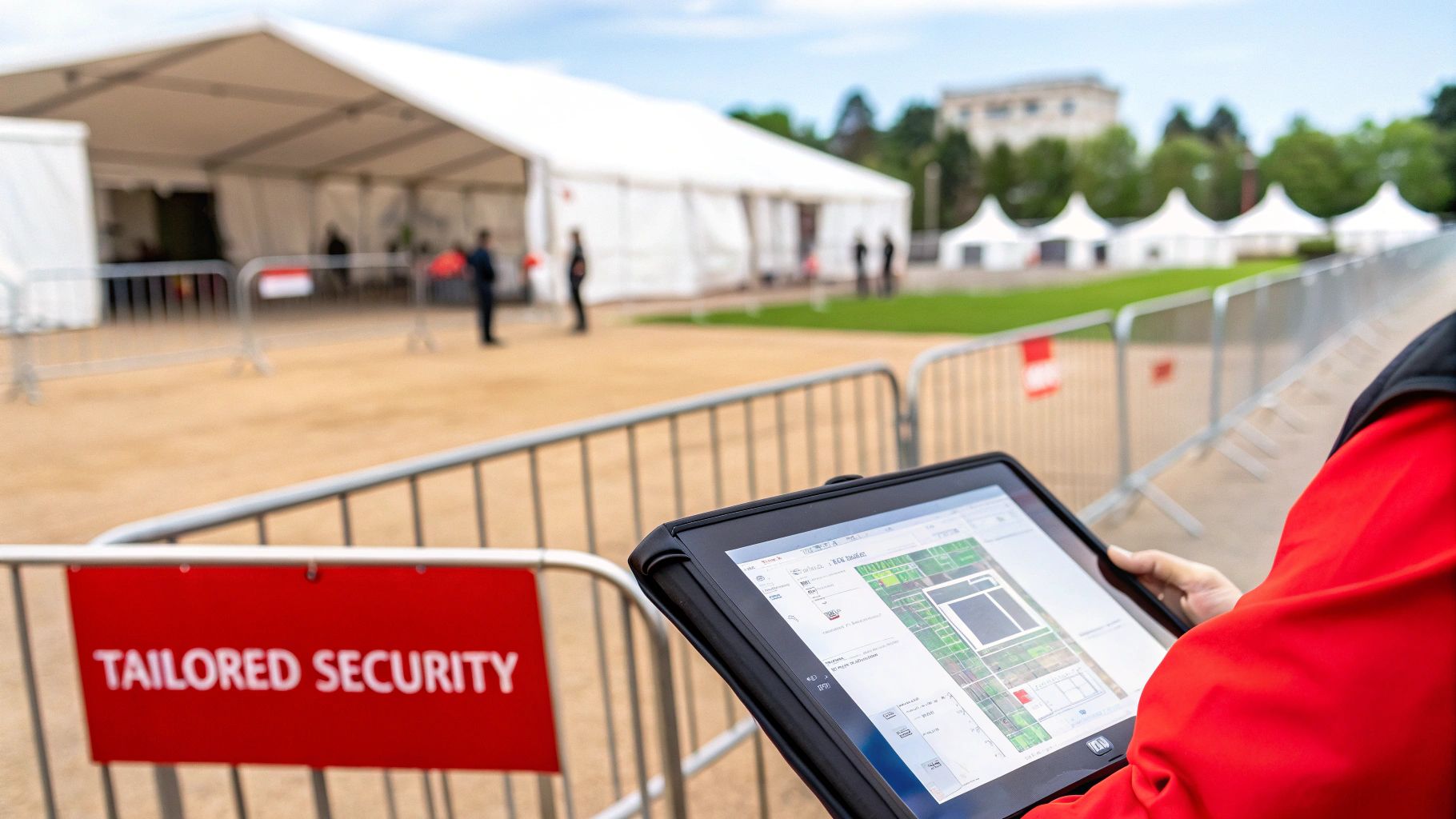
Conducting a Thorough Security Risk Assessment
Before you can pick the right tools for the job, you have to understand your unique weak spots. A security risk assessment isn't some complex forensic exercise; it's simply a methodical way of looking at your property through the eyes of a potential intruder. Asking yourself a few direct questions is the best way to start painting a clear picture of your security needs.
Honestly, this first step is the most critical one you'll take. It's the foundation of your entire security strategy. Get this right, and you won't waste money on features you don't need or, even worse, leave a gaping hole in your defences.
A simple checklist can help get you started:
- What are my most valuable assets? Be specific. Pinpoint what needs protecting, whether it's high-value stock, expensive equipment, sensitive customer data, or cash-handling areas.
- Where are my vulnerable points? Think like a burglar. Identify every potential entry point—back doors, ground-floor windows, loading docks, and any unsecured perimeter fences.
- What are my hours of operation? Your security needs are completely different after closing time. Define the periods when your property is most at risk.
- Who needs access and when? Think about your staff, cleaners, and delivery drivers. Answering this helps you plan for access control and set the right user permissions in the system.
Understanding System Costs and Scalability
Next up, let's get a handle on the financials. The cost of an alarm monitoring system really boils down to two main components: the upfront setup cost and the ongoing service fees. Getting your head around both is crucial for making a smart investment that doesn't blow your budget.
Upfront costs usually cover the hardware—all the sensors, keypads, and cameras—plus the professional installation. The ongoing costs are the monthly fees for the 24/7 monitoring service itself. Just as important, though, is thinking about the future. Your business will hopefully grow, and your security system needs to be able to keep up.
Choose a system that is scalable. A good provider will offer a modular solution, allowing you to easily add more sensors, cameras, or even cover a new location without having to replace the entire system.
This kind of forward-thinking ensures your initial investment stays valuable for years to come.
Partnering with a Compliant Security Provider
Finally, the real-world success of your alarm monitoring systems rests heavily on the partner you choose. In Australia, the security industry is tightly regulated, and for good reason. Your provider absolutely must be fully licensed and compliant with all relevant state and national standards.
This is not a corner you can afford to cut. An unlicensed or non-compliant provider exposes you to huge legal and financial risks. For example, a key indicator of a quality provider is whether their monitoring centre is graded according to Australian Standards. A Grade A1 monitoring centre represents the highest possible level of security and redundancy.
Beyond that, a top-tier provider will have a deep understanding of state-specific regulations in places like NSW, VIC, QLD, and the ACT, especially around alarm response protocols and managing false alarms. This expertise is what turns a good system into a great one—a solution that's not only effective but also fully compliant with local laws, giving you genuine peace of mind.
Frequently Asked Questions About Alarm Monitoring Systems
Choosing the right security system for your business can feel overwhelming, and it’s natural to have a lot of questions. To help you get some clarity and make a decision you're confident in, we've answered some of the most common queries we hear from business owners about professional alarm monitoring systems.
How is an alarm monitoring system different from a regular alarm?
A regular, unmonitored alarm simply makes a loud noise when triggered, relying on someone nearby to hear it and call for help. An alarm monitoring system is actively connected to a 24/7 professional monitoring centre. When the alarm is triggered, trained operators are immediately alerted, verify the threat, and dispatch emergency services (like police or fire) or a security patrol on your behalf. This guarantees a response, even if no one is around.
What happens if my internet or power fails?
This is a classic concern, and for good reason. A professional alarm monitoring system is built with exactly these scenarios in mind, incorporating multiple layers of redundancy to ensure it never goes offline.
Every system includes a backup battery that can keep it running for hours during a power outage. More importantly, it uses a cellular (4G/5G) connection as a failsafe for your main internet line. This dual-path communication means that even if a burglar cuts your phone line or your NBN drops out, the system will instantly switch to cellular and send its signal to the monitoring centre. Your property stays protected, no matter what.
How do professional services reduce false alarms?
False alarms are more than just an annoyance; they can lead to hefty council fines and make your team complacent. This is where a professional monitoring centre really proves its worth. They have strict, multi-step verification procedures to confirm an alarm is genuine before ever dispatching a response.
Here’s how they do it:
- Call Designated Contacts: The first action is usually to call you or your designated keyholders. This simple step can quickly confirm if an employee just entered the wrong code.
- Use Video Verification: With integrated systems, an operator can immediately access live footage from the camera linked to the triggered sensor. They can literally see what's happening on-site in real-time.
- Utilise Two-Way Audio: Some systems allow the operator to listen in or even speak through an on-site speaker. This can be used to verbally warn off an intruder or verify the situation with someone on-site.
By taking these steps to confirm a real threat, the monitoring team prevents costly and unnecessary dispatches, ensuring emergency services are reserved for when you truly need them.
Can monitoring be added to my existing security cameras?
Absolutely. In most situations, not only is this possible, but it's one of the smartest security upgrades you can make. The real strength of modern security lies in integration. A good provider can tie your existing CCTV, access control, and other hardware into one seamless, monitored ecosystem.
For instance, when a door sensor is tripped after hours, the system can be configured to automatically send the live video feed from the nearest camera straight to the monitoring operator's screen. This gives them immediate situational awareness, allowing for a faster, more accurate response.
Combining on-site guards with back-to-base monitoring creates a truly robust security shield. The technology acts as an infallible watchdog, while the guards provide the immediate physical presence and response capability.
Think of them as two sides of the same coin; they work best when they work together. Your on-site guards are a powerful visual deterrent and can take immediate action. The back-to-base monitoring acts as the tireless electronic watchdog, keeping an eye on every corner of your property, 24/7. The monitoring centre then becomes the command hub, able to coordinate with your on-site team, dispatch backup, and liaise directly with authorities.
Ready to secure your event, venue, or business with a reliable, professional security solution? The team at GM GROUP Services provides expert risk assessments and tailored security plans, including back-to-base alarm monitoring, across NSW, VIC, QLD, and the ACT. Find out more on our website.
Discover more from GM Group Services
Subscribe to get the latest posts sent to your email.