
Airport Security Melbourne starts to matter the moment you're standing at your kitchen bench, deciding what goes into your bag, how early to leave, and whether today's trip will be smooth or chaotic. For most travellers, security feels like a short checkpoint. In practice, it's a hard access gate with very little room for improvisation once you arrive.
That matters because Melbourne Airport operates at serious scale. It is Australia's second-busiest airport for passenger movements, handling 36,151,615 passengers across 217,041 aircraft movements in 2023, according to Melbourne Airport's passenger and aircraft movement figures. At that volume, airport screening only works when people move through it in a predictable, compliant way.
If you're flying soon, the simplest rule is this. Pack for screening, not just for travel. Keep documents easy to reach. Wear clothing that won't slow you down. Don't assume security staff can wave you through because you're in a rush.
If you're a business, venue operator, travel manager, or event organiser, the stakes are wider. Airport security Melbourne isn't just a passenger issue. It affects staff travel plans, VIP arrivals, international delegates, transfer timing, guest experience, and compliance risk. A missed screening requirement can disrupt a meeting schedule as easily as it can derail a holiday.
Your 2026 Primer on Airport Security Melbourne
Travelers encounter airport security at the tray line. Security teams think about it earlier than that. However, the fundamental work begins with flow management, clear rules, and a process that can be enforced consistently even when the terminal is busy.
Melbourne Airport supports a large and constant movement of people, bags, vehicles, and aircraft. That's why security rules aren't written for convenience. They're written so screening officers can make fast, repeatable decisions without treating every bag and every passenger as a special case.
What everyday travellers should focus on
For a normal passenger, the practical priorities are straightforward:
- Be ready before you join the queue: Boarding pass, passport if needed, and any essential medical items should be easy to access.
- Pack with the checkpoint in mind: If an item is awkward to explain, awkward to remove, or awkward to inspect, it will slow you down.
- Follow the first instruction given: Delays usually happen when people argue with process, not when they comply with it.
- Treat screening as a controlled area: Once you're there, staff are managing risk and throughput at the same time.
Practical rule: The fastest travellers aren't the ones who rush. They're the ones who arrive organised enough to move on the first instruction.
Why businesses should pay attention
Corporate travel teams and event organisers often focus on flights, accommodation, and transfers. Security screening gets treated as a generic airport step. That's a mistake. If you're coordinating an executive arrival, a media team, touring staff, or an overseas delegation, the checkpoint can become the point where timing slips.
Security planning around airport movement usually comes down to a few operational questions:
- Who is travelling with equipment, promotional material, or unusual carry-on items?
- Who may need extra time because of medical, accessibility, or language considerations?
- Who is responsible if a passenger is stopped, delayed, or redirected?
- How will onward transport adapt if an arrival clears later than expected?
Airport security Melbourne works best when travellers and organisers both accept the same reality. Preparation beats improvisation every time.
The Complete Melbourne Airport Security Screening Process
You reach the screening point with boarding time getting close, one child asking for a drink, a laptop half-buried in your carry-on, and a queue that suddenly looks slower than expected. That is usually the moment people lose time at Melbourne Airport. The process itself is straightforward. Delay comes from arriving at the lane unprepared.
Security screening is required before entry to the secure parts of the terminal. Melbourne Airport advises that body-scanner screening applies to travellers entering sterile areas of Terminal 2 and Terminals 1, 3 and 4, as set out on Melbourne Airport's security screening page.
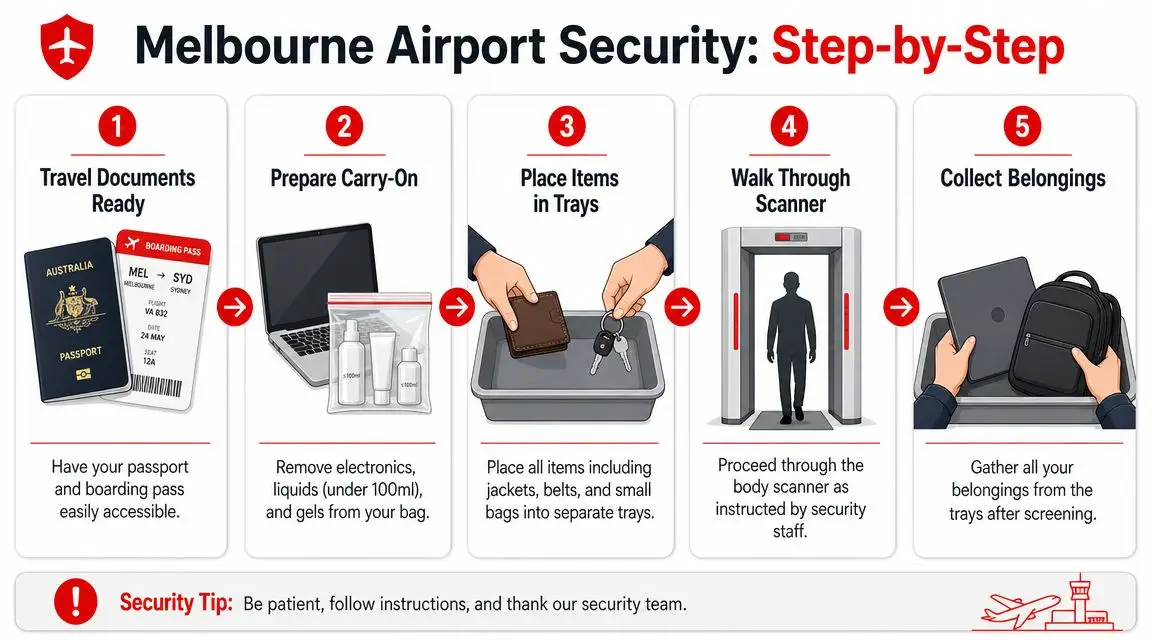
Step by step through the checkpoint
Screening works best when passengers treat it as a controlled sequence.
Join the right lane early
Keep your boarding pass and identification easy to reach before you arrive at the front. Searching through bags at the last second slows the line and usually causes more mistakes.Approach the trays ready to load
Empty pockets in advance. Separate bulky personal items from valuables. If your bag contains electronics, medical items, or anything that may need a closer look, place it where you can access it quickly.Load trays based on staff instruction
Officers will tell you what stays in the bag and what must be screened separately. That can vary by lane because the equipment setup is not always identical across terminals.Pass through the body scanner when directed
This is part of the standard entry process for secure areas. It is not an optional extra and it is not the point to start sorting out items that should have been prepared earlier.Collect bags and clear the belt area
Once your property is released, move to the side to repack. The belt area is for retrieval, not reorganisation.
What happens if you refuse screening
Refusal usually leads to confusion because some passengers treat screening like a service choice. It is an access requirement.
As noted earlier in Department of Home Affairs guidance, screening applies to people entering the secure area, including passengers, accompanying adults, children, infants, aircrew, airport workers, assistance animals and pets. That same guidance states that body scanners are the government's preferred screening method, and refusal can mean being denied entry to the secure area for up to 24 hours.
If you cannot complete the required screening, plan on not reaching the gate.
That point also matters for business travel coordinators, production teams, and event organisers moving groups through Melbourne. A single passenger refusing screening, or arriving with items that trigger secondary checks, can affect transfer schedules, vehicle bookings, and staff deployment on the other side of the airport.
What usually slows the process
In day-to-day operations, the common delays are predictable.
- Items left in pockets: phones, keys, coins, access cards, wallets
- Bags packed for the flight, not the checkpoint: laptops under clothing, cables wrapped around other contents, toiletries mixed loosely
- Shared trays between group members: property becomes harder to identify and retrieve
- Questions raised too late: travellers wait until they are at the scanner to ask about a medical device, liquid, or piece of equipment
For everyday travellers, the practical goal is simple. Be ready to follow the first instruction without needing to stop and repack.
For organisations, the lesson is broader. If staff, contractors, performers, or VIP guests are flying with technical gear, branded materials, medical equipment, or unusual carry-on items, brief them before they leave for the airport. Good pre-departure planning reduces delays at the checkpoint and protects the wider schedule.
What You Can and Cannot Pack A Guide to Prohibited Items
Packing mistakes usually begin with assumptions. A traveller knows an item is legal to own, useful on the trip, or expensive to replace, so they assume it must be fine in carry-on. Security screening doesn't work that way. The checkpoint decision is about whether the item can pass safely through that part of the airport journey.
For airport security Melbourne, the practical move is to separate items into three mental groups. Clearly safe in carry-on. Safe only under certain conditions. Better packed in checked baggage or left at home.
Carry-On Luggage Quick Guide Permitted vs. Prohibited
| Item Category | Permitted in Carry-On (with conditions) | Prohibited in Carry-On |
|---|---|---|
| Documents and valuables | Passport, boarding pass, wallet, phone, keys, jewellery, essential documents | Items you can't account for or identify quickly during inspection |
| Electronics | Phones, tablets, chargers, headphones, laptops when allowed by the screening setup | Damaged items that may trigger closer inspection or can't be screened clearly |
| Liquids, aerosols and gels | Small personal items packed in line with airline and airport requirements | Oversized or poorly packed liquids that don't meet checkpoint requirements |
| Clothing and accessories | Jackets, scarves, shoes, belts, hats, handbags, small personal items | Accessories with concealed blades or prohibited fittings |
| Toiletries and grooming items | Basic toiletries that comply with carry-on rules | Straight razors, large blades, or items officers determine aren't suitable for carry-on |
| Tools and sharp items | Usually best moved to checked baggage unless clearly permitted | Knives, cutting tools, pointed implements, and similar sharp objects |
| Sports and hobby gear | Soft items or simple accessories that pose no screening issue | Bats, clubs, poles, or equipment that could be treated as a weapon risk |
| Food and baby items | Sealed snacks, baby supplies, and essentials that can be screened | Items that leak, spoil, or can't be inspected effectively |
Items that cause the most confusion
Some categories repeatedly create trouble because travellers think in everyday use terms, not screening terms.
- Toiletry bags: A packed bathroom kit often contains one or two items that trigger secondary inspection.
- Work bags: Multi-tools, sample kits, boxed electronics, and spare batteries can complicate a simple screening pass.
- Family carry-on: Parents often split baby items, medicine, snacks, and chargers across multiple bags, which makes inspection slower.
- Souvenirs and gifts: Decorative blades, novelty tools, and wrapped items are common problem areas.
A good carry-on bag opens in layers. The items most likely to be checked should sit where you can present them without emptying half the case.
Packing choices that work in practice
Use compartments with a purpose. Keep valuables together, screening-sensitive items together, and emergency travel essentials together. Don't create a bag full of loose objects that staff have to interpret one by one.
For business travellers, I'd treat your bag like a workbench. If you carry tech, cables, paperwork, and presentation material, pack it so each category can be viewed or removed without disturbing the rest. For event teams, don't send branded merchandise, hardware, tools, or activation materials in personal carry-on unless someone has already checked that they're suitable.
What doesn't work is hoping a questionable item will slip through because the lane is busy. Busy lanes don't make screening looser. They make officers quicker at spotting what doesn't fit.
Fast-Track Options and New Screening Technology
Faster screening comes from two things. Better lane access and better lane design. Travellers usually think about the first and ignore the second.
Some passengers may have access to priority treatment through airline status, premium cabins, or airport-specific arrangements. Whether that applies to you depends on your airline, terminal, and ticket conditions. The important operational point is this. Priority access only helps if you still arrive prepared. A shorter queue doesn't fix a badly packed bag.
Where technology changes the experience
Melbourne Airport's Terminal 4 changed the screening experience in a practical way when it became the first major airport in Australia to deploy computed tomography checkpoint screening using Smiths Detection HI-SCAN 6040 CTiX units, according to Smiths Detection's Terminal 4 deployment announcement.
The immediate benefit for passengers is simple. Laptops and liquids can remain in carry-on bags, which reduces secondary handling and improves throughput.
What that means for travellers
This technology changes behaviour at the lane.
Instead of unpacking half your bag while balancing trays and documents, you can often keep more of your carry-on intact in Terminal 4. That reduces the stop-start rhythm that older lanes create. It also lowers the chance of leaving something behind in a tray because fewer items are spread across multiple containers.
For regular travellers, the practical takeaway is to avoid using old habits as a universal rule. Don't assume every terminal works like Terminal 4. Listen to the instructions at the specific lane you're using.
How businesses should use this information
For corporate travel and event logistics, terminal-specific screening matters more than people realise.
- Schedule realistically: A guest departing from a terminal with newer screening may move differently from one using a more traditional setup.
- Brief travellers properly: Send terminal-aware instructions rather than generic “arrive early” messages.
- Protect critical items: If staff are carrying presentation devices, media storage, or sensitive prototypes, plan the bag layout around possible inspection.
The best fast-track strategy isn't buying speed. It's removing avoidable friction before the traveller gets to the checkpoint.
Actionable Tips for a Faster Security Experience
Most delays are self-inflicted. Not because travellers are careless, but because they prepare for the flight and forget to prepare for the screening environment that comes first.
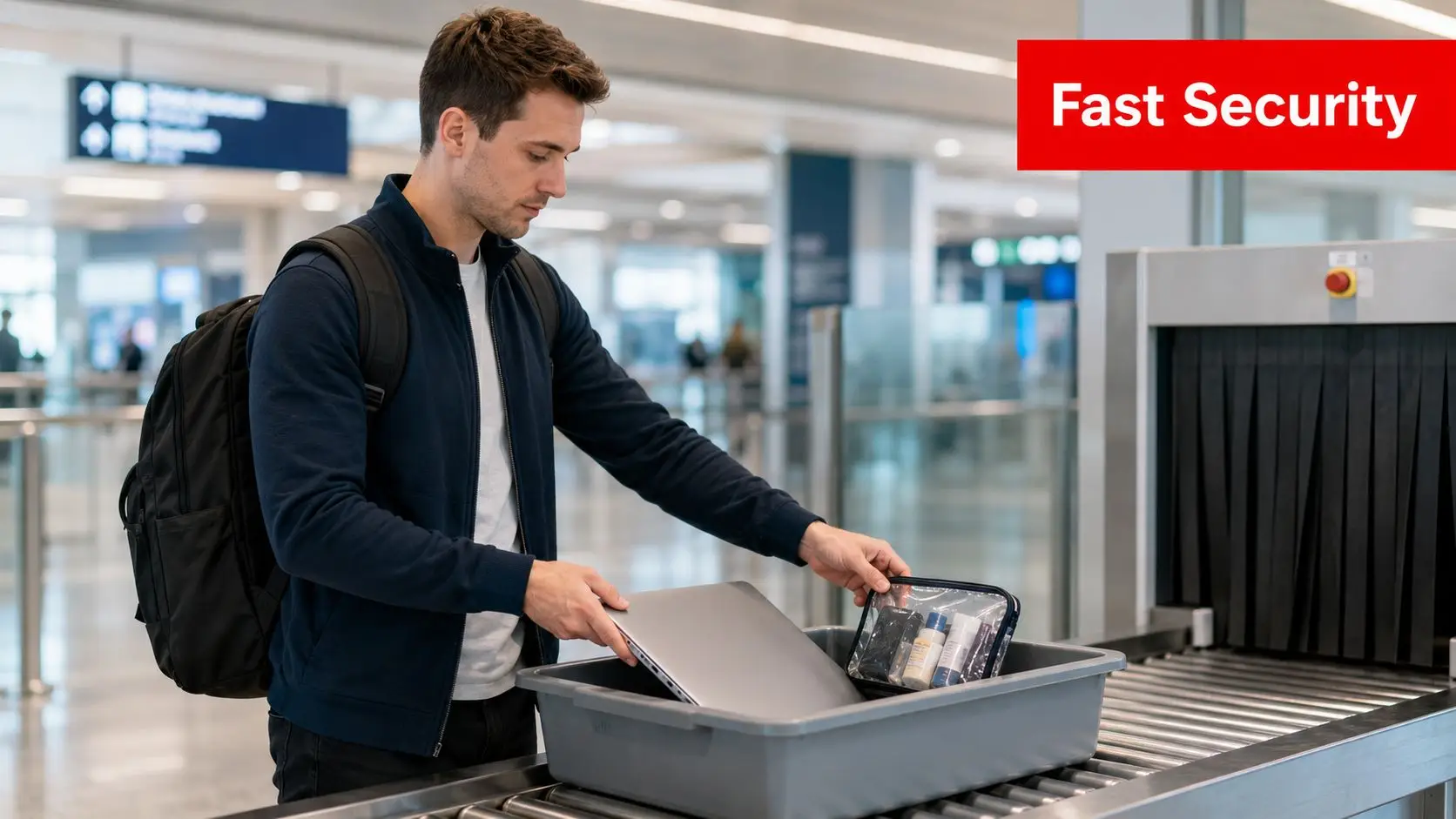
Before you leave for the airport
Use this short checklist.
- Wear simple clothing: Choose outfits that won't create extra screening steps. Minimal metal is usually easier.
- Build a top layer in your bag: Put the items most likely to be checked near the opening, not at the bottom.
- Empty your pockets in advance: Don't wait until you're standing at the tray belt.
- Consolidate small items: Wallet, phone, watch, keys, and earbuds should be easy to place together.
- Check your work gear: Office bags often collect tools, samples, and odd accessories over time.
At the queue entry
Your goal is to make the officer's job obvious. If they can see that you're ready, the interaction is usually smoother.
A few habits help immediately:
- Keep documents in one hand or one outer pocket
- Watch the lane ahead of you
- Copy the tray pattern that staff are asking for
- Don't reorganise at the front if you could've done it earlier
Travellers who pay attention to the lane flow usually clear faster than travellers who are technically prepared but distracted.
If you're travelling for work
Work trips create their own friction because business travellers carry dense bags. Laptops, chargers, battery packs, paperwork, presentation clickers, product samples, and spare phones all compete for space.
Use a layout that supports inspection:
- Tech in one section.
- Papers in another.
- Personal items separate from work kit.
That way, if your bag needs a second look, you can open one zone instead of exposing everything.
What not to do
A few behaviours almost always backfire:
- Don't joke about security issues: It wastes time and creates unnecessary escalation.
- Don't repack on the belt: Step aside if you need a minute.
- Don't argue with terminal-specific instructions: Different equipment can mean different handling.
- Don't assume your usual airport routine applies everywhere: Airport security Melbourne may feel familiar, but each lane still runs on local instruction.
The people who move fastest through screening aren't necessarily frequent flyers. They're the ones who reduce decision points for staff.
Security Compliance for Events and Organisations in Melbourne
For a traveller, airport security is one checkpoint. For an organiser, it is a chain of custody problem that starts before wheels down and ends only when the person, baggage, and schedule are safely handed over at the next site.

In Melbourne, that distinction matters. Delegates arrive tired, speakers are often working to the minute, and VIPs can bring privacy, media, or protest risk with them. Technical crews create a different problem again, because what looks normal at a venue can trigger questions in transit if equipment, tools, batteries, or branded materials are packed badly or assigned to the wrong bag.
Where organisers get caught out
The failure point is usually the handover between airport movement and event operations.
A keynote guest clears the terminal later than expected. The driver is waiting at the wrong collection point. The venue team assumes the guest is already en route. Meanwhile, the person carrying presentation gear has packed items in carry-on that should have been checked or reviewed in advance. None of that is dramatic. It is poor control, and it creates avoidable delays.
The recurring issues are consistent:
- No contingency around arrival timing: Transfers are booked too tightly, with no allowance for screening, baggage delays, or split exits.
- Unreviewed work equipment: Staff or contractors bring tools, display parts, batteries, or promotional stock without checking how those items should travel.
- Weak communication lines: Travellers do not know who to call, and operations teams rely on assumptions instead of live updates.
- Compressed run sheets: Airport pickup, hotel check-in, credential collection, sound check, and on-stage time are stacked too close together.
What good compliance planning looks like
Good planning is specific and boring. That is usually a good sign.
Send a clear movement brief before travel. Confirm terminal details, transfer contacts, baggage expectations, and escalation points. Review what each traveller is carrying, especially if they are transporting equipment, samples, or confidential material. Build a reporting chain so the driver, event lead, and venue contact all know who owns updates if timing changes.
Risk assessment matters most at the edges. Arrival points, kerbside pickup, hotel entry, and backstage access are where gaps show up. That is where organisers need to decide who requires closer oversight because of public profile, commercial sensitivity, personal safety concerns, or the value of the items being moved.
Teams coordinating suppliers, talent, delegates, and transport windows should also treat airport movement as part of the wider event plan. This practical guide to event planning is useful for that reason. It connects logistics, timing, and guest handling instead of treating them as separate admin tasks.
When to involve a security provider
Some airport movements can be handled internally with a disciplined operations lead. Others need licensed support.
That line is usually crossed when the traveller is high profile, the arrival is late at night, the visit involves sensitive commercial discussions, or the transfer route and venue create exposure that the event team cannot manage on its own. In those cases, a provider like GM GROUP Services can assist by integrating licensed VIP protection, transport support, and arrival risk assessment into the travel plan, so the handover from airport to vehicle to venue is controlled and documented.
The practical standard is simple. Someone should own the movement end to end. If nobody does, delays, missed pickups, information gaps, and unnecessary security exposure become the organiser's problem very quickly.
Frequently Asked Questions About Melbourne Airport Security
Can children and infants skip screening
No. Everyone entering the secure area is screened, including children and infants. For families, the practical fix is simple. Keep prams, baby items, and loose electronics easy to access so the lane does not become a repacking exercise.
What if I refuse the body scanner
If you refuse the required screening method, expect delays and a strong chance that you will not be cleared to continue to the gate. If you have a concern, raise it with screening staff early and ask what options are available at that checkpoint.
How should I travel with medication or medical equipment
Pack medication so it can be identified quickly. Keep prescriptions, labels, and medical devices together rather than spread across multiple bags. If equipment needs extra handling or explanation, tell staff before your bag enters screening.
What about oversized baggage or sporting equipment
Confirm the handling rules with your airline before the day of travel. Large, rigid, or unusual items often follow a different process from standard cabin or checked baggage, and that process can affect check-in time, transfer timing, and pickup arrangements.
How should I speak to security officers if I'm concerned about something
Be clear and brief. State the issue, answer the question asked, and mention any accessibility, medical, or family need at the start. Early notice gives staff more room to help.
I'm organising travel for executives or guests. What's the one thing I shouldn't miss
Control the handover points. Assign one person to own the traveller brief, live flight changes, airport meet-and-greet, and the response plan if screening, baggage, or transport disrupts the schedule. For organisations, that chain of responsibility matters more than memorising every screening rule.
For integrated security support for your organization's travel and event needs, contact the team at GM GROUP Services.
Discover more from GM Group Services
Subscribe to get the latest posts sent to your email.