
Back to base monitoring cost in Australia typically runs AUD $30–$60 a month for standard monitoring and AUD $40–$120 a month for commercial monitoring, with one-off setup of AUD $500–$1,200. Your real budget also needs communications hardware, servicing and attendance charges, not just the subscription.
A preventable fire-alarm attendance can dwarf that monthly bill: Fire Rescue Victoria lists $675 per truck per 15 minutes for the 2026–27 financial year, with reasonable or non-preventable events potentially exempt. That's a separate fire-service charge, not an ordinary security patrol fee, but it exposes the problem with buying monitoring on headline price alone.
Treat the subscription as the starting line, not the budget ceiling. For a venue, shop or construction site, the better buying decision starts with the response you need and ends with a five-year total that includes expected call-outs.
Back to Base Monitoring Cost by Service Tier
Standard back to base monitoring cost sits around AUD $30–$60 per month for professional monitoring, according to Castle Security's guide published in 2026. The difference between a cheap plan and a suitable plan is what the operator does after receiving an alarm.
Leadkit's Australian cost guide puts commercial monitoring around AUD $40–$120 monthly, higher-grade commercial services around AUD $65–$150, and typical monitoring-capable configuration around AUD $500–$1,200. Its standard residential range equates to AUD $360–$720 annually, before extras.
Monthly and setup cost by back to base monitoring tier
The table uses those indicative ranges, with basic internet-connected pricing from the monitoring-centre comparison discussed below. Going Rate's alarm-system guide places response-inclusive plans around AUD $80–$130 monthly, usually before attendance fees.
| Service tier | Typical monthly fee (AUD) | Typical one-off setup (AUD) | Best fit |
|---|---|---|---|
| Basic internet-connected monitoring | 25–40 | 500–1,200 | Small single-site premises |
| Standard monitoring | 30–60 | 500–1,200 | Small retail shop or office |
| Commercial monitoring | 40–120 | 500–1,200 plus communicator if needed | Licensed venue or multi-zone site |
| Higher-grade commercial with duress and escalation | 65–150 | 500–1,200 plus communicator if needed | Events, after-hours venues and high-value sites |
| Response-inclusive plan with patrol | 80–130 plus call-out fees | 500–1,200 | Sites that need physical response |
Setup is an indicative configuration allowance, not a tier-specific installation quote. An existing compatible system may only need connection and programming; a replacement panel or additional detectors require a separate scope.
Where the existing panel can't connect directly, Security Wholesalers' monitoring-cost guide allows approximately AUD $200–$800 or more for an IP/cellular communicator. Confirm whether that hardware is already included before adding it again.
Published prices as a reality check
NRMA Insurance listed wireless back-to-base monitoring from AUD $35 monthly in 2026. Metwide advertised residential monitoring at AUD $39.95 monthly including GST in 2025, while The Quote Yard reported Tasmanian commercial monitoring around AUD $60–$150 monthly, updated in 2026.
These aren't interchangeable offers. Residential notification, commercial escalation and physical response solve different problems.
Practical rule: Multiply the monthly quote by the months you'll pay, then add setup, communications hardware and separately billed services. Compare that first-year figure before discussing discounts.
What Drives Back to Base Monitoring Cost Up or Down
The monthly subscription is usually the smallest line in the budget. The expensive part is what happens after an activation: who receives the signal, how it travels, who gets called and whether attendance is billed each time.
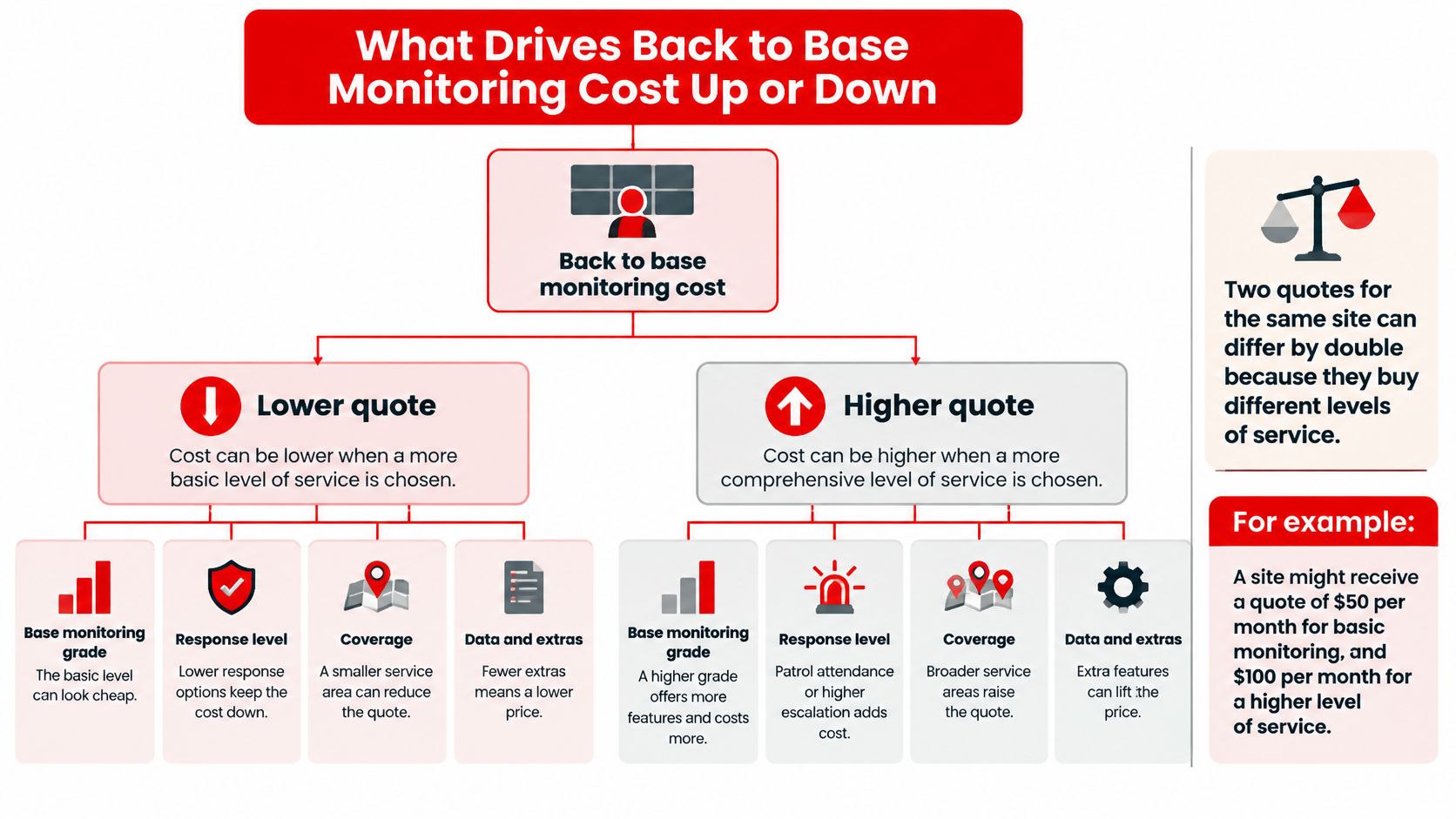
Two quotes for the same premises can sit far apart without either being wrong. One may buy notification only. Another may cover dual-path reporting, an after-hours escalation procedure and coordinated attendance, so compare what each quote makes happen rather than the headline fee.
The service settings that change the price
Monitoring-centre grade. Higher resilience, staffing and infrastructure requirements increase operating costs. Ask which centre receives your alarms and what certification applies to the quoted service.
Communications path. Single-path internet or cellular reporting generally costs less than dual-path reporting. Ask what happens if the router loses power or the primary network fails, and whether backup connectivity is included rather than optional.
Sites, users and zones. More premises and more complicated access arrangements require additional configuration and administration. Request a breakdown that separates physical sites from alarm zones, authorised users and app accounts.
Keyholder management. A simple contact list is different from a rotating duty-manager roster with escalation instructions. State who can answer overnight, who has keys and who can cancel a response.
Contract length and exit terms. A lower advertised subscription can hide a longer commitment or hardware repayment. Get cancellation terms, equipment ownership and the price-adjustment clause in writing before comparing totals.
Physical response. Attendance changes the service more than adding another app user. Confirm whether dispatch coordination, actual attendance and each callout are included, capped or billed per activation.
Buy resilience where failure would hurt
Spend on redundancy where a missed signal creates real exposure: a licensed venue after staff leave, a construction compound with plant on site, a retail store carrying weekend stock. For a short-term event office, the better spend is usually clean start and finish dates, portable communications and precise access instructions.
Do not pay for complexity you will not use. Do not strip backup communications just to make the monthly figure look cheaper, because false alarms and callout fees can dwarf a small subscription saving over five years.
The alarm panel does not determine the whole bill. The centre, the connection and the agreed response procedure decide how much protection that panel delivers.
How to Compare Monitoring Quotes Like for Like
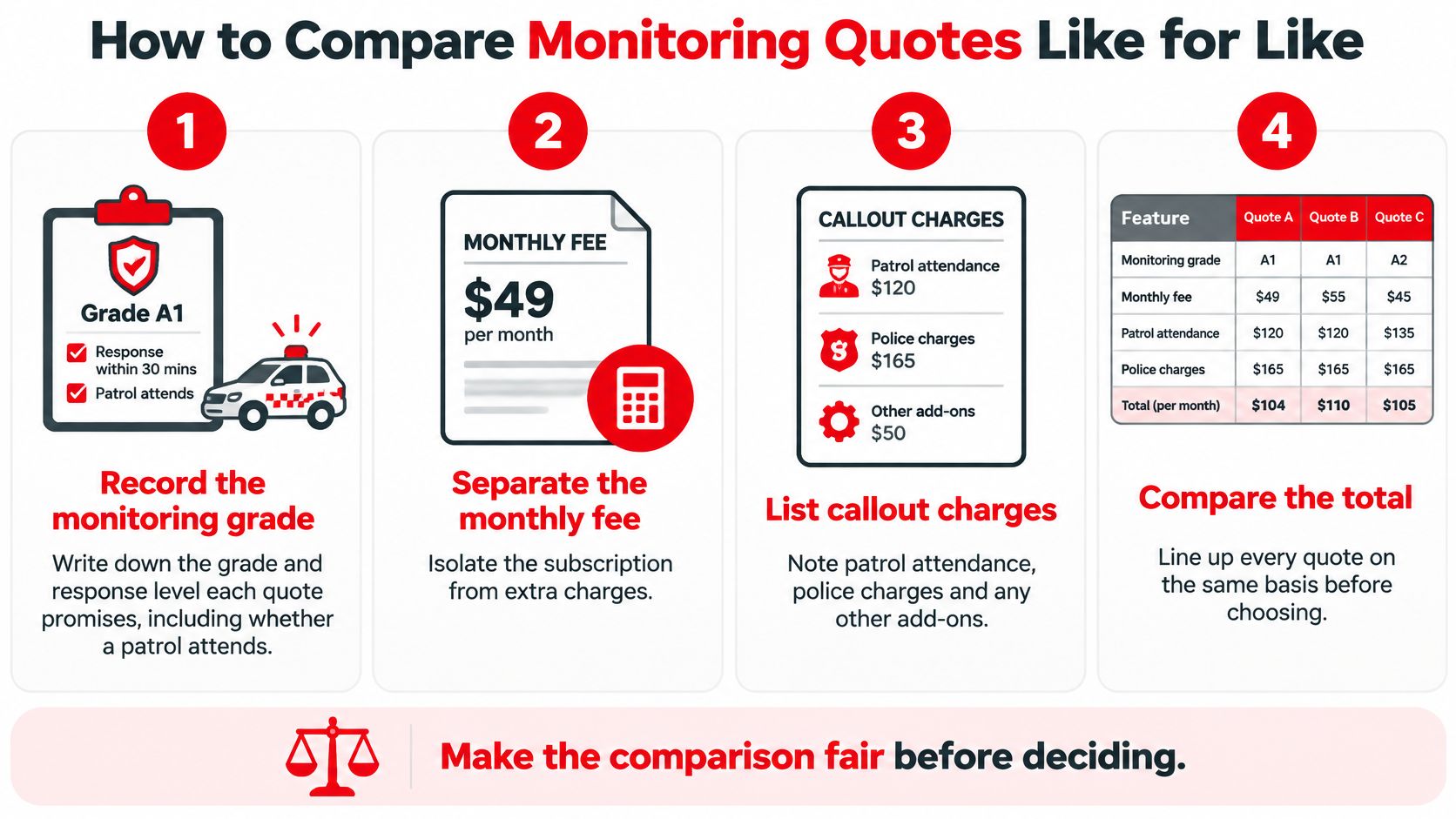
Put every quote into the same worksheet before choosing a provider. Separate the equipment you own from the services you rent and the responses you pay for only when something happens. The monthly subscription is usually the smallest line in a five-year budget, so rank quotes by total cost, not by the headline fee.
Price only means something against a fixed scope. Benchmarks such as average cleaning prices for facilities illustrate the principle: a per-unit figure is comparable only when the unit is defined. A monitoring quote works the same way.
Castle Security's explanation of alarm costs describes monitoring as an escalation chain involving operators, nominated contacts and potentially patrols or authorities. That makes the written response procedure just as important as the price schedule.
Build a fair comparison
Record the monitoring grade and response level. Write down the monitoring-centre arrangements and whether physical attendance is included. Notification-only monitoring shouldn't compete against a patrol arrangement as though they're equivalent.
Separate one-off costs. List installation, communicator hardware, programming and connection individually. Otherwise, a quote that excludes the communicator can look cheaper than a complete offer.
Itemise recurring services. Give monitoring, SIM/data, app licences and servicing separate lines. Mark each as included, separately billed or not supplied.
Check attendance billing. Establish whether patrol attendance is charged per activation and whether false and genuine activations attract the same charge. Include waiting time, unsuccessful access and extended attendance in the written questions.
Read the exit conditions. Record the contract term, cancellation fees and any right to increase prices. A discounted opening offer isn't enough to assess a long commitment.
Test the contact sequence. Ask who gets called first, how long escalation waits and what happens if nobody answers. Specify who can provide access without requiring a manager to drive across town.
Calculate first-year and five-year totals. Use identical assumptions for sites, users, service periods and attended activations. Weight the five-year figure hardest: a handful of attended false alarms a year can outweigh a modest subscription difference. Keep price-rise assumptions visible rather than presenting a flat-price calculation as a guaranteed future bill.
Send a complete scope
Paste this checklist into your quote email:
- Site scope: Premises, operating hours, alarm zones and authorised users.
- Equipment: Existing panel, communicator requirements and ownership.
- Recurring inclusions: Monitoring, connectivity, licences and servicing.
- Response: Contact order, verification, access and attendance charges.
- Commercial terms: GST treatment, commitment, cancellation and price changes.
Send the same scope to two or three providers and insist each one returns a completed worksheet. We work closely with clients to understand their sites, customers and security requirements, so bring that completed scope to the discussion and the proposed arrangement will reflect how your premises operate.
False Alarm and Callout Charges That Add Up
A cleaner entering a closed venue with the wrong disarm sequence can trigger a response that costs more than the subscription. A published Telstra Business Protect plan lists patrol dispatch at AUD $75 for the first 20 minutes plus AUD $15 per additional 15 minutes, making a hypothetical 40-minute attendance approximately AUD $105 if additional periods are billed as commenced blocks.
Treat that published plan as a benchmark, not a current offer. Its usefulness is showing how an apparently minor activation becomes an attendance invoice.
Charges that can apply on top of the monthly fee
Going Rate's monitoring-cost guide identifies indicative patrol attendance around AUD $70–$150 per activation. The other charges below operate under different rules and shouldn't be bundled together as a generic false-alarm fee.
| Charge | Typical amount (AUD) | When it applies |
|---|---|---|
| Patrol attendance per activation | 70–150 per attendance | Each attended activation, including false activations where the contract allows |
| NSW police repeat false-alarm charge | 200 per qualifying response after the first | Repeated police responses to the same device at non-residential premises under the statutory conditions |
| Victorian preventable false alarm, fire attendance | 675 per truck per 15 minutes for 2026–27 | Preventable fire-alarm attendance; reasonable or non-preventable events may be exempt |
| Communicator or SIM replacement | Hardware quoted separately; no verified SIM-replacement tariff | Failed communicator hardware or a connectivity issue requiring rectification |
The communicator allowance is for hardware, not a published SIM-replacement fee. Don't accept a combined replacement line without knowing which component failed and what you're paying to restore.
Under the NSW Police Act false-alarm provision, section 209, a non-residential owner or occupier can face $200 for each response after the first when police respond more than once within 28 days to false alarms from the same security device, unless another amount is prescribed. The provision presumes the alarm false unless the owner establishes otherwise; check the current applicable requirements before relying on a historic legislative amount.
Prevent the activation rather than arguing about the invoice
An unsecured construction gate, an unreliable warehouse roller-door contact and an untrained cleaner create different faults. Each needs a specific correction, not a longer delay before escalation.
- Map sensor zones and test each detector against its labelled location.
- Check the backup battery on a documented maintenance schedule.
- Train authorised users to disarm correctly and report mistakes immediately.
- Maintain keyholder records whenever staff or responsibilities change.
- Agree opening and closing procedures, including cleaners and contractors.
- Log every activation with zone, time, cause and response outcome.
A single avoided patrol attendance can offset a month of standard monitoring. Fix the recurring fault without weakening the response to a genuine incident.
Five-Year Costs for Events, Retail and Construction Sites
Use one site, year-round service and no call-outs as the baseline. Keep setup and communicator costs outside the subscription columns so nobody mistakes an incomplete total for an installed, fully operational system.
The calculations below apply the published monthly ranges to annual and five-year service periods. They assume unchanged tariffs and exclude servicing, licence charges, attendance, finance costs and contract exit fees.
Year-one and five-year totals by site scenario
| Site scenario | Monthly fee (AUD) | Year-one total before setup (AUD) | Five-year total before setup (AUD) |
|---|---|---|---|
| Small retail shop, standard monitoring | 30–60 | 360–720 | 1,800–3,600 |
| Licensed venue, commercial monitoring | 40–120 | 480–1,440 | 2,400–7,200 |
| Construction site, commercial monitoring plus communicator | 40–120 | 480–1,440 | 2,400–7,200 |
| Festival or events office, higher-grade monitoring | 65–150 | 780–1,800 | 3,900–9,000 |
Add setup of AUD $500–$1,200, plus a communicator where required, to both the first-year and five-year subscription totals. The construction row deliberately excludes its communicator from the displayed totals so the hardware is added once, not hidden inside the subscription.
For the retail shop, prioritise staff disarming procedures and reliable closing checks. For the licensed venue, price the duty-manager escalation and access arrangements rather than assuming someone will answer after a late shift.
A construction manager should also budget for changes as gates, sheds and work areas move. An events office needs a clear decision about whether monitoring protects equipment between events or only during the active production period.
Add an attendance scenario before approval
Using the published patrol range, a hypothetical four attendances annually adds AUD $280–$600 a year, or AUD $1,400–$3,000 across five years. Applied consistently, that allowance produces these subscription-plus-attendance budgets, still before setup and other extras:
- Small retail shop: AUD $3,200–$6,600.
- Licensed venue: AUD $3,800–$10,200.
- Construction site: AUD $3,800–$10,200, plus communicator hardware.
- Festival or events office: AUD $5,300–$12,000.
These are calculated scenarios, not forecasts of how often your alarm will activate. At the higher attendance allowance, patrol spending can exceed the lower annual subscription for a small shop.
Budget discipline: Show both a no-attendance baseline and an attendance allowance. Approve the operating budget against the latter.
For seasonal events, calculate the actual paid service period and any minimum commitment. Use the closest site row as a starting point, then replace every allowance with a written quote before approval.
Back to Base Monitoring Cost Questions Answered
Is self-monitoring cheaper?
Self-monitoring can remove the professional monitoring subscription, although connectivity, equipment and app charges may remain. Security Wholesalers' comparison of self-monitoring and professional monitoring explains the central trade-off: the owner must receive alerts and organise the response, so assess the saving against your ability to act while asleep, travelling or managing an event.
Does the monitoring fee include police attendance?
Police attendance isn't automatically included or guaranteed. Alarm type, verification, jurisdictional procedures and the agreed escalation plan determine what happens, so don't treat an operator's authority to contact police as a promise that police will attend.
Can I switch providers mid-contract?
You may be able to switch, but termination charges, hardware ownership and communicator programming can affect the cost. Read the cancellation provisions and confirm whether the incoming arrangement requires replacement equipment or reconfiguration before ending the existing service.
Does the price change with several sites?
A portfolio needs a site-by-site breakdown because different premises can require different communications, zones and response instructions. We work with clients to understand each site's security requirements; bring the full portfolio scope rather than assuming the cheapest location's price will apply everywhere.
What should I compare if the monthly prices are close?
Compare the exclusions and the operational instructions, not just the subscription. A clear answer about unanswered calls, access and attendance billing is more useful than an app feature your duty manager won't use.
Choose the arrangement your team can reliably operate. An impressive contact list offers little protection if every nominated person is unavailable after closing.
Confirm Your Back to Base Monitoring Cost Before You Sign
Build the five-year total before signing, including a realistic call-out allowance. The monthly subscription is the smallest line in that budget. Choose the monitoring tier that fits your site's response needs; the lowest advertised subscription rarely does.
A good buying decision also needs an operational owner. Nominate the person responsible for updating contacts, authorising procedure changes and reviewing activation records, so those tasks don't fall between the venue manager, facilities team and alarm technician.
Prepare the site information first
- List keyholders and after-hours contacts. Record availability, access rights and who can authorise attendance or cancellation.
- Document every alarm zone. Include sensor type, location and any known issue, such as a door contact affected by movement.
- Request comparable quotes. Give each bidder the same sites, users, attendance assumptions and contract period.
- Schedule a test through the monitoring provider. Book it in advance so the centre flags the signals as test traffic and holds dispatch. Then walk a genuine intrusion scenario and an accidental activation from initial signal through to closure.
- Confirm responsibility for charges. Identify who authorises patrol attendance, who receives invoices and how disputed activations are reviewed.
GM GROUP Services handles officer selection, site-specific instructions and ongoing management support where officers form part of the arrangement. That conversation should connect monitoring with the physical response your premises needs, because the two purchases set each other's real cost.
Take a complete figure into the budget meeting
Keep the calculation visible:
Five-year budget = setup + communications hardware + subscriptions + connectivity and licences + maintenance + expected attendance + applicable contract charges.
Record exclusions alongside the total. If emergency-service charges can't sensibly be forecast, state the exposure and the prevention controls your site will run. A guessed allowance hides the risk; a named control shows you're managing it.
Bring your zone schedule, contact list and proposed service period to the quote discussion so it starts with the site rather than a generic monthly price.
The number to take into the budget meeting is the five-year total including expected call-outs. That figure lets you weigh the service you're buying against the operating cost you're accepting.
GM GROUP Services offers Back to Base Monitoring, Vehicle Patrols, Event Security and Construction Site Security, so you can discuss monitoring alongside your site's response requirements in the same conversation. Request a quote from GM GROUP Services or call 1300 14 14 41 or 0499 020 304, and include your alarm details, after-hours contacts and expected attendance needs so you can build a complete budget before signing.