
Close protection security is a licensed, trained practice that keeps specific people safe through surveillance, movement control and rapid response, not just visible bodyguarding at events. In Australia, it sits within a security workforce of 66,800 security officers and guards, with median weekly earnings of $1,818 and about 2,600 job openings. You may be organising a festival, booking a high-profile speaker or managing a busy hotel entrance, and wondering whether ordinary venue security is enough. The answer depends on who is being protected, how they move, where exposure occurs and what the local licensing rules require.
A close protection plan should make a principal safer without making the event feel hostile. That calls for discreet observation, careful arrival planning, controlled access and clear communication with venue staff. It also calls for blunt compliance checks, because a person who looks like a bodyguard isn't automatically licensed to perform close protection work.
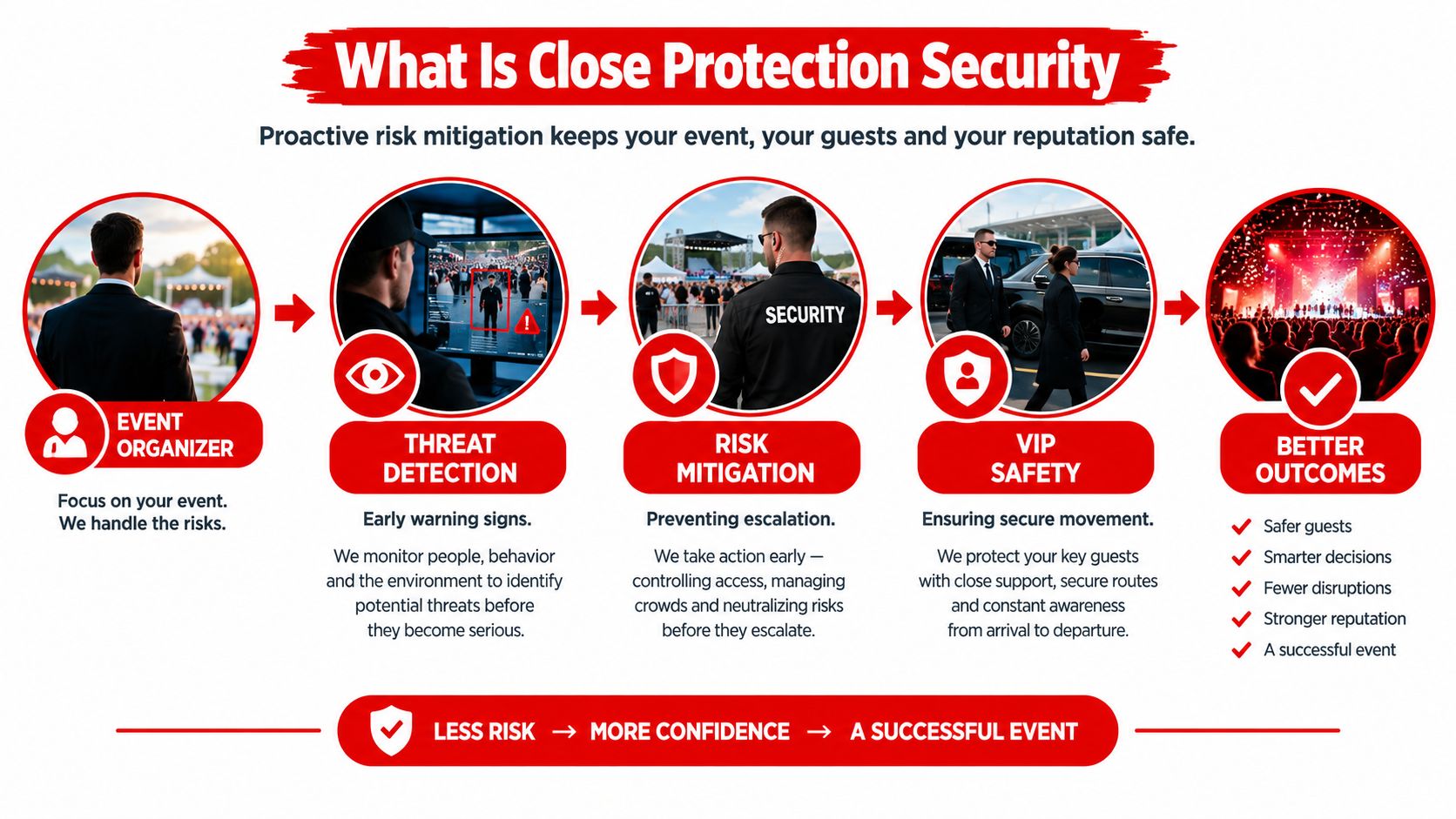
What Is Close Protection Security
A festival organiser notices an agitated person moving repeatedly towards a VIP entrance. The individual hasn't caused an obvious incident, so a standard guard may only watch the queue. A close protection operator looks at the wider pattern, checks the principal's planned movement, alerts the venue team and adjusts the route before the person gets close enough to create a confrontation.
That example captures the difference between close protection security and general guarding. A venue guard protects a location, entrance or crowd. A close protection operator protects a named principal, such as an executive, performer, dignitary or other high-profile person, while that person moves through changing environments.
The work combines advance planning, continuous risk assessment, observation, movement control and rapid response. The operator may remain close to the principal, but proximity is only one part of the job. The genuine value comes from identifying exposure points early and preventing a manageable concern from becoming a physical incident.
The principal changes the security plan
A singer moving from a vehicle to a stage needs a different protective arrangement from a company director attending a private function. The operator considers the principal's visibility, schedule, route, interactions and likely choke points. An entrance, backstage corridor, loading dock or vehicle drop zone can expose someone for only a short period, but that period still needs active management.
The Australian Federal Police describes close personal protection in terms that include full-time 24/7 protection, event-based protection and liaison support for high-office holders and visiting dignitaries. That range shows why organisers shouldn't buy a generic “bodyguard” package without explaining the principal's actual movement profile. The Jobs and Skills Australia occupation profile places this work within a substantial private security labour market rather than treating it as an informal niche.
Practical rule: If the brief only says “put a guard beside the VIP”, it isn't a protection plan yet. Define the principal, movements, exposure points and escalation process first.
For event budgeting, this distinction matters. Venue security may require broad coverage across entrances and public areas, while close protection requires specialist capability focused on one person or a small protective movement. You may need both. Close protection security doesn't replace crowd management, fire safety procedures or venue access controls. It adds a mobile, threat-driven layer around the person most exposed to the event environment.
Core Duties and Responsibilities of Close Protection Operators
Close protection is dynamic risk management, not static deterrence. A static guard holds a position and controls a defined area. A close protection operator continually reassesses the environment because the principal, crowd and threat conditions can all change while the event is underway.
Before the principal arrives
The operator begins with an advance assessment. That usually means examining the venue layout, identifying arrival and departure routes, locating alternate paths and noting places where crowd density or restricted visibility could create exposure.
A useful site review asks practical questions:
- Where will the vehicle stop? A drop zone should allow the principal to move quickly into a controlled area without unnecessary waiting.
- Who controls each access point? Venue security and the protection team need a shared understanding of authorised movement.
- Where can observers stand discreetly? A visible presence can deter some behaviour, but concealed observation may help the team notice developing concerns without drawing attention.
- Which route leads to safety? The team needs a clear circulation path and an agreed response if the planned route becomes unsuitable.
- Who receives an escalation call? Venue managers, security supervisors and police liaison contacts should know how information will move.
These checks matter most at predictable choke points, including entries, backstage areas, loading docks and vehicle drop zones. The Australian Federal Police explains that close protection must adapt to the principal and operational setting. Its description of close personal protection roles supports a model based on site mapping, secure circulation, observation and real-time liaison rather than a single guard standing in one place.
While the principal is moving
The operator monitors behaviour, spacing and access. That doesn't mean labelling someone as a threat because of appearance or nervousness. It means noticing changes in behaviour, unusual interest in the principal's movements, attempts to bypass controls or a person repeatedly appearing near restricted routes.
Communication must remain concise. A protection operator may need to tell venue security that the principal is changing direction, ask staff to hold a door or notify police when a concern has escalated beyond the venue's capacity. The operator also manages interactions, helping the principal avoid unnecessary exposure while preserving a professional and welcoming atmosphere.
When conditions change
A practical team has an escalation procedure before an incident begins. If a crowd surges near a stage door, the operator can move the principal through a pre-selected alternative route. If an unknown person reaches a controlled area, venue security can isolate the access point while the protection team moves the principal. The purpose isn't dramatic intervention. It's early detection, reduced exposure and controlled decision-making.
Training and Licensing Requirements in Australia
Australian close protection work sits within a formal training and licensing system. The central qualification is CPP31418 Certificate III in Close Protection Operations, a nationally recognised credential with 14 units of competency, including 8 core units, according to the CPP31418 training package.
That structure matters because CPP31418 isn't just a short bodyguard course. It's modular and competency-based. A provider should be able to explain the qualification, the units being delivered and how the completed training connects with the licence pathway in the state where the operator intends to work.
The Western Australia Police security licence training information identifies the qualification as the training basis for a security bodyguard licence. Victoria Police also identifies approved training and Registered Training Organisation requirements for private security licensing. The exact administrative process differs by jurisdiction, so organisers should verify the current state regulator's requirements rather than rely on a provider's general marketing language.
Training is not the same as permission to work
This distinction catches out new organisers and inexperienced workers. Completing a qualification may satisfy a training requirement, but it doesn't automatically give someone permission to perform close protection duties in every state.
Victoria requires applicants to complete approved training for each activity they want licensed. The Victoria Police eligibility and training guidance also states that training must be completed with an approved Registered Training Organisation and remain valid within 12 months of the licence application. Someone who completed relevant training 14 months ago may need to retrain or refresh before applying.
Queensland uses a separate process. Close protection must be performed under the Bodyguard function on a Class 1 Security Provider Licence. Training, probity checks, fingerprints and the application are separate steps handled by the Queensland Office of Fair Trading. A Queensland training provider's CPP31418 explanation makes the key point clear: completing the qualification alone doesn't automatically grant the licence.
| State | Qualification | Validity rule | Licensing steps |
|---|---|---|---|
| Victoria | CPP31418 may support bodyguard licensing when completed through an approved RTO | Approved training must be valid within 12 months of the application | Complete approved training, apply for the relevant activity, and satisfy the state licensing requirements |
| Queensland | CPP31418 is separate from the bodyguard licence function | Confirm current requirements with the Queensland Office of Fair Trading | Complete training, then complete probity, fingerprinting and licensing steps |
| New South Wales | Confirm the current close protection or bodyguard training and endorsement pathway | Check the current regulator rule before deployment | Verify the operator's licence, activity endorsement and provider compliance |
| Australian Capital Territory | Confirm the current approved training and licence pathway | Check the current regulator rule before deployment | Verify the individual and business licensing position before engagement |
For organisers, the procurement lesson is simple. Ask for the operator's current individual licence, the relevant activity or endorsement, the business licence details where applicable, the RTO evidence and the supervision arrangements. Don't accept “experienced bodyguard” as a substitute for a licence check.
Close Protection vs Other Security Roles
Different security roles solve different problems. The mistake is asking one role to cover every risk.
Close protection follows a named principal. The operator manages movement, proximity, observation and response as the principal travels through a venue or public environment.
Static guards protect fixed locations. They may control a gatehouse, monitor a building entrance or patrol a defined site. They aren't automatically equipped or licensed for bodyguard duties.
K9 units add detection and deterrence. A dog and handler may support searches, patrols or perimeter control, but that function doesn't replace a mobile protective detail around a person.
Venue security manages the wider environment. Venue teams monitor crowds, control access, respond to disorder and apply house policies. Their attention is distributed across the site, while close protection keeps a specific principal at the centre of the plan.
Choose by objective, not appearance
Start with the venue scope. A construction site may need static guarding, gatehouse control and vehicle checks. A festival may need crowd management, access control, emergency response and close protection for a performer. A corporate function may require a discreet operator who can coordinate movement without making the principal feel surrounded.
Then assess the principal. Is the person publicly recognisable? Will they use a public entrance? Are they expected to meet guests, move between rooms or leave at a predictable time? The answers influence the protection posture.
The AFP describes close personal protection teams as specially trained beyond regular sworn officers, with arrangements covering 24/7 personal protection, events and liaison support for high-office holders and visiting dignitaries. Its national policing service information reinforces that the role is threat-driven and integrated with access control, route planning and incident escalation.
A sensible deployment might combine a static guard at a service entrance, venue staff managing guest access, a K9 unit supporting a search requirement and a close protection operator moving with the principal. Those roles should share communications and escalation arrangements. They shouldn't compete for authority or operate as disconnected services.
The right question isn't “How many guards can we place at the door?” It's “Which person, place and movement creates the exposure, and which licensed function addresses it?”
Practical Examples for Event Organisers and Hospitality Venues
At a concert, the highest exposure may occur when a performer moves from a vehicle through a public-facing entrance. The organiser can reduce that exposure by mapping the route in advance, limiting unnecessary waiting, coordinating with venue security and keeping an alternate circulation path available. The close protection operator then manages the principal's movement while other staff continue managing the crowd.
At a festival, the plan may need to account for multiple stages, changing crowd flows and several vehicle access points. Close protection works best when the operator receives the schedule early, understands the site boundaries and can communicate quickly with the event security supervisor. A visible team can provide reassurance, but a discreet posture may be more suitable where the organiser wants a normal guest experience.
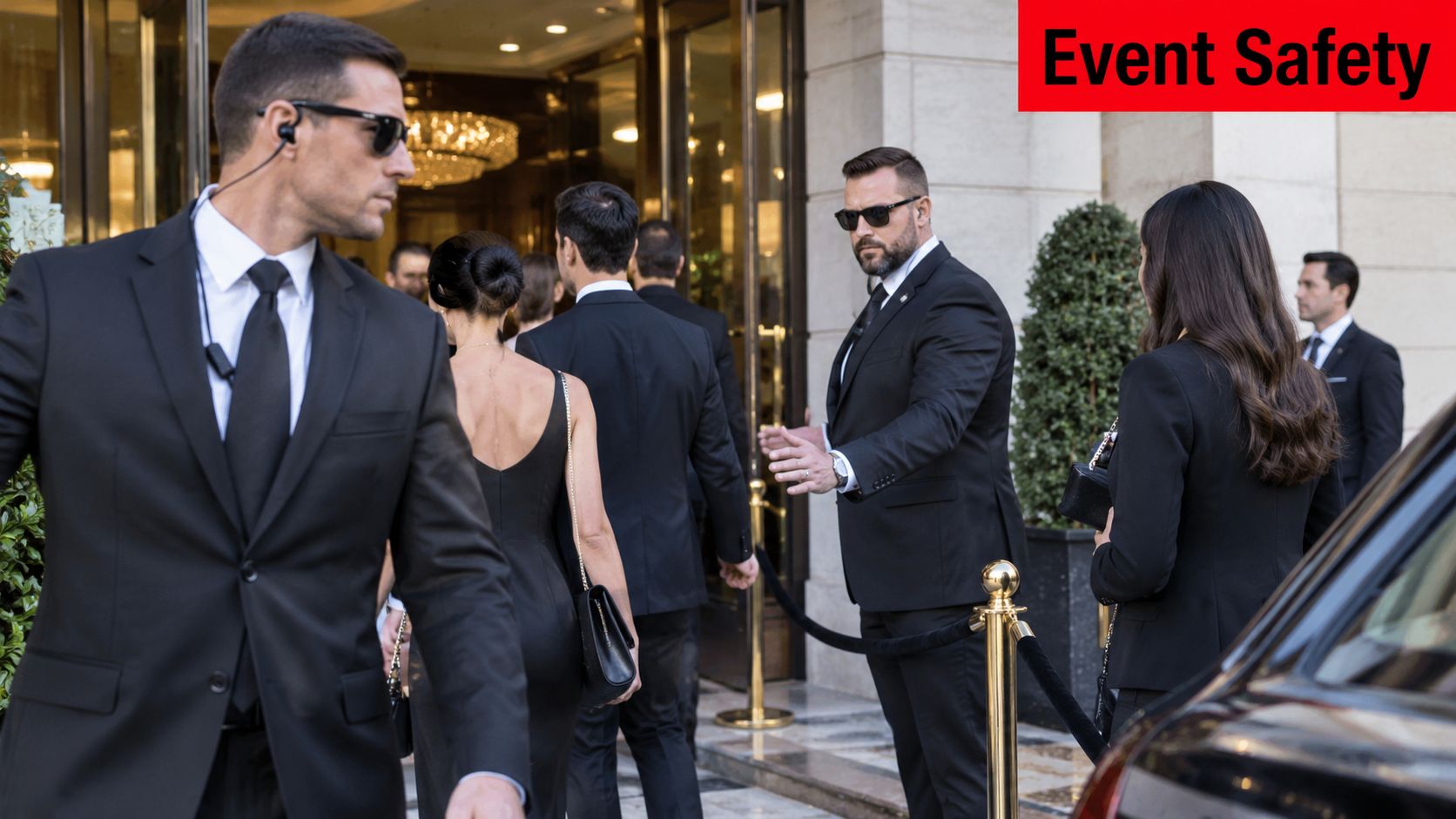
Hospitality settings need restraint and control
A hotel, restaurant, bar or club has a different operating rhythm from a concert. Staff must protect guests while maintaining service, privacy and responsible alcohol management. The operator may need to control a private arrival, prevent an unwanted approach in a foyer or coordinate a quiet departure through a service route.
RSA requirements and local security rules still apply. Close protection doesn't give an operator permission to ignore venue policy, licensing conditions or police direction. The provider should explain how its personnel will work with duty managers, crowd controllers and emergency contacts.
A corporate function creates another common scenario. An executive may need to move from a car park to a meeting room, attend a reception and leave through a different exit. The operator can use advance mapping and discreet observation to reduce exposure without disrupting the event's professional tone.
Compliance must sit beside deployment
The Australian private security sector includes 167,530 nationally licensed individual security personnel, and that number rose 6.10% in the past year and 13.4% between 2019 and 2024, according to the ASIAL Security Industry Licensing Report 2025. The report also records Victoria as having over 35,000 individual licence holders and nearly 900 business licence holders by 31 December 2023. A large workforce gives organisers more choice, but it doesn't remove the need to check the particular operator, licence function, supervision and state rules.
For every event, request a written deployment brief covering:
- Principal movements: Arrival, departure, public interactions and restricted areas.
- Venue coordination: Names of supervisors, communication channels and escalation contacts.
- Access controls: Doors, backstage routes, loading areas and vehicle zones.
- Operational review: How the provider will record incidents, supervise staff and report concerns.
How to Choose Close Protection Services
Start with the licence, not the uniform. Ask the provider to show that each person assigned to close protection holds the relevant individual authorisation and that the business can lawfully provide the service in the state where your event takes place.
Then check the training pathway. In Victoria, approved training must come from a Registered Training Organisation and must meet the application timing rule described by Victoria Police. If a provider can't explain the activity endorsement or refuses to identify the licensing basis, stop the procurement process until the position is clear.
Questions for the provider
Ask these questions before signing:
- Who is the principal? Confirm that the provider has assessed the person's profile, schedule and public exposure.
- What does the operator control? Clarify whether the service includes route planning, access coordination, observation and liaison, or only physical accompaniment.
- How will the team communicate? Establish the contact with venue security, the escalation path and the process for last-minute changes.
- Who supervises the detail? Request the name and availability of the operational supervisor, not only the assigned operator.
- How will performance be recorded? Ask for incident reporting, shift handover information and post-event review.
- How does the plan support RSA and local rules? The operator should fit into venue procedures rather than create a second, conflicting command structure.
Budgeting should follow risk and complexity. A short, controlled movement at a private venue may need a different arrangement from a public festival with multiple access points and changing schedules. Avoid buying a fixed number of guards before the provider has reviewed the site. A cheaper generic presence can leave the principal exposed, while an unnecessarily visible detail can interfere with guest experience.
Procurement test: A credible provider can explain what its people are licensed to do, where they will stand, how they will move the principal and what happens when the plan changes.
Frequently Asked Questions About Close Protection Security
Is close protection only for celebrities?
No. Performers and public figures may need it, but executives, visiting dignitaries, corporate speakers and other identifiable principals may also require protection. The deciding factors are exposure, movement, venue conditions and the consequences of a threat, not celebrity status.
Is a visible bodyguard always necessary?
No. Close protection can be discreet. The operator may remain near enough to respond while using controlled routes, observation points and coordination with venue staff to avoid creating unnecessary attention. Visibility is a deployment choice, not the definition of the service.
Does a security guard automatically qualify as a close protection operator?
No. General guarding and bodyguard functions are different activities. Check the individual's training, current licence and relevant activity endorsement. A professional appearance or previous experience doesn't replace the legal requirements of the state where the work occurs.
Does CPP31418 automatically give someone a Queensland bodyguard licence?
No. Queensland separates the qualification from the licence. Close protection work must be performed under the Bodyguard function on a Class 1 Security Provider Licence, and the Queensland Office of Fair Trading handles the licensing process after training, probity checks, fingerprints and other application steps. A Brisbane festival worker may complete CPP31418 and still be unable to act as a bodyguard until the relevant licence function is approved.
How should organisers compare quotes?
Compare the operational scope, not just the hourly figure. Ask whether the quote includes advance planning, route control, communication with venue security, supervision, reporting and a response plan for changed conditions. Two providers may use similar words while offering very different levels of preparation.
Why does the state matter?
Licensing, training acceptance and activity endorsements are administered through state and territory systems. An operator who is suitable for one deployment may still require separate verification before working elsewhere. Confirm the current requirements in NSW, Victoria, Queensland or the ACT before the event date.
GM GROUP Services offers licensed VIP and bodyguard protection for executives, events, venues and high-profile movements, with route planning, access coordination and discreet observation. To discuss a fit-for-purpose close protection plan that works alongside venue security and current Australian compliance requirements, visit GM GROUP Services.
Discover more from GM Group Services
Subscribe to get the latest posts sent to your email.