
Compliance monitoring starts when the radio call comes through, not when an auditor requests a folder. At a NSW music festival, a patron is shoved at the barrier, two crowd controllers argue about who owns the response, and an inspector watches from the wings. The duty manager needs more than a completed checklist. They need a lawful licence record, a supervisor who escalates correctly, usable footage, witness notes, and an evidence trail that still makes sense at 2am.
For operators across NSW, VIC, QLD and the ACT, the difficult part is rarely knowing that compliance matters. The friction sits in the details: different licensing frameworks, surveillance rules, notification obligations, contractors moving between states, and control-room staff making decisions from another jurisdiction. This guide sets out a practical compliance monitoring model for festivals, venues, construction sites and retail operations, with workflows that produce defensible evidence rather than compliance theatre.
What Compliance Monitoring Actually Means on the Ground
The festival incident above has three separate questions. Was the right person licensed and assigned to the task? Did the team follow the venue's incident procedure? Can the operator prove what happened, who acted, and what changed afterwards? Compliance monitoring answers all three while the operation is running.
The three layers on site
Regulatory compliance covers external obligations. A security operator checks licence status, role scope, required training, site permissions, staffing arrangements and event conditions before a worker enters the roster. A construction manager applies the same discipline to site access, induction records and relevant competency evidence.
Procedural compliance tests whether approved controls are being followed in real time. Supervisors should check barrier patrols, exclusion zones, bag-search processes, liquor-service escalation, contractor sign-in and emergency communications. A signed opening checklist doesn't prove that the team followed the procedure six hours later. Live observations, radio checks and exception reports do.
Evidentiary compliance concerns the record left behind. Incident logs, CCTV references, body-worn video exports, access data, witness statements, roster versions and corrective-action records need clear ownership and controlled access. The evidence should show the sequence, not merely confirm that an incident occurred.
Practical rule: If a control matters during an investigation, assign its evidence owner before the event begins.
A one-off audit samples the past. Compliance monitoring creates a feedback loop: detect an exception, escalate it, preserve evidence, correct the condition, and test whether the correction worked. That loop is especially important as regulators use inspections, internal and external reports, compliance actions and annual reporting to support more structured, risk-based oversight. The IBM overview of compliance monitoring also reflects the growing role of external specialists in Australian compliance programmes.
For procurement, contractor onboarding and supplier controls, a practical guide to compliance for procurement teams helps connect operational checks with purchasing workflows. On the ground, the principle is simple: the person who can stop an unsafe or unauthorised activity must receive the alert, understand the escalation path and leave an auditable record.
Legal and Regulatory Requirements in Australia
A retail store and a licensed venue may both roster security staff, but their compliance exposure isn't identical. Retail operations usually focus on store access, loss prevention, worker licensing, privacy and incident evidence. A festival or bar adds crowd control, liquor-service conditions, patron welfare, event approvals, surveillance and emergency coordination.
NSW
In NSW, the Security Industry Act 1997 and the NSW Police Force licensing regime shape how crowd controllers and other security workers can be deployed. A monitoring register should verify the worker's licence category, role and status before rostering. Event operators also need to account for event-specific controls, liquor licensing and requirements administered through the Office of Liquor and Gaming Regulation equivalent functions in NSW, including conditions affecting licensed premises and patron safety.
NSW also has a particularly important workplace-surveillance overlay. The Workplace Surveillance Act 2005 requires at least 14 days' written notice before computer, camera or tracking surveillance begins, with the notice explaining what is monitored, how it operates and when it occurs. These requirements are outlined in the Australian privacy and data-protection law guide. A camera policy alone isn't enough if the notice, access controls and retention process are missing.
Victoria
Victoria applies the Private Security Act 2004 to private security licensing, while major events can bring additional operational orders and conditions. Licensed venues also need to manage Liquor Control Victoria obligations, including responsible service of alcohol and patron-welfare controls. A Victorian monitoring workflow should therefore separate worker licensing from venue obligations, rather than treating one completed security check as proof of overall compliance.
Queensland
Queensland's Security Industry Regulation Act and licensing arrangements include the OSDM crowd controller licence pathway. The Office of Liquor and Gaming Regulation also applies controls around restricted and high-risk events. A Queensland event using a contractor from another state needs a local verification step. The contractor's home-state licence isn't a substitute for checking whether the person is authorised to perform the particular work in Queensland.
ACT
The Security Industry Act 2003, the Commissioner for Fair Trading licensing scheme and event approval requirements shape the ACT framework. Festival-scale gatherings need an approvals register that sits alongside security licensing and incident procedures. The run sheet should identify who owns approval conditions, who monitors them and who can pause an activity when a condition isn't being met.
A useful compliance reference library can sit alongside the operational register. The MR2 Solutions compliance hub is one place to review broader compliance topics, but operators still need state-specific legal advice for their exact activity.
Across all four jurisdictions, licences don't automatically transfer. Rules for working with minors, surveillance, privacy, record handling and incident reporting can differ. Build the programme around a national core, then attach a state overlay before each roster, event or site mobilisation.
Operational Processes and Responsibilities
A compliance programme fails when everyone is responsible in principle and nobody owns the next action. A multi-state operator such as GM GROUP Services needs named owners, controlled records and an escalation chain that works during a busy shift.
Five connected pillars
Governance and policy ownership sits with the compliance manager. This owner approves SOPs, maintains the obligations register, signs off licence rules and records accepted exceptions. Policies need version control, approval dates and a clear audience.
Workforce compliance belongs with HR or the training coordinator. The register should cover security licences, role scope, training currency, construction white-card checks where relevant, uniform identification and contractor documents. A worker shouldn't reach the roster merely because someone remembers seeing a licence previously.
On-site operational compliance is owned by supervisors and team leaders. They use rosters, pre-start checks, site instructions, incident logs and radio protocols to test whether the approved controls are operating. Their job isn't to complete paperwork for its own sake. It's to identify a condition that requires intervention.
Surveillance and evidentiary capture belongs with the control-room operator or nominated evidence custodian. That person manages CCTV access logs, body-worn video requests, exports, timestamps, access permissions and chain-of-custody notes.
Reporting and assurance sits with the compliance lead. Raw records become client dashboards, regulator-ready reports, management updates and corrective-action reviews. The compliance lead should challenge unexplained gaps rather than count completed forms.
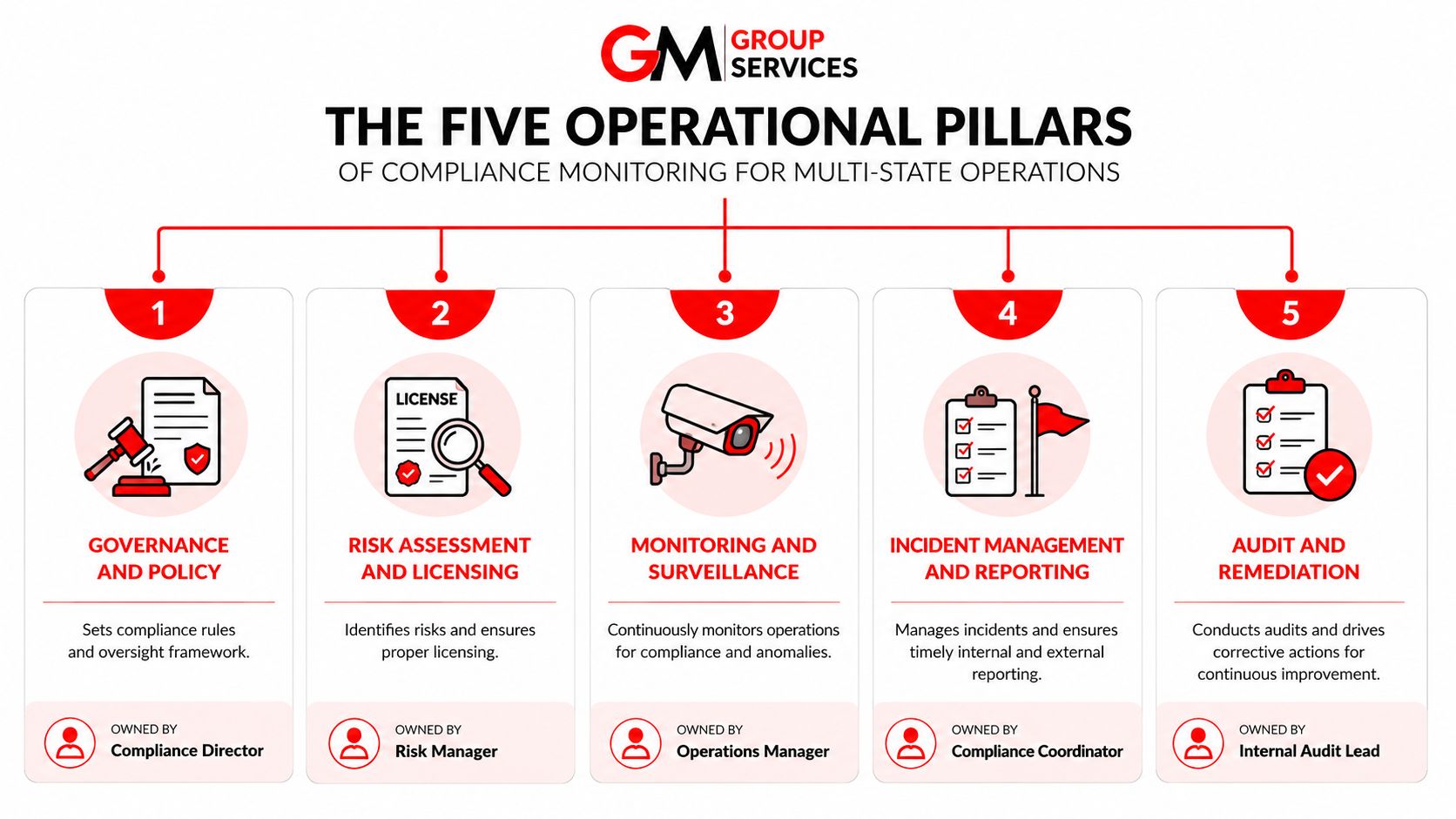
The pillars must connect. A licence lapse found in workforce compliance triggers a roster stop in operations, a notification to the supervisor, a record of the decision and a corrective action in assurance. If the control-room operator identifies an exclusion-zone breach, the supervisor intervenes, the incident record references the relevant footage, and the compliance lead checks whether the SOP or briefing needs revision.
For a smaller team, one person may hold several roles. That's acceptable if the register still distinguishes the actions, approvals and evidence. A shared drive can work initially, provided permissions, naming conventions and review dates are controlled. As the volume grows, a GRC-style log can reduce duplicated chasing, but software won't repair unclear ownership.
Comparing NSW, VIC, QLD and ACT Monitoring Rules
A single national form is tempting. It also creates false confidence. The safest approach is a common control template with a mandatory jurisdiction field, local instructions and a state-specific approval check before deployment.
The table below is an operational comparison, not legal advice. Exact duties can depend on the device, site, licence, event type, contract and regulator direction.
Compliance monitoring rules across NSW, VIC, QLD and ACT
| Rule area | NSW | VIC | QLD | ACT |
|---|---|---|---|---|
| Licensing approach | State-based security licensing, with role and licence-category checks. | Private security licensing under the Victorian framework. | State licensing, including relevant crowd-controller pathways. | Territory licensing through the Commissioner for Fair Trading framework. |
| Notice and surveillance | Workplace surveillance requires written notice at least 14 days before covered surveillance begins, with specified details. | Check the applicable privacy, employment and surveillance requirements for the device and workplace. | Apply the relevant privacy and workplace rules to the site, device and purpose. | Confirm territory requirements before monitoring staff, contractors or venue activity. |
| CCTV and signage | Use clear notices and documented access controls. Covert monitoring is highly restricted unless a specific authority applies. | Signage, privacy and venue conditions should be assessed together. | Confirm signage, access and recording arrangements for the event or premises. | Include local privacy and approval checks in the venue plan. |
| Audio capture | Treat body-worn and other audio capture as a separate risk from video. | Body-worn audio in licensed areas requires careful assessment of notice, purpose and access. | Check audio, consent and surveillance requirements before deployment. | Confirm local rules and document the decision before recording. |
| Incident response | Use a state-specific escalation and notification matrix. | Align incident handling with private-security, liquor and event obligations. | Include Office of Liquor and Gaming Regulation requirements for relevant events. | Link venue procedures to territory approvals and regulator contacts. |
A NSW contractor working at a Queensland event should be cleared against Queensland requirements before the first shift. A Sydney control room supporting an ACT venue needs the ACT rule set in the run sheet, not an assumption that the remote location changes the obligation. The same principle applies to body-worn audio in Victorian licensed areas. When a rule is uncertain, pause deployment and obtain advice rather than relying on a familiar form.
Implementation Steps, Tools and Templates
Start with the operation, not the software. A new coordinator should be able to open the programme and answer four questions immediately: what applies, who owns it, what evidence is required, and what happens when the control fails?
Build the programme in sequence
Map scope and jurisdictions. List every venue, event, construction site, retailer, contractor group, device and service. Mark where NSW, VIC, QLD or ACT rules apply, including staff who travel between locations.
Create the licence and policy register. Record worker, role, jurisdiction, licence category, expiry, verification date, approving person and roster status. Add SOP versions, event approvals, contractor insurances and review dates. The register should make an expired or unverified item visible before scheduling.
Write the control library. Map each obligation to a practical control and evidence owner. For example, “authorised crowd controller” becomes a pre-roster licence verification, supervisor spot check and retained verification record.
Deploy templates. Use state-tuned audit checklists, incident notification forms, evidence request forms, corrective-action logs and post-event reviews. Templates should include timestamps, location, owner, escalation status and closure evidence.
Set the reporting rhythm. Weekly dashboards should feed a monthly operations review. The monthly pack should identify overdue actions, repeat exceptions, licence risks, surveillance requests and incidents requiring executive attention.
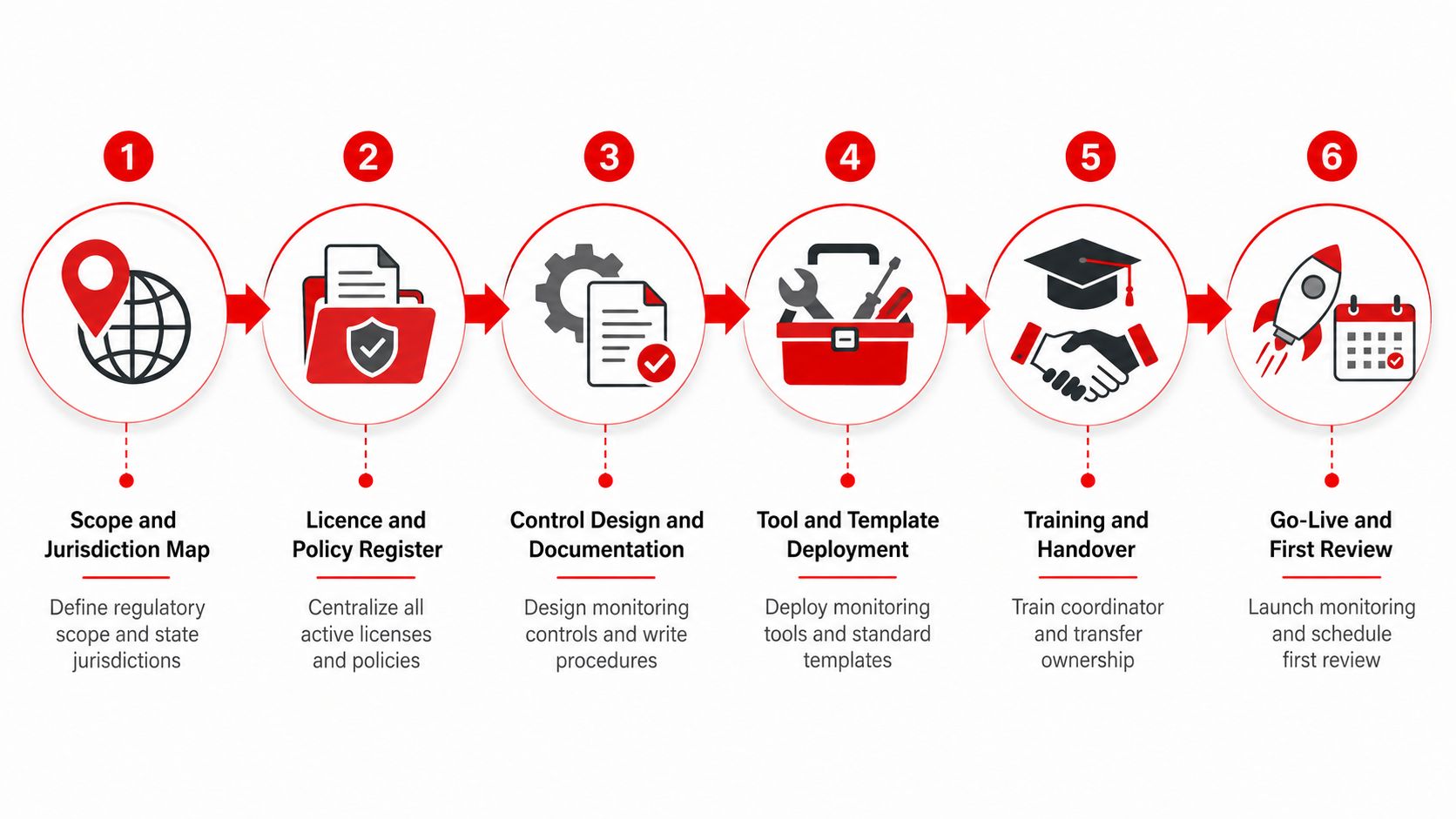
The practical toolset may include an incident register, body-worn video export log, CCTV access register, training records, contractor insurance folder, roster system and controlled shared drive. A monitoring platform should add reminders, role-based access, audit history, evidence links, exception workflows and reporting. A generic tracker may record a task, but it often won't preserve the decision trail or show whether a control was tested.
Start with spreadsheets when the scope is small and the fields are disciplined. Move to a GRC-style platform when multiple managers edit records, evidence is scattered across sites, or overdue actions are becoming invisible. Before buying, review an OperatorCompliance article on operator compliance software for questions to ask about workflow, records and operational fit.
Real-World Risk Scenarios and What They Teach Us
A monitoring programme proves its value in awkward moments. The following scenarios show how small control decisions can prevent a minor operational issue from becoming a regulatory or privacy problem.
Festival loading dock
During a Saturday-night CCTV review, an operator sees a contractor cross a loading-dock exclusion zone. The supervisor intervenes before the movement creates a wider crowd or liquor-service issue. The evidence file contains the relevant footage reference, contractor identity, time, supervisor action and close-out note, so the regulator's follow-up call becomes a short evidence check rather than a prolonged reconstruction.
Control changed afterwards: the venue added a loading-dock exception alert, a contractor sign-in cross-check and a mandatory supervisor close-out field.
Queensland event notification
At a Queensland event, a NSW-based control room treated a serious incident as a standard internal report and missed the applicable police notification window. The problem wasn't a lack of goodwill. The run sheet used the control room's home-state assumptions instead of the event jurisdiction.
Control changed afterwards: the operator placed a state-specific notification matrix inside every run sheet, with named decision-makers, escalation times and regulator contact details.
ACT venue audio capture
An ACT venue used body-worn audio without adequate signage. A privacy complaint followed, and the operator couldn't demonstrate that the audience had received clear information about the recording practice.
Control changed afterwards: the venue revised signage, consent wording, device instructions and the post-event audit step. The evidence owner now records where signs were placed, when they were checked and who approved the audio setting.
These incidents teach the same operational lesson: monitoring must test conditions before they become evidence problems. It also needs an exception path that reaches the person with authority to stop, restrict or correct the activity.
KPIs Reporting and Continuous Improvement
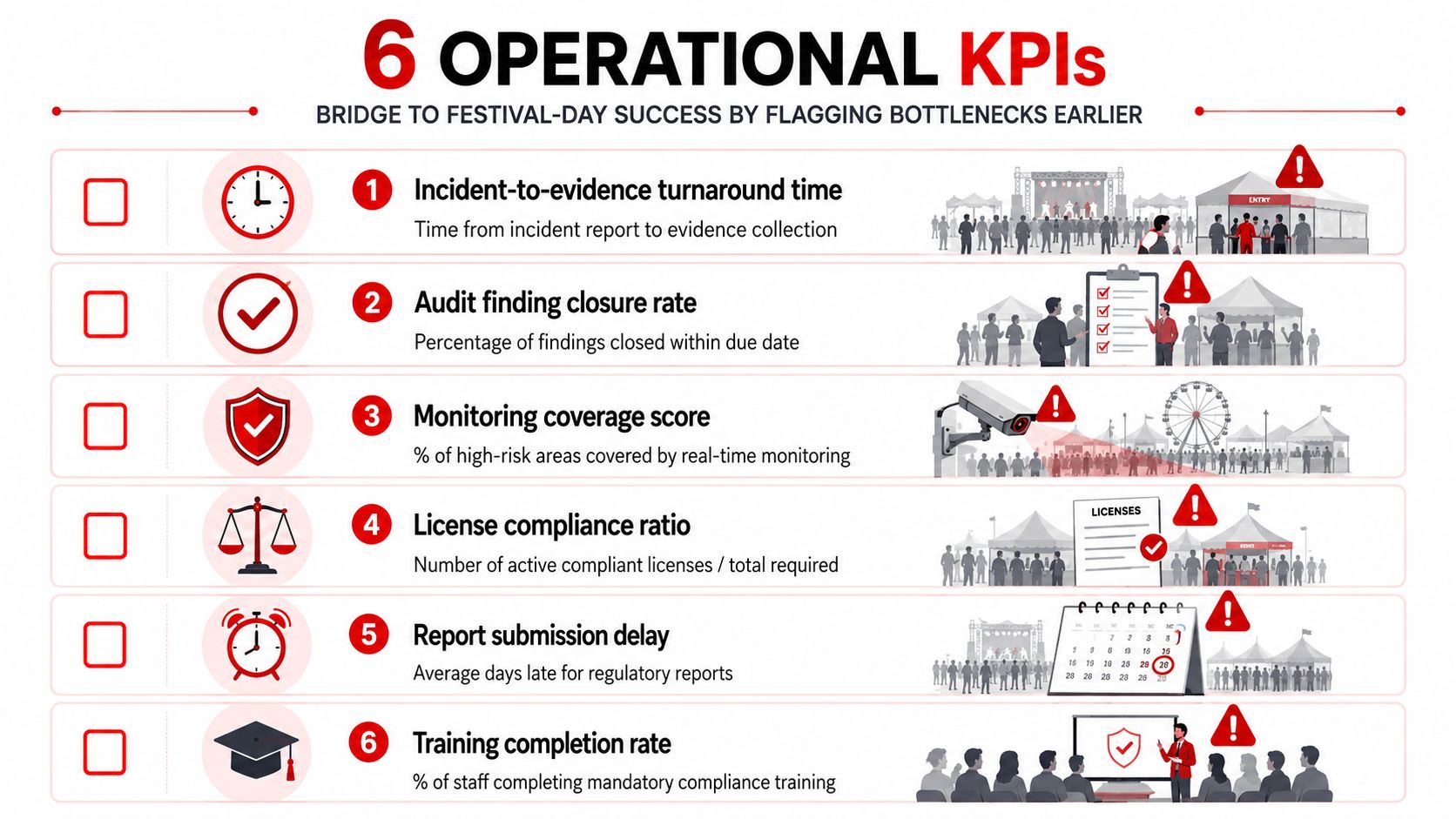
The original festival bottleneck would have appeared earlier if the operator tracked workflow performance rather than only counting incidents. Good compliance monitoring KPIs show whether the team can detect, evidence, escalate and close issues under pressure.
Six useful measures
- Incident-to-evidence turnaround: Time from the first incident report to preservation and collection of relevant records.
- Audit finding closure rate: The proportion of findings closed by their due date, with evidence accepted by the owner.
- Licence currency: The proportion of required licences verified as active and appropriate for the assigned role and jurisdiction.
- Training compliance: Completion and currency of mandatory training by role, site and state.
- Surveillance access-request turnaround: Time required to locate, approve and provide CCTV or body-worn video evidence.
- Corrective-action cycle time: Time from finding identification to verified closure.
Don't set artificial targets before establishing a baseline. A festival operator may prioritise evidence turnaround and crowd-control exceptions, while a construction business may weight induction, exclusion-zone and contractor-document controls more heavily. The useful comparison is against the operation's own risk profile and previous reporting cycle.
Reporting that reaches the right people
The weekly dashboard belongs with supervisors and operations managers. It should show open incidents, overdue actions, licence exceptions, training gaps, surveillance requests and repeat locations.
The monthly compliance pack goes to operational leadership and client contacts. It should explain trends, not just display totals, and identify where a procedure, briefing, roster or contractor control needs adjustment.
The quarterly assurance report should give directors or owners a concise view of material risks, unresolved exceptions, recurring failures, accepted risks and resource decisions. Escalate immediately when a licence issue affects deployment, a serious incident may require regulator notification, evidence cannot be preserved, or a privacy control has failed.
Use near-miss reports and corrective actions to revise SOPs and refresher training. A practical 90-day cycle starts with baseline measurement, then builds the dashboard, runs the first review, tests an evidence request and embeds the improvement loop into ordinary operations.
Frequently Asked Questions on Compliance Monitoring
What evidence might an Australian regulator request after an incident?
Expect the investigation to focus on the event sequence and the controls around it. Useful records can include licences, rosters, training evidence, supervisor notes, incident reports, CCTV references, body-worn video handling records, witness accounts, access logs, notifications and corrective actions. WHS processes should support internal reporting, escalation, regulator notification where the threshold is met and record keeping. The relevant categories for a notifiable incident are death, serious injury or illness, and dangerous incident, as outlined by Australian WHS incident-reporting guidance.
How is monitoring different from a one-off audit?
An audit reviews a defined sample at a point in time. Monitoring assigns ownership, tests controls during operations, captures evidence as work happens and escalates exceptions while there's still an opportunity to correct them. An audit can confirm that a checklist exists. Monitoring tests whether the supervisor used it, whether the exception was acted on and whether the fix remained effective.
How should one programme cover NSW, VIC, QLD and ACT?
Use a core-plus-state-overlay model. The core contains common controls such as licence verification, incident logging, evidence preservation, supervisor checks and corrective actions. Each state overlay adds local licensing, surveillance, privacy, event, liquor and notification requirements. The roster, run sheet and dashboard should carry the jurisdiction field so remote teams can't accidentally apply the wrong rule set.
How can a small team start on a limited budget?
Prioritise high-risk activities first: worker authorisation, serious incident escalation, surveillance access, crowd-control procedures, exclusion zones and evidence retention. Use a controlled spreadsheet, shared folder permissions, versioned templates and a weekly review before purchasing a platform. The test is whether the team can produce a coherent evidence pack during an investigation, not whether it owns sophisticated software.
GM GROUP Services can help event, venue, construction and retail operators establish practical monitoring through licensed personnel, site supervision, GPS geo-fencing, automated guard check systems and weekly reporting covering patrols, incidents, high-risk locations, photo records and performance. Visit GM GROUP Services to discuss a state-aware security and compliance monitoring approach for your sites and upcoming operations.
Discover more from GM Group Services
Subscribe to get the latest posts sent to your email.