
Occupational violence and aggression affects the Australian workforce at a scale that should change how every manager plans a shift. Safe Work Australia reports that 8 million Australians, or 41% of the population, have experienced at least one incident of violence since age 15, with work-related incidents making up at least 13% of those cases. The national analysis also records more than 1 million work-related violence incidents across the reference period, including 176,100 workplace incidents in the last 10 years. Safe Work Australia's national analysis makes the practical point clear: this is a mainstream work health and safety hazard, not an unusual event reserved for extreme workplaces.
This guide sets out 7 proven ways to prevent and respond to occupational violence and aggression across events, hospitality, retail and construction. It focuses on controls that hold up after dark, under crowd pressure and when a person has already crossed the line from frustration into threat.
What Occupational Violence and Aggression Really Means in Australian Workplaces
Safe Work Australia's definition is broad enough to match what frontline workers face. Occupational violence and aggression covers any incident where a person is abused, threatened or assaulted at a workplace or while carrying out work, including conduct in person, over the phone or online. The Safe Work Australia prevention guide also supports treating psychological harm as part of the risk, not as a lesser concern.
In a pub, that might mean a patron threatening a bartender after being refused service. At a festival, it could be a person forcing through a barrier, abusing a gate attendant or striking a crowd controller. In retail, an employee may face threats during a refund dispute. On a construction site, the trigger could be a trespasser, an access dispute or conflict between contractors.
The source can be external or internal. External aggression comes from customers, clients, patients, visitors, contractors or members of the public, and it is the central concern in customer-facing operations. Worker-on-worker aggression includes bullying, intimidation, harassment and physical conflict between colleagues. Both require a risk assessment, reporting pathway and management response.
Recognising more than physical assault
Physical conduct includes spitting, biting, kicking and punching, along with the use of weapons. Non-physical conduct can be just as operationally significant. Threats, sexual harassment, intimidation, sustained verbal abuse and aggressive online or telephone contact can create fear, distraction and psychological injury before anyone throws a punch.
Safe Work Australia recorded 53,139 accepted workers' compensation claims for assault by a person or persons and 12,721 accepted claims for exposure to workplace or occupational violence over the last 10 years. The 2024 national report also notes more than 1 million work-related violence incidents within the ABS Personal Safety Survey reference period. Compensation figures therefore represent only the incidents that enter that system.
Practical rule: If a worker changes their behaviour to avoid a person, location or task because they feel threatened, record the concern and assess it. Waiting for physical contact is poor prevention.
Violence belongs in every WHS meeting because it affects staffing, service delivery, supervision, morale and legal exposure. The most useful question isn't whether a venue has had “a serious incident”. Ask where aggression starts, who first sees it, how quickly help arrives and whether the control works when the site is busy.
Legal Duties and State Rules Across NSW, VIC, QLD and the ACT
The legal standard is consistent in its central demand. A business must eliminate or minimise risks to health and safety so far as is reasonably practicable, while officers must exercise due diligence and workers must take reasonable care and follow reasonable instructions. A licensed security provider can support those duties, but it can't take over the host employer's primary responsibility as a PCBU.
The model WHS framework applies across NSW, Queensland and the ACT in aligned form, while Victoria operates under its own occupational health and safety framework. The practical outcome is similar: identify foreseeable aggression, consult workers, implement controls, provide information and training, and review the controls when conditions change.
| Jurisdiction | WHS Act reference | Peak regulator | Psychosocial hazard duty | Notifiable incident trigger |
|---|---|---|---|---|
| NSW | Work Health and Safety Act 2011 (NSW) | SafeWork NSW | Manage psychosocial risks as part of the duty to protect health and safety | Death, serious injury or illness, or dangerous incident |
| VIC | Occupational Health and Safety Act 2004 (Vic) | WorkSafe Victoria | Control risks to psychological health under the OHS duty | Death, serious injury, illness or prescribed dangerous occurrence |
| QLD | Work Health and Safety Act 2011 (Qld) | WorkSafe Queensland | Identify and manage psychosocial hazards | Death, serious injury or illness, or dangerous incident |
| ACT | Work Health and Safety Act 2011 (ACT) | WorkSafe ACT | Manage psychosocial risks within the WHS framework | Death, serious injury or illness, or dangerous incident |
What managers should verify locally
Notification thresholds, regulator processes and workers' compensation requirements need jurisdiction-specific checking before an incident occurs. A manager should keep the relevant regulator's contact process in the emergency plan, identify who can notify the regulator, and separate that duty from the internal incident report.
State guidance should also sit beside the venue procedure. In NSW, consult SafeWork NSW material on preventing and responding to workplace bullying. In Victoria, use WorkSafe Victoria's prevention guidance alongside the organisation's risk assessment. Queensland and the ACT require the same disciplined approach under their respective legislation.
Don't write one national policy and assume it answers every question. Put the legal baseline in the policy, then add a state appendix covering notification, compensation and regulator contacts for each operating location.
Where the Risk Is Highest Across Events, Hospitality, Retail and Construction
Exposure isn't determined by the industry label alone. It comes from the combination of customer risk, environment, operations and timing. A quiet daytime retailer and a late-night venue may both serve the public, but their controls, staffing and escalation points are different.
Events generally sit at the highest exposure because several pressures arrive together. Late finishes, alcohol or drug use, dense crowds, gate queues, front-of-stage compression and post-event dispersal create multiple opportunities for conflict. Hospitality follows closely, especially where staff manage intoxication, refused entry, gaming-room disputes and closing-time behaviour.
Retail risk often begins with a commercial interaction. Theft intervention, refund disputes, late trading, lone-worker night fill and service station robbery risk place workers in exposed positions. Construction sites face a different pattern. Trespass, disputed access, subcontractor conflict, fatigue and remote plant yards can produce serious risk even when there are no customers.
| Sector | Customer risk | Environmental risk | Operational risk | Temporal risk | Overall exposure |
|---|---|---|---|---|---|
| Events | Intoxicated patrons, queue disputes, refusal of entry | Crowds, barriers, pinch points and poor dispersal routes | Screening, searching, crowd movement and emergency access | Late finishes, arrival surges and post-event dispersal | Very high |
| Hospitality | Refused service, intoxication, disputes and harassment | Dark venues, confined bars, gaming areas and exits | RSA decisions, cash handling and closing procedures | Evening trade, closing time and peak nights | High |
| Retail | Refund conflict, theft intervention and abusive customers | Isolated counters, car parks, service stations and limited sightlines | Loss prevention, lone work and cash exposure | Late trading, night fill and opening or closing | High |
| Construction | Trespassers, contractors and access disputes | Large sites, remote yards, plant movement and incomplete lighting | Gate control, permits, deliveries and subcontractor coordination | Shift changes, early starts, night works and fatigue | Medium to high |
Use the matrix to set priorities
Retail and construction frequently share an underreporting problem. Workers may describe aggression as part of the job, a customer-service nuisance or a contractor disagreement rather than an incident requiring action. That language hides patterns and leaves the next shift exposed.
Start with the location where the first contact happens. For a festival, review the gate, front-of-stage pit and transport route. For a pub, review the entry line, bar, smoking area and closing route. For a retailer, review the front counter, self-checkout, car park and stockroom. On construction sites, begin at the gatehouse, site office and delivery interface.
The highest-priority control is usually the one that gives staff time, distance and assistance before the interaction becomes physical.
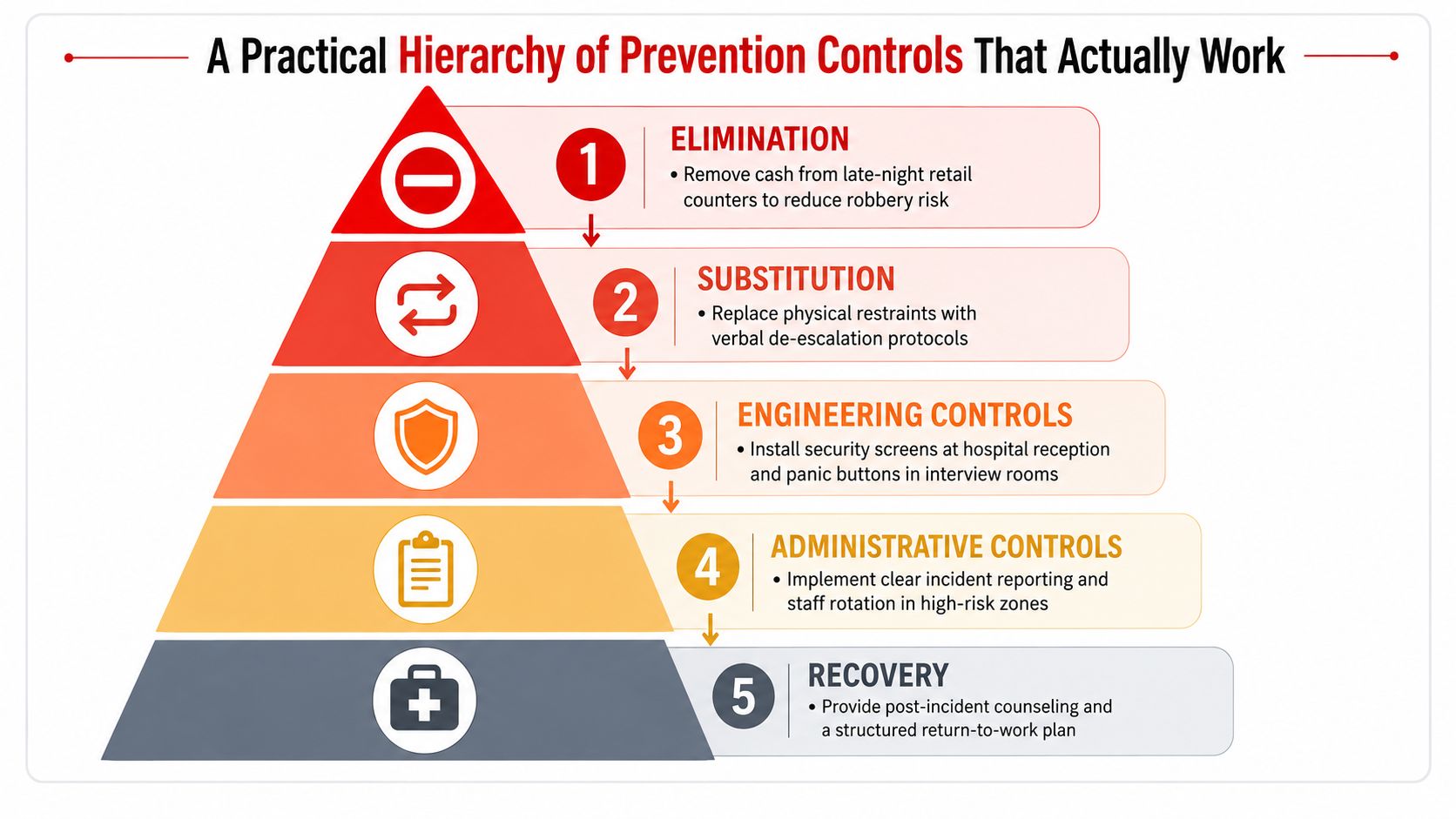
A Practical Hierarchy of Prevention Controls That Actually Work
The hierarchy works because it starts with changing the hazard, not telling workers to cope better. A pub that removes a problematic side entrance has reduced an opportunity for conflict. A bottle shop that changes late-night cash handling has reduced the reward for a robbery. These controls are stronger than relying on a worker's confidence in a tense moment.
Start at the top
Elimination and substitution remove or replace the exposure. Close a side door that creates an uncontrolled entry point at a music venue. End bottle service at a defined operational point if it repeatedly creates disputes. Replace physical intervention by ordinary staff with a verbal refusal and licensed security escalation process.
Engineering controls create space and delay. Use clear sightlines, correctly placed CCTV, stronger lighting, fixed barriers, controlled egress, duress buttons and secure staff-only areas. At a supermarket front counter, a clear route behind the counter matters more than another poster telling staff to stay calm. At a construction office, controlled access and a visible gatehouse allow staff to challenge entry from a safer position.
Make the lower layers support the upper ones
Administrative controls translate the design into consistent behaviour:
- Venue rules: Set capacity, entry, service and removal procedures in writing.
- Communication: Give staff a radio channel, duress code and named escalation point.
- Records: Log threats, harassment, near misses, property damage and physical incidents.
- Supervision: Rotate workers out of high-risk zones and check isolated posts.
- Recovery: Provide first aid, medical assessment, post-incident support and a structured return-to-work discussion.
Body-worn cameras and communication devices can assist with evidence, accountability and rapid support, but they don't replace lighting, distance or trained supervision. Choose two or three controls for the next risk assessment, then test them during a realistic busy period rather than approving them on paper.
Training, De-Escalation and the Role of Licensed Security Staff
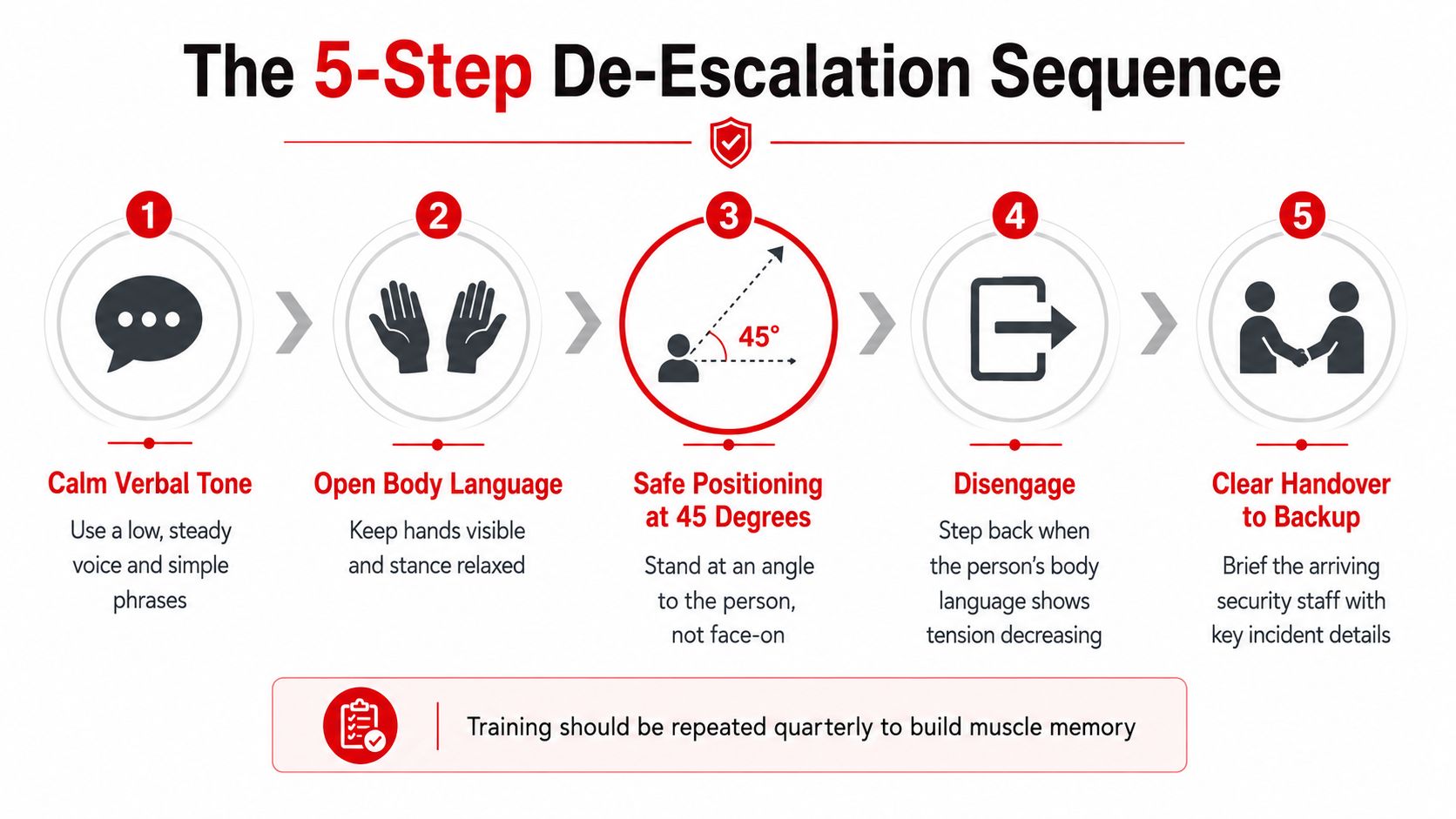
De-escalation is a physical skill as much as a verbal one. A worker who stands squarely in front of an agitated person, blocks the only exit and keeps arguing has reduced their own options. The safer sequence is repeatable.
Use the five-step sequence
- Calm verbal tone: Use a low, steady voice and short phrases. State what you can do, not just what the person can't do.
- Open body language: Keep hands visible, shoulders relaxed and movements deliberate.
- Safe positioning: Stand at roughly 45 degrees, not directly face-on. Keep a clear exit and avoid trapping the person or yourself.
- Disengage: Step back when tension drops, or withdraw immediately when the person advances, threatens or reaches for an object.
- Clear handover: Brief backup with the person's behaviour, location, known risks and action already taken.
Training should be treated as a system. Induction sets the baseline, refresher training reinforces it, scenario drills expose weak points and supervisor debriefs turn incidents into corrections. A bar team needs practice refusing service with an RSA-trained process, while a festival gate team needs practice managing queue compression and calling a supervisor without abandoning the entry point.
RSA requirements differ across NSW, Victoria, Queensland and WA, so managers should confirm the applicable state course, renewal and venue obligations. RSA competence helps staff identify intoxication and make consistent service decisions, but it doesn't authorise ordinary staff to use force.
Licensed security staff add a distinct control through lawful directions, trained intervention, incident witness statements and liaison with police. Their value is greatest when the handover is clear and the officer knows the site plan, duress process and client expectations.
For teams managing remote customer contact, these de escalation strategies for SaaS teams provide useful communication principles that can be adapted to phone and online interactions, although physical workplaces still require positioning, withdrawal and emergency controls.
Incident Response Procedures, Reporting and Recovery
When aggression starts, the first task is not to win the argument. It is to create distance, signal for help and prevent the situation spreading to other workers or customers.
Use this response sequence:
- Recognise and signal: Identify the behaviour and activate the agreed radio, duress or verbal alert.
- Move to safe cover: Take staff and vulnerable people away from the immediate area.
- Call for assistance: State the location, behaviour and whether anyone is injured.
- De-escalate or withdraw: Frontline staff should use trained communication only while a safe exit remains available.
- Escalate: Licensed security or police intervene according to the risk and lawful authority.
- Protect evidence: Isolate witnesses, preserve CCTV and retain relevant radio or access records.
- Treat injuries: Provide first aid and arrange medical assessment, including for psychological injury.
- Record and review: Complete the internal report, debrief staff and update the risk assessment.
- Manage compensation: Give the worker information and support to lodge the applicable workers' compensation notification.
Set internal timeframes that encourage prompt action, such as an initial report within 24 hours and a formal report within 48 hours. Those are internal controls, not substitutes for regulator or insurer requirements. Notifiable incidents involving death, serious injury or illness, or dangerous incidents require the relevant regulator pathway, and each jurisdiction's workers' compensation process should be confirmed before an event.
| Field | What to Capture |
|---|---|
| Date and time | When the incident began and ended |
| Location | Exact area, entry point, room, counter or site zone |
| Persons involved | Names, roles and contact details where appropriate |
| Witnesses | Names, positions and separate observations |
| Behaviour | Threats, abuse, intimidation, assault, property damage or weapon involvement |
| Description | A factual sequence, using the person's words where necessary |
| Injuries | Physical symptoms, psychological effects, first aid and medical referral |
| Evidence | CCTV location, body-worn camera reference, radio traffic and photographs |
| Police reference | Event number or attending officer details, if police attended |
| Actions taken | Evacuation, removal, service refusal, isolation, follow-up and control changes |
Recovery must continue after the person leaves. Offer EAP access, peer check-ins and a return-to-work plan. A supervisor should ask what the worker needs to feel safe on the next shift, then change the system where the answer identifies a control failure.
Partnering With a Security Provider and Your Next Steps
External security works when it connects to the host's existing controls. It shouldn't be a uniformed layer added at the gate while nobody has decided who owns the radio call, who preserves CCTV or who speaks to police.
At an event, a licensed provider can combine front-of-house posts with roving patrols, queue observation and controlled dispersal. In hospitality, RSA-trained crowd controllers can support entry decisions, service refusals and closing procedures. Retail may need duress response and loss-prevention officers, while construction sites often need traffic management, gate control and access verification.
Specify the handover before signing
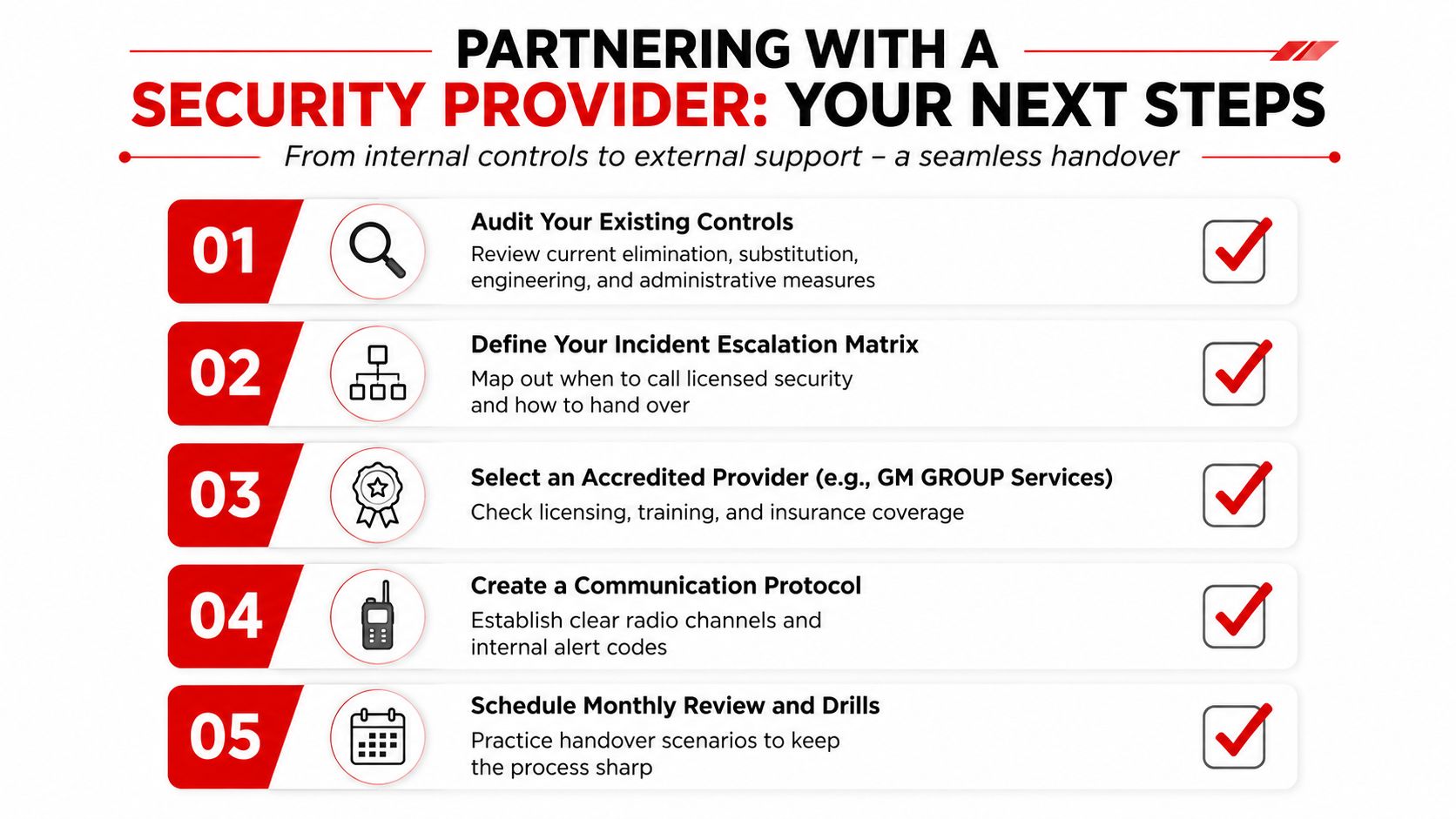
Ask a provider to show how its service will connect to the risk assessment and incident plan. Useful deliverables include:
- Site security plan: Post locations, patrol routes, access points and emergency exits.
- Escalation matrix: Clear thresholds for supervisor, security and police involvement.
- Incident templates: SafeWork-aligned fields for witnesses, evidence, injuries and actions.
- Debrief notes: A record of what happened, what worked and what must change.
- Review process: Scheduled risk reviews, training checks and performance discussions.
GM GROUP Services operates across NSW, Victoria, Queensland and the ACT, with services including static guards, crowd control, vehicle patrols, gatehouse control, loss prevention, emergency response and risk assessments. The relevant selection test is fit for purpose: confirm licensing, training, insurance, supervision, reporting quality and the provider's understanding of your site.
Print this seven-control action plan
- Identify exposure: Walk the venue or site across entry, service, exit and isolated areas.
- Remove opportunities: Close unsafe access points and change tasks that expose workers unnecessarily.
- Improve the environment: Fix lighting, sightlines, barriers, duress access and controlled egress.
- Set procedures: Document refusal, reporting, radio, witness and evidence processes.
- Train and drill: Practise calm communication, safe positioning, withdrawal and handover.
- Deploy licensed support: Match security posts and patrols to the actual risk, not habit.
- Recover and review: Support affected workers, complete reports and revise controls after incidents.
Complete the audit, mark the gaps and request a joint walk-through within 30 days. A practical service scope should name the posts, hours, equipment, escalation triggers, reporting outputs and review dates before the first shift begins.
GM GROUP Services provides licensed security for events, venues, hospitality, retail and construction sites, with custom guard deployment, crowd control, patrols, gatehouse support, emergency response and risk assessments across NSW, Victoria, Queensland and the ACT. Visit GM GROUP Services to discuss your occupational violence and aggression controls, request a site review and build a security plan that works under real operating pressure.
Discover more from GM Group Services
Subscribe to get the latest posts sent to your email.