
Benefits of security guards extend beyond visible deterrence. Australia had 52,768 full-time security personnel compared with 44,898 police officers in 2006, and ABC reported about 155,000 licensed guards in 2023, showing how central private security has become to frontline protection. Australian Institute of Criminology data and ABC reporting support the scale of this workforce.
A venue manager watching an unauthorised person approach a staff entrance, a retailer facing repeated theft, or a construction supervisor discovering an open gate needs more than a camera recording the problem. A trained guard can identify the risk, speak to the person, secure the area, document what happened and escalate the matter before a minor issue becomes an injury, shutdown or reputational problem.
The right deployment differs across events, hospitality, retail, corporate offices and construction sites. Procurement teams should connect guarding hours and role types with operational outcomes, including incident response time, unauthorised access attempts, theft patterns, injury events, evacuation performance, customer feedback, training compliance and insurance discussions. Examples help explain what good deployment looks like, but supplied case figures, ROI claims and compliance references should be documented and validated for the relevant Australian state before publication.
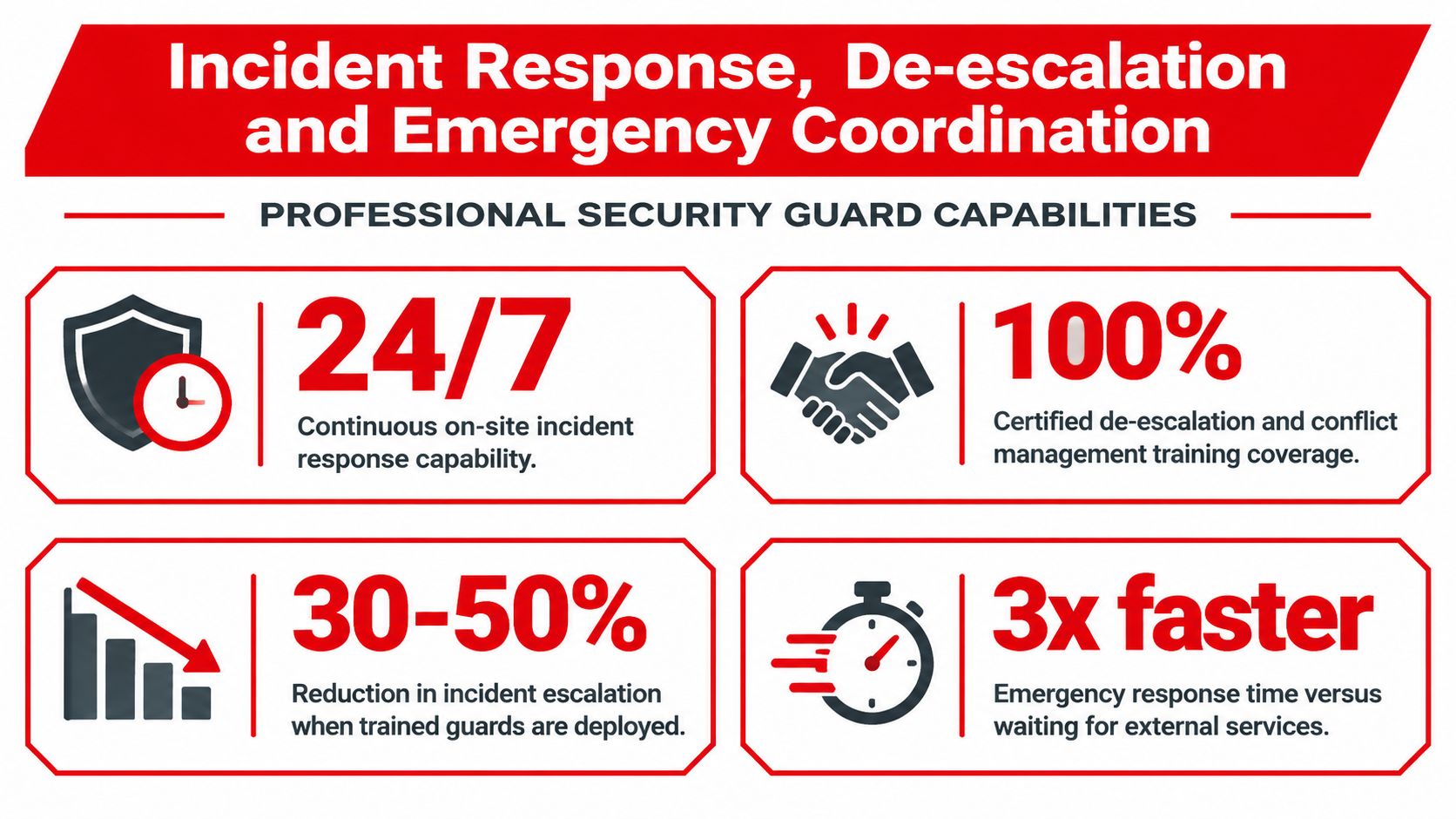
1. Incident Response, De-escalation and Emergency Coordination
The first operational advantage of security guards is human intervention at the moment risk appears. A guard can notice aggressive behaviour, an access breach, a medical emergency or a developing crowd problem, then take proportionate action while contacting supervisors or emergency services.
Cameras and alarms can detect events, but they can't calm an intoxicated person, separate disputing patrons, guide people away from danger or provide immediate reassurance. A professional guard can establish space, protect vulnerable people, preserve evidence and keep staff focused on their core duties.
In hospitality, the response may involve removing a disruptive patron without inflaming the situation. At a festival, guards can isolate a restricted area or redirect movement. On a construction site, they can secure an incident location and prevent workers or visitors from entering before the site manager assesses the risk.
What a response-ready deployment needs
A procurement decision should test capability, not just headcount. Ask how the provider handles:
- De-escalation: Guards should understand verbal calming techniques, boundaries, safe positioning and escalation triggers.
- Emergency coordination: Radio channels, supervisor contact details and procedures for ambulance, police and fire services should be clear before a shift begins.
- Incident reporting: Templates should capture the time, location, people involved, action taken, witnesses and outcome.
- Post-incident support: Managers should provide structured debriefing and psychological support after traumatic events.
Practical examples supplied for this use case include a Brisbane music festival where guards removed an intoxicated patron attempting to enter restricted areas, a Gold Coast resort where a CPR-trained guard intervened during a guest cardiac arrest, and a Sydney festival where guards coordinated evacuation during severe weather. These examples should be supported by client records before they're used as published case studies.
Practical rule: Measure the time from first observation to supervisor notification, intervention and handover. A shorter response is valuable only when the action is safe, documented and appropriate.
Schedule regular scenario exercises with the security team, including medical incidents, conflict, evacuation and restricted-area breaches. The Australian security workforce profile from Jobs and Skills Australia describes Security Officers and Guards as an established occupation, which supports matching trained personnel to different duties rather than treating every post as interchangeable.
2. Crime Prevention and Theft Deterrence
Visible guarding changes the calculation for opportunistic offenders. A uniformed professional at an entry, exit, loading area or high-value zone signals that someone is actively observing behaviour and can respond immediately.
The benefit isn't limited to physical presence. Effective loss prevention combines patrols, access control, CCTV coordination, staff communication and accurate reporting. A guard may identify repeated suspicious behaviour, notice a vehicle returning to a site, challenge an unauthorised person or preserve information that helps management recognise a pattern.
Australia's long-term experience provides useful context. ABC reported that private security numbers rose to record levels while overall offending fell across most categories over the past two decades, and that the growth in guarding didn't appear to correlate with increased crime. The reported Australian security and crime trend supports a preventative interpretation, although each organisation still needs its own baseline to assess results.
Match posts to vulnerability
A retail operator shouldn't place guards where they're easiest for customers to see if the actual loss point is an unobserved stockroom corridor. A construction manager may need a gatehouse post during deliveries and mobile patrols outside active hours. A resort may prioritise guest-floor observation, staff entrances and car parks.
Use deployment records to test whether posts are working:
- High-risk positioning: Cover exits, storerooms, contractor gates, entry points and isolated plant areas.
- Controlled checks: Use lawful, clearly communicated procedures for bag inspections and spot checks.
- Technology coordination: Compare guard observations with CCTV footage to identify recurring times, locations and behaviours.
- Access decisions: Define who may be refused entry and which situations require police involvement.
- Reporting quality: Track incidents by category, location and outcome rather than counting patrols alone.
The supplied examples include a Sydney shopping centre reporting a reduction in organised retail crime after placing static guards at multiple entrances, a Gold Coast resort using hospitality-focused theft prevention, and Perth construction sites using continuous patrols to reduce equipment theft. Those percentages, dollar amounts and incident counts require source documentation and shouldn't be published as verified performance metrics without it.
A guard's value is therefore best assessed against avoidable loss, disruption and recovery effort, not visibility alone.
3. Professional Access Control and Crowd Management
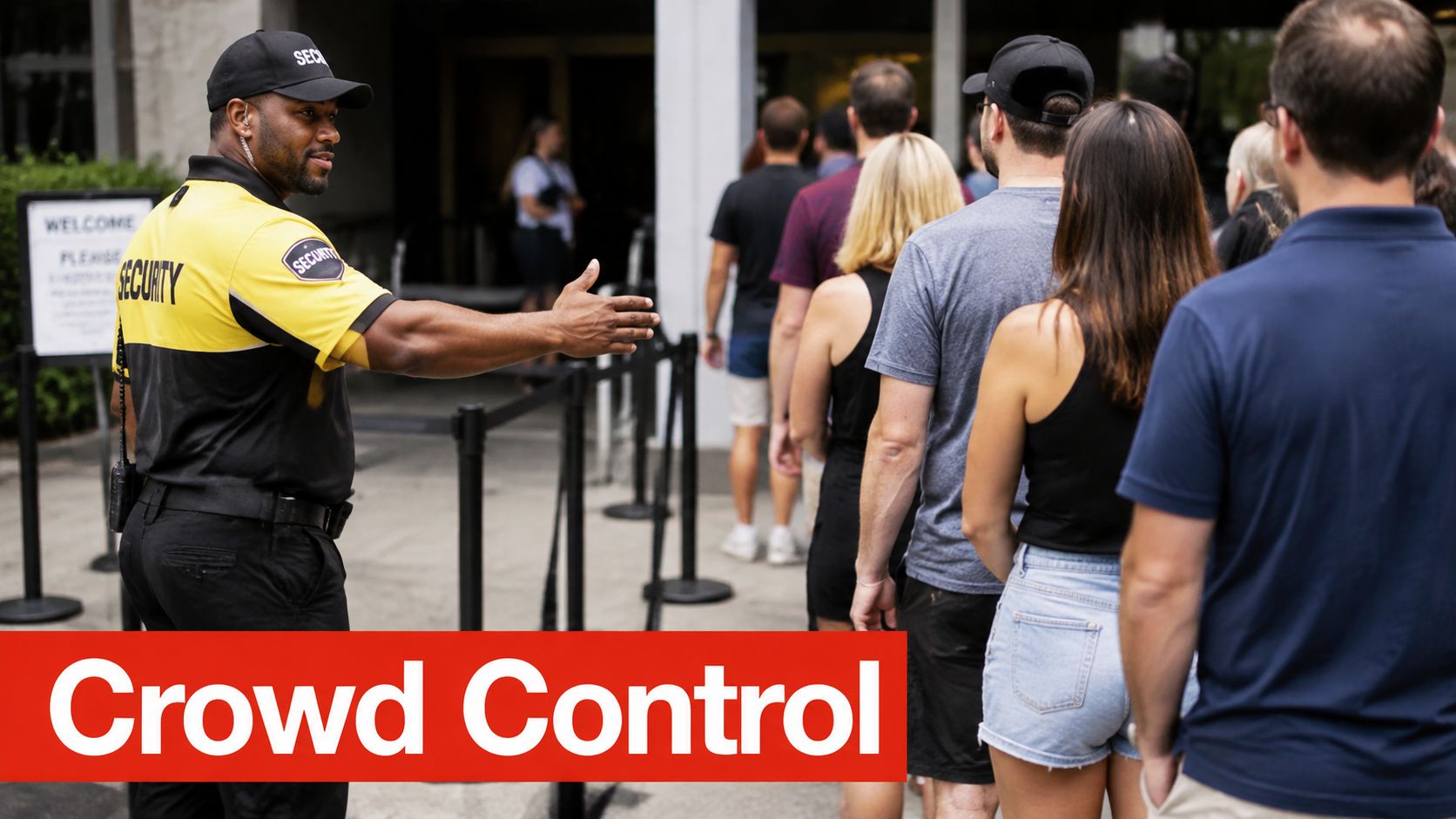
Crowd risk often develops through small failures. A credential isn't checked, a queue spills into a vehicle path, a restricted gate remains open, or people move toward a blocked area without clear direction. Security guards provide the physical coordination needed to manage those moments while preserving a usable customer experience.
At events, guards can verify passes, direct queues, monitor density and keep emergency routes clear. In corporate buildings, they can check employee credentials and challenge unfamiliar visitors. In retail, they can guide customer movement during busy trading periods. On construction sites, gatehouse guards can manage contractors, deliveries and visitor records.
Human judgement protects flow
A sign can communicate a capacity limit, but it can't judge whether a group is becoming distressed or whether a queue is obstructing an emergency route. A camera can show congestion, but a guard can move to the precise location, speak to the people involved and coordinate an alternative path.
The practical design should include:
- Zone ownership: Assign guards to defined entrances, stages, queues, loading areas or restricted zones.
- Radio discipline: Use agreed call signs and short escalation messages so supervisors receive useful information quickly.
- Density awareness: Train personnel to recognise compression, counterflow, blocked exits and signs of distress.
- Credential control: Separate ticket checking, accreditation, contractor access and emergency access where the risk requires it.
- Post-event review: Compare crowd movement observations with complaints, incidents and queue conditions.
A supplied example describes a New South Wales music festival using more than 150 trained staff for more than 45,000 attendees without serious incidents. Other supplied examples describe a Melbourne conference preventing unauthorised access attempts and a Queensland mall reducing customer injuries during Boxing Day sales. These figures need validation before publication, and event organisers should avoid treating attendance alone as proof of successful crowd management.
For planning context, procurement teams can also browse crowd control systems from Material Handling when combining physical barriers with trained guards. Barriers shape movement. Guards interpret behaviour and respond when the plan meets real people.
4. Enhanced Insurance Coverage and Liability Reduction
Security can support an organisation's duty-of-care position, but it doesn't automatically reduce premiums or eliminate liability. The defensible benefit comes from a documented, risk-based system that shows why coverage was selected, what guards were instructed to do and how incidents were handled.
That evidence can help during insurance renewal discussions and after an incident. A venue with clear post orders, training records, patrol logs and incident reports can demonstrate that it identified foreseeable risks and applied controls. A construction site can show how it controlled site access, protected equipment and escalated hazards. A hospitality operator can document how guards responded to conflict, intoxication and restricted-area breaches.
Treat documentation as a control
A guard's report should make the operational story understandable to someone who wasn't present. It should distinguish observed facts from assumptions, record escalation and identify any handover to police, ambulance, fire services or management.
Procurement teams should request:
- Coverage records: Confirm dates, locations, shifts and assigned roles.
- Training evidence: Check relevant licences, first-aid status and refresher training.
- Post orders: Ensure written instructions reflect the actual site risk.
- Incident logs: Review whether reports capture action and outcome, not just event labels.
- Renewal material: Give the broker evidence of controls before discussing insurance outcomes.
Supplied examples describe a Brisbane hospitality group reporting lower annual premiums after introducing continuous security and documented response procedures, a Sydney venue using incident reports in an assault claim, and a Gold Coast resort receiving a liability premium reduction after formal risk documentation. Those financial outcomes are not verified by the supplied regulatory or industry sources, so they should be treated as examples requiring client and insurer confirmation.
The sounder ROI question is not, “Will guards guarantee a discount?” It's, “Can this deployment reduce exposure and produce credible evidence of reasonable risk management?” The answer depends on the site, insurer, contract terms and quality of implementation.
5. Customer Experience Improvement and Welcoming Atmosphere
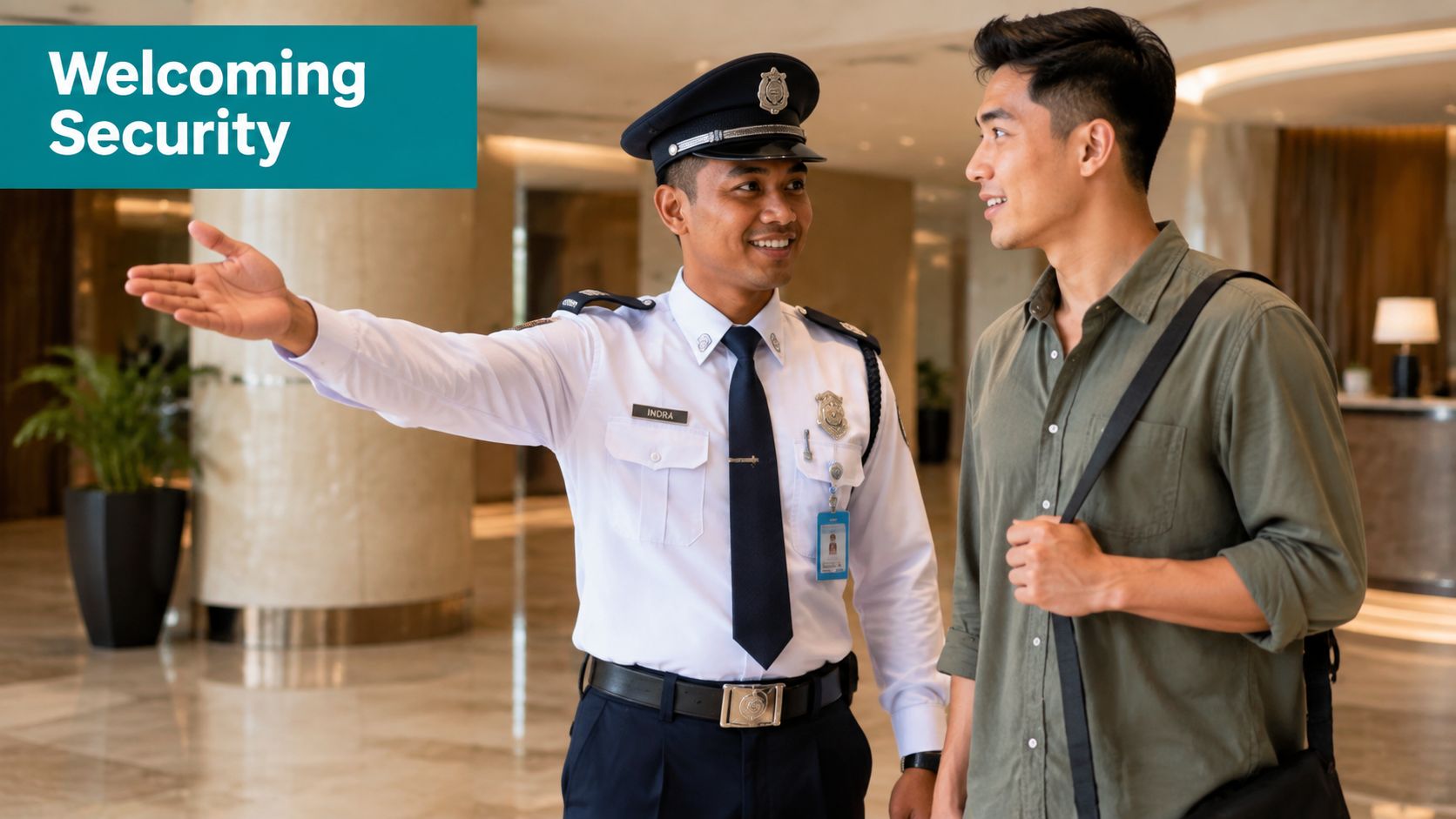
A guard can make a venue feel safer without making it feel hostile. The difference comes from recruitment, briefing and supervision. Personnel who greet visitors, provide directions, explain access rules calmly and use discreet radio communication can become part of the customer journey rather than an interruption to it.
This is particularly important in hotels, restaurants, clubs, shopping centres and conferences. Visitors may approach a uniformed guard first when they need help finding an entrance, locating a lost child, understanding a queue or reporting uncomfortable behaviour. A guard who knows the layout and the venue's service expectations can resolve simple issues without escalating them.
Select for interaction as well as control
The procurement brief should define customer-facing requirements alongside security duties:
- Service behaviour: Specify greetings, tone, appearance and assistance standards.
- Venue knowledge: Brief guards on entrances, amenities, exits, accessible routes and emergency assembly areas.
- Discreet communication: Set expectations for radio volume, personal devices and public conversations.
- Feedback collection: Ask customers and venue staff whether security felt professional, approachable and effective.
- Supervisor observation: Review interactions during live operations, not only after complaints.
The supplied examples describe a Melbourne shopping centre reporting improved mystery-shopper results after replacing cameras as the primary visible measure with customer-service-trained guards, a Sydney nightclub reporting higher satisfaction after hiring hospitality-trained security, and a Gold Coast resort linking a concierge security programme with more family bookings. The supplied percentages, ratings and booking figure need validation before publication.
A better measurement model combines safety and experience. Track complaints, assistance requests, conflict outcomes, customer feedback and repeat operational issues. A guard who prevents a disturbance while helping visitors reach the right place may protect revenue in a way that a simple incident count won't capture.
6. 24/7 Monitoring and Real-Time Threat Detection
Continuous guarding provides context that automated systems often lack. A camera may show someone near a vehicle, a badge reader may record an unusual entry, or an alarm may indicate a door opening. A night guard can connect those signals with behaviour, timing, lighting, vehicle movement and site conditions.
That human layer is especially useful for construction sites, industrial facilities, hotels, corporate buildings and properties with valuable equipment. Mobile patrols can identify damaged fencing, open gates, suspicious vehicles and unsafe conditions. Static guards can monitor the same access point consistently, while supervisors compare observations across shifts.
Build a monitoring system, not a lonely post
A guard working through the night needs clear information and escalation support. Provide site schematics, vulnerability maps, contact lists and instructions for preserving evidence. Use scheduled communication check-ins, with the interval selected through risk assessment rather than an arbitrary routine, and require meaningful status updates.
The operating model should answer five questions:
- What counts as suspicious? Define observable behaviours and site-specific warning signs.
- Who decides escalation? Name the supervisor and the circumstances requiring police, emergency or client contact.
- What does the guard check? List doors, fences, plant, lighting, restricted rooms and other relevant assets.
- How is technology used? Link patrol observations with CCTV, access logs and alarm records.
- How is alertness maintained? Use appropriate rotation, supervision, breaks and post design.
Supplied examples include Perth patrols identifying a burglary pattern, night guards at a Sydney corporate building detecting suspicious server-room badge activity, and a Brisbane hotel guard identifying a forged guest registration. These are practical scenarios, not verified published case studies, so the underlying records should be reviewed before the claims are used commercially.
The performance measure should include detection quality and response handling. Count actionable observations, false alarms, confirmed breaches, time to escalation and repeat vulnerabilities. That approach shows whether monitoring is preventing incidents or merely producing paperwork.
7. Regulatory Compliance, Legal Protection and Strategic Intelligence
Licensing and compliance are part of the procurement decision, not administrative details added after a contract is signed. The requirements differ by state and by assignment. In New South Wales, applicants must be at least 18, meet fit-and-proper and identity requirements, and enrol in or complete approved training for the licence class sought under the NSW security licensing legislation.
Queensland applies specific requirements where a guard intends to possess weapons while performing security duties, as set out in the Queensland guard security licence guidance. Victoria requires people acting as armed guards or cash-in-transit firearm holders to hold a current firearms licence as well as a private security licence, according to Victoria Police private security guidance.
Reforms make verification more important
Victoria's 2025 private security reforms made all private security activities licensed activities and introduced additional obligations for existing licence holders. From 19 December 2025, independent contractors with an ABN must hold both a Private Security Business licence and a Private Security Individual Operator licence, while first-aid and refresher-training requirements also form part of the changed compliance environment. The Victorian regulatory impact statement should be checked against current official guidance before contracting.
Compliance should also generate intelligence. A monthly report can reveal recurring conflict locations, access failures, shift-change vulnerabilities, repeated equipment exposure or times when staffing is poorly matched to demand.
Use a management dashboard covering:
- Licence status: Record expiry dates, role permissions and state requirements.
- Training currency: Check first aid, de-escalation and assignment-specific training.
- Incident patterns: Group reports by time, place, type and outcome.
- Corrective action: Assign owners and due dates for identified vulnerabilities.
- Effectiveness review: Compare conditions after changes with the original baseline.
The supplied examples describe avoided fines, reduced workplace safety risk and theft reductions after analysing shift-change patterns. Those claims require validation. The reliable conclusion is narrower and more useful: a licensed provider with disciplined reporting can help management identify compliance gaps and make better deployment decisions.
7-Point Benefits Comparison of Security Guards
| Service | Implementation Complexity 🔄 | Resource Requirements ⚡ | Expected Outcomes 📊 | Ideal Use Cases 💡 | Key Advantages ⭐ |
|---|---|---|---|---|---|
| Incident Response, De-escalation and Emergency Coordination | High 🔄, intensive training, protocols, incident command | High ⚡, 24/7 staff, certified first‑aid, comms links | Immediate stabilisation, reduced escalation, lifesaving interventions, 📊 ⭐⭐⭐⭐⭐ | Events, hospitality, construction sites, corporate locations | Rapid on-site response; evacuation coordination; medical first aid |
| Crime Prevention and Theft Deterrence | Medium 🔄, patrol patterns, SOPs, CCTV coordination | Medium ⚡, visible guards, loss-prevention tools, some tech | Reduces shrinkage (30–50%), fewer thefts and claims, 📊 ⭐⭐⭐⭐ | Retail, shopping centres, resorts, construction sites | Strong deterrence; lowers inventory loss; reduced insurance claims |
| Professional Access Control and Crowd Management | Medium–High 🔄, crowd psychology, credential systems | Medium ⚡, checkpoint staff, ID systems, radios | Prevents overcrowding, enforces capacity, fewer injuries, 📊 ⭐⭐⭐⭐ | Large events, conferences, peak retail periods | Capacity control; restricted-area protection; smoother flow |
| Enhanced Insurance Coverage and Liability Reduction | Low–Medium 🔄, documentation, risk assessments | Low ⚡, administrative records, formalised security measures | Insurance premium reductions (≈10–25%); stronger legal defence, 📊 ⭐⭐⭐⭐ | Venues seeking premium savings, hospitality, public venues | Premium discounts; evidence of reasonable care; risk mitigation |
| Customer Experience Improvement and Welcoming Atmosphere | Medium 🔄, customer-service training plus security skills | Low–Medium ⚡, front-facing guards with soft-skill training | Higher satisfaction and dwell time (examples: +28% bookings), 📊 ⭐⭐⭐⭐ | Hotels, malls, family-oriented venues, hospitality settings | Brand-ambassador presence; increased customer confidence and loyalty |
| 24/7 Monitoring and Real-Time Threat Detection | High 🔄, continuous ops, integration with CCTV and patrols | High ⚡, round-the-clock staff, patrol vehicles, monitoring tech | Detects threats early; prevents ~73% incidents before escalation, 📊 ⭐⭐⭐⭐⭐ | High-value sites, corporate campuses, 24/7 facilities, construction | Real-time detection; covers blind spots; proactive intervention |
| Regulatory Compliance, Legal Protection and Strategic Intelligence | Medium–High 🔄, licensing, reporting, analytics workflows | Medium ⚡, certified staff, data collection and reporting systems | Reduces fines/licence risk; intelligence cuts repeat incidents 35–65%, 📊 ⭐⭐⭐⭐ | Licensed venues, construction, organisations needing compliance | Regulatory alignment; audit trail; data-driven incident reduction |
Turn Security Benefits Into Measurable Results
The benefits of security guards become commercially meaningful when procurement teams connect each duty to a risk, a measure and a decision. Start with a site-specific assessment. An event promoter may need crowd control, gate screening, emergency coordination and response supervisors. A hotel may need overnight patrols, guest assistance and conflict de-escalation. A retailer may prioritise loss prevention and exit coverage. A construction manager may require gatehouse control, contractor verification, mobile patrols and protection of plant.
Define coverage by location and shift before requesting a price. A low-risk office entrance, a crowded festival gate and an isolated construction perimeter shouldn't receive the same staffing model. Ask providers to explain why they recommend static guards, mobile patrols, K9 units, covert operations, VIP protection, vehicle patrols, back-to-base monitoring or emergency response for the specific risk.
Then verify the provider. Check licences, business credentials, individual operator permissions, first-aid status, refresher training, supervision arrangements, insurance documentation and incident-reporting procedures. In Victoria, procurement teams should account for the 2025 reforms and the additional obligations applying to relevant contractors. In NSW, confirm age, probity and approved-training requirements for assigned personnel. In Queensland, check weapons permissions where the assignment involves weapons.
KPIs that support a real ROI review
A useful measurement plan can include:
- Incidents by type and location, to identify recurring exposure.
- Response time, from observation to intervention and escalation.
- Unauthorised access attempts, including credential and contractor issues.
- Shrinkage and theft events, matched against the relevant coverage period.
- Injury and medical events, including evacuation and handover performance.
- Customer feedback, focused on both safety and professionalism.
- Training compliance, including licence and refresher status.
- Insurance outcomes, recorded as confirmed broker or insurer results rather than assumptions.
ROI doesn't require an invented percentage. Compare the cost of deployment with documented avoided losses, reduced disruption, response improvements, customer outcomes and compliance evidence. Keep the baseline, calculation method and validation source for every reported result.
Frequently asked questions
Are security guards worth the cost?
They can be, when the deployment addresses a defined risk and performance is measured. The Australian workforce is substantial, with more than 120,000 licensed guards noted by the Australian Strategic Policy Institute, and Jobs and Skills Australia lists Security Officers and Guards as an established occupation with median weekly earnings of $1,818. The ASPI workforce reference and Jobs and Skills Australia profile provide context for the scale and professional nature of the labour pool. Before publication, verify the relevant ASPI page and use the workforce figure only with its original supporting context.
How should a business calculate security ROI?
Set a baseline for incidents, theft, response time, injuries, complaints and access failures. Compare those measures after deployment, then account for guard costs, avoided losses, operational continuity, customer feedback and confirmed insurance or compliance outcomes. Don't assign a financial value to an avoided incident unless the assumptions are documented.
Which roles suit events, hospitality, retail and construction?
Events commonly need crowd controllers, access teams, supervisors and emergency coordination. Hospitality often needs customer-facing guards and conflict response. Retail may require static loss prevention and entrance coverage. Construction sites frequently use gatehouse control, contractor checks, patrols and equipment protection.
How should a business evaluate GM GROUP Services?
Review how GM GROUP Services matches licensed personnel and service types to the site, including static guards, K9 units and handlers, VIP and bodyguard protection, covert operations, vehicle patrols, gatehouse control, loss prevention, monitoring, emergency response and risk assessments. Ask for a written deployment plan, supervision model, reporting examples, training records and state-specific compliance confirmation at GM GROUP Services. Validate all supplied claims, metrics and regulatory references for the relevant Australian state before publication.
Security should be treated as an operating control, not a generic line item. The procurement team should document the risk, choose the role, set the KPI, review the evidence and adjust coverage when conditions change.
GM GROUP Services provides licensed security across New South Wales, Victoria, Queensland and the ACT for events, venues, businesses, hospitality, retail and construction sites. Discuss static guarding, crowd control, patrols, access management, loss prevention, emergency response or a site-specific risk assessment with GM GROUP Services and request a fit-for-purpose security plan.
Discover more from GM Group Services
Subscribe to get the latest posts sent to your email.