
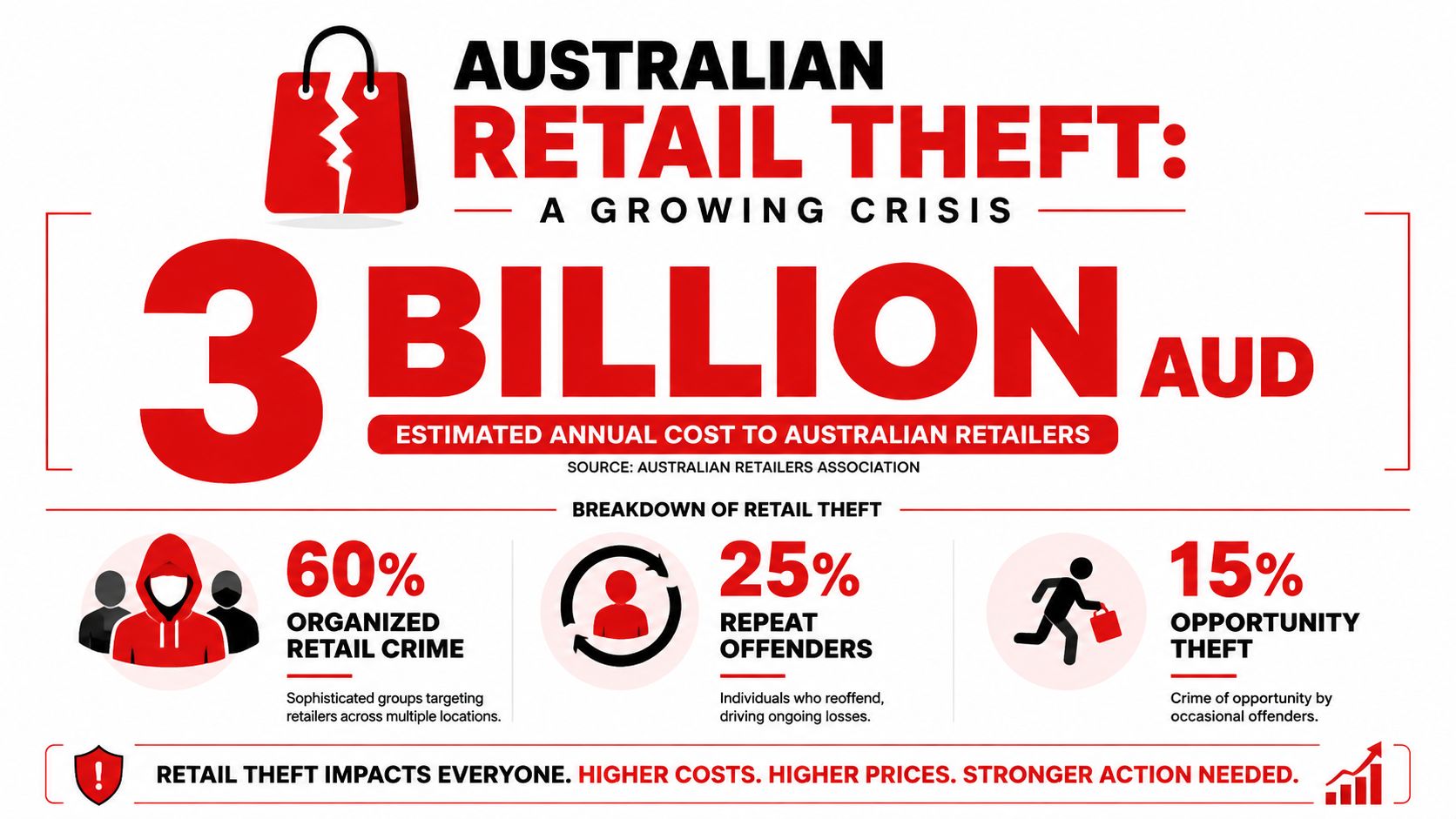
Loss prevention in retail stores has become a frontline operating priority. The Australian Bureau of Statistics recorded 595,660 victims of theft, excluding motor vehicle theft, in 2024, the highest number in 21 years, and the figure was 6% higher than in 2023 (ABS theft data summary). Retail locations accounted for 45% of theft incidents in 2024, compared with about 32% in 2010, putting stores at the centre of Australia's most common property crime problem.
That change has practical consequences for managers in NSW, VIC, QLD and the ACT. Cameras, tags and locked cabinets still have a place, but they won't compensate for empty aisles, weak incident reporting, poorly trained staff or a response model that treats every theft as an isolated event. Effective protection now combines store design, human visibility, safe intervention, accurate inventory controls and targeted technology.
Why Loss Prevention in Retail Stores Demands Urgent Attention
A NSW store can record more than 29,000 retail theft incidents in a year. Recorded incidents rose from 28,114 in 2023/24 to 29,552 in 2024/25, a 5.1% increase over two years, and were nearly 30% higher than a decade earlier (NSW retail theft analysis). Earlier BOCSAR analysis recorded a 47.5% year-on-year increase from October 2021 to June 2023, showing how quickly conditions changed after the pandemic (BOCSAR retail theft report).
Victoria presents the same pressure at store level. Theft from retail stores reached 41,547 incidents in 2025, up 6.1% year on year and 47.1% since 2023 (Griffith University retail crime analysis). Across Australia, retail crime was estimated to cost the sector A$7.79 billion in 2023–24. Managers therefore have to account for margin loss, roster decisions, insurance, customer confidence and staff retention, alongside the shrinkage figure.
Loss is broader than shoplifting
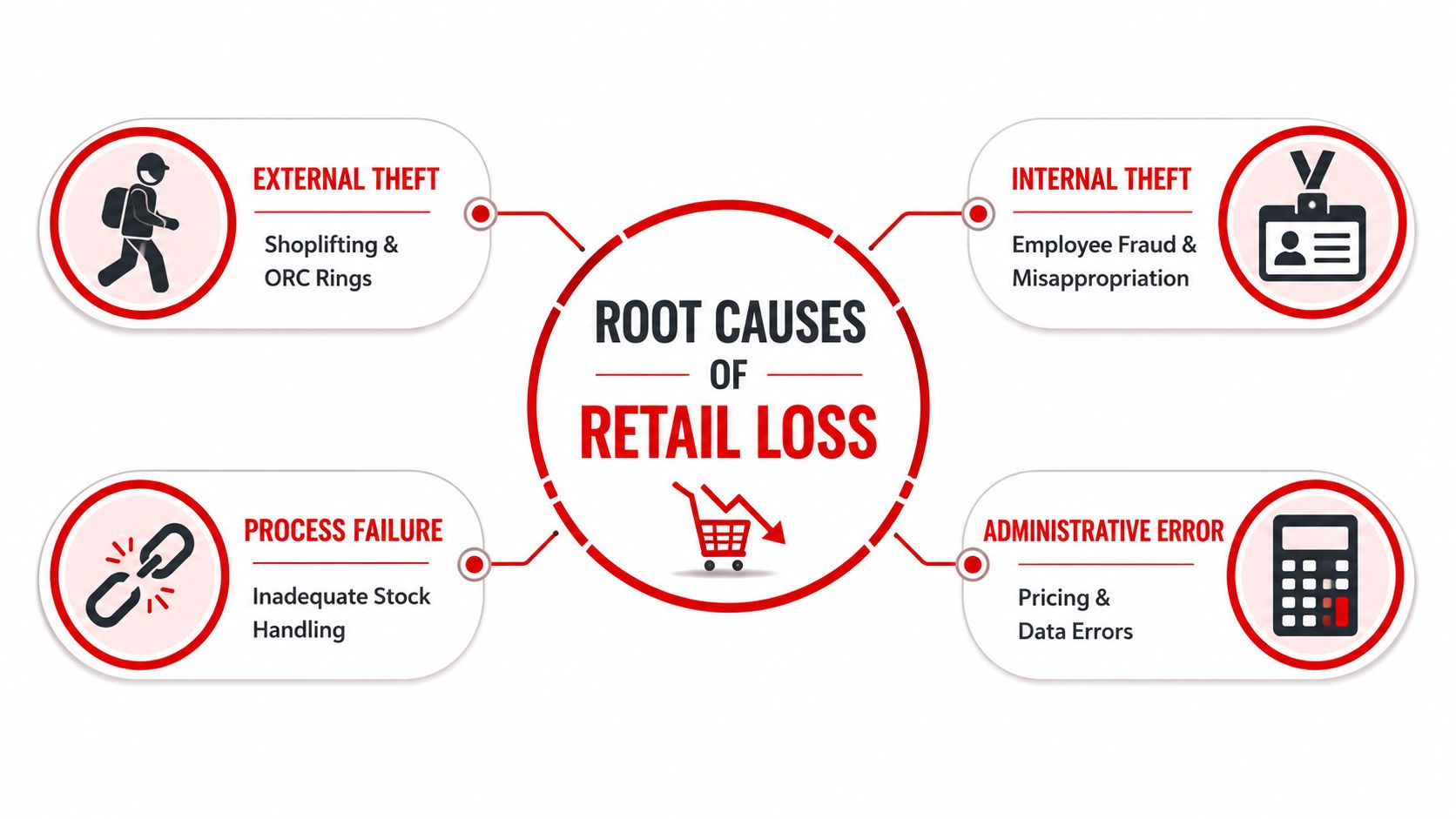
A useful loss prevention plan traces four connected leakage points:
- External theft: Opportunistic shoplifting, grab-and-run incidents, organised theft and aggressive behaviour at exits.
- Internal theft: Refund manipulation, sweethearting, unauthorised discounts, cash misuse and collusion.
- Administrative loss: Mis-scans, receiving discrepancies, pricing errors, vendor shortfalls and weak stock reconciliation.
- Damage and waste: Expired products, poor storage, handling damage and avoidable disposal.
The control must fit the cause. Extra guards will not correct a receiving process that accepts incomplete deliveries. Cameras will not expose refund fraud if managers ignore POS exceptions. A clean stock file will still leave a liquor store exposed if staff lack a safe procedure for a repeat offender who intimidates them.
Treat loss as a boardroom issue
Store leaders should review loss beside sales, labour, safety and customer experience. The ABS reported a 29% increase in “other theft” victims in 2024, reinforcing the pressure on retailers (Australian theft statistics).
That pressure supports a shift from passive deterrence to active, staffing-driven control. Managers need visible coverage during known incident periods, reliable reporting and staff who can recognise repeat-offender patterns safely. Technology should support those decisions, while floor presence addresses the venue-specific behaviour cameras and tags cannot manage alone.
Understanding the Root Causes of Retail Loss
The first diagnostic question isn't “Which camera should we buy?” It's “Where does the loss enter the business?” A store that answers that question poorly can spend heavily while leaving the actual weakness untouched.
External theft requires visibility and safe response
External theft includes concealed merchandise, coordinated grab-and-run activity and confrontational incidents. Industry reporting found that the top 10% of offenders accounted for about 60% of total harm and loss, while weapon events rose 66% year on year and intimidating or threatening events rose 39% (Australian retail crime reporting). Those patterns make staff safety as important as merchandise recovery.
Practical controls include clear facial coverage at entrances and POS, staffed sightlines, high-risk products near attended areas, useful incident descriptions and a response path for repeat offenders. Employees shouldn't physically confront someone to recover stock.
Internal theft needs controls without destroying trust
Internal loss can involve sweethearting at checkout, refund abuse, unauthorised price changes, cash handling failures or employees working with external offenders. The correct response is not blanket suspicion. It's separation of duties, permission controls, audit trails and exception-based review.
A store manager should be able to identify who processed a refund, who approved it and whether the transaction fits policy. Review patterns rather than personalities, then investigate fairly and document decisions.
Process failure often looks like theft
Receiving discrepancies, mis-picks, inaccurate transfers and poor inventory reconciliation can create phantom stock. If a product was never correctly received, a later count may wrongly classify the shortage as customer theft. Standardised receiving checks, manager sign-off and regular reconciliation help separate process failure from deliberate loss.
Damage and waste need their own controls. Pharmacies, supermarkets and convenience stores should review expiry handling, storage temperature, product rotation and disposal authorisations. The answer depends on the category, not on a generic security package.
Comparing Store Layout, Staffing, and Technology Controls
The most effective programme usually combines controls rather than choosing a single winner. Layout changes influence opportunity, people provide judgement and intervention, while technology improves visibility and creates an audit trail.
NSW Government guidance recommends keeping storerooms and staff areas inaccessible to customers with swipe cards or PIN codes, removing blind spots with mirrors or CCTV, using security tags on highly priced items, making eye contact with entering customers and displaying high-risk stock where staff can see it (NSW retail theft prevention guidance).
| Control Type | Best For | Cost Profile | Limitations | ROI Timeline |
|---|---|---|---|---|
| Store layout | Boutiques, pharmacies and small-format stores | Lower ongoing cost, with possible fixture changes | Determined offenders may adapt | Often visible after operational changes |
| Uniformed staffing | Entry points, shopping centres and high-risk periods | Recurring labour cost | Can become passive without clear duties | Depends on coverage and response quality |
| Covert staffing | Repeat offenders and organised theft patterns | Higher skill and supervision requirement | Less visible deterrence | Useful when intelligence is actionable |
| CCTV and analytics | Multi-site retailers and incident review | Upfront technology and ongoing maintenance | Alerts need trained human follow-up | Builds value as data and workflows mature |
| EAS and security tags | Apparel, electronics and premium merchandise | Per-item and system costs | Tags don't replace observation or response | Linked to correct placement and alarm handling |
| POS and inventory controls | Refund, discount, receiving and stock issues | System and process investment | Poor data creates misleading alerts | Improves as managers review exceptions consistently |
A small clothing boutique may gain more from clear sightlines, premium stock near the counter and a trained officer during vulnerable trading periods than from an expensive analytics platform. Large-format retail needs broader integration, including CCTV coverage, receipt procedures, self-checkout supervision, POS exception reporting and inventory controls.
For apparel managers reviewing tag types, the security tags for clothing guide provides useful context on how different tagging approaches fit merchandise and store operations. Tags are valuable when staff respond consistently, but an alarm that nobody owns soon becomes background noise.
Practical rule: Technology detects. People interpret, intervene safely and close the incident loop.
Building a Layered Loss Prevention Strategy
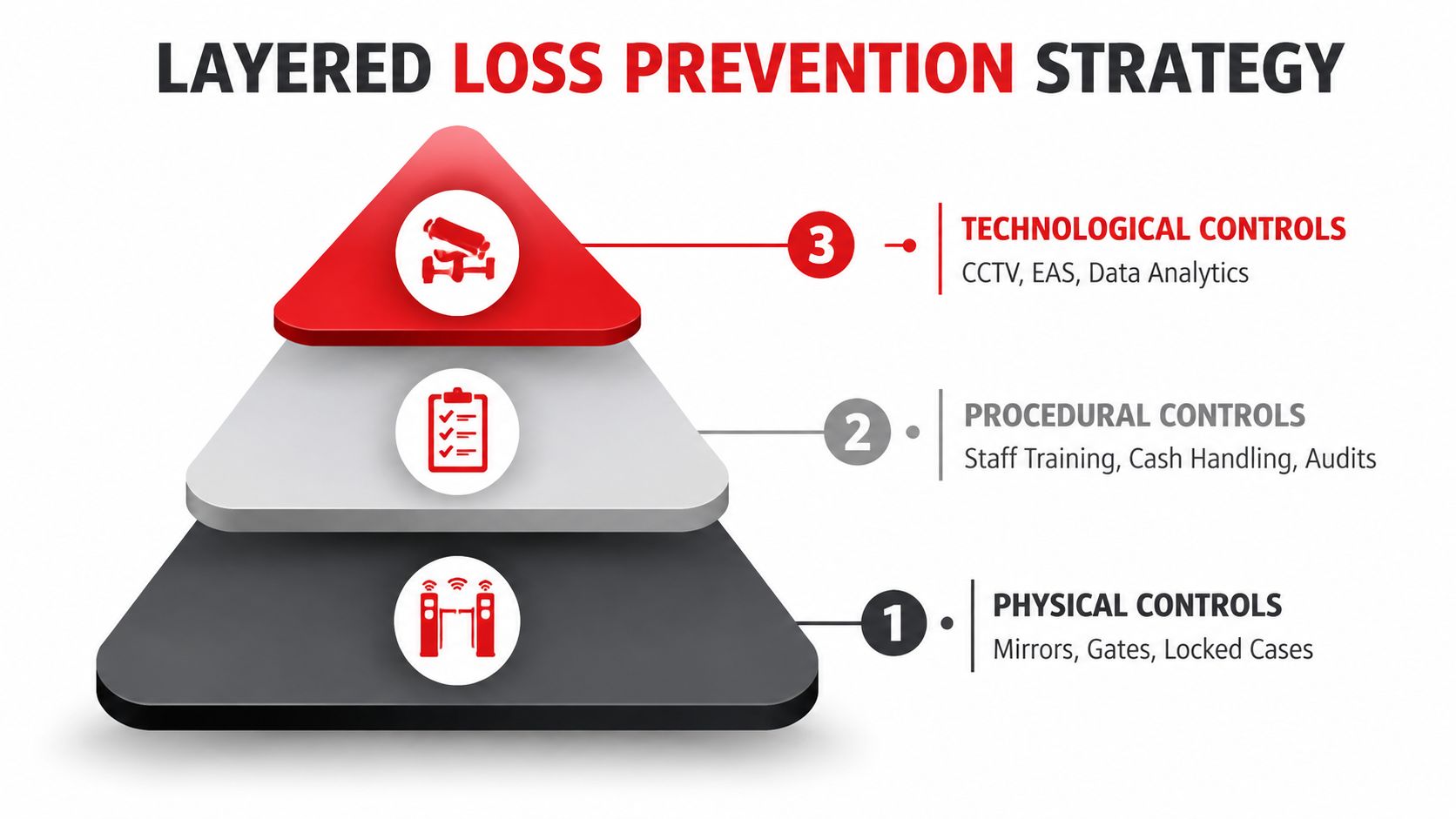
A layered model works because each control addresses a different failure point. Physical measures slow or discourage access, procedures establish consistent behaviour, and technology helps teams detect patterns that are difficult to see manually.
Start with the operating foundation
Begin with access, layout and staff practice before purchasing advanced tools.
- Secure restricted areas. Use controlled access for storerooms, staff rooms and cash locations. Keep keys, codes and access permissions reviewable.
- Train the floor team. Staff should know how to greet customers, identify concerns without profiling, preserve evidence, activate assistance and disengage from unsafe confrontations.
- Standardise cash and stock processes. Keep minimal cash on the premises, use a safe for cash storage, secure doors and windows, and activate alarms when required under the store procedure.
- Map vulnerable zones. Review entrances, self-service areas, high-value displays, liquor aisles, loading points and checkout blind spots.
Add people where risk justifies coverage
A covert officer can identify repeat behaviour without changing the customer-facing environment. A uniformed guard offers visible reassurance and can support staff during high-risk periods. K9 units may provide a strong visible deterrent in selected environments, but deployment must fit the venue, customer profile, access rules and local licensing requirements.
A single-site retailer shouldn't automatically copy the staffing model of a large shopping complex. Review incident timing, product category, venue design and staff confidence before deciding whether coverage should be static, mobile, covert or mixed.
Use technology to strengthen judgement
CCTV should provide useful views at entrances, POS, self-checkout and high-risk shelves. Analytics can flag unusual behaviour or recurring patterns, but alerts require calibration, privacy controls and a named responder. Receipt checks should be proportionate and consistent, while inventory systems should connect missing stock to receiving, transfers and sales data.
Managers reviewing employee controls can also consult this practical resource on how to reduce internal theft risk, particularly where refunds, permissions and reconciliation are involved.
Responding to Theft Incidents Safely and Effectively
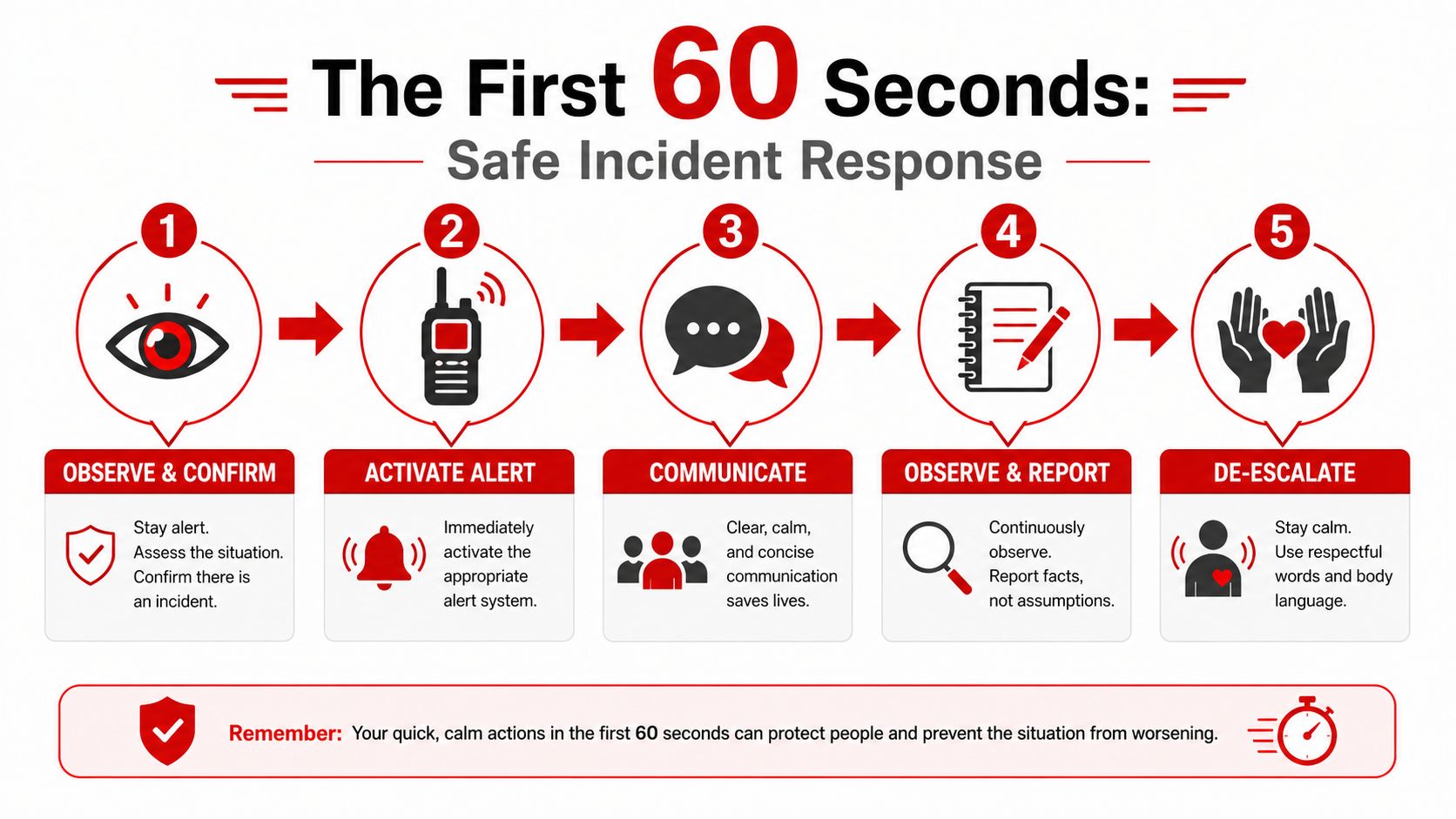
The first moments after a suspected theft determine whether staff stay safe and whether the store preserves useful evidence. Consider a staff member who notices a customer conceal merchandise and move towards the exit. The correct response isn't a rushed chase. The employee should observe, alert the designated responder and keep a safe distance.
A calm sequence protects people and evidence
- Observe and confirm: Note behaviour, direction of travel, merchandise and companions. Avoid assumptions based on appearance.
- Activate the alert: Use the store's radio, duress process or manager notification method.
- Communicate clearly: Give colleagues factual information, including location and safety concerns.
- Observe and report: Record the time, POS details, footage reference, descriptions and witness accounts.
- De-escalate: Stop arguing, create distance and allow trained security staff or police to take over when risk rises.
A confrontation at the exit can become a safety incident quickly, particularly where threats or weapons are involved. Staff should follow the store's approved procedure and relevant Australian legal advice regarding detention or citizen's arrest. They shouldn't improvise physical restraint or block a person's path unless specifically trained and authorised to do so.
Documentation turns an event into intelligence
An incident report should state what the employee saw, not what they assume the person intended. Include timestamps, product descriptions, staff involved, exact words used where relevant, footage references and whether police or a security partner was contacted.
Internal theft needs a similarly controlled response. Secure records, limit disclosure, preserve POS and access logs, and escalate through management and HR processes. Public accusations can create legal and safety risks, while weak documentation makes repeat patterns harder to identify.
Staff should never risk injury to protect merchandise. A well-recorded incident can support a later investigation, even when the product isn't recovered immediately.
Measuring Success with the Right KPIs and Metrics
Shrinkage is important, but it's a lagging measure. By the time a stock count reveals a problem, managers may not know whether the cause was theft, receiving error, damage, mis-scanning or inaccurate records.
Track indicators that show what teams can change during normal operations:
| KPI | What It Measures | Target Benchmark | Data Source |
|---|---|---|---|
| Incident frequency | How often reported events occur | Establish a store baseline and monitor direction | Incident reports and security logs |
| Average loss per incident | Value associated with each recorded event | Compare by category and venue type | Stock records and incident reports |
| Staff safety incidents | Threats, aggression and injuries connected to loss events | Seek a sustained reduction, with no tolerance for unsafe practice | Incident and workplace safety records |
| POS exceptions | Voids, refunds, discounts and overrides requiring review | Set policy-based thresholds by role | POS reporting |
| Inventory variance | Difference between recorded and physical stock | Investigate recurring variance by SKU and process stage | Inventory counts and receiving records |
| Response completion | Whether alerts receive a documented outcome | Aim for consistent ownership and closure | CCTV, radio and incident systems |
| Customer experience impact | Complaints or friction linked to controls | Keep interventions proportionate and evidence-based | Complaints and manager feedback |
Don't set one target for every store. A liquor venue, pharmacy, clothing retailer and shopping-centre tenant face different product and layout risks. Compare like with like, review trends over time and use results to adjust staffing, merchandising and procedures.
Engaging a Licensed Security Partner in Australia
A security provider should fit the store's risk profile, not just supply a uniform and a shift roster. Retailers operating across NSW, VIC, QLD and the ACT need to verify the applicable state or territory requirements, including provider licensing, individual guard credentials and any approvals relevant to specialist deployments such as K9 teams.
Vet capability before signing
Ask prospective providers for:
- Current credentials: Confirm licences through the relevant state or territory regulatory portal.
- Retail experience: Request examples of coverage for the store format, product mix and trading environment.
- Deployment options: Assess static officers, covert operatives, mobile patrols, K9 handlers and emergency response capability.
- Reporting standards: Require timestamped incident reports, footage references, escalation records and management review.
- Safety procedures: Check training for de-escalation, workplace violence and safe withdrawal.
- Insurance alignment: Confirm that coverage matches the activities and locations in the contract.
- Service levels: Define response expectations, supervision, relief arrangements and review meetings.
Off-the-shelf guarding often fails because it treats every site alike. A small centre may need visible presence at selected periods, while a repeat-offender problem may justify covert observation and cross-store intelligence. A construction-style patrol model also won't automatically suit a customer-facing retail environment.
GM GROUP Services provides licensed static guards, covert operations, K9 units and handlers, vehicle patrols, risk assessments and loss prevention support across NSW, VIC, QLD and the ACT. The useful question isn't whether a provider offers every service. It's whether the proposed deployment gives managers the right coverage, reporting and escalation for the risks recorded in that store.
Frequently Asked Questions About Retail Loss Prevention
Can retail staff detain suspected shoplifters?
The rules around citizen's arrest and detention vary by jurisdiction and circumstances. Staff should follow the retailer's approved procedure, avoid physical confrontation and seek legal or police guidance rather than relying on assumptions. A security officer's presence doesn't remove the need for safe conduct, accurate observation and proportionate action.
Should every store install AI CCTV?
No. CCTV analytics make more sense where the retailer has defined risk patterns, adequate camera coverage and people who can respond to alerts. A smaller store may gain faster value from better sightlines, trained staff and focused human coverage. Technology without follow-up creates alerts, not control.
Are EAS tags enough?
No. EAS tags can support deterrence and alert staff, but they won't fix blind spots, poor alarm response, inaccurate stock records or repeat-offender behaviour. Use them as one layer alongside layout, staffing, reporting and safe intervention procedures.
How should self-checkout supervision be designed?
Place attendants where they can see lanes and provide assistance without making honest customers feel accused. Review item-not-found events, intervention patterns and customer complaints, then adjust layout, training or technology. Targeted supervision is generally more useful than treating every customer as a risk.
Does insurance cover retail loss?
Insurance terms vary, and unreported or poorly documented incidents can be difficult to manage. Maintain incident records, preserve footage and confirm policy obligations with your insurer and broker. A claim process can't replace daily prevention and accurate inventory controls.
What should a manager do first?
Start with a store-level review. Map theft and process incidents, identify repeat patterns, check staff sightlines, review restricted access and examine POS or inventory exceptions. Then choose the smallest combination of layout, staffing, procedure and technology changes that addresses the clearest risk.
GM GROUP Services offers retail security, loss prevention officers, covert operations, K9 capability, patrols and risk assessments across NSW, VIC, QLD and the ACT. Visit GM GROUP Services to discuss a store-specific deployment, reporting process and safe response model.
Discover more from GM Group Services
Subscribe to get the latest posts sent to your email.