
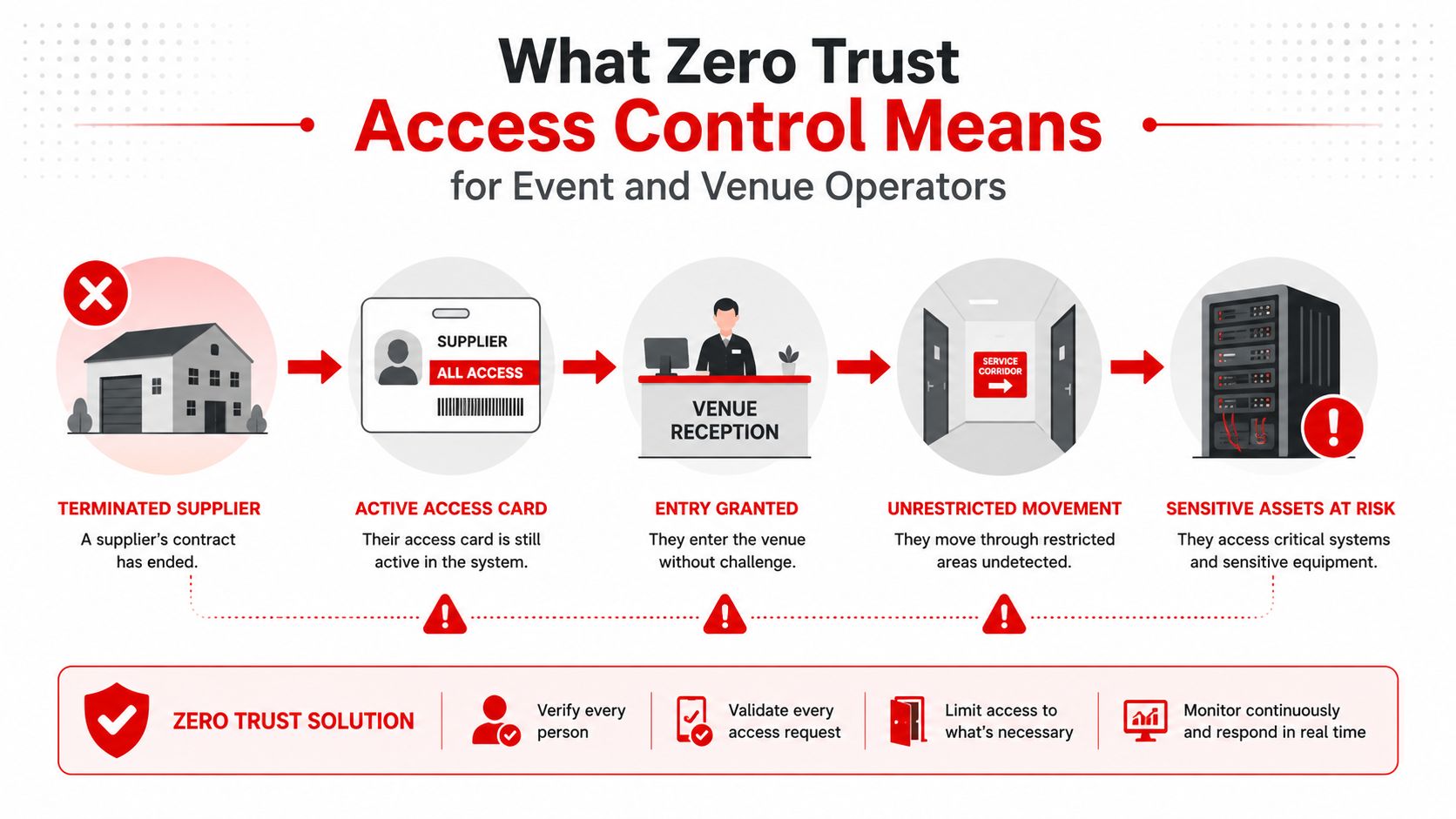
Zero trust access control starts with a familiar operational problem. It's Saturday night, a supplier has been terminated, but a contractor's old access card still works. The person passes reception, reaches a service corridor and gets close to equipment that should never have been available to that role. The venue may have guards, cameras and locked doors, yet one trusted credential has defeated the perimeter.
This article translates zero trust access control from an IT security model into decisions that event organisers, venue managers and construction supervisors make every day. You'll see how identity, device checks, time limits, segmented zones and continuous monitoring can work with existing guards, kiosks and back-to-base operations, rather than requiring an unrealistic rip-and-replace project.
What Zero Trust Access Control Means for Event and Venue Operators
Traditional security often treats an issued wristband, lanyard or door card as proof that access should continue. Once someone has passed the outer boundary, staff may assume the credential is still valid, the person is still authorised and the route they're taking is appropriate. That assumption creates the failure mode described above.
Zero trust access control takes the opposite stance. It assumes that no person, device or credential should receive trust automatically, even if it was previously checked. Each request is assessed against the person's identity, the device or credential being used, the location, the time, the requested resource and the current policy.
That doesn't mean every guest must be interrogated at every doorway. It means the operator decides which access requests carry risk and applies proportionate verification. A ticket holder may need a valid ticket at the public gate. A contractor entering a plant room may need identity confirmation, an active work assignment, a compliant device and supervisor approval.
Trust boundaries beyond the network
The familiar IT principles translate neatly into physical operations:
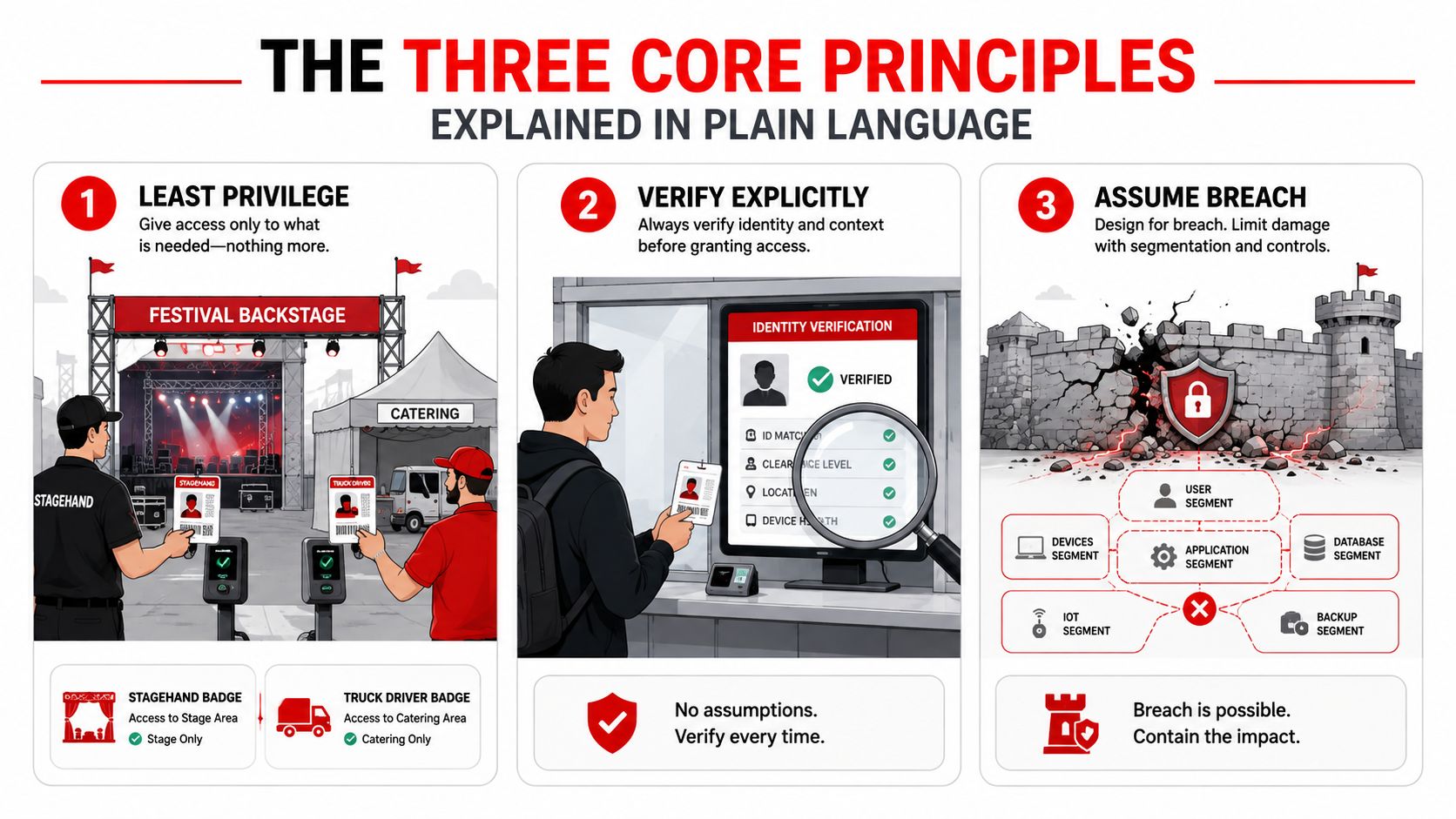
- Least privilege: a stagehand receives stage access, not a master credential for the whole site.
- Continuous verification: a valid pass can still be challenged when the person enters an unusual area or attempts access outside their approved shift.
- Micro-segmentation: cash rooms, VIP areas, loading docks, plant rooms and control systems become separate access zones.
The Australian Government's direction makes this more than a theoretical framework. The Australian Cyber Security Centre released Foundations for modern defensible architecture in February 2025, and the Protective Security Policy Framework formally added zero trust requirements for government entities on 24 July 2025. The accompanying guidance defines zero trust around least privilege and per-request decisions, while the Australian Public Service has a whole-of-government target to embed a “zero trust culture” by 2030. These milestones establish zero trust access control as an Australian public-sector security standard rather than an optional best practice. Australian Cyber Security Centre guidance explains the modern defensible architecture approach.
For commercial operators, the practical lesson is simple. Don't start by buying a large platform. Start by identifying which people, devices and areas should never inherit trust merely because they're inside the venue.
The Three Core Principles Explained in Plain Language
Zero trust becomes easier to operate when you treat its principles as three separate lenses. Each lens answers a different question about a person, credential, device or request.
Least privilege
Ask, “What is the smallest amount of access this person needs to complete the job?”
At a festival gatehouse, a stagehand needs access to assigned stages and approved backstage routes. A catering driver needs the delivery bay and catering area. Neither needs a credential that opens cash handling rooms, production control spaces and every staff entrance.
Practical controls include:
- Role-based credentials: issue separate access tiers for artists, crew, vendors, cleaners, supervisors and visitors.
- Time-bound passes: make access expire when a shift, delivery window or work package ends.
- Scoped permissions: link a credential to particular doors, zones and systems instead of issuing a site-wide pass.
- Fast revocation: disable lost, cancelled or compromised credentials without waiting for a physical card return.
A useful permissions model is covered in this secure permissions guide Pepy, which helps operators think in terms of roles and necessary access rather than convenience.
Verify every request
A credential proves only that a credential is being presented. It doesn't prove that the right person is using it, that the device is safe or that the request makes sense at that moment.
Consider a hotel duty manager presenting a master keycard at 3am. A zero trust process may require secondary verification because the time is unusual, the device is unfamiliar, the route is inconsistent with the person's role or the requested room is sensitive. Depending on the risk, verification could involve a multi-factor prompt, biometric re-check or confirmation from back-to-base monitoring.
Micro-segmentation
An open floor plan gives a person more opportunity to move than a building divided into controlled zones. Treat VIP areas, loading docks, cash rooms and plant rooms as separate trust boundaries, with distinct permissions, logs and escalation procedures.
Segmentation won't help if every credential opens every zone. Verification won't help if one compromised account can move across the entire site. The three principles must work together, with each access decision connected to a clear operational purpose.
How Zero Trust Maps to IT and Physical Security Together
The strongest implementation uses one decision logic across digital and physical environments. An identity provider and single sign-on system may decide which cloud application a staff member can use. A gatehouse process applies the same question to a contractor's badge, radio or site entry.
| IT Zero Trust Control | Physical/Operational Equivalent |
|---|---|
| Identity provider and single sign-on | Issue, update and revoke staff and contractor credentials through a controlled gatehouse process |
| Device posture checks | Inspect contractor laptops, radios and BYOD tablets before granting Wi-Fi, POS or operational application access |
| Network micro-segmentation | Divide the venue into stages, loading areas, cash rooms, plant spaces and public zones with separate permissions |
| Continuous monitoring and analytics | Correlate access events with CCTV, body-worn video, guard reports and incident management records |
| Per-session authorisation | Reconfirm high-risk door, system or equipment requests when time, location or behaviour changes |
| Privileged access management | Require supervisor approval and stronger controls for cash offices, production systems and building management systems |
Where the guard brief changes
A traditional briefing may say, “Check the pass and let approved contractors through.” A zero trust briefing is more precise: check the identity, confirm the assigned zone and time window, verify that the credential matches the person, and escalate exceptions rather than improvising.
The same approach applies to a contractor sign-on tablet. It should record who arrived, which organisation they represent, what work they're performing, which zones they need and when their access ends. A digital record can then support the supervisor, access system and incident team at the same time.
Integrate the decision system
Isolated controls create gaps. A door reader may record a successful scan while CCTV shows tailgating. A contractor register may show a valid worker while the person's device is unmanaged. A guard report may identify suspicious behaviour, but the credential remains active unless the incident process can trigger revocation.
The Australian zero trust model aligns with per-session access decisions based on the observable state of the user, service and requesting asset. Australian government coverage of zero trust architecture explains how gateways, authentication services, authorisation tokens and service identity infrastructure coordinate those decisions.
Operational rule: A scan, camera alert or guard observation becomes more useful when it can change the next access decision.
For a smaller venue, integration can begin with a shared incident register and disciplined revocation process. Larger operators may connect access control, identity, video analytics and incident management so that the system presents one current view of risk.
A Practical Implementation Roadmap You Can Start This Quarter
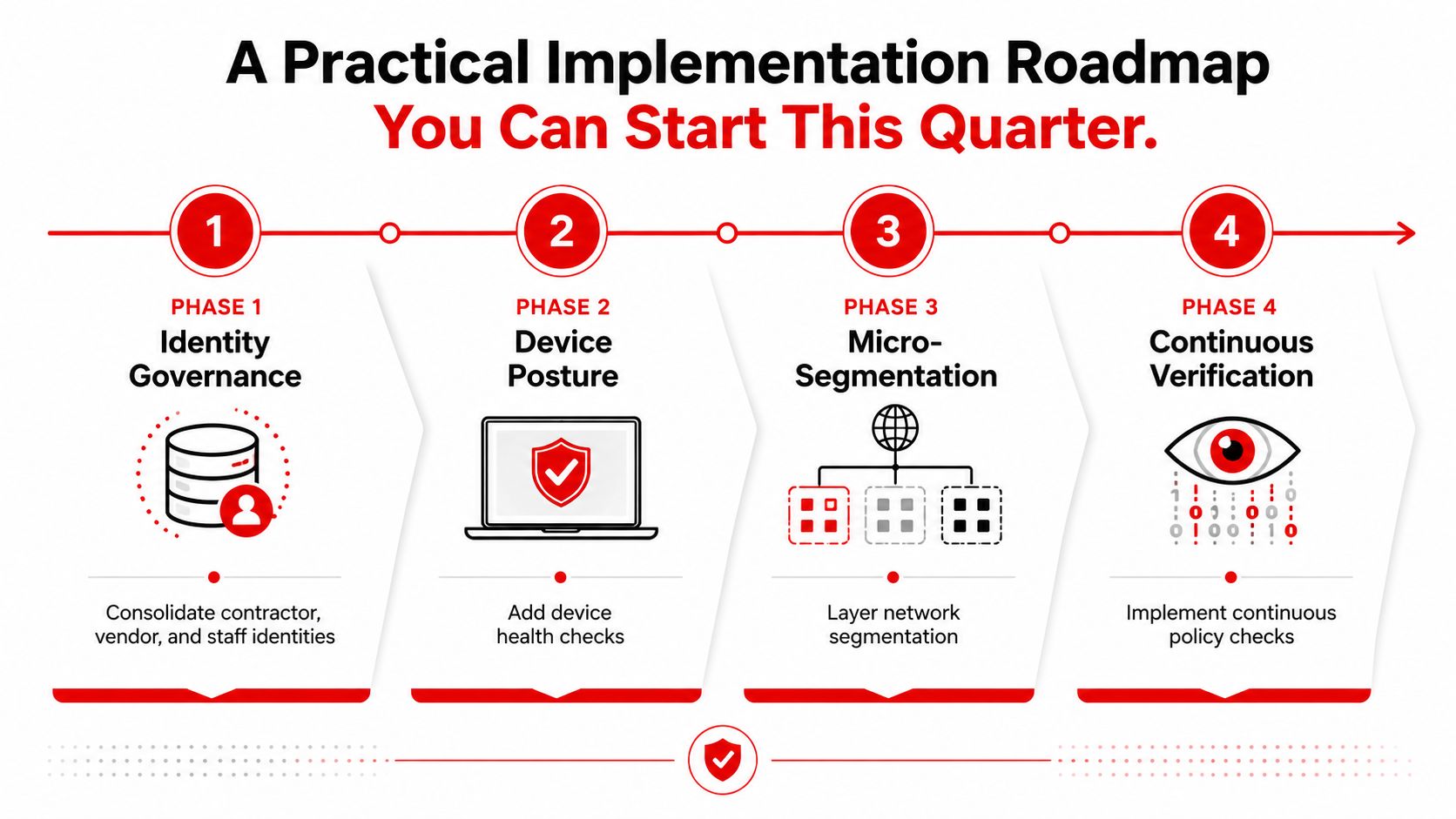
You don't need perfect identity infrastructure before beginning. The sensible approach is to retire implicit trust one important use case at a time, while keeping normal event operations moving.
Phase one, identity governance
Create one reliable register for staff, contractors, suppliers and temporary workers. Consolidate duplicate records where practical, then tighten joiner, mover and leaver workflows.
Start with the highest-risk permissions:
- Record the person, employer, role and approving manager.
- Assign access to specific doors, systems and shifts.
- Set an expiry date or review point.
- Revoke access when employment, supplier status or work scope changes.
- Issue role-based credentials for doors, radios and cloud systems.
Shared operational accounts deserve attention. If a team uses one login for a kiosk or application, identify the owner, reduce its permissions and plan an individual-account replacement.
Phase two, device posture
A person can be authorised while the device they're using is unsafe. Add basic checks at guard kiosks and contractor sign-on tablets, then introduce posture scoring for BYOD staff applications and basic mobile device management for handheld scanners.
A practical check might confirm that the device is registered, updated, encrypted where appropriate and not obviously altered. Don't block every unfamiliar device immediately. Begin in monitoring mode, identify false positives and define an exception process for urgent operational work.
Phase three, segmentation
Create micro-perimeters around stages, cash rooms, plant areas and building management system controllers. Use access groups, time windows and network VLANs where your equipment supports them.
Start with the zones where a misplaced credential would create the greatest operational or safety consequence. A single-site venue can begin with a controlled cash office and plant room rather than attempting to redesign every door.
Phase four, continuous verification
Add re-authentication for critical access points, alerts for unusual behaviour and tabletop exercises that test response. Review whether a lost credential is disabled quickly, whether supervisors understand exceptions and whether logs support an investigation.
Defer expensive nice-to-haves until a later budget cycle if they would delay the basics. Full behavioural analytics, extensive biometric coverage, complex software-defined perimeters and broad automation can wait while identity records, revocation and zone rules mature.
Real-World Examples for Events, Venues and Construction Sites
A zero trust design becomes clearer when you follow the person, credential and decision through a working environment.
A multi-stage festival
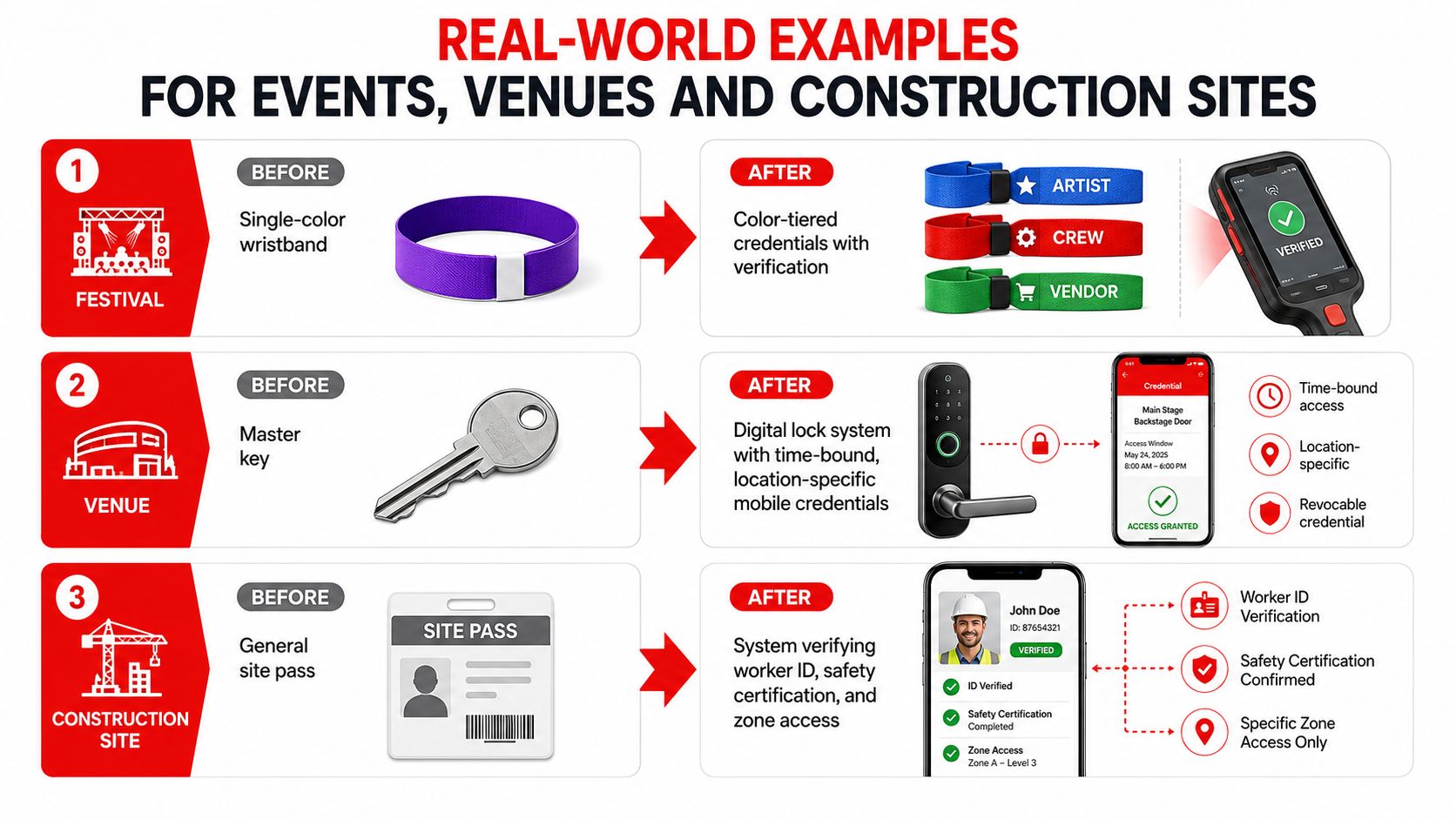
Before the change, every crew member receives a broad wristband that works across the event footprint. After the change, colour-tiered credentials distinguish artist, crew and vendor access, while each scan is checked against the person's identity token, assigned zone and approved time.
A lost wristband isn't replaced with another identical pass. The old credential is quarantined first, the replacement is linked to the verified person and the incident is recorded. Guards also receive a short escalation script for scans that don't match the wearer or location.
A late-night licensed venue
Bar staff pass through a staffed turnstile with an identity check suited to the venue's risk assessment. Cleaners receive access to public and back-of-house service zones after close, but not the cash office, liquor storage controls or management areas unless a supervisor authorises it.
Managers must re-authenticate before entering the cash office, even if their general staff credential remains active. That small change recognises that the requested room and time matter, not just the title printed on a card.
A construction site beside live operations
Subcontractors receive access to specific work fronts and time windows rather than a general site pass. Plant keys are issued against a daily SWMS sign-on, and visitor escorts are logged digitally instead of relying only on clipboard notes.
Access control can't replace physical hazard management. Supervisors should pair identity and zone rules with a documented electrical safety process, using resources such as this guide to commercial electrical hazard elimination when reviewing work areas and controls.
The operational lift is real. Guards must check exceptions consistently, supervisors must approve changes promptly and managers must review logs rather than treating them as paperwork. The benefit comes from making those responsibilities explicit.
Australian Compliance and Licensing Considerations
Zero trust access control doesn't remove existing Australian obligations. It adds a more disciplined way to demonstrate that people, contractors and visitors received only the access required for a legitimate purpose.
The Department of Home Affairs' 2025 Protective Security Policy Framework update formally added zero trust requirements for government entities, aligning implementation with the Information Security Manual and the Australian Cyber Security Centre's Guiding Principles to Embed a Zero Trust Culture. Commercial suppliers working with government may encounter those expectations through procurement, contract controls or assurance requests, even when they aren't Commonwealth entities themselves. The Australian guidance describes identity verification, compliant access and least privilege for every request.
Event and venue operators also need to account for state and territory security licensing rules for crowd controllers, RSA requirements in licensed venues and WHS duties when controlling contractor access on construction sites. The exact requirements depend on the jurisdiction, licence category, venue activity and work arrangement, so operational leaders should confirm obligations with the relevant regulator and legal adviser.
| Regulation or Standard | Access Control Activity Affected | Evidence to Retain |
|---|---|---|
| Protective Security Policy Framework | Identity, least privilege and per-request controls for applicable government work | Approved policies, access reviews, exception records and audit logs |
| State or territory security licensing | Deployment and supervision of licensed security personnel | Licence records, rosters, briefings and incident reports |
| RSA requirements | Staff access to licensed areas and responsible venue operations | Training records, procedures and supervisor checks |
| Model WHS laws | Contractor sign-on, work zones, inductions and site permissions | Inductions, SWMS records, approvals, visitor logs and incident actions |
| Privacy Act and Australian Privacy Principles | Collection and use of identity data, including biometrics | Collection notice, purpose, consent or authority, retention and access controls |
| Notifiable Data Breaches scheme | Response if identity or biometric information is exposed | Assessment record, containment actions, notifications and communications |
Biometric checks require particular care. Collect only what you can justify, explain the purpose clearly, restrict access to the records and establish retention and deletion rules. Incident logs should show who made a decision, what information was available, which policy applied and what happened next.
Frequently Asked Questions About Zero Trust Access Control
How should a small operator sequence the work?
Begin with identity, not advanced technology. Create a current register of staff and contractors, introduce credential-based sign-on, define the few zones that matter most and make revocation reliable. Once those basics work, add device checks and temporary segmentation.
Where does the return appear for a small venue?
The practical value usually appears in reduced standing privilege, fewer over-broad passes and faster response when a credential is lost or a worker leaves. It can also improve incident investigation because access events, guard observations and supervisor approvals are easier to connect. Public AU-specific ROI data by sector remains limited, so measure your own outcomes through revoked credentials, exception handling, unauthorised access attempts and investigation quality rather than promising a universal financial result.
Can a single-site venue or short event use the model?
Yes, if the scope is controlled. A short event can apply temporary identities, time-bound credentials and a small number of back-of-house zones without building an enterprise platform. The model is about the decision rule, not the size of the organisation.
How do we avoid disrupting guards?
Change the briefing before changing the entire workflow. Give guards a clear exception path, keep a manual fallback for outages, test the process during a quiet operating period and avoid making them interpret complex risk scores at a busy gate. The system should support their judgement with better information, not turn every access request into a technical investigation.
For a realistic starting point, choose one identity process, one contractor workflow and one sensitive zone, then measure how reliably the controls operate before expanding.
GM GROUP Services can help event, venue and construction operators align licensed guards, gatehouse control, access procedures, monitoring and incident reporting with a zero trust access control approach. Visit GM GROUP Services to discuss a fit-for-purpose security plan for your site, event or operating environment.
Discover more from GM Group Services
Subscribe to get the latest posts sent to your email.