
Security costs in Australia usually land at A$25 to A$40 per hour for unarmed guards, A$40 to A$75 per hour for armed guards, and A$35 to A$65 per hour for event security. If you need round-the-clock protection, expect roughly A$130,000 to A$438,000 per year depending on staffing and risk.
Security costs in Australia are rarely just an hourly rate. Labour makes up 60-65% of a contract, so the quote moves fast once you add penalties, licensing, supervision, insurance, and the roster you need security cost benchmarking.
How Much Does Security Cost in Australia
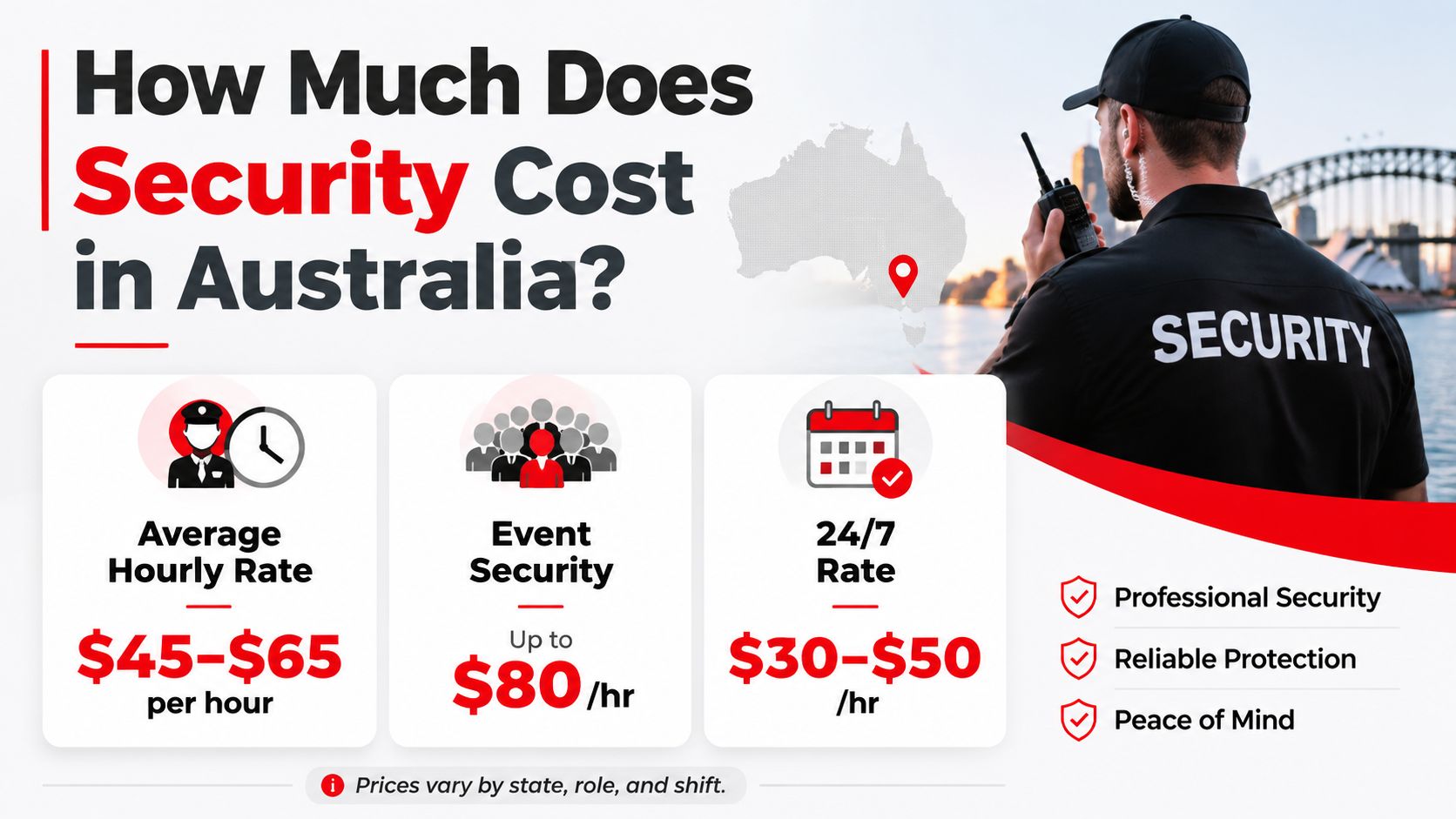
If you're wondering how much security costs, start with the advertised rate, then test it against labour, penalties, and compliance. In Australia, unarmed guards commonly sit at A$25 to A$40 per hour, armed guards at A$40 to A$75 per hour, event security at A$35 to A$65 per hour, and industrial or commercial sites at A$30 to A$55 per hour security services industry staffing costs.
The invoice gets bigger when you ask for real coverage. A round-the-clock security model can run from roughly A$130,000 to A$438,000 per year, and that gap usually comes from staffing depth, roster complexity, and the extra loadings that never show up in the first quote security budget context.
What those numbers really mean
A venue owner pricing Friday and Saturday nights should not compare that job with a 24/7 construction gatehouse. The first is a short, high-pressure deployment. The second is a staffing-heavy arrangement with handovers, supervision, and continuity, which is why the annual cost can climb so quickly.
Practical rule: judge the quote against the coverage you actually need, not the headline hourly rate.
Australian security pricing also shifts with state licensing, penalty rates, and the type of guard you can legally use. If the job needs licensed crowd controllers, after-hours coverage, or a supervisor on site, the advertised rate is only the starting point. Cost comes from labour on-costs, not the guard standing at the door.
For businesses already running cameras, access control, or monitoring systems, security spend sits alongside other operating costs that are planned around recurring protection, not a one-off purchase. That mindset is useful in hospitality, retail, events, and construction, because the cost is tied to labour intensity and ongoing presence, not just the headline rate.
A useful benchmark mindset is to look at total deployed coverage, not a single rate card. If you're comparing providers, ask what the rate buys you, which shifts it applies to, and what gets added later. That is where most buyers lose money.
Common Security Pricing Models Explained
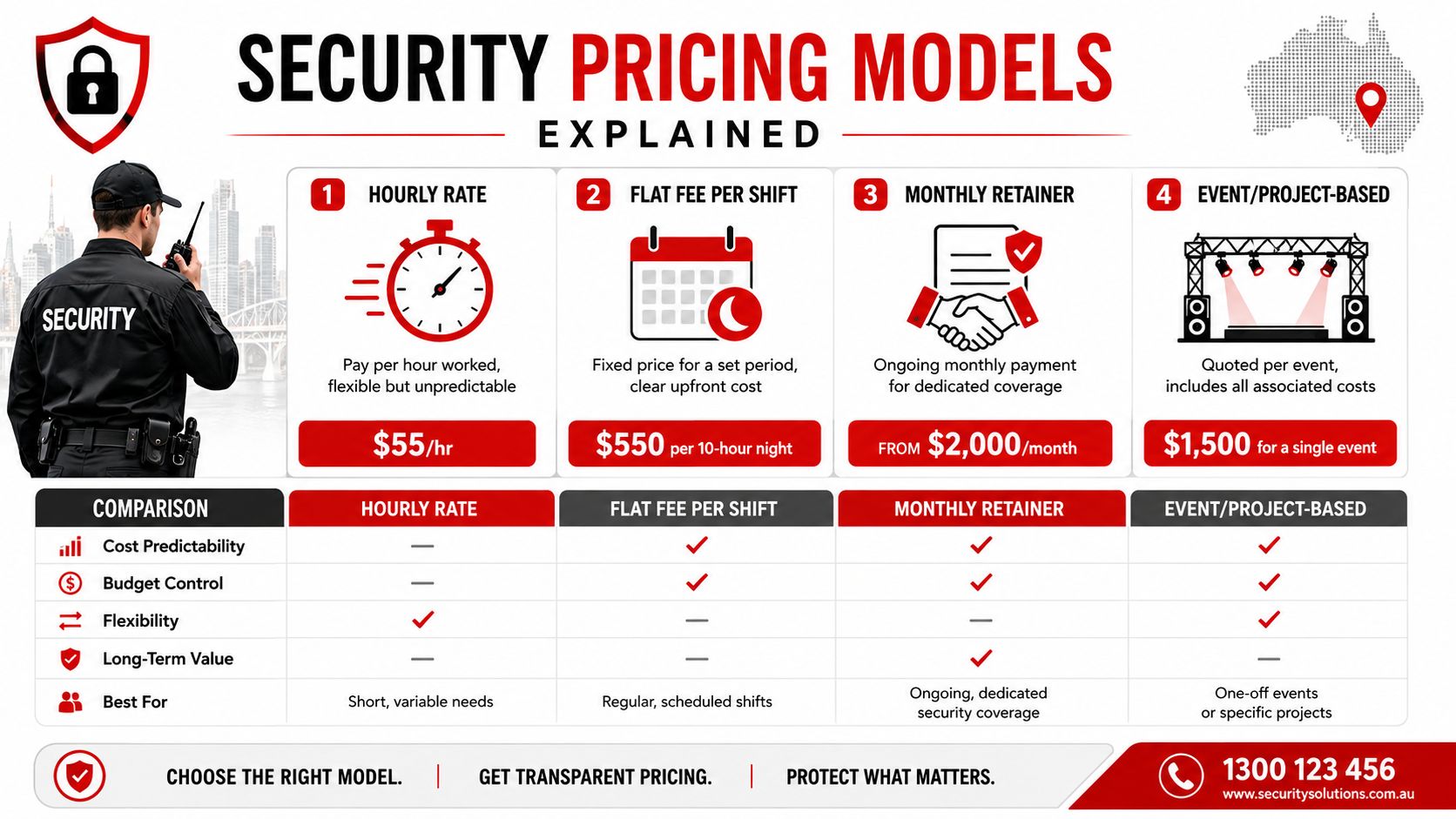
Security companies in Australia do not all sell the same thing. Some quote hourly rates, some price by shift, some offer monthly retainers, and others price by event or project. If you do not know the model, you cannot compare the quote properly.
Hourly, shift, retainer, and project pricing
Hourly pricing works best when the need changes week to week. A pub that needs extra crowd controllers on Friday night can keep it simple, but the final bill can still climb if minimum-hour clauses, call-out time, or overtime loadings apply.
Flat fee per shift is cleaner for predictable work. A static guard on a night shift is easier to budget when the supplier quotes the whole block, rather than a rate that changes every time a roster changes or a supervisor signs off extra coverage.
Monthly retainers suit ongoing protection where the supplier is effectively reserving capacity. That model is common for sites that need continuity, response planning, regular supervision, and a known team on rotation.
Project-based pricing is the smarter model for a one-off festival or a major activation, because it should bundle labour, mobilisation, and site-specific preparation into one agreed figure. If you are comparing related event costs such as marquee setup and temporary infrastructure, use marquee and tent rental rates as a reference point, because security usually rises when crowd flow, site layout, and access points get more complex.
A cheap hourly rate can still become the most expensive quote if the supplier pads every extra hour, arrival, briefing, and handover.
Venue managers get this wrong all the time. “Security” is not one product. Crowd control, static guarding, and monitoring all carry different staffing and compliance needs, and the quote should show that clearly. If a provider cannot tell you which model they are using, do not sign.
Key Cost Drivers Behind Every Security Quote
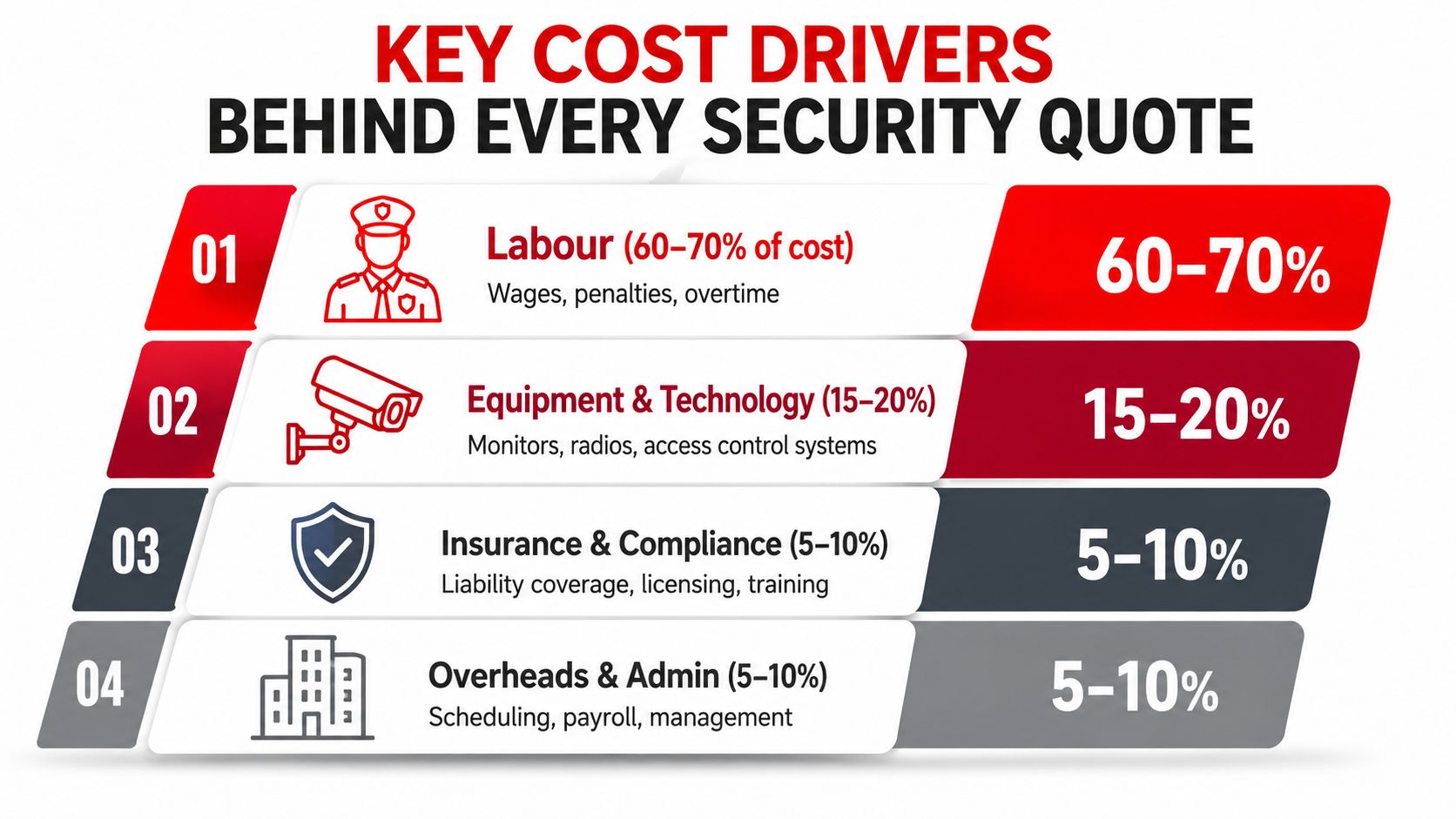
Labour drives the quote more than anything else, but the headline hourly rate hides the actual cost. The base wage is only the starting point. What inflates the bill is the full stack of labour on-costs, insurance, licensing, supervision, equipment, and margin. If a provider gives you a flat rate and refuses to explain what sits inside it, expect padding.
The labour benchmark matters because security is a people-heavy service, not a gear-heavy one. Industry staffing data shows labour takes the largest share of the price, with the rest spread across the costs that sit behind the guard on site, not beside them labour cost benchmark. That is why quotes that look close on paper can diverge fast once the provider adds rosters, compliance, and management.
The hidden items that change the price
Penalty loadings are one of the first things that push a quote up. Weekend, public holiday, overnight, and short-notice coverage all cost more because the contractor is paying above-base labour rates to keep the roster filled. Australia's security workforce is heavily casual and part-time, so those loadings are built into the price, not added as an afterthought workforce and pricing gap.
Superannuation and payroll obligations also sit inside the rate. Employers must pay super on eligible earnings, and reputable providers pass that through in their pricing superannuation and payroll obligations. Add workers' compensation, leave accruals, payroll tax where it applies, and roster admin, and the true cost moves well above the raw wage. That is the part many buyers miss when they compare quotes line by line.
Licensing changes the bill in a more serious way than most organisers expect. Victorian rules around Private Security Act 2004 compliance, and similar state regimes, control who can work, what service class they can provide, and where they must be licensed Victorian licensing and service classes. A NSW crowd-control licence can run roughly A$120 per application, and the licence must be held by the worker and available on site when required. Crowd controllers, guards, monitoring staff, and patrol work do not sit in the same compliance bucket, so two quotes can look close while carrying very different legal costs underneath.
Equipment and site setup add another layer. Radios, uniforms, torches, barriers, CCTV monitoring support, and mobile patrol vehicles all show up somewhere in the quote, either as a direct line item or buried in overheads. If the job needs more gear, more supervisors, or more handover time, the price rises even if the hourly rate stays unchanged.
Check the quote line by line: labour, penalties, super, insurance, licensing, equipment, and supervision. If one of those is missing, the quote is incomplete.
For NSW, VIC, QLD, and ACT buyers, the right move is to demand an itemised breakdown by service type and licence class. That is the only way to see where the quote is coming from and to stop suppliers from hiding compliance costs inside a neat-looking hourly rate.
Australian Security Cost Ranges by Service and Use Case
Australian security quotes usually start with a clean hourly rate, then grow once you factor in labour-on-costs, penalty loadings, supervision, licensing, and site-specific coverage. A festival is a staffing and crowd-management problem. A construction site is an access-control and continuity problem. A retail centre is usually about presence, deterrence, and response. The price should reflect that reality.
| Use Case | Hourly Rate Range (AUD) | Typical Staffing Mix | Estimated Weekly Cost |
|---|---|---|---|
| Music festival | A$35 to A$65 | Crowd controllers, entry checks, supervisors | 8 guards × A$50/hr × 10 hrs × 2 days = ~A$8,000/week |
| Licensed venue | A$35 to A$65 | Crowd controllers, floor presence, response lead | 3 guards × A$45/hr × 40 hrs = ~A$5,400/week |
| Corporate office | A$30 to A$55 | Static guard, patrols, monitoring support | 1 guard × A$35/hr × 24 hrs × 7 days = ~A$5,880/week |
| Retail centre | A$30 to A$55 | Loss prevention, patrols, customer-facing presence | 2 guards × A$40/hr × 50 hrs = ~A$4,000/week |
| Construction site | A$30 to A$55 | Static guard, gatehouse, patrols | 1 guard × A$38/hr × 12 hrs × 7 days = ~A$3,192/week |
| Residential development | A$30 to A$55 | Gatehouse, patrols, after-hours checks | 1 guard × A$35/hr × 10 hrs × 7 days = ~A$2,450/week |
These ranges are useful because they match how providers price the work. Event security sits higher when the site is crowded and escalation risk is real. Industrial and commercial sites often sit lower than specialised work, but they rise fast when the roster runs long, coverage is continuous, or compliance overhead is heavy. For current market pricing benchmarks, use the rate range as a starting point, then add the roster and penalty assumptions that fit the site.
State differences matter too. Licensing interpretation, award settings, and supervision expectations can shift a quote between jurisdictions. A line item that looks cheap in one state can fail compliance in another, especially once you factor in the right licence class, site coverage, and the extra labour cost of meeting local rules.
Buyers should ask one direct question. What staffing mix is being quoted, and what does that cover? That is the only way to compare a festival deployment with a gatehouse, or a nightclub with a retail centre, without being misled by a tidy hourly rate.
When Cheaper Security Becomes More Expensive
Low security quotes usually come from one of three places. The provider has under-scoped the job, trimmed staffing too far, or assumed the site will stay quiet. All three choices create avoidable risk.
Where hidden costs surface
Hospitality and venue sites carry violence and aggression risk, and weak deployment shows up fast. If a guard mishandles a crowd incident, misses an RSA issue, or turns up without the correct licence class, the problem stops being a simple staffing issue. It becomes a compliance breach, and the reputational fallout usually follows close behind venue risk and regulatory exposure.
Venue managers should judge a provider on performance under pressure, not the headline figure on the first invoice. A cheaper roster can look fine until an escalation starts, police are called, or the venue loses control of the floor. Then the bill rises through incident response, disruption, and damage to the venue's standing.
Do not buy the lowest rate if the provider cannot explain how they handle alcohol-related aggression, ejections, or handovers.
Fit-for-purpose deployment matters. A nightclub needing crowd controllers, a retail centre needing loss prevention, and a construction site needing static guards all require different service designs. GM GROUP Services, for example, offers licensed security guard services across events, venues, retail, and construction, with deployment based on hours, guards, and the services required. That structure is easier to budget than vague “security coverage” because the client can see exactly what is being bought.
The right question is straightforward. Ask whether the quote covers risk response, supervision, and compliance. If the supplier answers only with a cheaper hourly rate, they are selling you a number, not protection.
How to Get Accurate Security Quotes and Compare Providers
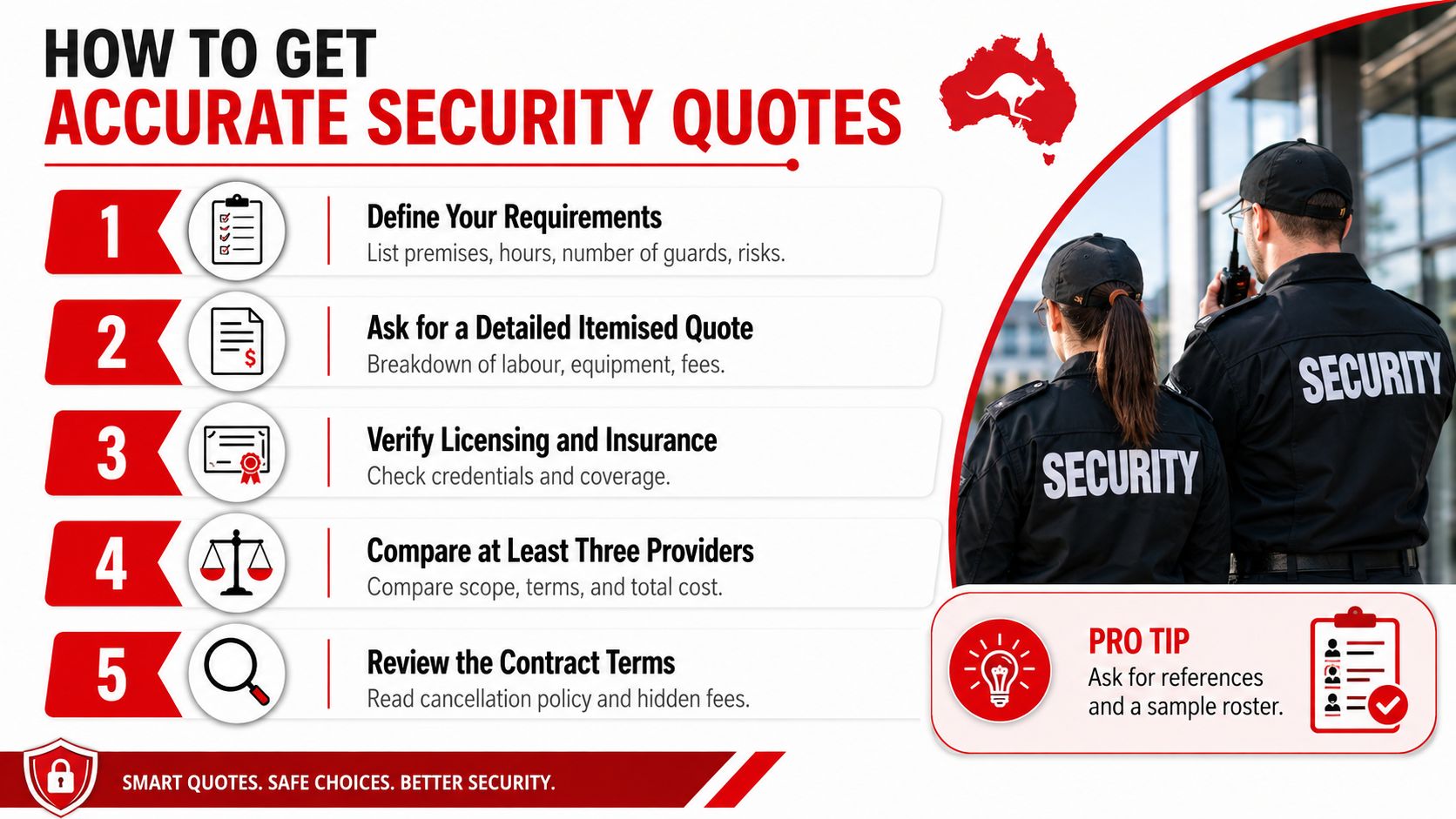
A quote that looks cheap on paper often becomes expensive once labour on-costs, penalty loadings, supervision, and state licensing are added. The only way to compare security providers fairly is to make every business price the same scope, with the same assumptions, on the same site.
A clean quote request process
Define the site clearly. Set out the operating hours, entry and exit points, number of guards, likely risks, and whether the job is static, patrol-based, or crowd-facing.
Ask for an itemised quote. Require the provider to separate labour, equipment, licence classes, supervision, mobilisation, and any other charge that sits outside the base hourly rate.
Verify licensing and insurance. Australian security pricing changes by state and by licence class, so ask for the exact credentials that apply to the work. If the provider cannot show them, do not use them.
Compare at least three providers. Judge them on scope, not on the first number you see. Two quotes can look similar while covering very different jobs.
Review the contract terms. Check cancellation, minimum hours, replacement staff, after-hours callout rules, and any uplift tied to weekends, nights, or public holidays.
Just as a business can request an aviation quote only after the scope is defined, security pricing works the same way. Undefined scope produces undefined prices.
Pro tip: ask for references and a sample roster. A provider that hesitates is usually hiding weak resourcing or loose scheduling.
You should also ask whether superannuation, workers' compensation, payroll obligations, and penalty rates are already built into the quote. That is the difference between a quote that holds and a quote that blows out later. If you are managing a festival, a licensed venue, or a multi-site retail portfolio, those questions save real money.
Smart Ways to Reduce Security Costs Without Compromising Safety
A lower security bill starts with fewer wasted hours, not fewer guards. Australian quotes rise fast once overtime, penalty loadings, supervision, mobilisation, and state licensing are added, so the smartest savings come from trimming that overhead without weakening coverage where the risk sits.
What lowers spend
Use static guards plus mobile patrols instead of overstaffing every access point all night. Put staff where the threat is real, then use CCTV and back-to-base monitoring to extend visibility across the rest of the site. A festival that consolidated entry points from five to two reduced its queue-controller headcount by 40 percent because it stopped paying people to watch empty lanes.
Schedule guards around verified peak periods. A venue that spikes late should not pay for a heavy presence during dead time, and there is no reason to carry the same roster through quiet hours. Long-term contracts can also steady pricing, which helps owners who want budget certainty instead of constant re-quoting.
Training matters more than many buyers admit. Well-briefed staff with clear standard operating procedures make fewer mistakes, and fewer mistakes mean fewer emergency callouts. That is where the saving sits.
Tight site planning cuts labour faster than bargaining over the hourly rate. If your event team is also working on overall production costs, find hybrid event production quotes and line up the access plan, staging, and crowd flow before you finalise security numbers. A cleaner layout usually means fewer posts, shorter handovers, and less reactive spending.
The goal is simple. Pay for the right coverage, not the most coverage. Cheap hours are useless if they create incidents you then have to clean up.
Frequently Asked Questions About Security Pricing
A compliant security quote should spell out labour, penalty loadings, supervision, insurance, licensing, and any equipment or mobilisation costs. If a provider only gives you an hourly rate, the quote is incomplete and will usually grow once rostering and compliance are added.
Do weekend and public holiday events cost more?
Yes. Weekend work, public holidays, after-hours shifts, and short-notice cover all push the bill up because providers have to pay penalty rates and move staff around to fill the roster.
Are armed guards necessary for most sites?
No. Most venues, retail sites, and events do not need armed guarding. Use armed staff only when the risk profile, licensing rules, and site requirements justify that level of response.
How should I budget for a multi-day festival?
Budget for the full deployment, not just the entry shift. Crowd control, supervision, handovers, meal breaks, fatigue management, and long rosters are what drive the final number, and that is where cheap quotes usually fall apart.
If you are ready to price security properly, GM GROUP Services can scope licensed protection for events, venues, retail, construction, and corporate sites across NSW, VIC, QLD, and the ACT. Visit GM GROUP Services to request a quote that separates labour, compliance, and deployment so you can compare real security costs instead of guesswork.
Discover more from GM Group Services
Subscribe to get the latest posts sent to your email.