
Cybersecurity physical security failures usually start the same way on a busy site, with a door that won't open, a camera that drops offline, or a badge reader that freezes just as the line builds. If you manage a festival, hotel, retail centre, or construction compound in NSW, VIC, QLD, or the ACT, that's not a minor inconvenience. It's the moment a digital problem turns into a gate problem, a crowd problem, or a safety problem.
Australia has already moved away from treating those risks as separate. Cybersecurity physical security now sits inside the same regulatory frame, because the Security of Critical Infrastructure Act 2018 was expanded by the Security Legislation Amendment (Critical Infrastructure Protection) Act 2022 to cover 11 sectors and tighten risk-management and information-sharing obligations, effectively treating cyber and physical security as one risk domain Genetec report on Australian critical infrastructure policy. That's a reality operators need to work from, not the old habit of handing “IT issues” to one contractor and “site security” to another.
The practical question is uglier and more useful, who patches the camera, who watches the logs, and who takes the call when the breach starts at a door instead of a laptop. That's the workflow most brochures skip, and it's the one this article deals with directly.
Why a Stalled Badge Reader Can Empty a Festival Site
The gate line is already moving faster than your radios can keep up. Then the access-control screen locks, the guard at the entry point starts waving people through manually, and your security lead is trying to work out whether the problem sits with the controller, the network, or the vendor's remote console. At that point, the issue is no longer just technical. It is crowd flow, incident management, and duty of care.
That is why cybersecurity physical security matters on live sites. A compromised system can affect site entry, surveillance, alarms, and operational safety at the same time, which is exactly how Australian regulation now treats connected security risk. For venue managers, hotel operators, retail teams, and construction supervisors, the point is plain, if the badge system, CCTV, and alarms sit on a network, they are part of the same failure chain.
What you should assume before the next incident
Plan for a breach that starts with access control, a camera network, or a poorly governed remote support account, because those are the systems that tie digital weakness to physical consequences.
If a digital failure can change who gets through a door, it is a physical security incident, not just an IT ticket.
That is the lens operators need when they brief staff, insurers, and contractors. A site can pay for guards, K9 support, back-to-base monitoring, gatehouse control, and incident response, and still be exposed if the connected systems behind those services are unmanaged.
If you need a simple planning benchmark before you tighten controls, look at how a structured access-control mindset is described in OctoStream's access control best practices. The useful takeaway is not the brand, it is the discipline, who is allowed in, how that access is logged, and what happens when the system misbehaves.
What Cybersecurity and Physical Security Convergence Actually Means
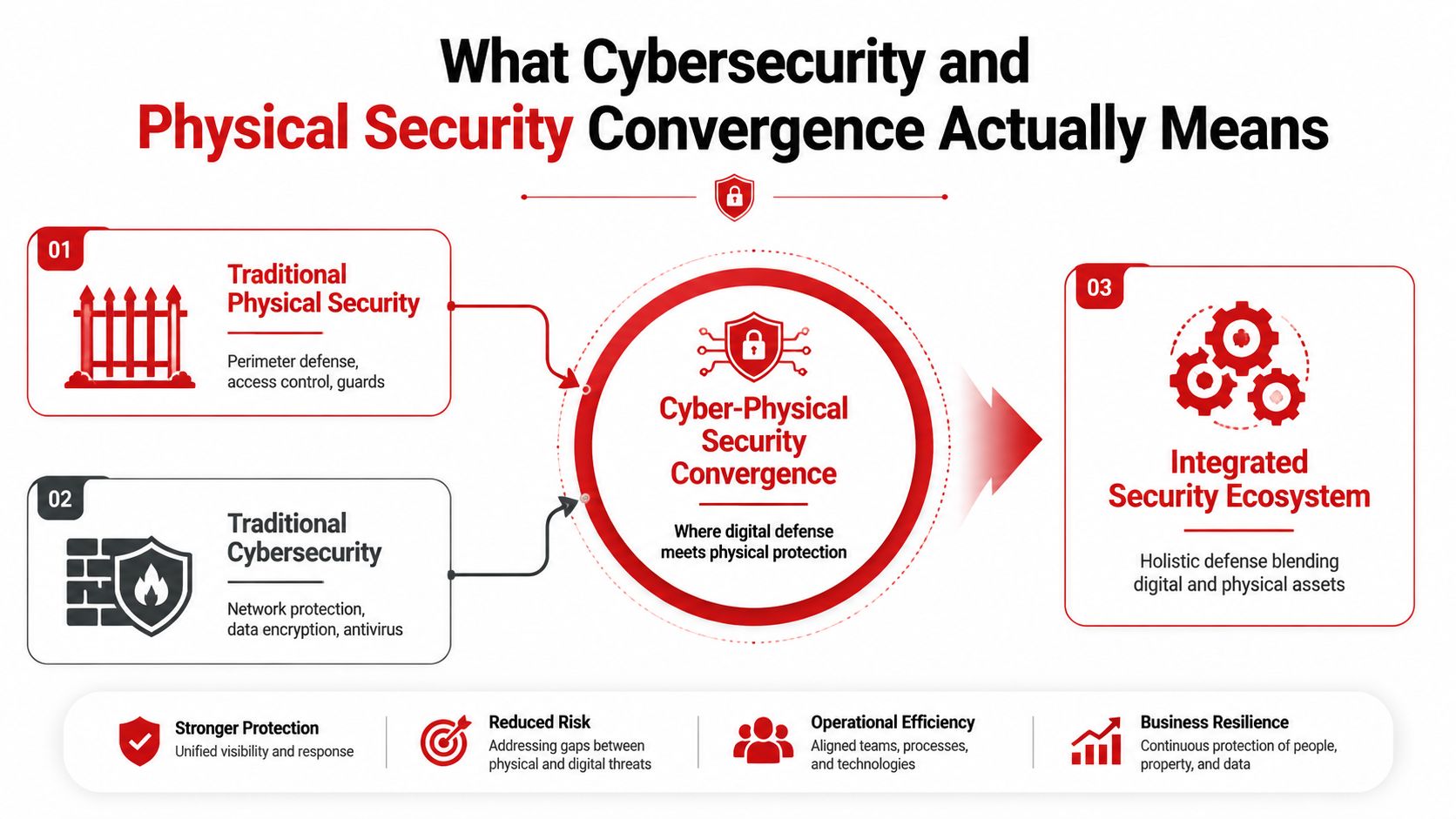
Traditional physical security used to mean fences, guards, locks, and cameras. Cybersecurity meant firewalls, patching, identity control, and monitoring. That split made sense when the systems barely touched. It doesn't make sense now, because the moment a badge reader, intercom, alarm panel, or camera is IP-connected, it becomes both a physical asset and a cyber asset.
Australia's Protective Security Policy Framework makes that layered thinking very clear, with a second security zone for server or communications rooms and extra security containers for servers, network devices, and cryptographic equipment PSPF physical security guidance. That matters because it forces an attacker to defeat perimeter, zone, and container controls in sequence, instead of just walking around one weak point.
A simple maturity scale
A site usually sits in one of three states:
- Siloed, the security provider handles guards and cameras, while IT handles patching and logs.
- Partially integrated, the systems talk to each other, but ownership is fuzzy.
- Fully converged, the same risk picture covers doors, devices, identities, and response.
The industry is still not where it should be. A Cisco Meraki survey found only 35% of respondents had fully integrated network and physical security, while 43% were partially integrated, 12% planned to do so, 7% were only considering it, and 2% had no plans Cisco Meraki survey report. That's a useful maturity benchmark for Australian buyers, because it shows full convergence is still the minority position.
Practical rule: if your camera vendor, access-control installer, and MSP all claim the system is “covered” but no one owns the combined risk, you're not converged. You're partitioned.
For sites that already run multiple systems, the right question isn't whether convergence sounds modern. It's whether the operator can see, control, and investigate one incident across both domains without handoffs that waste time.
Threat Scenarios That Hit Events, Venues, Retail and Construction Sites
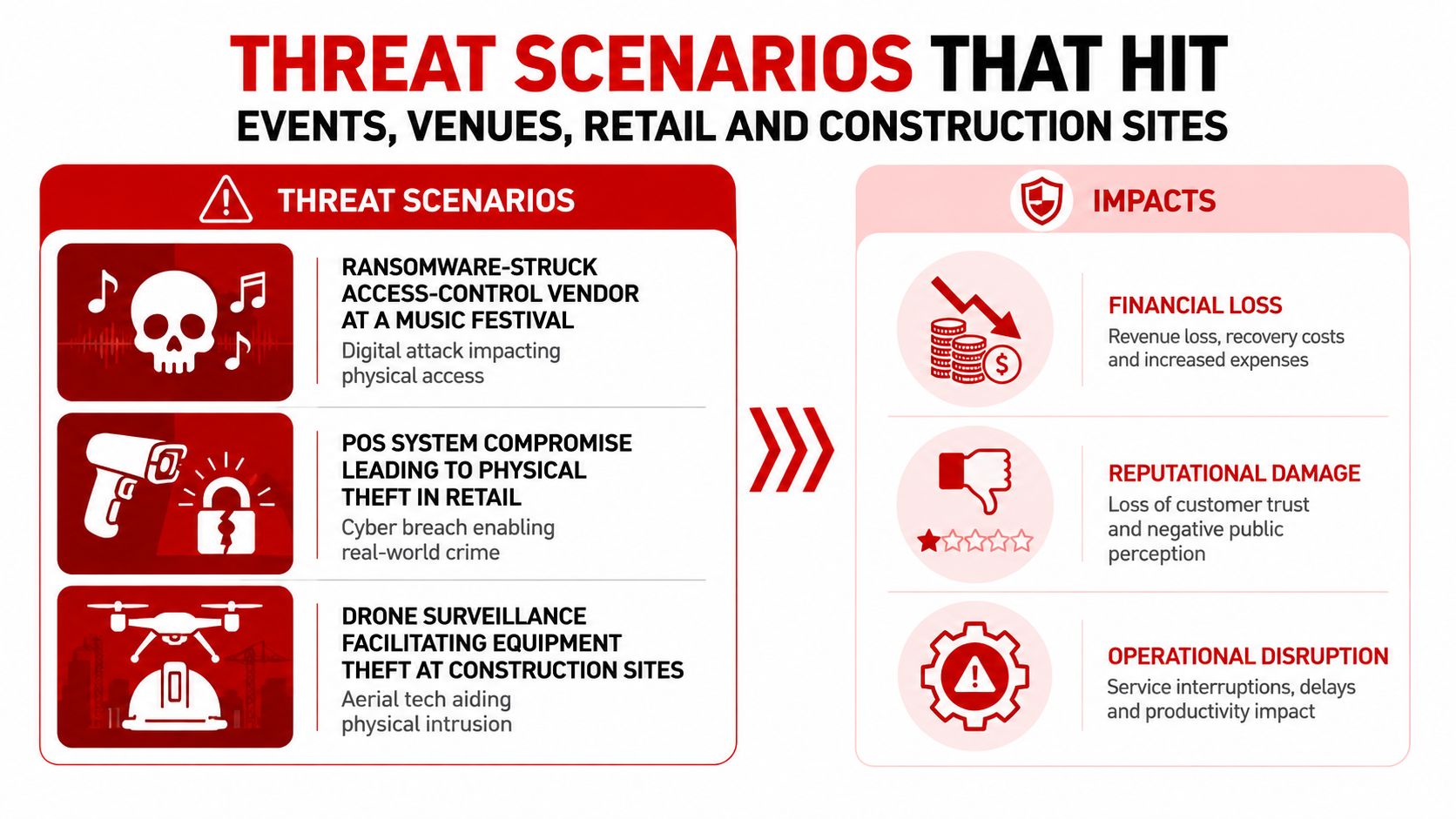
The most dangerous scenarios aren't exotic. They're the ones that turn everyday operational sloppiness into access loss, theft, or interruption. The Australian Signals Directorate's 2023-24 Annual Cyber Threat Report recorded 36,700 calls to the Australian Cyber Security Hotline, 1,113 cyber security incidents reported to the ACSC, and average self-reported cybercrime costs of A$49,600 for small business, A$62,800 for medium business, and A$63,600 for large business ASD report summary. Those figures don't describe abstract IT pain. They describe business disruption that can hit operations, staffing, and physical protection in the same week.
Rank the risk by blast radius, not novelty
A ransomware event that disables a festival access vendor is top-tier because it hits entry, staffing, and crowd control at once. A compromised CCTV network in a hotel is serious because live-monitored corridors and back-of-house areas suddenly lose visibility. A backdoor in a retail camera chain can become a theft enabler. A construction gatehouse NVR exfiltrating footage is dangerous because it reveals routines, deliveries, and blind spots.
Non-IT paths are the ones frontline teams control, and that's why they matter more than a theoretical zero-day. Tailgating, shared badges, contractor Wi-Fi, and vendor remote access all create real openings if nobody owns them operationally. If you want a practical supplement on the physical side of that problem, the approach behind bug sweeps Birmingham is a reminder that hidden devices, unauthorised access, and poor device governance are not just cyber issues.
The weak point is often an ordinary lapse, not a sophisticated attack.
That's the blunt truth. A shared login, an unpatched camera, or a poorly controlled guest path can do more damage to a venue than a technically impressive campaign that never reaches the doors.
A Seven-Step Workflow to Integrate Cyber and Physical Defences
Most organisations fall over because they buy tools before they assign ownership. The fix starts with one rule: every connected physical device must have a named owner, a patch status, a log source, and an escalation path. If that sounds basic, good. Basic is what's missing on too many live sites.
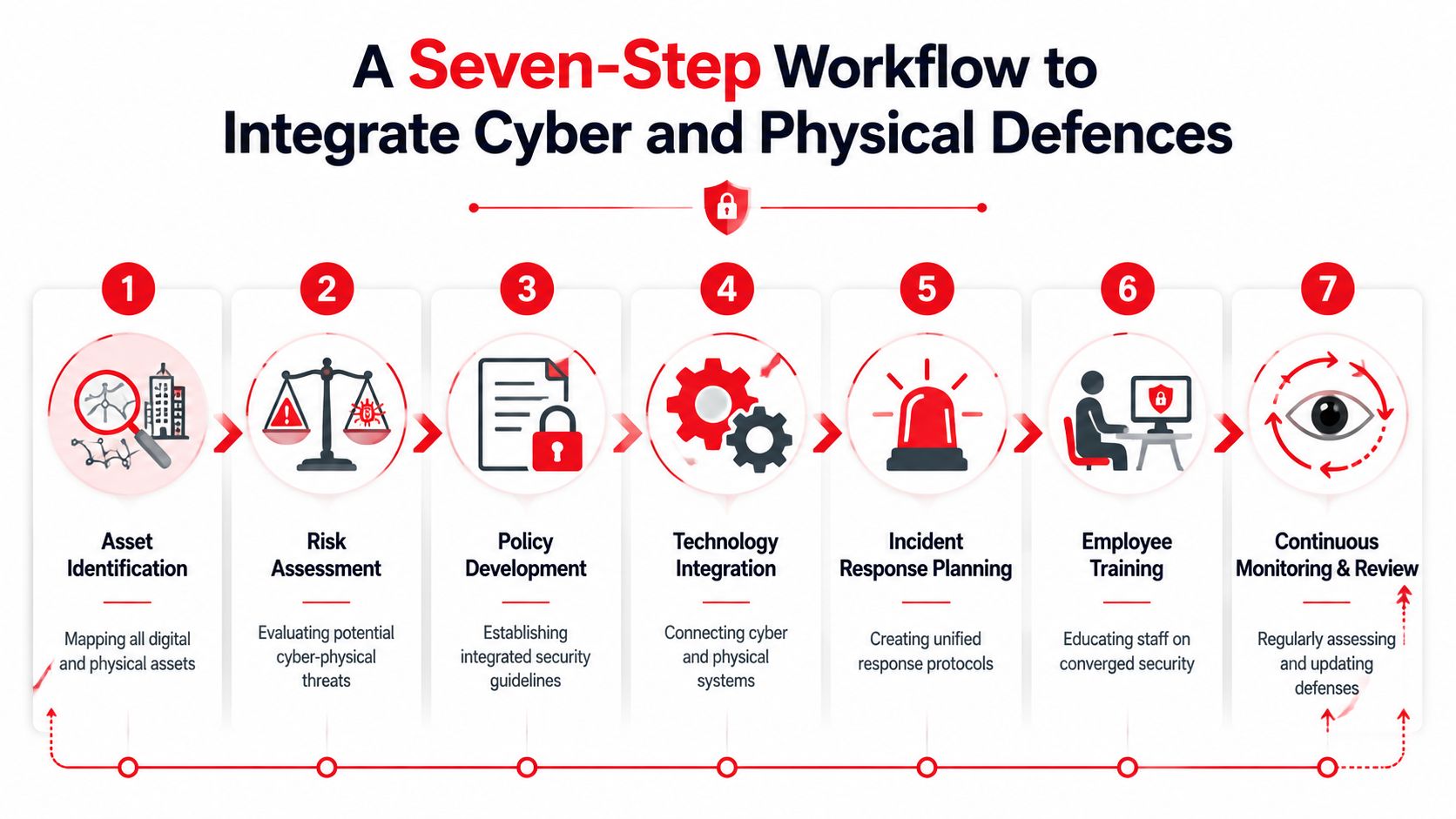
1. Identify every connected asset
Start with cameras, intercoms, alarm panels, NVRs, access-control controllers, and any building-management gear that touches security. The operations manager usually knows where the devices are, but the IT partner often knows how they're networked. You need both views in the same register.
2. Segment the network
CISA's convergence guidance is direct, IP-connected physical devices should be inventoried, segmented, and patched like any other endpoint, with dedicated VLANs, firmware review, credential audits, encrypted management sessions, and central log collection CISA convergence guidance. If cameras and access panels sit on flat routing with default passwords, you've left the side door open.
3. Name patch and firmware ownership
Do not let the vendor assume the client is patching, and do not let the client assume the installer is doing it. Put the responsibility in writing. The security provider, IT lead, or MSP should know exactly who approves firmware updates and who verifies they landed.
4. Tighten identities and credentials
Badge administrators, remote support accounts, and shared contractor logins need the same discipline as any privileged IT account. Remove shared access where you can, audit who can issue or revoke badges, and make sure temporary access really expires.
5. Pull logs into one view
CCTV, access control, alarms, and remote admin events belong in the same monitoring picture. If your SOC can't see physical-device events, it can't correlate them with the rest of the incident. That is a blind spot, not a workflow.
6. Write one incident runbook
Security operations, facilities, IT, and the physical security provider need the same escalation path. If a camera goes dark during a break-in, the guard team, the NOC, and the duty manager should know who calls whom first and what gets preserved.
7. Exercise the whole chain
Test the handoff under pressure. Use a gate failure, camera outage, or badge compromise scenario and watch who acts. If the exercise reveals confusion, that confusion is already in production.
Two Australian Sites, One Convergence Framework in Practice
A 600-guest hospitality venue in Melbourne doesn't need a theoretical lecture, it needs a manager who can keep the venue moving when a door controller fails after hours. In that kind of incident, the duty manager, the security provider, and the IT contractor need a shared playbook so they don't argue about ownership while guests queue at the entrance. The difference between disorder and control is usually whether someone has already defined the escalation path.
A construction site in western Sydney presents a different problem. Shared contractor logins on the gatehouse CCTV can expose live feeds to people who should never see them, and that's not just an IT issue, it's a site intelligence issue. The fix is straightforward: credential hygiene, network segmentation, and a patrol-style verification routine that checks whether the gatehouse system is behaving the way the roster says it should.
What the two sites have in common
Both sites rely on a mix of gatehouse control, back-to-base monitoring, uniformed guards, and rapid incident response. Both also fail for the same boring reasons, poor password discipline, weak device ownership, and no clean handoff between the people who run the site and the people who run the network.
A good operational model is one where a guard notices the symptom, the duty manager knows the escalation path, and the technical partner can act without delay. That's not glamorous. It is, however, how you stop a small fault from turning into an operational loss.
The lesson for venue and construction operators is blunt, the site that rehearses the joint response wins the first hour. The one that doesn't spends that hour making phone calls.
Choosing Vendors and Tools Without Buying the Same Gaps Twice
Most procurement mistakes come from buying technology before deciding who owns the risk. You can run a single integrated platform, a best-of-breed stack, or a security-provider-led model, but each one only works if the ownership model fits the site. For venues, retail centres, and construction compounds, seasonal rosters, contractor turnover, and remote sites matter more than sleek dashboards.
| Integration model | Best fit sectors | Strengths | Watch-outs |
|---|---|---|---|
| Single integrated platform | Multi-site venues, retail chains | One interface, cleaner audit trail, simpler training | Vendor lock-in, weaker flexibility if support is thin in Australia |
| Best-of-breed stack | Larger hospitality groups, mixed portfolios | Stronger specialist capability, easier to replace one layer | Integration gaps, patching ownership can get messy |
| Security-provider-led model | Events, construction, temporary sites | Fast deployment, practical site control, close link to guards and response | Needs disciplined partnership with IT or an MSSP |
What to demand before you sign
Ask who publishes firmware update cadence, who owns physical-device logs, and how incidents move between the SOC and the site team. If the MSSP refuses to include camera and access-control logs, that's a bad fit. If the access-control brand has no Australian support footprint, expect slower recovery and more finger-pointing.
CISA's 2022 summit paper is useful here because it recommends a blended approach for critical infrastructure and calls out the benefits of a stronger holistic risk view, better alignment and accountability, and faster identification and response across both domains CISA summit paper. For Australian operators, that translates into shared incident playbooks, joint reviews, and coordinated escalation paths, not just a larger software bill.
Sector Checklists and a 90-Day Starter Plan
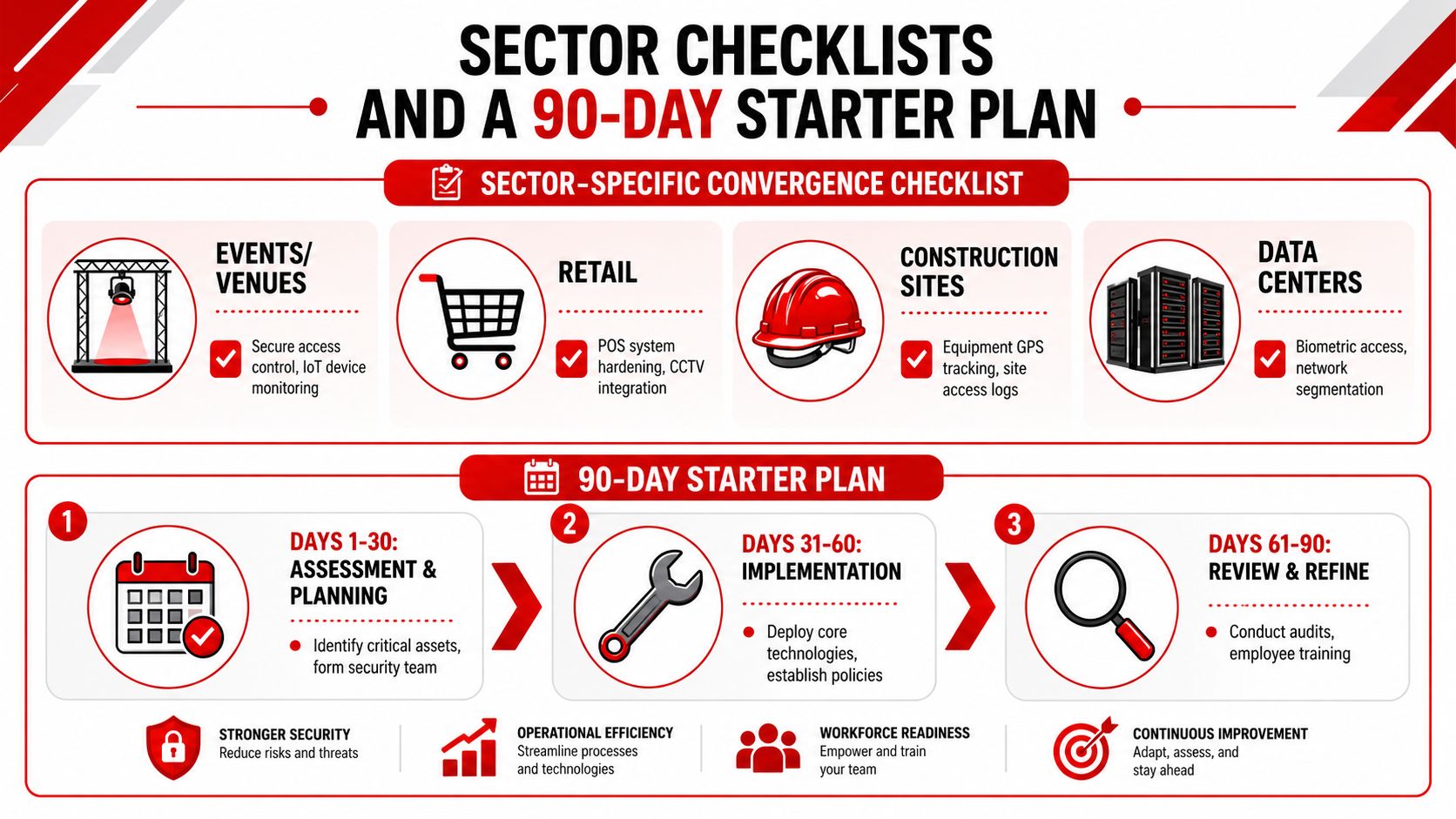
A duty manager or site supervisor can use the same walk-through on every site. Are the cameras online, patched, and logged. Who can issue badges. Do contractors have separate access. Can the alarm path still function if the network stalls. Those questions apply to events, hospitality, retail, and construction without needing a consultant's slide deck.
For a practical SME benchmark on the cyber side, the MY CYBER GUARD checklist for SMEs is a useful companion because it keeps the focus on actions, not slogans. Pair that mindset with the physical checks you already run on site, and the gaps become obvious fast.
A 90-day starter plan
- Days 1 to 30, inventory and segment: map every connected security device, name an owner, and separate the network paths.
- Days 31 to 60, govern credentials and patching: remove shared logins, document firmware responsibilities, and verify admin access.
- Days 61 to 90, exercise and refine: run a joint incident test, fix the broken handoffs, and write the playbook down.
Safe Work Australia recorded 139 traumatic injury fatalities in Australian workplaces in 2022-23, with falls from height and moving objects among the leading causes Safe Work Australia data via Genetec report. That's the reminder many teams need, physical controls still protect people, and converged planning has to protect staff and contractors, not just data and cameras.
GM GROUP Services helps Australian venues, construction sites, and businesses close the gap between physical security and cyber-enabled risk with practical, site-ready protection. If you're dealing with access control, CCTV, gatehouse operations, or incident response across NSW, VIC, QLD, or the ACT, visit GM GROUP Services and talk through a security plan that fits how your site runs.
Discover more from GM Group Services
Subscribe to get the latest posts sent to your email.