
Security Camera Systems Sydney aren't a niche upgrade, they're part of the city's working infrastructure. Sydney was ranked the 15th-most surveilled metropolitan city in the world with 12.35 cameras for every 1,000 people, and that changes what buyers should expect from a modern system.
In practice, that means a camera package in Sydney has to do two jobs at once, deter trouble and preserve usable evidence when something goes wrong. A system that looks fine on paper but fails at night, misses a doorway, or ignores privacy rules is expensive in the worst way, because it creates false confidence.
Why Security Camera Systems Sydney Are a Business Imperative in 2026
Sydney's surveillance density sets the expectation for every business that relies on CCTV. The city is not treating cameras as a novelty. They already sit inside public safety operations, transport corridors, entertainment precincts, and council practice. The Sydney Morning Herald reported that Sydney ranked 15th globally for surveillance density, while Australia had about 1 million CCTV cameras and NSW had about 300,000 of them (Sydney Morning Herald reporting).
That changes the buying decision. The question is no longer whether a site has cameras, it is whether the system produces usable footage when staff need it, police request it, or an insurer reviews an incident. Sydney City Council's own camera operation shows how embedded this approach has become, with 106 CCTV cameras in the local government area, monitored 24/7 by trained personnel. The city has long used footage as an operational tool, not passive storage.
The practical expectation on Sydney sites
I see the same demand pattern across hospitality venues, retail strips, construction compounds, and event sites. Owners want deterrence. Operations managers want evidence. Site supervisors want a system that does not become another maintenance problem. Those goals only align when the design matches the site.
Practical rule: if your cameras cannot support a real incident review, they are decoration, not security.
That is why the conversation has to include more than hardware. It also has to cover how the system helps defend your business online assets, because video, user access, and recorded footage now sit inside a broader security posture.
Why Sydney's mix of sites changes the brief
A pub in the inner west, a retail site in a shopping corridor, and a construction yard on the fringe of the CBD all have different capture problems. One needs face-level footage at a bar counter. Another needs a clear view of cash handling and loading access. The third needs perimeter visibility through low light and weather. A standard business CCTV kit rarely fits all three.
Security Camera Systems Sydney only pay off when they are designed for local density, local risk, and local compliance. In this market, the cost of a poor system is not just the equipment. It is the footage you do not have when somebody asks for it.
Assessing Your Site Security Risks Before Buying Cameras
Start with the site, not the catalogue. Walk the property at the times incidents are most likely, then map where people move, where valuables sit, and where a camera would help someone make a decision after an event. A good risk map is a list of problems, not a shopping list of devices.
Match the threat to the space
For event organisers, the obvious weak points are crowd-density chokepoints, emergency exits, and equipment staging areas. That's where conflict starts, where assets get moved, and where a post-incident review usually needs a clear timeline. For hospitality venues, the pressure points are entry and exit doors, bar counters, alleyways, and staff-only zones, because that's where theft, refusal incidents, and after-hours access issues tend to surface.
Retail operators should look harder at fitting rooms, cash-handling areas, loading docks, and perimeter fencing. Those spaces have different objectives, some need identification, some need deterrence, and some need simple proof that an access path was used. Construction managers should focus on material storage, crane paths, fence gaps, and unlit access roads, because those are the places where loss, trespass, and unsafe movement usually intersect.
Rank risk before you rank camera count
A site with one critical cash point and five low-value corridors does not need equal camera density everywhere. It needs sharper coverage where the impact of an incident is highest. The point of the assessment is to decide which area deserves close identification, which area only needs overview coverage, and which area can be left to another control, such as lighting or access control.
A site map that doesn't separate high-impact zones from low-value zones usually leads to overspend in the wrong places.
A practical way to do this is simple. List the likely incident, note where it would happen, and decide what evidence would matter most after the fact.
- Crowd control issues: Focus on entry funnels, queuing lines, and egress points, because those areas affect both safety and liability.
- Asset loss risk: Prioritise storage cages, loading bays, and equipment handover points, where movement matters more than broad coverage.
- Staff conduct concerns: Cover cash handling, back-of-house doors, and isolated work zones, where management often needs review footage rather than a live response.
- Perimeter intrusion: Watch fence lines, gates, and access roads first, especially if the site is dark after hours.
The best time to decide camera quantity is after you've identified the threat map. If you buy first and assess later, you end up with too many cameras in easy places and too few in the places that cost money.
Choosing the Right Camera Types and Specifications for Sydney Conditions
Resolution alone will not save a weak design. A camera can look strong on a datasheet and still fail in glare, shadow, rain, or a busy doorway if it does not capture the scene you need. The Department of Home Affairs CCTV design notice recommends at least 1080p for indoor and well-lit outdoor locations, with optimised infrared and WDR for darker or high-contrast scenes, and electronic image stabilisation for cameras mounted on swaying poles (Department of Home Affairs CCTV design notice).
Build around the scene, not the spec sheet
Sydney puts those decisions under real pressure. A camera facing a bright street entrance has different needs from one watching a loading dock at midnight. WDR helps where contrast is harsh, IR matters where light falls away, and stabilisation becomes relevant if the mount moves in wind or vibration. The camera has to match the environment before it matches the budget.
UTAS's CCTV specification guideline breaks the job into camera performance, storage performance, VMS works, software configuration, works execution, and commissioning and testing (UTAS CCTV specification guideline). That matters because it stops buyers from treating cameras as isolated hardware and reminds them that the spec only works when the rest of the system is planned properly.
A good brief also has to fit the site, not just the product range. In practice, that means checking whether the proposal has room for telecom infrastructure integration services if the network, backhaul, or cabinet layout needs coordination with the camera rollout. On many Sydney sites, that coordination decides whether the system performs reliably after installation or only looks complete on handover day.
Use the right camera type for the job
Fixed cameras are usually the best fit where you need consistent evidence at a known point, such as a till, doorway, or access gate. PTZ units make more sense where a live operator needs to follow activity across a larger area, but they are a poor substitute for fixed coverage if you need uninterrupted proof at multiple points. Panoramic cameras can reduce device count in open areas, but only if the scene suits them and the viewing angle still preserves detail where it matters.
The rest of the baseline is easy to overlook and costly to ignore. H.265 or H.265+ compression, PoE transmission, and local surveillance-grade HDD storage are practical benchmarks in Australian supply guidance, and they suit Sydney deployments where bandwidth and retention both matter (UTAS CCTV specification guideline).
A simple quote check
If two suppliers quote the same number of cameras but one includes better night capture, storage sizing, and commissioning, the cheaper quote may be the more expensive mistake. Ask each supplier the same questions.
- Can this camera hold detail at the scene's actual light level?
- Does the storage plan match the retention workflow?
- Is commissioning included as a separate deliverable?
If the answers are vague, the quote is incomplete.
Planning Camera Coverage Placement and Technical Infrastructure
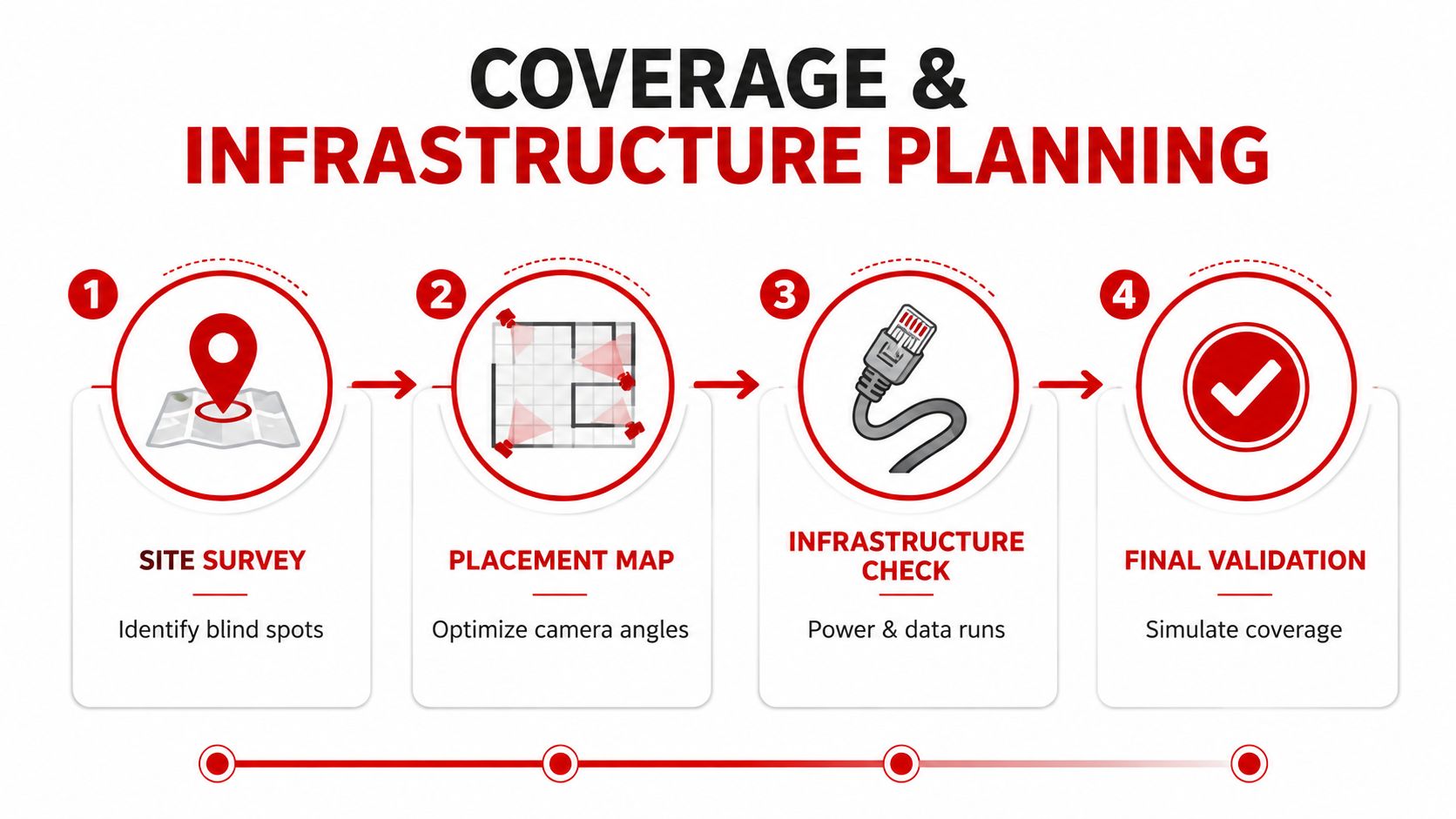
Good coverage starts with what the lens can see, then works backwards to power, data, and storage. Too many installs begin with wall locations and end with blind spots, because the physical mounting point was chosen before anyone thought about the field of view. The result is usually a neat-looking system that misses the behaviour that matters.
Place cameras for evidence, not symmetry
A symmetrical layout feels tidy, but it often wastes view on low-risk surfaces. In Sydney venues, the important view is usually the one that captures a face, a handover, a transaction, or a breach path, not the one that makes the floor plan look balanced. A camera aimed too high can help with wide perimeter awareness but lose the details you need to identify someone at a doorway.
That trade-off matters. Face-recognition clarity usually improves when the camera is positioned to see the subject more directly, but the wider the perimeter you try to cover, the more detail you lose at the edges. For a retail entrance or hospitality till, tighter framing often beats broad coverage. For a fence line or yard, broader context may be more useful than close identification.
Coverage rule: if a camera is trying to cover everything, it usually records nothing clearly enough.
Connect the layout to the infrastructure
Power over Ethernet makes many Sydney installs cleaner because one cable can carry both data and power, but it still has to be budgeted properly at the switch and rack level. If you're running hybrid or standalone gear, then power and data paths need to be planned separately, and that affects labour, enclosure choice, and fault-finding later. For projects where the network forms part of a broader site build, telecom infrastructure integration services can be useful when cameras need to sit inside a larger comms design rather than as a standalone add-on.
Storage should be sized against retention and review habits, not camera count alone. A site that expects frequent incident review needs a different retention plan from one that records mainly for deterrence and occasional investigation. That is why the storage conversation has to happen before the handover, not after the first complaint.
Test the system in real conditions
Sydney weather, traffic, and lighting all change the image. A camera that looks acceptable in daylight can smear under rain or perform badly when headlights sweep across an entry lane. Commissioning should test the actual scene at the actual time of use, because that's when focus, glare, motion, and angle problems become obvious.
I prefer a commissioning walk that checks three things: the camera can see the right zone, the recording is legible, and the retrieval process works the way the client expects. If the system can't pass all three, it isn't finished.
Navigating Legal Compliance and Privacy Requirements Across NSW
Installing cameras is the easy part. Using them legally is where Sydney operators get exposed, especially when the lens crosses from their own site into somebody else's space. Section 8 of the Surveillance Devices Act 2007 (NSW) makes it an offence to knowingly install, use, or maintain an optical surveillance device in circumstances involving entry onto premises or into a vehicle without consent, or interference with a vehicle or other object without express or implied consent. The maximum penalty is 5 years' imprisonment and/or a fine of $11,000 for an individual, or $55,000 for a company (Surveillance Devices Act commentary).
Know the boundaries before you mount anything
A camera fitted after entering a neighbour's yard without permission can create criminal exposure even if the device itself is ordinary CCTV equipment. The issue isn't brand or model, it's the circumstances of installation and use. That's why the first compliance question should be who controls the space, not where the bracket fits.
The City of Sydney's street safety camera code gives a practical local benchmark. It says cameras will not be used to look into private premises or residential properties, and recorded images are generally retained for 28 days. If footage is needed for a crime investigation or court proceedings, it can be kept for a further 7 days (City of Sydney street safety camera code).
What the lens can see matters as much as where it sits
NSW privacy guidance reinforces the same point, operators shall not allow cameras to view into private residences (NSW CCTV code). A retail store facing apartments can legally aim toward its own entry and loading areas, but it should avoid angles that catch bedroom windows, balconies, or internal domestic spaces across the road. The lens view is the legal issue, not just the installation point.
Strata adds another layer. In shared areas such as hallways, foyers, stairwells, and car parks, CCTV generally needs Owners Corporation approval, usually through a special resolution at a general meeting, and cameras can't go into private areas such as bathrooms or change rooms. Clear signage is usually required when cameras operate in common areas (NSW strata guidance).
A fast compliance checklist
- Confirm consent and ownership: Make sure the site manager or Owners Corporation controls the area being recorded.
- Check the lens view: Avoid private residences, bedrooms, balconies, or change rooms.
- Set retention rules: Align deletion settings with the operational need for the footage.
- Document access: Limit who can export, delete, or view recordings.
If you manage a venue, office, or strata site, treat CCTV like a governed system, not just a security device. That mindset prevents most of the avoidable legal problems.
Procurement Installation and Maintenance Best Practices for Sydney Businesses
A poorly scoped CCTV job usually fails before the first camera is mounted. A proper procurement brief separates camera performance, storage performance, VMS works, software configuration, works execution, and commissioning, which is the right structure for Sydney tenders as well as it is for any controlled site review (UTAS CCTV specification guideline). If a quote skips one of those stages, it is not a complete quote.
Put commissioning in the contract
Commissioning needs to sit in the contract, not in a verbal handover. The system should be tested as a working whole, with image quality, playback, export, access, and retention settings checked before the client signs off. A camera fixed to a wall is not proof of a working system.
Sydney projects often expose problems only after the install is finished. A camera can be in the right position and still fail the job if glare washes out the scene, the retention period is too short, or the interface makes retrieval slow when staff need it. Commissioning should surface those faults while there is still time to fix them.
The practical test is simple. Can an operator find the right clip quickly, export it without breaking the chain of custody, and confirm the image is clear enough to identify people or activity in the area that matters? If the answer is no, the handover is incomplete.
Build maintenance into the operating rhythm
A CCTV system needs ongoing care if you want it to stay defensible. Quarterly lens cleaning keeps dust, salt, and traffic grime from softening the image, firmware updates reduce avoidable faults, and storage health checks help catch failed drives before they wipe out evidence. Reviewing footage-access logs also matters, because it shows who has touched the system and whether access is being controlled properly.
Maintenance note: the most common system failure I see is not a total breakdown, it is gradual decline caused by dirty lenses, ignored storage warnings, and no one checking whether the camera still frames the right area.
A reporting template helps site managers stay honest. Record the camera ID, the image condition, any faults, who reviewed the logs, and whether corrective action was taken. That paper trail helps with due diligence if an insurer, auditor, or investigator asks how the system is managed.
Maintenance planning should also match the site's tolerance for downtime. A retail venue with long trading hours, a hospitality site with weekend peaks, and a construction compound all need different service intervals and response times. For some Sydney businesses, scheduled maintenance support is the practical choice when the system needs regular oversight rather than a one-off install.
Keep the installation timeline realistic
Council approvals, strata votes, network changes, and back-to-base monitoring integration all take time. If a vendor promises a rapid rollout without acknowledging approvals or existing comms constraints, they are probably compressing the part that causes the most delay later. The cheapest schedule on paper often becomes the most expensive once rework, access issues, and follow-up visits are added.
Procurement should also account for the way the site operates. A venue that trades late, a retail store that cannot shut down during business hours, and a building site with changing access points all need a rollout plan that fits those limits. That means phasing work around operations, checking cable paths before purchase, and confirming who will own the system after handover.
The best outcome is a system that works on day one and is still usable months later. That comes from clear scope, proper commissioning, and maintenance that is written into the operating plan from the start.
Understanding Costs and Return on Investment for Security Camera Systems in Sydney
The right budget depends on the risk profile, not the postcode. A small retail fit-out, a bar with a late-night crowd, a construction site, and a festival footprint all need different levels of coverage, storage, and operational support. That's why the cheapest option is often the most expensive one once the system has to prove itself.
ROI comes from usable footage, not camera count
The Australian Institute of Criminology study on Sydney Trains found police requested CCTV footage in 27% of 22,370 criminal matters between January 2014 and September 2017, and clearance rates improved by 6.7 percentage points for theft and burglary matters and 7.5 percentage points for property damage matters when CCTV footage was requested (Australian Institute of Criminology study summary in City of Sydney annual report). That doesn't mean every Sydney site will see the same outcome, but it does show that footage can materially support investigations when it's captured and retrieved properly.
Match the budget to the operating model
DIY systems can make sense for low-risk spaces where the main need is basic observation and occasional review. Professional installation becomes more sensible when cable runs, image quality, and compliance framing matter. Fully managed monitored systems suit sites where someone has to watch, respond, or maintain the system as an ongoing service.
The decision usually comes down to three questions.
- Is the risk local and simple? A small office may only need a modest system with limited retention.
- Does the site operate at night or in crowds? Hospitality, events, and construction sites usually need stronger design and faster review.
- Will footage support legal or insurance processes? If yes, the system needs cleaner governance and better maintenance than a casual install.
The ROI conversation should also include staff time, access control, and incident handling. If your team spends less time disputing events because the footage is clear and easy to retrieve, the system is already paying part of its way. If it only records blurry clips that nobody can find, you've bought a cost, not a control.
GM GROUP Services plans and supports security solutions for events, hospitality venues, retail sites, construction projects, and corporate environments across NSW and beyond. If you're comparing Security Camera Systems Sydney options, visit GM GROUP Services to discuss a fit-for-purpose approach that ties camera coverage, on-site protection, and ongoing operational support together.
Discover more from GM Group Services
Subscribe to get the latest posts sent to your email.