
Security guard hourly rates start at $27.17 per hour for an adult level 1 officer under the Security Services Industry Award from 1 July 2024. The billed rate to a client is usually much higher once penalties, on-costs and margin are added.
Security guard hourly rates are the first thing most venue managers ask about when they're staring at three quotes for the same Saturday-night shift. The problem is that a quote is not one number, it's a stack of wage, penalty, insurance, supervision and compliance costs that all sit on top of the award floor.
For NSW, VIC, QLD and the ACT, that distinction matters. A guard posted at a bar, a construction gate or a festival entrance isn't priced from a single “market average”, the benchmark starts with the award, then rises with the roster and the risk.
What Security Guard Hourly Rates Really Mean in Australia
A decent quote should make sense before you look at the fine print. If it doesn't, you're not comparing hourly rates, you're comparing different cost structures wrapped in the same headline number.
A basic weekday static post can look inexpensive on paper because it sits close to the award floor. The moment you move that same guard to a Saturday night, a public holiday, a high-traffic venue, or a post that needs extra supervision, the number changes because the labour input changes.
That's why the cheapest quote can be the wrong quote. If one provider has trimmed supervision, underpriced compliance, or failed to allow properly for penalties, the shortfall usually shows up later as roster problems, rushed briefings, weak incident handling or extra charges.
Practical rule: compare the whole deployment, not the face value of the hourly figure.
The other trap is mixing up the guard's wage with the client's bill rate. The guard's wage is the base, the bill rate is the outcome after award obligations, payroll costs, insurance, training, uniforms, admin and margin are added.
For buyers, the safest mindset is simple. Treat security guard hourly rates as a pricing system, not a sticker price. Once you do that, the quotes start telling you the truth about the service you're buying.
The Award Wage Floor and How It Sets the Base Rate
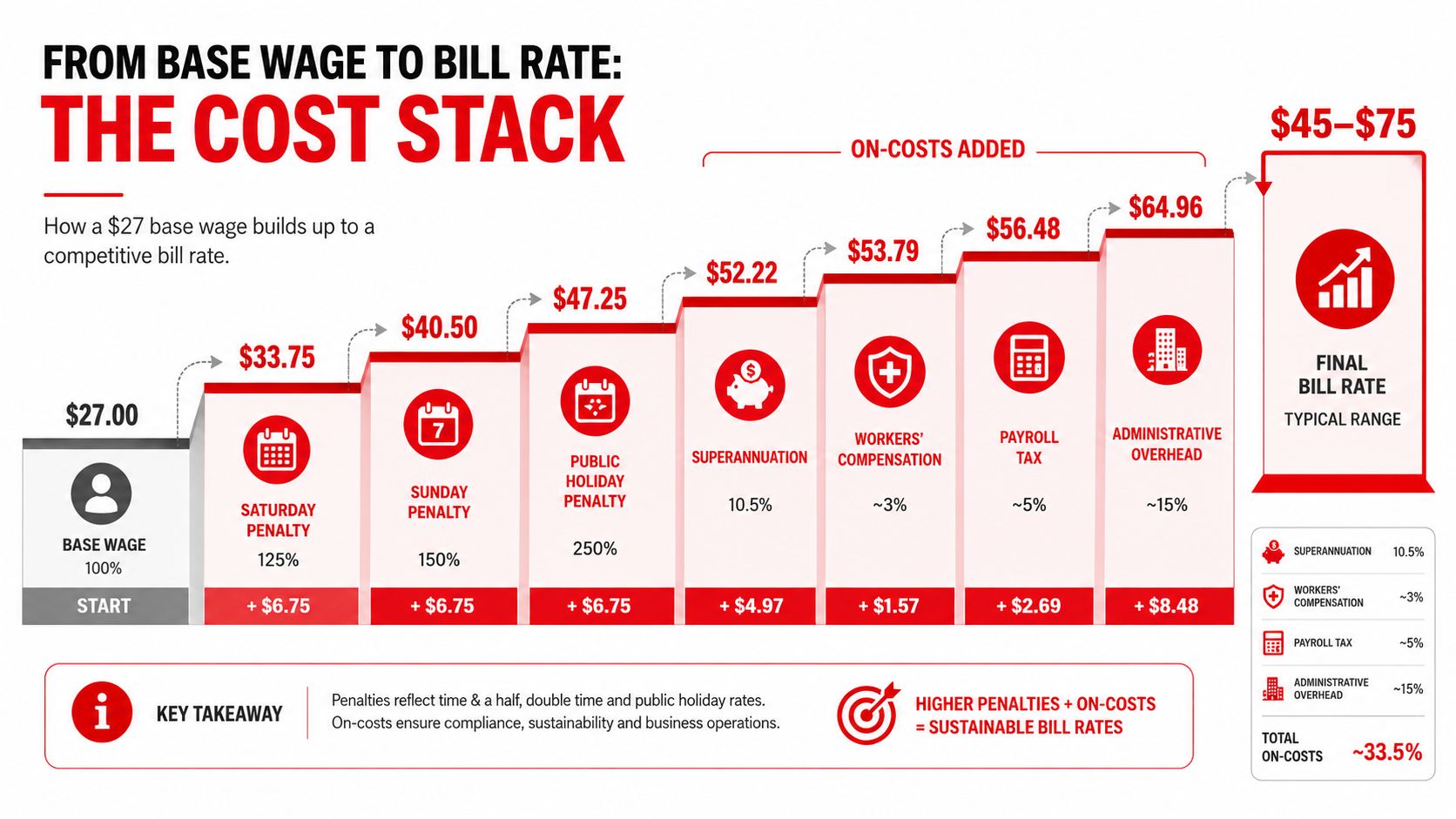
The starting point is the Security Services Industry Award 2020 (MA000118). Under that framework, a level 1 adult security officer is paid $27.17 per hour from 1 July 2024, level 2 is $28.84 per hour, and level 3 is $30.52 per hour. Those figures set the wage floor, not the client's final invoice.
The classification ladder matters because not every guard does the same job. A more experienced officer, someone with extra licences, or a supervisor carrying more responsibility can sit at a higher level than a basic static guard, even on the same site. That's why two people in the same uniform can legally earn different hourly amounts.
For a client, the big takeaway is that a quote below the award floor is a warning sign. A licensed provider has to meet award obligations, so a lowball rate usually means somebody has cut corners elsewhere, or the quote is not comparing like for like.
Guard pay and bill rate are not the same thing
The wage floor is only the first layer. The bill rate includes penalty conditions, on-costs and the provider's commercial margin, which is why the amount you pay is materially higher than the amount the officer earns.
The clean way to think about it is this, award classification → ordinary hourly pay → penalties and loadings → final billed hourly rate. If the provider can't explain each step, the quote isn't transparent enough for procurement.
For planning, that distinction matters more than most buyers realise. It affects event budgets, hospitality rosters, retail floor coverage and construction gatehouse work because the same guard can move between very different cost bands depending on classification and shift type.
What Pushes the Hourly Rate Up Once Penalties and On-Costs Are Added
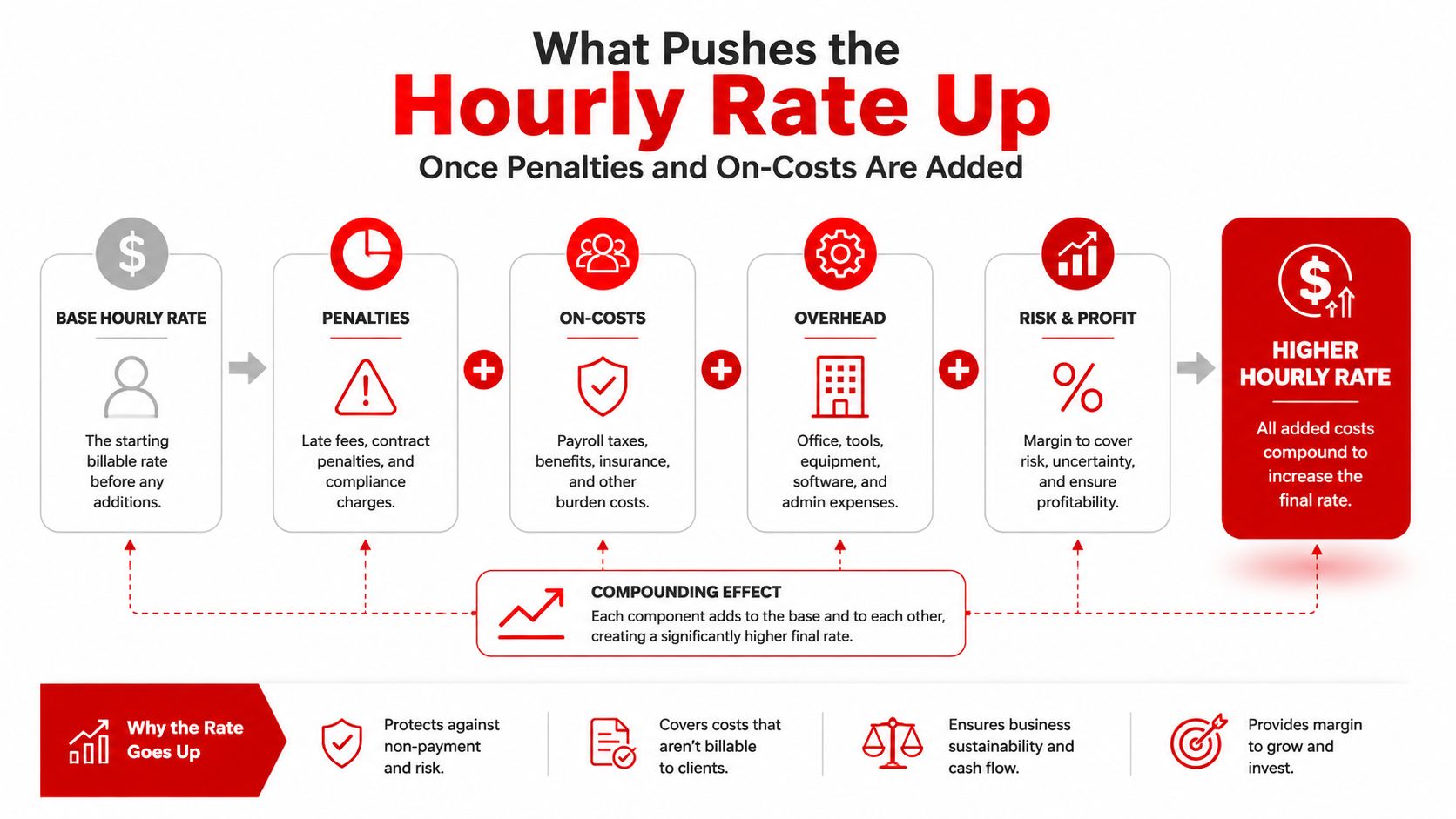
The biggest jump in security guard hourly rates comes from the roster, not the uniform. Under the award, Saturday work is paid at 125% of the minimum hourly rate, Sunday work at 150%, and public holiday work at 250%. That alone can turn a routine shift into a very different labour cost.
Once penalties are in play, providers still have to cover the rest of the operating stack. That includes superannuation, workers compensation, payroll tax where applicable, uniforms, equipment, training, supervision and administration. None of that is optional if the deployment is meant to be compliant and sustainable.
The line items that usually move a quote
A transparent quote should normally make room for more than the guard's time on site. The items that most often shape the final bill are:
- Penalty loadings: Weekend, night and public holiday rostering lifts the cost of labour.
- Superannuation and insurance: These sit above wages and protect the provider and the client's risk position.
- Training and supervision: A capable shift still needs briefing, oversight and fallback support.
- Uniforms and equipment: Radios, torches, hi-vis, PPE and venue-specific gear all have a cost.
- Admin and margin: Scheduling, payroll, compliance checks and profit are part of the commercial rate.
A Saturday-night festival post is rarely priced like a weekday office lobby. The venue expects crowd management, fast escalation and a crew that can hold the line under pressure, so the provider prices the labour, the risk and the backup required to keep it working.
A good quote tells you where the money goes. A bad one hides those choices until an invoice dispute starts.
Typical Hourly Ranges by Service Type and Region
For most buyers, the right question isn't “What do guards cost?” It's “What does this post require, and which roles sit above the basic static rate?” Static guarding is the floor, but event work, patrols, control-room coverage and close protection all sit higher because the role demands more judgement, more responsiveness or more specialised licensing.
| Service type | Indicative hourly range (AUD) | Common drivers |
|---|---|---|
| Static guard | Close to the award floor, rising with penalties | Site risk, hour of day, supervision, roster length |
| Mobile patrol | Higher than a single static post | Vehicle use, route coverage, reporting burden |
| Event and crowd control | Higher again | Peak-time pressure, venue familiarity, customer-facing work |
| K9 handler | Premium over standard guarding | Handler skill, dog deployment, specialist oversight |
| VIP and close protection | Premium rate | Threat profile, discretion, planning, travel time |
| Control-room operator | Higher than basic guarding | Monitoring, escalation, systems use, documentation |
| Loss prevention officer | Varies with retail risk | Customer contact, incident handling, surveillance duties |
The pattern across NSW, VIC, QLD and the ACT is the same, the rate moves with labour supply, licence requirements and the type of post. Event staffing and after-hours work tend to cost more because they need more reliable labour, stronger supervision and officers who can handle public interaction without losing control of the site.
Control-room and loss-prevention work can also price differently from front-of-house guarding because the skill mix changes. A person who can sit on cameras, document incidents clearly and escalate correctly is not the same resource as a visible doorway guard.
For planning, that means you should budget by role, not by vague “security” line item. Two guards on the same property can have very different commercial value if one is holding a gate and the other is managing a live incident channel.
Worked Examples for Events, Venues and Construction Sites
A clean comparison starts with the post, the hours and the penalties. If you skip one of those, the hourly figure becomes decorative instead of useful.
A weekday office lobby guard is usually the simplest example. The shift is more likely to sit near ordinary hours, with a stable post order and limited equipment, so the bill rate stays closer to the base structure than a weekend event deployment. The cost still includes supervision and admin, but the roster is predictable.
A Saturday-night hospitality venue is different. RSA-aware staff, customer interaction, late finishes and weekend penalties all push the quote upward, especially if the venue expects fast incident reporting and the guard needs to coordinate with management rather than just stand at the door.
Budget rule: the more the site depends on judgement, the more you should expect to pay for the right guard, not the cheapest one.
For a weekend festival, the mix can include crowd control, K9 coverage and extra supervisors. That changes the invoice because you're not buying one guard, you're buying a coordinated deployment with different rates for different posts. For a planning template that helps teams map roles, numbers and baseline assumptions in a structured way, the baseline measurement examples agenda is a useful reference point.
If you're comparing quotes for a wedding, a venue buyout, or another event with multiple moving parts, the same logic applies. A broad overview like compare wedding venue expenses can help remind you that site cost is only one piece of the total event budget.
The reusable rule is simple. Ask for the role mix, the rostered hours, the penalty treatment and any extra charges for travel, setup or equipment. Once those are visible, the blended hourly rate on the invoice becomes much easier to test.
How to Compare Quotes and Reduce Cost Without Cutting Corners
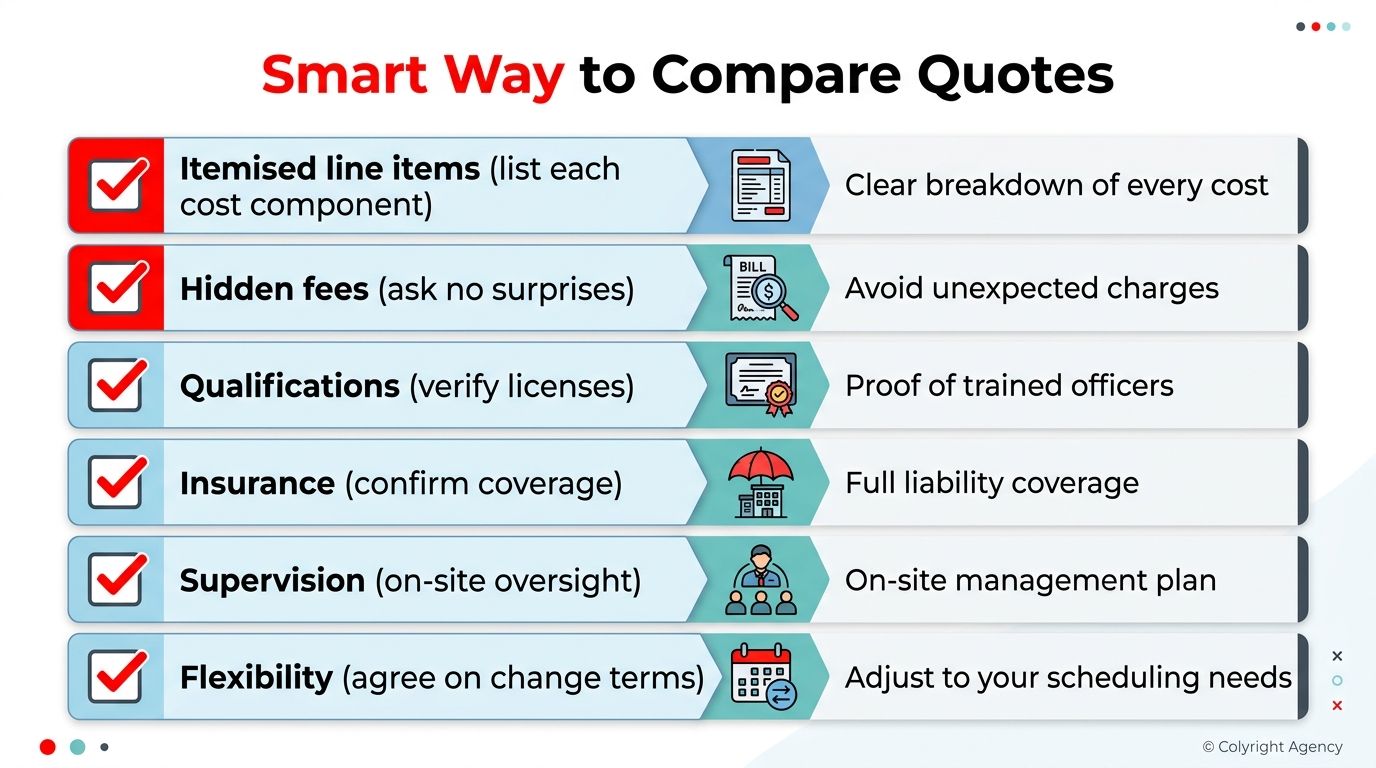
A good RFQ makes it easier to compare providers on the same terms. Ask for itemised labour, penalties, equipment, supervision, travel and any minimum shift rules so the hourly figure doesn't hide the true cost.
The next filter is staffing model. Guards who are directly employed, subcontracted or pulled from a mixed labour pool can land on different cost bases, so you need to know who is responsible for compliance, payroll and backup if someone calls in sick. If the provider can't answer that clearly, the quote probably isn't robust enough for a live venue or site.
You can also reduce cost without weakening the deployment. The safest levers are roster design and post design, not cutting training or supervision. Bundling adjacent shifts, avoiding unnecessary Sunday or public holiday coverage, and sharing a static guard across nearby tenancies can all improve efficiency when the risk profile allows it.
Vehicle patrols can also make sense where a full-time fixed post is unnecessary. If the site needs visibility and response rather than constant presence, a patrol pattern may be a better commercial fit than paying for a stationary officer all night.
Questions worth asking before you sign
- What exactly is included? Confirm whether supervision, equipment and travel are already in the figure.
- Who backs up the shift? A proper provider should explain replacement coverage without hedging.
- What changes the price? Last-minute roster changes, venue moves and longer event hours should be clear upfront.
- Can you compare the same shift type? Saturday night, weekday day, public holiday and overnight work should never be lumped together.
One practical option for NSW, VIC, QLD and ACT buyers is to shortlist providers that can show how they match the guard to the site. GM GROUP Services does that across events, venues, retail, construction and patrol work, with pricing tied to hours, guards and services required rather than a one-line guess.
Compliance, Licensing and QA That Shape a Reliable Rate
A cheap quote with weak compliance is usually the most expensive one on the table. In NSW, VIC, QLD and the ACT, security work sits inside state licensing rules, so the provider has to prove the officers are properly authorised and the deployment is structured around those obligations.
RSA training matters whenever a guard is working a licensed venue or an event where alcohol is part of the environment. That doesn't just change behaviour at the door, it changes how the officer reads conflict, documents incidents and coordinates with venue staff under pressure.
Quality assurance is where reliable operators separate themselves. Site inductions, clear post orders, incident reporting, supervision visits and back-to-base monitoring all take time and cost money, but they reduce avoidable callouts and confusion on shift handover. For a useful comparison, a business looking at operational compliance can also review smoke alarm compliance checks for businesses to see how serious providers structure a compliance task around regular checks rather than wishful thinking.
The right questions on an RFQ are blunt ones:
- Are the guards licensed for the state and site type?
- Who trains them on this venue or project?
- How are incidents reported and escalated?
- What supervision happens after the shift starts?
- What is the backup plan if the roster changes?
If the provider answers those clearly, the quote may be higher, but it's usually more defensible. Compliance isn't an add-on to the hourly rate, it's part of what you're buying when the site needs reliable coverage.
Key Takeaways and Frequently Asked Questions
The floor starts with the award, the final number comes from the cost stack, and the right guard depends on the site risk. Compare like for like, not quote for quote, and always separate the guard's pay from the client's bill rate.
FAQ 1. What minimum hours should I expect?
Most providers build quotes around a minimum engagement, especially for events, callouts and after-hours work. That's because mobilising staff, equipment and supervision takes time even if the post itself is short.
FAQ 2. Why do quotes differ so widely?
The biggest reason is that providers don't all price the same stack. One quote may include penalties, supervision, insurance and admin properly, while another may leave those costs undercooked or hidden.
FAQ 3. Is GST included in the hourly rate?
You need to ask directly, because not every quote presents the same way. The useful comparison is the final charged amount for the exact roster you need.
FAQ 4. How should I brief a provider for a first event?
Give them the site map, operating hours, expected attendance, alcohol service details, access points, escalation contacts and any known risk hotspots. A good briefing reduces guesswork and gives you a tighter, more realistic quote.
GM GROUP Services provides licensed security across NSW, VIC, QLD and the ACT, with guard, patrol, K9, VIP and event coverage shaped around the site and roster you need. If you want a quote that separates wage floor, penalties and operational support properly, visit GM GROUP Services and ask for a deployment that matches your risk, your venue and your budget.
Discover more from GM Group Services
Subscribe to get the latest posts sent to your email.