
A security guard uniform is usually the first thing a client, patron or contractor notices, and it can either calm a site or make it feel tense before a single word is spoken. If you've ever watched an event entry line tighten up because guards looked too much like police, you already know the issue isn't fabric. It's identification, trust and control.
At venue level, the uniform has to do three jobs at once. It needs to satisfy licensing and presentation rules in NSW, Victoria, Queensland and the ACT, it needs to fit the site's post orders, and it needs to survive long shifts without making staff miserable. Get that balance wrong and you create confusion, complaints and avoidable compliance risk.
Why the Security Guard Uniform Matters More Than You Think
A Friday night festival entry can go sideways fast when the crowd thinks security has turned into police. I've seen it happen at a packed gate where dark tactical shirts, heavy patches and aggressive styling made patrons step back, ask questions and start filming before the guards even spoke. Nobody had broken the law, but the uniform had already changed the mood.
The uniform is part of the first contact
That's the part managers often underestimate. A security guard uniform is not just clothing, it's the first public signal of role, authority and intent. In Australian private security, the uniform has to help identify the officer while avoiding police-like insignia, because the visual line between security and law enforcement matters operationally and legally. The broader Protective Service Workers occupation is large and still expanding, so when uniform standards slip across multiple guards or multiple sites, the problem stops being cosmetic and becomes a brand and compliance issue for venues, events, construction sites and retail settings. The historical move from plain watchman dress to standardised uniforms reflects the sector's shift to regulated private security services rather than ad hoc guarding (Australian uniform framework and workforce context).
Practical rule: if a patron has to guess whether your team is security or police, the uniform has failed.
Why venue clients feel the effect first
The impact shows up in crowd behaviour, staff confidence and how quickly people cooperate during a search, escort or incident response. At a hospitality venue, a softer branded shirt can keep the team approachable. At a concert gate or sports entry, a more assertive look can be useful, but it still has to stay inside the guard identity and away from police styling.
For new venue clients, I always frame uniform policy the same way I frame post orders. Both documents tell staff how to behave, but the uniform tells the public who's in charge before anyone gives an instruction. That's why the garment deserves the same attention as reporting lines, incident escalation and site induction.
Legal and Identification Rules That Shape Every Uniform
Start with the rule that never changes. The security guard uniform must identify the officer clearly and must not blur into police attire. That's the common thread across Australian licensing practice in NSW, Victoria, Queensland and the ACT, even though the exact wording sits in state and territory systems rather than one national standard. From a manager's point of view, the test is simple, can a reasonable person tell at a glance that the wearer is private security, not law enforcement?
Read the uniform as a compliance document
The practical way to assess a uniform spec sheet is to check four things.
- Identification is obvious. The company or employer identity should be visible, and the guard role should be clear.
- Restricted styling is avoided. Anything that looks like police, such as police-style caps, police wording or badge shapes that imply law enforcement, is a problem.
- The site rule overrides the base kit. Post orders can require high-vis outerwear, weather protection, protective footwear or other additions.
- The garment works at the job site. A retail loss-prevention fit won't necessarily work for a construction gate or outdoor festival entry.
That distinction between uniform policy and post orders matters more than most owners realise. The policy sets the standard kit. The post orders set the site-specific additions and exceptions.
Here's a useful reference point if you already manage PPE alongside uniforms. The issues are similar to ANSI and OSHA hard hat rules in that site type, visibility and safety context determine what can be worn and where. A plain uniform rule never covers every environment, so it's worth comparing clothing policy with head protection guidance when you're building a full site standard (ANSI and OSHA hard hat rules).
| Jurisdiction | Identification Required | Restricted Terms |
|---|---|---|
| New South Wales | Clear guard identification tied to licensing and site presentation | Police-like terms and styling |
| Victoria | Clear guard identification tied to licensing and site presentation | Police-like terms and styling |
| Queensland | Clear guard identification tied to licensing and site presentation | Police-like terms and styling |
| ACT | Clear guard identification tied to licensing and site presentation | Police-like terms and styling |
| Texas | Company name, the word “Security”, and the officer's last name on the outermost garment (Texas rule) | None of the listed terms are allowed to be hidden or unclear |
| Ontario | Employer name, logo or crest on the chest of the outermost piece, with no police-style forage cap (Ontario Uniforms Regulation) | Police-style forage cap |
| Arizona | Shoulder patch, breast patch, and back wording requirements, with security terms only (Arizona rule) | “Police”, “Officer”, “Sheriff” |
A manager who can't explain the difference between the base uniform and the post order usually hasn't finished the job spec.
Concrete examples make the rule easier to apply
Texas is useful because it shows how regulators can force identification onto the outer garment, with the company name, the word Security and the officer's last name all visible. Ontario goes further on visual distinction by requiring the employer's name, logo or crest on the chest and banning a police-style forage cap. Arizona is even more prescriptive, with shoulder patch sizes, breast patch sizing and back lettering rules that keep the public from confusing private security with law enforcement.
A good site manager doesn't copy those rules into Australia. The right move is to use them as a mental model. If another jurisdiction can be that specific about identification, then your local specification should be just as clear about what's mandatory, what's forbidden and what gets added for the site.
Core Components and Fabric Choices That Stand Up to the Job
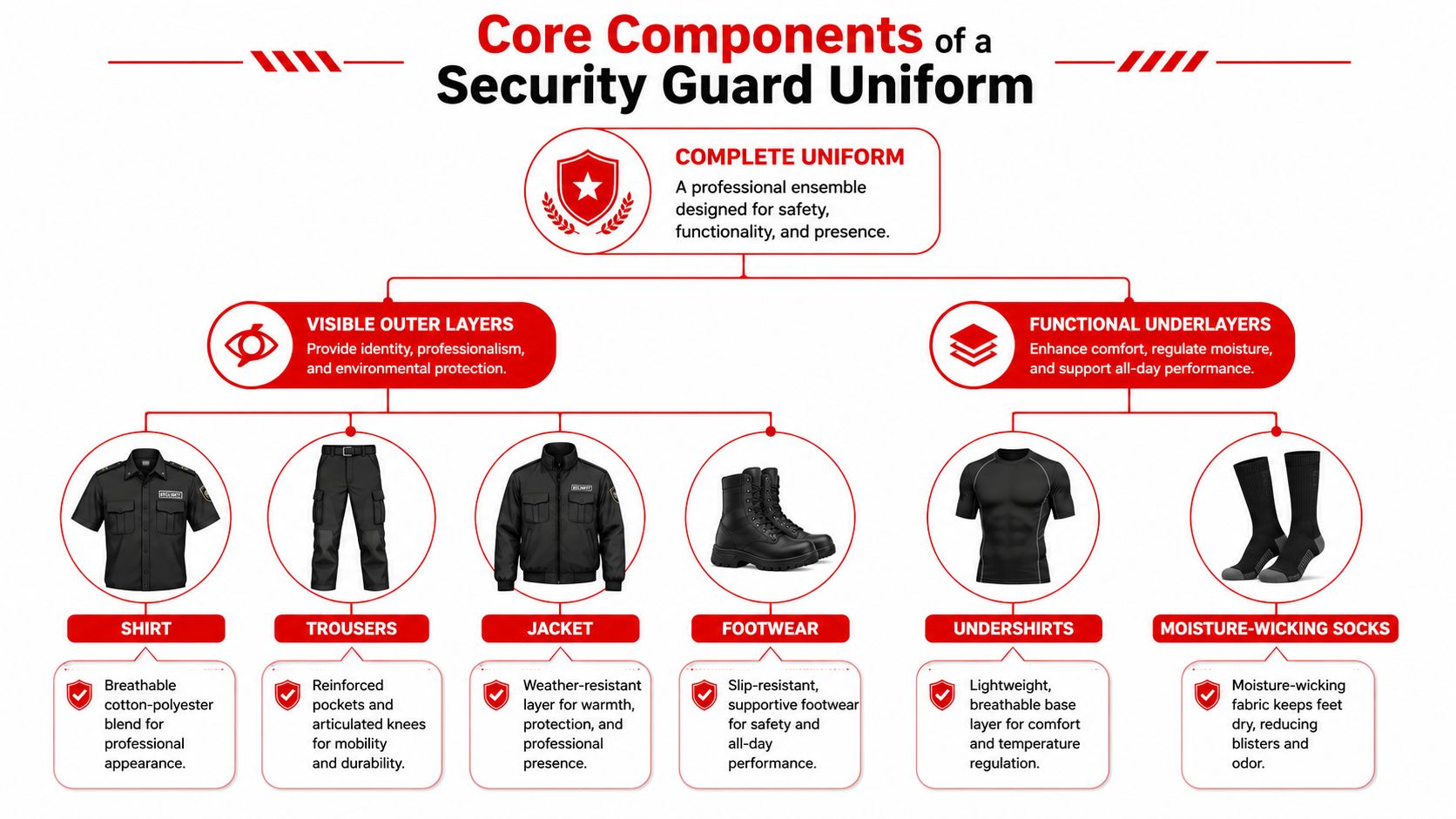
A good security guard uniform starts with function, because the wrong fabric or cut creates problems on shift. Australian workwear suppliers commonly build around a 65/35 polyester-cotton blend at about 220 to 250 GSM, and that gives procurement a practical starting point for tear resistance, laundering durability and day-long wear across different sites (Pacific Uniform AU catalog). That specification will not suit every post, but it is a sensible baseline when you are balancing compliance, branding and comfort.
Build the uniform layer by layer
The shirt usually carries the first visual cue. For front-of-house work, a polo or button-down presents cleanly without looking overly tactical, which matters in venues where the guard needs authority without putting patrons on edge. Trousers need to handle radios, torches and repeated sitting, so pocket placement, waistband comfort and seam strength matter more than fashion detail. Footwear has to match the site, because weak shoes fail quickly on long standing shifts.
The technical details are not optional. Australian workwear guidance points to reinforced stitching at stress points, pre-shrunk colour-fast fabric, bar-tacking at pocket openings and belt loops, and double-needle seams as the standard defence against seam failure and shrinkage in uniforms that get washed constantly (security uniform construction guidance). If you have seen a shirt split at the pocket after a few hard weeks, the reason for those details is obvious.
Visibility and heat need to be balanced
For operational environments, high-visibility garments are commonly specified to AS/NZS 4602.1:2011. Fluorescent fabric improves daytime conspicuity, while retroreflective material helps recognition under headlights and in low ambient light. In practice, reflective tape is usually kept to outerwear or traffic-control variants, because a hospitality shirt should not read like road crew kit, and the wrong look can work against the venue.
The trade-off is straightforward. Heavier, reinforced garments generally last longer and reduce replacement frequency, but they can also add heat stress in outdoor Queensland work and summer festival deployments. Layered systems handle that better than one all-season outfit. A breathable shirt, a tougher outer layer and a separate weather shell usually give more flexibility than forcing one garment to do every job.
For fabric selection, T-Shirt Envy's fabric recommendations are useful when you are comparing durability against comfort, especially if your team needs branded undershirts or lighter promotional layers that still hold their shape after repeated washes.
How Uniforms Differ Across Events, Hospitality, Construction and Retail
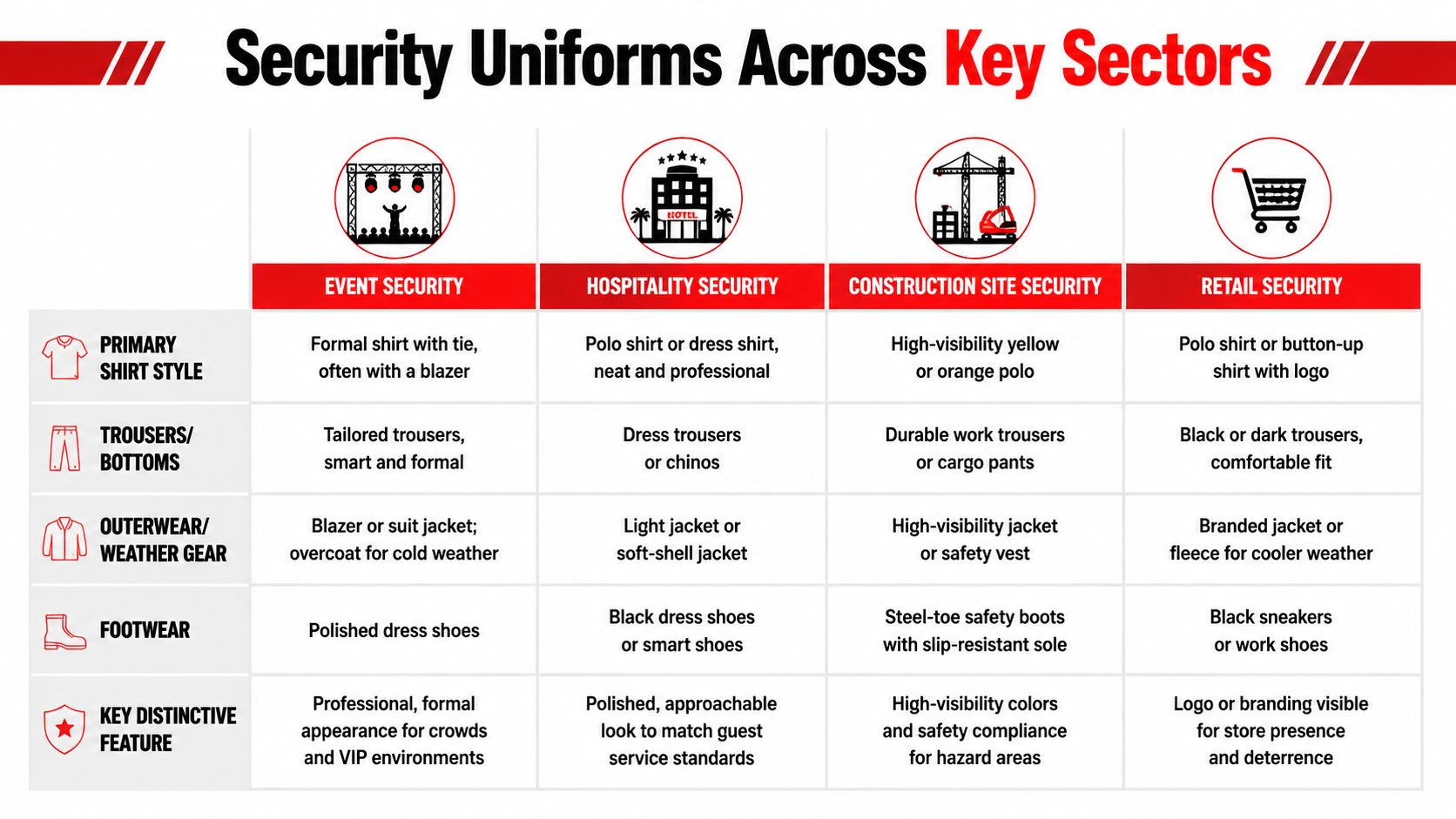
The quickest way to choose the wrong security guard uniform is to assume every site needs the same kit. Events want visibility and crowd control. Hospitality wants authority without intimidation. Construction wants safety compliance first. Retail often wants the officer to look discreet enough to protect the floor without turning the whole store into a checkpoint.
Event and festival work needs the most flexible setup
At events, guards usually need visible outerwear, radio access on the chest and weather layers that can be added or removed as the shift changes. If you're managing entry, bag search or perimeter patrol, the uniform has to support movement and fast communication without losing identity. That usually means outerwear that can carry ID clearly, plus practical pockets for notebooks, torches and keys.
Hospitality asks for a softer public face
Bars, clubs, hotels and restaurants are different. A dark shirt, subtle badge and clean trousers can read as security without unsettling patrons. In those environments, the uniform often becomes part of the venue's service style, so the cut and finish matter as much as the identification. A blazer can work in higher-end venues, while still keeping the guard clearly separate from management or concierge staff.
Construction and retail solve different problems
Construction sites prioritise high-visibility outerwear, safe footwear and compatibility with hard hats. Retail loss prevention often goes the other way, with covert dress, earpieces and body-worn cameras instead of a highly visible uniform. The job changes the presentation, and the post order should be the thing that drives that choice, not personal preference.
The practical difference across sectors is easier to compare when you treat the uniform as a toolset, not a costume.
Operational note: if a site brief and the uniform policy disagree, the brief usually wins on the day, but the policy needs updating afterwards.
The best way to avoid churn is to write the role into the kit. If the site needs visible crowd control, say that. If it needs low-profile loss prevention, say that too. A generic uniform issue sheet won't hold up across all four environments.
Specifying and Branding the Uniform for Your Site
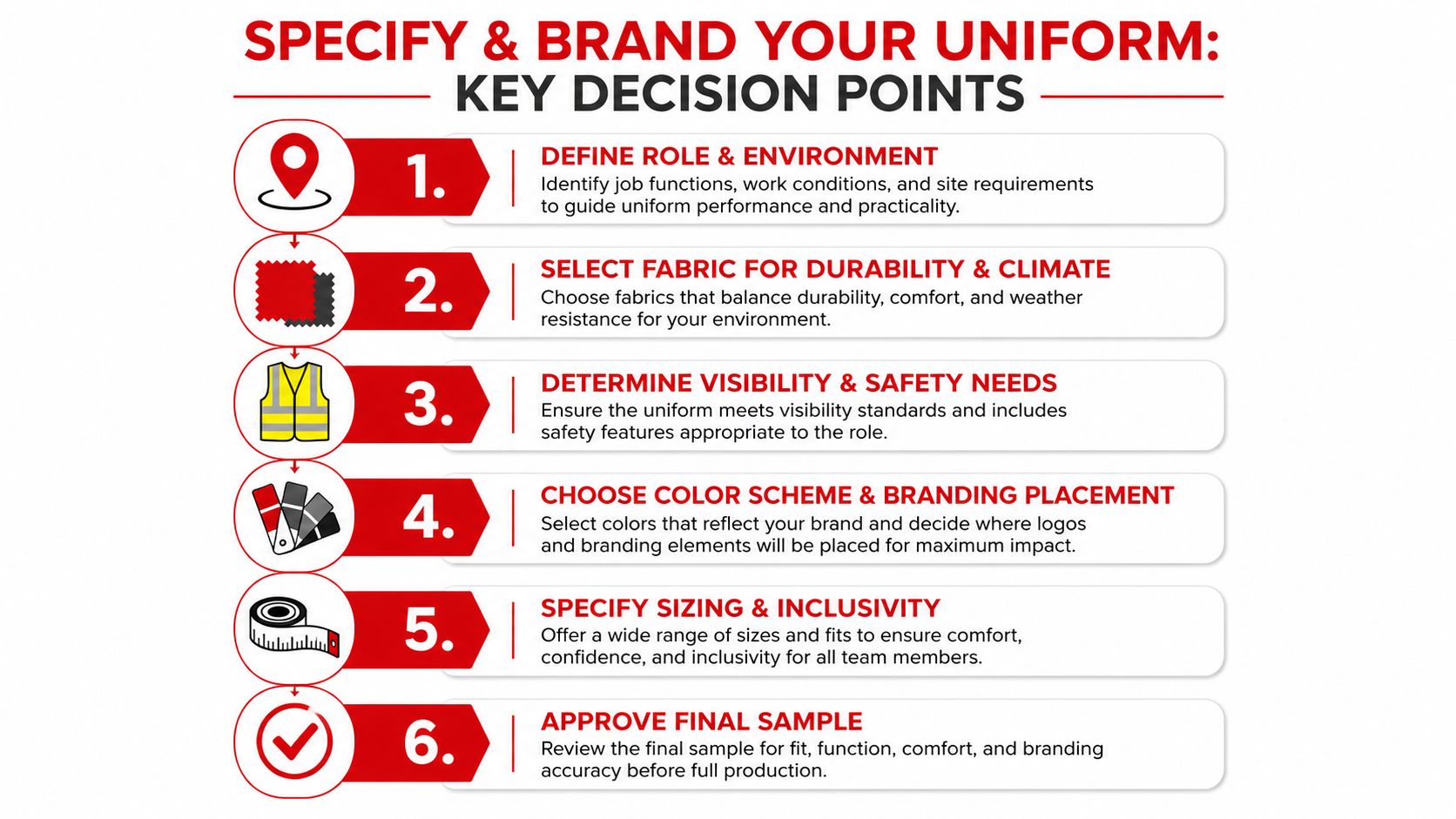
A usable security guard uniform spec starts with compliance and ends with brand fit. The order matters. If you begin with logo placement and colour preference, you often end up trying to make a bad uniform legal after the fact. Start with identification rules, then add the site's functional needs, then decide how much branding still makes sense.
Write the spec in the right order
The cleanest process is straightforward.
- Define the role and environment. Event entry, hotel lobby, retail floor or construction gate all demand different kit.
- Set the identification rules first. Decide where the employer name, badge or crest must sit, and what can't appear.
- Choose colour and finish. Dark tones can work well in hospitality and corporate spaces, while brighter outerwear belongs in safety-driven settings.
- Assign accessory points. Radios, body-worn cameras, torch loops and notebook access should be planned, not improvised.
- Check fit and movement. A uniform that looks sharp on a hanger can fail once someone reaches, runs or kneels.
- Approve a sample on-site. Lighting, crowd distance and background colour all affect how the kit reads.
That process also leaves room for small morale gains. A branded undershirt or a consistent belt setup can lift staff pride without weakening the standard, as long as the core uniform remains controlled. I've also seen providers issue different presentation styles for different jobs, including a traditional police-style uniform with company patch and badge, a concierge-style blazer and tie, and plain-clothes officer-style clothing for executive protection work. GM GROUP Services is one Australian operator that deploys those kinds of role-specific options across different environments, which shows how far presentation can move when the site justifies it.
Branding should support trust, not fight it
Your logo placement needs to stay readable without turning the garment into a billboard. If the badge sits too low or the branding gets too busy, the public misses the point. If the colours drift too close to law enforcement styling, you've created a different problem entirely.
A good spec usually gives one clear visual message. This person is security, this person belongs to this venue, and this person is here to do a specific job. That's enough.
Maintenance, Replacement and Lifecycle Best Practices
A clean security guard uniform does more for a site than most managers think. Faded shirts, loose threads and mismatched outerwear signal drift. Patrons notice it, clients notice it, and your own team notices it the fastest because they wear it all shift.
Treat uniform care like operational maintenance
The smartest approach is to manage uniforms as a rotating pool, not a one-off purchase. Guards wash garments often, so colour-fast fabrics and reinforced seams matter over time, not just on issue day. If you've specified bar-tacked pockets and double-needle stitching, you've already reduced the likelihood of early failure, but you still need a replacement rule for damaged, stretched or out-of-standard items.
Uniforms fail publicly. When one shirt fades or one jacket tears, the whole team looks inconsistent.
Write the replacement trigger into the standard. If a badge peels, a patch loosens or a garment loses its shape, it gets replaced. For event work, keep spare kit ready so staff aren't sent out in damaged outerwear after a rain hit or a snag at the loading dock. That spare pool matters most where shifts are long and turnover is high.
Keep the lifecycle tied to the site, not the calendar
The right replacement rhythm depends on shift intensity, laundering frequency and how hard the garment works. A quiet indoor post is very different from a festival entry team or a construction gatehouse team. Fading, shrinkage and seam wear tell you more than a date stamped on a spreadsheet.
The other risk is inconsistency. If one guard turns up in a different shade of black, another in a stretched polo and another in a jacket with the wrong badge placement, your public image drops immediately. That's why maintenance policy belongs inside the uniform standard itself, not in a separate HR folder nobody reads during induction.
Procurement Checklist and Common Questions for Managers
Before you place an order, work through the uniform in the same order you'd work through any other site-control asset. Confirm the licensing identification rules for your state, map each role to its environment, draft the spec, test it with one team, review the feedback after the first run and then scale. That sequence keeps you from buying a kit that looks good in a catalogue but fails at the gate.
A rollout that works in practice
Start with a small pilot group. Use guards who work the hardest site conditions, because they'll surface the problems quickest. Ask them what happens when they sit, bend, radio the supervisor or work in heat, not just whether the shirt looks sharp.
Then lock the specification. If the first sample passes, standardise the badge location, outerwear choice and accessory placement before ordering the full issue. A rolling fix across multiple sites creates inconsistency faster than any supplier mistake.
Common questions managers ask
How often should uniforms be washed?
As often as the role requires, but the key is keeping the garment clean, colour-consistent and serviceable. A uniform that looks tired after laundering needs a different fabric or a different issue policy.
Where should body-worn cameras sit?
They should be placed where the officer can access controls and the device stays secure through movement. The exact position should come from the post order and the hardware used.
What if a guard refuses to wear an item?
Check whether the item is legally required, site-mandated or just preferred. If it's a compliance item, the refusal becomes a supervision issue. If it's preference, the site standard may need a review.
What happens if outerwear is damaged mid-shift?
Keep spares on hand. A damaged jacket or broken badge shouldn't force a guard to finish the shift in non-standard kit.
If you need a provider that can align presentation with site demands across NSW, Victoria, Queensland and the ACT, GM GROUP Services can help with uniformed security deployed for events, venues, retail, construction and corporate sites. Their team works across guard styles that suit different environments, so you can match compliance, branding and comfort to the actual job rather than guessing from a catalogue.
Discover more from GM Group Services
Subscribe to get the latest posts sent to your email.