
Emergency response team equipment list planning usually starts too late. A venue manager has the run sheet locked, contractors confirmed, security rostered, and then an uncomfortable question lands: if a patron collapses, a crowd surges, smoke appears backstage, or a vehicle clips a barrier, what exactly does the response team have in hand in the first minute?
That's where good events separate themselves from risky ones. An emergency response team equipment list isn't admin. It's the difference between controlled action and frantic improvisation. At a major festival, a crush point near the main stage can escalate fast if guards can't talk clearly, medics can't reach the patient, and supervisors can't see what's happening across the site. The same problem shows up in pubs, retail centres, construction sites, and corporate venues. Teams are present, but presence alone doesn't solve incidents.
The practical standard in Australia is simple. Equip for the site you're operating, the crowd you expect, the hazards you know about, and the escalation paths you can't rule out. That means communication, PPE, medical gear, command systems, evacuation tools, detection devices, and mobile kits that staff can deploy without delay. It also means matching equipment quality to the environment. Cheap radios fail in noisy venues. Untested PPE sits in cupboards. Oversized medical bags slow responders down when speed matters more than carrying every possible item.
This guide gives you a working emergency response team equipment list built for event and venue managers who need operational clarity, not vague theory. It draws on Australian emergency practice and the fit-for-purpose mindset used by providers such as GM GROUP Services, with practical trade-offs, compliance notes, and deployment advice that can be used on festivals, licensed venues, retail sites, construction projects, and public events across NSW, VIC, QLD, and the ACT.
1. Personal Protective Equipment and Tactical Gear
Start with the gear your team wears before you worry about the gear they carry. PPE is the foundation of any emergency response team equipment list because responders who aren't protected become casualties, distractions, or liabilities. For most venues, that begins with high-visibility vests, helmets where impact risk exists, cut-resistant or heavy-duty gloves, eye protection, wet-weather layers, steel-capped boots, and role-appropriate load-bearing pouches.
The mistake I see most often is buying one generic PPE package for every post. That doesn't work. A rapid-response supervisor in a dense concert crowd needs mobility and instant identification. A construction-site emergency team needs tougher head, hand, and foot protection. A waterfront or storm-exposed event needs weatherproof outerwear that staff can move in.
Here's a practical visual reference for the baseline standard teams should project:
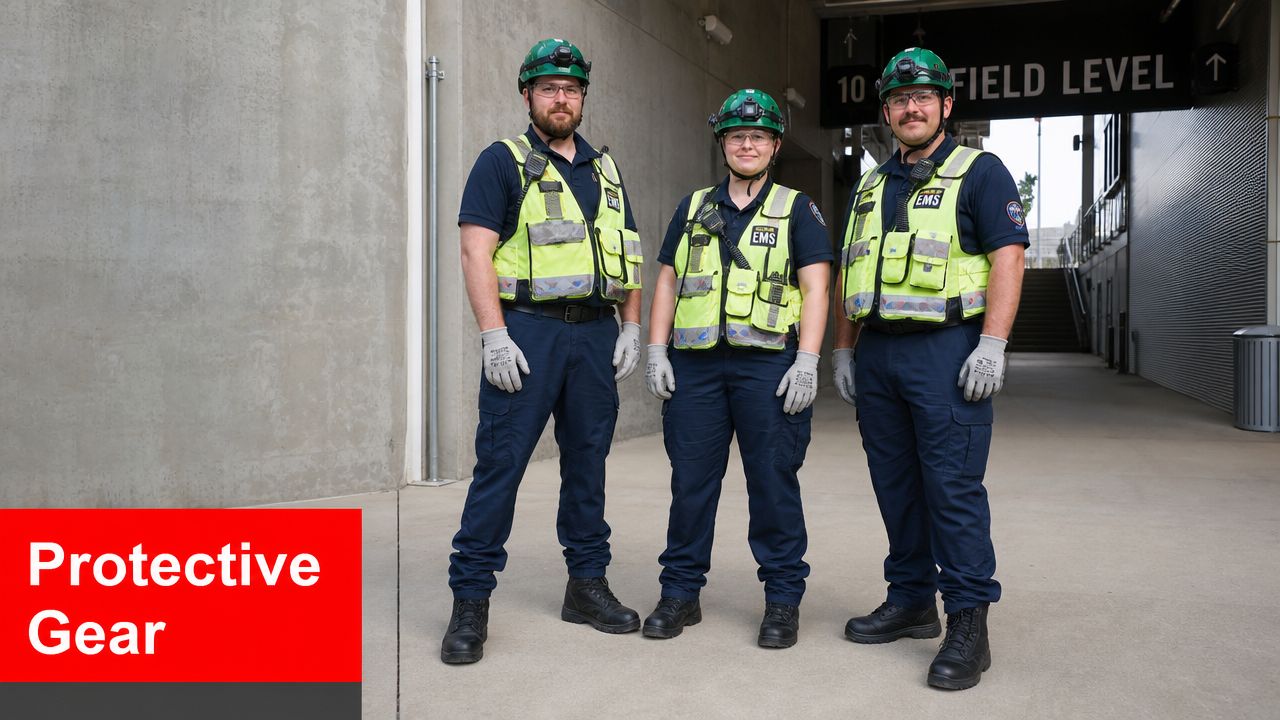
Match PPE to the hazard profile
Australian responder capability standards go well beyond ordinary paramedic gear when complex hazards are in play. Technical guidance documented for specialised emergency units sets out 24 distinct categories of advanced equipment, including breathing apparatus with gas-tight PPE, protection suits, dry suits with water rescue equipment, confined space kits, remote lighting, temporary shelters, carbon monoxide detectors, detection identification monitors, body-worn cameras, secure communications, and CBRN countermeasures. Most event teams won't carry the full specialist set, but venue managers should understand the principle. Hazard exposure dictates the equipment envelope.
Practical rule: If your site has pyrotechnics, generators, temporary structures, kitchens, plant, water exposure, or vehicle movement, standard hi-vis and gloves won't be enough on their own.
Use colour-coding carefully. It helps patrons and staff identify medics, supervisors, extraction teams, and wardens, but only if everyone is briefed on what each colour means. If the coding system changes from event to event, confusion replaces visibility.
- Quarterly fit checks: Test helmets, vests, eye protection, and gloves on the actual staff who'll wear them.
- Role-based issue: Give pit teams, gate teams, and mobile supervisors different PPE loadouts where the risks differ.
- Storage discipline: Keep stock dry, clean, and protected from heat. Degraded straps, brittle plastics, and faded high-vis gear are common avoidable failures.
A good PPE setup should make the team faster, more visible, and safer. If the kit slows them down or sits unused because it's uncomfortable, the list looks compliant on paper but fails in operation.
2. Communication Systems and Two-Way Radios
When an incident starts, communication failure usually arrives before resource failure. Teams might have enough staff, enough barriers, and enough first aid gear, but if messages are delayed, unclear, or trapped on the wrong channel, the response falls apart. That's why communication sits near the top of every serious emergency response team equipment list.
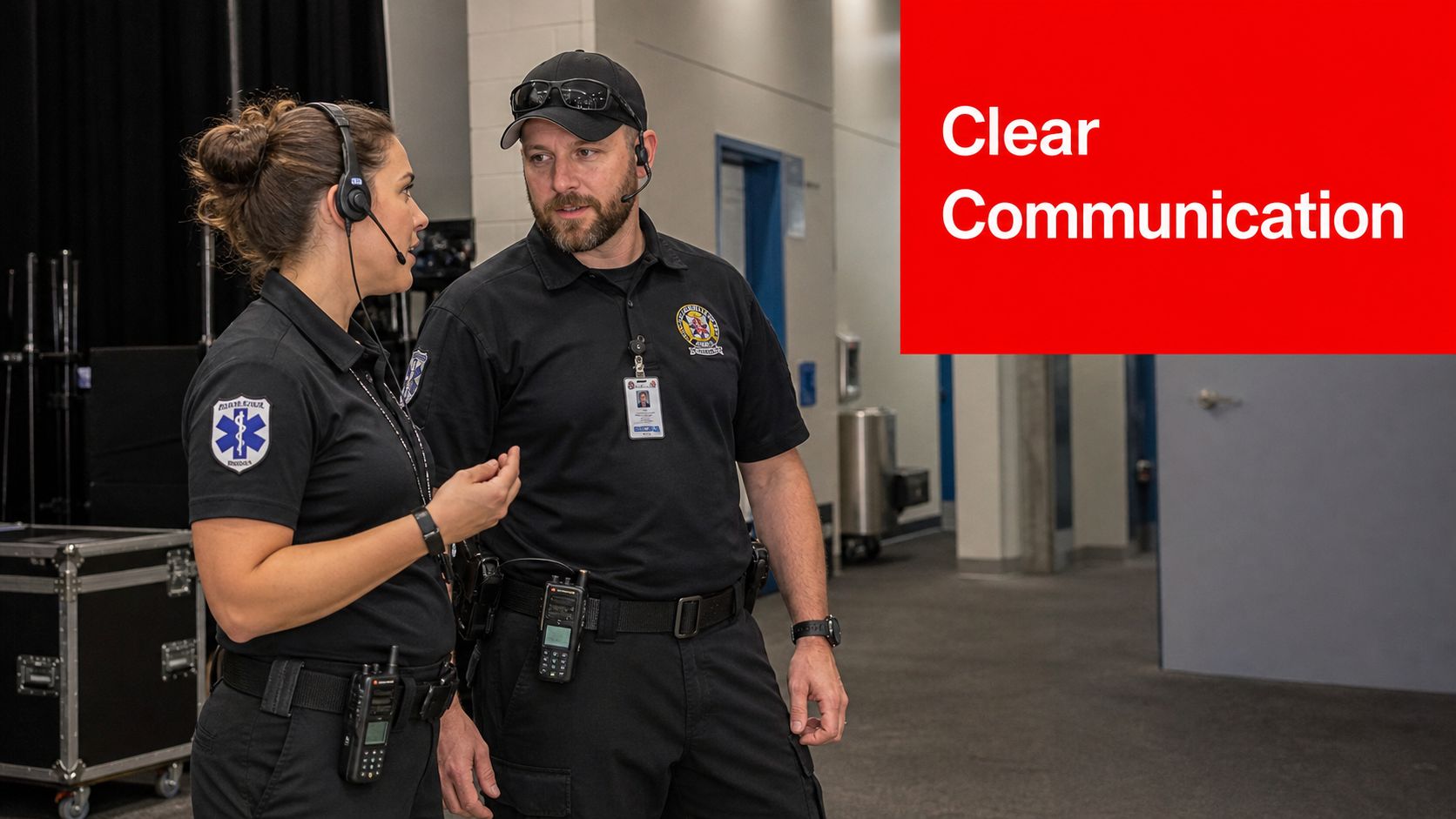
For most venues, the core stack is straightforward. Digital two-way radios, discreet earpieces or speaker mics, spare batteries, charging banks, a communications plan, and a simple channel structure. Large sites may also need repeaters, backup mobile phones, a PA link, and satellite or remote-area contingencies for regional operations.
This is the difference between basic and effective communications in practice. Workplace emergency standards in Australia require mobile phones, two-way radios, megaphones, PA systems, intercoms, and verbal alert systems, alongside alarms, manual call points, whistles, air horns, and sirens. Event managers should treat those as complementary layers, not substitutes. Radios coordinate responders. Alert systems move crowds.
What works on noisy and spread-out sites
Festival security at multiple entry points needs short, standardised language. Hotel, restaurant, and club teams need quieter comms that don't escalate patron anxiety. Construction and industrial sites need radios that cut through machinery noise and keep channels disciplined.
A few operational habits make a huge difference:
- Plain language codes: Use plain language for critical incidents unless every team is trained to the same code set.
- Dead-zone testing: Walk the site before the event, including stairwells, loading docks, plant rooms, and toilets.
- Battery swaps: Issue charged spares to supervisors and command staff, not just charging stations in an office.
- Radio logs: Record major calls and time points for investigations and insurance follow-up.
Here's the human side of this gear in action:
Don't overlook resilience tools. The NSW SES emergency kit guidance includes a battery-powered or hand-cranked radio with spare batteries, plus signalling tools such as a whistle and torches. That's domestic guidance, but the lesson applies operationally. If site power drops or mobile coverage becomes unreliable, teams still need a communication fallback.
In noisy venues, the best radio system isn't the one with the most features. It's the one every supervisor can use under stress without repeating themselves three times.
Cheap consumer radios are one of the worst false economies in event operations. They're fine until a surge, medical event, or evacuation starts. Then audio quality, channel bleed, short battery life, and fragile accessories become operational risks.
3. First Aid and Medical Response Kits
Medical capability is where a lot of lists become unrealistic. Some sites under-pack and can't stabilise a patient. Others over-pack with bulky gear that nobody can find quickly. A workable emergency response team equipment list needs both fixed medical resources and mobile treatment capability.
At minimum, healthcare-style emergency response capability in Australia requires a defibrillator with spare adhesive pads, portable oxygen tanks with regulators, masks and tubing, first aid supplies such as gauze, wound wipes, adhesive dressings, antiseptics and bandages, spinal immobilisation equipment including backboards and cervical collars, IV supplies, emergency medications including epinephrine, and PPE such as masks, gloves, gowns and face shields. Not every venue team will administer every intervention, but event managers should know what their contracted medical capability includes and what escalation relies on external ambulance response.
Build kits in layers, not one giant bag
Use three layers. Public-access first aid points for patrons and staff. Response bags for mobile teams. Higher-acuity stores in the command or medical room. That structure works far better than one oversized trauma bag hidden in a locked office.
Queensland Health's rural and remote guidance shows how useful precise kit design can be. The mandatory emergency response pack specifies exact counts in colour-coded pockets, including a BLUE POCKET with items such as 3 cannulas, 2 retractable 14g IV cannulas, 1 Yankauer sucker, 1 suction catheter, 4 Blueys, 1 small adult NIBP cuff, 1 pulse oximeter, 1 manual sphygmomanometer, 1 stethoscope, 4 tongue depressors and 1 thermometer, plus a GREEN POCKET with 2 eyepad packets and 2 eye shields. The lesson for venues is clear. Standardised pocketing saves time.
This kind of setup is worth aiming for in portable event kits:
- AED placement: Put AEDs where trained staff can reach them fast, not where they look neat on a wall.
- Trauma separation: Keep catastrophic bleeding supplies separate from routine first aid consumables.
- Expiry checks: Audit pads, oxygen fittings, medications, and sterile items on a fixed schedule.
- Handover forms: Give responders a simple casualty handover card so ambulance crews get useful information fast.
For larger events, match medical inventory to risk. An advanced team carries a much broader medicine profile than a basic team. In Australia's specialised emergency medical framework, an EMT2 team must carry 198 distinct medicine units compared with 20 for an EMT1 team, under the National Trauma Centre's January 2024 v4.2 medicines list. That kind of difference matters when you're deciding whether a site needs basic first aid, contracted paramedics, or a more advanced clinical presence.
4. Surveillance and CCTV Monitoring Equipment
CCTV doesn't replace boots on the ground. It makes those boots smarter. In a crowded venue, surveillance gives supervisors early warning on pressure points, anti-social behaviour, queue build-up, unauthorised access, and movements that field teams can't see from ground level.
Good surveillance in an emergency response team equipment list includes fixed cameras, mobile cameras where needed, monitoring screens, recording capability, secure storage, and operators who know what they're looking for. Poorly staffed control rooms are common. Screens alone don't create awareness if nobody is actively reading them.
Use CCTV to solve operational problems
At festivals, cameras help identify crowd compression near bars, merch lines, and stage fronts. In bars and clubs, CCTV supports patron safety, incident reconstruction, and RSA-related interventions. On construction sites, it helps track unauthorised access and movement around plant or hazardous areas. In corporate or VIP environments, it helps coordinate discreet protective movements without flooding the floor with personnel.
What works in practice:
- Cover transitions: Entry gates, choke points, stairwells, loading docks, and back-of-house corridors matter more than decorative wide shots.
- Preserve evidence: Build a clear process for flagging and exporting footage after an incident.
- Train operators: Watching screens is a skill. Staff need threat indicators, escalation triggers, and radio protocol.
- Post signage: Privacy and surveillance notices need to be visible and consistent with Australian obligations.
The most common failure is camera placement for convenience rather than operational value. Event managers often discover blind spots only after an injury, theft, or assault. Walk the site with the monitor feed open and test the coverage against actual crowd movement, not the floorplan.
The best camera is the one pointed at the problem before the problem starts. Most venues still install for after-the-fact review, not active intervention.
Budget matters here. If you can't justify a full camera uplift in one procurement cycle, prioritise high-risk zones first. Stage barricade lines, main exits, cash handling points, and vehicle-pedestrian interfaces usually provide the fastest operational return.
5. Incident Command, Response Coordination and Post-Incident Investigation
A well-equipped team still underperforms if nobody owns the incident picture. Command gear is less visible than radios or first aid bags, but it's one of the most important parts of an emergency response team equipment list. This category includes command boards, site maps, role cards, incident logs, body-worn camera retrieval processes, briefing packs, evidence bags, digital reporting tools, spare chargers, and secure devices for escalation calls.
In practical terms, command starts before the event opens. Assign who becomes incident controller, who handles medical liaison, who manages perimeter control, who speaks to venue management, and who documents decisions. If you wait until the incident starts, supervisors duplicate work and miss critical details.
The equipment side of command
A functioning command post should have:
- Current site maps: Include exits, medical points, hydrants, assembly areas, restricted zones, and vehicle routes.
- Hard-copy backups: Don't rely only on tablets or laptops.
- Decision logs: Record times, actions, and who authorised them.
- Evidence tools: Incident forms, witness sheets, photo protocols, secure storage, and access control for sensitive files.
For larger or higher-risk sites, consider how command survives environmental and infrastructure disruption. The Australian technical standards noted earlier include remote briefing suites, satellite communications, weatherproof lighting, temporary shelters, and tactical medicine equipment in advanced responder setups. Those aren't only specialist concepts. They reinforce an event management truth: command capability has to remain functional when the site is dark, wet, noisy, and under pressure.
Post-incident investigation also belongs here. Festivals and venues often make one of two mistakes. They either over-document trivia and bury the key facts, or they fail to preserve enough detail to defend the venue later. Keep forms short, factual, and structured around who, what, where, when, immediate action taken, and what follow-up is required.
Debrief quickly while memory is fresh. Review radio traffic, CCTV, witness notes, and supervisor actions. Then fix the equipment gaps, not just the behavioural ones. If a team member couldn't access gloves, didn't know where the AED was, or lacked a torch in a blackout corridor, that's an equipment planning failure as much as a training issue.
6. Emergency Access and Egress Control Equipment
A headliner finishes, rain starts, power drops in one section, and 2,000 patrons turn toward the nearest gate at once. At that point, access and egress equipment stops being a site-plan detail and becomes a life safety system. Event and venue managers need gear that keeps exits usable, separates opposing flows, protects responder access, and supports fast decisions under pressure.
For Australian venues, the baseline starts with compliant exit signage, emergency lighting, door hardware, and fire safety infrastructure required under the National Construction Code and the relevant state and territory work health and safety duties. The Australian Building Codes Board guidance on exits and egress provisions is a useful reference point for managers reviewing whether the built environment supports safe movement. For temporary events, that baseline is only the start. You also need operational equipment that matches crowd density, site shape, weather exposure, and accessibility obligations.
The practical toolkit usually includes portable barriers, retractable belt barriers, traffic cones, bollards, gate keys, lockable swing gates, emergency opening tools where permitted, illuminated batons, portable floodlights, backup torches, glow marking for route edges, evacuation chairs, and clear wayfinding signs that still make sense in low light and high noise.
Budget choices matter here. Spend first on equipment that preserves exit capacity and responder movement. A well-placed stock of barriers, lighting, and accessibility evacuation gear will usually do more for real-world safety than a polished digital map that no one can use in a blackout.
What to deploy, and why
Temporary layouts fail in predictable ways. Vendors push stock into rear corridors. Queue systems creep into exit paths. Cable ramps narrow door approaches. Security screening lanes stay in place after the risk picture changes. The fix is not more theory. It is a deployment plan for each access point and egress route.
Use this checklist for pre-opening setup:
- Exit protection: Keep every designated exit clear to full width, including the approach side and discharge area outside.
- Barrier reconfiguration: Identify which barriers can be removed or swung open within seconds, and who holds the authority and keys.
- Responder lanes: Mark internal routes for medics, fire crews, and extraction teams moving against crowd flow.
- Accessible egress: Position evacuation chairs and assign trained operators where stairs affect patron or staff evacuation.
- Lighting backup: Place portable lighting and torches at choke points, stairwells, gates, and external assembly paths.
- Traffic interface: Separate pedestrian exits from vehicle movements, rideshare pickup zones, and service entries.
- Night and weather test: Walk the route in darkness, rain, and operating conditions, not just during bump-in.
Accessibility deserves specific attention. If a patron cannot self-evacuate down stairs, the site needs more than good intentions. It needs the right chair, trained staff, a protected route, and a handover point that is realistic for that building or event footprint. That is both a safety issue and part of meeting Australian disability access expectations in practice.
Different sites need different emphasis. A licensed venue may need front-entry hardware that can switch from controlled admission to rapid outward flow. A festival may need temporary vehicle barriers and pedestrian channeling that protect emergency lanes without creating trap points. A stadium concourse may need extra lighting and mobile signage because smoke, noise, and crowd surge can make familiar routes hard to read.
I have seen expensive venues get this wrong by treating barriers as static infrastructure instead of response equipment. If the team cannot tell you which gate opens first, which lane stays clear for paramedics, and how an exit route changes when a bar queue blows out, the equipment plan is incomplete.
Keep the standard simple. Every exit must be identifiable, reachable, openable, lit, and defendable from obstruction. Every access control device on site should support that outcome, not interfere with it.
7. Hazardous Material and Contamination Response Equipment
Most event and venue hazards aren't dramatic. They're cleaning chemical spills, fuel leaks, kitchen incidents, bodily fluid contamination, battery overheating, or exposure to smoke and fumes. But those everyday hazards still require dedicated kit. A serious emergency response team equipment list should include absorbents, disposal bags, nitrile gloves, eye protection, masks or respirators where appropriate, cordons, signage, spill socks, sharps containers where relevant, and access to Safety Data Sheets.
The trade-off here is between realism and overreach. Your team shouldn't pretend to be a full hazmat unit if they aren't trained or licensed for that role. But they do need enough equipment to isolate, protect, contain, and hand over safely.
Know when to contain and when to withdraw
For ordinary venues, your response threshold should be simple. If the substance is known, limited, and covered by site procedure, the team isolates the area and uses the kit. If the substance is unknown, airborne, spreading, or causing symptoms, the team withdraws, protects life, and escalates.
The broader Australian responder standards underline how specialist this can become. Advanced equipment lists for emergency units include gas-tight PPE, detection identification monitors, carbon monoxide detectors, and CBRN-oriented equipment. That should remind event managers not to underplay exposure risk around generators, confined service corridors, cleaning stores, battery charging areas, pyrotechnics, and maintenance compounds.
Practical examples:
- Bars and restaurants: Cleaning agents and kitchen chemicals need storage discipline and spill response nearby.
- Construction sites: Fuel, solvents, asbestos concerns, and contaminated runoff need clear handover paths.
- Hotels and public venues: Biohazard incidents in bathrooms or rooms require proper isolation and disposal tools.
- Temporary event infrastructure: Portable sanitation zones and fuel storage areas deserve their own kit positioning.
Unknown substance, strong odour, respiratory complaint, or multiple people affected. Don't make that a bravery test. Clear the area and escalate.
A common budget error is placing one spill kit at the far end of the site to satisfy procurement. Put kits where incidents are likely, not where storage is easy. Proximity matters more than box count.
8. Environmental Monitoring and Threat Detection Systems
Some incidents announce themselves late. Good monitoring helps you act earlier. Fire detection, weather monitoring, gas detection, structural alerts, flood exposure checks, and perimeter alarms all belong in a mature emergency response team equipment list, especially for outdoor events and mixed-use sites.
This category matters because managers often depend too heavily on visual observation. By the time staff can see smoke, feel crowd discomfort from heat, or notice a tent starting to load up under wind, the response window has already narrowed.
Detection should trigger action, not just data
Specialised Australian emergency equipment guidance includes remote and weatherproof lighting, carbon monoxide detectors, detection identification monitors, and unmanned aerial drones with live camera feeds. For the right site, these aren't luxuries. They're practical tools for maintaining awareness across dark, spread-out, or hazardous areas.
At minimum, think in layers:
- Fire and smoke: Detection linked to alarms and staff response procedures.
- Weather: Reliable wind and storm monitoring for outdoor structures and patron comfort.
- Air quality and gases: Important around generators, enclosed work areas, kitchens, and service zones.
- Perimeter and after-hours intrusion: Useful for multi-day events, storage compounds, and construction-adjacent venues.
One overlooked issue is alert fatigue. If sensors trigger too often with no clear action framework, staff start ignoring them. Set thresholds, assign ownership, and test escalation pathways. A monitor in the office doesn't help if nobody is rostered to watch it or authorised to pause operations.
This is also where drone use can be helpful when managed lawfully. Large outdoor venues benefit from rapid visual confirmation of traffic congestion, queue problems, perimeter breaches, or weather impact on temporary infrastructure. The operational value comes from integrating that feed into command, not flying a drone because it looks modern.
9. Rapid Deployment and Mobile Response Kits
The first team on scene rarely has time to run back to a store room. That's why grab-and-go kits are one of the most useful categories in an emergency response team equipment list. These kits should support the first few minutes of action before bigger resources arrive.
For events and venues, that usually means compact medical supplies, gloves, masks, eye protection, a torch, casualty cards, basic barrier tape, a radio battery, and site-specific extras such as naloxone where clinically authorised and governed by protocol, cooling aids for heat, or rain ponchos for exposed command points. The key is predictability. Every bag should be packed the same way.
Build kits for the incident types you actually face
A concert pit team might carry trauma basics, hearing-safe comms, and extraction markers. A mobile security patrol might carry first aid, a torch, nitrile gloves, and scene-control tape. A construction rapid-response team may need heavier PPE and site access tools. VIP protection details usually need a discreet medical and communications profile rather than a bulky visible bag.
Portable support equipment also matters outside medical gear. On active sites, managers often underestimate the value of transport tools for moving supporting supplies quickly. For example, logistics teams handling batteries, water, barriers, and heavy consumables may benefit from purpose-built stair climbing equipment for job sites when lifts are unavailable or stairs slow redeployment.
- Seal and label kits: Use tamper tags and external content labels.
- Position by travel time: Store kits where the nearest responder can reach them without keys or permissions delays.
- Restock after use: Don't wait for monthly audits if a bag was opened during the last shift.
- Train with the actual bag: Staff should know where every item sits by touch, not by guesswork.
The most effective mobile kits feel slightly under-packed to procurement staff and exactly right to responders. If a bag is so full that the first needed item is buried under ten unlikely items, the design has failed. Speed beats theoretical completeness in the first response phase.
10. Personal Accountability and Personnel Tracking Systems
Teams can't manage an emergency properly if they don't know where their own people are. Accountability tools are one of the most neglected parts of an emergency response team equipment list, especially at events where staffing mixes contractors, in-house teams, medics, marshals, and temporary supervisors.
At the basic end, accountability means rosters, sign-on records, zone assignments, check-in times, and assembly procedures. At the stronger end, it includes digital guard touring, live check statuses, GPS-enabled mobile alerts, and back-to-base visibility for supervisors. The right level depends on venue complexity, crowd profile, and whether your operation spans multiple gates or sites.
Manual backup still matters
The broader emergency technology market is moving toward mobile-connected systems. A 2025 market outlook notes that mobile devices hold a 47.3% share in the global personal emergency response systems market, reflecting the practical shift toward wearable and app-based alerts. That trend makes sense for security operations too, but you still need a manual fallback when batteries die, networks drop out, or an incident forces people into radio-only operation.
A good accountability setup includes:
- Current personnel roster: Updated before gates open, including contractors and relief staff.
- Zone board or digital map: So command can see who is posted where.
- Welfare checks: Scheduled contact points for isolated or roaming staff.
- Assembly accountability forms: Fast head counts after evacuation or partial site closure.
One emerging gap deserves attention. Public guidance around emergency kits has highlighted limited support for mental health and neurodiversity needs, while published response equipment lists often omit structured de-escalation tools. For event managers, that means accountability shouldn't stop at counting staff. Teams also need a plan for identifying distressed patrons, escalating to the right responder, and carrying simple communication aids where the risk profile justifies it.
If you rely on an app, make sure supervisors can still account for people with pen and paper. Technology helps. It doesn't remove the duty to know who's on site, who's missing, and who needs support.
Emergency Response Equipment: 10-Item Comparison
A venue manager making purchase decisions usually has two constraints at the same time. Budget is limited, and the kit still has to work under Australian compliance obligations, contractor pressure, and short bump-in timelines. The comparison below is meant to help with operational prioritisation, not just product selection.
Use it to decide what must be funded first, what can be staged, and where a paper process is still the right backup if systems fail.
| Item | 🔄 Implementation Complexity | ⚡ Resource Requirements | ⭐📊 Expected Outcomes | 💡 Ideal Use Cases | ⭐ Key Advantages |
|---|---|---|---|---|---|
| Personal Protective Equipment (PPE) and Tactical Gear | 🔄 Moderate. Requires correct sizing, issue records, replacement cycles and task-specific selection | ⚡ Moderate to High. Bulk purchasing, secure storage, cleaning, inspections and spares | ⭐⭐⭐ 📊 Better responder protection and fewer preventable task-related injuries | 💡 Festivals, construction sites, licensed venues, cash handling, hostile patron environments | ⭐ Improves responder safety, supports WHS duties and presents a controlled professional standard |
| Communication Systems and Two-Way Radios | 🔄 High. Requires channel planning, dead-spot testing, call-sign discipline and user training | ⚡ High. Radios, charging banks, repeaters, licensing, accessories and maintenance | ⭐⭐⭐ 📊 Faster coordination, clearer escalation and fewer delays between detection and action | 💡 Large events, spread-out precincts, multi-level venues, command posts | ⭐ Real-time coordination, scalable deployment and reliable fallback when mobile networks are congested |
| First Aid and Medical Response Kits | 🔄 Moderate. Kit checks, expiry control, AED readiness and staff competency must be managed | ⚡ Moderate. Kits, consumables, AEDs, trauma items and trained personnel | ⭐⭐⭐ 📊 Faster stabilisation and stronger early care before ambulance handover | 💡 Any venue or event, high-footfall areas, remote work zones, heat-exposed sites | ⭐ Immediate life-saving capability, supports duty of care and helps teams act before paramedics arrive |
| Surveillance and CCTV Monitoring Equipment | 🔄 High. Requires camera placement, retention settings, privacy controls and monitoring procedures | ⚡ High. Cameras, storage, network capacity, display stations and trained operators | ⭐⭐⭐ 📊 Better live visibility, clearer evidence capture and stronger deterrence in known problem areas | 💡 Large venues, retail sites, perimeter lines, entries, bars and crowd-pressure points | ⭐ Supports proactive detection, detailed incident documentation and post-incident review |
| Incident Command, Response Coordination & Investigation | 🔄 Very High. Requires defined command roles, logs, briefing structure and multi-agency alignment | ⚡ High. Command space, boards or software, dedicated supervisors and documentation tools | ⭐⭐⭐⭐ 📊 More organised control of incidents, cleaner handovers and stronger post-incident defensibility | 💡 Major incidents, complex sites, multi-team events, severe weather, evacuation management | ⭐ Clear command structure, scalable coordination and audit-ready records |
| Emergency Access and Egress Control Equipment | 🔄 Moderate to High. Involves route testing, hardware placement, signage review and crowd-flow validation | ⚡ High. Barriers, locks, exit hardware, emergency lighting interfaces, signage and upkeep | ⭐⭐⭐ 📊 Cleaner evacuations, fewer bottlenecks and better emergency vehicle access | 💡 Stadiums, concert venues, licensed premises, temporary event sites, construction zones | ⭐ Supports safe egress, access control and alignment with building and accessibility requirements |
| Hazardous Material and Contamination Response Equipment | 🔄 High. Requires specific procedures, isolation protocols and disposal arrangements | ⚡ High. Spill kits, chemical PPE, containment gear, decontamination supplies and specialist support | ⭐⭐⭐ 📊 Faster containment and reduced exposure to staff, patrons and contractors | 💡 Kitchens, plant rooms, loading docks, chemical stores, industrial and construction settings | ⭐ Limits spread, protects responders and supports environmental and safety obligations |
| Environmental Monitoring and Threat Detection Systems | 🔄 High. Requires correct thresholds, integration, calibration and alert routing | ⚡ High. Sensors, dashboards, testing, maintenance and IT support | ⭐⭐⭐ 📊 Earlier warning of heat, air-quality, gas or perimeter threats so teams can intervene sooner | 💡 Outdoor events, enclosed buildings, plant areas, temporary structures, high-risk perimeters | ⭐ Continuous monitoring, earlier intervention and less reliance on manual patrol checks alone |
| Rapid Deployment and Mobile Response Kits | 🔄 Low to Moderate. Requires practical pack design, simple load lists and restocking discipline | ⚡ Moderate. Portable lighting, first response gear, batteries, PPE and scene-control items | ⭐⭐⭐ 📊 Faster initial action at the incident point, especially before fixed resources arrive | 💡 Patrol teams, roaming supervisors, festival response units, remote corners of site | ⭐ Portable, quick to issue and useful where fixed infrastructure is too far away |
| Personal Accountability and Personnel Tracking Systems | 🔄 Moderate. Depends on procedure discipline, supervisor follow-through and backup methods | ⚡ Moderate. Tags, boards, RFID or GPS tools, software and training | ⭐⭐⭐ 📊 Faster checks on staff location and fewer gaps during evacuation or welfare incidents | 💡 Large teams, contractor-heavy sites, remote posts, multi-zone operations | ⭐ Improves responder welfare, supports command decisions and strengthens legal defensibility |
One practical rule applies across all ten categories. Buy equipment in the order your team will rely on it in the first ten minutes of an incident. For many Australian venues, that means radios, PPE, first aid capability, mobile response kits and access control usually come before higher-cost upgrades unless the risk profile clearly says otherwise.
From Checklist to Action Implementing Your Equipment Plan
A strong emergency response team equipment list only matters if it changes what your team is able to do on the day. Most failures don't happen because managers forgot every category. They happen because equipment was bought without a deployment plan, training cycle, storage logic, or ownership model. The list looked complete. The operation wasn't.
The first step is to map equipment against real scenarios, not abstract risk language. Use your site history, event profile, licensing conditions, crowd behaviour patterns, weather exposure, contractor footprint, and physical layout. A daytime family festival, a late-night licensed music event, a shopping centre activation, and a construction project all need different emphases even when the category headings are similar. Communication, medical support, command, access control, and PPE appear on every list. The detail changes.
Budget planning should follow risk and access time. Spend first where delay creates the most serious consequences. That usually means reliable radios, fit-for-purpose PPE, AED access, mobile first response kits, scene lighting, and command resilience. CCTV upgrades, specialised sensors, and advanced digital systems can be staged if necessary, but basic life safety and coordination tools shouldn't be deferred while lower-priority technology gets funded.
Procurement also needs one owner. When venues split responsibility between operations, security, WHS, contractors, and front-of-house teams, gear goes missing between the cracks. Assign a single equipment lead with authority to set specifications, track asset locations, maintain service records, and trigger replenishment. Then give each category a simple standard. Which radios are issued. Which medical bags are used. Which barriers are designated for emergency access. Which forms and logs are mandatory. Standardisation reduces hesitation.
Training is where the list becomes operational. Staff shouldn't only know that equipment exists. They should know where it is, who carries it, when it's deployed, what they're authorised to do with it, and what triggers escalation. Scenario-based drills are far more useful than generic toolbox talks. Run crowd surge responses with radios and barriers. Run cardiac arrest drills with the actual AED and oxygen kit. Run blackout procedures with torches, emergency lighting checks, and command relocation. Run spill and contamination isolation using the actual kit. If the first time a supervisor opens a grab bag is during a live incident, the drill program is too weak.
Maintenance discipline matters just as much. PPE degrades. Radio batteries fade. AED pads expire. Oxygen fittings go missing. Torches disappear into vehicles. Signage gets moved for bump-in and never returns. Create a fixed inspection schedule with a named person, a checklist, and a documented close-out process. High-use and life-critical equipment deserves tighter inspection intervals than static low-touch items.
For event and venue managers in Australia, compliance should be treated as the floor, not the finish line. Legal obligations, state guidance, licence conditions, and site rules set the minimum. Operational excellence comes from matching equipment to foreseeable realities on your site. That's the mindset strong security providers bring to planning. Fit-for-purpose deployment beats copying another venue's kit list every time.
If you operate across NSW, VIC, QLD, or the ACT, external expertise can save a lot of wasted spend. A professional partner can assess your risk profile, identify gaps in your current emergency response team equipment list, align staffing and equipment levels, and help you build a practical deployment model that protects patrons, staff, contractors, property, and brand reputation. For event-heavy, public-facing, or higher-risk environments, that level of planning usually pays for itself the first time an incident is managed cleanly instead of becoming a headline.
FAQs
What should be on a basic emergency response team equipment list for an event venue?
Start with PPE, radios, first aid supplies, an AED, command documentation, access and egress tools, torches, signage, and mobile response kits. Then add site-specific equipment for weather, hazardous substances, crowd pressure points, or industrial hazards.
How often should emergency response equipment be checked?
Life-critical and high-use items should be checked on a fixed schedule and after every deployment. In practice, venues usually need pre-event checks, post-incident restocking, and formal periodic audits for medical gear, batteries, PPE condition, and signage.
Do event organisers need advanced medical gear on site?
That depends on the event profile, location, crowd, and contracted medical model. Some sites only need strong first response and clear ambulance handover. Others need a more advanced clinical capability because the risk profile or access delays are higher.
What's the most overlooked part of an emergency response team equipment list?
Accountability and command tools. Many venues buy visible hardware but neglect logs, role cards, site maps, welfare check systems, and backup processes when technology fails.
How can venues improve on a limited budget?
Prioritise what changes the first few minutes of an incident. Reliable communications, good PPE, AED access, clear exits, mobile kits, and practical training usually deliver more value than expensive add-ons purchased before the basics are working properly.
SEO title: The Ultimate 10-Point Emergency Response Team Equipment List
SEO meta description: Emergency response team equipment list for Australian events and venues. Learn the 10 essential categories, legal notes, practical examples, and deployment advice.
Suggested URL: /emergency-response-team-equipment-list
Need a practical review of your emergency response team equipment list before your next event, venue launch, or site upgrade? GM GROUP Services helps organisations across NSW, VIC, QLD, and the ACT plan, deploy, and support fit-for-purpose security and emergency response capability, with experienced teams, strong reporting, and a focus on patron safety, compliance, and brand protection.
Discover more from GM Group Services
Subscribe to get the latest posts sent to your email.