
Close protection services are often considered only when a new risk lands on someone's desk. You may be confirming a keynote speaker for a conference, managing an executive visit after a contentious announcement, or preparing a festival lineup that suddenly includes talent with privacy, stalking, or crowd-management concerns. At that point, the usual event security plan often isn't enough.
What most buyers need isn't a stereotypical bodyguard. They need a disciplined protection function that can assess exposure, plan routes and access, monitor digital chatter, coordinate discreetly with venue teams, and respond calmly if conditions change. Good close protection protects the person, but it also protects the schedule, the audience experience, and the organisation's reputation.
What Are Close Protection Services Really
Close protection services are a specialised security function focused on keeping a person safe through planning, intelligence, movement control, and immediate response. In practice, that can mean escorting a senior executive through a shareholder meeting, securing a performer's backstage movement, or managing a low-profile arrival for a private client who doesn't want attention.
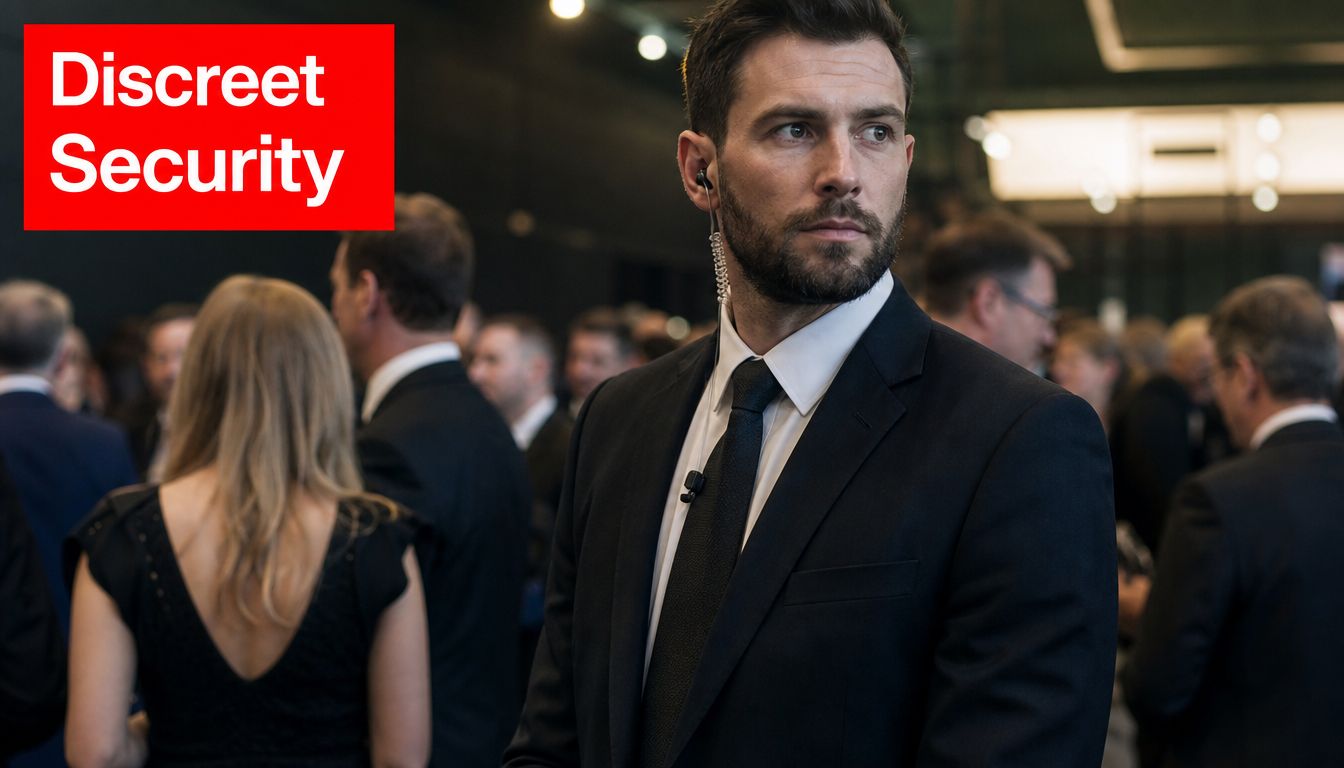
The Hollywood version gets the focus wrong. The visible escort is only the outer layer. Substantive work happens before the principal arrives: screening the route, understanding the venue flow, identifying pressure points, confirming who has access, and deciding what should happen if the environment shifts unexpectedly.
The job is risk reduction, not theatre
An event organiser usually notices the difference quickly. A basic guard asks where to stand. A close protection team asks who the client is meeting, which door creates the least exposure, whether there's an unscheduled meet-and-greet risk, who controls lifts, where vehicles can stage, and how communications will work if the venue gets noisy.
That distinction matters in Australia because private security isn't a fringe service. The Australian Institute of Criminology documented that 52,768 individuals were employed full-time in security in 2006 compared to 44,898 police officers, showing the private security sector had already exceeded the national police workforce in full-time personnel at that point, making services like close protection a practical part of national safety infrastructure in many settings (Australian Institute of Criminology on private security workforce scale).
Practical rule: If the assignment can affect people, operations, access, transport, and public perception at the same time, you're no longer buying “just a guard”.
Where close protection fits best
Close protection services are commonly used in environments such as:
- Corporate activity: board meetings, investor events, executive travel, site visits, and media appearances.
- Live events: concerts, festivals, hospitality venues, and appearances where crowd proximity is part of the job.
- Private matters: family movement, sensitive personal situations, and discreet residential or travel support.
- Legal or reputational risk periods: witness attendance, controversial announcements, or situations where attention may escalate quickly.
What works is proportionate protection. What doesn't work is over-securing a routine task or underestimating a crowded, fast-moving one.
Identifying Your Need for Close Protection Services
Many clients don't start with the words “we need close protection services”. They start with a situation that feels slightly outside the scope of normal security. That's the right place to begin. The decision should come from exposure, not image.
Four common triggers
A corporate office may host a speaker whose presence could attract protest, media attention, or hostile interest. A family office may need privacy and smooth movement rather than an obvious security footprint. A festival promoter may need artist protection that works with production timing, credential control, and dense public traffic. A legal team may need calm, reliable movement for a witness or participant whose attendance can't become a spectacle.
Each of those cases has a different risk profile. The mistake is treating them as if they all need the same type of operative.
Ask these questions before you brief a provider
Use this checklist-style test to work out whether close protection services are the right fit and what kind of deployment you need:
- Who is the person at the centre of the risk: An executive, performer, family member, witness, or visiting dignitary each creates different planning needs.
- What creates the exposure: Public visibility, a known grievance, unpredictable crowds, privacy concerns, travel movement, or online hostility.
- How long does the risk last: A single evening, a multi-day event, a roadshow, or an ongoing protective requirement.
- What environment are they moving through: Office tower, hotel, green room, loading dock, retail site, airport transfer, or open public venue.
- How visible should the security presence be: Some assignments need a discreet corporate profile. Others benefit from a visible deterrent.
- Who else must be coordinated: Executive assistants, production managers, venue operations, drivers, legal representatives, or internal risk teams.
The better your brief, the better the protection plan. “We need a bodyguard” is rarely enough detail to produce a sound deployment.
Temporary detail or embedded support
A common decision point is whether you need a short-term protective detail or a more embedded arrangement.
A temporary detail suits scheduled events, airport transfers, speaking engagements, hospitality appearances, and site visits. The principal enters a defined environment, the team manages movement and access, and the operation ends when exposure ends.
An embedded arrangement suits executives or private clients whose exposure repeats across locations and dates. In that case, the provider has to learn routines, key stakeholders, approved transport methods, reporting lines, and behavioural expectations. Consistency matters more than force projection.
What usually doesn't work
Close protection services are often undermined by three buying mistakes:
- Late engagement: Bringing protection in after schedules, access plans, and publicity are already locked.
- Role confusion: Expecting one operative to perform concierge, driver, access controller, and incident lead all at once.
- Buying on appearance: Choosing the “toughest-looking” option instead of the team best suited to the environment.
If you're unsure, describe the exposure, not the solution. A competent provider can then tell you whether you need close protection, event security support, secure transport, or a blend of all three.
Inside Modern Close Protection Operations
The strongest close protection services don't begin at the kerb when the principal steps out of a vehicle. They begin much earlier, with a structured operating cycle that turns unknowns into manageable variables.
The operating cycle behind effective close protection services
A professional detail usually runs through the same broad pattern: assess, plan, brief, execute, review. Each phase has its own discipline. Weak operators rush to the visible part. Strong operators spend most of their effort reducing the chance that visible intervention will ever be needed.
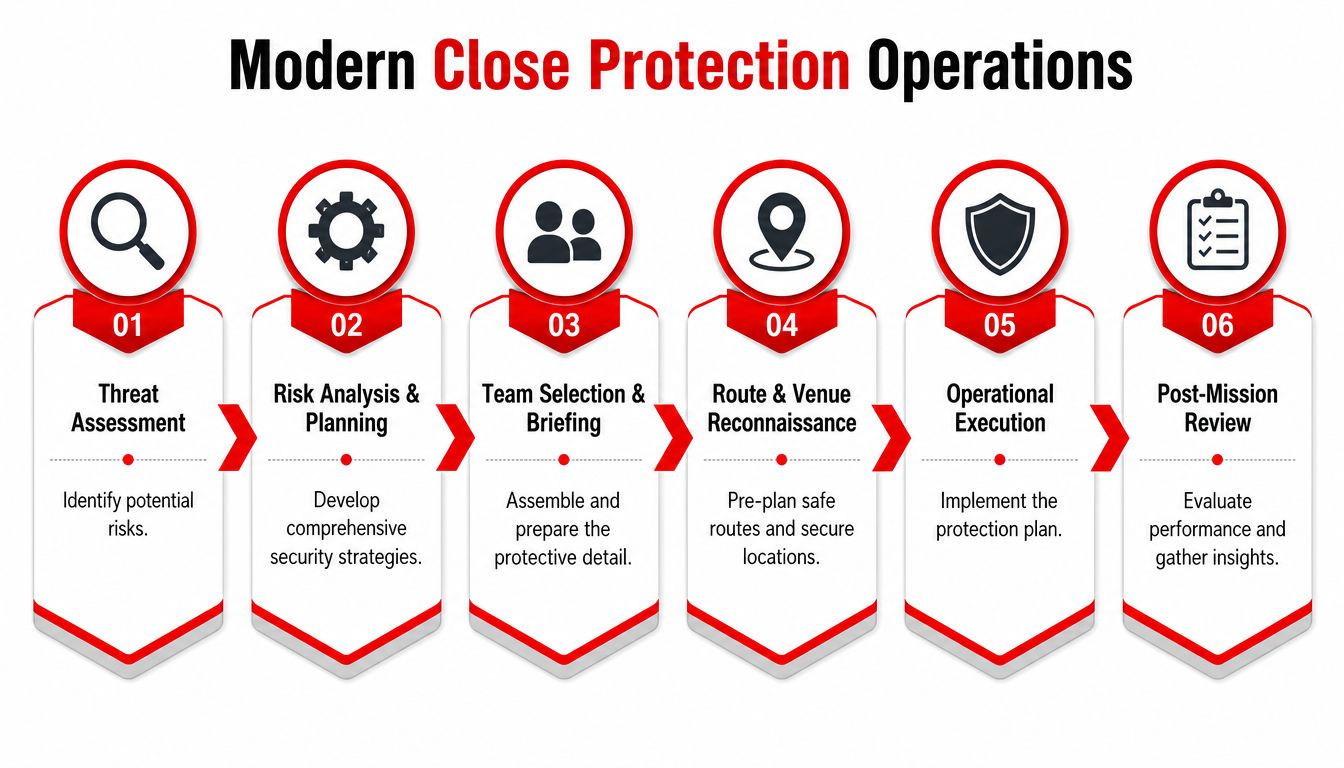
In practical terms, that means:
Threat assessment
The team identifies who or what could realistically affect the principal. That includes physical approach points, crowd pressure, schedule exposure, transport vulnerabilities, and known interpersonal risks.Planning and advance work
Here, close protection services earn their value. The team confirms entrances, exits, holding areas, vehicle access, staging points, route options, and emergency alternatives.Briefing and assignment clarity
Every person needs a clear role. Who stays with the principal. Who handles vehicle movement. Who liaises with venue control. Who calls a move if access degrades.Execution
The visible phase should look calm and unremarkable. Good execution isn't dramatic. It's controlled, anticipatory, and quiet.Debrief
Even a smooth job should produce lessons. Delays, crowd surges, access failures, and comms problems should be captured while they're fresh.
Protective intelligence changes the quality of the plan
Modern close protection services have moved beyond purely physical escort work. In Australia, teams are increasingly adopting intelligence-led approaches that blend physical skills with surveillance detection and cyber coordination, helping separate a true protective intelligence capability from a basic guarding model (modern Australian close protection teams and protective intelligence).
That matters because many threats now announce themselves online before they appear at a venue. Public comments, reposted schedules, obsessive interest, doxxing-style behaviour, or hostility around a corporate issue can all affect the way a physical operation should be built.
What protective intelligence looks like in practice
For event organisers and corporate teams, protective intelligence often involves:
- Social media monitoring: spotting public references to attendance, timing, access points, or intent.
- Digital pattern review: identifying whether a person's movements or accommodation have become too easy to predict.
- Surveillance detection awareness: watching for repeated presence, unusual observation, or suspicious loitering around transport or venue choke points.
- Coordination with internal teams: checking with communications, executive support, or cyber teams before public releases create avoidable exposure.
The best close protection services don't just ask, “What happens if someone approaches?” They ask, “What signs told us this approach was likely?”
What works and what fails on the ground
What works is layering. Outer perimeter screening, controlled access, planned movement, low-profile escort positioning, and transport readiness all support each other.
What fails is reliance on a single visible operative with no advance work behind them. That person may still be competent, but they're being asked to solve a planning problem in real time. That's not a strong operating model, especially in events, hospitality, or executive movement where conditions change by the minute.
Navigating Australian Close Protection Licensing
Licensing is where many buyers either protect themselves properly or expose themselves unnecessarily. Close protection services sit inside a regulated environment, and clients should treat licensing as a frontline due diligence issue, not a paperwork exercise.
Why licensing matters in close protection services
Licensing shows that the operative and provider are operating within the legal framework of the relevant jurisdiction. It also gives the client a practical benchmark for training, background screening, and role legitimacy.
In Australia, a qualified close protection officer must complete 14 specific units of competency under the CPP20218 Certificate II in Security Operations framework to legally operate in close protection, including units such as Implement close protection services (CPPSEC3123) and Providing advanced resuscitation (close protection officer competency requirements in Australia).
Those units matter operationally. Negotiation skills help manage conflict before it becomes force. Advanced resuscitation matters when the issue is medical rather than criminal. Close protection implementation training matters because movement, positioning, and evacuation decisions need to be deliberate, not improvised.
A licence tells you the person may lawfully perform the role. The training behind that licence tells you whether they're likely to perform it well.
State-based licensing requirements overview 2026
Because many clients operate across multiple states, it's worth asking providers how they manage jurisdictional compliance for every deployment.
| State/Territory | Governing Body | Key Licence Class | Noteworthy Requirement |
|---|---|---|---|
| NSW | NSW Police Force Security Licensing & Enforcement Directorate | Security operative licence relevant to bodyguard or close protection functions | Clients should verify that the operative is licensed for the actual role being performed, not just general guarding |
| VIC | Licensing authority in Victoria for private security activities | Private security registration relevant to personal protection work | Registration must match the work category and remain current for the assignment period |
| QLD | Queensland security licensing authority | Security provider and individual licensing relevant to protective duties | Buyers should confirm both business and operative permissions before interstate deployment |
| ACT | ACT licensing authority for security industry activities | Licence or registration relevant to security operations | Cross-border work needs careful checking where movement between jurisdictions is involved |
This table is a practical overview, not a substitute for checking current licence status directly with the provider and relevant authority. For clients assessing use-of-force questions more broadly, this guide to understanding self defence laws is useful background reading because legal assumptions made in casual conversation are often wrong.
What to ask for before confirming the booking
Don't just ask, “Are you licensed?” Ask for documentation and ask role-specific questions.
- Current licences: Confirm the licence class fits close protection or personal protection work in the state of deployment.
- Training alignment: Ask whether the operative holds the close protection competency units required for the role.
- Jurisdiction coverage: If the principal moves between NSW, VIC, QLD, or the ACT, check how compliance will be maintained.
- Supervision and reporting: Ask who supervises the assignment and how incidents, variations, and concerns are documented.
A provider that's vague on licensing will usually be vague on operations as well.
How Expert Close Protection Teams Are Deployed
Deployment is where planning becomes visible. The quality difference between average and expert close protection services often comes down to one principle: fit the team to the task.
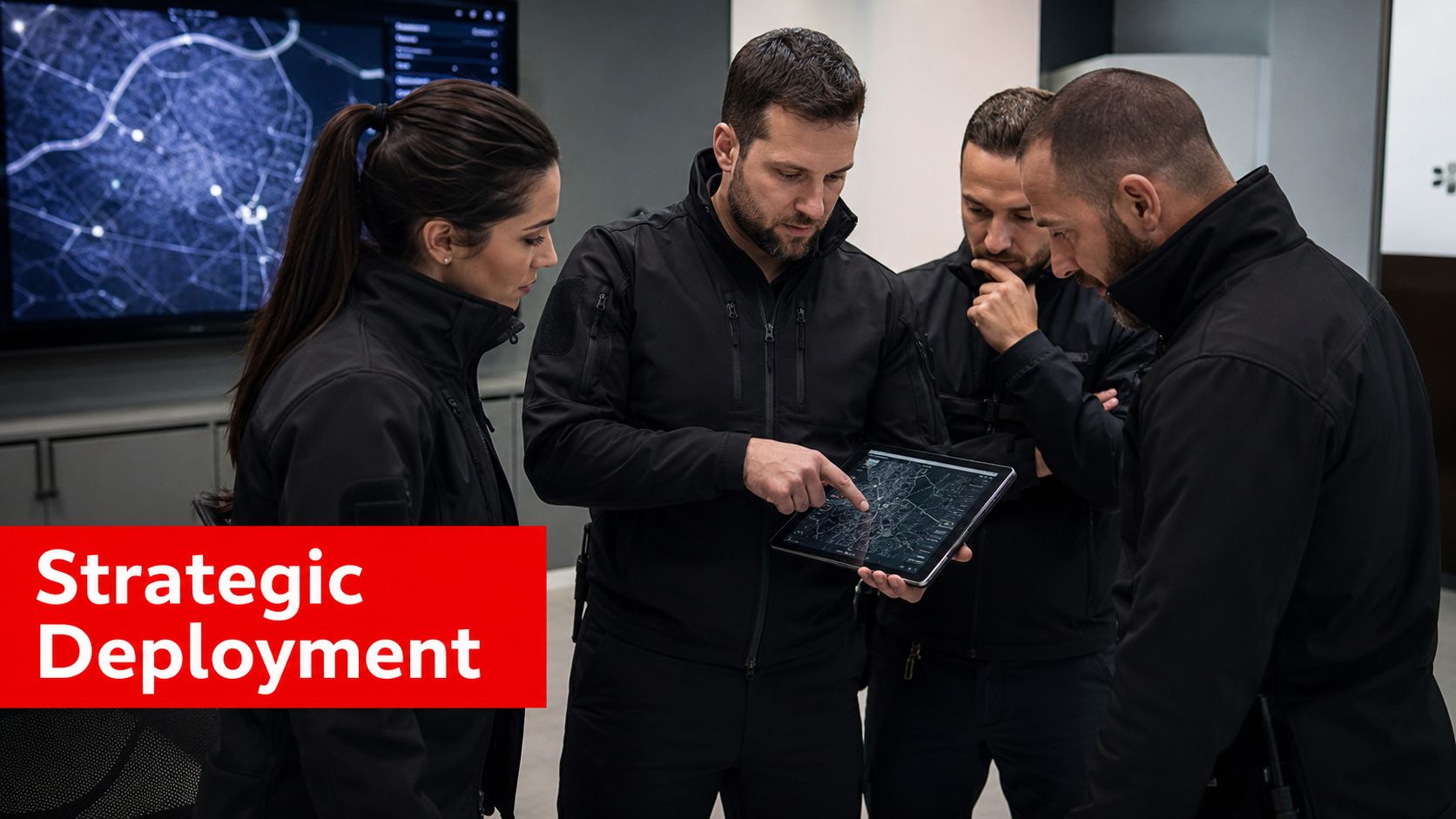
A public-facing festival detail doesn't need the same posture as a discreet escort for a chairperson arriving at a board dinner. A retail or hospitality environment has different movement patterns from a construction site or a courthouse. The strongest providers don't push one template into every job.
Matching people to the environment
The operative's demeanour matters as much as technical competence. In a corporate setting, the right officer is often calm, well-presented, unobtrusive, and excellent with executive assistants, reception staff, and venue managers. In a high-volume event setting, the right team may need stronger crowd-reading ability, tighter radio discipline, and a more visible deterrent presence.
Typical deployment choices include:
- Low-profile executive escort: suited to office towers, hotels, shareholder meetings, and airport transfers where discretion protects both safety and optics.
- High-visibility event support: suited to concerts, festivals, and nightclub or hospitality environments where crowd management and fast movement control are central.
- Secure transport integration: suited to movements where the vehicle plan is as important as the on-foot plan.
- Specialist augmentation: suited to environments where K9 screening, covert observation, or broader venue security support must work alongside close protection.
Assets should solve a real problem
Expert close protection services use extra capability only when it changes the risk picture. A K9 unit is valuable when screening or detection needs justify it. Enhanced vehicle capability matters when route exposure or transfer sensitivity demands it. Covert support makes sense when a visible deterrent would draw the wrong kind of attention.
What doesn't work is adding personnel or assets merely to appear substantial. That often creates congestion, poor communication, and friction with the client's own operations.
Why deployment quality matters commercially
The broader Australian Investigation & Security Services industry, which includes close protection, is projected to reach a market size of $13.9 billion in 2026 according to IBISWorld's Australian Investigation & Security Services industry outlook. That scale tells you something important. Buyers are not only paying for presence. They're paying for specialised planning, compliant staffing, and the ability to adapt the deployment to the risk.
Good deployment feels proportionate. The principal can function, the organiser keeps control, and security doesn't become the main event.
The commercial lesson is simple. Generic deployment is usually cheaper only on paper. If the wrong people, profile, or transport plan creates delay, disruption, or reputational friction, the “saving” disappears quickly.
Your 10-Point Checklist for Selecting a Provider
If you're comparing close protection services, most sales conversations will sound similar. Every provider will say they're professional, discreet, and experienced. The useful differences appear when you ask operational questions and insist on specifics.
The shortlist test
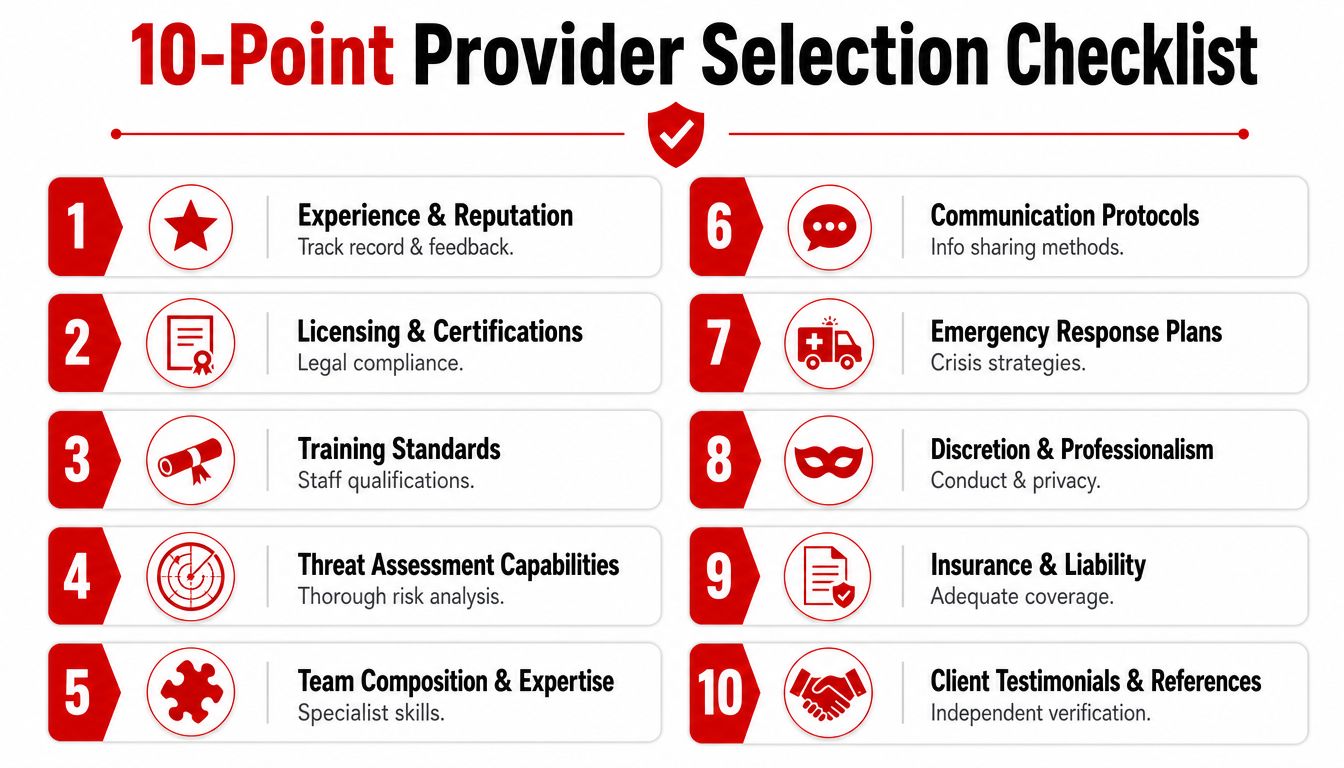
Use this checklist to separate a polished pitch from a capable protection partner.
Can they show current licensing for the actual states of deployment
Don't accept a general assurance. Ask for state-relevant proof.Do they explain their advance process clearly
A competent provider should be able to describe venue recon, route planning, access control, and contingency preparation in plain language.Can they talk intelligently about protective intelligence
If they only describe standing near the client, they may be offering guarding dressed up as close protection.Do they adapt the team to your environment
Ask who they would assign to a board meeting versus a festival dressing-room movement. The answer shouldn't be identical.How do they integrate with your existing people
Close protection must work smoothly with production, venue operations, front-of-house, legal, executive support, and transport.
The operational questions buyers often forget
The second half of the checklist is where practical diligence lives.
What are their communication protocols
Ask how updates, changes, and incidents are reported during and after the job.How do they handle medical or emergency issues
Not every assignment ends because of a security threat. Medical response capability and escalation discipline matter.Can they operate discreetly when required
Some environments need overt deterrence. Others need a team that blends into a corporate or hospitality setting.What insurance and liability arrangements support the work
The provider should answer this directly and without evasiveness.Will they provide relevant references or examples of similar work
You're looking for comparable environments, not generic praise.
Ask providers to describe a protection plan for a scenario close to yours. The quality of that answer tells you more than a brochure ever will.
What a strong answer sounds like
A strong provider will ask useful questions back. They'll want to know the principal's profile, the event flow, vehicle access constraints, arrival timing, public exposure, backstage or executive-only areas, and who has authority to change the plan on the day.
A weak provider jumps straight to headcount.
That's the practical test many buyers miss. Close protection services aren't purchased by the hour in the same way as basic guarding. They're designed around risk, logistics, client expectations, and decision-making under pressure. If a provider can't demonstrate that thinking before the contract is signed, they're unlikely to produce it once the operation starts.
Frequently Asked Questions About Close Protection
How much do close protection services cost
Cost depends on the risk profile, assignment duration, location, required team size, hours, transport requirements, and whether the job needs discreet executive support or a larger event-facing presence. The most useful way to assess value is to compare the provider's planning depth, licensing, and deployment fit, not just the quoted rate.
How much notice should I give
More notice is always better because close protection services rely on planning. Early engagement gives the team time to assess routes, confirm venue arrangements, coordinate with stakeholders, and build contingencies. Short-notice deployments are possible, but they compress the planning window and can limit options.
Can close protection be discreet
Yes. Many clients don't want an obvious bodyguard profile. A good team can operate with a low-profile corporate or hospitality presentation while still maintaining protective coverage, communication discipline, and movement control.
Do I need close protection or standard event security
If the risk centres on a specific person, their movement, their exposure, and the consequences of disruption around them, close protection services are usually the better fit. If the need is broader crowd management, perimeter control, or venue coverage, standard event security may be enough. In many real jobs, the answer is a coordinated blend.
What information should I prepare before contacting a provider
Have the basics ready: who needs protection, where they're going, when they're arriving, who they're meeting, what level of visibility is expected, whether there are known concerns, and who within your organisation will approve changes on the day. That makes the first conversation far more productive.
If you need licensed, fit-for-purpose protection for executives, events, venues, or high-profile movements across NSW, VIC, QLD, or the ACT, GM GROUP Services is a strong place to start. Their team delivers customized close protection and wider security support for concerts, festivals, hospitality venues, corporate functions, retail, and business environments, with a practical focus on compliance, communication, and 24/7 responsiveness.
Discover more from GM Group Services
Subscribe to get the latest posts sent to your email.