
SEO Title: State Security Licence Requirements Avoid Penalties with 6 Practical Checks
SEO Meta Description: Security licence requirements affect events, venues, sites, and contractors across NSW, VIC, QLD, and the ACT. Learn the rules, risks, and practical checks that prevent compliance mistakes.
Suggested URL: /security-licence-requirements
Security licence requirements sit at the front of every safe event, venue opening, after-hours site handover, and contractor deployment. If you're hiring guards for a festival, pub, retail centre, construction project, or corporate function, you're not just buying labour. You're taking on compliance risk.
Most clients realise this when someone asks a simple question on short notice. Is every guard licensed for the role they're performing? If the answer isn't immediate and documented, the problem is already operational, not administrative. A licence issue can disrupt entry points, delay bump-in, expose the venue operator, and create a mess with insurers, managers, and stakeholders.
The practical reality is straightforward. Security compliance isn't only the guard's problem. It belongs to the security provider, the site manager who signs off on deployment, and the organiser who allows the work to happen.
Why Your Business Cannot Ignore Security Licence Requirements
A common scenario goes like this. A venue manager is focused on patron flow, contractors are finishing setup, and the security team is already on site. Then a compliance question lands. Who is licensed for crowd control, who is cleared for static guarding, and who has current supporting qualifications attached to that role?
At that point, delays are expensive. Replacing staff at the gate, reshuffling duties, or stopping a deployment while documents are checked can throw off the whole run sheet. For hospitality venues, it can affect trade. For events, it can affect opening times, patron experience, and the relationship with the principal contractor or promoter.
Where clients get caught
Businesses usually don't get into trouble because they intended to cut corners. They get caught because they assumed the provider had already aligned the licence class, site duties, and supporting credentials. That assumption is risky.
The businesses most exposed are the ones that:
- Book at short notice: Last-minute staffing often means less time to verify licence classes and supporting certificates.
- Change the brief on site: A guard booked for one function can end up doing another if the shift plan isn't tightly controlled.
- Rely on verbal confirmation: If compliance records aren't available, your team has nothing solid to rely on.
Practical rule: If a person can't be matched to the correct role, licence status, and current supporting documents before they start, they shouldn't be rostered into that position.
Why this matters beyond paperwork
Licensing affects who can lawfully perform key duties at your site. It also affects the quality of response when things go wrong. A properly trained and vetted guard brings more than a visible presence. They bring recognised competency, documented screening, and a level of role-specific readiness that an unverified worker doesn't possess.
For clients, that means lower operational uncertainty. It also means better decision-making in crowd pressure, conflict, first aid response, access control, and incident reporting. Those aren't abstract benefits. They're the difference between a minor issue being managed early and a preventable problem escalating in front of patrons, staff, or contractors.
Understanding the Core Security Licence Framework
A security licence isn't just an ID card. It's a government-controlled approval that says a person has met specific eligibility, training, and background standards for the kind of work they're doing. For clients, that's the starting point. The next question is whether the licence matches the assignment.
What a licence really tells you
At a practical level, a licence tells you three things:
| What you need to know | Why it matters on site |
|---|---|
| The person was assessed | The regulator has checked identity, eligibility, and background requirements. |
| The person was trained | The licence is tied to recognised training relevant to the role. |
| The person is approved for certain work | Not every security task is interchangeable. Crowd control, static guarding, and related duties need the right authority. |
Clients often focus on the first point and stop there. That's where mistakes happen. A valid licence still needs to line up with the actual duties on the roster.
The part most people misunderstand
The phrase fit and proper person causes more confusion than almost anything else in security licence requirements. Many people hear it and assume it only means a criminal record check. It doesn't.
In the ACT, applicants must pass Access Canberra's fit and proper person test, which looks at broader character and conduct beyond criminal records, and ASIAL notes that private security officers must meet a standard of probity, which leaves uncertainty about how past non-criminal misconduct may affect eligibility, as outlined by this eligibility guide for private security licensing.
That matters to clients because a worker can look suitable on paper and still present a licensing issue if there are unresolved questions around conduct, honesty, or probity.
A provider that only checks whether a licence card exists is doing half the job. The real compliance task is checking whether the licence is current, appropriate for the role, and supported by the right underlying qualifications.
What works and what doesn't
What works is a disciplined pre-deployment process. Before anyone arrives, the provider should verify licence type, expiry, supporting certificates, and assignment fit. If the job changes, the compliance check needs to change with it.
What doesn't work is treating all guards as interchangeable. It also doesn't work to assume that because someone has worked another site, they can automatically work yours. Different venues, event conditions, and state rules create different obligations.
Your Guide to Security Licence Requirements in NSW, VIC, QLD and the ACT
A guard arrives for a multi-day event, has worked plenty of sites before, and presents a licence card at sign-in. If the licence class is wrong for the assignment, the training window has lapsed, or the jurisdiction applies a broader suitability test than your team expected, the problem sits with the contractor and the client. That is why state-by-state checking matters.
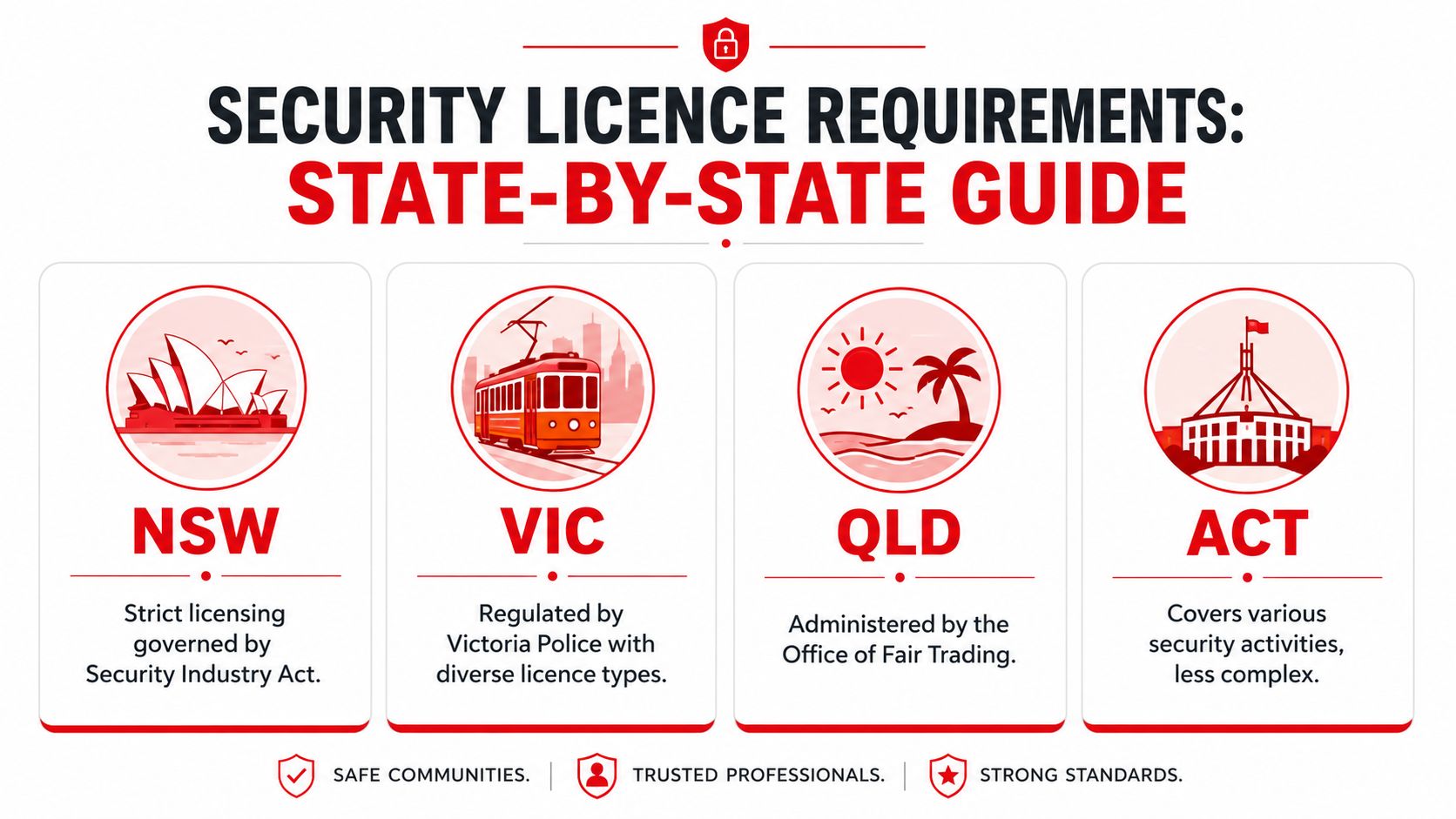
The rules across NSW, VIC, QLD and the ACT share a common theme. Licensing is not just about whether someone is allowed to work in security. It is about whether they are approved, trained, and documented for the specific work you are asking them to do in that state. Clients who run events across borders need a verification process that travels with the job. Teams that also secure your operations with managed IT security usually understand this point faster, because both physical and digital security fail in the same place: assumptions.
New South Wales
NSW is where role matching catches clients out. For many entry-level operational roles, especially unarmed guarding and crowd control, the baseline commonly includes Certificate II in Security Operations CPP20218 and a current HLTAID011 Provide First Aid certificate, along with the licensing checks handled through SLED, as outlined in the NSW-focused licensing overview.
For a venue operator, the practical question is simple. Does the person booked for this post hold the right authority for this exact task? A guard suitable for static asset protection is not automatically suitable for crowd control, and a provider should be able to show the supporting records before the shift starts.
NSW clients should also expect clean document control. If an inspector asks questions on-site, delays and vague answers create avoidable risk.
Victoria
Victoria creates problems through paperwork discipline and timing. Applicants need to meet age and work-rights requirements, and the application process can involve certified international police checks where relevant. The bigger operational issue is training currency. If approved training falls outside the accepted application window, the licence process can stall even if the candidate has already done the course.
Victoria also applies detailed identification requirements through the Victoria Police application guidance. That matters because small document errors become rostering problems later. I have seen candidates who looked deployable on paper get delayed because IDs were not certified correctly or the application pack was assembled poorly.
For clients, the lesson is to test the provider's process, not just the worker's claims. Ask when the training was completed, when the application was lodged, and whether the ID check was done to the regulator's standard.
Queensland
Queensland tends to expose weaknesses in workforce planning. For a Security Provider Licence Class 1, applicants need certified identification and must go through fee-based checks including criminal history review and fingerprinting, as set out in this Queensland licence process guide.
Queensland also applies a disqualification framework that can block an application where certain offences are recorded within the relevant period. For clients, that means replacement staff are not always easy to source at short notice. A provider with a thin bench can promise coverage and still struggle to lawfully fill the roster once screening issues surface.
That is a contract risk, not just an HR issue. Event managers should ask how many properly cleared substitutes the provider can deploy if two or three guards drop out the week of the job.
ACT
The ACT is often underestimated because the market is smaller. The compliance standard is not lighter. The fit and proper person test carries real weight, particularly where concerns relate to honesty, conduct, or probity rather than a straightforward criminal conviction.
Clients should pay attention to that distinction. If a provider only checks whether a licence exists, they may miss the suitability questions that can affect deployment, renewals, or regulator scrutiny later. GM GROUP handles this by checking licence status, role fit, training support, and the underlying compliance position before rostering staff onto a site.
A quick comparison for busy managers
| State or territory | Core issue clients should watch |
|---|---|
| NSW | Correct licence class, role fit, and current supporting qualifications such as CPP20218 and HLTAID011 where the role requires them |
| VIC | Training timing, identification accuracy, and any extra police check requirements tied to the applicant's history |
| QLD | Screening delays, disqualification risk, and whether the provider has enough cleared backup staff |
| ACT | Broader fit and proper assessment, including conduct and probity issues that go beyond a basic criminal record check |
For businesses operating in more than one jurisdiction, the safest method is consistent pre-deployment verification with state-specific checks built into it. That is the point where experienced providers earn their fee.
The Licence Application and Renewal Journey
Clients don't need to run the application for their guards, but they do need to understand where applications fail. Most failures come from timing, paperwork, and incomplete follow-through rather than from the headline training itself.
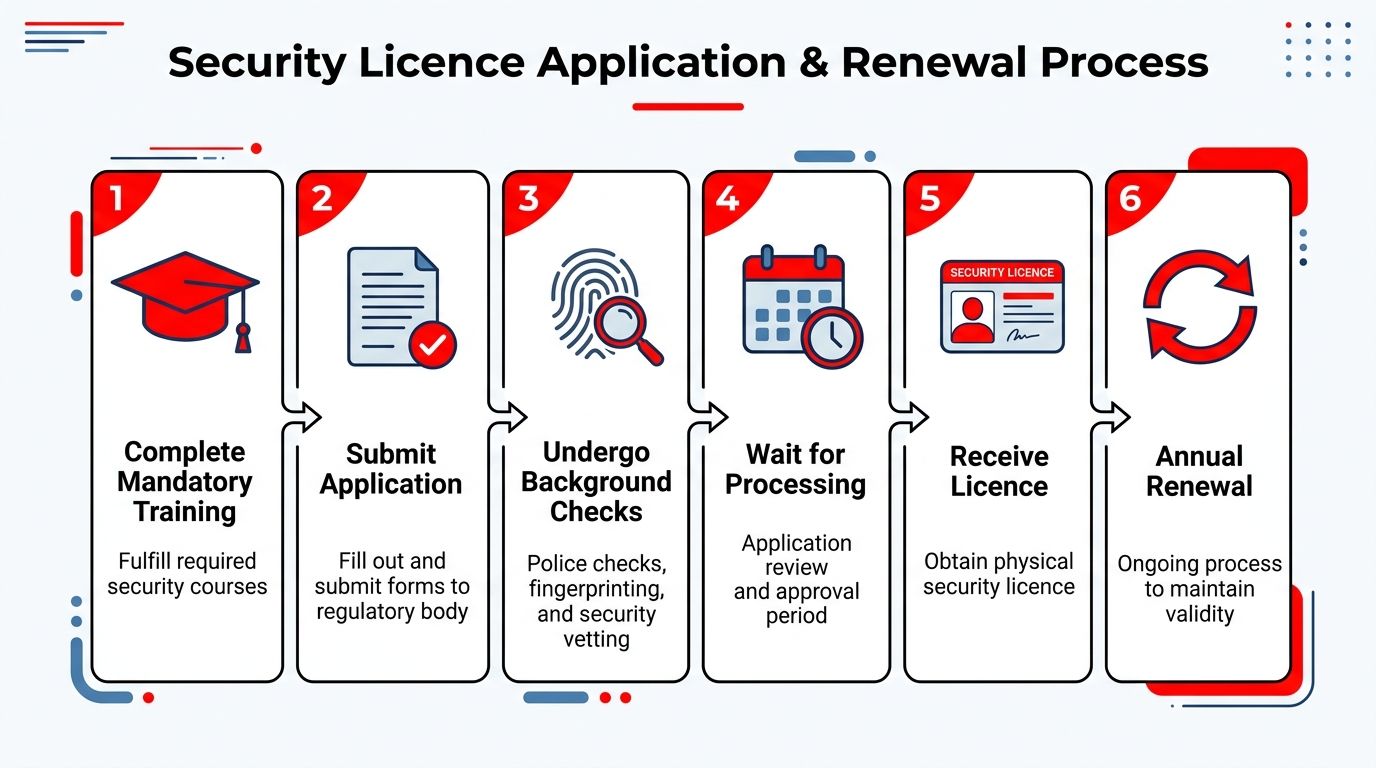
The application path in practice
A workable compliance process usually follows this order:
Training first
The applicant completes the mandatory security training and any required supporting certificates for the intended licence class.Document assembly
Identification, training records, and supporting paperwork need to be gathered in the correct form. Certified documents matter. Missing or informal copies slow things down fast.Application lodgement
The application goes to the relevant state authority, and from there the background and identity checks take over.Checks and vetting
Depending on the jurisdiction, that can include criminal history review, fingerprinting, international checks, and broader suitability assessment.Approval before deployment
The licence needs to be granted and current. “Application submitted” isn't the same as “approved for duty.”
The NSW timing trap
New South Wales gives a very concrete example of why process discipline matters. Applicants must submit their security qualifications within 42 days of lodging the application, and failure to provide evidence of completed training units within that deadline results in refusal by SLED, as set out on the NSW security operative licence application page.
That isn't a small technicality. For clients, it affects mobilisation planning. If a provider is bringing on new guards for a major event window, any slippage in training evidence can wipe out expected availability.
Renewal is not just a diary reminder
Renewal problems usually come from complacency. People assume that once a guard has been licensed, the hard part is done. It isn't. Ongoing compliance means checking that the licence remains current and that related qualifications tied to the role haven't lapsed.
A sound renewal system should include:
- Expiry tracking: Licence dates, first aid dates, and any role-linked certificates should be monitored before roster allocation.
- Role-based review: If a guard is moving into different work, the provider should confirm the licence conditions still fit.
- Client-side visibility: Site managers should be able to request current evidence without chasing multiple people.
The safest provider isn't the one that says renewals are under control. It's the one that can show you the current records before the shift starts.
Common Pitfalls and On-Site Compliance Obligations
The expensive compliance failures usually happen an hour before gates open.
A supervisor is short one guard. Someone available is moved from a quieter assignment into a crowd-facing role. The licence check was done at onboarding, nobody rechecks the role conditions, and the client assumes the provider has it covered. If that worker is not properly licensed or does not hold the supporting qualifications for the task being performed, the risk sits with more than the guard. It reaches the venue, the organiser, and the contract chain around the job.
The mistakes that keep showing up
The first problem is role creep. A guard booked for static presence can end up managing entries, screening patrons, or dealing with crowd pressure because the site changed after the roster was issued. On paper, that can look like a small operational adjustment. In compliance terms, it can mean the wrong person is doing licensed work outside the original brief.
The second problem is stale records. Training, identity checks, and licence evidence need to match the current assignment, not the file that was accepted months ago. As noted earlier, state regulators set clear expectations around eligibility and training timing. Providers that treat compliance as a one-time onboarding task usually get caught at deployment.
There is also confusion around the fit and proper person test. Clients often assume that once a licence card exists, the issue is settled. It is not that simple. The test goes to character, history, and suitability to hold a licence in the first place. Providers need to manage that screening properly, but clients should understand the practical consequence. A licence problem can remove a worker from your site without much warning if suitability concerns surface during application, review, or renewal.
Shared obligations between provider and client
Providers handle licensing, verification, and rostering. Clients still control the work environment, the tasking, and many of the decisions that create compliance exposure on site.
If your venue manager asks guards to take on duties outside the agreed scope, the compliance position changes immediately. If your event team allows informal shift swaps without site sign-in checks, you create an identification problem. If incident records are poor, it becomes harder to defend the supervision and allocation decisions made during the shift.
Use this check before each deployment:
- Match the task to the licence class: Entry control, patrols, guarding, and crowd-facing duties should be allocated deliberately, not interchangeably.
- Confirm supporting qualifications are current: First aid, induction records, and site-specific requirements need to be checked against the actual job.
- Verify identity on arrival: The person who turns up must be the person cleared and rostered for that shift.
- Control changes on the ground: Any duty change should trigger a fresh review by the supervisor, not an assumption that the original check still covers it.
- Keep usable records: Incident notes, sign-on details, and supervisor instructions should be clear enough to stand up if a regulator or client representative asks questions later.
Security exposure also sits in the systems around the guards. Many venues need to secure your operations with managed IT security because rostering platforms, access control logs, CCTV workflows, and contractor communications often sit inside the same operating environment.
What fails on busy sites
Three habits cause repeated trouble.
- Verbal swaps: One guard replaces another and nobody completes a fresh check.
- Duty drift: The assignment changes mid-shift, but the paperwork and supervision do not.
- Assumed compliance: Head office believes the site checked the worker. The site believes head office checked the worker. Neither can prove it.
The fix is disciplined site control. Strong providers build that into daily operations, and experienced clients insist on it before the first shift starts.
On-site compliance is a live control point. If the task changes, the licence check and supporting records need to be reviewed at the same time.
How GM GROUP Services Ensures Seamless Compliance
Clients usually don't want a lecture on legislation. They want a provider that can field the right people, show current records, and keep the site running without avoidable compliance issues. That comes down to systems.
What disciplined compliance looks like
A workable provider process includes pre-deployment licence verification, expiry tracking, role matching, and supervision once the team is on site. It also means checking support qualifications that attach to the assignment rather than treating them as optional extras.
For a Class 1 security licence in NSW covering crowd controllers, a current HLTAID011 Provide First Aid certificate is mandatory, and GM GROUP Services confirms this specific qualification is checked for deployed guards to maintain SLED compliance on client sites.

Why clients value this approach
From an operations point of view, the benefit isn't abstract. It means the provider can allocate people according to the actual site task, monitor expiry dates before they become roster problems, and produce compliance evidence when a venue manager, organiser, or regulator asks for it.
The better approach also improves day-to-day service quality. When guards are deployed into work they are properly licensed and prepared for, they handle patron interaction, access control, and incident response more consistently. That protects people, but it also protects the venue's reputation.
For clients running events, hospitality venues, retail sites, or construction projects across multiple jurisdictions, this kind of process takes pressure off internal managers who already have enough moving parts to control.
Frequently Asked Questions About Security Licensing
Can a guard use one licence in every state
Not automatically. State and territory rules differ, and Victoria specifically requires a Mutual Recognition Application for people transferring interstate credentials into that jurisdiction under its process settings noted earlier. If you're operating across borders, check the local approval pathway before rostering anyone.
If a guard's licence expires during a contract, who carries the risk
Operationally, everyone involved carries some risk. The provider has the primary responsibility to prevent unlawful deployment, but the client also needs to act once they know or should have known there is a problem. The safe response is immediate removal from duty until status is clarified.
Does a venue manager need a security licence
Typically, not merely for managing the venue or contract. A licence question arises when a person is performing licenced security activities, not just overseeing the site commercially or operationally.
What's the most overlooked issue in security licence requirements
The background suitability question. Many people check age, ID, and training, then stop there. The harder issue is whether the person meets the regulator's broader suitability standard, especially where probity or past conduct is involved.
What should I ask a provider before an event or site mobilisation
Ask for role-based verification, not generic reassurance. You want confirmation that each deployed worker is licensed for the specific assignment, that supporting qualifications are current, and that a supervisor can produce records quickly if questioned.
If you need a provider that can align staffing, licensing, and site duties before problems reach your front gate, speak with GM GROUP Services. They work across events, venues, hospitality, retail, construction, and corporate environments in NSW, VIC, QLD, and the ACT, with compliance checks tied to the actual work being performed.
Discover more from GM Group Services
Subscribe to get the latest posts sent to your email.