
Biometric security is already part of daily life, even if you don't call it that. If you're running a festival gate, managing a club entrance, supervising a construction site, or protecting a retail stockroom, you've probably hit the same problem. You need to know who someone is, fast, without creating queues, arguments, or blind spots.
Cards get shared. PINs get forgotten. Paper sign-in sheets tell you very little when something goes wrong later. Biometric security changes that by tying access to a person rather than to something they carry. Used properly, it can tighten access control, support compliance, and make your on-site team more effective.
For Australian operators, the timing matters. Public use is growing, legal expectations are tightening, and operational standards are getting higher. The challenge isn't just buying a scanner. It's choosing a system that fits your venue, your workforce, and your privacy obligations.
The Future of Access Is Here Biometric Security Explained
A festival gate is a good place to understand biometric security because everything happens at once. Guests are arriving, contractors are unloading, security staff are checking IDs, and venue managers are trying to keep the line moving without letting the wrong person through. In that environment, every weak access method shows its flaws quickly.
Biometric security uses a physical or behavioural trait to verify identity. That could be a fingerprint, a face, an iris pattern, a vein pattern, or even the way a person interacts with a device. The core idea is simple. Instead of asking, "What card are you holding?" the system asks, "Are you the enrolled person?"
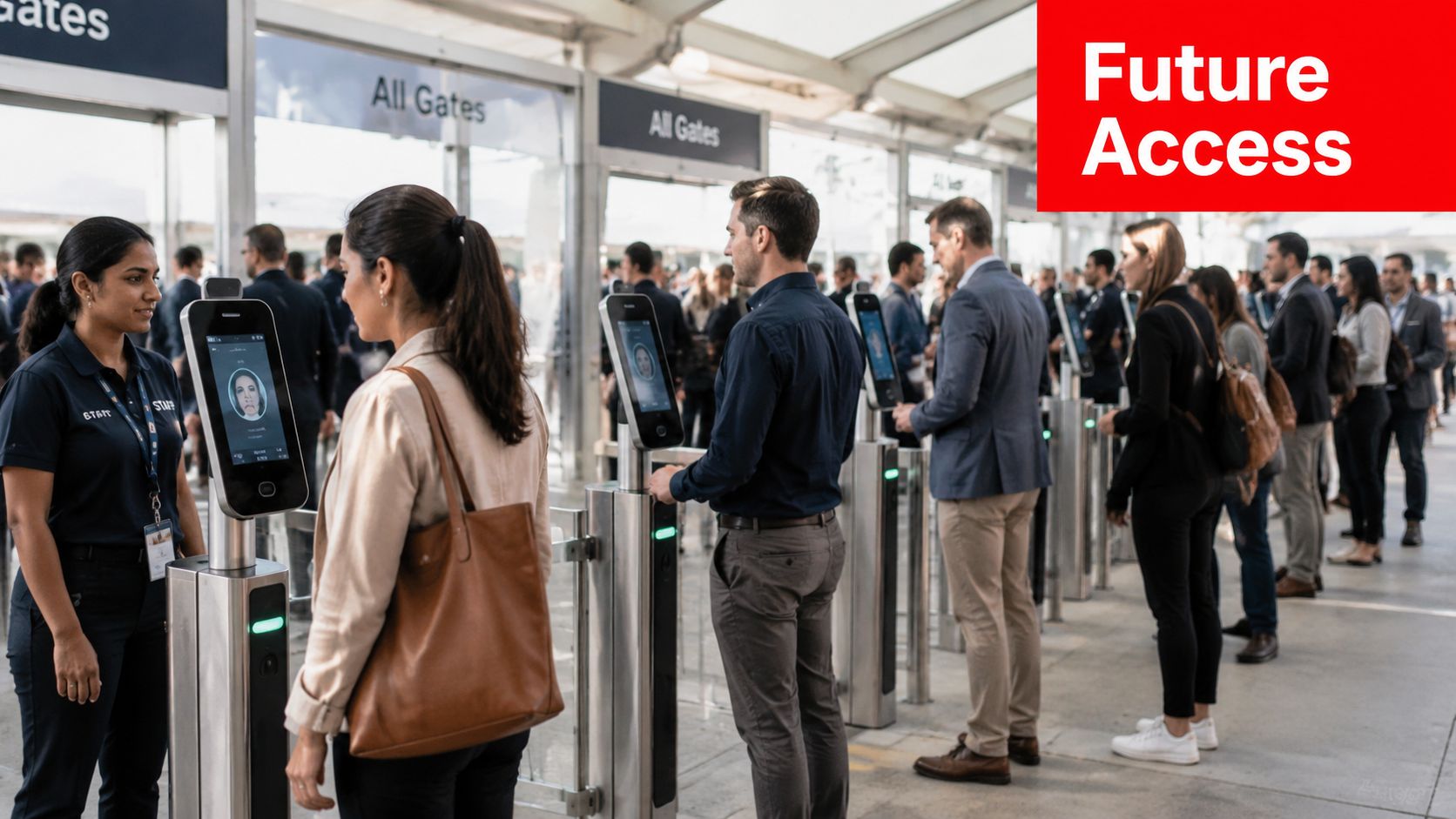
Biometric security in everyday operations
At a temporary event, facial recognition can help verify approved staff at a restricted entrance. On a construction site, a fingerprint reader can control access to plant areas or site offices. In a corporate venue, a biometric system can confirm that only authorised personnel enter back-of-house spaces.
That shift is part of a bigger Australian trend. The Australian biometrics market projection says the market is projected to grow from USD 1032.0 Million in 2025 to USD 3282.1 Million by 2034, at a 13.31% CAGR. In practical terms, more businesses are treating biometric verification as a normal part of identity control, not a niche tool.
More than phone unlocking
Many people still think biometrics means accessing a mobile phone with a thumb or face. That's only the consumer version. In security operations, its primary value is stronger identity checking, cleaner audit trails, and less dependence on passes that can be lost or shared.
If you're trying to understand the wider facial recognition ecosystem before looking at access control, this guide to understanding face search technology helps explain how face matching works in plain language.
Practical rule: Biometrics work best when you use them to solve a specific access problem, not when you install them because the technology looks impressive.
Comparing 5 Key Types of Biometric Security
Not all biometric systems solve the same problem. A busy stadium entrance needs something different from a fenced construction site or a staff-only retail storeroom. The easiest way to think about each modality is this. Every system is trying to use a person-specific key, but each key behaves differently in practice.
Comparison of Biometric Security Modalities
| Modality | How It Works | Pros | Cons | Best For |
|---|---|---|---|---|
| Fingerprint | Scans fingerprint features and compares them with an enrolled template | Familiar, quick, practical for staff access | Contact-based use can slow flow, dirty hands can affect reads | Construction sites, staff doors, plant rooms |
| Facial recognition | Maps facial features from a live camera image | Contactless, useful where hands are occupied, suitable for higher throughput | Lighting, camera position, and crowd movement affect performance | Events, venues, reception entries |
| Iris scanning | Reads patterns in the coloured part of the eye | Strong identity assurance, less affected by worn hands | Can feel intrusive, less suited to rushed high-volume entry | Higher-security rooms, controlled corporate settings |
| Vein pattern | Uses vein structure in the hand or finger | Hard to imitate, useful for secure internal access | Hardware can be more specialised | Restricted industrial or sensitive internal areas |
| Behavioural biometrics | Looks at patterns such as typing or device interaction | Works in the background, useful for digital fraud signals | Less useful for a physical turnstile or gate by itself | Digital systems, online account protection |
Which type fits the site
A fingerprint unit often suits a fixed workforce. Staff learn the process, enrolment is manageable, and supervisors can pair the system with roster checks. That's why it often fits construction compounds, depot entries, and staff-only access points.
Facial recognition tends to suit environments where throughput matters more. If people are carrying equipment, wearing gloves, or moving through a gate in quick succession, contactless verification can reduce friction.
Iris and vein systems usually make sense when the access point itself is highly sensitive. They aren't always the first choice for a club door or event lane, but they can suit secure rooms, controlled cabinets, or internal areas with stricter access rules.
Behaviour matters too
Behavioural biometrics are different. They don't usually replace a physical gate system. Instead, they support digital security by spotting whether the person using a device behaves like the enrolled user. For a retailer or venue operator, that can be useful in back-office systems, fraud review workflows, or remote access settings.
Choose the modality around the environment. Dust, sunlight, gloves, queues, noise, wet weather, and rushed users matter as much as the sensor.
Understanding Biometric Accuracy False Positives and Negatives
Most confusion about biometric security starts here. A system can make two different mistakes. It can let the wrong person in, or it can block the right person. Security managers often hear vendor language around "accuracy" without getting a clear explanation of that trade-off.
The nightclub door test
Think about a bouncer at a club. If the bouncer is very strict, some legitimate patrons get delayed or turned away while their ID is checked again. If the bouncer is too relaxed, someone who shouldn't be inside gets through. Biometric systems face the same balancing act.
A false acceptance rate means the system incorrectly grants access to someone unauthorised. A false rejection rate means the system incorrectly denies access to someone who should be allowed in.
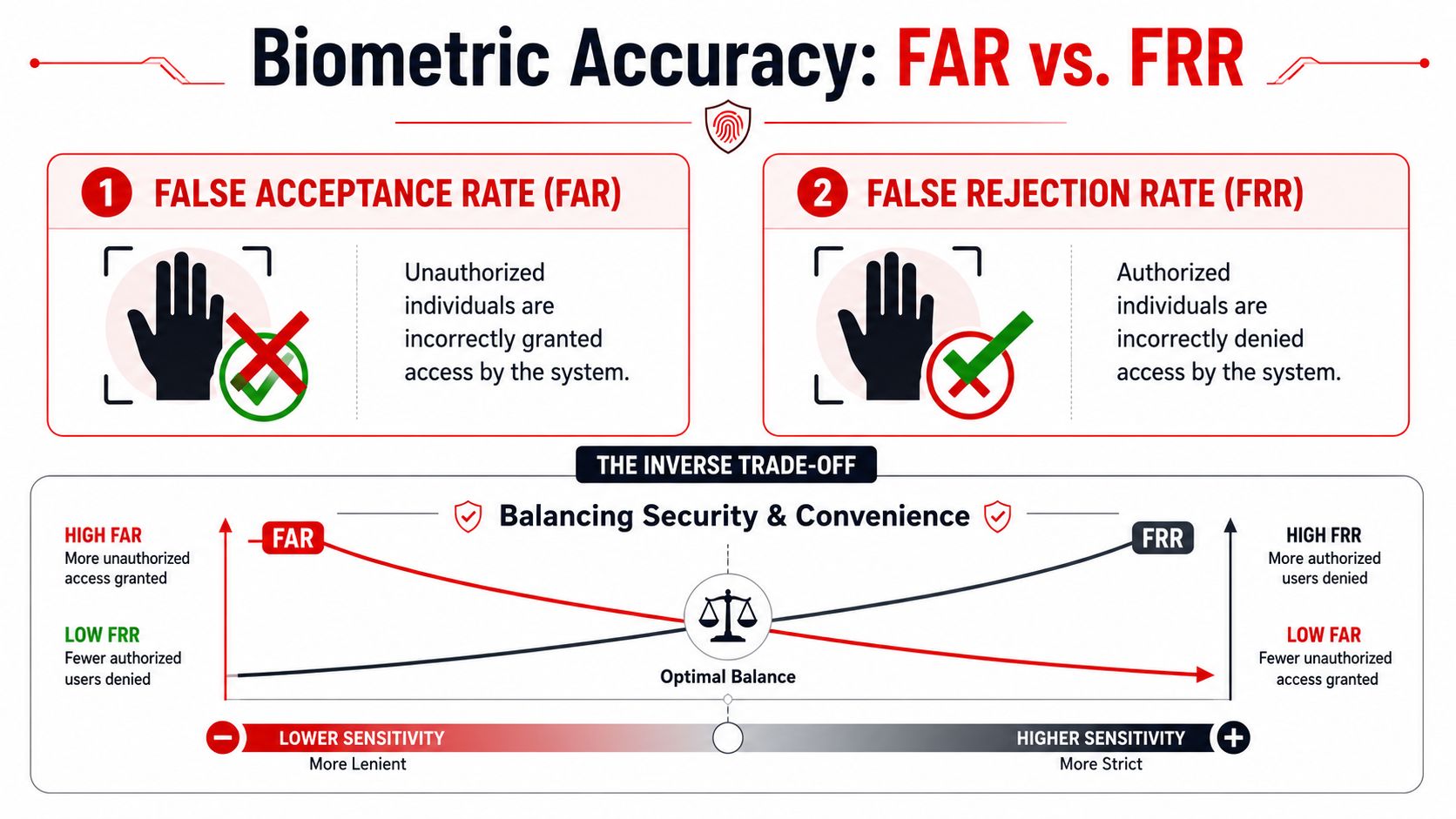
Why thresholds matter in biometric security
These systems use a matching threshold. Lower the threshold and the system becomes more permissive. Raise it and the system becomes stricter. That's why a single claim of "high accuracy" doesn't tell you enough. You need to know where the threshold is set and what that setting does to operations.
For Australian venue use, facial recognition threshold guidance notes that a threshold of 0.85 can achieve a False Acceptance Rate below 0.001% while keeping the False Rejection Rate under 5%. That balance matters because an entry point has two jobs at once. It must block unauthorised access and keep legitimate patrons moving.
Questions to ask before rollout
When you're assessing a system, ask practical questions rather than broad ones:
- What happens at peak entry time when many people arrive together?
- How does the system handle retries for legitimate users who are rejected?
- What is the fallback process if a scan fails?
- Who reviews exceptions and how quickly?
A secure system that creates constant manual overrides isn't efficient. An efficient system that accepts the wrong people isn't secure.
The right setting depends on the location. A public-facing event lane may tolerate a different balance from a server room, cash office, or controlled site compound.
Biometric Security and Australian Privacy Law Compliance
A venue can install accurate scanners, fast entry lanes, and well-trained guards, then still create legal risk at the point of enrolment. The problem usually starts with process, not hardware. If people are unclear about what is being collected, why it is needed, who can access it, or how long it stays on file, the security program is already exposed.
That matters in Australia because biometric information is generally treated as sensitive information. For an event operator, builder, or retailer, that changes the standard from "collect it because it's useful" to "collect it only for a clear purpose, with proper notice, consent where required, and tight handling controls."
The legal article on biometric data obligations in Australia explains why privacy impact assessments, staff training, and breach response planning should be built into deployment from the start. This is especially important where a biometric system supports front-line operations, such as contractor access to a site compound, staff entry to a gaming room, or back-of-house control at a major event. In those settings, technology and guard services need to work as one operating model. The scanner verifies identity. The on-site team handles exceptions, consent questions, refusals, and incident escalation.
A good compliance program shows up in everyday decisions:
- Use a defined purpose. Tie collection to a specific access, identity, or verification function.
- Get clear, informed consent where required. Explain what is collected, how it is used, where it is stored, and when it will be deleted.
- Collect less. If a template will do the job, do not keep unnecessary raw images or extra identifiers.
- Control access internally. Limit who can view, export, or administer biometric records.
- Set a deletion rule. Retain data for an operational reason, not because the system makes storage easy.
- Train front-line staff. Guards, supervisors, and venue managers should know the privacy script as well as the access procedure.
Victoria's OVIC biometrics and privacy guidance gives a practical model. It points organisations toward encrypting biometric templates, separating them from raw data where possible, and destroying information when it is no longer needed. That approach suits real operations. A construction site, stadium, or retail back-of-house area does not need indefinite retention to stay secure. It needs defensible retention that matches risk, incident review needs, and privacy obligations.
Retention is often the weak point.
If biometric data is compromised, the person affected cannot reset their face or fingerprint like a password. Disposal therefore belongs inside the security plan, alongside enrolment, access review, and incident response. If you are building a broader records-handling process, standards behind NAID AAA certified data destruction help turn disposal into a controlled procedure rather than an informal admin task.
Compliance checkpoint: If your team cannot explain where biometric data is stored, who can access it, why it is retained, and how it is deleted, the system is not ready for live use.
There is also a firm boundary under the Digital ID Act 2024. Accredited entities are prohibited from using one-to-many biometric matching for banned purposes. For operators on the ground, the practical lesson is simple. Use biometrics for specific, consent-based authentication tasks, and keep broad surveillance ambitions out of the design.
Real-World Use Cases for Events Construction and Retail
Biometric security becomes easier to evaluate when you stop thinking about the technology and start looking at moments of friction. Where does your team lose time? Where do credentials get shared? Where does manual checking break down?
Events and hospitality
An event manager has a VIP entrance, a staff gate, and a back-of-house loading point. The public queue needs speed, but the artist compound needs tighter identity control. A contactless facial recognition lane can support smoother check-in for pre-enrolled personnel, while security staff handle exception cases, intoxication issues, or prohibited items.
In bars and clubs, biometrics can also support restricted-area control. A scanner doesn't replace RSA decision-making or patron management, but it can reduce disputes about whether someone was authorised to use a service corridor, office, or cash area.
Construction sites
A site manager often faces a different problem. Workers arrive early, contractors rotate, and after-hours access creates risk around tools, plant, and compliance. Fingerprint-based access can tie entry to a specific enrolled person rather than to a shared swipe card.
That also creates better accountability. If an incident happens in a restricted area, the access history is far more useful than a paper sign-in sheet with illegible handwriting or a borrowed pass.
Retail and multi-site operations
Retailers usually need control in stockrooms, offices, delivery areas, and cash handling zones. Biometric access can help narrow who can enter sensitive spaces, while behavioural controls can support digital account security for internal systems.
If you want a useful comparison point from another access-heavy environment, this overview of Fitness GM access control shows how operators think about member flow, permissions, and secure entry in a practical setting. The same logic applies to many commercial premises. The system has to fit movement patterns, staffing realities, and user behaviour.
Where biometric security works best
Biometrics tend to perform best when all of the following are true:
- The access point is clearly defined: One doorway, gate, lane, or checkpoint.
- The user group is known: Staff, contractors, members, approved guests.
- There is a fallback process: Guard review, supervisor approval, or alternate credential.
- The operational goal is specific: Faster entry, tighter restricted access, or cleaner audit history.
A Strategic Checklist for Implementing Biometric Security
Many projects go wrong before the hardware is installed. The system looks good in a demo, but the live environment is harsher than the sales presentation. Rain, dust, glare, crowds, gloves, rushed contractors, and inconsistent enrolment all affect outcomes.
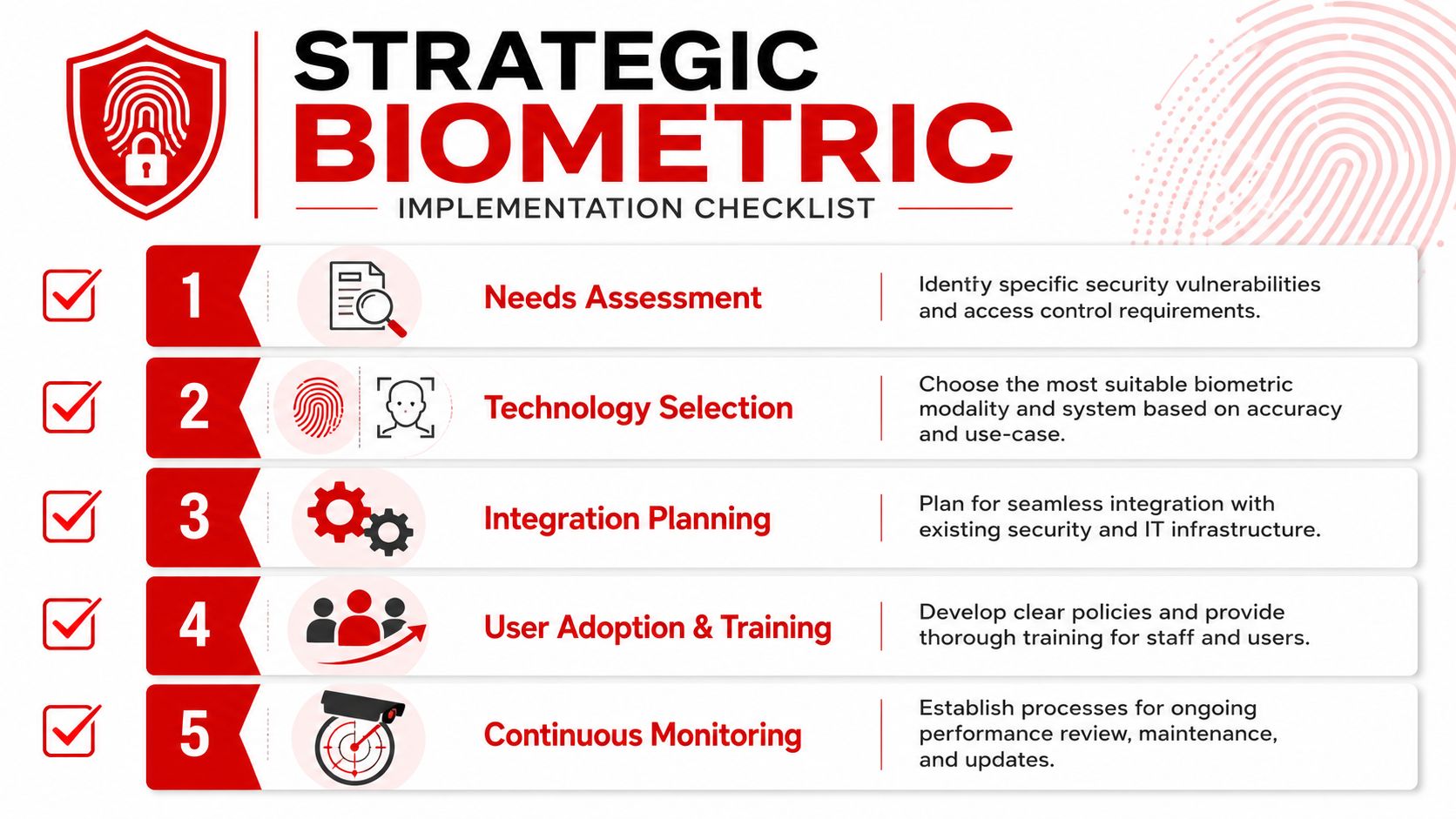
Start with the operational problem
Don't begin by picking a scanner. Begin by defining the failure you're trying to fix.
Map the risk points
Identify where unauthorised access, credential sharing, slow entry, or weak audit trails hurt operations most.Choose the right modality
Match the biometric method to the site conditions. A gate exposed to dust and wet weather may need a different approach from a climate-controlled office.Plan the fallback process
Every system needs a human-managed backup. That might be supervisor verification, manual ID check, or a temporary credential path.
Test in the real environment
A major blind spot in biometric security procurement is accepting polished performance claims without testing the site reality. The ARC-linked warning on protected settings highlights that many biometric systems show poor, commercially non-viable performance in protected, real-world settings. That's exactly why a festival gate, busy venue entrance, or active construction compound can't be assessed like a clean lab.
Ask vendors to demonstrate the system under your likely conditions:
- Lighting conditions: Daylight, backlight, night operations
- User conditions: PPE, hats, sunglasses, dirt, rushed movement
- Traffic conditions: Peak surges, group arrivals, repeated scans
- Exception handling: Power interruption, network loss, failed reads
Don't buy a biometric system based on a conference-room demo. Test it where people will actually use it.
Build governance before rollout
Implementation is as much a people project as a technology project. You need enrolment rules, consent forms, privacy notices, staff scripts, training, and a process for complaints or opt-out discussions where appropriate.
A practical checklist for launch looks like this:
- Document the purpose: Why the biometric security system exists and which access problem it solves.
- Define data handling: Where templates are stored, who manages access, and how deletion works.
- Train supervisors: They need to handle user questions confidently and consistently.
- Review performance: Check rejection patterns, override frequency, and site-specific issues after launch.
How Biometrics Complement GM GROUPs On-Site Security
The biggest mistake clients make is thinking biometric security replaces people. It doesn't. It changes what people spend their time doing.
A scanner is good at repetitive identity checks. It doesn't get tired, it doesn't forget a face after a long shift, and it creates a more consistent access decision at the point of entry. That helps most when the task is narrow and repeatable.
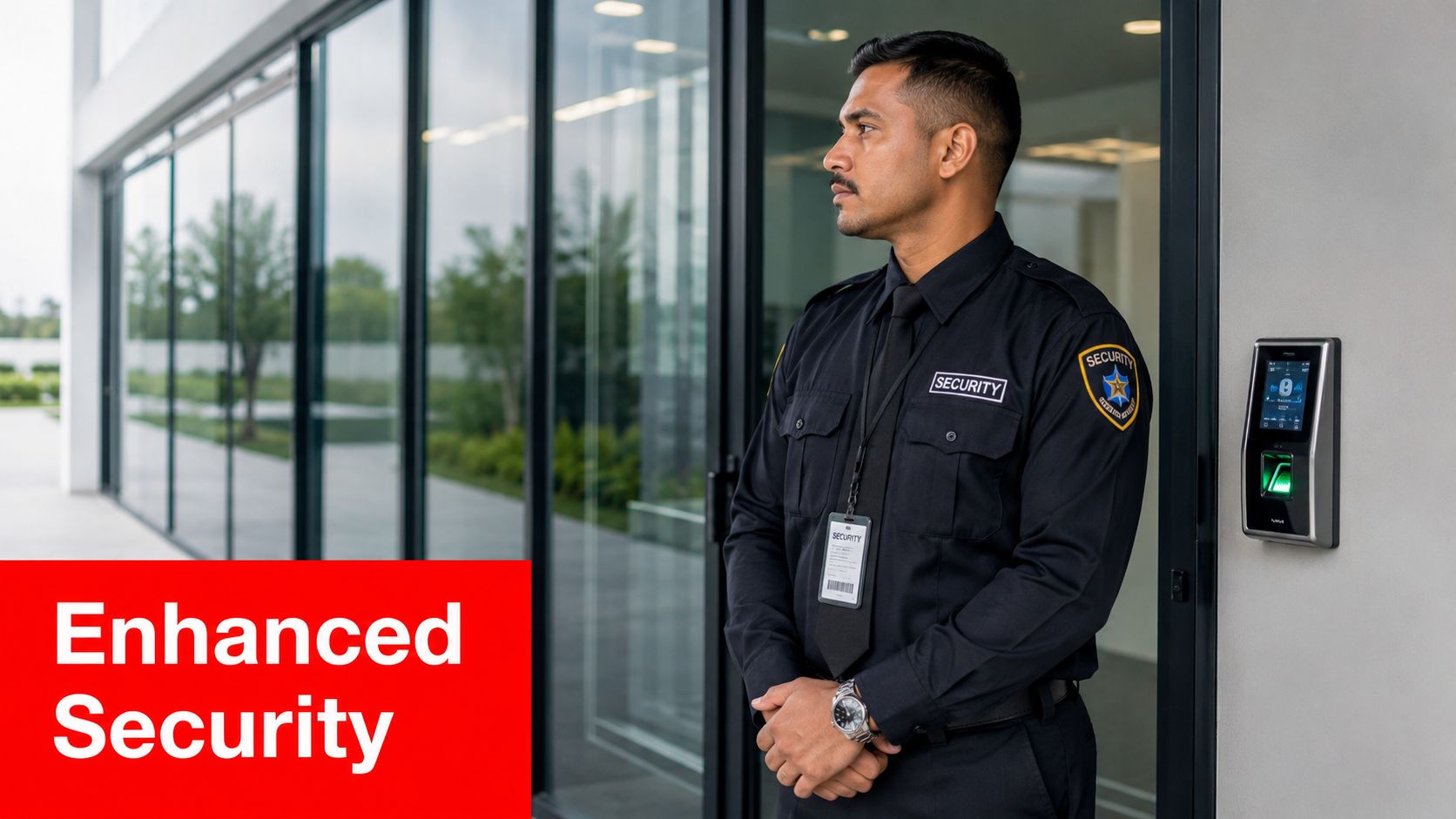
What technology can do well
Biometric systems support:
- Identity verification at speed: Useful for staff entries and controlled zones
- Audit support: Helpful when reviewing who accessed a location
- Access consistency: Less reliance on memory, paper logs, or shared cards
What human security still owns
Guards and supervisors handle the harder part of security work:
- Reading behaviour: Spotting agitation, intoxication, tailgating, or suspicious intent
- Resolving exceptions: Managing failed scans, visitor disputes, and unusual scenarios
- Responding to incidents: De-escalation, emergency action, and crowd management
- Protecting the experience: Keeping a site safe without making it feel hostile
Here, integrated security works best. The technology verifies identity. The human team applies judgement. In a venue, event, or construction environment, that division of labour is often the difference between a neat system on paper and a security model that works effectively on a busy day.
Frequently Asked Questions About Biometric Security
What happens if a biometric security system goes down during an event
A failure plan should be built before the system goes live. On a busy event night, that usually means guards can switch to manual ID checks, approved staff can use a backup credential, and supervisors know who decides edge cases at the gate.
Biometric access works like an express lane. If the scanner stops, the site still needs an open general lane that keeps people moving without losing control. For venues and events, that often matters as much as the scanner itself.
Can an employee refuse to use biometric security
Sometimes, yes. The answer depends on the job, the reason the biometric is being collected, whether a practical alternative exists, and how the employer has handled policy, notice, and consent.
In Australia, this is not just a technology question. It is also an employment, privacy, and workplace relations question. A construction company, retailer, or venue operator should get legal and HR advice before treating biometric use as a condition of entry or employment.
Are biometrics too expensive for a small business
Cost should be measured against risk, not curiosity. If a small business only needs basic front-door control, cards, PINs, and trained staff may be enough. If it has repeated credential sharing, restricted stock access, or contractor movement that needs tighter records, a small biometric deployment may be justified.
The practical approach is usually narrow first. Secure one door, one room, or one process. Then check whether it reduces admin time, access misuse, or after-hours uncertainty before expanding.
Why are people still uneasy about it
Because biometric data feels personal in a way a swipe card does not. You can replace a card. You cannot replace your face or fingerprint in the same straightforward way, so people tend to ask harder questions about storage, misuse, and who gets access.
That concern should be expected. It should not be dismissed as resistance to new technology. Clear notices, limited collection, secure handling, and visible human oversight help build trust, especially in workplaces and public-facing sites where people want to know that security is being managed fairly.
If you're weighing biometric access, guard deployment, or a blended security model for a venue, event, construction site, or business, GM GROUP Services can help you assess the operational reality on the ground and build a practical security approach around it.
Discover more from GM Group Services
Subscribe to get the latest posts sent to your email.