
Expert event security services are a cornerstone of any successful gathering. When you think about event security, what comes to mind? For many, it's the classic image of guards at the door. But in reality, professional event security is much more than that. It's the complete, behind-the-scenes strategy that ensures everything runs smoothly and safely. Think of it less like hiring bouncers and more like commissioning an architect to design a detailed blueprint for safety. It's a critical investment in protecting your guests, your assets, and your brand's reputation.
What Are Event Security Services, Really?
Imagine your event is a big-budget film production. Your event security services team is the well-oiled crew making it all happen. You've got crowd management specialists who are like location scouts, mapping out every corner of the venue. The emergency response teams are your stunt coordinators, ready for any high-action scenario. And the security manager? They're the director, making sure every piece works in perfect harmony to create a seamless, safe experience for everyone who walks through the door. This coordinated approach is precisely why a proper security plan isn't just a 'nice-to-have'—it's a non-negotiable for any successful event.
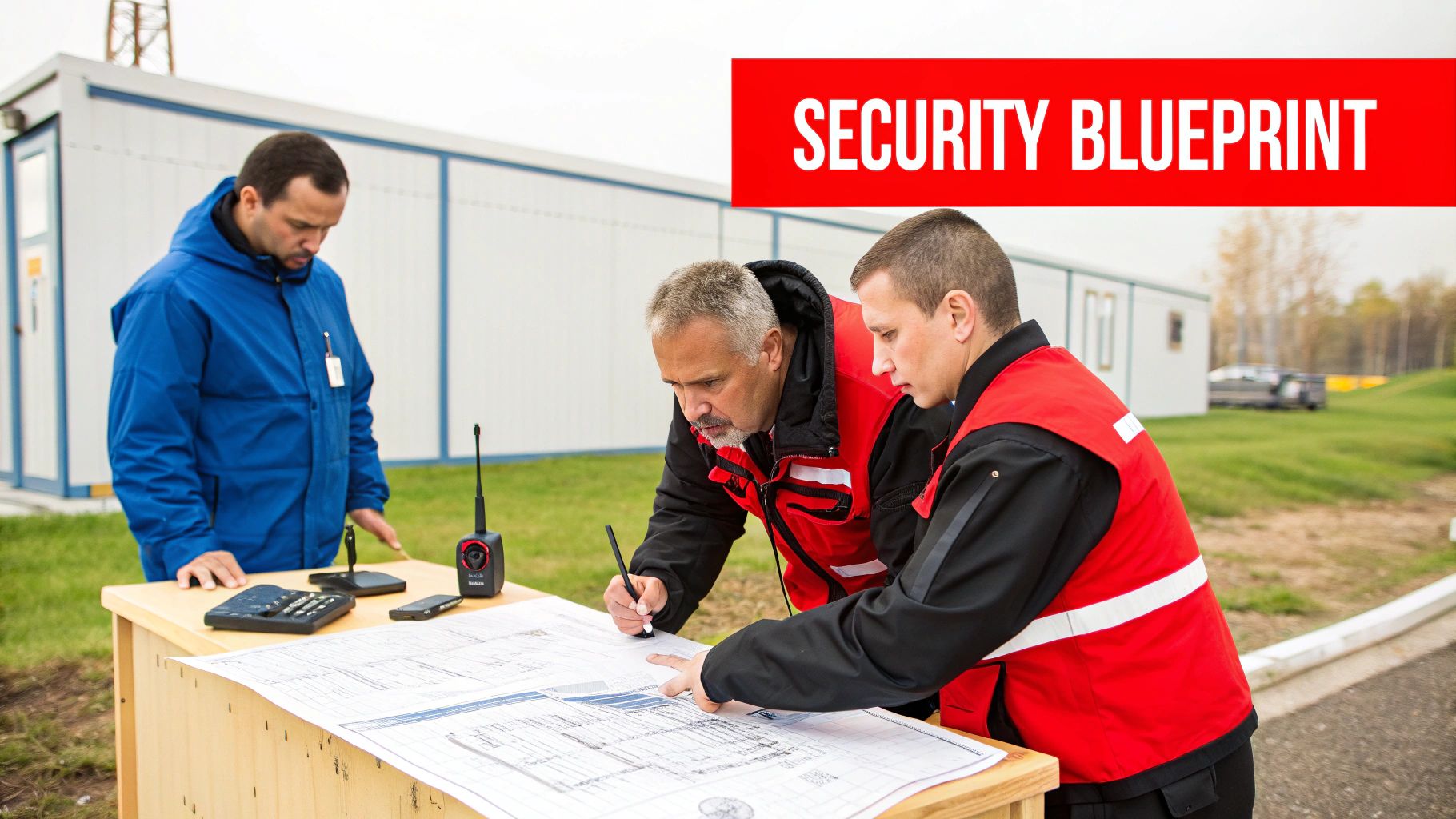
It’s a common mistake to think security is just about reacting when things go wrong. The truth is, 90% of effective security work is preventative. A truly professional provider is obsessed with identifying and neutralising risks long before they have a chance to affect your event. This proactive mindset is what separates the amateurs from the experts in modern event security.
The Proactive Blueprint for Safety
An effective security strategy is never a one-size-fits-all template. It has to be built from the ground up, based on a deep understanding of your event's unique DNA. It all starts with a thorough risk assessment, creating a customised plan that makes guests feel safe without feeling like they're being watched.
Here are the core elements of this proactive approach:
- Comprehensive Risk Assessment: This is where we identify potential weak spots. That could be anything from an unsecured access point at a music festival to the risks of handling cash at a corporate gala. Actionable Insight: Before your next event, walk the venue with your security lead and deliberately try to find three "back ways" in. Are they monitored? This simple exercise often reveals critical blind spots.
- Strategic Guard Placement: It's not just about putting someone on the front door. Personnel need to be positioned intelligently—in low-traffic zones, backstage, near high-value assets—to create a visible and effective deterrent.
- Integrated Communication: Every single person needs to be on the same page. All security staff, event organisers, and even local authorities should be able to communicate instantly to coordinate a response to anything that comes up.
- Emergency Preparedness: You have to plan for the unexpected. What's the protocol for a medical emergency? An unexpected crowd surge? A sudden severe weather event? Having clear, actionable plans is crucial.
By focusing on strong, well-planned security measures, event organisers create an environment where everyone feels safe and the event can run without a hitch. The real goal is to blend security so seamlessly into the event that guests can simply relax and enjoy the experience.
More Than Just Guards
At the end of the day, top-tier event security services provide something far more valuable than just a physical presence; they deliver peace of mind. Your security team often becomes the face of your event—they're the first people guests see on arrival and the last ones they see when they leave.
Their professionalism, their communication skills, and their ability to de-escalate a tense situation are just as important as their physical response capabilities. This dual focus on customer service and safety transforms security from a necessary cost into a valuable asset that actively enhances the attendee experience and protects your brand. This guide will walk you through exactly how to build this essential framework for your next gathering.
Understanding Your Event Security Service Options
When it comes to event security services, there's no such thing as an off-the-shelf solution. Think of it less like buying a product and more like assembling a specialised toolkit. The right mix of services is entirely dependent on your event's unique vibe, its size, and the specific risks involved.
Getting this mix right is everything. It's the difference between creating an atmosphere where guests feel genuinely safe and one where they feel policed. A security plan that’s too heavy-handed for a corporate gala can be just as useless as one that’s too light for a music festival. The real skill is in understanding all the tools available and layering them intelligently to build a safety net that feels supportive, not restrictive.
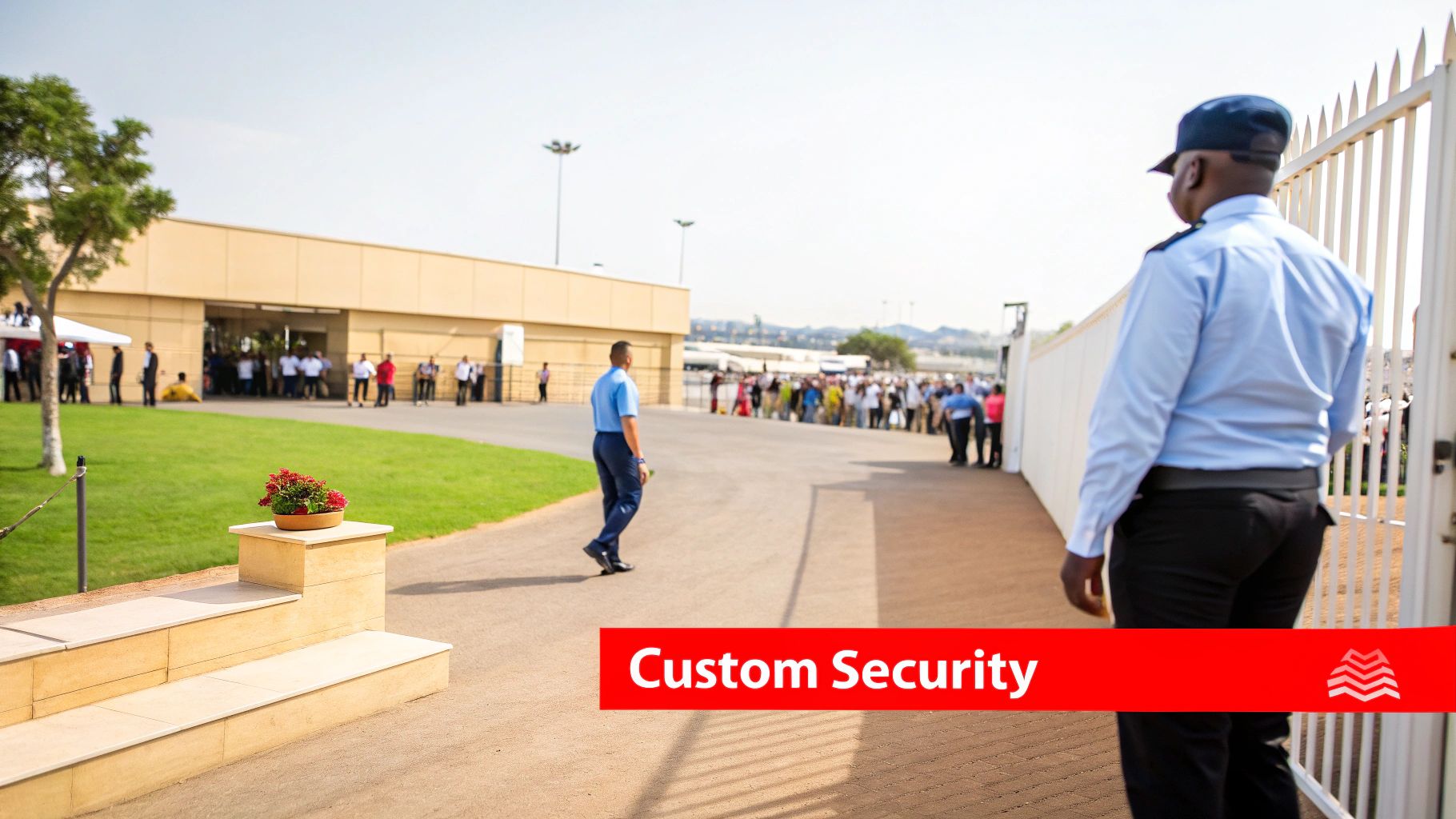
Visible Security: The Front Line of Deterrence
When you think of event security, you probably picture a guard in a uniform. That visible presence is the cornerstone of any good plan. It acts as a powerful psychological deterrent, often stopping trouble before it even has a chance to start. But 'visible security' is more than just one type of guard; it’s a team of specialists with distinct roles.
- Uniformed Static Guards: These are your anchors. Positioned at critical points—entrances, exits, VIP areas, and stage fronts—they form the backbone of your access control. Their job is to hold a fixed position, stay observant, and make sure only the right people get into the right places.
- Crowd Controllers: These aren't just static guards. They are professionals trained in the art and science of crowd dynamics. They manage the flow of people, keep queues orderly, and are experts in de-escalating tensions before a minor disagreement becomes a major problem. They keep the energy positive.
- K9 Units and Handlers: For large-scale events, nothing beats the deterrent of a K9 team. Used for screening for illegal substances or patrolling wide-open perimeters, their keen senses and commanding presence add a layer of security that’s nearly impossible to match.
Discreet Security: Protection That Blends In
Sometimes, the best security is the kind you never notice. For high-end corporate events, private functions, or any gathering where an overt security presence would kill the mood, discreet measures are the way to go. These services offer total protection that melts into the background.
The whole point of discreet security is for it to be felt, not seen. It’s about giving hosts and their high-profile guests complete peace of mind, letting them enjoy the moment while a team of experts quietly manages risk behind the curtain.
Here are some of the most effective low-profile event security services we deploy:
- Plain-Clothed Operatives: Think of them as your eyes and ears inside the crowd. Often called covert security, these professionals blend in with your guests to spot suspicious behaviour and neutralise threats from within. Their skill is intervening so subtly that no one else even knows it happened.
- VIP and Close Personal Protection: When you have a high-profile speaker, performer, or guest, they need a dedicated bodyguard. This is a highly specialised service that involves much more than just sticking by their side; it includes planning secure travel routes, sweeping venues beforehand, and ensuring their safety from arrival to departure.
- Backstage and Asset Protection: An event has plenty of sensitive zones the public never sees. This service focuses on securing them. Guards ensure only people with the right credentials can access green rooms, production areas, or anywhere high-value equipment is stored.
Now that you have a better sense of the different tools in the toolkit, you can see how a partner like GM GROUP builds a plan that’s truly fit-for-purpose. It's never about picking just one thing. It's about a smart, strategic combination of visible and discreet measures to create a security blanket perfectly tailored to your event.
Matching Security Services to Event Types
To make it even clearer, here’s a quick reference guide showing how different security services map to various event environments.
| Event Type | Primary Security Need | Recommended GM GROUP Services |
|---|---|---|
| Music Festivals | Crowd management, access control, perimeter security | Uniformed Guards, Crowd Controllers, K9 Units, Backstage Protection |
| Corporate Galas | Guest safety, asset protection, discreet presence | Plain-Clothed Operatives, VIP Protection, Static Guards (entrances) |
| Private Parties | Unobtrusive monitoring, access control | Plain-Clothed Operatives, VIP/Host Protection |
| Sporting Events | Crowd control, de-escalation, entry screening | Crowd Controllers, Static Guards, K9 Units (optional), Bag Check Staff |
| Construction Sites | Asset protection, after-hours surveillance, access logging | Static Guards, Mobile Patrols, Alarm Response |
| Retail Pop-Ups | Loss prevention, crowd flow, staff safety | Plain-Clothed Operatives, Uniformed Guards (at entrance) |
This table illustrates how the right combination of services creates a tailored solution that addresses the specific risks and desired atmosphere of each unique setting.
State-by-State Security Regulations: A Practical Guide
Hiring event security in Australia isn’t just about putting bodies on the ground. You’re navigating a minefield of state-specific laws, and getting it wrong can have serious consequences for your event, your guests, and your own legal standing. Each state and territory—from NSW to WA—has its own rulebook for security licensing, training, and how guards must operate.
Think of these regulations as the industry's quality control. They ensure every security professional you hire has been properly vetted, trained, and knows how to handle their job with competence. For an event organiser, trying to decipher these rules can be a nightmare. This is precisely why leaning on a seasoned security provider is so important.
A good partner takes the legal headache off your plate. They translate the dense legal requirements into a practical, boots-on-the-ground security plan. They ensure every detail, from guard numbers to their specific qualifications, is 100% compliant, letting you focus on what you do best: running an amazing event.
The Core Compliance Areas You Can't Ignore
While the rules differ from state to state, there are a few non-negotiables that apply everywhere, whether you're in New South Wales, Victoria, Queensland, or the ACT. Any professional security firm has to have these basics locked down.
Here’s what absolutely must be in place:
- Proper Security Licensing: It's illegal for anyone to work security without a valid licence from the relevant state authority. That goes for crowd controllers, static guards, everyone. Your provider must be able to guarantee that 100% of their staff on your site hold a current, state-specific licence. No exceptions.
- Responsible Service of Alcohol (RSA) Certification: If you're serving alcohol, your security team needs to have current RSA certificates. This isn't just a nice-to-have; it's a legal requirement that trains them to spot and manage intoxicated patrons, prevent underage drinking, and handle alcohol-fuelled issues before they escalate.
- Public Liability Insurance: Your security contractor must hold significant public liability insurance. This is your financial safety net. If an incident involving the security team occurs, this insurance protects you from being held liable.
- State-Specific Ratios and Training: Some states mandate specific guard-to-guest ratios, especially for licensed venues or major public gatherings. On top of that, some roles or venue types demand specialised training that goes beyond a standard security licence.
“Compliance isn't just about ticking a box. It's the bedrock of a safe event. A truly expert provider doesn't just aim for the minimum; they weave state laws into the DNA of the security plan, making sure every decision is legally sound.”
A Quick Look at State Differences
The nuances between states are exactly why local expertise matters so much. A standard security plan in Sydney might fall short in Melbourne or Brisbane.
For instance, in New South Wales, everything runs through the Security Licensing & Enforcement Directorate (SLED), which has very strict protocols for incident reporting. Head down to Victoria, and you're dealing with the Licensing and Regulation Division (LRD) of Victoria Police, governed by the Private Security Act 2004.
Up in Queensland, the Office of Fair Trading is in charge, with specific regulations often targeting pubs, clubs, and major events. And the ACT has its own unique framework managed by Access Canberra. A provider like GM GROUP knows these local variations inside and out, guaranteeing a smooth and compliant operation wherever your event is held.
This level of detail is critical in what has become a massive industry. The Australian private security sector employs over 180,000 people and pulls in around $11 billion in revenue each year. With forecasts pointing to continued growth, the demand for professional and, most importantly, compliant event security services is only going to get stronger. You can read the full research about these security industry trends to get a sense of the market's scale. This growth just highlights how vital it is to pick a partner who is not only experienced but absolutely meticulous about following the rules in every state.
How to Build Your Event Security Plan
Great event security services don't just happen. They're the result of careful, proactive planning that starts long before the first guest even thinks about showing up. Think of building a security plan like drawing up an architectural blueprint—it demands a detailed survey of the site, a crystal-clear vision of the final structure, and a strategic layout to make sure everything holds together.
This approach turns the often-overwhelming job of securing an event into a clear, step-by-step process. By systematically flagging risks and deciding on your responses ahead of time, you build a solid plan that protects your guests, your assets, and your reputation.
Start with a Detailed Risk Assessment
First things first: you absolutely must conduct a thorough risk assessment. This isn't just a quick glance around; it's a deep dive into every single vulnerability specific to your event, looking past the obvious to uncover what might be hiding in plain sight.
You need to analyse every detail through a security lens. Consider these factors:
- Venue Layout: Are there any blind spots? Unsecured doors? What about that poorly lit corner of the car park? Identifying the natural choke points where crowds will bunch up is crucial.
- Nature of the Event: Is it a high-energy music festival packed with a younger crowd, or a black-tie corporate gala with high-profile guests and valuable equipment? The risks are worlds apart.
- Cash Handling: Will you have ticket sales on the door or merchandise stands with full cash registers? That's a magnet for theft.
- External Threats: What's the local area like? Is there a history of public disturbances nearby that could spill over?
Define Clear Security Objectives and Roles
Once you know what you’re up against, you can set clear goals for your security team. These objectives need to be specific, measurable, and directly tied to the risks you’ve just identified. Simply aiming to "keep everyone safe" isn't a plan; it's a wish.
A well-defined objective sounds more like this: "To prevent unauthorised access to backstage areas by maintaining a static guard at the main entry point and conducting credential checks for all personnel." This level of clarity ensures everyone understands their mission.
This is also the stage where you figure out your staffing levels. It’s a classic mistake to assume that more guards automatically equals better security. The real key is strategic deployment—putting the right people with the right skills in the right places at the right time. This is where professional event security services really show their value.
Alt text: Security personnel standing guard at an event entrance, demonstrating professional event security services.
Map Out Your Emergency Response Protocols
Even with the tightest security, you have to plan for the unexpected. Your emergency response protocol is your playbook for when things go sideways. It needs to lay out clear, actionable steps for different scenarios to ensure your team can respond quickly and effectively, minimising panic and potential harm.
You’ll want to map out responses for key scenarios, including:
- Medical Emergencies: Who is the designated first aid contact? What's the clearest path for paramedics to get to a patient?
- Security Incidents: How does a staff member report a fight or a suspicious individual? What are the exact steps for de-escalation?
- Evacuations: What are the designated escape routes and muster points for every section of the venue? Who has the authority to give the evacuation order?
The need for this level of detailed planning is reflected in the growing demand for skilled security professionals. In Australia, the Investigation and Security Services sector is projected to hit a market value of $13.9 billion by 2025. This isn't just a number; it shows that more and more event organisers recognise the non-negotiable value of expert security planning. To make sure you don't miss any critical steps, using a comprehensive event planning checklist template can be an invaluable tool for building out your security strategy.
Choosing the Right Partner for Your Event Security Services
Picking the right security provider is hands-down one of the most important decisions you'll make when planning an event. It’s not just about ticking a box. Your security partner becomes an extension of your own team, a collaborator who is genuinely invested in the success and safety of your event.
Get it right, and they blend seamlessly into the background, ensuring everything runs smoothly. Get it wrong, and you're exposed to a world of risk. That’s why you can’t just go with the cheapest quote. You need to dig deeper and vet their reliability, experience, and professionalism.
A proper vetting process helps you see past the sales pitch. By asking the tough questions and knowing what to look for, you can find a company that doesn't just protect your guests and assets, but also your hard-earned reputation.
Your Non-Negotiable Vetting Checklist
Before you even think about costs, there are some absolute must-haves. These are the fundamentals that separate the professionals from the cowboys and form the bedrock of a trustworthy partnership.
Here’s what to check off your list first:
- Verify All Licensing and Insurance: Don't just take their word for it. Ask to see physical copies of their master security licence for every state they operate in (NSW, VIC, QLD, ACT) and their public liability insurance certificate. Any professional firm will have these on hand and provide them without a fuss.
- Assess Relevant Experience: "Events" is a broad term. Ask them for specific examples of events they’ve secured that are similar to yours in size, scale, and crowd type. A team that excels at black-tie corporate functions might not be the right fit for a multi-day music festival.
- Evaluate Staff Training Protocols: What happens after a guard gets their basic licence? Ask about their ongoing training programs. Do they invest in upskilling their team in areas like advanced first aid, conflict de-escalation, or even customer service? A real commitment to professional development is a huge green flag.
- Check for Verifiable Testimonials: Look for real reviews and case studies from past clients. An unwillingness to provide references or a complete lack of a track record should set off alarm bells immediately.
Beyond the Basics: What to Ask Potential Providers
Once you've confirmed the essentials are in place, it's time to get into the details. The answers to these questions will reveal how a company really operates and whether their approach genuinely fits your needs. A quality provider of event security services will have clear, confident answers ready.
A professional security partner doesn't just show up on the day. They follow a proven process.
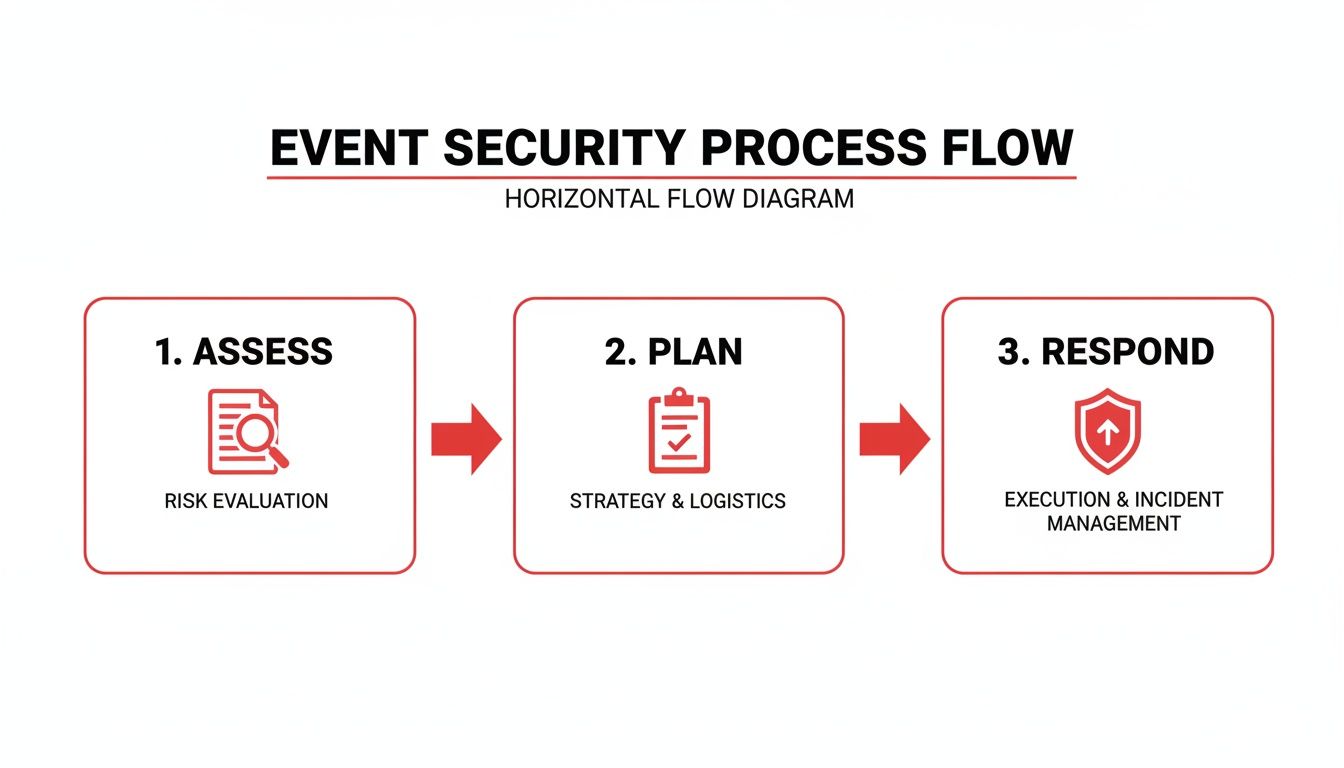
This simple flow shows that good security is a continuous cycle of assessment, planning, and response—not just a one-off task. A key part of this today is technology. The Australian security market, encompassing everything from video surveillance to access control, was valued at around AUD 4.38 billion in 2025 and is projected to nearly double by 2035. You can get more insights on this growing security market and the tech that's driving it.
FAQs for Selecting Your Event Security Partner
Q1: What are the biggest red flags to watch for when hiring event security services?
A: Be very wary of "one-size-fits-all" pricing; no two events have the same risks. Another major red flag is a provider who gets vague when you ask about their supervision structure or emergency protocols. And, of course, any hesitation to show you their licensing or insurance documents is a clear sign to walk away.
Q2: How important is a site visit before receiving a final quote?
A: It's absolutely critical. A provider who gives you a firm price without ever setting foot in your venue is just guessing. A thorough site visit is the only way to conduct a proper risk assessment, which is the foundation of any effective security plan. Always insist on a walkthrough before you sign anything.
Q3: Should the security provider help create the emergency response plan?
A: 100%. A great security partner will actively collaborate with you and the venue staff to build or refine your emergency plans. Their on-the-ground experience is invaluable for creating practical, effective responses for everything from a medical incident to a full-scale evacuation. That collaborative approach is the mark of a true security partner, not just a contractor.
Frequently Asked Questions About Event Security Services
When you're deep in event planning, security questions are bound to pop up. It can feel like a complex world to navigate, but getting a handle on the key pieces helps you make smart, confident decisions. Let's cut through the jargon and answer some of the most common questions we hear from event organisers.
Think of this as your practical guide to getting security right. From figuring out costs to understanding a guard's legal authority, these insights will help you feel much more prepared for your next event.

How Is the Cost of Event Security Services Determined?
There’s no simple, one-size-fits-all price tag for event security services. The final cost is a blend of several crucial factors, starting with the size and location of your event (whether it's in NSW, VIC, QLD, or the ACT), how long it runs, and the specific risks we identify in the planning stage.
Essentially, the price comes down to:
- Number of Guards: The total headcount needed to safely cover every corner of your venue.
- Specific Roles: Different roles come with different pay rates. A standard crowd controller's rate differs from that of a close personal protection officer for a VIP.
- Specialised Needs: If you need extra layers of security like K9 units, mobile patrols, or advanced screening tech, these will naturally shape the final quote.
Any reputable security partner will insist on a thorough risk assessment before locking in a price. A word of advice: always balance cost with experience. The cheapest quote is rarely the safest bet.
How Far in Advance Should I Book Security?
The earlier, the better. For large-scale events like a music festival or a major corporate conference, you should be locking in your security partner at least three to six months out. This gives us the breathing room we need to conduct proper risk assessments, draft detailed operational plans, and roster the best-fit team for the job.
If you’re planning a smaller, more straightforward function, four to six weeks is usually enough lead time. Booking early isn't just about ticking a box; it means you get a dedicated, high-quality team and avoid the stress (and higher costs) that come with scrambling at the last minute.
What Is the Difference Between Static and Patrol Guards?
It's all about their function on the ground. A static guard is assigned to one fixed post—think an entrance, a backstage door, or a VIP area. Their job is to be a visible deterrent and control access to a specific zone. They are the anchors of your security plan.
A patrol guard, on the other hand, is constantly on the move, covering the entire event space. They create a wide security net, actively looking for potential issues, checking fence lines, and being the first to respond to incidents anywhere on-site. The best security plans almost always use a strategic mix of both to cover all bases.
An effective security strategy leverages both static and patrol guards in tandem. Static guards secure your critical points, while patrol guards provide the flexibility to respond to dynamic situations anywhere on the premises.
Can Security Legally Remove Someone from My Event?
Yes, absolutely. Licensed security personnel are acting as agents for you, the event organiser. This gives them the legal authority to remove a person from private property for a valid reason, like disorderly conduct, aggression, or breaking the event's rules.
Officers are trained in de-escalation and are legally required to use only the minimal force necessary, in line with state laws across NSW, VIC, QLD, and the ACT. This authority is what allows them to maintain a safe and enjoyable environment for everyone else.
Ready to ensure your next event is safe, compliant, and professionally managed? GM GROUP Services provides expert, tailored security solutions across Australia. Contact us today to discuss your event security needs.
Discover more from GM Group Services
Subscribe to get the latest posts sent to your email.