
Getting a security guard license is your official, government-issued passport to work in Australia's private security industry. It's much more than a simple ID card; it’s a credential proving you have passed mandatory training, undergone comprehensive background checks, and meet the strict character standards set by state regulators. It is the fundamental building block of trust and professionalism in this field.
This license is the absolute first step for a career in protecting people and property. You cannot legally work as a security officer without one. For businesses and event managers, understanding these requirements is just as critical. It's the key to staying compliant and, more importantly, ensuring a genuinely safe environment for everyone.
Why a Security Guard License Is Non-Negotiable
If you're looking to start a career protecting people, events, and properties, getting your security guard license is the very first step. You simply cannot legally work as a security officer in Australia without one.
For event organisers and venue managers, understanding these licence requirements is just as critical. It's the key to staying compliant with the law and, more importantly, creating an environment that is genuinely safe for everyone.
A Mark of Trust and Professionalism
When you hire a licensed security guard, you’re bringing on board someone who has been officially vetted. The purpose of the licensing process is to filter out individuals who might pose a risk, ensuring only suitable, trustworthy people join the profession. For instance, a licensed guard has been cleared through police checks, meaning you can be confident they don't have a criminal history that would compromise their integrity. This official stamp of approval gives you, your clients, and the public real confidence that the person on duty is competent and reliable.
The need for qualified security professionals is massive. Australia has over 153,000 people holding active security licences, a number that highlights the huge demand across states like New South Wales, Victoria, Queensland, and the ACT. In fact, the industry is seeing a 6.10% year-on-year growth in individual licence holders. You can dive deeper into these trends over at the Australian Security Industry Association Limited (ASIAL).
Different Licences for Different Roles
Security isn't a one-size-fits-all job, and the licensing system reflects that. While the exact names and codes can vary from state to state, the licences generally fall into distinct classes that spell out what a guard is legally allowed to do.
- Unarmed Guard (Class 1A): This is your foundational security guard license. It’s for guards at static sites like shopping centres, office buildings, and events, where the main job is monitoring crowds and controlling access. Practical example: A guard patrolling a corporate lobby overnight.
- Crowd Controller (Class 1C): Absolutely essential for licensed venues—think pubs, clubs, and music festivals. This licence allows guards to manage patrons, check IDs, and handle entry refusal when needed. Practical example: A guard checking IDs at the entrance to a nightclub.
- Bodyguard (Class 1B): This is a more specialised licence for those providing close personal protection to clients.
Before we dive into the state-by-state specifics, let’s quickly break down what these common licence classes mean in practice.
Common Australian Security License Classes at a Glance
This table gives a quick overview of the most common security licence classes and the sorts of jobs they cover across Australia’s key states. Keep in mind that the exact naming conventions can differ slightly depending on where you are.
| Licence Class | Permitted Activities | Common Requirements |
|---|---|---|
| Class 1A – Unarmed Guard | Static guarding at sites like shopping centres, corporate offices, and construction sites. Access control and general property protection. | Certificate II in Security Operations, First Aid Certificate, Police background check. |
| Class 1B – Bodyguard | Providing close personal protection to an individual or group. Assessing security risks for a client and planning protective measures. | Specialised bodyguard training units, higher-level experience, comprehensive background checks. |
| Class 1C – Crowd Controller | Screening entry, monitoring behaviour, and removing patrons from licensed venues like pubs, nightclubs, and large events. | Certificate II in Security Operations (including crowd control units), RSA Certificate, First Aid. |
| Class 2A – Security Consultant | Providing advice on security equipment, risk assessment, and security protocols for businesses or individuals. | Extensive industry experience, higher-level qualifications (e.g., Certificate IV), clean criminal record. |
| Class 2B – Master Licence | Authorises a business or individual to provide security guards or security services to other clients. Required for security business owners. | Business registration (ABN/ACN), demonstrating financial viability, stringent probity checks. |
Ultimately, these different classes ensure that the person doing the job has the right training and has been vetted for that specific role, whether it's watching over a building site or managing a packed concert.
Actionable Insight: For any business, partnering with a security provider who guarantees their entire team is fully licensed isn't just best practice—it's the most intelligent risk management decision you can make. It protects your patrons, your property, and your reputation from serious legal and financial consequences.
Your State-by-State Guide to Getting a Security Guard Licence
If you're looking to get a security guard licence in Australia, the first thing to know is that there’s no single, nationwide process. Each state and territory plays by its own set of rules. What gets you licensed in New South Wales might not be enough in Victoria or Queensland.
This guide will walk you through the specifics for NSW, VIC, QLD, and the ACT, giving you a clear roadmap whether you're an aspiring guard or an event organiser needing to hire one.
Getting the details right is non-negotiable. Every state has a different regulatory body that issues licenses and keeps everyone in line. If you don't meet their exact standards, your application will get rejected, and you'll be out of pocket and back at square one. This state-by-state approach ensures every security professional is properly vetted and trained for local conditions, which ultimately makes events and venues safer for everyone.
New South Wales (NSW) Requirements
In NSW, the Security Licensing & Enforcement Directorate (SLED) is the agency in charge. To get a Class 1 security licence, you’ll need to tick a few important boxes.
- Age: You must be at least 18 years old.
- Training: You have to complete the CPP20218 Certificate II in Security Operations from a SLED-approved training organisation. No shortcuts here.
- First Aid: A current HLTAID011 Provide First Aid certificate (or an equivalent) is mandatory.
- Background Check: SLED will run a detailed criminal history check. Certain offences will automatically disqualify you from holding a licence.
The application itself is done online through Service NSW. You’ll need to upload proof of your identity, your training qualifications, and pay the fee.
Victoria (VIC) Requirements
Down in Victoria, the industry is regulated by Victoria Police's Licensing & Regulation Division (LRD). Their process is just as strict, with a huge focus on your character and overall suitability for the role.
To get a Private Security Individual Operator Licence, you have to prove you are a "fit and proper person." This means they dig deep into your background to make sure you're trustworthy.
The key requirements are:
- You must be 18 years of age or older.
- You need to successfully complete the required training units from a registered training organisation.
- You'll have to submit certified copies of your ID documents and a recent photo.
- A National Police Check and providing your fingerprints are part of the deal.
Your application needs to leave no doubt that you have both the competence and the character to hold a security guard licence.
From the Field: For event organisers, checking a guard's licence is more than just a box-ticking exercise. You need to look at the specific subclasses on their licence, like 'Crowd Controller.' If you hire an unarmed guard for a role that legally requires a crowd controller, you could face massive fines and serious liability issues if something goes wrong.
Queensland (QLD) and Australian Capital Territory (ACT)
Up in Queensland, the Office of Fair Trading is responsible for security licensing. The requirements mirror other states pretty closely: complete a Certificate II in Security Operations, pass a criminal history check, and provide proof of identity. One key difference is that your fingerprints will be recorded as part of your application.
Over in the Australian Capital Territory (ACT), Access Canberra handles security licensing. Their process is much the same as their neighbours, calling for a Certificate II qualification, a First Aid certificate, and a clean police background check. You'll also need to prove you are competent and of good character to get your licence.
The need for properly licensed professionals is only growing. The Australian private security industry's market size is on track to hit $13.9 billion, which shows just how much businesses in hospitality, events, and construction rely on qualified guards. You can get a deeper look at this growth on IBISWorld. This demand is all about businesses investing in the right people to protect their assets and people.
To get a better sense of how it all fits together, this chart shows how a main security licence branches out into different specialisations.
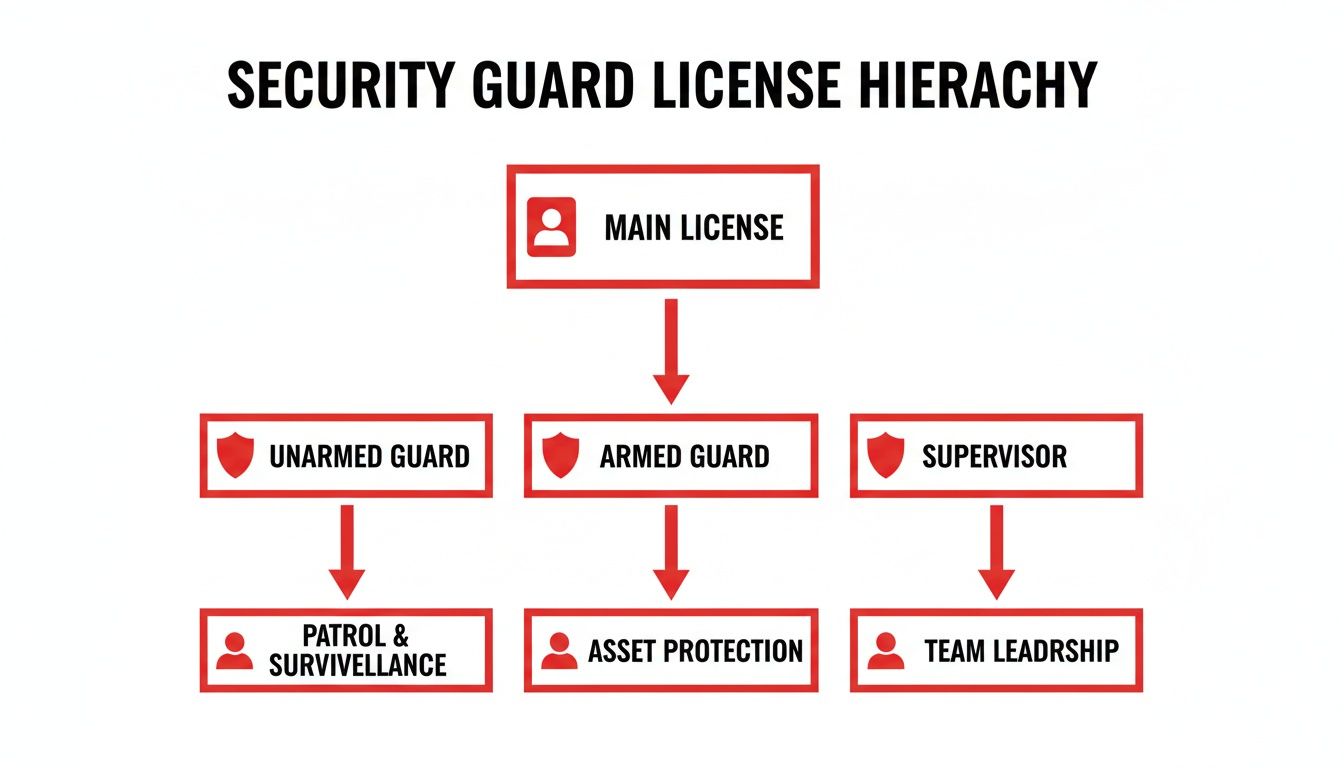
As you can see, a general security guard licence is your starting point. Roles like crowd controller or bodyguard need extra endorsements or classes on top of that.
Comparing Security Licence Requirements Across States
To make things a bit clearer, here's a side-by-side look at the key licensing requirements for security guards in four of Australia's major jurisdictions.
| Requirement | New South Wales (NSW) | Victoria (VIC) | Queensland (QLD) | Australian Capital Territory (ACT) |
|---|---|---|---|---|
| Regulating Body | Security Licensing & Enforcement Directorate (SLED) | Victoria Police – Licensing & Regulation Division (LRD) | Office of Fair Trading | Access Canberra |
| Minimum Age | 18 years | 18 years | 18 years | 18 years |
| Core Training | CPP20218 Certificate II in Security Operations | Required units from CPP20218 or equivalent | CPP20218 Certificate II in Security Operations | CPP20218 Certificate II in Security Operations |
| First Aid Cert | Yes (HLTAID011 or equivalent) | Yes | Yes | Yes (HLTAID011 or equivalent) |
| Background Check | Comprehensive criminal history check | National Police Check & Fingerprinting | Criminal history check & Fingerprinting | National Police Check |
| RSA Required? | For crowd control in licensed venues | For crowd control in licensed venues | For crowd control in licensed venues | For crowd control in licensed venues |
While the core principles are similar—be 18, get trained, and have a clean record—the small administrative differences between states are where people often get tripped up. Always check the specific requirements for the state you plan to work in.
Getting the Right Training and Qualifications
Think of a security guard licence less as a piece of plastic and more as a badge of honour. It's solid proof that you’ve put in the work, gone through professional training, and mastered the skills needed to protect people and property with confidence. This journey all starts with nationally recognised training that sets the standard right across the country.
The absolute cornerstone of this training is the CPP20218 Certificate II in Security Operations. If you're serious about a career in security in Australia, this is your non-negotiable starting point. It's not just another course; it's a comprehensive program designed to give you the practical, real-world abilities to handle situations effectively and, just as importantly, legally.
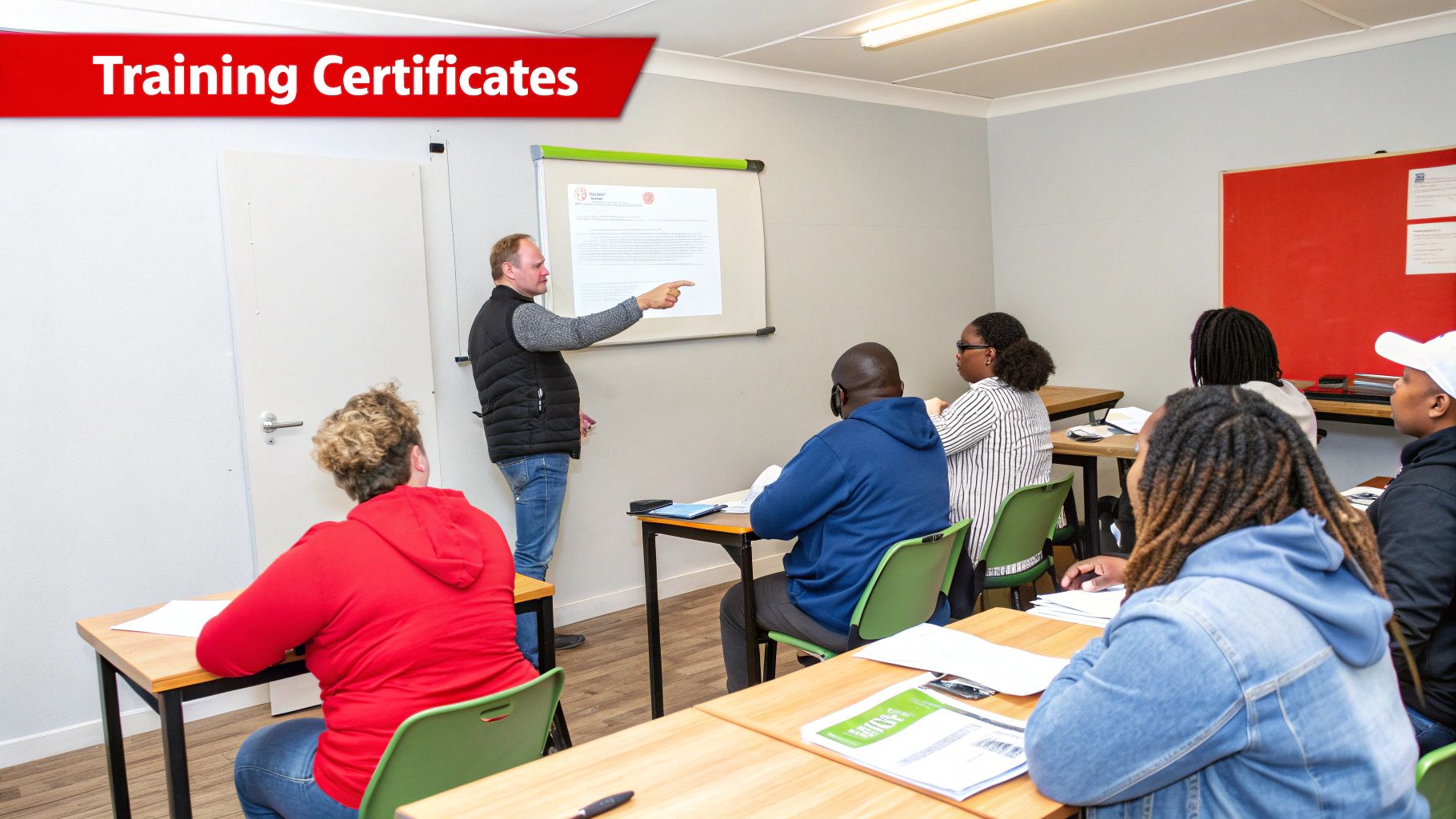
This foundational qualification isn't about memorising a textbook. It's about building muscle memory for the critical tasks you'll face daily—from calmly talking down a tense situation to spotting a potential risk before it ever has a chance to escalate. It ensures every licensed professional out there is working from the same playbook of competence.
What You'll Actually Learn
The CPP20218 Certificate II is made up of core units, each zeroing in on a vital part of security work. You can think of them as the building blocks of your professional toolkit.
You'll get hands-on with skills like:
- Talking People Down (Communication & De-escalation): Learning how to use your words and body language to diffuse conflict before it gets physical. This is arguably the single most important skill a modern security professional can have.
- Spotting Trouble (Risk Assessment): Developing a keen eye for identifying potential threats, hazards, and weak spots in any environment, from a quiet construction site to a packed music festival.
- Staying Safe (Defensive Techniques): Understanding how to protect yourself and others using approved, minimum-force methods when there's no other choice.
- Knowing the Rules (Legal & Procedural Knowledge): Getting a firm grip on the laws that dictate your actions—things like your powers of arrest, how to handle evidence, and writing an accurate incident report.
Mastering these skills is what separates a true professional from someone just wearing a uniform. It’s what gives you the ability to act decisively and correctly when the pressure is on, which is absolutely essential for keeping your security guard licence valid.
The Extra Certifications That Open Doors
While the Certificate II is the main event, a few other certifications are pretty much essential, especially depending on the kind of work you want to do. Having these under your belt makes you far more versatile and valuable.
A big one is the Responsible Service of Alcohol (RSA) certificate. If you have any plans to work at a licensed venue—a pub, nightclub, concert, or festival—an RSA isn't just a good idea, it's a must-have. It teaches you how to spot and manage intoxicated patrons responsibly.
Actionable Insight: Holding both a security guard license and an RSA certificate is a powerful combination. It tells employers that you're not only trained in security protocols but are also equipped for the unique challenges of environments where alcohol is served.
Another critical ticket is HLTAID011 Provide First Aid. As a security guard, you're often the first person on the scene. This qualification gives you the skills to provide immediate medical help for injuries or health crises until paramedics can take over. It could genuinely be the difference between life and death.
The demand for well-trained security professionals is booming. In the last year alone, the number of security licences in Australia jumped by 6.10%, with over 153,000 active holders. This growth is creating a huge pool of talent for event and venue security, especially in hotspots like NSW, Victoria, Queensland, and the ACT. You can dive into the specifics in the latest ASIAL industry report. This commitment to ongoing training and certification is what keeps the industry professional and effective.
Staying Compliant and Protecting Your Licence
Getting your security guard licence is a massive milestone, but it's really just the starting line. Now, the real work begins: keeping that licence in good standing. Think of it less like a certificate you hang on the wall and more like a driver's licence—it needs to be renewed, and you have to follow the rules of the road to keep it.
For event managers and venue operators, this isn't just a minor detail. A single guard working with an expired or suspended licence can put your entire operation at risk, opening you up to fines, legal action, and a PR nightmare. Making sure every security professional on your team is fully compliant isn't just good practice; it's essential risk management.
The Licence Renewal Process
Your security guard licence has an expiry date, and it’s non-negotiable. While the exact steps vary between states and territories, the basic process is pretty similar across Australia. Let it lapse, and you’re legally barred from working. Simple as that.
Generally, renewing your licence involves a few key steps:
- Lodging Your Renewal: You'll need to fill out a renewal application, which is usually done online, well before your current licence expires.
- Paying the Fee: There’s always a fee involved, and it can differ depending on your state and the specific licence class you hold.
- Keeping Your Details Current: You’ll have to confirm that all your personal information is up to date, especially your address and any changes to your criminal history.
- Refreshing Your Skills: In some states, you might be required to complete refresher training or renew certifications like First Aid to prove your skills are still sharp.
Actionable Insight: The biggest mistake you can make is leaving it to the last minute. Government bodies aren't known for their speed, and processing can take weeks. A good rule of thumb is to kick off the renewal process at least 6-8 weeks before your licence expires. This buffer helps you avoid a stressful gap where you can't legally work.
Avoiding Disqualification and Suspension
Holding a security guard license is a privilege, not a right. The authorities that issue them, like SLED in NSW or Victoria's LRD, have a responsibility to pull anyone from the industry who proves they aren't fit to hold that trust. The kinds of actions that get a licence suspended or cancelled are always serious.
Here are some of the most common reasons a guard might lose their licence:
- Criminal Charges: Being convicted of certain offences, especially anything involving violence, dishonesty, or drugs, is a fast track to getting your licence revoked.
- On-the-Job Misconduct: Using excessive force, failing to follow critical procedures during an incident, or acting unprofessionally can all trigger an investigation that puts your licence at risk.
- Failing to Report: This is a big one. If you're charged with a serious offence, you are legally required to inform the licensing body within a short window (often 7-14 days). Trying to hide it is a serious breach of regulations.
A Quick Checklist for Event Managers
If you're hiring security, their compliance is ultimately your responsibility. An out-of-date security guard licence on your site is a huge liability waiting to happen.
Here’s a simple system to stay on top of it:
- Build a Compliance Register: All you need is a basic spreadsheet. Track each guard's full name, licence number, and, most importantly, the expiry date.
- Set Calendar Reminders: For each expiry date, create alerts for 90 days and 60 days out. This gives your guards and your team plenty of time to get renewals sorted.
- Do Random Spot Checks: Don't be afraid to occasionally ask guards on-site to see their physical licence. It reinforces the message that compliance is a priority and helps you catch any slip-ups before they blow up.
Protecting your event and your reputation starts with the basics. Ensuring every guard is 100% compliant is one of the easiest and most important steps you can take.
How Event Organisers Can Verify a Security Guard Licence
When you’re hiring security staff, the single most important credential you need to check is their licence. For event organisers and venue managers, this isn't just about ticking a compliance box—it's a critical step in protecting your patrons, your team, and your business from serious legal and financial trouble. Failing to ensure every guard on-site is properly licensed can have disastrous consequences.
Thankfully, confirming a security guard license is pretty straightforward once you know where to look. Each state government provides a public online register for this exact purpose, turning what sounds like a headache into a quick, simple check. Think of it as your digital due diligence.
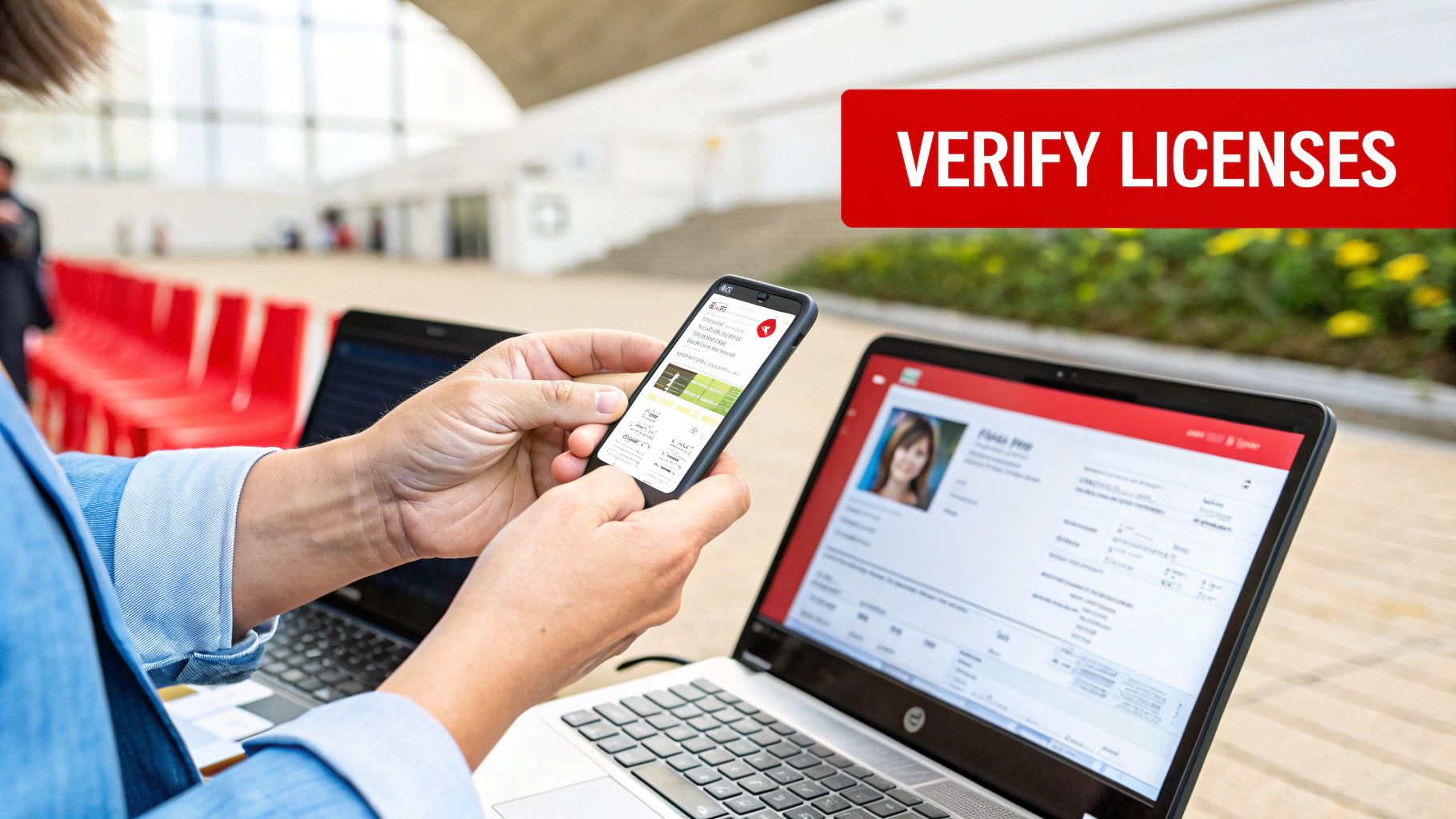
This simple step lets you move forward with confidence, knowing every member of your security team is legally authorised to be there. It’s a non-negotiable part of upholding professional standards and safeguarding your event’s reputation.
Using Online Public Registers
Every state and territory in Australia has an online database where you can instantly check the status of a security licence. These are your official sources of truth. All you need to do is enter the guard's licence number to confirm it's valid.
Here are the direct links you'll need:
- New South Wales (NSW): The Security Licensing & Enforcement Directorate (SLED) provides a Public Register to verify any NSW security licence.
- Victoria (VIC): Victoria Police’s Licensing eServices Portal has a Public Register for checking private security licences.
- Queensland (QLD): The Office of Fair Trading has an Online Licence Search for all security providers.
- Australian Capital Territory (ACT): Access Canberra runs the Security Industry Public Register where you can verify licences.
Pro Tip for Event Managers: Get into the habit of running every guard’s details through the state register before their first shift. This simple check can save you from huge liability issues and guarantees you're only working with legitimate, licensed professionals.
What to Look For on a Physical License Card
While the online check is your go-to, you should also know what to look for on a physical security guard license card. These cards hold all the key information you need to confirm a guard's identity and authorised duties.
When a guard arrives on-site, take a moment to inspect their card for these details:
- Clear Photo ID: The photo has to be a clear, current likeness of the person holding the card. This is your first line of defence against someone using a fake or borrowed ID.
- Full Name and Licence Number: Check that the name and licence number match your records and what you found on the online public register.
- Expiry Date: This is a big one. An expired licence means the guard is not legally allowed to work, no exceptions.
- Licence Class and Subclasses: Make sure the licence class (like 1C for Crowd Controller) matches the job they’ll be doing at your event. A guard licensed only for static patrol can't legally work the door.
A valid security guard license is your proof that the holder has passed all the necessary background checks and training. Treating this verification seriously is just good, responsible event management.
Choosing the Right Security Partner for Your Business
Knowing the rules around a security guard licence is one thing, but finding a security partner who lives and breathes those standards is another challenge entirely. For any event organiser or business owner, the security provider you choose is a direct reflection on you—impacting your safety, your reputation, and your legal compliance.
This isn't just about putting a person in a uniform at the door. It's an investment in genuine peace of mind. A top-tier security partner sees the licence as the starting point, not the finish line. They build on that foundation with rigorous, continuous training and a deep-seated culture of professionalism that you can see in every guard they supply.
What to Look For in a Security Company
When you start talking to potential security companies, you need to cut through the sales pitch and look for solid proof of their commitment to quality. A great partner will be upfront and transparent, readily showing you their credentials and operational standards.
Here’s a practical checklist to run through:
- A Valid Master Licence: This is non-negotiable. The first thing you should ask for is proof of their company's master licence for your state. This is their legal ticket to operate.
- Commitment to Ongoing Training: Ask them what they do for training beyond the basic security guard licence requirements. Do they have their own professional development programs?
- Strong Client References: Don't just take their word for it. A reputable company should be more than happy to connect you with current clients who have similar needs.
- Clear Communication and Reporting: How do they handle incident reports? Who is your point of contact? You need to know there’s a clear and reliable system in place before you need it.
The Real Value of Professionalism
The difference between a "good enough" security team and a truly professional one is huge. A well-managed, professional team does more than just stand watch; they actively reduce your risk, creating a genuinely safer environment for your staff, your customers, and the public. This has a knock-on effect, contributing to a positive atmosphere and boosting the reputation of your event or venue.
While checking a guard's licence is the baseline, many organisers now also look at using pre-employment assessment tools to get a fuller picture of a guard's suitability and competence, going beyond just the credentials they hold.
At the end of the day, the right security partner gives you more than just guards—they give you confidence. You get the assurance that your brand, your assets, and your people are being protected by professionals who aren't just licensed, but are also highly trained, properly supervised, and dedicated to being the best in their field.
Frequently Asked Questions About the Security Guard License
Whether you're looking to start a career in security or you're a business owner making sure your team is compliant, the licensing rules can feel a bit tangled. Let's untangle them. Here are some straightforward answers to the questions we hear most often about getting a security guard license in Australia.
How Long Does It Take to Get a Security Guard Licence?
Realistically, you should budget for at least 2-3 months from start to finish. The timeline varies a bit between states, but it breaks down into two main stages. First, you've got to complete the required training, like the Certificate II in Security Operations. That course typically takes anywhere from two to four weeks of full-time study. Once you’re qualified, you submit your application to the state's licensing authority. They then run extensive background checks, which can take another four to eight weeks, depending on their workload.
Can I Use My Security Licence in a Different Australian State?
Yes, but it isn't automatic. Under the Mutual Recognition Act, a current licence from one state can be recognised in another. It’s a huge help for guards who move interstate. The catch is, you have to formally apply for mutual recognition with the licensing body in the new state before you can legally work there. It involves some paperwork and verification, but it's a non-negotiable step for staying on the right side of the law.
Will a Criminal Record Stop Me from Getting a Security Licence?
It can, but it’s not always a deal-breaker. Every state runs a detailed criminal history check as part of the application process. Certain offences—especially those involving violence, dishonesty, or drugs—are often red flags that lead to disqualification. The golden rule here is to be 100% honest on your application. Hiding a past offence, no matter how small you think it is, is one of the fastest ways to get your application rejected. It can also seriously jeopardise any future attempts to get licenced.
What is the difference between an individual licence and a master licence?
It's simple: an individual security guard licence lets a person perform security duties. A master licence is for a business that employs guards and provides security services. If you're hiring a security company, you need to check two things: that the company holds a valid master licence, and that every single guard they provide holds a valid individual licence.
What should I do if a guard’s licence doesn't show up in the public register?
If you can't find a security guard license in the online register, you cannot let that person work. It could mean the licence is expired, suspended, or even fraudulent. Actionable Insight: Contact your security provider immediately to resolve the discrepancy and request a replacement guard if necessary. Never proceed with an unverified guard on site.
Ready to partner with a security provider that guarantees full compliance and unwavering professionalism? GM GROUP Services delivers award-winning, licensed security solutions across NSW, VIC, QLD, and the ACT. We ensure every guard is expertly trained, fully vetted, and perfectly matched to your needs. Secure your event or business with confidence today.
Discover more from GM Group Services
Subscribe to get the latest posts sent to your email.