
Personal bodyguard security is essential in a world of unpredictable threats, but the reality of elite protection is a world away from the Hollywood stereotype of a stone-faced giant in a dark suit. The truth is, many people have dangerous misconceptions about what real protection entails.
Real protection isn't about looking intimidating; it's about meticulous strategy, forward-planning, and managing an environment so effectively that threats never get a chance to materialise. It's a game of chess, not a fistfight. This guide reveals 5 critical truths you must understand before hiring any professional.
What Is Modern Personal Bodyguard Security?
At its core, modern personal bodyguard security is about creating a secure, seamless bubble around a person or a group. Forget the old idea of a human shield. Today's top-tier protection officers are a blend of risk analyst, advance planner, and expert de-escalator.
Their main job is to make sure a client can conduct their business—whether that's at a high-profile product launch, a sensitive corporate meeting, or a public appearance—without a single disruption or hint of harm. This is done through a layered approach that kicks off long before the client even steps out the door. The work is subtle, often completely invisible, and designed to ensure nothing ever goes wrong in the first place.
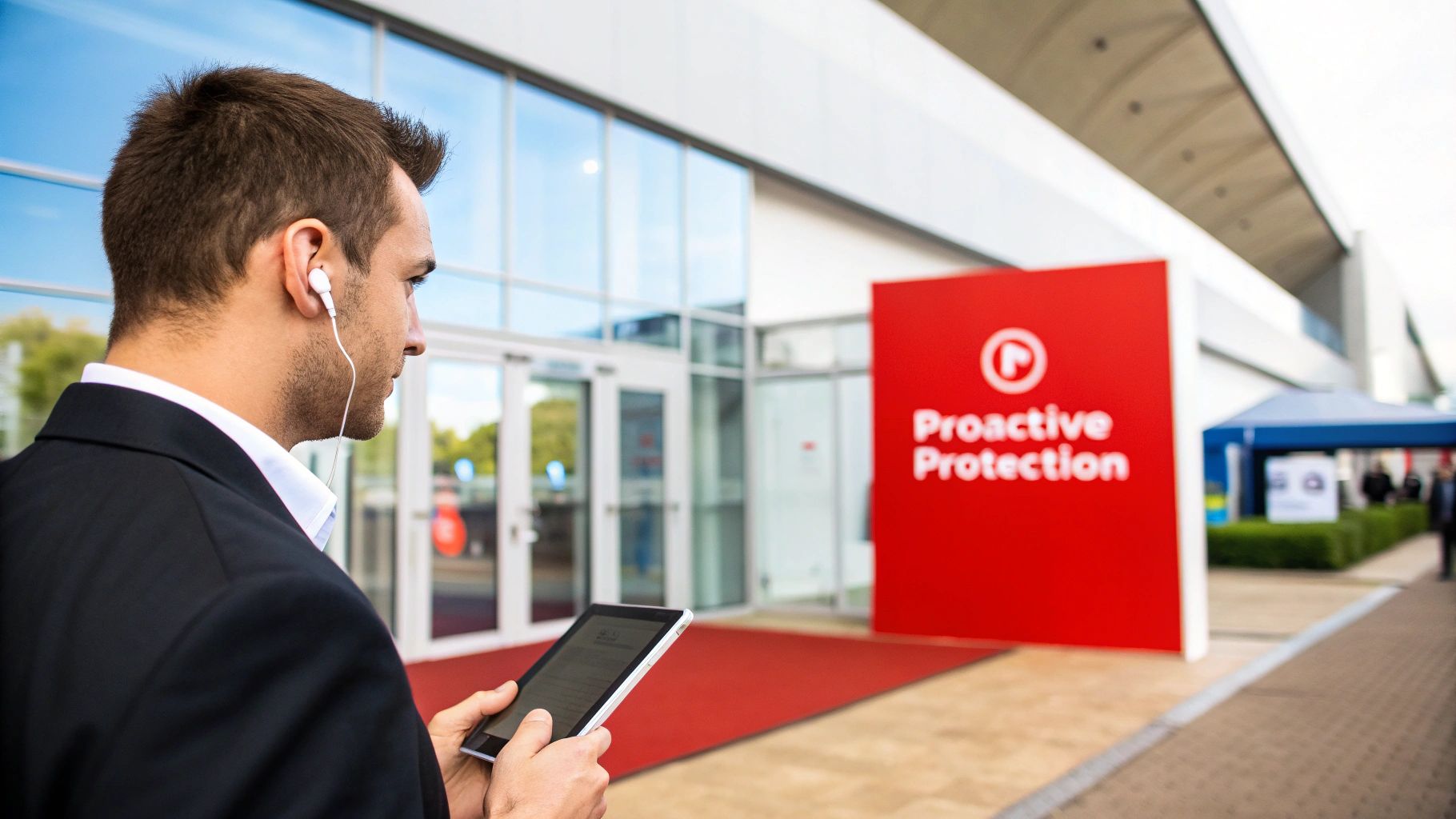
Beyond Physical Presence: The Strategy of Protection
The true value of professional protection is its strategic depth. While a physical response is always the last line of defence, the real work is a constant cycle of assessing, preparing, and adapting. This proactive mindset is what separates a professional security detail from someone just standing watch.
Here's what that modern approach looks like in practice with actionable insights:
- Advance Planning: This means scouting venues, mapping out primary and backup travel routes, and identifying potential weak spots or choke points—often days before an event. Actionable Insight: Before any high-profile event, insist that your security team provides you with a brief on primary, secondary, and emergency exfiltration routes from the venue.
- Threat Assessment: It’s a continuous process of scanning the environment for risks. That could be anything from an agitated individual in a crowd to a logistical flaw in a building's emergency exits. Actionable Insight: Ask your security provider how they monitor social media and local intelligence for event-specific threats.
- Discreet Management: The best operators blend in. They provide a blanket of security without drawing unnecessary attention, letting the client move and interact naturally.
- Liaison and Coordination: A protection detail works hand-in-glove with venue staff, event organisers, and even local authorities to build a unified security front. Everyone needs to be on the same page.
The Growing Need for Professional Security
And it’s not just for A-list celebrities anymore. Australia's private security industry has become a powerhouse, generating over $11 billion a year and employing more than 180,000 people. With 153,000 licensed personnel, the industry is now significantly larger than our nation's police and defence forces combined, which shows just how vital this role has become.
This demand is booming, especially in New South Wales, Victoria, Queensland, and the ACT. Event promoters, venue managers, and corporate leaders are increasingly turning to expert personal bodyguard security to manage complex risks. For a deeper dive, the ASIAL Security 2025 report lays out these trends in detail.
A professional bodyguard’s goal is to make their presence felt through the safety they create, not the attention they draw. The best security detail is one you barely notice is there.
The Real Duties Of An Elite Personal Bodyguard Security Team
Forget what you’ve seen in the movies. The world of personal bodyguard security has very little to do with dramatic shootouts and everything to do with making sure those moments never happen in the first place. An elite protection officer's most critical work is almost invisible—it's the meticulous planning, sharp intellect, and forward-thinking strategy that neutralises a threat long before it becomes one.
The old-school image of a bodyguard as just 'muscle' is completely outdated. Today's professionals are specialists in proactive safety. Their most important contributions often happen hours, sometimes even days, before a client ever sets foot in a location. This is the art and science of "advance work."
The Core Of Protection: Advance Work
Advance work is the absolute cornerstone of effective personal bodyguard security. It's all about detailed reconnaissance of every single location on a client's schedule. Think of it like a film director scouting a location; they need to know every angle, every entry and exit point, and every potential problem before the cameras start rolling.
Let's say a CEO is speaking at a major conference in Melbourne. Long before she arrives, her protection detail has already been hard at work:
- Scouting the Venue: They’ve walked the entire site, from the underground car park to the green room and the stage itself. They've identified potential hazards, blind spots, and safe, secure holding areas.
- Mapping Travel Routes: The team has planned not just one, but primary, secondary, and even tertiary routes to and from the venue. They’ve factored in peak hour traffic, potential road closures, and emergency extraction points.
- Liaising with On-site Staff: They connect with the venue's own security team, event managers, and sometimes even local emergency services. This creates a single, seamless safety plan where everyone is on the same page.
- Assessing Potential Threats: This isn't just about physical security. It involves checking for planned protests, monitoring social media for specific risks, and identifying any individuals who might pose a threat.
Because of this methodical prep, a secure bubble is already established around the client the moment they step out of their vehicle.
The ultimate mark of success for a bodyguard is a completely uneventful day. It means their strategy and proactive measures worked perfectly, eliminating risk before it could ever surface.
More Than Just Planning: Emergency Response
While prevention is always the goal, a top-tier protection officer is constantly prepared for the worst-case scenario. Their expertise isn't just in planning; it’s in taking immediate, decisive action when needed. This is where their deep training in de-escalation and emergency response shines.
They are trained to read a room, scanning body language and crowd dynamics to spot the subtle signs of aggression or distress that an untrained person would miss. Their first move is almost always to de-escalate a situation quietly and without confrontation. Calmly redirecting an overzealous fan or discreetly managing an intoxicated guest at a function stops a small problem from blowing up into a major incident.
Putting It Into Practice: A Real-World Scenario
Imagine a high-profile musician headlining a massive festival in Queensland. The role of their personal bodyguard security team goes far beyond simply walking them to the stage.
- Before the Show: The team has already swept the entire backstage area, secured the dressing rooms, and set up controlled access points. No one gets in without proper authorisation.
- During the Performance: Officers are positioned discreetly but strategically—at the side of the stage, out in the front-of-house, and near the mixing desk. From these vantage points, they monitor the crowd for any potential disturbances.
- After the Show: There’s a pre-planned, secure exit route ready to go. The goal is to get the client away from the venue swiftly and smoothly, avoiding chaotic crowds and potential bottlenecks.
This multi-layered approach shows that modern protection is an intelligent, dynamic process. The true value of an elite bodyguard isn't just in their physical presence, but in their ability to think several steps ahead, making sure every possibility is accounted for.
Understanding Australian Security Laws And Licensing
Bringing personal bodyguard security on board is a lot more than just a practical step—it's a serious legal commitment. Here in Australia, the security industry is tightly regulated for a good reason: to protect clients, the public, and the officers themselves. Trying to navigate this world without knowing the rules can open you up to some serious risks, so it’s vital to get a handle on what governs professional protection.
Hiring someone without the right license or certification isn't just a bad decision; it can land you in legal hot water. Let's break down the essential legal and licensing rules across New S-outh Wales, Victoria, Queensland, and the ACT, so you can make a choice that’s both safe and fully compliant with the law.
Why Licensing Is Non-Negotiable
The first, most critical thing you must do when hiring any security provider is to check their licenses. Every Australian state and territory has its own specific laws that spell out exactly who can work as a security professional. These laws are there to make sure every person offering protection services has passed background checks, finished mandatory training, and is considered fit to do the job.
Hiring an unlicensed person or company doesn't just put you in physical danger—it creates a huge liability. If something goes wrong, your insurance might not cover the damages, and you could even be held responsible for hiring an illegitimate operator. Professional firms like GM GROUP Services always put compliance first, making sure every team member holds the correct, up-to-date licenses for their specific role and the state they're working in.
This chart shows how a licensed professional approaches their duties, with a clear focus on being proactive and preventing issues before they start.
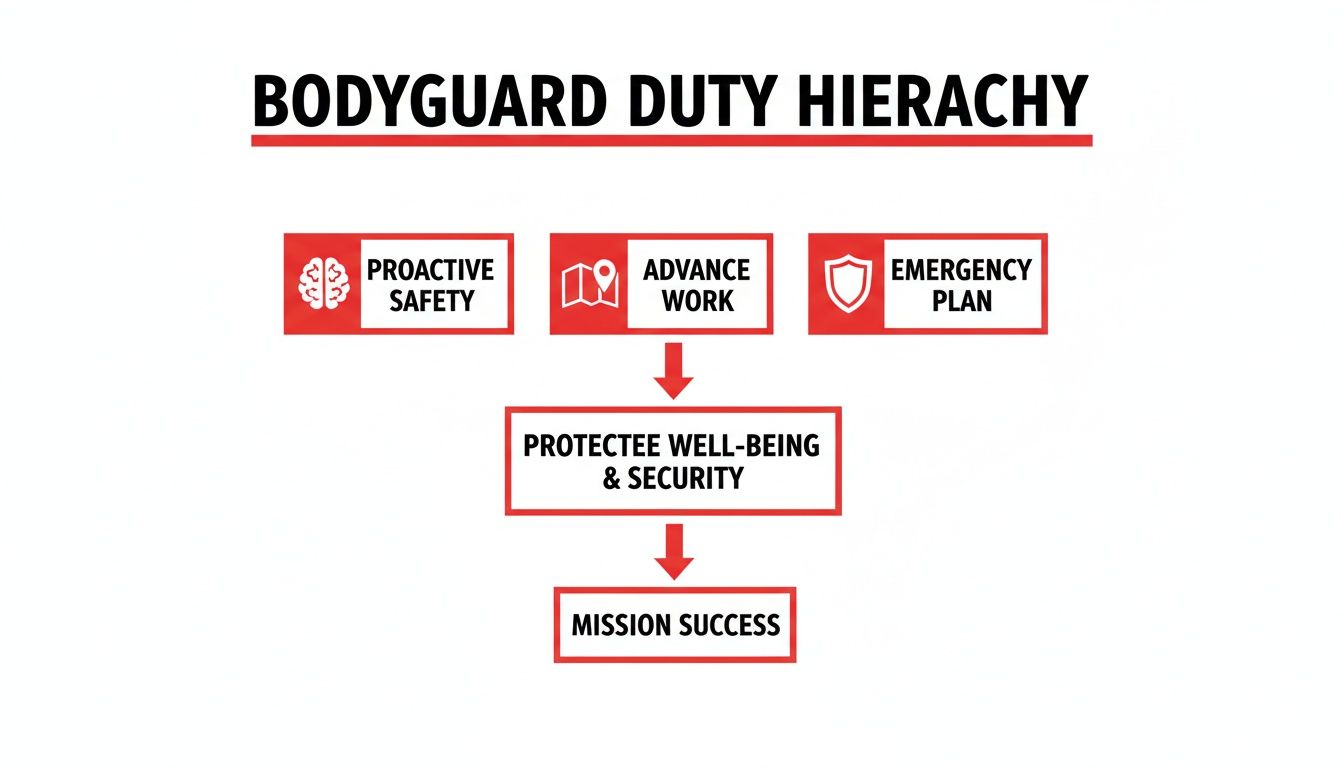
As you can see, the foundation of real security isn't just about reacting—it's built on strategic planning and doing the homework well in advance.
Use-Of-Force And RSA Certification
Beyond the basic license, security personnel are held to strict use-of-force guidelines. These are legal boundaries that define when and how much force is appropriate to control a situation. The key rule? It must always be reasonable and in proportion to the threat. A properly trained bodyguard knows that their best tools are observation, communication, and de-escalation. Physical intervention is always the absolute last resort.
On top of that, for any security working in licensed venues like bars, clubs, or event spaces, a Responsible Service of Alcohol (RSA) certificate is almost always required. This training gives them the skills to identify and manage intoxicated patrons, helping to keep the environment safe for everyone. An officer with an RSA can spot trouble brewing early and handle it professionally, stopping things from getting out of hand.
When you hire a licensed security professional, you're not just paying for a person; you're investing in their certified training in conflict resolution, emergency response, and legal compliance. It's your assurance of professionalism and accountability.
State-By-State Regulatory Snapshot
While the core ideas behind security regulation are pretty similar across the country, the specific government bodies and laws are different from state to state. Knowing who’s in charge of the industry where you are helps you verify credentials and understand the high standards that providers have to meet.
This table gives a quick, clear comparison of the key regulatory frameworks.
Australian Security Licensing Requirements At A Glance
| State/Territory | Regulatory Body | Key Legislation | RSA Requirement For Venues |
|---|---|---|---|
| NSW | Security Licensing & Enforcement Directorate (SLED) | Security Industry Act 1997 | Yes |
| VIC | Victoria Police – Licensing & Regulation Division (LRD) | Private Security Act 2004 | Yes |
| QLD | Office of Fair Trading (OFT) | Security Providers Act 1993 | Yes |
| ACT | Access Canberra | Security Industry Act 2003 | Yes |
As the table shows, each jurisdiction has a specific authority that issues licenses and enforces industry standards. A reputable personal bodyguard security firm will have no problem showing you its master license details and proof of individual officer licenses for the state they’re operating in. That kind of transparency is the hallmark of a partner you can trust—and a non-negotiable for operating legally. Making this simple check should be your first line of defence in the hiring process.
How Professionals Conduct A Security Risk Assessment
When you think of personal bodyguard security, you might picture a large, imposing figure. But the real work starts long before any physical presence is needed—it begins with a sharp mind and a strategic plan. This is where a professional security risk assessment comes in. It’s a methodical process used to pinpoint potential threats and weak spots before a client is ever in harm's way.
This isn't about ticking boxes on a generic form. It’s a deep dive, a bespoke analysis tailored for a specific person, place, and situation. By looking at a scenario from every possible angle, professionals uncover risks that an untrained eye would easily miss. Understanding this process shows you exactly why a one-size-fits-all approach to security isn't just ineffective; it can be downright dangerous.
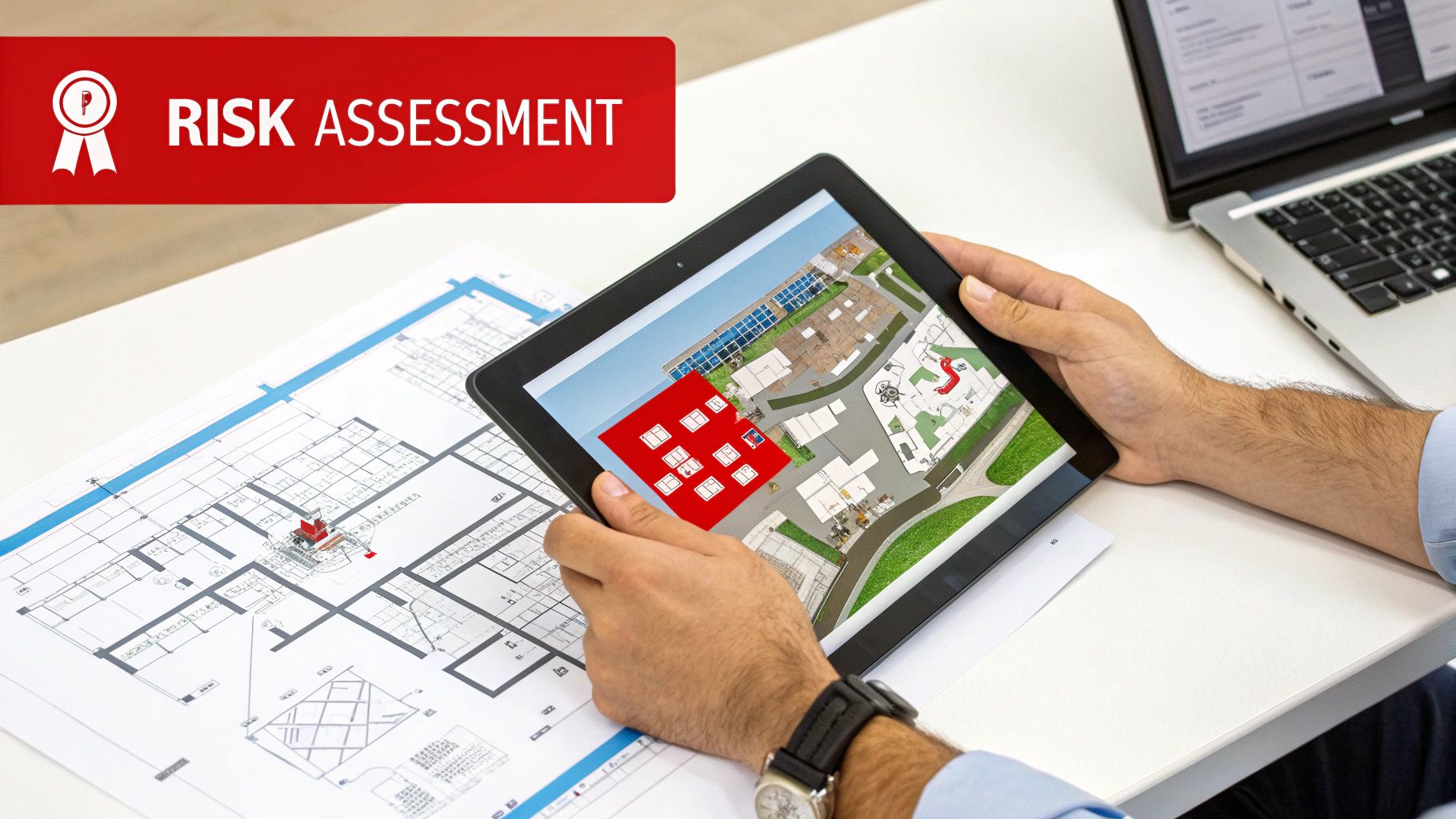
The Three Pillars Of A Risk Assessment
A proper assessment is built on three core phases. Each step logically flows into the next, building a complete picture of the security landscape and giving us a clear plan of action.
- Identify Assets and Threats: First, we need to know what we’re protecting (the asset) and what might harm it (the threat). An asset could be a specific person, their family, sensitive data, or even a valuable piece of property. The threats can be anything from random criminal acts to targeted attacks or simple logistical failures.
- Analyse Vulnerabilities: With the assets and threats defined, the team hunts for weaknesses that could be exploited. A vulnerability could be as simple as a poorly lit car park, an unmonitored side entrance at an event, or even just a daily routine that's become too predictable. This is all about finding the chinks in the armour.
- Develop Control Measures: This is where the plan comes together. Based on the threats and vulnerabilities we've found, we create tailored control measures to reduce or eliminate the risks. This might mean changing travel routes, adding more security staff to a specific area, or putting new access control procedures in place.
The goal of a risk assessment isn't to build a fortress. It's to create an intelligent, flexible security strategy that adapts to the real world. It’s about being prepared, not paranoid.
Personal Bodyguard Security Assessments In Action
While the principles of risk assessment don't change, how they're applied can look completely different depending on the job. Let's walk through a few real-world examples from different sectors across Australia.
- Music Festival in Queensland: For a massive public event like a festival, crowd dynamics are the main game. The assessment would focus on access points to stop people from sneaking in, mapping crowd flow to prevent dangerous bottlenecks, and planning clear emergency evacuation routes. Practical Example: Identifying that a narrow corridor between the main stage and a food vendor area could become a crush point and stationing two guards there to manage flow during peak times.
- Corporate Headquarters in Sydney: At a corporate head office, the risks are more subtle. The assessment would prioritise executive travel security, the threat of corporate espionage, and access to sensitive parts of the building. Control measures would likely involve securing executive offices, planning discreet arrivals and departures, and maybe even sweeping for hidden listening devices.
- Construction Site in the ACT: The main risks on a construction site boil down to protecting assets and ensuring safety. Here, the assessment focuses on preventing the theft of expensive machinery and materials, controlling who comes on-site, and making sure everyone is sticking to workplace health and safety rules.
Extending The Security Perimeter
A truly thorough security assessment doesn't just stop at the person. It extends outwards to cover their property, their vehicles, and their digital footprint. A holistic approach means considering things like modern car park security and multi-layered defence systems as part of the overall strategy.
This comprehensive view, ensuring every part of a client’s environment is secured, is the hallmark of a professional personal bodyguard security operation.
Your Checklist For Hiring The Right Security Partner
Bringing on personal bodyguard security isn't like hiring any other service. You're not just buying a product; you're building a partnership based on absolute trust, professionalism, and hard-earned expertise. Choosing the right provider is a massive decision that has a direct impact on your safety and, just as importantly, your peace of mind. To get it right, you need to look past the price tag and start asking the tough questions that separate the true professionals from the rest.
Think of this as your guide to vetting a potential security partner. It's designed to help you pinpoint a reputable and effective firm that actually understands your specific needs, ensuring you get the high standard of protection you deserve.

Core Questions For Any Potential Security Firm
Before you even get to discussing rates, there are some fundamental, non-negotiable qualifications any legitimate provider must have. These form the very foundation of a professional security operation.
- Are You Fully Licensed and Insured? This is the first and most critical question. Ask to see their master security licence for the state you're in (NSW, VIC, QLD, or ACT) and proof of public liability and professional indemnity insurance. A reputable company won’t just have these documents; they'll be ready to show you without a moment's hesitation.
- What Is Your Training and Vetting Process? How do they actually find, screen, and prepare their people? Dig into their background check procedures, what certifications are mandatory (like First Aid and RSA), and whether they invest in ongoing professional development. The answer tells you everything about their commitment to quality.
- Can You Provide Relevant Experience and References? The team that secured a huge music festival might not be the right fit for discreet corporate executive protection. Ask for real-world examples of their work in situations similar to yours and don't be shy about requesting references from their past or current clients.
Defining Your Operational Needs
Once you've confirmed the basics, it's time to get specific. This is where you match their capabilities to your unique risk profile. A good provider will never push a one-size-fits-all package; they’ll work with you to craft a plan that fits like a glove.
- Overt vs. Covert Operations: Are you looking for a visible deterrent or protection that flies under the radar?
- Overt (Uniformed): This is perfect for public events or venues where a clear security presence is needed to manage crowds and stop trouble before it starts. The uniform itself is a powerful deterrent.
- Covert (Plain-Clothed): For clients who need protection without attracting unwanted attention, covert operators blend seamlessly into the environment. This is the go-to method for many executives, VIPs, and individuals wanting low-profile personal bodyguard security.
- Specialised Capabilities: Does your situation call for something more than standard protection? This could mean K9 units for sweeping large venues, armoured vehicles for high-risk transport, or even technical surveillance counter-measures (bug sweeping).
A professional security consultation should feel like a strategic partnership. The provider should be asking you as many questions as you ask them to fully understand your risk landscape before proposing a solution.
Understanding The Cost Of Personal Bodyguard Security
Of course, cost is always a factor. But it’s vital to understand what's actually driving the price. In the world of security, cheaper is rarely better. You're paying for experience, reliability, and skill. The final quote you receive will be a reflection of several key variables that determine the complexity and risk level of the job.
The table below breaks down the main factors that influence the cost of bodyguard services, helping you see where your investment is going.
Understanding The Cost Of Bodyguard Services
| Cost Driver | Description | Impact On Price |
|---|---|---|
| Risk Level | The perceived threat to the client. High-profile individuals or those facing specific threats require more intensive planning and resources. | High |
| Personnel Experience | Elite operators with specialised skills (e.g., advanced driving, medical training) command higher rates for their expertise. | Medium to High |
| Assignment Duration | Short-term, one-off events may have a higher hourly rate compared to long-term, ongoing contracts which can offer better value. | Medium |
| Number of Agents | The size of the security detail required to provide adequate coverage for all potential vulnerabilities. | High |
| Logistics & Location | Assignments in remote locations or those requiring extensive travel, accommodation, and other logistical support will incur extra costs. | Medium to High |
| Special Equipment | The need for specialised assets like armoured vehicles, advanced communication systems, or K9 units will add to the overall expense. | High |
By digging into these detailed questions, you shift from simply hiring a guard to strategically selecting a true security partner. This thorough process ensures the personal bodyguard security team you choose is qualified, experienced, and perfectly matched to protect what matters most.
FAQs on Personal Bodyguard Security Services
Thinking about personal bodyguard security for the first time? It's natural to have a lot of questions. We find that once people understand the nuts and bolts, they feel much more confident in their decisions. To help you get there, we've pulled together the most common questions we hear every day and answered them directly.
Let’s clear up any confusion and get you the facts.
What is the difference between a bodyguard and a static security guard?
It's a common point of confusion, but their roles are worlds apart. A static security guard is all about protecting a place—think a building lobby, a construction site gate, or a retail store. They're there to secure property and control who comes and goes from a fixed spot. Personal bodyguard security, on the other hand, is entirely focused on a person. A bodyguard is mobile, moving with you. Their job is to constantly assess changing environments, plan safe travel routes, and provide close, adaptive protection wherever you go. The training is completely different, zeroing in on personal threat assessment, de-escalation, and immediate response to keep the client safe.
Should I choose a uniformed or plain-clothed bodyguard?
This really comes down to what you're trying to achieve. One isn't better than the other; they're just different tools for different jobs.
- Uniformed (Overt): A uniform is a powerful visual deterrent. It sends a clear message. This is perfect for managing crowds at events, keeping things orderly in a busy venue, or just preventing trouble before it starts by having an obvious security presence.
- Plain-Clothed (Covert): When discretion is key, plain-clothed is the only way to go. Executives, public figures, or anyone who needs top-tier protection without attracting attention will opt for this low-profile approach. It’s all about blending in.
A professional will help you weigh the pros and cons after a proper risk assessment to figure out which approach makes the most sense for your situation.
Can I hire personal bodyguard security at the last minute?
Yes, absolutely. A well-organised security firm like ours is built for rapid response and can often deploy professionals on very short notice for urgent situations. It's a core part of what we do. That said, if you can give us more lead time, it’s always better. More time allows the team to do its homework—conducting thorough risk assessments, visiting the site in advance, and mapping out logistics. This level of preparation is what turns a simple security presence into a truly seamless and effective operation.
When are K9 security units the right choice?
K9 units are a highly specialised resource and not something you see on a typical personal protection detail. You bring them in for specific, often high-risk, scenarios where a dog's unique senses are a game-changer. They're incredibly effective for securing large event perimeters, sweeping a venue for explosives or contraband before a VIP arrives, or as a powerful psychological deterrent against more organised threats. We'd only recommend a K9 unit if a security consultation reveals a specific risk that their unique skills are perfectly suited to neutralise.
How much does personal bodyguard security cost?
The cost varies significantly based on factors like risk level, number of agents, duration, and required special equipment (e.g., armoured vehicles). A simple, low-risk assignment might cost a few hundred dollars for a single event, while a comprehensive, long-term detail for a high-profile individual could run into thousands per day. It's crucial to get a detailed quote based on a thorough risk assessment.
Ready to create a secure environment for your next event, venue, or project? The team at GM GROUP Services provides expert, licensed, and reliable security solutions across NSW, VIC, QLD, and the ACT. Contact us today for a professional security consultation.
Discover more from GM Group Services
Subscribe to get the latest posts sent to your email.