


Interpersonal skills training usually gets attention right after a preventable incident.
A patron argues at the gate because their ID won't scan. A guest complains that a guard was rude when giving directions. A contractor gets frustrated at sign-in and pushes back on site rules. None of these moments starts as a major security issue. They become one when the guard on the spot can't listen, explain, calm, and control the interaction at the same time.
That's the core job in events, venues, retail, construction, and corporate front-of-house. Security staff don't just enforce rules. They represent the site, protect the client's brand, and make judgement calls under pressure. If your training only covers powers, procedures, and reporting, you'll get compliance on paper and inconsistency on the floor.
The good news is that interpersonal skills can be trained properly. Australia already has a strong culture of workforce training. The Australian Bureau of Statistics reported that 41% of employed people in 2021–22 participated in work-related training in the previous 12 months, and 58% of Australians aged 15–74 had a non-school qualification in 2023, showing that structured skill development is already normal across the workforce through the broader adult learning system described in this Australian training participation overview. For security operations, that means there's no reason to treat people skills as informal or optional.
Why Generic People Skills Fail in Security
Most generic communication advice sounds fine in a classroom. Make eye contact. Be empathetic. Stay calm. Listen actively. The problem is that none of that tells a guard what to do when a line is building, music is loud, a patron is intoxicated, and the venue manager wants the issue resolved now.
Security work changes the context.
In a licensed venue, a guard might need to refuse entry without provoking an argument. At a festival, they may need to give a firm direction while preserving crowd flow. On a construction site, they may need to challenge an unfamiliar person at the gate without creating unnecessary friction. In each case, the guard is balancing customer service, compliance, and control at once.
Why the usual advice breaks down
Generic people skills training often fails for three reasons:
- It ignores pressure: Staff may understand the right words in theory, then lose structure when someone becomes aggressive, embarrassed, or non-compliant.
- It treats friendliness as the goal: Security doesn't need passive friendliness. It needs controlled rapport that helps staff gather information, maintain authority, and reduce risk.
- It lacks role specificity: A hotel concierge, a retail assistant, and a crowd controller all use communication differently. The overlap matters, but the operational demands are not the same.
Practical rule: If training never rehearses refusal, redirection, boundary setting, or conflict de-escalation, it isn't preparing security staff for their actual job.
There's also a labour-market reason this matters. In a 2024 Pew survey on job skills and training, 85% of workers rated interpersonal skills as “extremely” or “very” important, on par with written and spoken communication. In Australia, that lines up with the National Skills Commission's Skills Priority List framework, which tracks shortages across 800+ occupations using national and state-level labour-market data. For security, hospitality, events, and facilities, that signals a simple reality. Interpersonal capability isn't a soft extra. It's part of workforce readiness.
What effective interpersonal skills training looks like in practice
A useful security program trains behaviours that can be observed on shift:
- How the guard opens an interaction
- How they gather facts before making a call
- How they explain a decision
- How they hold boundaries without inflaming the situation
- How they hand over incidents to supervisors, police, first aid, or venue management
That's the gap many operators feel. They don't need another poster about empathy. They need staff who can manage intoxication, refusals, guest complaints, and access control professionally in front of the public.
The Core Competencies for Security Professionals
Before you build a program, define what “good” looks like. Vague standards produce vague performance. Good interpersonal skills training for security should target a small set of behaviours that supervisors can coach and assess.
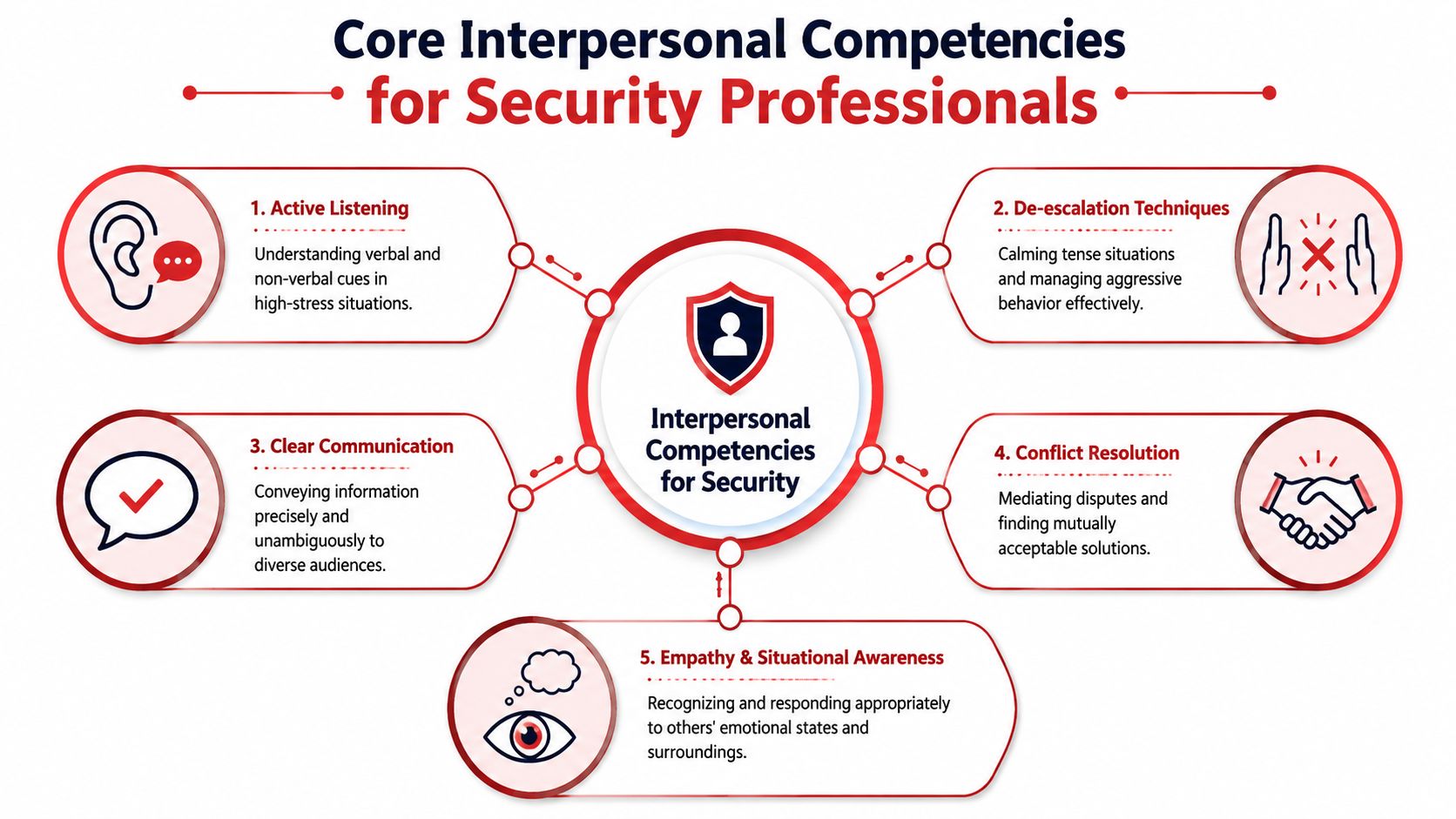

Active listening under pressure
This isn't counselling. It's controlled information gathering.
A strong guard listens for the detail that changes the response. Is the patron angry about the rule, confused about the process, or embarrassed in front of friends? Is the contractor refusing sign-in, or do they not know the induction requirement? Staff who interrupt too early often miss the actual trigger.
Look for behaviours such as:
- Short clarifying questions: “Who asked you to come through here?” or “What happened just before that?”
- Visible attention: facing the person, not scanning away mid-sentence unless safety requires it
- Accurate restatement: confirming facts before giving direction
Strategic empathy
Empathy in security isn't agreement. It's recognition.
When a guard says, “I understand you're frustrated,” they're not surrendering authority. They're lowering resistance long enough to move the interaction forward. Strategic empathy helps staff acknowledge emotion without debating policy.
This is especially useful in licensed venues, where patrons often react to embarrassment more than to the actual decision.
A person who feels heard is easier to direct than a person who feels dismissed.
Clear and authoritative communication
Security staff need plain language, not speeches. Directions should be short, respectful, and unambiguous. If a guard rambles, the interaction gets messy. If they sound aggressive, the interaction hardens.
For teams that need help tightening verbal delivery, this guide for professionals to speak clearly is a useful reference because it focuses on structure, pacing, and clarity rather than empty confidence tips.
Tactical de-escalation
De-escalation is the point where all the other competencies meet. It includes tone, stance, word choice, timing, and knowing when not to crowd someone. It also means recognising when de-escalation has stopped working and support is needed.
A guard who keeps repeating the same instruction louder isn't de-escalating. They're escalating with volume.
Unwavering professionalism
Professionalism shows most clearly in low-level friction. Anyone can appear professional when the site is calm. The test comes when a guest is rude, a queue is backing up, or a contractor tries to pressure the guard into skipping process.
Core signs of professionalism include:
- Consistency: rules applied the same way across people and situations
- Composure: steady voice, controlled facial expression, no sarcasm
- Clean handover: concise updates to supervisors and accurate incident notes
These competencies give trainers something concrete to coach. They also give supervisors a shared language when they need to correct performance after a shift.
Designing Your Interpersonal Skills Training Modules
The biggest mistake in interpersonal skills training is treating it like a one-off classroom talk. Behaviour change needs practice, feedback, and repetition. Evidence-backed summaries of soft-skills programs have associated instructor-led practice with immediate feedback and accountability with productivity gains of up to 67% and customer satisfaction increases above 30% in some settings, as discussed in this review of soft skills training and business outcomes. The same source warns against one-off workshops and points to repeated practice, psychological safety, and reflection as the reasons training sticks.
For security teams, that means short modules with clear operational outcomes.
Four modules that fit real security work
| Module | Focus | Key Activities |
|---|---|---|
| Foundations of Professional Communication | Tone, clarity, first contact, radio discipline, body language | Paired drills, greeting scripts, radio handover practice |
| Advanced De-escalation Techniques | Emotional control, verbal redirection, boundary setting, exit options | Guided role-play, phrase replacement exercises, supervisor feedback |
| Managing Challenging Behaviours and Intoxication | Signs of agitation, refusal language, crowd influence, support triggers | Venue scenarios, escalation thresholds, team positioning rehearsal |
| The Security Guard as a Customer Service Ambassador | Wayfinding, guest reassurance, complaint handling, visible professionalism | Front-of-house simulations, complaint response drills, post-incident reflection |
Module 1 Foundations of professional communication
Start here because many later errors come from poor first contact.
Train staff to open interactions cleanly, identify themselves when needed, explain process early, and avoid loaded language. In noisy environments, they also need to know how to slow speech, simplify directions, and confirm understanding. Radio communication belongs here too. Guards who speak clearly face-to-face but give confused handovers over radio still create risk.
Module 2 Advanced de-escalation techniques
This module should focus on what staff do in the first moments of tension. Good content includes emotional labelling, low-friction language, maintaining distance, and deciding when to bring in a second staff member.
Useful drills include rewriting bad phrases. For example, replace “Calm down” with “I'm going to explain what happens next” or “Let's step over here and sort it out.” One phrase attacks emotion. The other creates a path.
On-shift coaching note: Train the sentence before the problem. Staff perform better when they already have language ready for refusal, delay, and complaint handling.
Module 3 Managing challenging behaviours and intoxication
At this point, generic training usually stops being useful. Staff need role-specific practice for intoxicated patrons, argumentative guests, impatient contractors, and visitors who become confrontational when challenged.
Cover practical points such as:
- How to refuse entry without public humiliation
- How to separate the main speaker from their audience
- How to keep options open while holding the line
- How to call support early without making the interaction theatrical
If you use video to support consistency across multiple sites, short internal clips can help standardise briefing language and demonstration scenes. Teams planning that format may find this resource on mastering B2B training video production useful when turning site procedures into watchable training content.
Module 4 The security guard as a customer service ambassador
A lot of incidents never become incidents if the first contact is competent and respectful. This module trains staff to give directions, handle routine complaints, and project calm authority at entry points, concierge desks, loading zones, and event perimeters.
Key learning objectives should include:
- Represent the site well: Staff should sound like part of the operation, not separate from it.
- Protect experience while enforcing rules: Guests remember how decisions were delivered.
- Recover small issues early: A poor queue interaction can become a complaint, a social media problem, or a supervisor distraction.
Build each module as a short cycle. Brief. Demonstrate. Practise. Debrief. Repeat.
Running Powerful Roleplay Scenarios
Role-play is where interpersonal skills training becomes real. It's also where weak facilitation ruins good content. If the scenario feels fake, rushed, or unsafe, staff will perform for the room instead of practising properly.
The answer isn't more drama. It's better setup.
How to run role-play so guards actually learn
Start with a tight brief. Give the participant their role, the scene, the objective, and one operational constraint. Example: “You're on entry at a licensed venue. The patron says they've been here before and shouldn't need to show ID again. Your objective is to maintain entry control without escalating the queue.”
Then brief the role-player separately. Tell them what emotion to bring, what facts they know, and what behaviour should emerge if the guard handles it poorly. This keeps the scenario consistent enough to coach.
The debrief matters as much as the scenario. Don't ask, “How do you think that went?” and leave it there. Use specific prompts:
- Opening: Did the guard establish control early?
- Listening: Did they identify the actual issue?
- Language: Did they use clear, non-inflammatory phrasing?
- Positioning: Did their stance help or hinder the interaction?
- Closure: Did they resolve, redirect, or hand over cleanly?
Three scenarios worth using repeatedly
The denied entry
A patron is refused entry because they cannot satisfy venue requirements. They become verbally resistant and start appealing to status. “I know the manager.” “You let my friend in.” “This is ridiculous.”
What to watch for:
- Guard explains the decision without over-explaining
- Guard avoids debate traps
- Guard offers the next step, if one exists
- Guard keeps voice level while the patron raises theirs
The escalating noise complaint
At a corporate function or hotel environment, a guest complains aggressively about noise, queueing, or another group's behaviour. They're not threatening yet, but they want immediate action and they want someone to blame.
Good guards won't become defensive here. They acknowledge the complaint, clarify the specifics, explain what they can do, and avoid promising outcomes they can't control.
The patron needing first aid
This scenario trains calm communication under urgency. A distressed friend calls for help, gives incomplete information, and expects instant action. The guard has to gather usable facts, direct bystanders, contact the right support, and keep the area controlled.
Poor listening is quickly evident. Guards who rush to speak can miss location, symptoms, or whether the person is conscious.
Let staff fail safely in training. It's better to correct a bad phrase in rehearsal than after a complaint, an injury, or an unnecessary use-of-force review.
What strong facilitation looks like
Good facilitators correct one thing at a time. If a guard misses five points, pick the one that would have changed the outcome most. Run the scenario again immediately and let them apply the adjustment.
Psychological safety matters here. Staff need to know the goal is sharper performance, not public embarrassment. Challenge them hard inside the scenario. Respect them fully in the debrief.
Assessing Performance and Measuring Training ROI
If you can't measure behaviour, you can't manage training quality. This is one of the biggest weak spots in interpersonal skills training. Public content often describes empathy, listening, or communication in broad terms, but doesn't show employers how to verify whether staff perform better under pressure. That measurement gap is central to the discussion in this evidence-based review of interpersonal skills evaluation.
For security teams, measurement has to connect training to site outcomes.
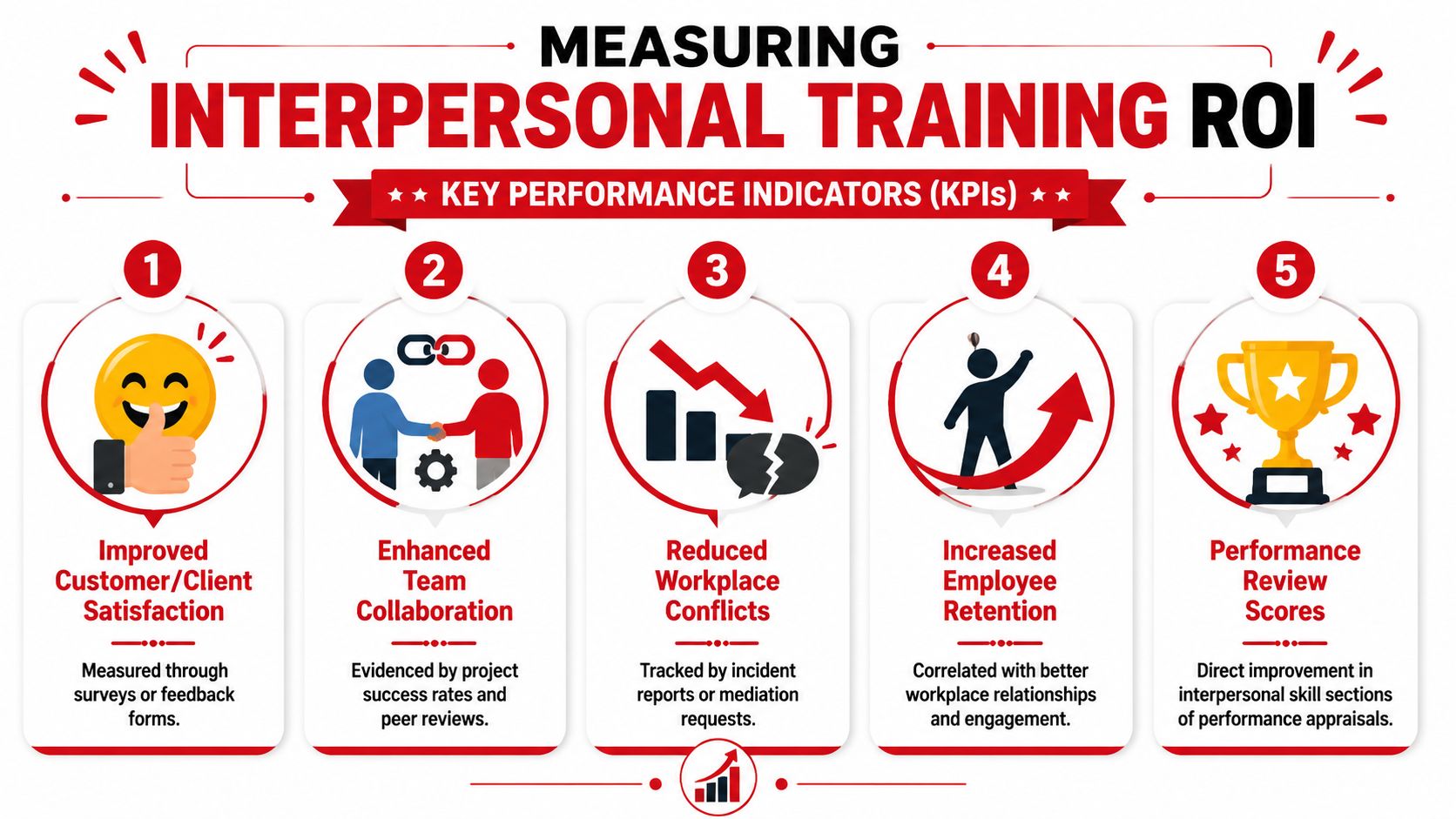
What to track after interpersonal skills training
You don't need a complicated system. Start with indicators supervisors already recognise:
- Complaint volume: Are fewer interactions turning into formal complaints?
- Incident escalation rate: Are staff resolving more low-level issues before they become supervisor or police matters?
- Guest feedback quality: Are comments mentioning professionalism, helpfulness, or calm handling?
- Handover quality: Are incident notes and verbal reports becoming clearer and more complete?
- Supervisor intervention frequency: Are managers being pulled into routine friction less often?
These are practical because they show behaviour in context, not just classroom completion.
A simple assessment rubric for supervisors
Use a short rubric during role-plays and live observation. Score each item as below standard, meets standard, or strong. Keep the criteria behavioural.
| Skill area | What the supervisor looks for |
|---|---|
| Information gathering | Asked clarifying questions before making a decision |
| Verbal control | Used short, clear, respectful instructions |
| Emotional regulation | Maintained composure despite resistance |
| De-escalation technique | Reduced tension through tone, phrasing, and pace |
| Professional closure | Resolved, redirected, or handed over correctly |
This kind of rubric works because it removes vague feedback like “be more confident.” Instead, the supervisor can say, “You gave the direction clearly, but you skipped the clarifying question and that pushed the patron straight into argument.”
For teams building a more formal review process, this guide on how to measure training effectiveness is a useful companion because it helps translate observed behaviour into repeatable evaluation steps.
Measurement standard: Don't ask whether staff liked the training first. Ask whether they behave differently on shift.
How to review results without overcomplicating it
Run a simple cycle:
- Observe role-play performance before training.
- Repeat observation after module completion.
- Review live-site feedback from supervisors.
- Compare complaint patterns, escalations, and handover quality.
- Adjust the next training block based on what still breaks down.
That approach gives managers something operational, not abstract. You're not trying to prove a theory. You're checking whether guards handle real interactions better.
Making It Stick Long-Term Improvement Strategies
One training day can lift awareness. It won't build a professional security culture on its own.
The teams that improve keep interpersonal skills training close to daily operations. They use pre-shift refreshers, fast coaching after incidents, and short practice blocks tied to what staff are seeing on the ground. That's what turns training language into habits.
Reinforcement methods that work on live sites
Use short, repeatable methods instead of waiting for the next formal session.
- Pre-shift micro-drills: Run a five-minute practice on one issue only, such as refusing entry, handling a complaint, or giving directions under pressure.
- Supervisor shadow coaching: Observe one or two live interactions and give immediate feedback while the details are still fresh.
- After-action reviews: When an incident goes well or badly, strip names and emotion out of it, then ask what phrase, decision, or delay changed the outcome.
Build recognition into the standard
Staff repeat what leaders notice.
When a guard handles a difficult patron professionally, mention the specific behaviour. Not “good job.” Say, “You kept your voice level, clarified the issue, and gave a clear next step.” That tells the team what good looks like.
A practical long-term loop looks like this:
- Train one behaviour
- Observe it on shift
- Coach it quickly
- Recognise it publicly
- Rebuild scenarios from real incidents
That's how interpersonal skills training stops being a classroom topic and becomes part of site standards.
Frequently Asked Questions
How often should security teams run interpersonal skills training
Short and often works better than rare and heavy. Formal sessions help, but regular refreshers during briefings and supervision keep standards alive.
Who should deliver the training
The best trainer is someone who understands both behaviour and operations. If the facilitator can't connect communication skills to entry control, intoxication management, complaint handling, and incident response, staff will tune out.
Should new and experienced guards train together
Sometimes. Mixed groups work well for role-play and discussion. Separate groups work better when newer staff need fundamentals and senior staff need advanced de-escalation or coaching responsibility.
What if guards see this as soft or unnecessary
Tie it to the job. Show how poor wording creates complaints, delays, refusals, and escalations. Most resistance fades when staff see that better interactions make the shift smoother and safer.
What's the fastest place to start
Start with one module on first contact and one module on de-escalation. Then measure complaint handling, escalation patterns, and supervisor feedback for changes in day-to-day performance.
If you need security staff who can protect people, manage conflict, and represent your venue professionally, GM GROUP Services delivers security solutions across NSW, VIC, QLD and the ACT. Their teams support events, venues, hospitality sites, retail, construction and corporate environments with trained, licensed professionals who understand that safety and customer experience go together.